YouTube influencer marketing is a strategy where small businesses partner with YouTube creators to promote products through video content, leveraging long-form credibility and search-driven discovery to drive purchases.
This guide covers platform mechanics and goal-setting, influencer selection and budgeting, content formats and campaign structure, performance measurement and common mistakes, and scaling strategies tied to unified commerce systems.
YouTube's architecture gives small businesses an evergreen asset; videos remain discoverable through search for years, and 61% of Gen Z report that YouTube helped them discover previously unknown brands. This combination of intent-driven search and creator-endorsed demonstration makes the platform uniquely effective for DTC product discovery.
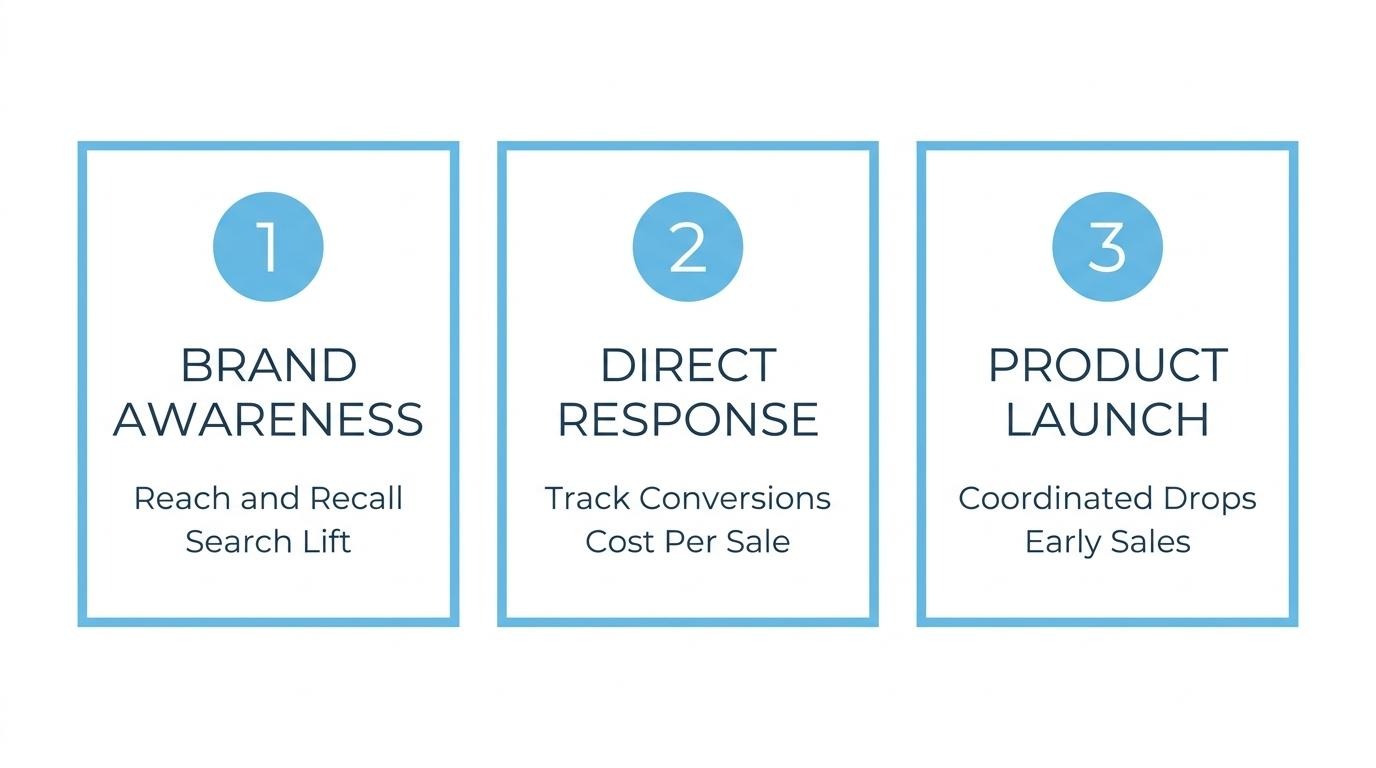
Campaign goals divide into three frameworks: brand awareness measured by reach and branded search lift, direct-response conversion tracked through unique codes and UTM links, and product launches that compress buyer journeys into coordinated creator drops.
Influencer tiers range from nano creators charging $50–$500 per video to mid-tier partners at $5,000–$20,000, with hybrid payment models reducing upfront risk. Brands have shifted toward the "creator middle class" for rate affordability, talent availability, and hyper-engaged audiences.
Content formats that drive results include dedicated product reviews, haul and unboxing videos, tutorials with natural product integrations, and Shorts for top-of-funnel exposure. Each format maps to different stages of the buyer journey.
Structured briefs, FTC-compliant disclosure, and multi-layer attribution frameworks prevent the most common failures: selecting creators by vanity metrics, launching without conversion paths, and micromanaging creative direction. Scaling requires transitioning from one-off deals to ambassador programs, with influencer performance data resolving in the same system that powers CRM and lifecycle automation.
YouTube influencer marketing is a strategy where small businesses partner with YouTube creators to promote products through video content. It differs from other platforms in format depth and discovery mechanics.
YouTube influencer marketing differs from other platforms through long-form content that builds source credibility and parasocial relationships between creators and viewers. A 2025 study published in Research Papers in Economics found that source expertise in influencer marketing directly impacts purchase intention through these parasocial dynamics, a relationship that short-form platforms struggle to replicate.
Unlike Instagram or TikTok, YouTube videos remain discoverable through search for years, compounding returns over time. Global spend on influencer marketing reached $32.55 billion in 2025, with brands increasingly prioritizing ROI-first strategies. YouTube's search-driven architecture gives small businesses an evergreen asset rather than a fleeting impression.
YouTube is effective for DTC product discovery because its format combines visual demonstration with creator trust, driving awareness among audiences actively seeking recommendations. According to YouTube Culture & Trends research, 61% of Gen Z (online 14- to 24-year-olds) agree that YouTube has helped them discover brands or products they didn't know about.
This makes YouTube particularly valuable for direct-to-consumer brands without large advertising budgets. Viewers watch product integrations within content they already trust, which lowers the barrier to first purchase. For small businesses selling physical products, few channels match this combination of intent-driven search and creator-endorsed demonstration.
With YouTube's discovery mechanics established, the next step is defining clear campaign goals that align with business objectives.
You set goals for a YouTube influencer campaign by aligning each campaign's KPIs to a specific business objective. The three most common goal frameworks cover brand awareness, direct-response conversion, and product launches.
The goals that work for brand awareness campaigns center on reach, recall, and audience growth. Effective awareness KPIs include:
Awareness campaigns prioritize top-of-funnel visibility over immediate sales. For small businesses entering a new market or category, these metrics reveal whether the influencer's audience is actually absorbing your brand message. Tracking branded search volume alongside view counts separates passive exposure from genuine interest.
The goals that work for direct-response conversion campaigns measure actions taken after viewing influencer content. According to Digital Applied, landing pages with embedded video convert at 86% higher rates than text-only equivalents, making YouTube a strong direct-response channel when paired with proper attribution.
Key direct-response KPIs include:
Direct-response campaigns demand clear conversion paths. Without a dedicated landing page, unique discount code, or trackable link in the video description, isolating influencer-driven revenue becomes nearly impossible.
The goals that work for product launch campaigns combine awareness velocity with early purchase signals. Launch campaigns compress the buyer journey into a tight window, so KPIs must capture both buzz and action simultaneously:
Product launches benefit most from coordinated creator drops where multiple influencers publish within the same 24–48 hour period. This concentrated exposure creates a perception of momentum that isolated posts cannot replicate.
With clear goals defined for each campaign type, the next step is identifying which influencer tier best fits your objective and budget.
Small businesses should consider nano, micro, mid-tier, and macro influencers depending on budget, goals, and audience size. Each tier offers distinct trade-offs in cost, engagement, and reach.
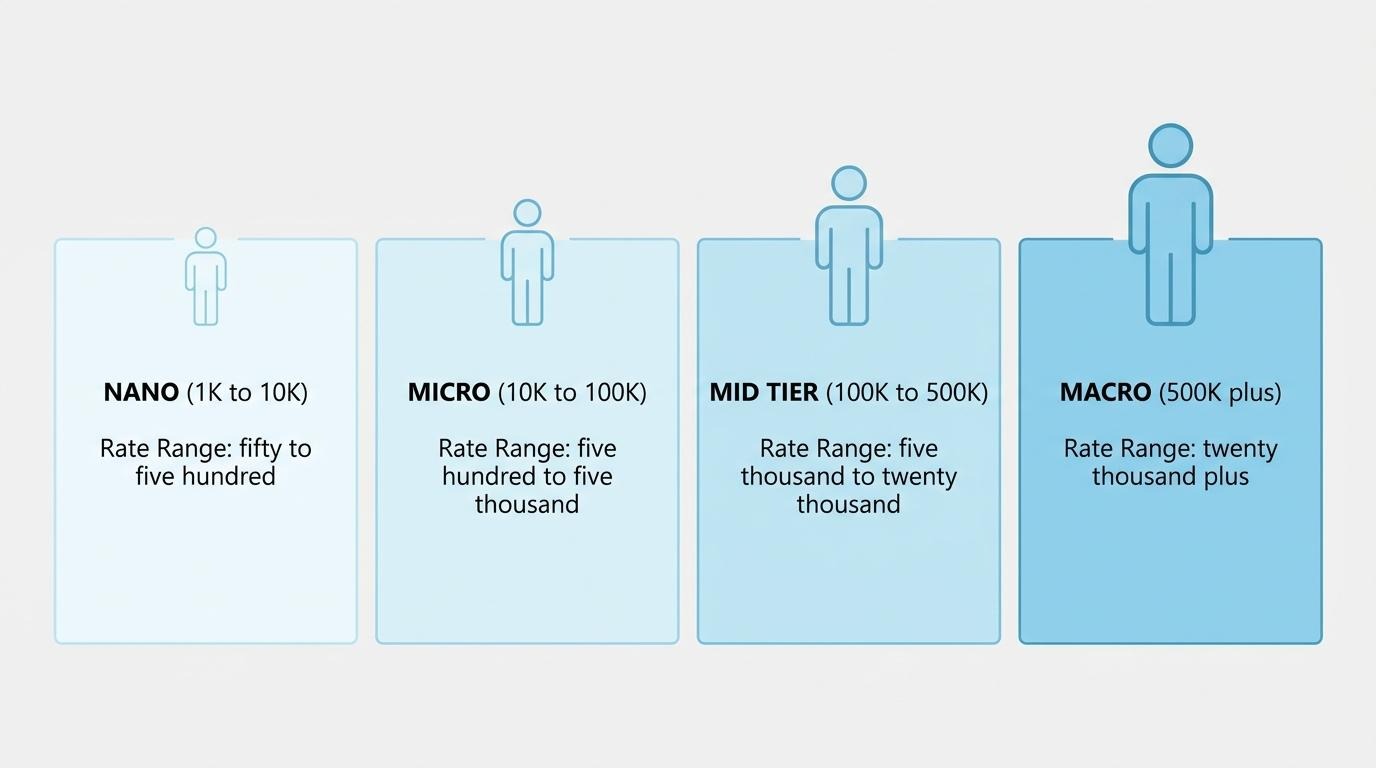
Nano influencers are YouTube creators with 1,000 to 10,000 subscribers who typically serve highly specific niches. Their audiences tend to be tightly knit communities with strong trust in the creator's recommendations.
Key characteristics of nano influencers include:
According to the American Influencer Council, brands have become favorable to the creator middle class, including nano creators, because of rate affordability, more talent options, and hyper-engaged audiences. For small businesses testing influencer marketing for the first time, nano creators offer low-risk entry points with measurable community response.
Micro influencers are YouTube creators with 10,000 to 100,000 subscribers who balance niche authority with meaningful reach. They typically produce consistent, polished content within a defined vertical.
Benefits of partnering with micro influencers include:
This tier works well for direct-response campaigns where both engagement and volume matter. Micro influencers often maintain the personal connection of smaller creators while reaching audiences that can move revenue metrics.
Mid-tier influencers are YouTube creators with 100,000 to 500,000 subscribers who operate as semi-professional or full-time content producers. Their channels typically feature production quality comparable to media outlets.
What mid-tier creators offer small businesses:
Mid-tier partnerships require larger budgets but deliver scale that nano and micro tiers cannot match. For brands launching new products or entering new markets, this tier provides the visibility needed to establish awareness quickly.
Macro influencers are YouTube creators with 500,000 to 1,000,000 subscribers who command significant audience attention and professional production infrastructure. Their content reaches broad demographics across multiple interest areas.
Considerations for small businesses evaluating macro influencers:
Most small businesses should treat macro partnerships as milestone investments rather than routine campaigns. The cost-to-engagement ratio shifts at this level; unless product margins support the spend, reinvesting across multiple nano or micro creators often delivers stronger per-dollar returns.
With influencer tiers defined, the next step is finding creators who align with your specific niche.
Finding the right YouTube influencers for your niche requires evaluating audience data, vetting content quality, and using discovery tools designed for your vertical.
You evaluate audience demographics and engagement by analyzing a creator's viewer data against your target customer profile. Key metrics to assess include:
A 2025 study published in SAGE Open found that source expertise directly impacts purchase intention, reinforcing why audience-creator alignment matters more than raw reach. Channels where viewers actively engage through comments and shares signal trust, which translates to higher conversion potential for DTC brands.
You vet content quality and brand alignment by reviewing a creator's existing videos for production standards, messaging tone, and category relevance. Look for consistent upload schedules, professional audio and lighting, and whether sponsored integrations feel natural within the creator's typical format.
A 2022 Gardner-Webb University dissertation on user-generated content found that trust significantly impacts purchase intention for subscription-based products, underscoring why brand-creator fit determines campaign outcomes. Avoid creators whose past sponsorships conflict with your brand values or whose audience reacts negatively to promotional content. The best partners already discuss products in your category organically.
The tools that help identify influencers in your vertical include dedicated influencer marketing platforms, YouTube's native analytics, and social listening software. Effective discovery options include:
For brands running storefronts that integrate directly with YouTube Shopping, matching influencer audiences to existing customer data simplifies targeting significantly.
YouTube influencer marketing costs small businesses anywhere from $50 to $20,000+ per video, depending on creator tier and payment structure. The subsections below break down nano/micro rates, mid-tier pricing, and alternative payment models.
Nano influencers (1K–10K subscribers) typically charge $50–$500 per dedicated YouTube video. Micro influencers (10K–100K subscribers) typically charge $500–$5,000 per video, depending on production quality and niche authority.
According to the American Influencer Council, brands have become favorable to this "creator middle class" because of greater talent availability, rate affordability, and hyper-engaged audiences. These tiers often deliver stronger cost-per-engagement than larger creators, making them practical entry points for small businesses testing influencer partnerships.
For brands spending under $5,000 monthly on influencer content, concentrating budget across several nano or micro creators usually generates more touchpoints than a single larger placement.
Mid-tier influencers (100K–500K subscribers) typically charge $5,000–$20,000 per dedicated YouTube video. Rates vary based on:
The industry lacks standardized pricing models for influencers; as research published through Taylor & Francis Online notes, subjective marketer valuation often determines rates rather than fixed benchmarks. Small businesses should request media kits with audience demographics and past campaign performance before negotiating.
Common payment models beyond flat fees include:
Hybrid models reduce upfront risk for small businesses while incentivizing creators to produce content that converts, not just entertains.
With pricing structures defined, the next step is choosing content formats that maximize return.
The types of YouTube content formats that drive results include dedicated product reviews, haul and unboxing videos, tutorials with product integrations, and Shorts with vertical video mentions.
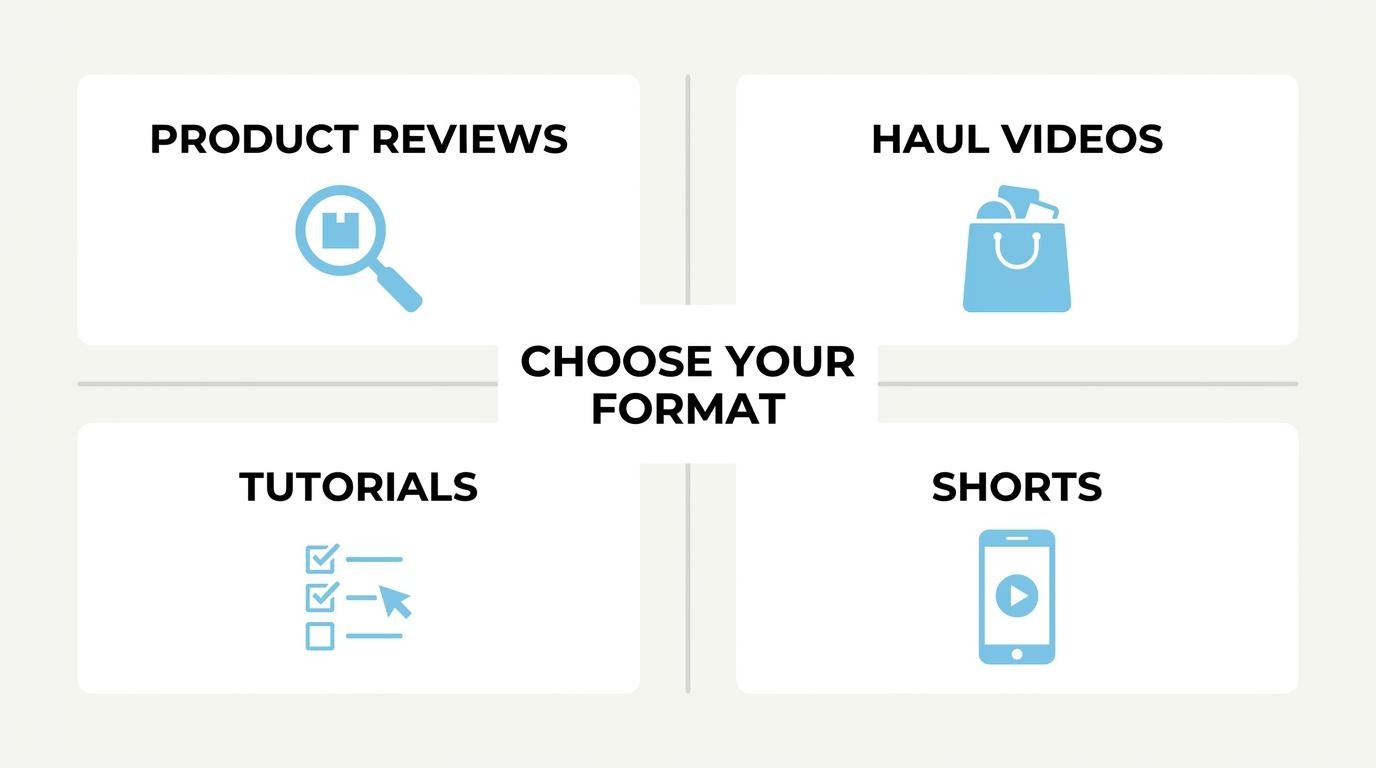
Dedicated product reviews place a single product at the center of an entire video. The creator examines features, demonstrates real-world use, and shares an honest verdict. This format generates high purchase intent because viewers actively search for "[product name] review" before buying. According to a 2025 Google/SmithGeiger analysis of the top 5,000 most-purchased products on YouTube, successful shopping trends are driven by four key factors: creators, communities, content formats, and product trends. For small businesses, a well-matched review from a trusted creator can outperform paid ads because the recommendation carries built-in credibility.
Haul and unboxing videos showcase multiple products in a single video, creating a discovery moment for viewers. Hauls work particularly well for fashion, beauty, and lifestyle brands where visual presentation matters. The format benefits small businesses by:
Unboxing videos also highlight packaging quality and brand presentation, giving DTC brands an opportunity to make a strong first impression beyond the product itself.
Tutorials and how-to integrations embed a product within educational content that solves a specific problem. A creator teaching a makeup technique naturally incorporates a brand's foundation; a tech creator explaining workflow automation demonstrates a specific tool. This format delivers long-tail search value because how-to videos rank for informational queries and accumulate views over months. The product mention feels organic rather than promotional, which reduces viewer resistance. Small businesses benefit most when the tutorial addresses a genuine pain point their product solves.
Shorts and vertical video mentions deliver rapid product exposure in under 60 seconds. YouTube Shorts generate billions of daily views, making them effective for broad awareness at low production cost. The format suits quick demonstrations, before-and-after reveals, and punchy testimonials. While Shorts rarely drive immediate conversions alone, they serve as top-of-funnel touchpoints that familiarize audiences with a brand before longer-form content closes the sale.
With content formats mapped to campaign goals, the next step is structuring a clear influencer brief.
An influencer brief and agreement structure includes creative guidelines, legal contract terms, and FTC-compliant disclosure requirements. The sections below cover what to include in each component.
The creative brief should include campaign objectives, key messaging points, brand guidelines, content format specifications, and a timeline with deliverable deadlines. Essential elements are:
Leaving room for the creator's authentic voice within these guardrails produces content that resonates with their existing community rather than reading as a scripted ad.
The contract terms that protect both parties include payment structure, content ownership, usage rights, exclusivity clauses, and termination conditions. A well-drafted agreement specifies:
Both the brand and influencer benefit when deliverables, timelines, and compensation triggers are documented rather than assumed verbally.
FTC disclosure requirements are handled by ensuring every sponsored video contains clear, conspicuous identification of the material connection between brand and creator. According to the Federal Trade Commission, a "material connection" includes any financial relationship, such as payment, free products, or discounted services, and must be clearly disclosed.
Key compliance practices include:
Non-compliance exposes both the brand and creator to FTC enforcement action, making disclosure protocols a non-negotiable contract clause.
With brief and agreement structures established, tracking performance determines whether the campaign delivers measurable returns.
You track influencer campaign performance by combining attribution methods, defined KPIs, and channel isolation techniques. The sections below cover YouTube-specific attribution, essential metrics, and revenue separation.
The attribution methods that work for YouTube traffic include unique discount codes, UTM-tagged links, dedicated landing pages, and platform-native shopping integrations. Each method ties viewer actions back to a specific creator.
A 2025 study published in Research Papers in Economics found that source expertise significantly impacts purchase intention within influencer marketing contexts, reinforcing why creator-level attribution matters for accurate performance measurement. Layering multiple methods captures both last-click and assisted conversions, which single-touch models consistently miss.
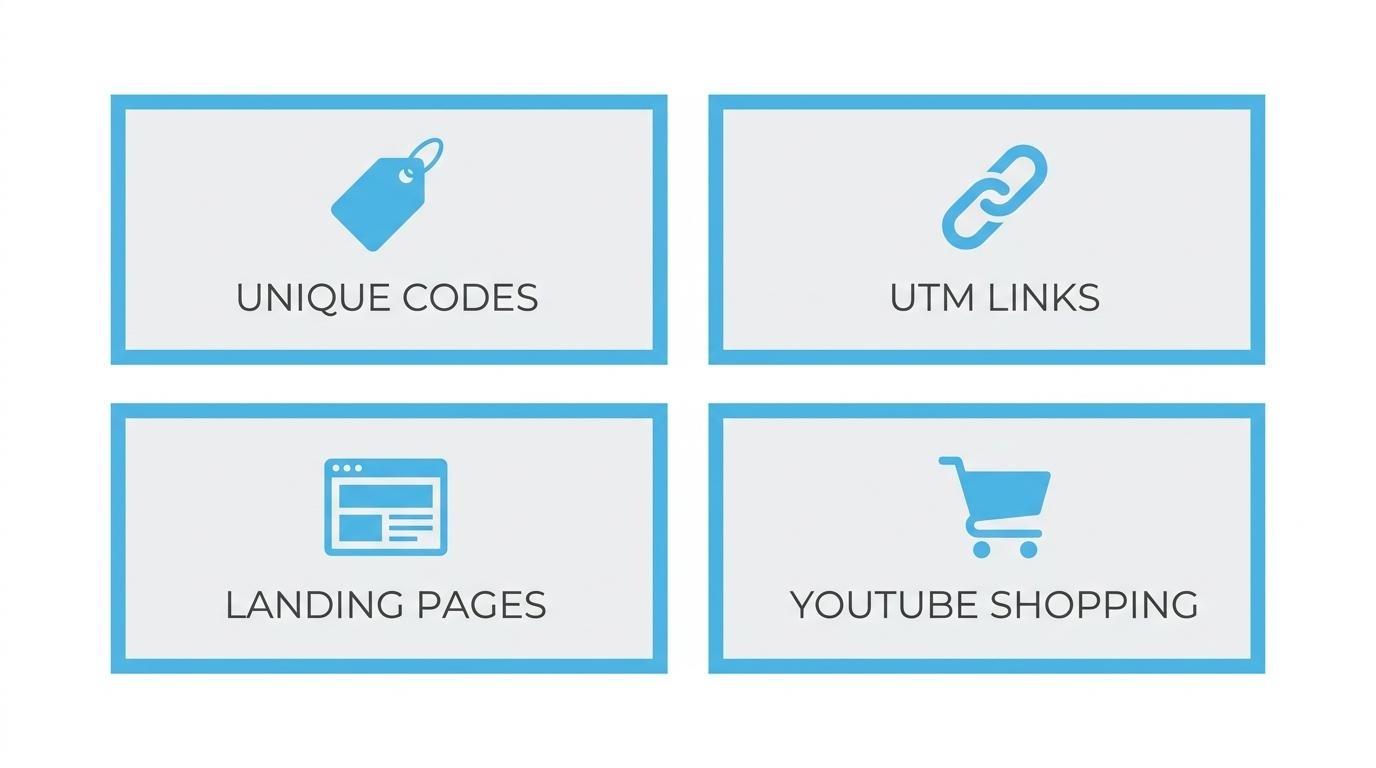
The KPIs you should monitor during and after a campaign span awareness, engagement, and revenue metrics:
During the campaign, monitor daily CTR and CPA to catch underperforming placements early. After completion, evaluate 30-day and 60-day cohort data to capture delayed purchases common with YouTube's longer content shelf life.
You isolate influencer-driven revenue from other channels by building a multi-layer attribution framework that separates organic, paid, and creator-sourced conversions. Start by establishing baseline revenue before campaign launch, then measure incremental lift during the active period.
When attribution data lives in a unified system rather than scattered across disconnected tools, isolating influencer revenue becomes significantly more reliable. With measurement systems established, avoiding common campaign mistakes protects the ROI these metrics reveal.
Common mistakes small businesses make with YouTube influencers include selecting creators by vanity metrics, launching campaigns without conversion infrastructure, and restricting creative freedom. Each error undermines ROI in distinct ways.
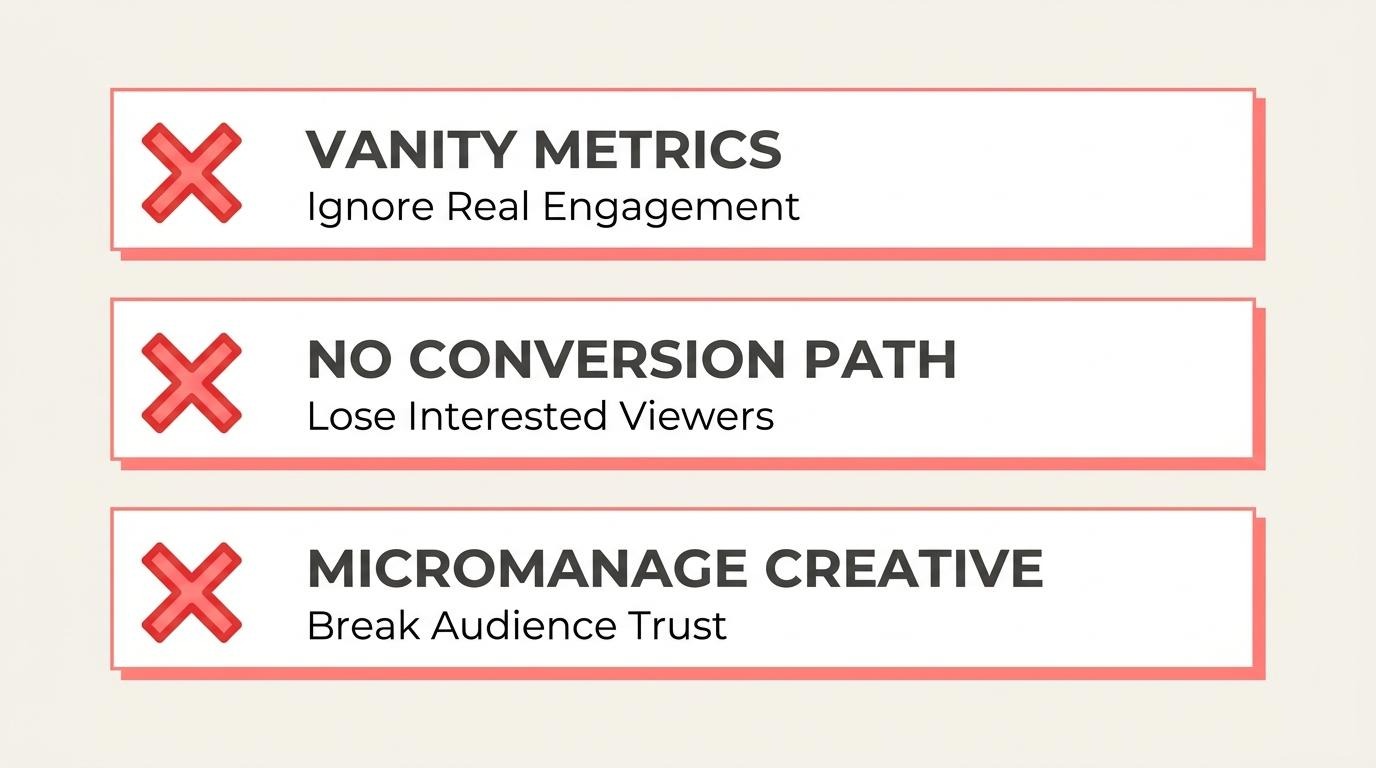
You avoid choosing influencers based on subscriber count alone by evaluating engagement quality, audience demographics, and content relevance before reach. A creator with 8,000 subscribers and 12% engagement often drives more purchases than one with 200,000 subscribers and 0.5% comment rates.
Metrics that matter more than subscriber count include:
According to Zigpoll, influencers with higher engagement rates generally produce higher conversion rates. This underscores why audience trust outweighs raw reach; a smaller creator whose community trusts their recommendations converts better than a large channel with passive viewers.
Campaigns fail without clear conversion paths because even high-quality influencer content cannot drive revenue when viewers have no frictionless route from video to checkout. The gap between "interested" and "purchased" widens every time a potential buyer encounters a dead link, generic homepage landing, or missing discount code.
Essential conversion path elements include:
For scaling DTC brands, this is where fragmented tech stacks create real cost. If your attribution, storefront, and CRM live in separate systems, connecting influencer-driven traffic to actual customer records becomes manual and unreliable.
What happens when you micromanage creative direction is audience disengagement. Viewers subscribe to creators for their authentic voice; scripted, overly branded integrations feel like commercials, triggering skips and eroding the parasocial trust that makes influencer marketing effective.
Creators understand their audience's tone, humor, and content rhythm better than any external brief can capture. When brands dictate exact scripts, shot lists, or talking points word-for-word, the resulting content underperforms because it breaks the creator's established rapport with their community.
A stronger approach provides guardrails rather than scripts: share key messaging pillars, required disclosures, and product details, then let the creator translate those into their natural format. The brief sets boundaries; the creator fills them with content their audience will actually watch.
With common pitfalls identified, the next step is building systems that scale campaigns as revenue grows.
You scale YouTube influencer campaigns by transitioning from isolated collaborations to structured ambassador programs and centralized relationship management. The following subsections cover when to formalize ongoing partnerships and how to coordinate multiple creators efficiently.
You should move from one-off deals to ambassador programs once repeat collaborations with the same creator consistently outperform first-time partnerships in conversion rate and audience trust. According to PR Newswire, global influencer marketing spend reached $32.55 billion in 2025, driven by a measurable shift toward ROI-first strategies and AI integration across workflows. This growth rewards brands that lock in proven creators before competitors do.
Signs you are ready to formalize:
Ambassador contracts typically include exclusivity clauses, tiered commission structures, and content cadence requirements. For most scaling DTC brands, formalizing these relationships reduces per-acquisition costs over time because the creator's audience develops familiarity with the product.
You manage multiple influencer relationships simultaneously by centralizing communication, content calendars, and performance tracking into a single operational workflow rather than scattered email threads. Key management components include:
As your roster grows past five active creators, manual coordination breaks down. Spreadsheet-based tracking becomes error-prone, and response times slow. Brands operating at this scale benefit from systems where influencer performance data, customer records, and order attribution resolve in one place rather than across disconnected tools.
Understanding how influencer-driven traffic converts requires connecting that attribution data to your broader customer lifecycle.
Influencer-driven traffic converts at higher rates when customer data lives in one system because attribution, segmentation, and lifecycle triggers operate from a single record. The following sections cover CRM-connected attribution and key takeaways.
What changes is that every influencer-referred visitor resolves to one customer record from first click through repeat purchase. SHOPLINE became a global partner with YouTube Shopping in 2024, allowing merchants to directly link their stores within YouTube's backend. This connection means influencer-sourced traffic flows into the same CRM that powers lifecycle automation, subscriptions, and POS data.
When attribution connects directly to lifecycle flows, brands can trigger post-purchase sequences specific to the influencer cohort, measure true LTV by creator, and suppress already-converted customers from retargeting. Instead of reconciling data across a separate attribution tool, email platform, and storefront, the entire path from YouTube click to second purchase lives in one place.
For brands running multiple influencer partnerships simultaneously, this eliminates the manual tagging and CSV exports that typically break when campaigns scale beyond three or four creators.
The key takeaways about YouTube influencer marketing for small businesses are:
Small businesses that treat influencer marketing as a lifecycle channel rather than a one-off awareness tactic will compound returns over time. The brands seeing the strongest results are those connecting creator-driven acquisition directly to retention infrastructure, not treating YouTube as an isolated top-of-funnel experiment.