
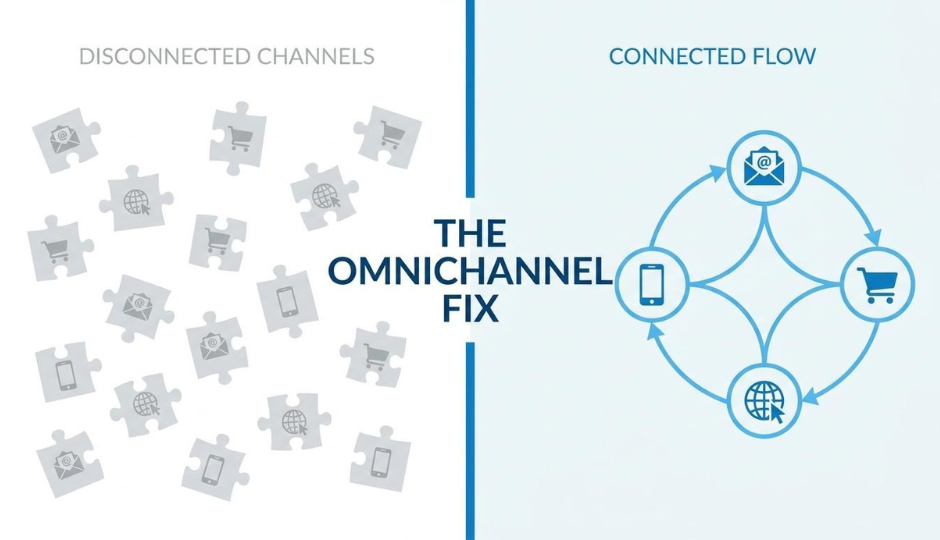
An omnichannel strategy in ecommerce connects every sales channel, touchpoint, and data source into one unified customer experience. When it works, companies enacting omnichannel strategies can retain up to 90% more customers compared to single-channel retailers. When it fails, scaling brands might see profits shrink even as revenue climbs.
This guide covers omnichannel foundations and why they matter at scale, the root causes of strategy failure, how to diagnose a broken omnichannel experience, and the practical path to fixing it through data unification and platform consolidation.
For DTC brands between $1M and $50M in revenue, omnichannel breakdowns typically start with fragmented customer data, tool sprawl, and disconnected POS and web systems. These structural problems compress margins by forcing manual workarounds, creating duplicate customer profiles, and producing inconsistent messaging across channels.
Recognizing failure early depends on tracking the right signals. Declining repeat purchase rates, widening conversion gaps between channels, and conflicting customer records across tools all point to systemic misalignment rather than individual channel weakness.
The fix does not require starting from scratch. We walk through how to unify customer data with a shared architecture, connect online and offline experiences through synchronized payment and fulfillment systems, and deploy marketing automation as a retention engine tied to centralized customer records. Consolidating onto fewer, connected systems (reducing app stack costs in the process) is the most direct path to restoring omnichannel execution without disrupting live sales.
An omnichannel strategy in ecommerce is an approach that connects every sales channel, touchpoint, and data source into one unified customer experience. Rather than treating each channel as a standalone operation, it ties online storefronts, physical retail, social commerce, and customer service into a single, integrated system. Related concepts, such as unified commerce, cross-channel retail, and integrated retail, represent the ongoing evolution of aligning both front-end customer interactions and back-end operations under one framework. The goal is brand consistency across sales channels, where a shopper's history, preferences, and interactions follow them regardless of where they engage. For scaling DTC brands, this distinction matters: omnichannel is not about being present everywhere, but about ensuring every channel shares the same customer record, operational logic, and consistency.
Omnichannel matters for DTC brands scaling past $1M because revenue growth at this stage can frequently outpace operational efficiency, compressing margins instead of expanding them. Without a unified approach to channels, data, and customer experience, scaling amplifies existing inefficiencies.
Brands doing $1M to $50M in revenue often hit a plateau where revenue increases but profit decreases due to unoptimized omnichannel scaling and rising customer support volumes. That Brands scaling from roughly $1M to $50M in revenue often experience margin pressure as operational complexity increases, including higher fulfillment costs, growing customer support demand, and more complex inventory and channel management. Without operational optimization, these factors can temporarily outpace revenue growth and compress profitability.
For operators at this stage, the core issue is this: every disconnected tool, every siloed dataset, and every manual workflow adds cost without adding clarity. Customer acquisition may keep working, but retention, fulfillment, support, and operational costs can climb faster than topline revenue. The result is a business that looks like it is scaling while its unit economics quietly deteriorate.
This is precisely why omnichannel strategy, not just omnichannel presence, becomes essential before a DTC brand crosses the $1M threshold. The sections ahead examine what causes these strategies to fail and how to rebuild them around unified data, consolidated tooling, and connected customer experiences.
The most common reasons omnichannel strategies fail include fragmented customer data, tool sprawl, disconnected POS and web systems, siloed marketing campaigns, rising app stack costs, and manual operations overhead.
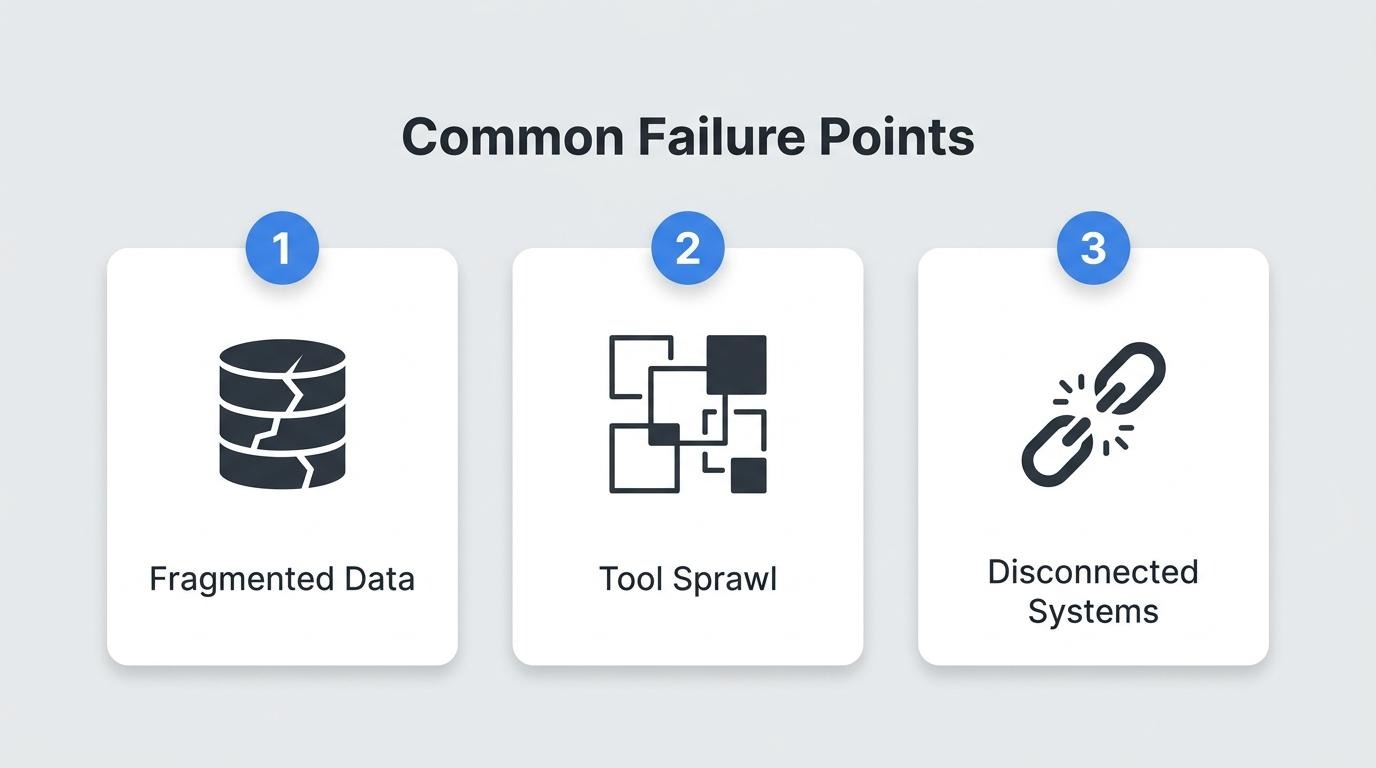
Fragmented customer data breaks omnichannel because it prevents the seamless, unified experience that the customer expects and that the strategy depends on. Omnichannel strategy should prioritize the user's journey and preserving continuity over simply treating channel expansion as a revenue lever, so when data lives in disconnected systems, that journey fractures. According to ScienceDirect, companies that implement omnichannel strategies retain up to 90% more customers compared to single-channel retailers. That retention gap materializes when data flows between channels in real time. Integrating disparate data sources into a single architecture helps create unified customer understanding that can ultimately impact revenue. Without that foundation, visibility gaps emerge, personalization stalls, churn may increase, and the entire omnichannel promise collapses into a collection of disconnected touchpoints.
Tool sprawl undermines channel consistency by creating separate data environments that cannot communicate in real time. When a brand runs one app for email, another for loyalty, a third for subscriptions, and a fourth for analytics, each tool holds its own version of the customer. Pricing, promotions, and messaging can drift between channels because no single system governs them. The result is conflicting experiences and disjointed brand touchpoints: a customer might see one offer on email and a different one at checkout. Each added tool also introduces another integration point that can break, compounding inconsistency. Consolidation into fewer, connected systems is often the most important fix for brands at scale.
Disconnected POS and web data causes failure because it splits the customer record into two incomplete profiles. In-store purchases, browsing history, and online orders exist in separate databases, making accurate segmentation and personalization impossible. According to Coresight Research, over 70% of retailers lose at least 5% of their operating margin to in-store inefficiencies, including out-of-stocks, pricing and promotion execution issues, planogram non-compliance, and challenges in allocation and assortment planning. These issues are often exacerbated by fragmented data across POS systems, ecommerce storefronts, and inventory management platforms, which limits real-time visibility into stock availability across channels. When inventory counts diverge, overselling online or dead stock in stores can occur. For brands running multiple channels, unifying POS and ecommerce data under one system is not optional; it is the baseline requirement for omnichannel execution.
Siloed marketing campaigns hurt retention by delivering inconsistent messages across channels, which erodes customer trust. When email, SMS, social, and in-store promotions operate independently, the same customer receives conflicting offers or redundant outreach. According to ContactPigeon, marketing campaigns employing an omnichannel approach report a 494% higher order rate compared to those launched on a single channel. That gap illustrates how much revenue siloed execution can leave behind. Lifecycle marketing needs a shared data layer so every touchpoint reflects where the customer actually is in their journey, not where one isolated tool assumes they are.
Lack of a single customer record stalls growth because every growth lever, from personalization to retention to accurate attribution, requires knowing who the customer is across all touchpoints. Without one unified record, teams waste time reconciling data between tools instead of acting on it. Segmentation becomes unreliable, repeat purchase campaigns may target the wrong cohorts, and LTV calculations miss. This problem compounds as brands scale: without proper integrations, more channels generate more fragmented data, demanding more manual reconciliation. In some cases, growth can be constrained not by lack of demand, but by challenges in retaining customers and driving repeat purchases, where factors such as post-purchase experience, fulfillment reliability, and lifecycle marketing effectiveness limit long-term revenue expansion.
Rising app stack costs distract from strategy by redirecting budget and attention toward maintaining integrations instead of improving the customer experience. Each added app carries subscription fees, developer hours for custom connectors, and ongoing maintenance when APIs change. At scale, brands running fragmented marketing and ecommerce stacks often face significant integration and maintenance costs, including engineering time spent connecting systems, reconciling data, and managing tool complexity–all costs that can materially reduce the efficiency of marketing investments. This cost creep is often gradual enough that many teams do not audit total spend until margins tighten. Lowering total cost of ownership frees resources for actual strategic initiatives like lifecycle programs and channel expansion.
Manual operations overhead stifles execution by consuming team bandwidth on repetitive tasks that could be automated. Inventory syncs done via spreadsheet, customer exports between platforms, and manual order routing all introduce delays and errors. When staff spends hours reconciling data instead of optimizing campaigns or improving fulfillment, strategic priorities stall. The compounding effect is significant: each manual process slows the next decision that depends on it. Brands operating at real volume cannot afford this friction. Automating core workflows through an integrated system removes the bottleneck and lets teams focus on growth rather than maintenance.
Understanding these failure points is the first step; recognizing the warning signs in your own data is the next.
You can tell your omnichannel strategy is failing by tracking specific metrics tied to retention, conversion consistency, and data integrity. The sections below cover key performance signals, repeat purchase trends, and data inconsistency patterns.
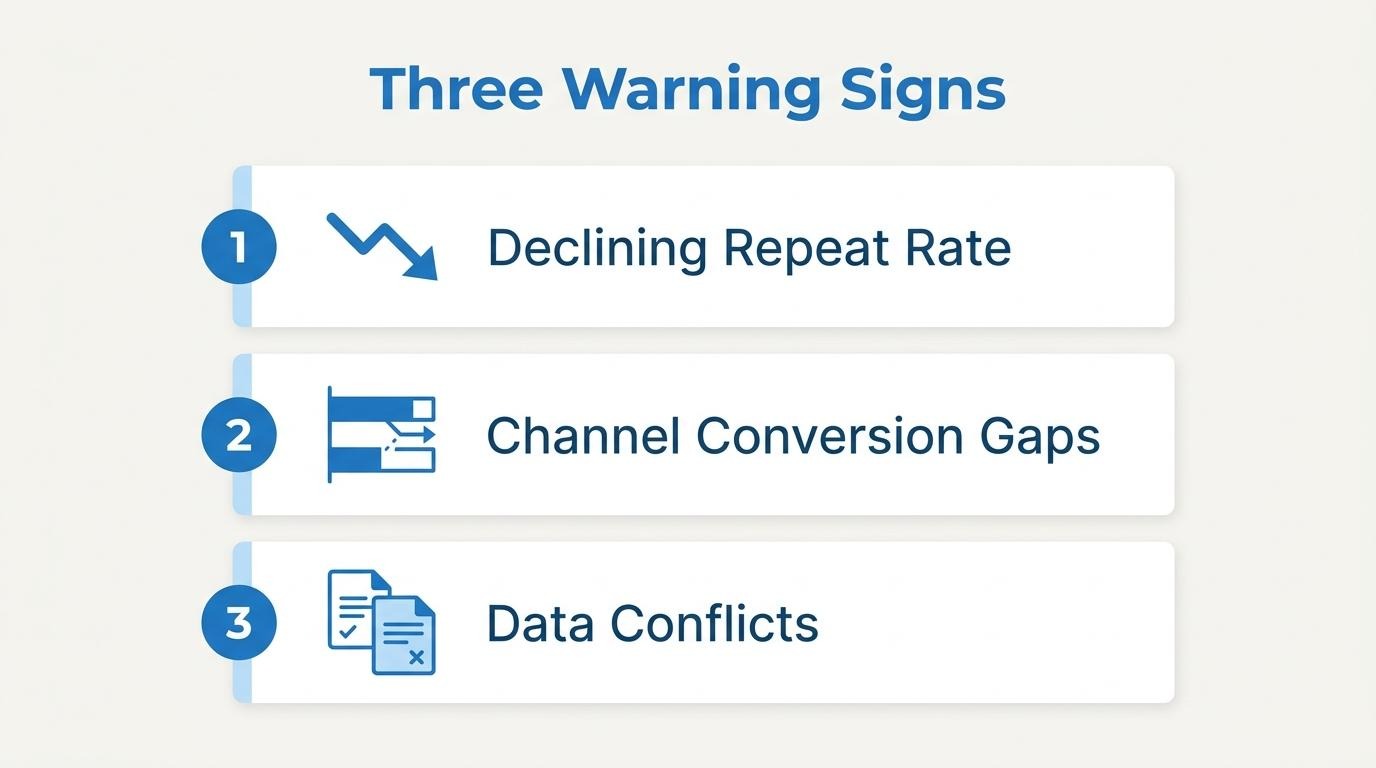
Some of the metrics that can signal a broken omnichannel experience include weak cross-channel customer behavior or widening gaps between channel-level conversion rates, rising customer acquisition costs paired with flat or declining lifetime value and retention rates, inventory accuracy problems, poor data visibility and attribution gaps, and operational teams working in silos. A healthy omnichannel operation produces relatively consistent performance across touchpoints. When one channel converts at 4% and another at 0.8% for the same audience segment, the disconnect can point to broken handoffs rather than channel-specific weakness. Omnichannel failure is not usually a single metric, but rather a combination of metrics. Other more specific signals can include:
For scaling DTC brands, these metrics often surface gradually, which makes them easy to dismiss as normal variance until margin erosion becomes obvious.
A declining repeat purchase rate reveals that customers are not experiencing a cohesive journey after their first transaction. The post-purchase experience, including follow-up messaging, loyalty incentives, and product recommendations, may run on disconnected tools that fail to coordinate timing or relevance. When lifecycle touchpoints operate independently, returning customers receive generic outreach instead of personalized sequences based on actual purchase behavior. This friction quietly pushes buyers toward competitors who recognize them across channels. While a sustained drop in repeat purchases can have many causes including problems with the product itself, it can also be a systems problem where customer context gets lost between the first sale and subsequent purchases.
Inconsistent customer data across tools may show up as duplicate customer profiles, incomplete purchase histories, and mismatched segmentation between platforms. A customer who buys in-store and later browses online may appear as two separate records, one in the POS and another in the ecommerce CRM. Omnichannel strategies often fall short not because of missing tools, but due to a lack of alignment across the organization's strategic and customer priorities.
These inconsistencies erode trust quickly, and compound as a business scales. Recognizing data misalignment early is the first step toward building a unified foundation for omnichannel execution.
A successful omnichannel strategy looks like a unified system where every channel shares one customer record, consistent inventory data, and coordinated messaging. Rather than treating each touchpoint as independent, it connects online storefronts, physical retail, marketing automation, and customer service into a single operational layer. According to a report by ScienceDirect, companies that implement omnichannel strategies retain up to 90% more customers compared to single-channel retailers. The defining trait is not channel count; it is data continuity. When a customer browses online, buys in-store, and contacts support by email, each interaction draws from the same profile. Pricing, promotions, and product availability stay synchronized across every surface. This consistency eliminates the friction that causes cart abandonment, support escalation, and brand distrust. For scaling DTC brands, the practical benchmark is straightforward: if a customer cannot move between channels without repeating themselves or encountering conflicting information, the omnichannel strategy is not yet successful.
You unify customer data across all channels by consolidating disparate data sources into a single architecture that resolves every interaction to one customer record. This involves adopting a Customer Data Platform, aligning POS and web systems, and eliminating tool-level data silos.
Customer Data Platforms use consolidated customer data to deliver consistent, personalized experiences across multiple channels, driving omnichannel personalization. Without this consolidation layer, each channel generates its own version of the customer, and no amount of marketing spend compensates for that fragmentation. For brands operating at scale with five or more tools feeding separate databases, the practical first step is mapping every customer touchpoint to a shared identifier. Platforms built around a shared customer data layer, SHOPLINE for example, keep online, offline, and lifecycle data tied to one customer record rather than reconciling siloed exports after the fact. The goal is not just cleaner data; it is helping data stay aligned across storefront, CRM, and marketing systems so personalization decisions happen automatically rather than manually.
You should connect online and offline experiences by unifying payment methods, inventory visibility, and fulfillment options across digital and physical channels. The key tactics involve digital wallets in-store, cross-channel returns, and shared purchase data.
Digital wallet adoption in physical stores illustrates how quickly offline behavior is shifting toward digital convenience. According to McKinsey, in-store digital wallet usage in the US rose to 28% in 2024, up from 19% in 2019. This trend means brands need payment systems that recognize the same customer whether they tap a phone at a register or check out on a website.
Cross-channel fulfillment is another critical connector. 55% of consumers prefer returning online purchases in-store, and 40% make additional purchases during pickup or return visits, according to Ryder. That secondary transaction only happens when the in-store system knows what the customer bought online, which requires a shared data layer between POS and ecommerce.
For brands running separate offline and online systems, these interactions create data blind spots. A customer who buys online, returns in-store, and then repurchases through a mobile app looks like three different people without a unified record. Bridging that gap is less about adding new channels and more about ensuring every channel writes to the same customer profile.
Platforms that support a shared customer data layer, such as SHOPLINE, can help unify POS and storefront transactions under a single customer record when properly integrated, reducing common data synchronization issues in O2O (online-to-offline) retail environments. With online and offline touchpoints feeding a single system, marketing automation can target based on a fuller picture of customer behavior rather than partial channel snapshots.
Marketing automation serves as the execution layer that turns unified customer data into timely, personalized interactions across every channel. Without it, even well-integrated omnichannel systems remain passive data repositories rather than active retention engines.
The real leverage of automation in omnichannel is its ability to act on behavioral signals in real time, not just broadcast scheduled campaigns. When a customer browses online, purchases in-store, or abandons a cart, automation triggers the right message on the right channel without manual intervention. This is what separates brands that retain customers from those that simply reach them.
Existing customer bases, which account for 21% of a brand's total customers, drive an average of 44% of total annual revenue, according to data cited by Gorgias. That concentration of revenue in a small segment makes automated lifecycle sequences (post-purchase flows, win-back campaigns, replenishment reminders) disproportionately valuable. Brands that treat automation as an afterthought leave that revenue exposed to churn.
For scaling DTC brands, the critical question is whether marketing automation lives inside the same system as customer data and commerce, or sits in a separate tool requiring constant syncing. Disconnected automation platforms create the same fragmentation problems that break omnichannel in the first place: delayed data, inconsistent messaging, and duplicate customer records. Platforms built around a shared customer data layer, including SHOPLINE, keep lifecycle marketing tied to one customer record rather than requiring full manual reconciliation of data between a separate ESP, CDP, and storefront.
Automation also shifts the economics of retention. Manual campaign execution requires headcount that scales linearly with channel count. Automated workflows, once built, can sometimes save business money in addition to increasing efficiency. For brands operating between $1M and $50M in revenue, this distinction can play a factor in whether omnichannel expansion improves margins or erodes them.
With automation supporting customer engagement across the entire lifecycle, including acquisition, conversion, and retention at scale, the next step is knowing how to fix a broken omnichannel strategy without rebuilding from scratch.
You fix an omnichannel strategy without starting over by consolidating tools incrementally, migrating customer-facing systems first, and reducing app stack costs during the transition. The following subsections cover each step.
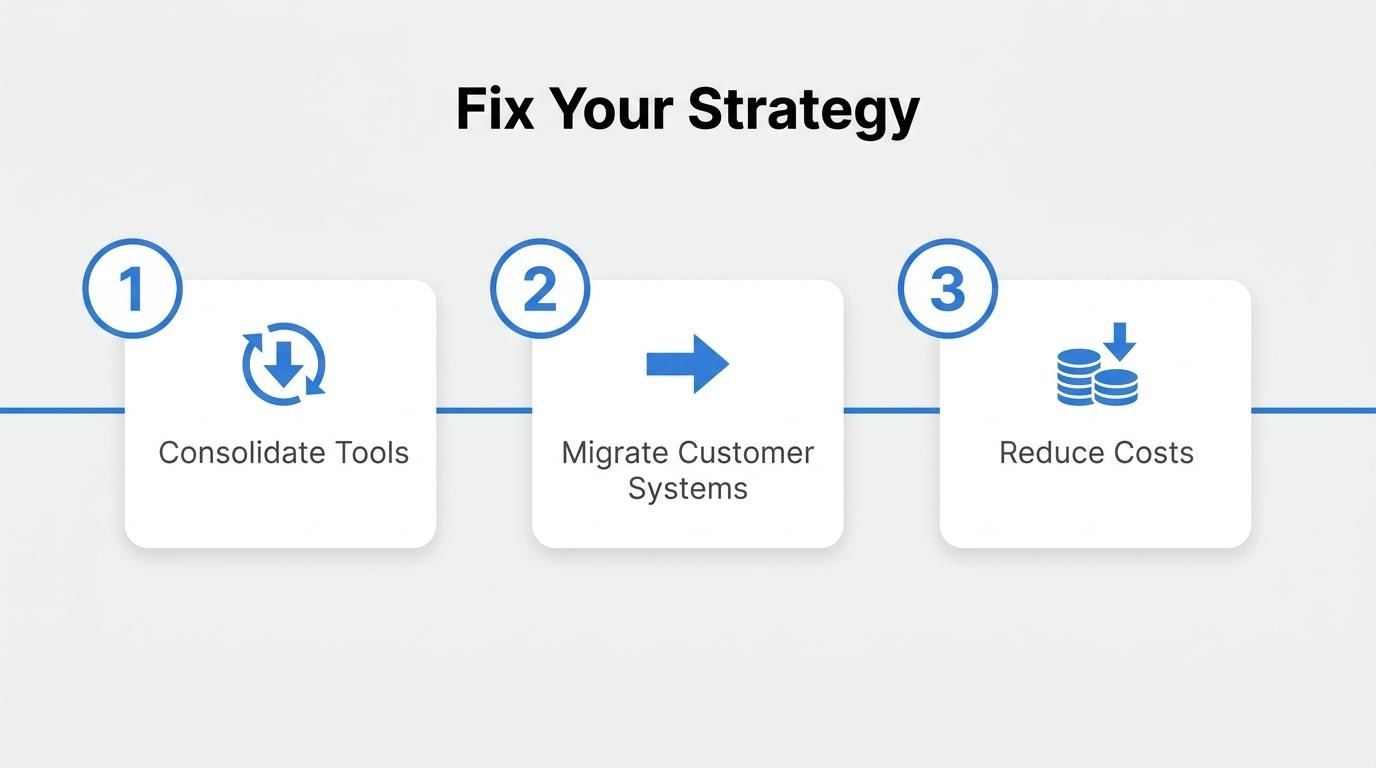
Yes, you can consolidate tools without disrupting live sales by running parallel systems during the migration window. The key is staging the transition rather than executing a single cutover. Start by identifying which tools share overlapping functions, then migrate one integration at a time while keeping the live storefront operational on the existing stack.
Prioritize consolidating systems that already cause the most data sync errors, since these carry the lowest risk of disruption when replaced. Shadow-test each new unified module against live transaction data before deactivating the legacy tool. This approach limits downtime exposure to individual functions rather than the entire commerce operation.
In some omnichannel transformation programs, teams prioritize migrating customer-facing processes first to quickly improve user experience, while backend systems are stabilized in parallel or addressed in later phases, though execution strategy varies by business needs. According to Gartner research on unified commerce transformation, retailers drive results by focusing on customer-facing processes, shaping back-end systems around them, and leveraging real-time inventory data, an important consideration to keep in mind when designing omnichannel strategies.
In practice, a migration sequence might follow this order:
You reduce app stack costs during a transition by auditing redundant subscriptions, consolidating overlapping tools onto fewer platforms, and eliminating per-app fees that compound at scale. Lowering the total cost of ownership of an ecommerce tech stack frees up resources that can be invested into innovation and positions brands for more efficient scaling.
Practical cost-reduction steps include:
For brands running 5 to 15 apps, consolidation onto a platform with integrated CRM, marketing automation, and POS capabilities typically eliminates the highest-cost redundancies first. With costs under control, the next question is whether consolidating onto a single platform influences omnichannel outcomes.
Consolidating onto one platform helps influence omnichannel strategy outcomes by replacing disconnected tools with a single system where customer data, sales, and marketing capabilities can operate. The sections below cover what unified CRM, POS, and marketing data enables, and the key takeaways from the omnichannel failures discussed throughout this article.
When CRM, POS, and marketing systems share a unified location, customer interactions can be better tracked and unified to a central profile regardless of channel. This helps reduce the reconciliation gaps that can cause inconsistent messaging, inventory mismatches, and blind spots in lifecycle targeting.
A shared record means that an in-store purchase can updates the same profile that triggers the post-purchase email sequence and informs the next ad suppression list. Without that link, each system builds its own partial view of the customer, and teams make decisions on incomplete data.
For brands operating at scale, this consolidation can occasionally also reduce total cost of ownership by removing the sync layers, middleware, and manual exports that hold a multi-app stack together. SHOPLINE is one option for brands pursuing this unified approach, running commerce, CRM, marketing automation, and POS integrations inside a unified layer.
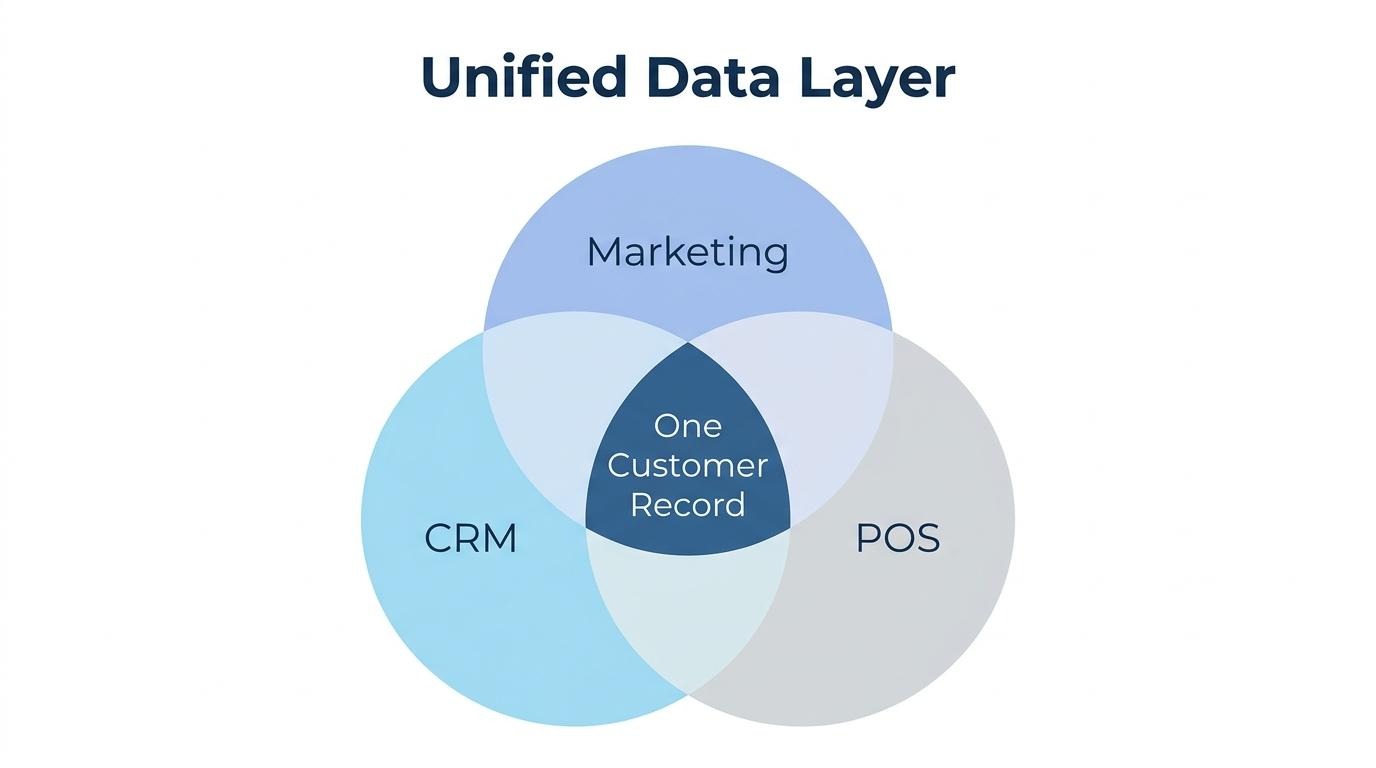
The key takeaways about omnichannel failure covered in this article center on data fragmentation, tool sprawl, and misaligned priorities as the root causes, not necessarily missing channels.
According to ContactPigeon, omnichannel campaigns report a 494% higher order rate compared to single-channel launches–highlighting that while expanding across channels can significantly increase customer reach, it also requires unification to ensure consistent brand experience across these channels. A practical path forward for scaling brands is reducing stack complexity first, and building retention and personalization on top of unified data within an integrated system.
.png)
.png)
.png)

