
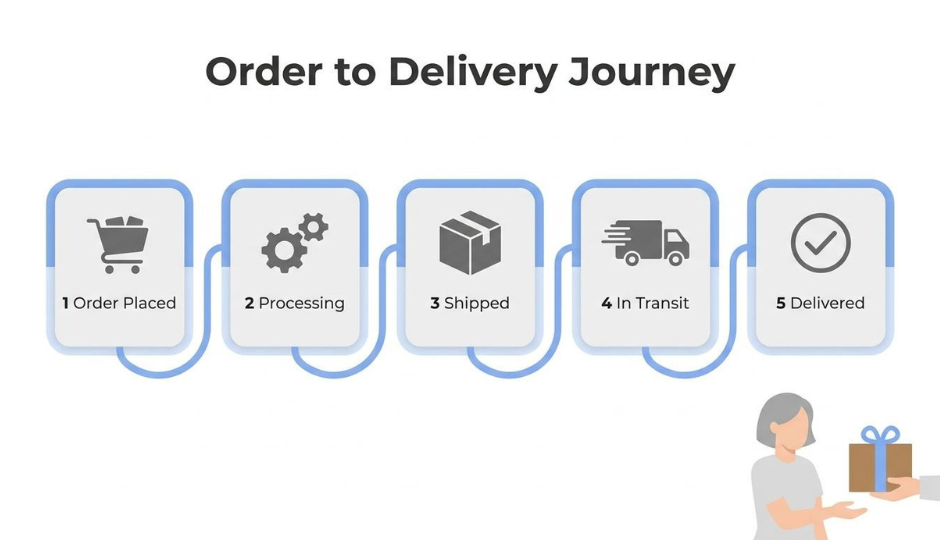
Fulfillment statuses are the stage-by-stage labels that tell ecommerce customers exactly where their order stands between purchase and delivery. Each status, from "order received" through "delivered" or "returned," shapes buyer confidence, trust, and willingness to purchase again.
This guide covers fulfillment status definitions across the order lifecycle, the end-to-end fulfillment process, how status visibility and speed affect customer experience, the cost of fulfillment errors, and how unified systems protect retention at scale.
Every major ecommerce fulfillment status carries a distinct psychological weight. "Order received" replaces uncertainty with confirmation, "processing" and "picked and packed" signal operational progress, and "shipped" transforms a warehouse task into a tangible delivery timeline. Statuses like "on hold," "backordered," or "partially fulfilled" introduce friction that demands proactive, specific communication to prevent cancellations.
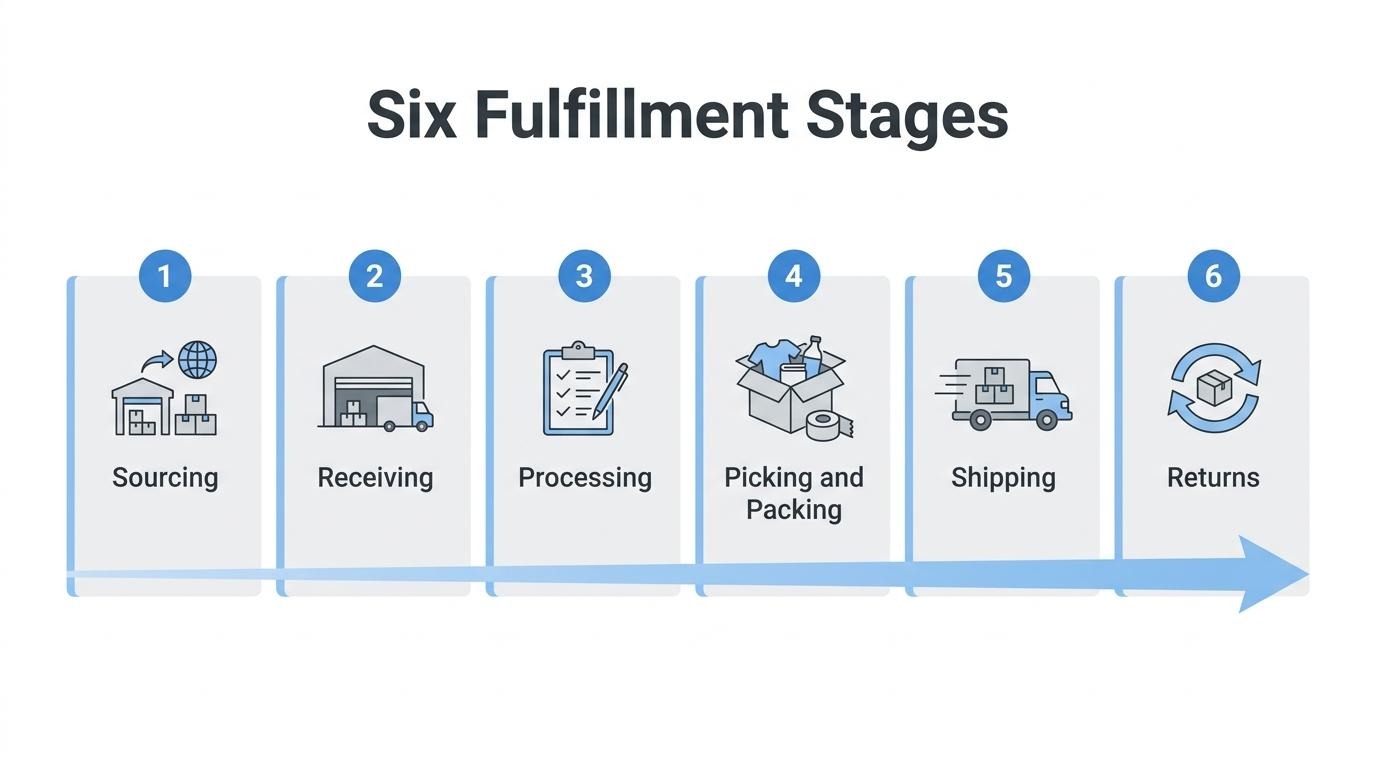
The standard fulfillment process moves through sourcing, receiving, order processing, picking and packing, shipping, and returns. A breakdown at any stage cascades directly into the status updates customers see and the perception they form of a brand.
Fulfillment communication quality determines whether customers feel confident or anxious. Frequent tracking updates reduce post-purchase anxiety, while stale or inaccurate statuses drive support volume; WISMO inquiries alone can account for up to half of all ecommerce support tickets.
When errors like wrong items, missing products, or damaged packages reach customers, the damage extends beyond a single order into long-term retention and lifetime value. Fragmented systems that produce conflicting status messages compound the problem.
Consolidating fulfillment, order management, and customer data into one platform eliminates the sync gaps where these failures originate and turns post-purchase communication into a repeatable loyalty driver.
Fulfillment statuses in ecommerce are stage-by-stage labels that tell customers exactly where their order stands between purchase and delivery. The following sub-sections define each major status, from order received through returns.
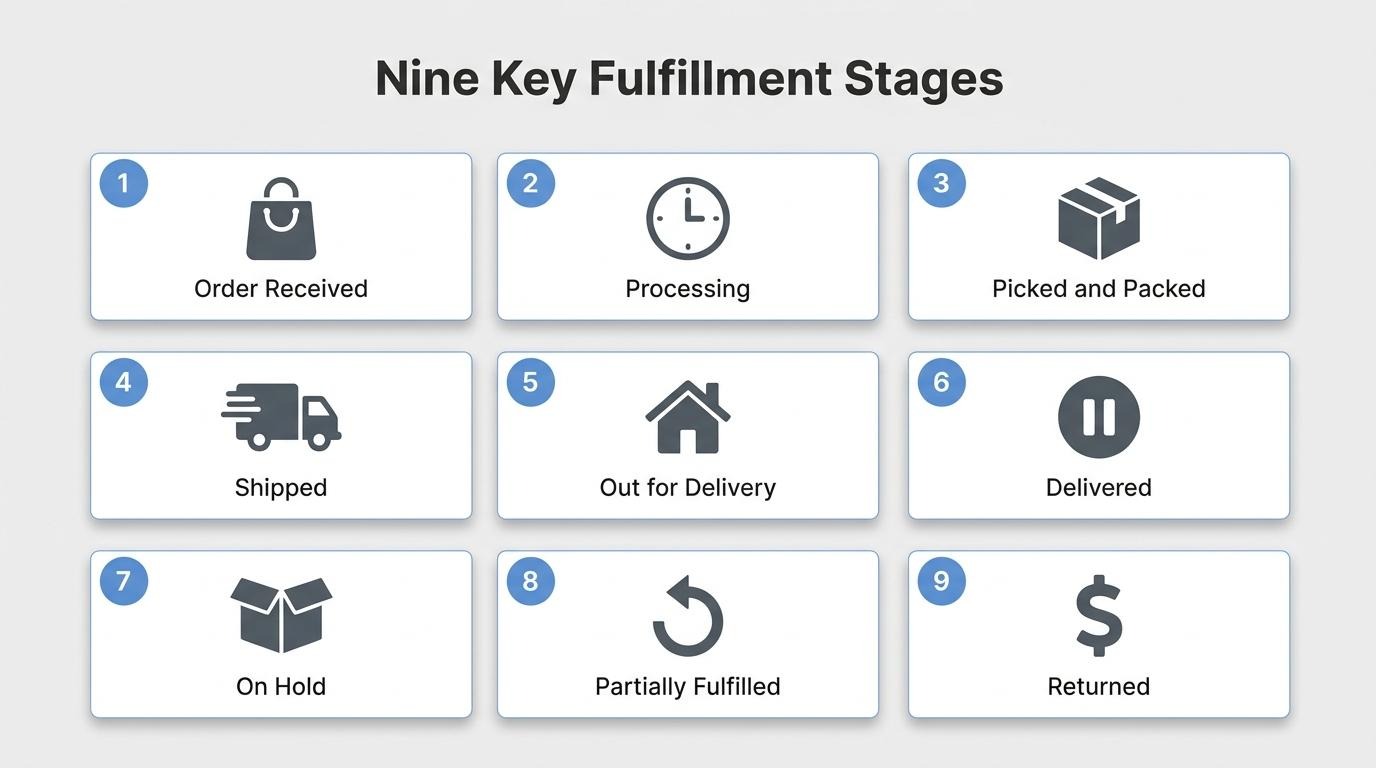
"Order received" means the ecommerce system has accepted and confirmed the customer's purchase. This status serves as the first acknowledgment that payment was processed and the order entered the fulfillment queue. For shoppers, it replaces uncertainty with a concrete starting point. Without this initial confirmation, buyers may wonder whether their transaction completed at all, prompting unnecessary support contacts. A clear "order received" notification sets the tone for the entire post-purchase experience and establishes the communication cadence a customer can expect going forward.
"Processing" status indicates the merchant is actively preparing the order for shipment. During this stage, the warehouse management system verifies inventory availability, validates payment details, and queues the order for picking. Customers who see a processing status understand their purchase has moved beyond simple confirmation into operational handling. This is often the longest pre-shipment window, so setting realistic timeframe expectations here reduces inbound support inquiries. For merchants handling high volume, processing speed directly reflects operational efficiency and staffing capacity.
"Picked and packed" means warehouse staff have located the ordered SKUs and securely packaged them for transit. Picking involves retrieving items from storage locations using detailed instructions, while packing ensures products are protected and labeled with a shipping label. This status signals the order is physically ready to leave the facility. Customers interpret it as meaningful forward progress because it confirms their specific items exist, have been handled, and are one step from carrier handoff.
"Shipped" status tells the customer that a carrier has taken possession of the package and transit has begun. This update typically includes a tracking number, enabling real-time visibility into the shipment's journey. According to a McKinsey survey, about 50 percent of respondents track order status to confirm the shipment is progressing and remains on time. Clear shipped notifications with carrier details significantly reduce the need for customers to contact support.
"Out for delivery" means the package has reached the local distribution hub and a driver is en route to the customer's address. This status narrows the delivery window from days to hours, creating the highest anticipation point in the fulfillment cycle. When this update arrives late or fails to appear, the disconnect between expectation and reality generates frustration disproportionate to the actual delay. Precise "out for delivery" alerts respect the customer's time and reinforce brand reliability.
"Delivered" status confirms the carrier has completed the final handoff and the package has reached its destination. This confirmation typically relies on driver scans, GPS data, or photo proof of delivery. For the customer, it closes the fulfillment loop and shifts attention to product satisfaction. Inaccurate delivered statuses, where the system marks a package delivered before the customer has it, create immediate distrust. Accurate delivery confirmation is the final trust signal in the fulfillment chain and directly shapes whether the overall experience feels reliable.
"On hold" or "backordered" statuses signal that the order cannot proceed through standard fulfillment due to inventory shortages, payment issues, or verification requirements. "On hold" often indicates a temporary block that needs manual resolution, while "backordered" means the item is out of stock and awaiting replenishment. Both statuses create uncertainty for customers. Proactive communication explaining the reason and estimated resolution timeline is essential; vague or missing updates in these situations quickly undermine trust and create frustration, often pushing customers toward cancellation rather than patience.
"Partially fulfilled" status means some items in the order have been shipped while others are still being processed or on hold. This occurs when orders contain products from different warehouse locations or when certain SKUs face inventory constraints. Customers encountering this status need clear itemization showing which products shipped and which remain pending. Without that granularity, partial fulfillment feels like an error rather than a logistical reality. Detailed breakdowns within the status update prevent confusion and help customers track each item independently.
"Returned" or "refund initiated" indicates the post-delivery phase has begun, with the customer sending back a product or the merchant starting the refund process. "Returned" confirms the item is in transit back to the warehouse or has been received. "Refund initiated" signals the merchant has approved the financial reversal. Customers watch these statuses closely because money is at stake. Delays between return receipt and refund processing erode confidence quickly. Timely, transparent updates through this final stage protect the relationship and influence whether the customer considers purchasing again.
Understanding each fulfillment status prepares merchants to communicate clearly at every stage of the order lifecycle.
The standard ecommerce fulfillment process is a sequence of operational stages that move a customer's order from purchase to doorstep. It covers sourcing, receiving, processing, shipping, and returns.
According to Flowspace, ecommerce fulfillment covers five core stages: receiving and storage, order processing, picking and packing, shipping and delivery, and returns and reverse logistics. Before those stages begin, sourcing determines where inventory is obtained and how it reaches the warehouse. Each stage generates a corresponding fulfillment status that customers see in their order tracker.
The core stages after sourcing products follow this sequence:
For scaling brands, the reliability of each stage matters more than raw speed. A breakdown at any point, whether a receiving error that miscounts inventory or a packing mistake that sends the wrong SKU, cascades into the status updates customers see and directly shapes their perception of the brand. Understanding how these stages connect to customer-facing statuses reveals where experience gaps typically form.
Fulfillment statuses directly affect customer experience by shaping buyer confidence, trust, and support burden at every post-purchase touchpoint. According to Salesforce, 43% of consumers say a poor customer experience deters them from shopping with a brand again. The sections below cover how real-time visibility reduces anxiety, how stale updates erode trust, and how inaccurate information floods support queues.

Real-time status visibility reduces customer anxiety by replacing uncertainty with continuous confirmation that an order is progressing. When a shopper clicks "buy," a psychological gap opens between payment and possession. Each status update closes that gap incrementally.
According to Narvar, nearly four in ten shoppers say frequent tracking updates directly reduce their post-purchase anxiety. That finding underscores a simple principle: proactive communication is cheaper than reactive damage control. Brands that surface granular milestones, from processing confirmation through carrier handoff, give buyers fewer reasons to worry and fewer reasons to contact support. For scaling DTC operations, building this visibility into the default order flow is one of the highest-ROI investments in post-purchase experience.
Delayed or stale status updates erode trust by leaving customers without a clear picture of where their order stands. When the last visible update is hours or days old, buyers fill the silence with doubt.
As LinkedIn's customer experience research notes, unclear order updates, meaning vague or missing communication about purchase status, can quickly undermine trust and create frustration. The damage compounds with time; a status stuck on "processing" for 48 hours signals either operational failure or indifference, neither of which encourages a repeat purchase. Frequent, honest updates maintain credibility even when delays occur. Acknowledging a setback transparently often preserves more loyalty than silence ever could.
Inaccurate status information drives support tickets by forcing customers to seek answers the system should have provided automatically. Every mismatch between a displayed status and reality triggers a "Where Is My Order?" (WISMO) inquiry.
According to Claimlane, WISMO queries can account for up to 50% of all support tickets for ecommerce businesses. Each ticket consumes agent time and overhead. The root cause is rarely the carrier alone; it is often a disconnect between fulfillment systems and the customer-facing tracking page. Brands that unify order data into a single source of truth see fewer status discrepancies and, consequently, a lighter support load.
With the link between fulfillment communication and customer experience established, delivery speed adds another layer of expectation.
Customers expect transparent order tracking because online purchasing removes the physical confirmation of receiving goods at the point of sale, creating an information gap that triggers uncertainty. Post-purchase anxiety, shipment monitoring habits, and the cost of support inquiries all drive this expectation.
The modern shopper treats visibility into fulfillment statuses as a baseline requirement, not a bonus feature. When brands fail to meet this expectation, the consequences show up in support queues, eroded trust, and lost repeat business. According to a Narvar study, 66% of consumers feel anxious at least sometimes after placing an online order, with 34% reporting they feel anxious often or always. That anxiety doesn't resolve on its own; it resolves with clear, timely status updates at each fulfillment stage.
Three forces make transparent tracking a non-negotiable:
For brands operating at scale, the math is straightforward: every vague or missing status update is a support cost, a trust liability, and a retention risk rolled into one. Proactive fulfillment communication isn't just what customers prefer; it's what keeps operations efficient and margins intact.
Understanding why these expectations exist sets the stage for examining how fulfillment speed itself shapes satisfaction.
Fulfillment speed shapes customer satisfaction less through raw delivery velocity and more through reliability and expectation alignment. The sections below cover same-day and next-day perception, multi-day fulfillment and repeat purchases, and subscription timing and retention.
Same-day and next-day expectations affect perception by anchoring what customers consider "normal" delivery, making any deviation feel like a failure. When a brand advertises rapid fulfillment windows, the promise itself becomes the benchmark. In practice, a consistent two-day window that hits its promise outperforms a same-day pledge that occasionally misses. Brands offering accelerated shipping should treat the commitment as a ceiling, not a target. Overpromising speed and underdelivering reliability erodes trust faster than simply setting a longer, accurate timeline from the start.
Multi-day fulfillment impacts repeat purchase intent primarily when status communication breaks down between order placement and delivery. Customers who choose standard shipping generally accept longer timelines; the friction arises when updates stall or contradict each other during that window. Vague or missing status messages quickly undermine trust, turning a routine wait into active doubt about whether the order will arrive at all.
43% of consumers say a poor customer experience deters them from shopping with a brand again, according to Salesforce. For multi-day fulfillment, proactive status updates at each stage keep the perceived wait manageable. Silence during a five-day window does more damage to repurchase likelihood than the five days themselves.
Subscription order fulfillment timing affects retention by determining whether recurring customers experience consistency or disruption in each cycle. According to a study published in the Journal of Retailing, fulfillment failures such as out-of-stocks significantly delay the time to the next order by an average of 7.22%.
Subscription retention is already challenging. Recharge reported that subscription merchants averaged a 33% twelve-month customer retention rate in 2022. Even a single missed or delayed shipment compounds churn risk in a model where predictability is a core value proposition. Brands running recurring fulfillment should treat timing precision as a retention lever, not just an operational metric.
With fulfillment speed expectations set, the next consideration is what happens when errors reach the customer directly.
Fulfillment errors that reach the customer trigger credibility loss, loyalty erosion, and surging return rates. The subsections below cover how wrong-item shipments, missing items, and damaged deliveries each create distinct consequences.
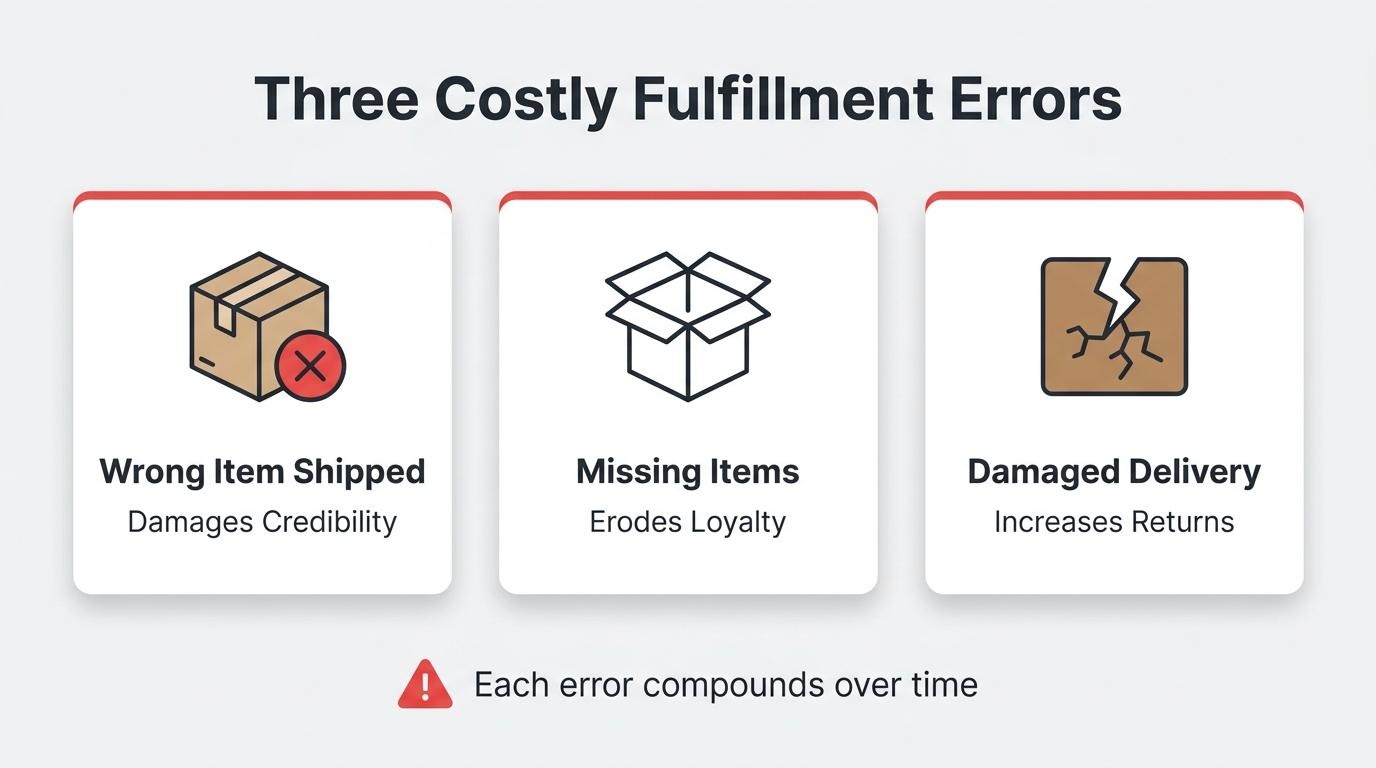
Wrong-item shipments damage brand credibility by signaling operational incompetence at the most visible touchpoint: the unboxing moment. When a customer opens a package and finds a product they never ordered, the immediate reaction is distrust in the brand's ability to handle basic logistics.
This type of error forces the customer into an unplanned support interaction, compounding frustration. According to Salesforce, 43% of consumers say a poor customer experience deters them from shopping with a brand again. A single wrong-item shipment can undo months of marketing investment because the customer now questions whether their next order will be correct. For brands processing high volumes, even a small wrong-item rate compounds into measurable reputation damage across reviews and social channels.
Missing items in an order affect customer loyalty by creating a gap between what was promised and what was delivered. This discrepancy triggers immediate doubt about whether the brand can be trusted with future purchases.
A study published in the Journal of Retailing found that fulfillment failures, such as out-of-stocks, significantly delay the time to the next order by an average of 7.22%. Missing items amplify this effect because the customer already committed payment for something they did not receive. Resolution speed matters enormously here; slow or difficult claims processes turn a fixable mistake into a defection that can permanently affect customer retention. Brands that lack unified order data may spend more time verifying what was packed versus what was ordered, further delaying resolution and deepening loyalty damage.
Damaged-product delivery influences return rates by making returns unavoidable rather than discretionary. Unlike sizing issues or preference changes, a damaged item leaves the customer no choice but to initiate a return or replacement.
In 2024, 85 million packages arrived damaged in the U.S., resulting in nearly $3 billion in costs for retailers, according to the New York Post. Each damaged delivery generates picking, shipping, and restocking costs on top of the original fulfillment expense. Repeated damage incidents also train customers to expect problems, which increases preemptive return behavior on future orders. For scaling brands, consolidating fulfillment data into a single system helps identify packaging weaknesses and carrier issues before they become systemic.
With the direct costs of fulfillment errors now clear, the next question is how these mistakes compound over time to affect retention and lifetime value.
Fulfillment processes affect customer retention and lifetime value by shaping every post-purchase interaction a buyer has with a brand. Reliable order handling, accurate delivery, and consistent communication convert one-time buyers into repeat customers, while fulfillment failures accelerate churn and shrink lifetime value.
Customer acquisition costs for subscription models alone have risen over 222% in the past ten years, according to Recurly. That shift makes retention the more sustainable growth lever. Every fulfillment touchpoint, from order confirmation to final delivery, either reinforces a customer's decision to buy again or gives them a reason to leave.
When fulfillment runs smoothly, customers build habitual purchasing patterns. Predictable shipping timelines and accurate status updates reduce the friction that causes hesitation before a repeat order. Conversely, a single wrong-item shipment or unexplained delay can reset the trust a brand spent months earning. The cumulative effect compounds: each positive fulfillment cycle shortens the interval between orders, while each failure extends it.
For brands operating at scale, fulfillment is not a back-office function; it is the primary retention mechanism. Pricing, product quality, and marketing bring customers in, but the fulfillment experience determines whether they stay. Brands that treat fulfillment as a cost center rather than a retention driver often find themselves spending more to replace churned customers than they would to keep existing ones.
Fragmented fulfillment data compounds the problem, making it harder to identify patterns in delivery failures or customer complaints before they escalate into lost revenue.
Fragmented fulfillment data creates a disconnected customer experience by forcing manual reconciliation and verification between separate systems. The sections below cover how siloed systems produce contradictory status messages and how missing unified order data slows support resolution.
Siloed systems cause conflicting status messages when each platform in the fulfillment chain maintains its own version of order data. A warehouse management system may mark an order as "shipped" the moment a label is created, while the storefront continues to display "processing" until tracking data syncs. This delay can result in inconsistent status updates across customer touchpoints, creating confusion and potentially undermining trust in the brand’s reliability. When there are multiple platforms where status can be checked and the statuses contradict, shoppers cannot determine which status reflects reality and this confusion often triggers unnecessary support contacts. For scaling brands running separate OMS, POS, and ecommerce tools, these discrepancies compound with order volume and become operationally expensive to reconcile.
Lack of unified order data delays customer support resolution by forcing agents to search multiple disconnected systems before answering a single question. When order history, inventory levels, and shipment tracking live in separate tools, agents toggle between dashboards to piece together a complete picture. This increases average handle time per ticket and raises the likelihood of providing inaccurate information. SHOPLINE POS seamlessly integrates with ecommerce websites to share merchandise, inventory, marketing, and customer data, which is the type of consolidation that gives agents a single view of each order. Without that single source of truth, even straightforward inquiries become multi-step investigations that frustrate both the customer and the support team.
Resolving these data gaps sets the stage for stronger post-purchase communications.
Post-purchase communications tied to fulfillment build loyalty by keeping customers informed at every stage between checkout and delivery, turning potential anxiety into confidence. Proactive updates, delivery confirmations, and follow-up messages reinforce trust and encourage repeat purchases.
When brands treat fulfillment notifications as relationship touchpoints rather than transactional alerts, each message strengthens the customer's connection to the brand. Owning the post-purchase journey through consistent, branded communication directly builds customer trust and long-term retention. Silence between order placement and arrival is where doubt grows, whereas structured communication fills that gap.
The most effective post-purchase sequences align each message to a specific fulfillment milestone:
Each of these touchpoints reduces the likelihood of a "where is my order" inquiry while simultaneously reinforcing brand presence during the highest-attention window in the buyer journey. Brands that automate these sequences inside a single system, rather than stitching together separate email tools and fulfillment platforms, maintain consistent messaging and accurate status data across every notification. For scaling DTC brands managing fulfillment across channels, this consistency is what separates one-time buyers from loyal repeat customers.
DTC brands should manage fulfillment across online and offline channels by unifying inventory, order data, and status visibility into a single system. The key areas to address include real-time inventory synchronization, consistent status messaging, and shared customer records.
Real-time inventory synchronization across brick-and-mortar and online stores allows brands to capture every sales opportunity, preventing oversells in one channel while stock sits idle in another. Without this synchronization, customers encounter out-of-stock messages online for items physically available in-store, or vice versa.
Consistent fulfillment status messaging matters equally across channels. A customer who buys online for in-store pickup expects the same tracking clarity as a customer receiving home delivery. When each channel runs on separate systems, status updates conflict, creating the kind of confusion that erodes trust and generates unnecessary support volume.
Shared customer records tie purchase history, fulfillment preferences, and communication touchpoints to one profile regardless of where the transaction originated. This eliminates the friction of asking customers to re-identify themselves or manually reconcile orders placed in different channels.
For scaling DTC brands operating both ecommerce storefronts and physical retail, the consolidation challenge is real. Unified commerce solutions align systems like POS, OMS, CRM, and ecommerce into a single source of truth to improve planning and fulfillment. Brands running disconnected tools for each channel often discover that the cost of reconciling fragmented data exceeds the cost of migrating to a consolidated platform.
The practical priority is straightforward: connect inventory counts in real time, standardize fulfillment status definitions across every touchpoint, and resolve all customer interactions to one record. Brands that treat online and offline fulfillment as separate operations inevitably create the disjointed experiences that push customers toward competitors with more seamless systems. With omnichannel fulfillment unified, subscription order timing becomes the next critical retention lever.
Fulfillment plays a central role in subscription order experience by directly influencing whether customers stay or cancel after the first few cycles. Consistent timing, accurate inventory, and proactive status communication determine how subscribers perceive reliability.
Subscription models depend on predictable, recurring deliveries. When fulfillment breaks down, the impact compounds faster than with one-time purchases because each missed or late shipment erodes accumulated trust. According to a 2022 Recharge report, subscription merchants averaged only a 33% twelve-month customer retention rate, which underscores how narrow the margin for fulfillment error really is.
Rising acquisition costs make retention even more critical. With customer acquisition costs for subscription models climbing over 222% in the past decade, losing a subscriber to a preventable fulfillment failure, such as an out-of-stock item or a delayed shipment, carries an outsized financial penalty. Fulfillment failures like stockouts significantly delay the time to a subscriber's next order by an average of 7.22%, according to a study published in the Journal of Retailing.
For subscription brands operating at scale, the fulfillment layer is not just logistics; it is the product experience itself. A subscriber who receives the right items, on time, with clear status updates at every cycle has little reason to churn. A subscriber who encounters even one disrupted cycle may start evaluating alternatives. Brands that consolidate fulfillment, order management, and customer data into a single system reduce the gaps where these failures typically originate.
Consolidating fulfillment into one system eliminates multi-tool friction by replacing disconnected apps with a single source of truth for order, inventory, and customer data. Below, we cover how SHOPLINE unifies fulfillment across channels and the key takeaways from this article.

SHOPLINE unifies fulfillment statuses across commerce, POS, and CRM by running all three inside one platform with a shared data layer. SHOPLINE centralizes order, inventory, and customer data within a single platform, minimizing the need for fragmented systems and complex data synchronization. When a warehouse picks and packs an order, the status update appears simultaneously across multiple touchpoints such as the online storefront and CRM profile.
This architecture removes the reconciliation gaps that typically emerge when brands stitch together standalone fulfillment apps, a shipping tool, and a separate CRM. For scaling DTC brands managing both online and retail operations, a natively unified system reduces the sync errors and data lag that fragment both the customer experience and operational efficiency.
The key takeaways about how fulfillment statuses and processes impact your customers center on visibility, speed, accuracy, and system cohesion:
For brands operating at scale, the fulfillment experience is not a back-office concern; it is a primary touchpoint shaping whether a customer returns or churns. Consolidating fulfillment data into one system is one of the most practical ways to protect that experience.
.png)
.png)
.png)

