
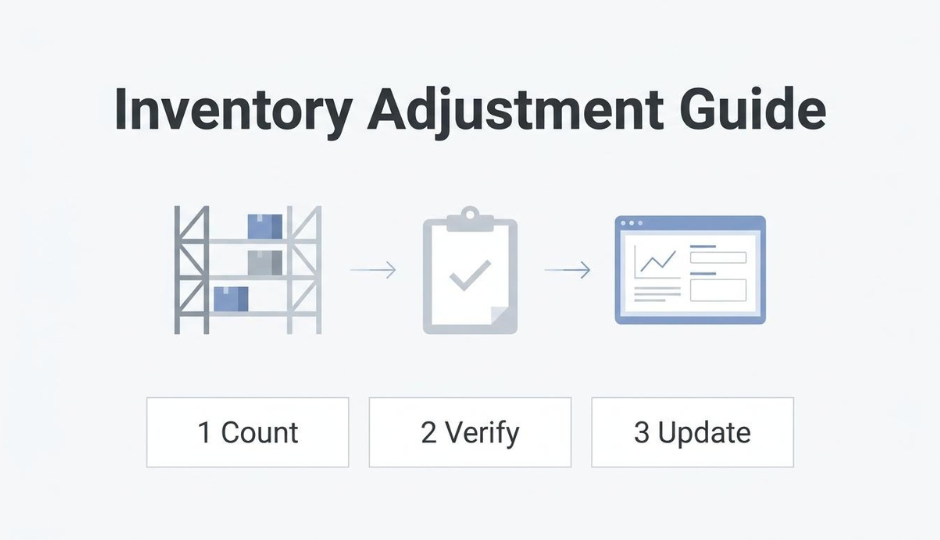
An inventory adjustment is an accounting correction that aligns recorded inventory balances with actual quantities or updated valuation information. Businesses make these corrections when physical stock no longer matches system records due to theft, damage, receiving errors, or obsolescence.
This guide covers the foundations of inventory adjustments, their common causes and types, the step-by-step process for executing them correctly, the tools and frequency required, best practices and mistakes to avoid, their financial reporting impact, and how unified commerce systems simplify cross-channel accuracy.
Inventory adjustments exist because ecommerce and retail operations generate constant discrepancies between what systems show and what shelves hold. 65% of inventory records in a retail dataset were found inaccurate according to a Harvard Business School empirical analysis, and multi-channel selling can amplify that drift with every additional storefront, warehouse, or fulfillment node.
The reasons behind adjustments range from damaged goods and shrinkage to supplier short-ships, returns, cycle count mismatches, and expired stock. Each cause maps to a specific adjustment type: quantity corrections, value write-downs, or status reclassifications that change an item's sellability without altering its count.
Executing an adjustment follows a six-step sequence: identifying the discrepancy, verifying the physical count, documenting the reason, updating system records, obtaining authorization, and reconciling with accounting. Barcode scanning, standardized reason codes, and tiered approval workflows keep each step accurate and auditable.
Adjustments directly change balance sheet asset values and income statement COGS figures, making documentation and reconciliation compliance necessities rather than optional habits. For brands selling across both online and physical channels, a unified system that propagates corrections instantly across every storefront eliminates the reconciliation gaps that separate tools create.
An inventory adjustment is an accounting correction used to align recorded inventory balances with actual quantities or updated valuation information. Businesses make these corrections when physical stock no longer matches what the system shows, whether due to theft, damage, receiving errors, or obsolescence. These modifications can increase or decrease stock counts, and they directly change how inventory appears on financial statements. For scaling ecommerce brands managing thousands of SKUs, even small recording gaps compound quickly, making routine adjustments a non-negotiable part of accurate operations.
Inventory adjustments are necessary for ecommerce because online selling often introduces discrepancies between recorded stock and actual quantities. Without regular corrections, these gaps compound into overselling, fulfillment failures, and financial misstatements. The subsections below cover the scale of inaccuracy, its financial consequences, and the ecommerce-specific dynamics that make adjustments unavoidable.
According to a Harvard Business School analysis on a retail dataset, 65% of retailers' inventory records were inaccurate, a problem often called "phantom inventory" that causes stockouts and lost sales across digital storefronts. In ecommerce, where customers expect real-time availability, even small record errors trigger oversells, backorders, and cancellations that erode trust. Multi-channel selling amplifies this risk; every additional sales channel, warehouse, or fulfillment node creates another point where quantities can drift from reality. Returns processing, shipping damages, and receiving errors compound daily, making the gap between system counts and shelf counts wider over time. Regular inventory adjustments close these gaps before they cascade into customer-facing problems or accounting errors.
The financial stakes are significant. EY reported that retail shrinkage resulted in profit losses exceeding $100 billion in 2022, with unrecognized inventory losses distorting both balance sheets and income statements. For ecommerce operators specifically, inaccurate records can mean incorrect cost of goods sold calculations and unreliable demand forecasting. Each unresolved discrepancy quietly chips away at margin accuracy and cash flow visibility.
Ecommerce also moves faster than traditional retail. Orders process around the clock, promotional spikes shift inventory rapidly, and fulfillment networks split stock across locations. This velocity means discrepancies emerge faster and stay hidden longer without systematic adjustments. For scaling brands managing thousands of SKUs across multiple channels, treating inventory adjustments as optional rather than operational infrastructure is a costly oversight in ecommerce operations.
The common reasons for inventory adjustments include damaged goods, shrinkage, receiving errors, customer returns, cycle count corrections, and expired stock. Each cause creates a gap between recorded and actual inventory that requires correction.
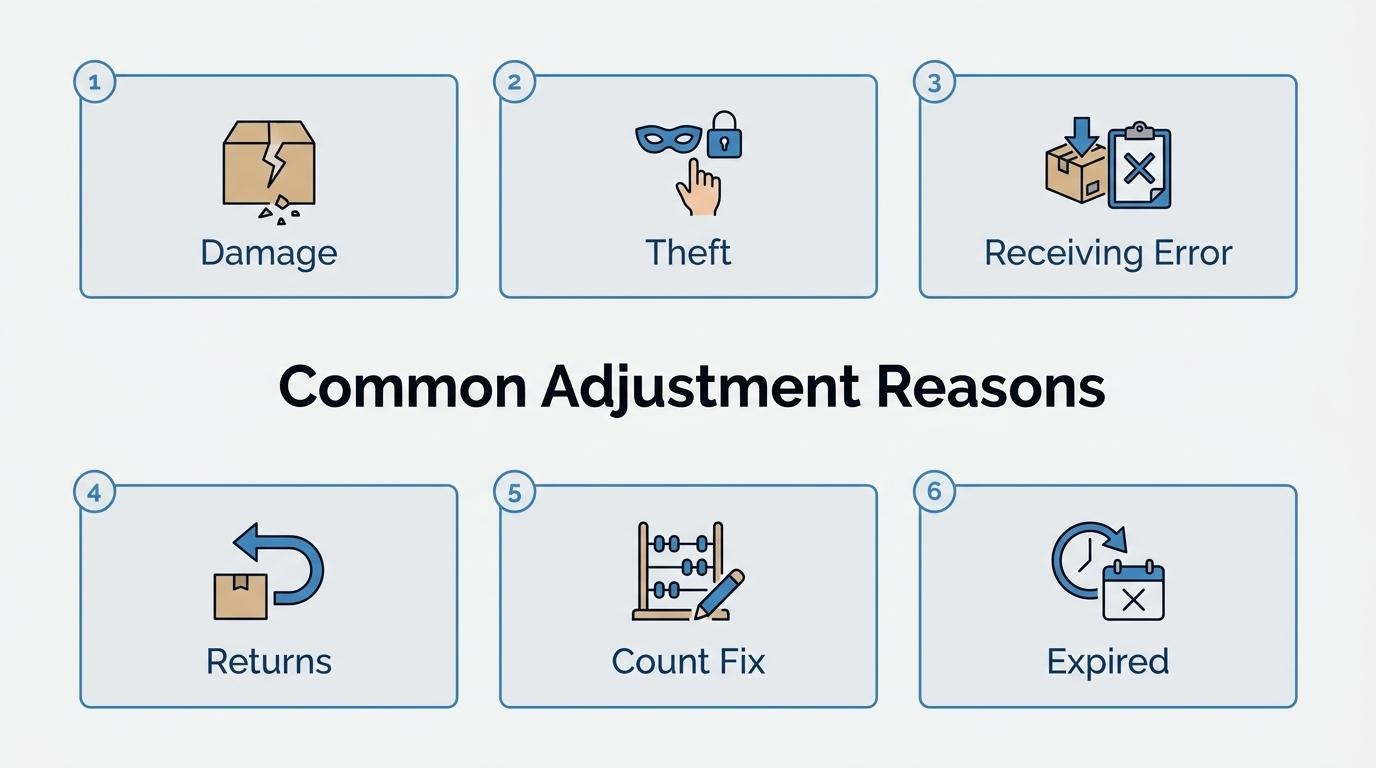
Damaged or defective goods are products that become unsellable due to breakage, manufacturing flaws, or mishandling during storage and transit. When items sustain damage, their recorded quantity or value no longer reflects reality. Warehouse teams typically identify these during receiving inspections, picking, or routine shelf checks. Each instance requires a downward quantity adjustment or a value write-down to remove the unusable units from available stock. Failing to adjust for damaged goods inflates sellable inventory counts, which leads to overselling, fulfillment delays, and inaccurate cost of goods sold on financial statements.
Shrinkage and theft represent inventory losses that occur without a corresponding sales transaction. Common forms include employee theft, shoplifting, administrative errors, and vendor fraud. According to a 2024 report from the National Retail Federation, retailers reported a 93% increase in the average number of shoplifting incidents per year in 2023 versus 2019, alongside a 90% increase in dollar loss over the same period. These losses only surface when physical counts reveal fewer units than records show. Because shrinkage erodes margins silently, regular adjustments are essential to keep financial reporting accurate and prevent compounding discrepancies over time.
Receiving errors and supplier discrepancies occur when the quantity or condition of goods delivered does not match the purchase order. A supplier might ship 480 units instead of 500, include the wrong SKU, or deliver items that fail quality inspection. If the receiving team logs the purchase order quantity rather than the actual count, the inventory system immediately carries a phantom surplus. Catching these gaps at the dock through careful verification against packing slips prevents downstream problems. When discrepancies slip through, adjustments reconcile recorded stock to the true amount on hand.
Returns and exchanges trigger inventory adjustments because merchandise re-enters the supply chain in varying conditions. A returned item may be restockable, requiring an upward quantity adjustment. Alternatively, it may arrive damaged or opened, necessitating a write-down or disposal adjustment instead. Exchanges compound the complexity: one SKU decreases while another increases simultaneously. Without timely adjustments for each return outcome, available-to-sell counts drift from reality. For brands selling across multiple channels, this drift compounds quickly, making consistent return-processing workflows critical to inventory accuracy.
Cycle count corrections are adjustments made after systematic partial counts reveal discrepancies between recorded and physical inventory. Rather than shutting down operations for a full physical count, cycle counting audits small subsets of SKUs on a rolling schedule. Cycle counting requires a smaller amount of continuing effort throughout the year, which can be easier to manage than a single massive count at year-end. When a count uncovers a mismatch, the adjustment reconciles the system record to the verified physical quantity. This ongoing approach catches errors closer to when they occur, reducing the risk of compounding inaccuracies.
Expired or obsolete stock consists of inventory items that can no longer be sold due to passed shelf-life dates, regulatory restrictions, or market irrelevance. Perishable goods in food and beauty categories carry hard expiration dates, while fashion and electronics become obsolete as seasons or product generations change. These items must be adjusted out of sellable inventory through quantity reductions or value write-downs. Holding expired or obsolete stock without adjustment overstates asset values on the balance sheet and distorts profitability metrics. Proactive monitoring of aging inventory helps brands identify at-risk SKUs before write-offs become unavoidable.
Understanding these common triggers prepares you for selecting the right adjustment type for each situation.
The different types of inventory adjustments fall into three categories: quantity adjustments, value adjustments, and status adjustments. Each type corrects a distinct dimension of your inventory records.

Quantity adjustments correct the recorded unit count of an item to match actual physical stock. These are the most common type of inventory adjustment, triggered when a count reveals more or fewer units than the system shows.
Common causes include:
Even small unit-count errors compound quickly across hundreds of SKUs, making regular quantity reconciliation one of the highest-impact accuracy habits a brand can build.
Value adjustments modify the recorded monetary worth of inventory without changing unit counts. These corrections align book value with current market conditions or actual cost.
There are several triggers for value adjustments, such as:
Under U.S. GAAP, inventory is measured at the lower of cost or market, and any write-down is recognized as a permanent reduction in carrying value with no subsequent reversal permitted. Under IFRS (IAS 2), inventory is measured at the lower of cost and net realizable value, and prior write-downs may be reversed if conditions improve, up to the original cost.
Understanding which accounting framework applies determines how value adjustments flow through financial statements. For scaling ecommerce brands carrying seasonal or trend-sensitive inventory, timely value adjustments prevent overstated assets from distorting margin analysis.
Status adjustments reclassify inventory between categories without altering quantity or value. These changes update an item's availability, condition, or sellability designation within the system.
Common status reclassifications include:
Status adjustments are often overlooked, yet they directly affect what customers see as available to purchase. A product sitting in "quarantine" that the system still lists as sellable creates oversell risk and fulfillment failures. Maintaining accurate status designations across channels becomes especially critical for brands operating both online and in-store, where unified inventory visibility prevents conflicting availability promises.
You perform an inventory adjustment step by step by identifying the discrepancy, verifying the physical count, documenting the reason, updating your system, obtaining approval, and reconciling with accounting.

You identify the discrepancy by comparing your system's recorded inventory quantities against actual stock levels. This comparison typically surfaces during cycle counts, receiving checks, or when fulfillment teams flag unexpected shortages. Common triggers include:
Each flagged mismatch becomes the starting point for a formal adjustment. Catching discrepancies early prevents them from compounding into larger financial and operational problems downstream.
You verify the physical count by conducting an independent recount of the affected SKUs. A second team member or supervisor should perform this recount to eliminate human error from the first tally. Key verification steps include:
Verification matters because the adjustment you enter will directly change financial records. A careless recount creates a new error instead of fixing the original one; double-checking protects both accuracy and accountability.
You document the reason for the adjustment by recording a specific cause code and a written explanation for every quantity or value change. Standard reason categories include damage, theft, supplier short-ship, expiration, and administrative error. Each entry should capture:
The Sarbanes-Oxley Act requires companies to maintain and evaluate internal controls over financial reporting, including appropriate documentation and evidence to support those controls and their effectiveness. In practice, this includes maintaining audit trails for key processes such as inventory adjustments. While documentation is required for compliance, it also provides operational visibility that can help identify recurring discrepancies or loss patterns over time.
You update inventory records in your system by entering the verified adjustment directly into your inventory management or ERP platform. The update should reflect the corrected quantity, the reason code, and the employee who submitted the change. Best practices for this step include:
For brands selling across multiple storefronts, synchronized updates prevent the same phantom inventory problem from reappearing on a different channel minutes later.
You get proper authorization and approval by routing each adjustment through a defined approval hierarchy before it posts to the general ledger. Approval workflows typically operate on a tiered structure:
Segregation of duties is critical here. The person who counts the inventory should not be the same person who approves the adjustment. This separation reduces fraud risk and strengthens internal controls, particularly for businesses subject to external audits.
You reconcile adjusted records with accounting by matching every posted inventory adjustment to its corresponding journal entry in the general ledger. Quantity increases typically debit the inventory asset account, while decreases credit it and hit cost of goods sold or a shrinkage expense account. Reconciliation steps include:
Regular reconciliation ensures that balance sheet inventory values remain accurate, which directly supports reliable financial reporting and forecasting.
The tools you need to perform inventory adjustments include inventory management software, barcode scanners, spreadsheets or ERP systems, and standardized adjustment forms. Each tool serves a distinct role, from capturing physical counts to maintaining auditable records. Essential inventory correction tools fall into several categories:
For scaling ecommerce brands managing inventory across multiple channels, the most practical investment is a platform where adjustment workflows, stock tracking, and accounting sync operate within the same system. Separate tools for each function can create reconciliation gaps that compound over time, especially when online and offline stock must stay aligned. Understanding how often to apply these tools matters just as much as choosing the right ones.
You should perform inventory adjustments as often as your sales volume, channel complexity, and shrinkage patterns demand. The right frequency depends on whether you operate a single storefront or sell across multiple channels simultaneously.
For most ecommerce and retail operations, adjustments fall into three frequency tiers:
Multi-channel sellers need more frequent adjustments than single-channel operations. A 2015 study published in Springer Link highlights that effective multi-channel retailing requires coordination between warehouse operations and inventory management, with integrated design choices improving operational efficiency across channels. When stock feeds into a website, marketplace listings, and a physical location simultaneously, even a small lag between channels creates overselling risk or phantom inventory.
The real driver is not a fixed calendar schedule; it is the rate at which your actual stock diverges from your recorded stock. Businesses experiencing frequent returns, supplier discrepancies, or theft-related losses should shorten their adjustment cycles. Operations with stable, predictable inventory flows may have different intervals without significant accuracy loss. Matching adjustment frequency to operational reality prevents both the cost of constant corrections and the larger cost of letting errors accumulate undetected.
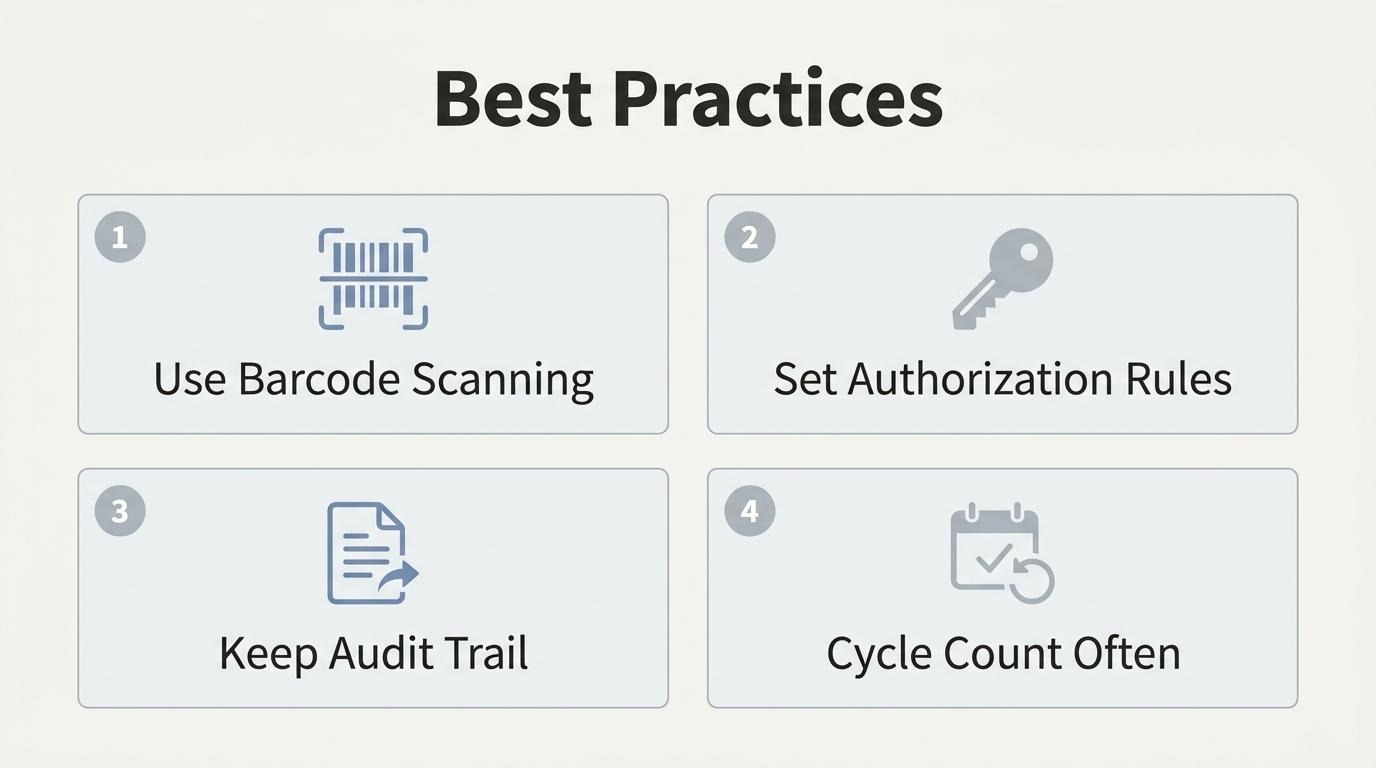
Best practices for accurate inventory adjustments center on standardized processes, reliable counting methods, and system-level controls that prevent errors before they compound. The following subsections cover the core practices that keep adjustment data clean and trustworthy.
Outdated inventory accounting methods remain a persistent problem across retail. According to a 2024 Retail Dive report, legacy approaches like the retail inventory method (RIM) are still used by some major chains, quietly driving inaccurate stock data, flawed forecasts, and persistent supply chain inefficiencies. Modern practices address these risks through methods such as cost accounting, as well as tighter documentation, better technology, and consistent verification routines.
For operators managing inventory across multiple sales channels, these practices become even more critical; the next section explores how adjustments differ between online and in-store environments.
Inventory adjustments differ for online versus in-store operations in their triggers, timing, and data flow. Online channels face virtual discrepancies from overselling and sync delays, while physical stores contend with hands-on issues like shelf shrinkage and miscounted receiving. The subsections below cover the specific challenges unique to each channel and the synchronization demands of omnichannel selling.
Online sellers face inventory adjustment challenges driven by real-time sync failures across multiple sales channels. A product listed on three marketplaces can sell simultaneously, creating phantom stock that requires immediate quantity corrections. Returns processing adds another layer; items re-entering the warehouse may need status adjustments before they are sellable again.
Up to 65% of retailers' inventory records were inaccurate in a Harvard Business School study of a retail dataset, a problem amplified when digital storefronts pull from the same pool without centralized updates. Overselling, canceled orders, and fulfillment errors generate adjustment volume that physical stores rarely encounter at the same velocity.
Brick-and-mortar stores face inventory adjustment challenges rooted in physical handling and in-person transactions. Shrinkage from shoplifting, employee theft, and administrative errors accounts for the majority of discrepancies. Damaged goods discovered on shelves, miscounted shipments at the receiving dock, and items moved between display areas without system updates all create gaps between recorded and actual stock.
The National Retail Federation reported in 2024 that retailers saw a 93% increase in average shoplifting incidents per year in 2023 compared to 2019. These tangible, ongoing losses require frequent cycle counts and manual verification that digital-only operations largely avoid.
Omnichannel selling complicates inventory adjustments because a single SKU must stay accurate across online storefronts, physical locations, and hybrid fulfillment models like ship-from-store. An adjustment made at one node, such as writing down damaged units in a retail location, must propagate instantly to every connected channel. Without that synchronization, customers see available stock that no longer exists, leading to overselling and fulfillment failures.
Without synchronized inventory, retailers face significant challenges in ship-from-store fulfillment, underscoring the need for cross-channel transaction integrity. For scaling brands juggling both digital and physical sales, this complexity makes consolidated systems far more practical than reconciling separate tools after the fact.
The mistakes you should avoid during inventory adjustments include skipping documentation, relying solely on manual data entry, making changes without authorization, and failing to reconcile adjusted records with your accounting system, though in modern systems reconciliation is often built into the workflow and happens automatically, while still being reviewed periodically. Each of these errors compounds over time, creating inaccurate stock data and financial reporting gaps.
Skipping documentation during inventory adjustments creates compliance risk and makes discrepancies nearly impossible to trace. Every adjustment needs a recorded reason code, a timestamp, and the name of the person who initiated the change. The Sarbanes-Oxley Act requires sufficient documentation to demonstrate that inventory controls are designed appropriately and operating effectively, often including audit trails for adjustments. Without this paper trail, even a routine correction can trigger audit flags or obscure the root cause of recurring inventory losses.
Relying on manual data entry introduces preventable errors into inventory records. Industry heuristics typically indicate that manual data entry errors occur at roughly 1 in 300 keystrokes, while barcode scanning errors are typically in the range of 1 in several million scans, representing a 1,000–10,000× improvement in accuracy. When adjustment quantities are typed by hand, transposed digits or miskeyed SKUs quietly distort stock levels. Automating entry at the point of adjustment eliminates this risk at its source.
Making adjustments without proper authorization undermines inventory control integrity. Unauthorized changes allow errors, theft, or fraud to go undetected because no one reviews the logic behind the correction. Effective adjustment workflows require a defined approval chain where a second person, typically a supervisor or inventory manager, reviews and signs off before any record changes. This separation of duties is a core internal control that prevents a single individual from both identifying and resolving discrepancies unchecked.
While modern systems often reconcile inventory adjustments automatically, older or less integrated systems can allow inventory records and financial statements to drift out of sync if those adjustments aren’t consistently reconciled. Every quantity or value adjustment changes asset totals on the balance sheet and cost of goods sold on the income statement. When these changes are not synced to the general ledger promptly, financial reports misstate profitability and inventory value. Scheduling reconciliation immediately after each adjustment batch, rather than waiting for month-end, keeps both systems aligned and prevents costly restatements during audits.
Understanding common mistakes is essential, but the financial consequences of those errors deserve closer attention.
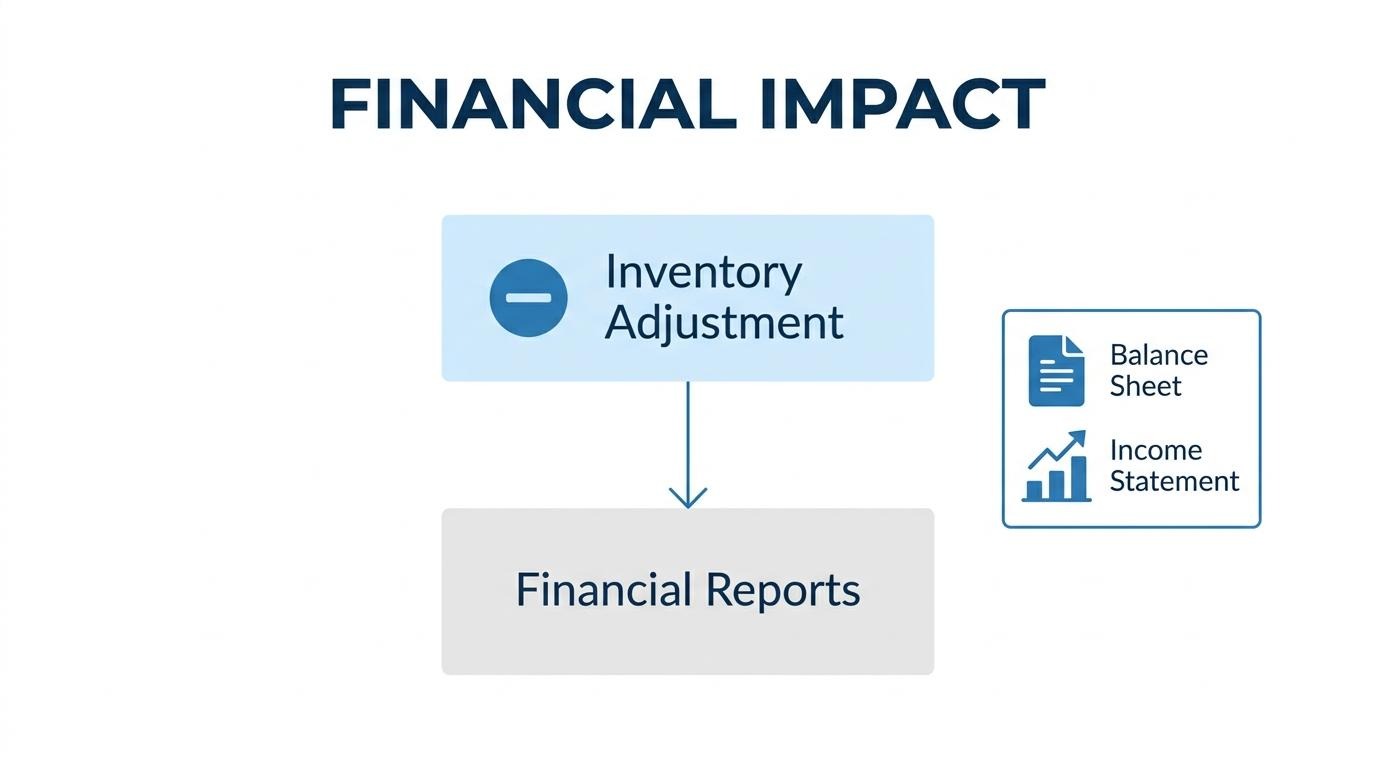
Inventory adjustments affect financial reporting by changing asset values on the balance sheet and altering cost of goods sold on the income statement. These changes flow through to net income and retained earnings.
Because inventory adjustments directly impact the balance sheet (asset value) and income statement (COGS/expenses), they therefore also affect net income and retained earnings. When a business writes down damaged stock or corrects a quantity error, the recorded inventory asset decreases. That reduction simultaneously increases COGS or appears as a separate expense, which lowers reported profit for the period.
For ecommerce brands running at scale, even small, frequent adjustments compound across reporting periods. Delayed or inaccurate adjustments distort gross margins, mislead forecasting models, and can trigger compliance issues during audits. Timely, well-documented adjustments keep financial statements reliable and audit-ready, which is especially critical for brands preparing for investor scrutiny or regulatory review.
Understanding these reporting implications sets the stage for how unified inventory systems simplify the adjustment process across channels.
Managing inventory adjustments changes fundamentally when online and offline data live in one system: adjustments propagate instantly across every channel, eliminating reconciliation delays and reducing compliance gaps. Below, we cover how SHOPLINE handles cross-channel adjustments natively and the key takeaways for performing inventory adjustments effectively.
SHOPLINE handles inventory adjustments across channels without manual syncing by maintaining a shared inventory record that updates all connected sales channels simultaneously. Inventory adjustments, which are increases or decreases made to account for theft, loss, breakages, and receiving errors, reflect everywhere the moment they are entered.
This unified approach solves a real operational problem. Retailers without synchronized inventory face more challenges, especially in ship-from-store fulfillment models, undermining transaction integrity across channels. When adjustments from a physical count or a write-down update in one universal location instead of requiring manual exports between disconnected tools, the risk of phantom inventory shrinks considerably.
For brands running both online storefronts and POS locations, consolidating adjustment workflows into one system is one of the most practical steps toward accurate, audit-ready inventory data.
The key takeaways about performing an inventory adjustment are:
Accurate inventory adjustments are less about any single correction and more about building a repeatable, documented process that scales with operational complexity.
.png)
.png)
.png)

