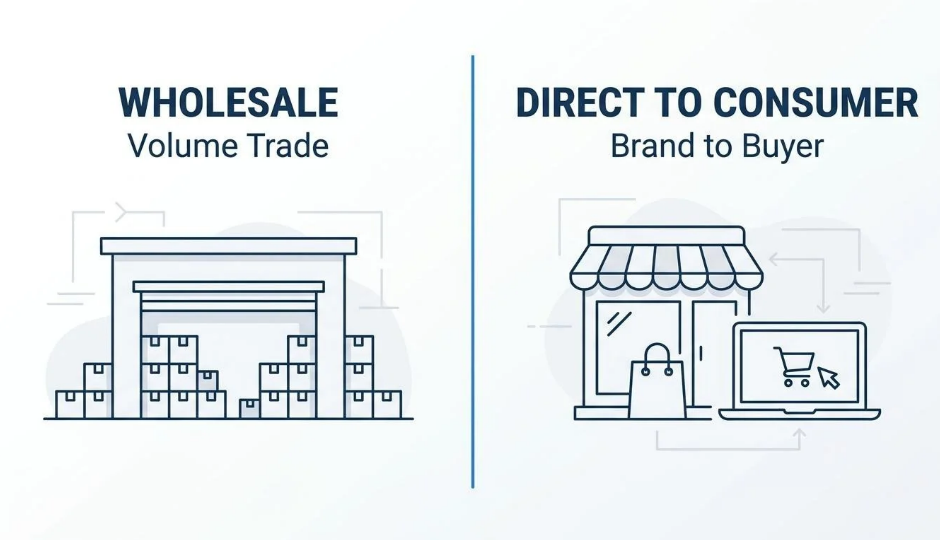
Wholesale is the bulk sale of goods to retailers or business buyers at discounted per-unit pricing, while direct-to-consumer (DTC) is the sale of products straight from the brand to the end customer through owned channels. Each model structures margin, customer ownership, and operations differently.
This guide covers how each business model works, the core differences between wholesale and DTC across margins and data and brand control, the advantages and disadvantages of each approach, hybrid distribution strategies that combine both channels, category-specific recommendations, and how to choose the right model based on your brand's revenue stage.
Wholesale operates through layered pricing where manufacturers, wholesalers, and retailers each add a markup before products reach consumers. Keystone pricing sets retail at two times wholesale cost, giving retailers a 50 percent gross margin. Minimum order requirements, bulk logistics, and net-30 to net-90 payment terms define the operational rhythm.
DTC brands bypass those intermediaries entirely, capturing the full spread between production cost and consumer price. They acquire customers through owned storefronts, paid media, and content marketing while collecting first-party data on every transaction. The trade-off is direct responsibility for fulfillment, customer service, and acquisition spend.
Profit margins, customer data access, cash flow timing, and scalability diverge sharply between the two models. Wholesale scales through distribution breadth and predictable bulk orders; DTC scales through owned infrastructure and retention economics. Most brands past the early growth stage find that running both channels outperforms either one alone.
Managing a hybrid strategy without tool sprawl requires unified inventory, pricing, and customer data across channels. SHOPLINE keeps wholesale and DTC operations on a single shared backend, preventing the sync errors and fragmented customer records that compound as order volume grows.
Wholesale in ecommerce is the sale of goods in bulk to retailers, business buyers, or other wholesalers through digital channels rather than directly to individual consumers. The model centers on high-volume orders, discounted per-unit pricing, and business-to-business relationships conducted on B2B ecommerce platforms or dedicated wholesale portals.
According to the International Trade Administration of the U.S. Department of Commerce, B2B ecommerce transactions are made between businesses, where a supplier sells in bulk, while B2C is where a business sells its product directly to a customer, either directly from a company website or an online marketplace. This distinction is the foundation of every wholesale versus direct-to-consumer comparison. Wholesale ecommerce preserves the traditional bulk-buying dynamic; it simply moves the order process, catalog management, and payment flow online. Buyers browse digital catalogs, place large orders against tiered price lists, and receive shipments sized for resale rather than personal use.
What separates wholesale ecommerce from a standard B2C storefront is the buyer relationship. Wholesale customers are businesses purchasing inventory they intend to resell, repackage, or use operationally. Pricing reflects that intent: per-unit costs drop as order volume rises, and payment terms often extend to net-30 or net-60 rather than requiring immediate checkout payment. For brands evaluating how to distribute products at scale, understanding this model is the starting point before comparing it against selling directly to end consumers.
Direct-to-consumer (DTC) in ecommerce means a brand sells its products directly to the end customer, bypassing wholesalers, distributors, and retail partners entirely. According to a 2021 study published in Fashion and Textiles (Springer Nature via PubMed Central), DTC brands are defined as ecommerce brands that sell directly to consumers without retailer "middlemen" like department stores, typically beginning as purely online businesses that fully leverage digital channels for marketing and selling. The brand owns the entire transaction: the storefront, checkout, customer relationship, and post-purchase experience. This model gives merchants complete control over pricing, messaging, and first-party data collection, though it also shifts every operational responsibility onto the brand itself.
The wholesale business model works by manufacturers selling products in bulk to intermediary buyers, who then resell those goods to end consumers or other businesses. Key mechanics include supply chain roles, pricing layers, and order minimums.
The key players in a wholesale supply chain are manufacturers, distributors, wholesalers, and retailers. Manufacturers produce goods and sell them in large quantities to wholesalers or distributors. Distributors act as regional intermediaries, breaking bulk shipments into smaller lots for retailers. Retailers then resell those products to individual consumers.
Each player adds a margin and a logistics layer. In a dual-channel supply chain, a manufacturer may also sell directly to consumers, which means the same producer can function as both supplier and competitor to its retail partners. According to a study published in The International Journal of Logistics Management, information integration and organization integration in logistics management significantly affect supply chain integration, with integrated supply chains influencing financial performance more than operational performance for omnichannel retailers.
Coordination between these players determines whether products reach shelves on time and at the right cost.
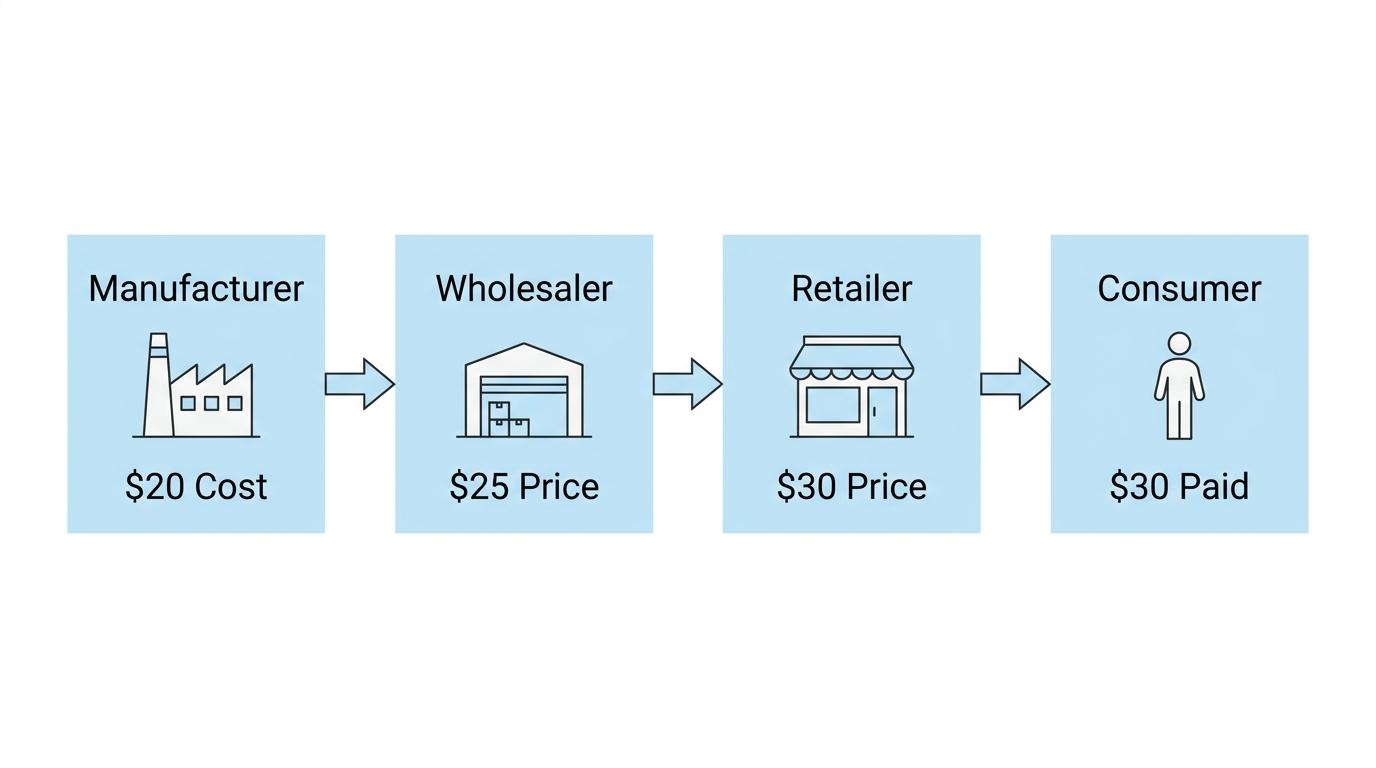
A typical wholesale pricing structure follows a tiered markup model where each intermediary adds a margin before the product reaches the consumer. The traditional retail baseline is called keystone pricing: the retail price equals two times the wholesale price, giving the retailer a 50 percent gross margin, according to Oregon State University's New Product Development Program.
Here is how the markup layers typically stack:
This layered structure contrasts sharply with DTC brands, which bypass retailer middlemen and capture the full spread between production cost and consumer price. For brands evaluating wholesale, understanding each margin layer is essential to setting a viable price point.
Minimum order requirements in wholesale are quantity thresholds that buyers must meet before a wholesaler will process a purchase. These minimums exist because wholesale trade, as defined by the United Nations Statistics Division, involves resale to retailers, institutional buyers, or other wholesalers, not individual consumers. Handling small, one-off orders erodes the cost efficiencies that make bulk distribution viable.
Minimums vary widely by product category and supplier. According to a U.S. Department of Agriculture study, one wholesaler enforced a policy requiring no fewer than five cases of canned goods per order, with exceptions granted only in rare special situations. Common minimum order formats include:
For growing brands, negotiating favorable minimums early protects cash flow while securing access to broader retail distribution.
The direct-to-consumer business model works by letting manufacturers sell products directly to end buyers through owned channels, removing wholesalers and retailers from the transaction. Below, we cover how DTC brands acquire customers, structure pricing, and manage fulfillment.
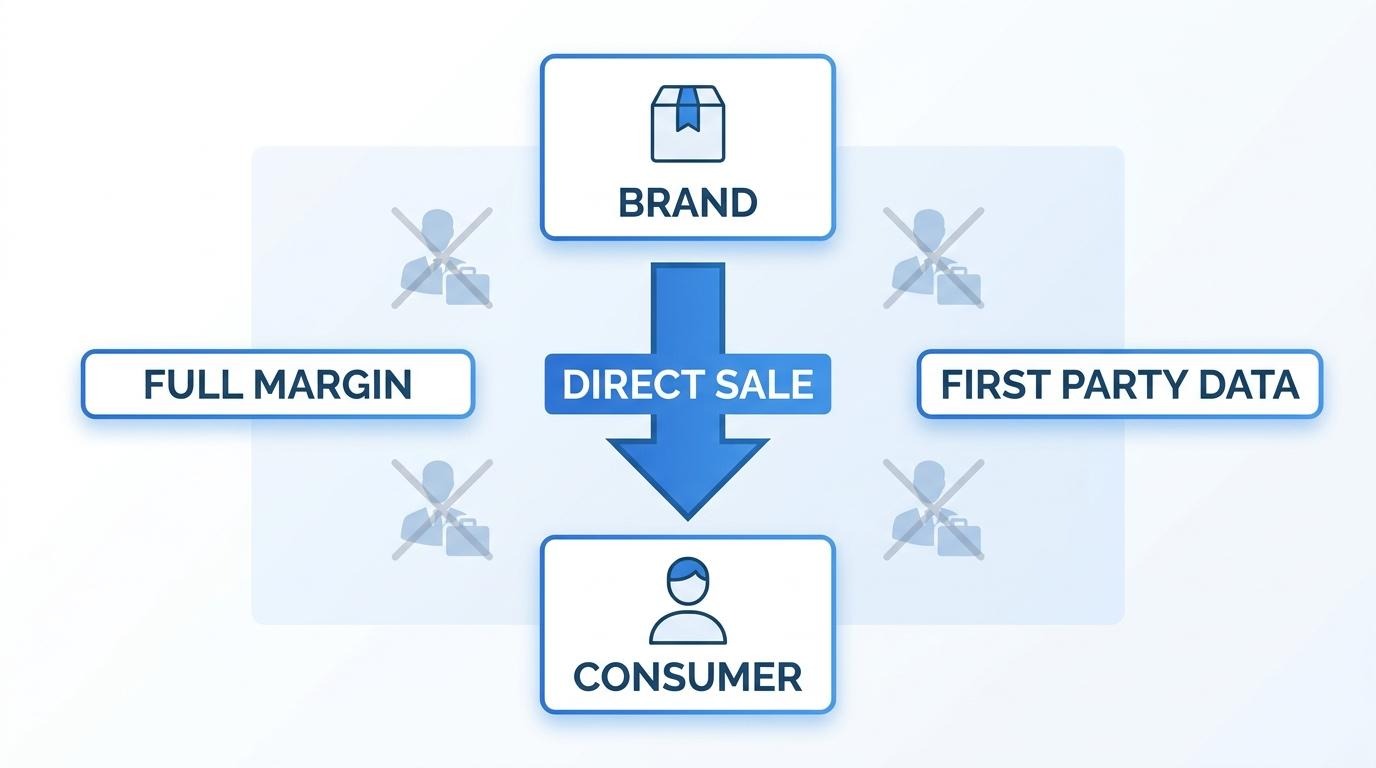
DTC brands reach customers without retailers by using internet channels to sell and communicate directly with buyers. According to research published in Communications of the ACM, internet channels enable manufacturers to bypass traditional intermediaries such as distributors, resellers, dealers, and retailers while also gathering richer customer information, reducing advertising costs, and providing competitive pricing.
The primary acquisition channels include:
Because no retail partner controls the shelf or the customer relationship, DTC brands own every touchpoint from discovery through post-purchase. This direct line to the consumer is what makes first-party data collection possible at a depth wholesale sellers rarely achieve.
A typical DTC pricing structure eliminates wholesale and retail markups, allowing the brand to capture the full spread between production cost and consumer price. In a traditional wholesale chain, a manufacturer sells at cost-plus to a wholesaler, the wholesaler marks up for the retailer, and the retailer applies another margin before the product reaches the consumer.
DTC brands collapse that chain. Instead of splitting margin across two or three intermediaries, the brand sets one consumer-facing price and retains the difference after covering production, marketing, and fulfillment. The trade-off is straightforward: higher per-unit margin comes with the responsibility of funding customer acquisition and logistics internally. For brands with strong digital marketing capabilities, this structure often yields better unit economics than sharing margin through wholesale layers.
DTC brands handle fulfillment and shipping by managing the entire order lifecycle internally or through third-party logistics (3PL) providers. The three most common approaches are:
Under FTC rules, sellers must ship items within the timeframe promised in advertising, or within 30 days if no delivery window is stated. Meeting these requirements at scale is one of the most operationally demanding aspects of DTC. As order volume grows, brands running multiple fulfillment channels often find that unifying inventory, order, and customer data inside a single system reduces the manual coordination that slows execution.
With fulfillment mechanics in place, the key differences between wholesale and DTC become clearer.
The main differences between wholesale and DTC span profit margins, customer ownership, brand control, cash flow timing, data access, and scalability. Each factor shapes how a brand grows and operates.
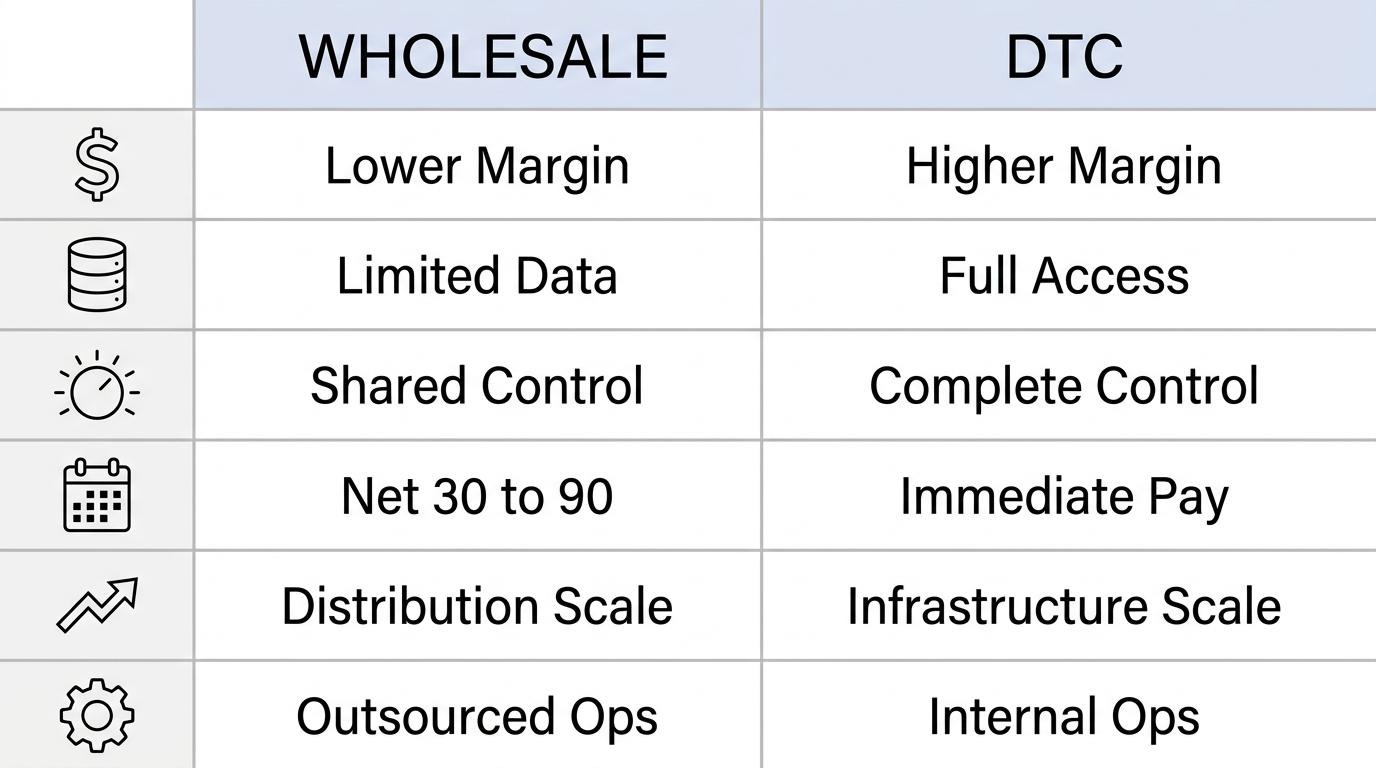
Profit margins in wholesale vs. DTC differ significantly because each model distributes value across a different number of intermediaries. Wholesalers typically receive a margin of four to six percent, while retailer margins range from 15 to 40 percent, according to the U.S. Department of Agriculture's Foreign Agricultural Service. The total distribution network cost represents 10 to 20 percent of the final retail price.
DTC brands bypass those layers entirely, capturing the full spread between production cost and retail price. Although higher per-unit margins look attractive, DTC sellers absorb expenses that wholesale partners would otherwise handle, including fulfillment, customer acquisition, and returns. The margin advantage is real, but only after accounting for the operational costs that come with owning every step of the sale.
Customer ownership in wholesale vs. DTC differs in one fundamental way: wholesale brands sell to retailers, while DTC brands sell directly to the end consumer. As the University of Kansas Open Textbook Network notes, the direct channel provides close contact with the customer and full control of all aspects related to marketing a company's products.
In wholesale, the retailer owns the customer relationship. The brand rarely accesses buyer names, purchase history, or contact details. DTC reverses this completely; every transaction generates first-party data the brand controls. For brands building long-term retention and lifecycle marketing, that ownership distinction is the single most consequential difference between the two models.
Brand control changes in wholesale vs. DTC because wholesale delegates presentation, pricing, and customer experience to retail partners, while DTC keeps all three in-house. A wholesale brand cannot dictate how a retailer photographs products, trains floor staff, or runs promotions alongside competing labels.
NIKE's fiscal 2024 results illustrate this tension at scale: NIKE Direct revenues reached $21.5 billion, while wholesale revenues hit $27.8 billion, according to NIKE, Inc. investor reporting. Even at that level, the company continues investing in owned stores and digital channels precisely because DTC gives it full control over storytelling, pricing consistency, and the in-store experience that wholesale partners cannot guarantee.
Cash flow timing in wholesale vs. DTC differs because each model collects payment on a fundamentally different schedule. Wholesale buyers typically pay on net-30, net-60, or net-90 terms, meaning a brand ships inventory weeks or months before receiving payment. Large orders improve predictability, but extended payment windows can strain working capital, especially for brands funding raw materials and production upfront.
DTC transactions settle immediately or within a few business days through payment processors. This faster cash conversion cycle gives brands more flexibility to reinvest in inventory, marketing, or product development without waiting on retailer payment schedules. For growing brands managing tight cash positions, that timing gap often matters more than the margin difference.
Data and customer insights differ in each model because wholesale creates a data gap between the brand and the buyer, while DTC generates first-party data on every interaction. In wholesale, the retailer captures transaction data, browsing behavior, email addresses, and purchase frequency. The brand receives aggregate sell-through reports at best.
DTC brands collect granular data at every touchpoint: site behavior, cart activity, email engagement, purchase cadence, and support interactions. This data feeds segmentation, personalization, and lifecycle automation. Brands operating both channels often find that their DTC data informs smarter wholesale decisions, from assortment planning to regional demand forecasting.
Scalability in wholesale vs. DTC follows different growth curves with different constraints. Wholesale scales through distribution breadth: each new retail partner opens access to an established customer base, physical shelf space, and local foot traffic without requiring the brand to build that infrastructure. A single purchase order from a major retailer can move more units than months of DTC advertising.
DTC scales through owned infrastructure: website performance, fulfillment capacity, customer acquisition efficiency, and retention systems. Growth requires proportional investment in logistics, support, and marketing. The operational ceiling is higher because the brand controls every variable, but so is the operational burden. Most brands scaling past $1M in revenue find that combining both channels balances reach against control.
With these core differences mapped, the next step is evaluating when each model's advantages matter most.
The advantages of selling wholesale include higher order volumes, faster revenue scaling, reduced per-unit marketing costs, and access to established retail distribution networks. Below, each benefit is explored in detail.
According to Iowa State University Extension, a product priced at $20 per unit at wholesale may reach consumers at $30 after wholesaler and retailer markups of $5 each. While the brand earns less per unit than it would selling direct, the volume and velocity of wholesale orders often compensate for the thinner margin.
For brands already managing complexity across multiple sales channels, wholesale's operational simplicity is often underestimated. The model lets teams focus on product development and production rather than splitting attention across individual consumer support, last-mile logistics, and per-order marketing. That operational focus compounds over time, especially past the $1M revenue mark.
With these wholesale strengths in mind, the trade-offs deserve equal attention.
The disadvantages of selling wholesale include lower per-unit margins, limited customer data access, reduced brand control, and dependency on retailer relationships. Each drawback affects profitability, marketing, and long-term brand equity differently.
Wholesale selling produces lower per-unit profit margins than direct-to-consumer sales. According to a U.S. Department of Agriculture Foreign Agricultural Service report, wholesalers receive a margin of only four to six percent, while retailers capture 15 to 40 percent on the same product. Because wholesale pricing must leave room for retailer markups, brands sacrifice significant revenue on every unit sold. For brands with high production costs, this compression can make scaling through wholesale alone financially unsustainable without massive volume.
Selling wholesale limits access to customer data because retailers, not brands, own the end-consumer relationship. Purchase behavior, email addresses, and demographic information stay with the retail partner. Without first-party data, brands cannot build lifecycle marketing campaigns, personalize product recommendations, or accurately measure customer lifetime value. This blind spot becomes increasingly costly as a brand scales, since retention strategies depend on direct customer insights that wholesale channels rarely share.
Wholesale selling reduces brand presentation control by placing merchandising, pricing, and in-store experience decisions in the retailer's hands. A retailer may discount products during promotions, display them alongside competing brands, or position them in low-traffic areas. According to the Federal Trade Commission, while manufacturers have some leeway in setting advertising terms, enforcement of brand standards across dozens of retail partners remains difficult. Consistent brand storytelling is nearly impossible when each retailer interprets the brand differently.
Wholesale creates dependency on retailer relationships for revenue stability. A single large retailer canceling orders or reducing shelf space can cause immediate cash flow disruption. Retailers also dictate payment terms, often stretching to net-60 or net-90, which strains working capital. This power imbalance means wholesale brands must continuously invest in account management and trade promotions just to maintain existing placements, rather than directing those resources toward growth.
Wholesale selling carries the risk of channel conflict when brands also operate direct-to-consumer channels. As a 2025 article in the California Management Review notes, channel conflict occurs when the same brand sells at different prices across distribution channels, or when a manufacturer's DTC channel competes directly with existing retail partners. Managing pricing parity, product exclusivity windows, and promotional calendars across channels requires careful coordination that many growing brands underestimate.
With these wholesale trade-offs in mind, direct-to-consumer advantages offer a useful counterpoint.
The advantages of selling direct-to-consumer include higher profit margins, full brand control, direct customer data ownership, and faster market feedback. These benefits span pricing, relationships, and operational agility.
DTC brands capture the full retail price by eliminating intermediary markups. In a traditional wholesale chain, the manufacturer's price passes through a wholesaler markup and then a retailer markup before reaching the consumer. According to Iowa State University Extension, a product priced at $20 by the manufacturer may retail at $30 after wholesaler and retailer markups of $5 each. Selling direct lets brands retain that $10 spread. The trade-off is real, though: higher per-unit revenue comes with direct responsibility for marketing, fulfillment, and customer acquisition costs that intermediaries would otherwise absorb.
DTC selling gives brands full control over every customer touchpoint, from product presentation to packaging to post-purchase communication. Retailers may discount products, place them beside competitors, or present them in ways that dilute brand positioning. When a brand owns its storefront, it dictates visual merchandising, messaging tone, and the unboxing experience. This level of control is especially valuable for premium or lifestyle brands where perception directly influences willingness to pay.
DTC brands own first-party customer data, including purchase history, browsing behavior, email engagement, and return patterns. As noted by the University of Kansas Open Textbook Network, the direct channel provides close contact with the customer and full control of all aspects related to marketing. This data fuels segmentation, personalized retention campaigns, and product development decisions. Wholesale sellers, by contrast, receive purchase orders from retailers with little visibility into who actually bought the product or why. For scaling brands, this data advantage compounds over time; every transaction enriches the customer profile rather than disappearing into a retailer's system.
DTC brands can test new products, adjust pricing, and respond to customer feedback without waiting on retailer buying cycles. A wholesale launch typically requires months of lead time for line reviews, purchase orders, and shelf-space allocation. Selling direct compresses that timeline to days. Brands can run limited drops, A/B test pricing on their own storefront, and read real-time sales velocity to decide whether to scale production. This speed is a meaningful competitive edge in fast-moving categories like beauty, apparel, and food.
DTC selling builds stronger customer relationships because every interaction happens between the brand and the buyer, with no intermediary filtering the experience. Brands can implement loyalty programs, subscription models, and lifecycle marketing sequences that turn one-time buyers into repeat customers. These retention mechanics are difficult to execute through wholesale because the retailer controls the post-purchase relationship. For brands operating at scale, the ability to drive repeat purchases and increase lifetime value from a single, unified customer record often justifies the higher operational burden of running a direct channel.
The disadvantages of selling direct-to-consumer include high customer acquisition costs, full operational burden for fulfillment and logistics, slower scaling compared to wholesale, and the need to build brand awareness from scratch without retailer distribution networks.
Customer acquisition costs are higher in DTC because brands must drive all their own traffic through paid advertising, content marketing, and social media without relying on retailer foot traffic or established distribution partners. Every sale requires direct investment in reaching individual consumers. According to a study published in Fashion and Textiles (Springer Nature), DTC brands typically begin as purely online businesses, fully leveraging digital channels for marketing and selling. That channel dependency means marketing spend scales linearly with revenue targets, and rising ad costs on platforms like Meta and Google compress margins over time. For brands below $1M in revenue, this cost structure can consume the margin gains that DTC pricing provides.
DTC requires more operational resources because the brand assumes every function that retailers and wholesalers normally handle. Warehousing, pick-and-pack, shipping, returns processing, and customer service all fall on the brand's internal team. As Rutgers Cooperative Extension notes, if you don't use a middleman, you must perform those sales functions yourself, allowing less time for production. This operational load creates a meaningful trade-off:
Each function adds headcount or software cost that wholesale partners would otherwise absorb.
Scaling is slower with a DTC-only model because growth depends entirely on the brand's own marketing reach and fulfillment capacity. Wholesale distributes products across hundreds or thousands of retail locations simultaneously, creating instant geographic coverage. DTC brands, by contrast, must build audience awareness one customer at a time. Research from the University of California Agriculture and Natural Resources demonstrates that the higher prices producers earn from direct marketing are not pure profit; price premiums compensate for the costs incurred when direct marketing produce. That finding applies broadly: margin advantages shrink as brands invest in the infrastructure needed to scale fulfillment, technology, and customer support. For brands pursuing rapid national expansion, a DTC-only approach often creates a ceiling that wholesale distribution would not.
Understanding these constraints helps clarify when a hybrid model might offset DTC limitations with wholesale reach.
Yes, you can use both wholesale and DTC at the same time. Many brands operate hybrid distribution strategies that combine bulk sales to retailers with direct consumer channels. The key challenges involve managing channel conflict and setting consistent pricing.
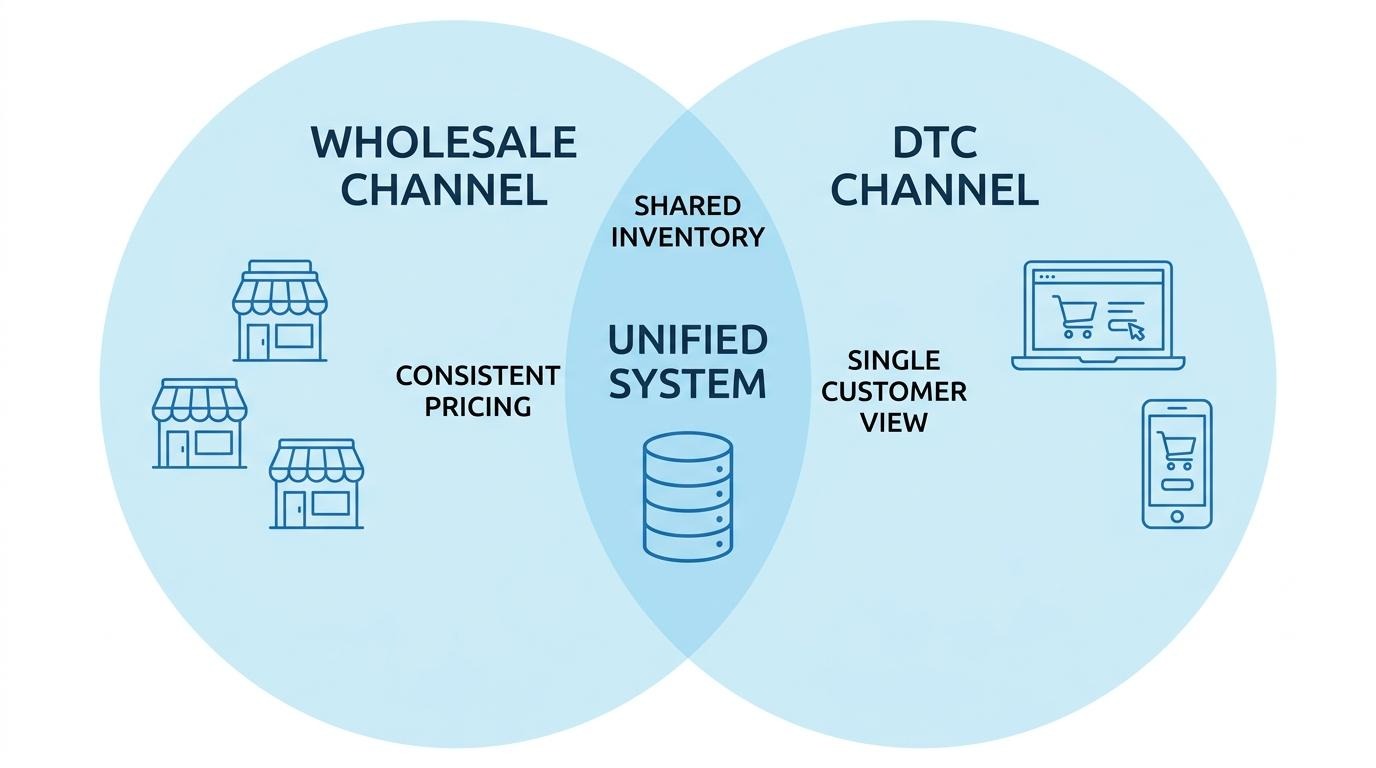
A hybrid distribution strategy is a model that combines direct, indirect, and blended sales channels under one brand. According to research by Rambocas et al. (2015) and Moriarty and Moran (1990), distribution channels fall into three main types: direct, indirect, and hybrid. The hybrid approach lets brands sell wholesale to retailers while simultaneously operating their own e-commerce storefronts and physical locations. This combination is now standard among scaling consumer brands; it balances the volume predictability of wholesale with the margin advantages and customer data access of DTC. For most brands past the $1M revenue mark, running a single channel leaves growth on the table.
You avoid channel conflict between wholesale and DTC by maintaining pricing consistency, differentiating product assortments, and aligning fulfillment timelines across channels. Channel conflict occurs when the same brand sells at different prices across distribution channels, when certain partners receive product earlier than others, or when a manufacturer's DTC channel directly competes with existing retail partners, as outlined in a 2025 California Management Review analysis on channel convergence.
Practical steps to reduce conflict include:
Major hybrid brands demonstrate this balance works at scale. Levi Strauss reported its wholesale channel generated 54% of net revenues in fiscal 2024, while DTC contributed 46%. Similarly, adidas maintained a 60/40 wholesale-to-DTC split in 2024. These ratios show that wholesale and DTC coexist productively when channel boundaries are respected.
You set pricing across wholesale and DTC channels by anchoring both to a unified retail price and integrating your systems to enforce consistency. Your DTC price should match or closely align with the manufacturer's suggested retail price (MSRP) that wholesale partners use. Selling below MSRP on your own site undercuts retailers and accelerates conflict.
Brands with strong pricing discipline see measurable results. Ralph Lauren reported DTC comparable store sales increased 13% for the full year of fiscal 2025, with high single-digit growth in average unit retail, demonstrating that consistent pricing supports premium positioning rather than eroding it. A study published in Electronic Markets found that firms need to integrate CRM, ERP, and billing systems across channels to maintain this consistency. Without connected systems, price discrepancies emerge from manual errors and delayed updates.
Platforms that centralize wholesale and DTC operations, including SHOPLINE, keep pricing rules and inventory data in one system, which reduces the sync issues that typically cause cross-channel pricing conflicts.
The better model depends on the product category's margin structure, shelf life, and customer buying behavior. Fashion and beauty brands often benefit from hybrid approaches, while food and home goods face distinct distribution constraints.
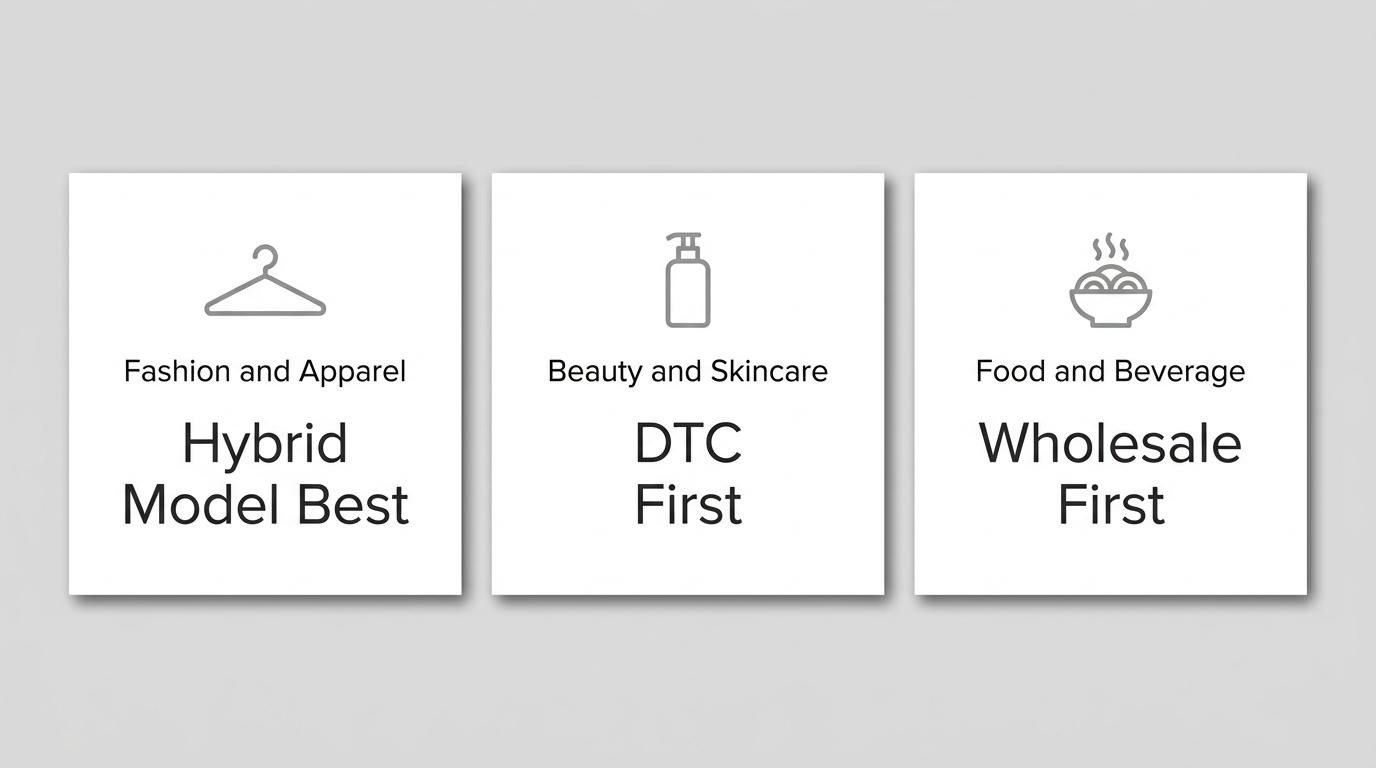
A hybrid model works best for fashion and apparel brands. Wholesale provides broad retail shelf presence and predictable bulk orders, while DTC preserves full-price positioning and direct customer relationships. Geographic price differences matter here; following Coleman (2009), Georgia Institute of Technology research defines spatial arbitrage as purchasing and reselling the same product in different locations to exploit price discrepancies, a risk apparel brands face when wholesale and DTC pricing diverge across regions.
Most established apparel brands already operate both channels. The key is segmenting product lines: offering core collections through wholesale partners and reserving exclusive colorways, capsule drops, or limited editions for DTC. This protects retailer relationships while giving the brand a reason to drive customers to owned channels.
A DTC-first model works best for beauty and skincare brands, particularly those building around ingredient education, personalized routines, or subscription replenishment. Beauty products carry high margins that absorb DTC acquisition costs, and customers often want guidance that retail shelf placement alone cannot provide.
That said, selective wholesale partnerships accelerate discovery. Brands that launch DTC and later expand into curated retail gain credibility from physical shelf presence without sacrificing margin on their entire catalog. The strongest approach reserves hero SKUs for retail distribution while keeping bundles, refills, and loyalty programs exclusive to owned channels. For brands managing both, keeping product and customer data in one system prevents inventory mismatches across channels.
Wholesale works best for most food and beverage brands. Short shelf life, cold chain requirements, and low per-unit price points make DTC fulfillment expensive relative to the order value. Grocery retailers and foodservice distributors provide the volume and logistics infrastructure that perishable goods demand.
DTC can supplement wholesale for specialty, artisan, or subscription-based food brands where higher price points justify individual shipping costs. Shelf-stable products like coffee, snacks, and condiments suit DTC subscriptions well because they combine repeat purchase behavior with lightweight packaging. For most food brands, however, wholesale remains the primary revenue driver, and DTC serves as a brand-building and margin-capture layer rather than the core channel.
Wholesale works best for home goods brands selling bulky, lower-frequency-purchase items like furniture, kitchenware, or décor. Shipping costs for oversized products erode DTC margins quickly, and consumers often prefer to see and touch home products before buying.
DTC suits home goods brands with smaller, design-forward products that photograph well and command premium pricing: candles, textiles, organizing systems, or curated collections. These categories benefit from storytelling and lifestyle content that owned channels deliver more effectively than a retail shelf. For home goods brands scaling across both channels, maintaining consistent pricing is essential since customers readily compare prices between a brand's website and retail partners.
With category-level channel strategy defined, the next step is matching these models to your brand's specific revenue stage and operations.
You decide between wholesale and DTC by evaluating your revenue stage, margin requirements, and operational capacity. The following subsections break down which revenue stage favors each model and what infrastructure each one demands.
The revenue stage that favors wholesale over DTC is the early growth phase, when a brand needs volume and broad distribution faster than it can build its own customer acquisition engine. Wholesale lets you move large quantities through established retail networks without funding individual marketing campaigns for every sale.
According to Iowa State University Extension, a product priced at $20 per unit reaches consumers at roughly $30 after the wholesaler and retailer each add their markup. You sacrifice per-unit margin, but predictable bulk orders stabilize cash flow at a stage when marketing spend and customer acquisition costs would otherwise consume most of your revenue. For brands generating under $1M annually, wholesale purchase orders can fund production runs that would be difficult to finance through DTC sales alone.
The revenue stage that favors DTC over wholesale is the scaling phase, typically once a brand generates enough recurring demand to justify the cost of its own acquisition, fulfillment, and retention infrastructure. At this point, the margin difference between selling at wholesale prices and capturing the full retail price becomes significant enough to fund growth internally.
Brands operating above $1M in annual revenue often find that DTC delivers higher lifetime value per customer because they own the relationship, the data, and the post-purchase experience. Rather than splitting margin across wholesalers and retailers, DTC brands reinvest that spread into lifecycle marketing and repeat-purchase mechanics. The trade-off is clear: DTC demands more operational investment upfront, but the compounding returns on owned customer data tend to accelerate once volume supports the infrastructure.
The operational capacity you need for each model differs significantly across fulfillment, marketing, and customer service:
Brands that lack in-house fulfillment and marketing teams often start with wholesale to reduce operational overhead. As internal capabilities mature, layering in DTC becomes viable. The key question is whether your team can handle per-order economics, because every DTC sale carries its own pick, pack, ship, and support cost.
Understanding your operational readiness makes it easier to choose the right platform infrastructure for managing both channels.
You manage wholesale and DTC without tool sprawl by running both channels from a single platform that shares inventory, customer data, and order management. The sections below cover how SHOPLINE unifies this data and the key takeaways from choosing between wholesale and DTC.
SHOPLINE unifies DTC and wholesale data in one system by keeping commerce, CRM, marketing automation, and order management on a shared data layer. Instead of syncing a separate B2B portal, email platform, subscription app, and POS, both channels resolve to one customer record and one inventory pool.
This matters because running wholesale and DTC typically forces brands into five to fifteen disconnected tools, each holding a fragment of the customer picture. When a retail buyer's wholesale orders and a consumer's DTC purchases live in separate systems, pricing errors, overselling, and blind spots in lifetime value calculations become routine.
On SHOPLINE, wholesale price lists, bulk order workflows, and DTC storefront transactions share the same backend. Inventory updates reflect across channels in real time, and lifecycle marketing triggers from both B2B and B2C activity without requiring a third-party CDP or connector. For brands at the $1M to $50M revenue stage, this consolidation removes the operational drag that compounds as order volume grows.
The key takeaways about wholesale vs. DTC center on three decisions: margin structure, customer ownership, and operational complexity.
For brands weighing consolidation, the core question is not which model to choose, but whether the systems behind both channels can operate as one. The right platform decision at this stage prevents years of compounding integration debt.