Dropshipping taxes are the combined sales tax, federal income tax, self-employment tax, and international duty obligations that apply when you sell products shipped directly from a supplier to your customer. Because the seller never holds inventory, tax responsibilities follow the buyer's location and the supplier's shipping origin rather than the seller's own address.
This guide covers sales tax nexus and collection rules, federal income and self-employment tax obligations, deductible business expenses, international customs and VAT requirements, and ongoing compliance as you scale.
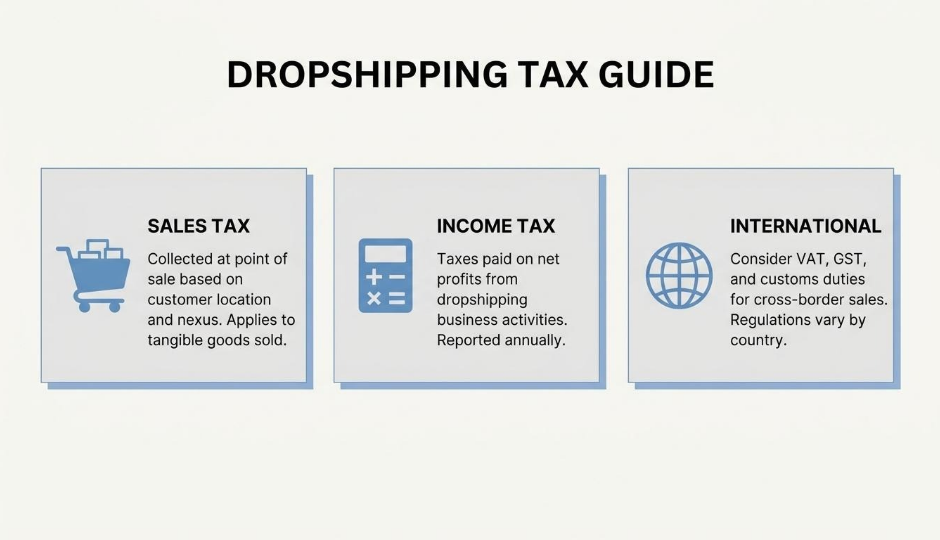
Sales tax nexus determines where you must collect. Economic nexus thresholds vary by state; most require collection once you exceed $100,000 in revenue or 200 transactions, though states like California set the bar at $500,000. Marketplace facilitator laws can shift collection duty to the platform, but sales through your own storefront remain your responsibility. Origin-based and destination-based sourcing rules further dictate which rate applies to each order.
Federal income tax applies to all net dropshipping profit. Sole proprietors report on Schedule C, while LLCs and S-Corps file separately. Self-employment tax adds 15.3% on top of income tax for sole proprietors and single-member LLCs, making entity structure a meaningful financial decision.
Ordinary and necessary business expenses reduce taxable income. Platform fees, supplier costs, shipping charges, advertising spend, and qualifying home office use all count as deductions when properly documented.
International suppliers introduce customs duties, VAT, and GST rules that vary by destination country. The U.S. de minimis threshold exempts individual shipments valued at $800 or less from import duty, but state sales tax still applies to the retail transaction.
Estimated quarterly payments, organized recordkeeping, and centralized order data across channels prevent penalties and audit exposure as your operation grows.
Dropshipping taxes differ from traditional retail taxes because the seller never holds inventory, creating multi-party transactions that split tax obligations across states and countries. Key differences include nexus complexity, resale certificate requirements, and international de minimis thresholds.
Traditional retailers buy inventory, store it in a warehouse, and ship from a known location. That single point of origin simplifies which state's sales tax applies. Dropshipping removes the warehouse entirely. A customer orders from your online store, you purchase from a supplier, and the supplier ships directly to the buyer. This three-party chain means the product may originate in a state or country where you have no physical presence, yet your sales activity can still trigger tax collection duties elsewhere.
According to the U.S. Small Business Administration Office of Advocacy, the average large online retailer collects sales taxes in about 18 states, representing roughly 47.2 percent of total national, state, and local sales tax collections. For dropshippers selling across all 50 states from day one, the potential filing burden is significantly higher than for a brick-and-mortar shop operating in a single jurisdiction.
Resale certificates add another layer of complexity. As the Comptroller of Maryland defines it, a resale certificate is a written statement that merchandise purchased will be resold in a taxable sale. In dropshipping, the relationship between you and your supplier often qualifies as a resale transaction; without a valid certificate on file, your supplier may charge you sales tax on the wholesale price, cutting into margins. The Vermont Department of Taxes further notes that the responsibility falls on the seller to determine whether the buyer submits the exemption certificate in good faith.
International sourcing introduces customs thresholds that traditional domestic retailers rarely encounter. Under Section 321 (19 USC 1321), the U.S. de minimis provision allows goods valued at $800 or less per person per day to enter free of duty and import tax. Many dropshipped products from overseas suppliers fall under this threshold, which means customs duties often do not apply to individual consumer shipments. However, that exemption does not eliminate your obligation to collect state sales tax on the retail transaction.
For small business owners running a dropshipping operation, the tax landscape is fundamentally different because obligations follow the customer's location and the supplier's shipping origin rather than your own address. This complexity across nexus rules, resale documentation, and import thresholds is what the following sections break down in detail.
Dropshippers need to collect sales tax in the United States when they establish nexus in a state that imposes sales tax. The type of nexus, marketplace facilitator laws, and state-specific thresholds determine when collection is required.
Economic nexus is a tax obligation triggered when a seller exceeds a state's sales revenue or transaction threshold, even without physical presence in that state. The Supreme Court of the United States established this framework in its 2018 South Dakota v. Wayfair decision, which overruled older physical-presence requirements and upheld thresholds of $100,000 in sales or 200 transactions.
For dropshippers, economic nexus applies to total sales delivered into a state. Thresholds vary: Arizona, for example, phased its remote seller threshold from $200,000 in 2019 down to $100,000 for 2021 and beyond, according to the Arizona Department of Revenue. California sets its threshold at $500,000 in combined sales of tangible personal property. Because dropshippers can accumulate orders across many states quickly, even modest per-order revenue can trigger nexus in lower-threshold jurisdictions.
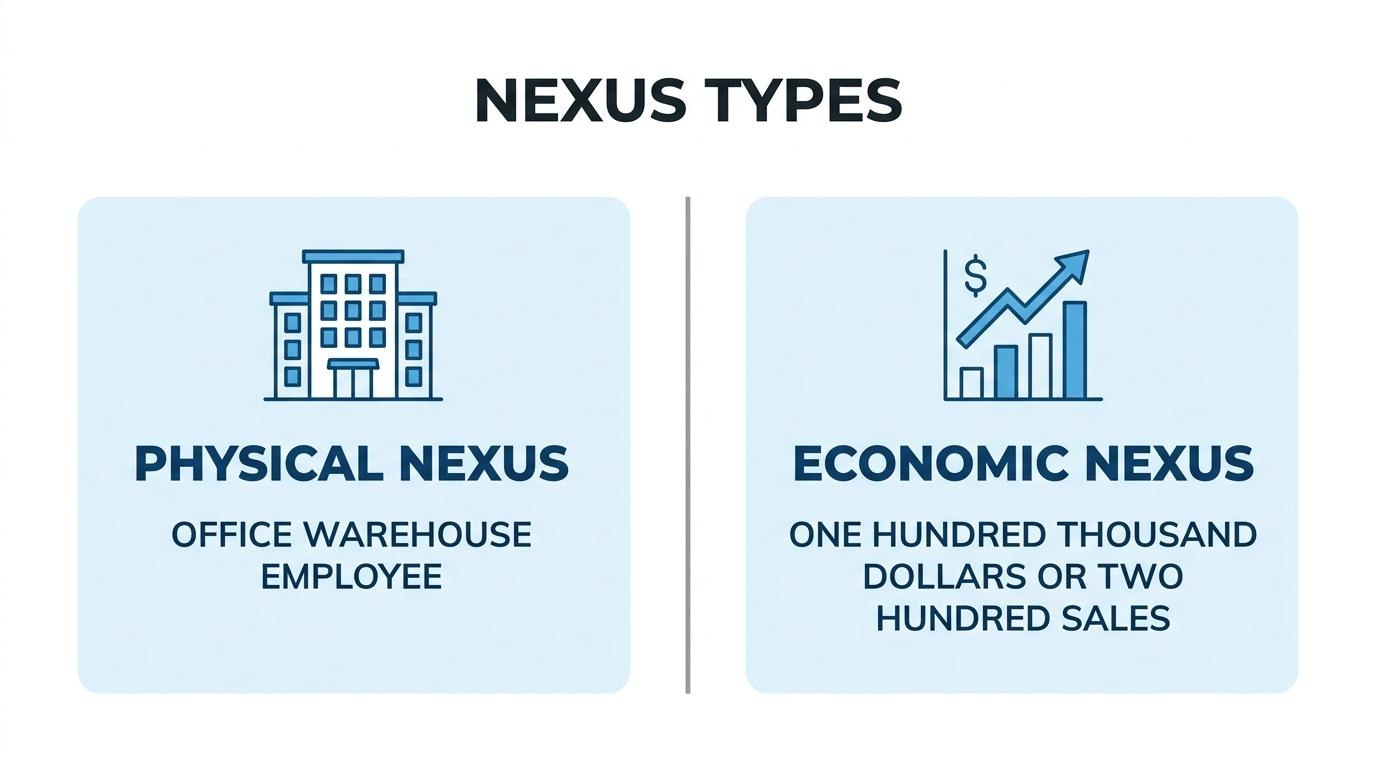
Physical nexus is a sales tax obligation created by having a tangible business presence in a state, such as an office, warehouse, employee, or agent operating there. Dropshippers can trigger physical nexus if a supplier or fulfillment partner stores inventory on their behalf within a state. Some states have also enacted legislation treating affiliate relationships or in-state agents as sufficient physical connections.
Even without owning property or employing staff, a dropshipper whose third-party supplier ships from an in-state warehouse may create enough physical presence to require registration. Sellers with physical presence in a state must register regardless of sales volume, which makes supplier location a critical compliance variable that many new dropshippers underestimate.
Marketplace facilitator laws shift sales tax collection responsibility from the individual seller to the platform facilitating the sale. According to the Virginia Department of Taxation, a marketplace facilitator has economic nexus if it sells or facilitates more than $100,000 in annual gross retail sales or 200 or more transactions to Virginia customers.
When these laws apply, the facilitator collects, reports, and remits sales tax on behalf of sellers. As the Utah State Tax Commission confirmed, marketplace sellers are not liable for taxes a facilitator is required to collect. Missouri requires facilitators to report facilitated sales on a separate line of their vendor's use tax return after January 1, 2023.
Key implications for dropshippers include:
For dropshippers selling across both independent stores and third-party marketplaces, tracking which channel handles tax collection is essential to avoiding double-collection or missed obligations.
The states that require dropshippers to collect sales tax include all 45 states (plus Washington, D.C.) that impose a statewide sales tax, provided the seller meets nexus thresholds. How tax is calculated depends on whether a state uses origin-based or destination-based sourcing.
Origin-based sales tax states handle dropshipping by sourcing the sale to the seller's location rather than the buyer's. States such as Texas, Pennsylvania, Ohio, Virginia, and Utah use this model, meaning the tax rate applied is based on where the business operates.
This creates a simpler calculation for dropshippers with a single business location, since one rate covers most in-state transactions. However, according to the Kansas Department of Revenue, origin-based sourcing functions as the default rule; destination-based sourcing applies first when the retailer knows where the purchaser receives the item. Five states forgo statewide sales taxes entirely: Alaska, Delaware, Montana, New Hampshire, and Oregon. For dropshippers selling into those jurisdictions, no state-level collection obligation exists regardless of sourcing method.
Destination-based sales tax states handle dropshipping by sourcing the taxable sale to the location where the buyer receives the goods. The majority of states with a sales tax follow this model, which means dropshippers must apply the combined state, county, and city tax rate at the customer's shipping address.
This approach increases compliance complexity significantly. A single dropshipping store selling nationwide may need to track hundreds of distinct tax jurisdictions. According to the Illinois Department of Revenue, effective January 1, 2025, retailers previously collecting Illinois Use Tax on out-of-state sales to Illinois customers are now subject to destination-based sales tax under Public Act 103-983. For growing dropshipping businesses, automated tax software becomes practically essential once destination-based filing obligations span multiple states.
When you dropship to states with no sales tax, you do not collect state sales tax on those orders. The five states without a statewide sales tax are Alaska, Delaware, Montana, New Hampshire, and Oregon.
No state-level collection or remittance obligation applies for shipments into these jurisdictions. Keep in mind that Alaska allows local municipalities to levy their own sales taxes, so certain borough-level obligations may still exist. Additionally, the absence of sales tax does not eliminate other tax duties. Both sales tax and use tax are excise taxes, as noted in testimony before the U.S. House Committee on the Judiciary; some buyers in tax-free states may owe use tax on purchases, though collection responsibility typically falls on the consumer rather than the seller.
Understanding state-by-state sourcing rules sets the stage for the next step: registering for a sales tax permit where you have nexus.
You register for a sales tax permit as a dropshipper by applying through each state's tax authority where you have established nexus. The process involves gathering business identification documents, submitting an online application, and receiving your permit before collecting tax.
Registration requires identifying every state where you owe sales tax, preparing your business details, completing each state's application, and understanding the timeline before you can legally collect.
The states that require you to register are those where you have established either economic nexus or physical nexus. Economic nexus thresholds vary by state. Most set the bar at $100,000 in annual sales or 200 transactions, though some differ significantly.
According to the Idaho State Tax Commission, once you meet all nexus criteria, you need to get a seller's permit if you do not already have one. Start by listing every state where your sales volume crosses the threshold, then register in each one individually. Missing even one state creates compliance risk, so a thorough nexus analysis should come before any registration step.
The information you need to apply for a sales tax permit typically includes:
Most states also ask for your start date of business activity in that state. Having these details ready before you begin speeds up multi-state registration considerably. Some applications take minutes; others require additional documentation depending on the state.
The registration process takes anywhere from immediate approval to several weeks, depending on the state. Many states with online portals, such as Texas, California, and Virginia, issue permits within a few business days after submission.
States that still require paper applications or manual review may take two to four weeks. You should not collect sales tax until you have received your active permit number, since charging tax without authorization can create legal issues. For dropshippers registering across multiple states simultaneously, staggering applications and tracking each status in a spreadsheet prevents permits from slipping through the cracks.
Planning registration before you hit nexus thresholds, rather than scrambling after, is one of the simplest ways to avoid penalties and start collecting on time.
You calculate sales tax on dropshipping orders by applying the correct rate for each taxable jurisdiction where you have nexus, then remitting collected tax to each state by its filing deadline. The process involves rate determination, order-level calculation, and timely filing.
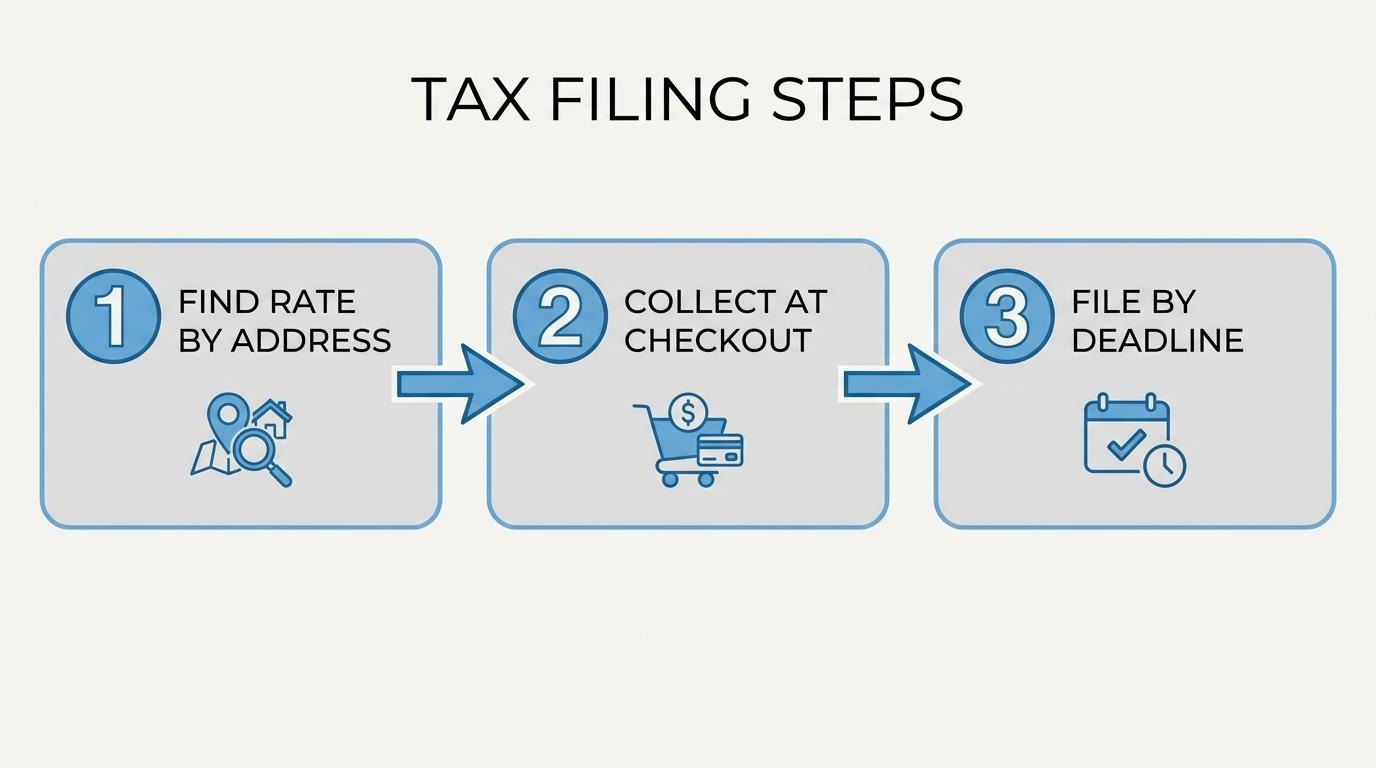
You determine the correct sales tax rate for each order by identifying whether the destination state uses origin-based or destination-based sourcing rules, then applying the combined state and local rate for that location. Most states use destination-based sourcing, meaning the rate depends on where the buyer receives the goods.
Rates vary significantly. A single state can have dozens of local jurisdictions layering additional percentages on top of the base state rate. For dropshippers shipping to multiple states, this means every order may carry a different tax rate depending on the customer's exact address, including city, county, and special taxing district.
You apply sales tax at checkout on dropshipping orders by configuring your ecommerce platform to calculate tax automatically based on the customer's shipping address and your registered nexus states. The platform pulls the applicable rate and adds it to the order total before payment.
Key configuration steps include:
Manual calculation is impractical at scale. Even a modest dropshipping operation shipping to ten or more states faces hundreds of possible rate combinations.
You file and remit collected sales tax according to each state's assigned filing frequency, which is typically monthly, quarterly, or annually based on your sales volume in that state. Each state sets its own deadlines and portal for submission.
According to the Colorado Department of Revenue, the sales tax penalty for failure to file or pay is the greater of $15 or 10% of the unpaid tax, plus 0.5% per month the balance remains outstanding, capped at 18%. Missing deadlines in even one state can trigger compounding penalties.
Filing involves reporting total taxable sales, exempt sales, and the tax collected for each jurisdiction. Some states offer a small vendor discount for on-time remittance, which offsets a fraction of compliance costs. Staying ahead of each state's calendar prevents penalties from quietly eroding your margins.
With tax calculation and remittance processes established, tracking the federal income tax side of your dropshipping profits is the next critical step.
Dropshipping business owners pay federal income taxes on net business profit, with the exact filing method depending on business structure. The subsections below cover sole proprietor taxation, LLC and S-Corp treatment, and self-employment tax obligations.
Dropshipping income is taxed for sole proprietors as personal income reported on Schedule C (Form 1040). According to Utah State University Extension, Schedule C is used to report income or loss from a business operated as a sole proprietor, and an activity qualifies as a business if the primary purpose is income or profit with continuity and regularity.
Net profit from Schedule C flows directly to the owner's Form 1040 and is taxed at ordinary individual income tax rates. Because sole proprietorships do not create a separate business entity, there is no corporate return to file. This simplicity makes Schedule C the default starting point for most new dropshippers, though it also means every dollar of profit faces both income tax and self-employment tax without the pass-through strategies available to other structures.
Dropshipping income is taxed for LLCs and S-Corps differently depending on the entity's tax election. A single-member LLC is treated as a disregarded entity by the IRS, so profits pass through to Schedule C just like a sole proprietorship. Multi-member LLCs default to partnership taxation, filing Form 1065 and issuing Schedule K-1 to each member.
An S-Corp election changes the picture. The business files Form 1120-S, and owners who actively work in the business must pay themselves a reasonable salary subject to payroll taxes. Remaining profit distributed as shareholder distributions avoids self-employment tax. For dropshippers generating consistent net income above their reasonable salary, the S-Corp election can reduce the overall tax burden compared to sole proprietor or default LLC filing.
Self-employment taxes apply to dropshipping profits at a combined rate of 15.3 percent. According to 26 U.S.C. § 1401, as published by the Legal Information Institute at Cornell Law School, the self-employment tax consists of 12.4 percent for Social Security and 2.9 percent for Medicare, both imposed on self-employment income each taxable year.
Sole proprietors and single-member LLC owners owe this tax on all net earnings from Schedule C. The deductible portion (half of the self-employment tax) reduces adjusted gross income but does not lower the self-employment tax base itself. For dropshippers scaling past six figures in net profit, this 15.3 percent layer is often the strongest financial argument for evaluating an S-Corp election.
Understanding federal income and self-employment obligations sets the stage for identifying which business expenses can offset that taxable income.
Dropshipping business expenses you can deduct on your taxes include platform fees, supplier costs, shipping charges, marketing spend, and home office costs. Each category must qualify as ordinary and necessary under federal tax law. The sections below break down which specific expenses qualify.
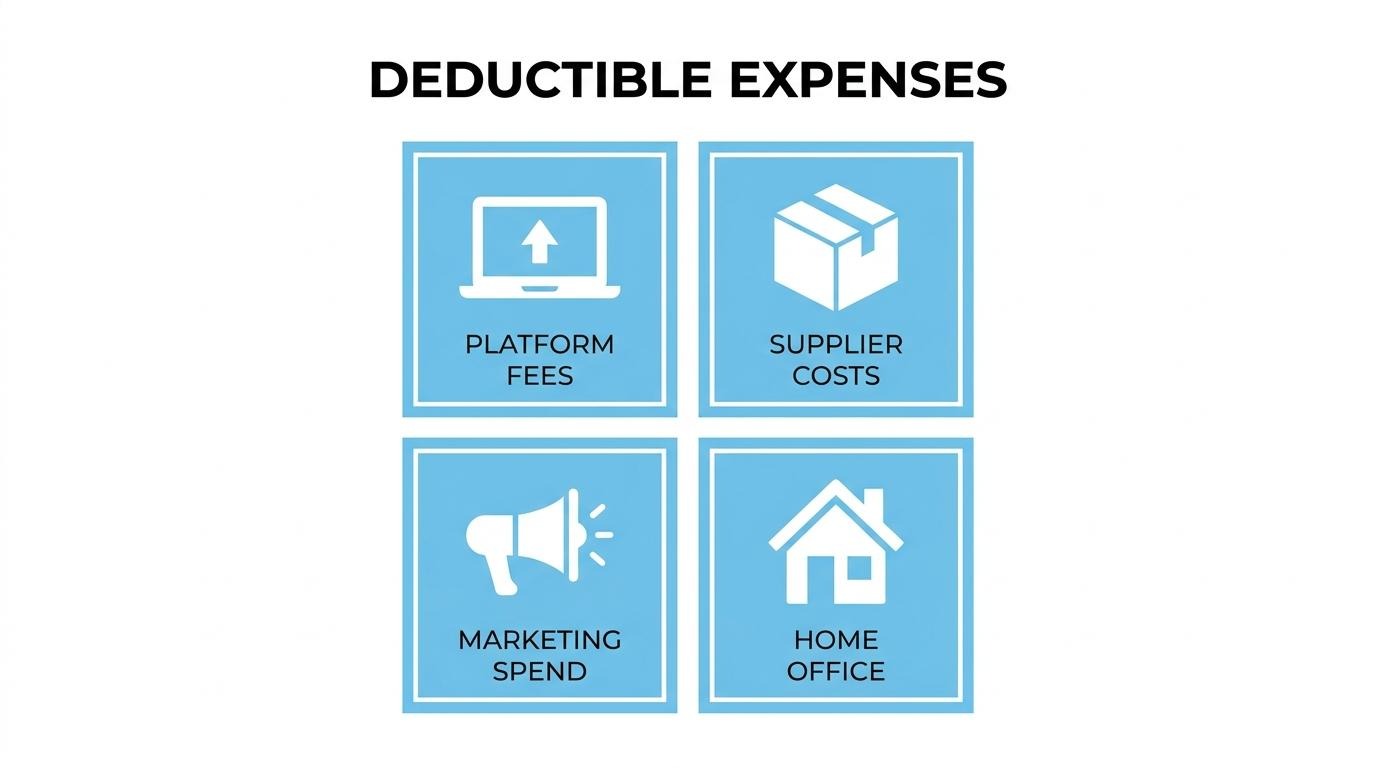
Platform and software fees qualify as deductions when they are ordinary and necessary costs of running your dropshipping business. As stated in 26 U.S.C. § 162, the IRS allows a deduction for "all the ordinary and necessary expenses paid or incurred during the taxable year in carrying on any trade or business."
Deductible platform and software fees include:
These costs are reported as business expenses on Schedule C for sole proprietors. Your business structure determines which form you file, but the underlying deductibility remains the same. Keep receipts and invoices for every subscription, because the IRS requires documentation that ties each expense to your trade or business activity.
Yes, you can deduct supplier costs and shipping fees as legitimate business expenses. The cost of goods purchased from suppliers for resale represents your primary deductible expense in a dropshipping operation.
Deductible supplier and shipping costs include:
These costs reduce your gross income before other deductions apply. For dropshippers, supplier payments and shipping fees often make up the largest share of total expenses. Tracking each transaction individually is essential, since the IRS expects clear records connecting every cost to a specific sale or business purpose.
Marketing and advertising costs are tax deductible when they directly promote your dropshipping business. The IRS treats advertising as an ordinary business expense, meaning the full amount spent in a given tax year is deductible rather than capitalized.
Common deductible marketing expenses include:
One frequently overlooked detail: promotional product samples sent to influencers are also deductible as advertising costs. Document each campaign with invoices, ad platform receipts, and proof of business purpose to support your deduction if audited.
Home office expenses are deductible for dropshippers who use a dedicated portion of their home regularly and exclusively for business. According to a Congressional Research Service report on gig economy tax obligations, eligible small business owners can deduct operating costs including "business-related mileage in a personal vehicle, equipment and materials needed for work, and the use of a home office."
The IRS offers two methods for calculating this deduction:
Beyond the office space itself, equipment such as computers, monitors, desks, and chairs used for your dropshipping operations qualifies separately. The key requirement is exclusive business use; a kitchen table used for both family meals and order management does not qualify.
With deductible expenses identified, maintaining organized records ensures you capture every eligible write-off at tax time.
International dropshipping suppliers affect your tax obligations by introducing import duties, customs taxes, and foreign VAT or GST requirements that domestic-only sellers never encounter. The sections below cover import duty exposure and how overseas fulfillment changes sales tax rules.
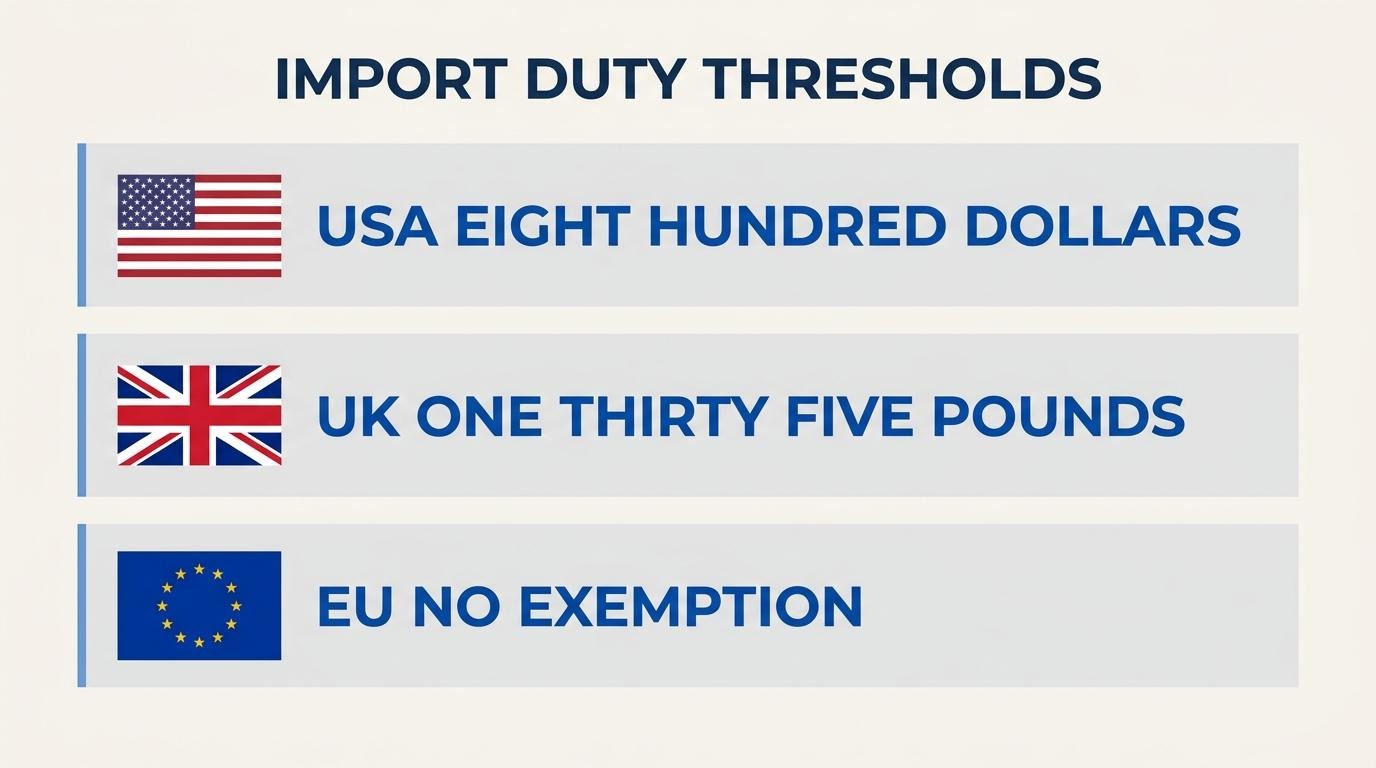
You may owe import duties or customs taxes on dropshipped goods, depending on the shipment's value and the destination country's de minimis threshold. Most countries set a minimum value below which customs duties are not collected. In the United States, Section 321 (19 USC 1321) exempts individual shipments with an aggregate fair retail value of $800 or less from duty. Many dropshipped consumer goods fall under this threshold when shipped directly to a single customer.
Other countries apply different limits and tax types:
For dropshippers selling internationally, checking each destination country's de minimis rules before pricing products prevents unexpected costs that erode margins.
Dropshipping from overseas suppliers changes sales tax rules by adding foreign VAT and import tax obligations on top of domestic collection requirements. In a standard drop shipment, the seller takes a customer's order and has a third-party supplier ship directly to the buyer. When that supplier is overseas, the transaction crosses customs boundaries, triggering rules that purely domestic fulfillment avoids.
The EU's VAT e-commerce rules illustrate this shift. According to the European Commission, these regulations require marketplaces and platforms facilitating online sales of goods imported from third countries to collect import VAT on consignments with an intrinsic value not exceeding EUR 150. Sellers who fulfill from China or other non-EU origins must either register for the Import One-Stop Shop (IOSS) or ensure VAT is collected at checkout.
Domestically, your U.S. sales tax nexus obligations remain unchanged regardless of where the supplier is located. You still collect based on where the customer receives the goods. The international layer simply adds compliance requirements on top of existing state obligations, making accurate tax automation essential as cross-border volume grows.
Estimated quarterly tax payments for dropshippers are prepaid installments of federal (and often state) income tax and self-employment tax, sent to the IRS four times per year instead of in one lump sum at filing. Because dropshipping income has no employer withholding, the IRS expects you to pay as you earn.
Self-employed dropshippers owe both income tax and self-employment tax on net profits. Under 26 U.S.C. § 1401, self-employment tax equals 15.3% of self-employment income: 12.4% for Social Security and 2.9% for Medicare, as documented by the Legal Information Institute at Cornell Law School. That obligation, combined with your marginal income tax rate, determines total quarterly liability.
The IRS requires estimated payments when you expect to owe $1,000 or more in tax for the year after subtracting withholding and credits. Quarterly due dates follow a fixed schedule:
Each payment covers estimated income tax plus estimated self-employment tax for that quarter's earnings. You calculate these using IRS Form 1040-ES, which provides a worksheet for projecting annual income, deductions, and credits. Many dropshippers base estimates on the prior year's tax liability, dividing it into four equal payments; others recalculate each quarter as revenue fluctuates seasonally.
Underpaying triggers an estimated tax penalty. The safe harbor rule lets you avoid penalties by paying at least 100% of the prior year's total tax (110% if adjusted gross income exceeded $150,000). For dropshippers whose income varies month to month, the annualized income installment method offers an alternative that aligns payments more closely with actual earnings periods.
State estimated tax obligations vary. Most states with an income tax impose their own quarterly payment requirements, often mirroring federal due dates but using separate vouchers. Dropshippers operating as sole proprietors, single-member LLCs, or partners should check both federal and state requirements each year.
Keeping quarterly payments current is one of the simplest ways to avoid year-end surprises; the next step is ensuring the records behind those payments hold up to scrutiny.
Dropshippers should keep sales transaction records, expense receipts, resale certificates, sales tax filings, and bank statements for a minimum of three years, though the IRS recommends retaining records for up to seven years in certain situations. Accurate recordkeeping protects against audits and substantiates every deduction claimed on tax returns.
The core records every dropshipping business should maintain include:
The IRS standard retention period is three years from the filing date for most returns, extending to six years if gross income is underreported by more than 25%, and seven years if a loss deduction from worthless securities or bad debt is claimed. No statute of limitations applies to fraudulent returns or unfiled returns, so those records should be kept indefinitely.
According to the Federal Trade Commission, businesses that collect sensitive personal information about customers should have a sound security plan to collect only what is needed, keep it safe, and dispose of it securely. For dropshippers storing customer names, addresses, and payment data alongside tax records, this guidance applies directly to how long and how safely those records are retained.
From a practical standpoint, digital record storage is far more reliable than paper for dropshipping businesses processing hundreds or thousands of monthly orders across multiple states. Cloud-based accounting software that categorizes transactions by tax jurisdiction at the point of sale eliminates the retroactive sorting that causes most recordkeeping failures during audits. The cost of maintaining organized records is always lower than the cost of reconstructing them under pressure.
Understanding what records to retain sets the foundation; knowing which tax mistakes to avoid prevents those records from documenting costly errors.
The most common dropshipping tax mistakes to avoid include ignoring nexus obligations, skipping resale certificates, misreporting income, and neglecting estimated quarterly payments. Each error carries financial penalties that compound over time.
For dropshippers scaling across multiple channels, these mistakes multiply with each new sales jurisdiction. Consolidating order data and tax records into one system reduces the risk of missed filings as volume grows.
Handling dropshipping tax compliance when scaling across channels requires centralizing order data, automating tax calculations per jurisdiction, and maintaining clean records as sales volume grows. The sections below cover how SHOPLINE consolidates tax-relevant data natively and the key takeaways from this guide.
SHOPLINE unifies tax-relevant order data without separate apps by housing commerce, CRM, and order management inside a single system with a shared data layer. Every transaction, whether from a web storefront, social channel, or POS terminal, resolves to one customer record and one order stream. This eliminates the sync gaps that typically emerge when brands stitch together separate tax tools, marketplace connectors, and accounting integrations. For dropshippers tracking nexus thresholds across multiple states, having all sales data in one place reduces the risk of undercounting transactions that could trigger economic nexus. SHOPLINE is one option for brands consolidating away from a multi-tool setup where fragmented data creates compliance blind spots.
The key takeaways about dropshipping taxes covered in this guide are:
Scaling across channels amplifies every one of these obligations. Building compliance into your operations early, rather than retrofitting it after an audit notice, is the most cost-effective approach for any growing dropshipping brand.