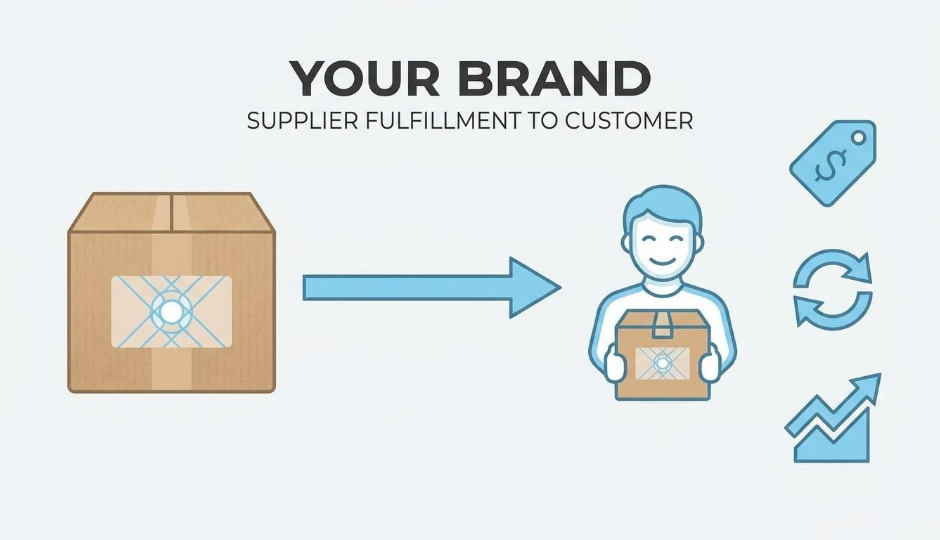
Private label dropshipping is an e-commerce model where a third-party supplier manufactures, brands, and ships products directly to customers under the retailer's own label, with no inventory held by the seller.
This guide covers what separates private label from generic dropshipping, how the business model operates from niche selection through fulfillment, supplier evaluation and top providers, high-performing product categories and their margins, and the legal, loyalty, and scaling strategies that sustain long-term growth.
Generic dropshipping sells unbranded goods where multiple stores compete on price alone. Private label dropshipping adds brand ownership to that same zero-inventory framework, giving sellers control over product specs, packaging, and customer perception. That distinction creates pricing power and repeat-purchase potential that commodity listings cannot match.
The operational model follows a clear sequence: choose a niche with recurring demand, source a supplier offering custom branding and compliant labeling, build product pages around a cohesive brand identity, then connect your store so orders route automatically to the supplier for branded fulfillment.
Suppliers range from broad marketplaces like Alibaba to category specialists like Supliful for supplements, Blanka for skincare, and Dripshipper for coffee. Vetting requires sample orders, branding capability checks, shipping timeline verification, and MOQ comparison; newer suppliers now offer zero-minimum, same-week fulfillment that traditional manufacturers cannot.
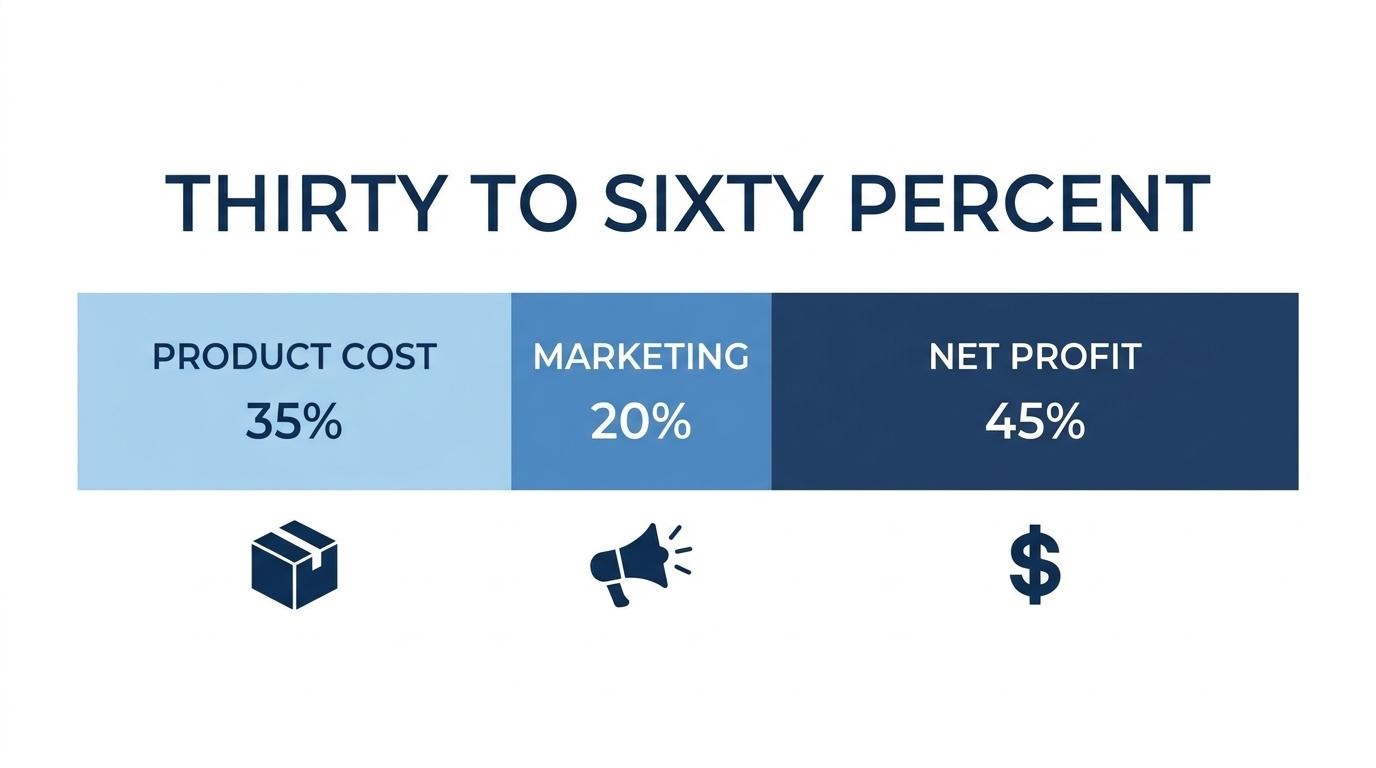
Margins typically land between 30% and 60%, though marketing spend and tool fragmentation quietly compress profitability. Categories like beauty, supplements, coffee, apparel, and pet products each carry specific regulatory requirements under the FDA, FTC, and CPSC that the seller of record must meet.
Scaling past launch involves transitioning top SKUs to held inventory, building subscription revenue on consumable products, and expanding into multi-channel retail while keeping product data, CRM, and marketing unified inside a single platform.
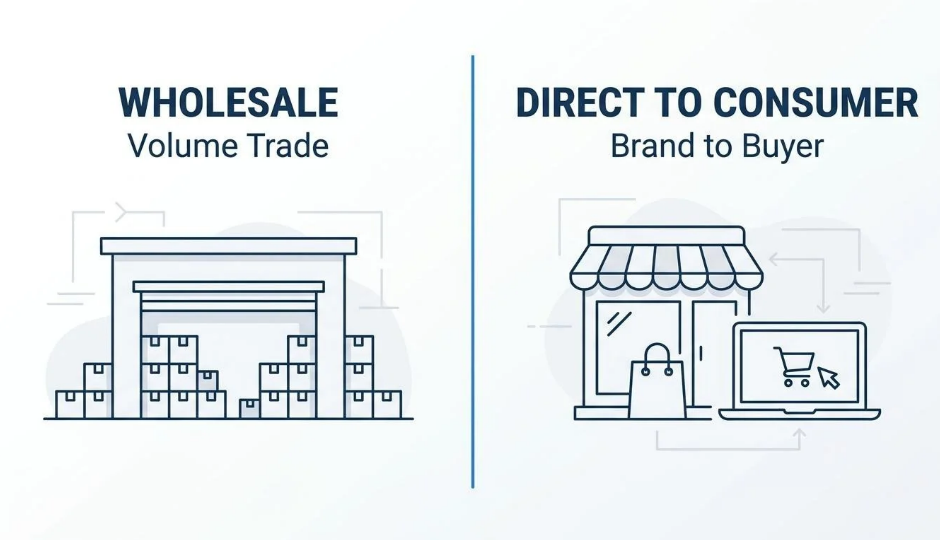
Private label dropshipping differs from regular dropshipping in who controls the brand. Regular dropshipping sells generic, unbranded products sourced from third-party suppliers. Private label dropshipping sells supplier-manufactured products under the retailer's own brand name, with custom packaging, logos, and labeling.
In a standard dropshipping model, the vendor does not hold inventory but serves as an intermediary between buyers and a third-party supplier, as defined by Encyclopaedia Britannica. The supplier ships directly to the customer, and the seller has no input on product design or presentation. Multiple stores often sell the identical item, competing purely on price.
Private label dropshipping follows the same fulfillment logic: no inventory, supplier ships direct. The critical difference is brand ownership. According to BigCommerce, a private label product is one that a retailer gets produced by a third party but sells under its own brand name, controlling the specs, packaging, and everything else. This control creates a distinct product identity that competitors cannot replicate by listing the same SKU.
The practical implications of this distinction shape every operational decision:
For operators already generating meaningful revenue, this distinction matters most at scale. Selling unbranded products works for testing demand, but building a defensible business requires brand equity that generic dropshipping cannot deliver. Private label dropshipping bridges that gap: it preserves the zero-inventory, low-capital advantage of dropshipping while adding the brand differentiation that supports long-term customer lifetime value.
Understanding this foundation clarifies every subsequent decision, from choosing suppliers to selecting product categories.
DTC brands should consider private label dropshipping because it combines brand ownership with low capital risk during a period of accelerating e-commerce growth. The subsections below cover market momentum, margin advantages, and how this model reduces the barrier to branded product launches.
U.S. e-commerce sales reached an estimated $1,192.6 billion in 2024, an increase of 8.1% from 2023, according to the U.S. Census Bureau. That trajectory means more consumers are buying online, yet competition for attention keeps intensifying. Private label dropshipping lets DTC brands enter or expand product lines without committing to warehouse leases, bulk inventory purchases, or the $5,000 to $15,000 minimum order quantities that traditional contract manufacturers typically require. The retailer controls product specs, packaging, and brand presentation while a third-party supplier handles production and fulfillment.
This matters for scaling brands because margin pressure and tool sprawl already strain operations. Owning the brand on each product, rather than reselling generic goods, creates pricing power and repeat-purchase potential that unbranded dropshipping simply cannot deliver. When customer acquisition costs keep climbing, the ability to build recognizable product lines without holding inventory is a meaningful operational advantage.
For brands already managing complexity across multiple sales channels, private label dropshipping also opens a low-risk path to test new categories. A skincare DTC brand can trial a supplements line; an apparel brand can add accessories. Each launch validates demand before any bulk commitment, keeping cash flow flexible at a stage where misallocated inventory can stall growth.
The private label dropshipping business model works by combining custom-branded products with supplier-fulfilled shipping, so you sell under your own label without holding inventory. The steps below cover niche selection, supplier sourcing, store listing, and order fulfillment.
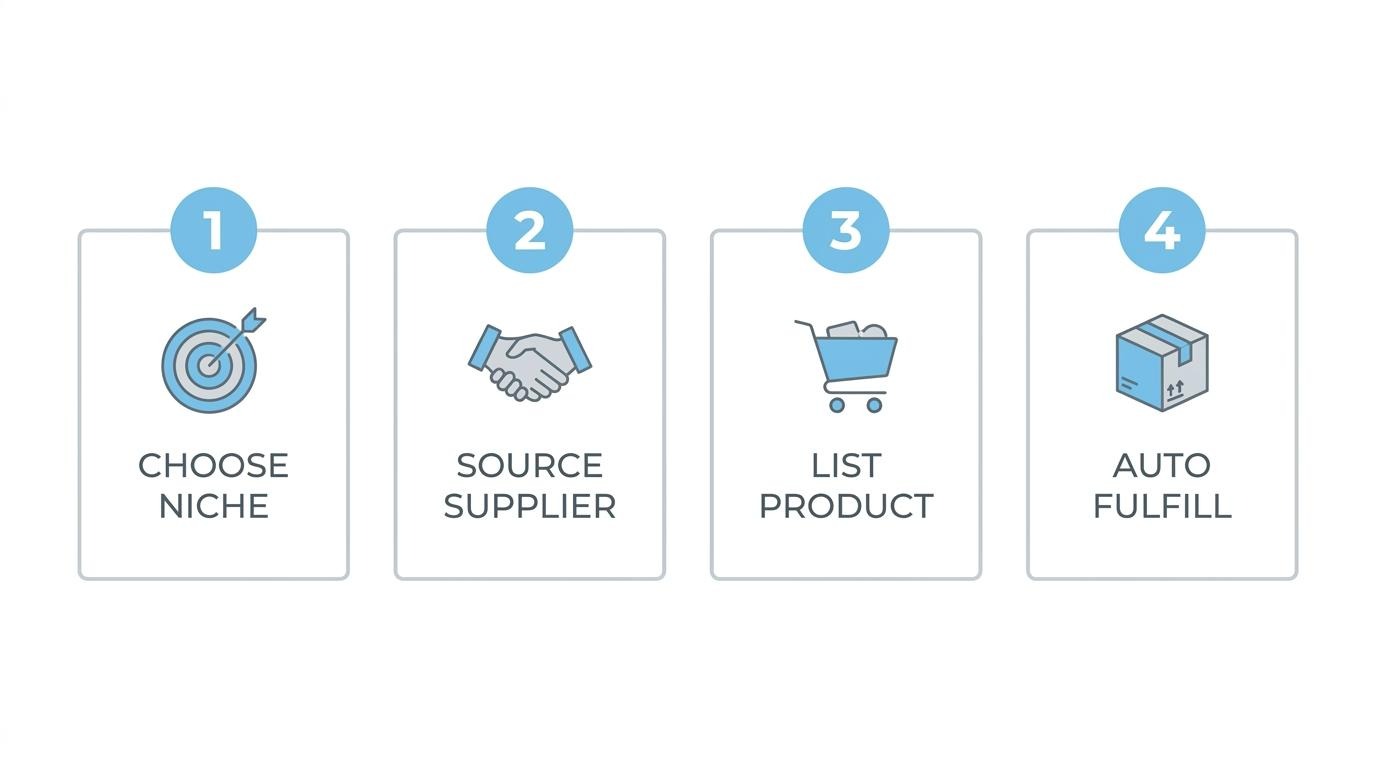
You choose a profitable niche for private label dropshipping by identifying product categories with strong consumer demand, healthy margins, and room for brand differentiation. The best niches share several traits:
Start by validating demand with keyword research tools and marketplace bestseller lists. Cross-reference search volume against supplier availability; a niche with demand but no willing private label supplier is a dead end. For most operators, narrowing to a specific audience segment within a broader category yields better margins than competing on breadth.
You source and brand a product with a dropshipping supplier by finding a manufacturer that offers both white-label production and custom branding services. According to Zendrop's help documentation, custom packaging includes branded boxes and logo printing, while private labeling places your brand name directly on the product itself.
The sourcing process typically follows this sequence:
Some suppliers, particularly in supplements and beauty, require minimum order quantities per SKU. Others allow single-unit fulfillment from day one, which reduces upfront financial risk considerably.
You list and market a private label product in your store by creating product pages that emphasize your brand story, then driving traffic through targeted acquisition channels. Strong listings include:
For marketing, paid social ads on platforms like Meta and TikTok perform well for visually driven private label categories. Email and lifecycle marketing build repeat purchases once initial acquisition is running. Content marketing through blog posts, tutorials, and ingredient breakdowns establishes authority in your niche over time. The key differentiator from generic dropshipping is that every touchpoint reinforces one cohesive brand identity.
You handle order fulfillment and shipping through your supplier by connecting your online store to the supplier's system so orders route automatically. When a customer purchases from your store, the order transmits to the supplier, who then produces or picks, packs with your branding, and ships directly to the buyer.
Shipping timelines vary by supplier location and method. Printful, for example, takes 2 to 5 business days to create a product and fulfill an order, with domestic US standard shipping adding another 3 to 4 business days after fulfillment. International orders from overseas suppliers can take significantly longer.
To maintain customer satisfaction, set realistic delivery expectations on your product pages and in confirmation emails. Proactive communication about shipping windows prevents the support tickets that erode trust in a new brand.
With fulfillment logistics mapped out, the next step is identifying which suppliers actually deliver on these promises.
The top private label dropshipping suppliers include Alibaba, AliExpress, Printful, Printify, Spocket, Zendrop, Apliiq, Dripshipper, Supliful, and Blanka. Each serves different product categories, branding depths, and fulfillment models.
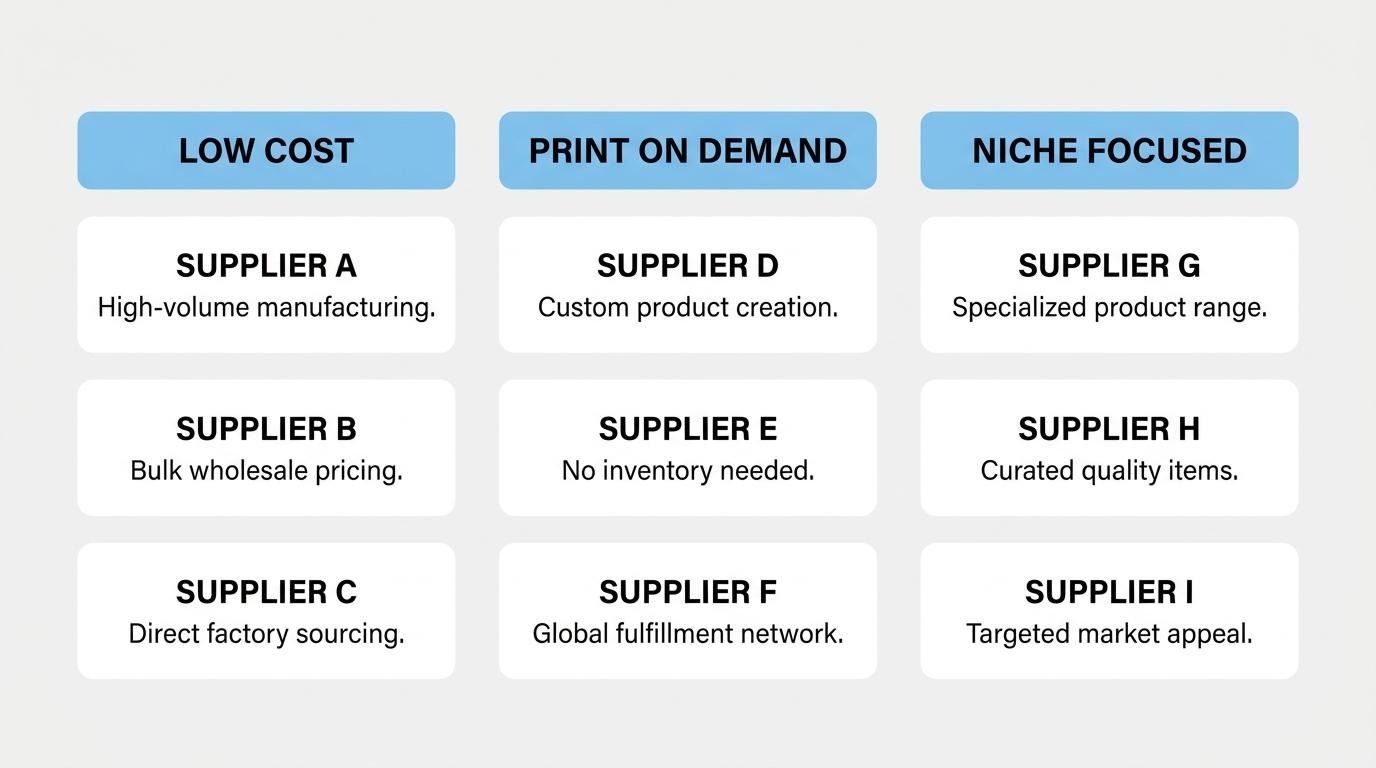
Alibaba is China's largest integrated international online wholesale marketplace. According to Alibaba Group's fiscal year 2024 Form 20-F filed with the SEC, the platform connects Chinese and overseas suppliers to wholesale buyers, including trade agents, retailers, manufacturers, and SMEs engaged in import and export. Alibaba supports private labeling through direct manufacturer relationships, custom packaging negotiations, and bulk production runs. Sellers typically negotiate MOQs, branding specifications, and shipping terms directly with factories. Transit times from Chinese suppliers generally range from 3 to 10 days depending on fulfillment method.
AliExpress is a retail-facing marketplace that allows single-unit purchasing without minimum order quantities. Products are generally sold as-is, meaning direct private labeling through the platform is limited compared to Alibaba's factory-level customization. AliExpress charges no subscription fee for dropshipping access; costs come primarily from the store platform, apps, payment processing, shipping, and marketing. Buyer protection covers items lost in transit within guaranteed delivery windows. For sellers wanting branded products, AliExpress works best as a product research and testing channel before moving to a manufacturer relationship for custom labeling.
Printful is a print-on-demand fulfillment supplier specializing in custom-branded apparel, accessories, and home goods. Printful handles production, branding, and shipping under the seller's label. Order creation and fulfillment take 2 to 5 business days. Domestic shipping within the US and Canada offers flat-rate standard delivery in 3 to 4 business days after fulfillment, with express options completing in 1 to 3 business days. No minimum order quantities apply, making Printful practical for testing new product designs before committing to larger production volumes.
Printify is a print-on-demand platform connecting sellers with a global network of print providers. Printify holds a 4.6 out of 5 rating on G2 based on 58 reviews. The platform offers over 900 customizable products across apparel, accessories, and home decor categories. Sellers upload designs, and Printify's network produces and ships orders under the seller's brand. No inventory investment is required. Multiple print provider options per product let sellers compare production quality, pricing, and shipping speed before selecting a fulfillment partner for each SKU.
Spocket is a dropshipping supplier marketplace emphasizing US and EU-based products for faster domestic shipping. Spocket holds a 4.5 out of 5 TrustScore on Trustpilot across 10,662 reviews. The Starter plan costs $39.99 per month and includes access to over 100 million products, 25 unique product selections, branded invoicing, unlimited orders, and bulk checkout. Multiple store support and 24/7 chat and email support are included. Branded invoicing lets sellers present a cohesive brand identity on every shipment without revealing the third-party supplier.
Zendrop is a dropshipping platform offering custom packaging and private labeling services. Custom packaging includes branded boxes, logo printing, and other packaging designs. Private labeling places the seller's brand name directly on the product itself. This two-tier branding approach lets sellers control both the unboxing experience and product-level brand visibility. Zendrop integrates with major ecommerce platforms for automated order routing. For brands serious about differentiation, having both packaging and product-level branding from the same supplier simplifies quality control across the entire customer experience.
Apliiq is a private label apparel supplier focused on custom streetwear and fashion pieces. Orders placed through an integrated store are automatically routed to Apliiq, which produces and ships directly to the customer under the seller's brand. Customers receive the product as if it came from the seller's own operation. Apliiq specializes in cut-and-sew customization, woven labels, custom packaging, and unique fabric combinations. This level of garment-level customization goes beyond standard print-on-demand, making Apliiq particularly suited for fashion brands building a distinct product identity.
Dripshipper is a private label coffee dropshipping supplier that lets sellers build a branded coffee business without roasting or holding inventory. Sellers choose from roast profiles, blends, and single-origin options, then apply custom labels and packaging. Orders are roasted fresh and shipped directly to customers. The platform integrates with popular ecommerce storefronts for automated fulfillment. Coffee's consumable nature creates strong repeat-purchase potential, which makes it one of the more compelling private label categories for building subscription revenue alongside one-time sales.
Supliful is a private label supplements and wellness dropshipping supplier. Traditional contract manufacturers require $5,000 to $15,000 in minimum order quantities and 8 to 16 week lead times. With Supliful, sellers start free, hold zero inventory, and first orders ship in 48 hours. Product categories span capsules, powders, gummies, and specialty blends covering immune support, energy, beauty, sports nutrition, and more. This dramatically lower barrier to entry makes supplements accessible for brands that want to validate demand before committing five-figure production runs.
Blanka is a private label beauty and skincare dropshipping supplier offering pre-formulated products with custom branding. Sellers select from product lines including serums, moisturizers, cleansers, and cosmetics, then add their own labels and packaging. No minimum order quantities are required, which removes the financial risk of testing new skincare products and niches. Integration with major ecommerce platforms automates order syncing so production, packaging, and shipping happen without manual work. For beauty brands entering the market, Blanka offers a low-risk path to validating product-market fit before investing in proprietary formulations.
With suppliers identified, the next step is learning how to evaluate and vet them effectively.
You evaluate and vet a private label dropshipping supplier by verifying production quality, branding options, shipping reliability, and pricing terms. The following subsections break down each criterion.
The production quality and sampling standards you should verify include material consistency, finished-product accuracy, and pre-sale sample testing. Always order physical samples before committing to a supplier. Inspect stitching, labeling, packaging durability, and ingredient accuracy against your specifications.
For regulated categories, confirm third-party certifications. According to NSF, food equipment certification includes requirements for material safety, design and construction standards to prevent bacterial harboring, and production facility audits ensuring good manufacturing practices.
Suppliers unwilling to send samples or share certification documentation are not worth the risk, regardless of price.
The branding and customization options a supplier should offer include custom packaging, logo placement, branded inserts, and private label printing on the product itself. According to Zendrop's help center, custom packaging covers branded boxes and logo printing, while private labeling puts your brand name directly on the product.
Look for suppliers that also support:
Without these options, your products look generic. The more brand touchpoints a supplier controls, the harder it becomes for customers to distinguish your product from unbranded alternatives.
The shipping times and fulfillment locations you should expect depend on whether your supplier operates domestic or international warehouses. Domestic US fulfillment typically delivers within 3 to 7 business days. According to Printful, standard domestic shipping takes 3 to 4 business days after a 2-to-5-day production window.
International suppliers, particularly those shipping from China, often quote 3 to 10 days for transit alone. Prioritize suppliers with fulfillment centers in your primary market. Faster, predictable delivery directly influences customer satisfaction and repeat purchase rates, making fulfillment location one of the most underrated factors in supplier selection.
The minimum order quantities and pricing structures typical for private label dropshipping vary widely by supplier category. Traditional contract manufacturers often require significant upfront commitments; according to Supliful, conventional manufacturers require $5,000 to $15,000 MOQs with 8-to-16-week lead times.
Newer dropshipping-first suppliers have lowered these barriers considerably:
For most emerging brands, starting with a low-MOQ or no-MOQ supplier reduces financial risk while you validate product-market fit before scaling into bulk pricing tiers.
With supplier vetting criteria established, the next step is identifying which product categories fit this model best.
The product categories that work best for private label dropshipping include beauty and skincare, coffee and food, apparel and accessories, supplements and wellness, and pet products. Each category offers distinct branding opportunities and supplier dynamics.
Private label dropshipping works for beauty and skincare by partnering with manufacturers who produce formulations sold under your brand name. Suppliers like Blanka and Selfnamed let you customize labels, packaging, and product selection without holding inventory. According to the FDA's Cosmetics Labeling Guide, cosmetics marketed in the United States must list ingredients in descending order of predominance and comply with the FD&C Act and FP&L Act. This makes choosing a supplier who handles compliant labeling essential. Skincare's consumable nature drives repeat purchases, which makes it one of the strongest categories for building a recognizable private label brand through dropshipping.
Private label dropshipping works for coffee and food products by connecting sellers with roasters or food producers who package goods under a custom brand. Suppliers like Dripshipper roast, label, and ship coffee directly to customers on your behalf. Food safety compliance adds complexity to this category. The USDA Food Safety and Inspection Service outlines four core guidelines for every step of food preparation: clean, separate, cook, and chill. Sellers must verify that their supplier follows proper handling standards and meets labeling requirements. Despite the regulatory layer, coffee and specialty food products command strong margins because customers develop flavor loyalty and reorder consistently.
Private label dropshipping works for apparel and accessories through print-on-demand and cut-and-sew suppliers who apply your branding to garments. Platforms like Printful and Apliiq produce custom-labeled clothing, from woven neck labels to branded packaging, and ship directly to buyers. The Federal Trade Commission requires most textile products to carry a label listing fiber content, country of origin, and the identity of the manufacturer or responsible business. Apparel benefits from high perceived value when branding is executed well. However, sizing inconsistencies and return rates tend to be higher than in other private label categories, so ordering samples before listing is critical.
Private label dropshipping works for supplements and wellness by sourcing capsules, powders, gummies, and specialty blends from manufacturers who label products with your brand. Supliful, for instance, lets sellers start free with zero inventory, shipping first orders within 48 hours, while traditional contract manufacturers typically require $5,000 to $15,000 minimum order quantities and 8 to 16 week lead times. Supplement categories span immune support, energy, beauty, and sports nutrition. Regulatory scrutiny is significant; sellers must ensure suppliers follow current Good Manufacturing Practices and accurate label claims. For brands willing to navigate compliance, supplements offer high margins and strong subscription potential.
Private label dropshipping works for pet products by sourcing treats, grooming supplies, and accessories from manufacturers who apply your custom branding. Pet owners tend to be loyal, emotionally driven buyers who repurchase consumables like food supplements and grooming items on a predictable cycle. This repeat-purchase behavior makes pet products a natural fit for private label brands aiming to build long-term customer relationships. Sellers should verify ingredient sourcing, safety certifications, and packaging compliance before listing any ingestible pet product. While competition in this space is growing, niche positioning around specific breeds, dietary needs, or eco-friendly materials can create meaningful differentiation.
With category selection in place, understanding profit margins helps set realistic pricing expectations.
The profit margins in private label dropshipping typically range from 30% to 60%, significantly higher than generic dropshipping margins of 10% to 20%. This wider margin exists because branded products command premium pricing that unbranded alternatives cannot. Several factors determine where a seller lands within that range:
Private label sellers who invest in organic content, email retention, and repeat-purchase mechanics protect more of their gross margin over time. For brands scaling past initial launch, consolidating marketing, CRM, and storefront operations into fewer systems also reduces the per-order cost structure that quietly erodes profitability.
The biggest risks and challenges of private label dropshipping include limited quality control, longer shipping times, thin margins under price pressure, supplier dependency, and regulatory liability. Each of these can erode brand trust if left unmanaged.
Quality control gaps. Because a third-party supplier manufactures, brands, and ships every order, you never physically inspect most units before they reach customers. Defective or inconsistent products generate returns, negative reviews, and chargebacks. Ordering samples before launch reduces this risk but cannot eliminate batch-to-batch variation entirely.
Shipping speed disadvantages. Many private label dropshipping suppliers operate from overseas facilities. According to a product listing on Alibaba.com for a private label fulfillment agent, transit times range from 3 to 10 days, and that window does not include the 2 to 5 business days some suppliers need for production and fulfillment. Customers accustomed to two-day delivery may abandon repeat purchases when packages arrive slowly.
Thin and volatile margins. Per-unit costs run higher than bulk wholesale because suppliers handle branding, storage, and shipping individually. When competitors undercut pricing or ad costs rise, margins compress quickly. Brands that fail to differentiate on packaging, formulation, or storytelling often find themselves in a race to the bottom.
Supplier dependency. A single supplier controls your product availability, quality, and fulfillment speed. If that supplier raises prices, runs out of stock, or shuts down without notice, your entire catalog stalls. Vetting backup suppliers and maintaining relationships with at least two vendors per SKU is essential risk mitigation.
Regulatory liability. The seller of record bears legal responsibility for product safety and labeling compliance, not the manufacturer. The U.S. FDA requires cosmetics sold in the United States to comply with labeling requirements under the Federal Food, Drug, and Cosmetic Act and the Fair Packaging and Labeling Act, regardless of where the product is manufactured. Overlooking these obligations exposes brands to fines, product seizures, and lawsuits.
Brand reputation fragility. With no control over the unboxing experience beyond what you specify upfront, every fulfillment error reflects on your brand. Inconsistent packaging, wrong items, or missing inserts erode trust that took months of marketing spend to build.
For operators running at meaningful volume, these risks compound. The brands that survive treat supplier management and compliance as ongoing operations, not one-time setup tasks. Understanding these challenges prepares you to build the brand loyalty strategies covered next.
You build brand loyalty with private label dropshipped products by controlling every customer touchpoint, from packaging and product quality to post-purchase communication. The strategies below cover branded packaging, consistent quality, and retention-focused marketing.
Building loyalty in a model where you never touch inventory requires deliberate effort at every stage of the customer experience. Without physical control over fulfillment, the brand elements you can control become disproportionately important.
Branded packaging influences repeat purchases by transforming a generic delivery into a memorable brand experience. Custom boxes, tissue paper, and branded inserts create an unboxing moment that reinforces your identity. Zendrop, for example, offers custom packaging including branded boxes and logo printing, while also supporting private labeling that puts your brand name directly on the product. When customers associate quality presentation with your brand rather than a faceless supplier, they are far more likely to reorder. Branded packaging also reduces the perception that products are mass-market commodities, which justifies premium pricing and strengthens emotional attachment to your label.
Product consistency matters more in dropshipping because you cannot inspect every unit before it ships. One defective item or a sudden quality shift can erode trust permanently, since customers hold your brand accountable regardless of who manufactured the product. Ordering regular samples from your supplier helps catch quality drift early. According to NSF, food equipment certification standards include requirements for material safety, design and construction for cleanability, and product performance, with production facility audits ensuring good manufacturing practices. Applying a similar audit mindset to your own supplier relationships, even outside food categories, helps maintain the consistency that repeat buyers expect.
Post-purchase emails and loyalty programs drive retention by keeping customers engaged after the transaction ends. A well-timed order confirmation, shipping update, and follow-up review request sequence builds trust and opens dialogue. Loyalty programs that reward repeat purchases with points, early access, or exclusive products give customers a financial and emotional reason to return. For scaling brands managing these touchpoints across email, CRM, and storefront separately, the operational friction of syncing data between tools often delays or weakens these campaigns. Lifecycle marketing systems that connect purchase history to automated outreach produce more relevant messaging, which directly supports the repeat-purchase behavior that sustains a private label brand.
With loyalty mechanics established, understanding the legal framework ensures your brand stays compliant as it grows.
The legal requirements that apply to private label dropshipping in the US include product labeling compliance, consumer safety certifications, transparent business disclosures, and category-specific regulations enforced by the FTC, FDA, and CPSC. Key areas span labeling, product safety, and advertising rules.
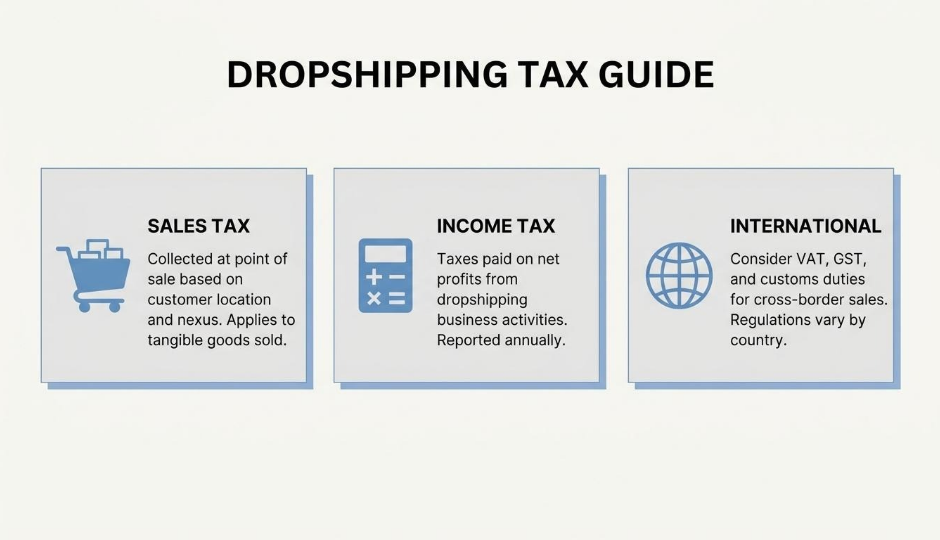
Private label dropshipping sellers in the US bear the same legal obligations as any retailer selling branded consumer products. The fact that a third-party supplier manufactures and ships the product does not remove the seller's liability for compliance. Cosmetics must follow FDA labeling rules. Textiles require FTC fiber content labels. Children's products need CPSC certification. Advertising claims must be truthful under federal and state law. Sellers who skip these steps risk fines, product seizures, and account suspensions.
According to the U.S. Food and Drug Administration's cosmetics labeling guide, cosmetics marketed in the United States must comply with the labeling requirements of the Federal Food, Drug, and Cosmetic Act and the Fair Packaging and Labeling Act, with ingredients declared in descending order of predominance. The Federal Trade Commission requires that most textile and wool products carry a label listing fiber content, country of origin, and the identity of the manufacturer or responsible business. The U.S. Consumer Product Safety Commission states that a Children's Product Certificate (CPC) is a statement of compliance created and issued by a manufacturer or importer, not a document applied for or registered with the CPSC.
Key compliance areas for US private label dropshipping sellers include:
For brands scaling private label operations, overlooking category-specific requirements is one of the most common and costly mistakes. A compliant foundation built early protects against enforcement actions and builds the consumer trust that sustains long-term growth.
You scale a private label dropshipping brand beyond launch by transitioning to inventory, adding subscriptions, and expanding into retail or multi-channel selling. Each strategy addresses a different growth ceiling.
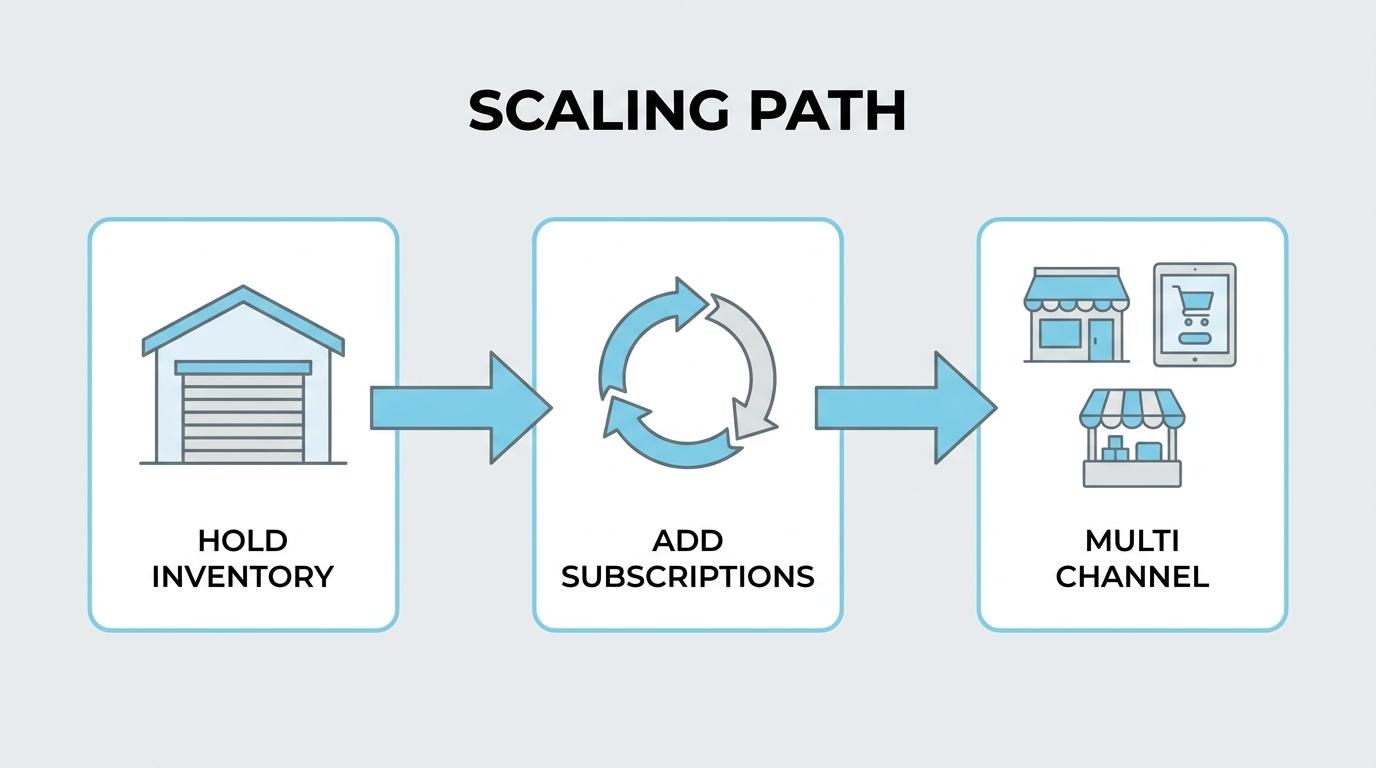
You should transition from dropshipping to holding inventory when per-unit costs, shipping speed, or stockout risk begin limiting growth. Traditional contract manufacturers require $5,000–$15,000 MOQs and 8–16 week lead times, according to Supliful, so the shift demands careful planning.
Signals that justify the move include:
A phased approach works best: hold inventory for top sellers while continuing to dropship newer or slower-moving products. This hybrid model reduces risk without requiring full warehouse commitment upfront.
You add subscription offers to private label products by identifying consumable or replenishable SKUs and building recurring purchase options into your storefront. Supplements, coffee, skincare, and pet supplies are natural fits because customers reorder on predictable cycles.
Key steps to launch subscriptions:
For brands already managing fragmented tools for subscriptions, consolidating recurring-revenue mechanics into the same system that runs the storefront eliminates sync issues between billing, fulfillment, and customer records.
You expand into retail or multi-channel selling by listing private label products across marketplaces, wholesale channels, and physical retail while maintaining consistent branding and pricing. According to the U.S. Census Bureau, e-commerce sales reached an estimated $1,192.6 billion in 2024, representing 16.1% of total retail sales; the remaining 83.9% signals substantial opportunity beyond a single online storefront.
Practical expansion paths include:
Multi-channel success depends on operational discipline. Each new channel adds complexity in inventory tracking, order routing, and customer communication. Brands that unify these operations inside a single platform rather than stacking channel-specific tools tend to scale with fewer breakdowns.
With scaling strategies mapped out, the next step is managing daily operations without tool sprawl.
You manage private label dropshipping without stacking tools by running product data, CRM, and marketing inside a single platform. The sections below cover what changes operationally and the key takeaways.
What changes is that product data, CRM, and marketing share one customer record instead of syncing across disconnected apps. Order history, browsing behavior, and lifecycle triggers all resolve in the same system, so segmentation and automation execute without manual CSV exports or third-party middleware.
For private label brands scaling past launch, this matters because branded product lines depend on repeat purchases. When a subscription app, email platform, and storefront each hold separate customer profiles, retention campaigns rely on incomplete data. A unified data layer lets lifecycle sequences fire based on actual purchase frequency, not best-guess syncs that lag by hours or days.
Some all-in-one platforms, including SHOPLINE, handle commerce, CRM, marketing automation, and subscriptions natively rather than requiring five to fifteen separate tools. For brands operating at real volume, consolidating the stack removes sync failures that quietly erode repurchase rates.
The key takeaways about private label dropshipping center on brand ownership, supplier vetting, and operational consolidation:
The brands that succeed treat private label dropshipping not as a shortcut, but as a brand-building model where supplier relationships, customer data, and retention mechanics work together from day one.