Wholesale boutique clothing is trend-driven apparel purchased in bulk from B2B suppliers at below-retail pricing, then resold through independent boutiques online or in store. The right supplier keeps per-unit costs low, inventory fresh, and margins healthy.
This guide covers supplier evaluation criteria, the 13 top wholesale boutique clothing suppliers in detail, wholesale pricing structures, trend sourcing, supplier vetting, domestic versus overseas sourcing trade-offs, profit margin calculations, US legal requirements, and multichannel inventory management.
Supplier evaluation starts with four factors: minimum order quantity, fabric quality, return policies, and shipping speed. MOQ requirements range from $0 at suppliers like Boulevard Apparel to €500 at Griffati, so matching a supplier's minimums to your capital and testing needs prevents overstock risk.
We profile 13 vetted suppliers, including FashionGo, Bloom Wholesale, Tasha Apparel, OrangeShine, Faire, Wholesale Central, and others spanning US-based, European, and UK wholesale platforms. Each listing covers MOQ, shipping terms, return policies, and category strengths.
Wholesale pricing operates on tiered discount structures where per-piece cost drops as order volume increases, with tops typically ranging from $8 to $15 per unit and accessories starting as low as $2 per piece. Calculating true landed cost, including shipping, duties, and carrying expenses, reveals actual margins per SKU.
Vetting and legal compliance protect those margins further. We walk through business license verification, sample order evaluation, resale certificate requirements, state tax registrations, and FTC labeling rules for textile products.
Finally, we cover how centralized inventory management across online and in-store channels prevents oversells and missed reorders, including how SHOPLINE unifies stock tracking, POS, and reorder workflows inside a single platform.
You should source wholesale boutique clothing because it lowers per-unit costs, gives access to trend-driven inventory, and protects profit margins at scale.
Buying wholesale eliminates middlemen between your boutique and the manufacturer. Suppliers in major fashion districts, such as Los Angeles and Miami, source styles directly from producers, which keeps markup low and selection current. Bloom Wholesale, for example, states that every style is sourced directly from the Los Angeles fashion district with no middlemen and no markup, offering flat-rate shipping of $9.95 on orders under $800.
Wholesale purchasing also lets boutique owners test new categories (dresses, plus size, accessories) without committing to large minimums. Many B2B platforms now require no MOQ, so smaller retailers can reorder frequently and match inventory to real-time demand.
The cost advantage compounds over time. Lower acquisition costs per piece mean wider retail margins on each sale, which creates room for promotions, seasonal markdowns, and customer loyalty programs without eroding profitability.
For boutique owners managing both online and in-store channels, consistent wholesale sourcing from reliable suppliers simplifies operations. Rather than juggling multiple one-off vendors, a curated supplier list keeps quality predictable and reorder cycles efficient. Understanding what to look for in a supplier is the next step to protecting those margins.
You should look for low minimum order quantities, consistent fabric quality, fair return policies, and fast shipping. These four factors protect margins and keep inventory moving.
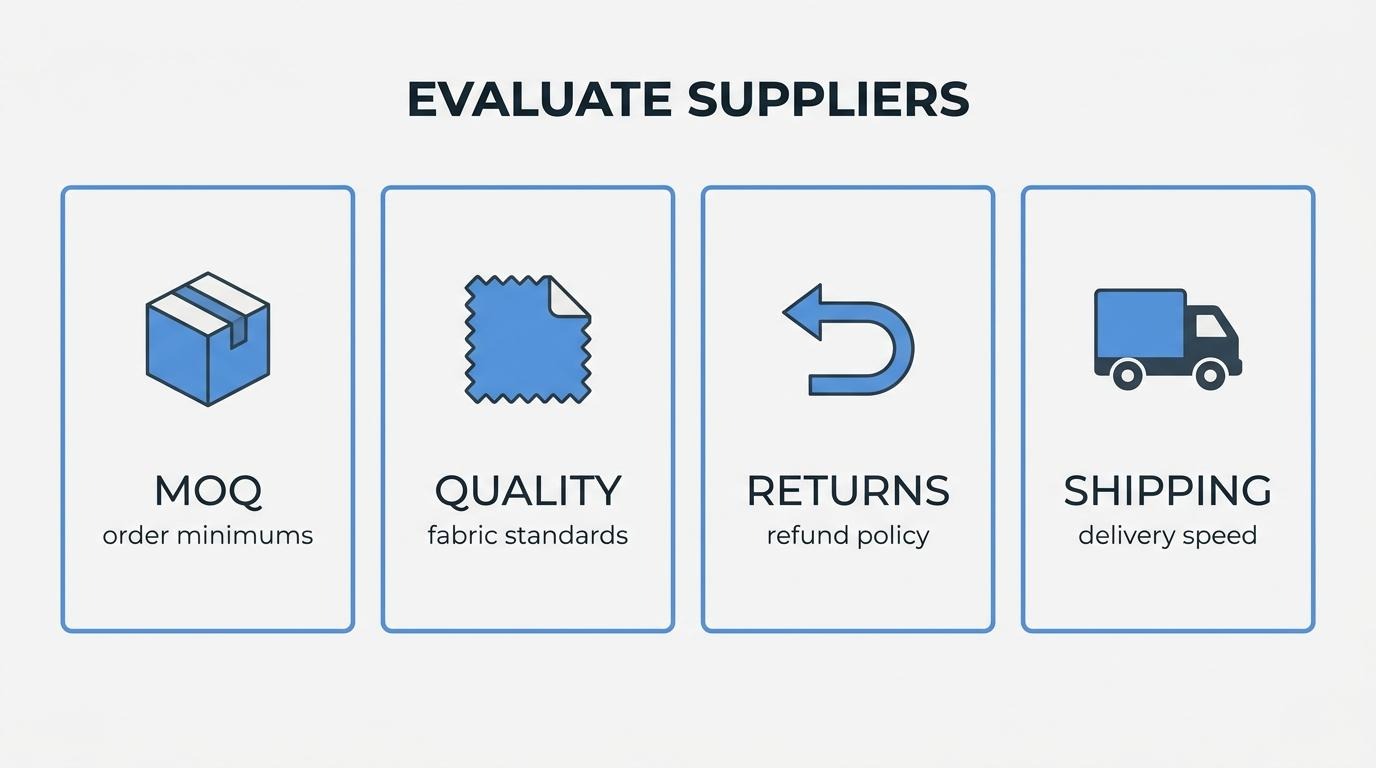
Minimum order quantity is one of the most critical factors for boutiques because it directly controls how much capital gets locked into a single purchase. Small retailers need flexibility to test styles before committing to large runs.
MOQ requirements vary widely across wholesale platforms:
According to a Lehigh University Manufacturing Logistics Institute paper, buyers negotiate order quantity and wholesale price simultaneously with sourcing suppliers. For newer boutiques, prioritizing suppliers with low or no MOQ requirements reduces the risk of overstock while preserving cash flow for marketing and operations.
Fabric quality plays a defining role in supplier selection because it determines return rates, customer satisfaction, and repeat purchases. Poor materials lead to complaints and erode brand credibility faster than any pricing advantage can offset.
According to SCORE, small businesses should evaluate suppliers on stability, quality, customer service, cost, compatibility, and the potential to build business credit. Request fabric swatches or sample packs before placing a full order. Check fiber content labels, stitching consistency, and wash durability. Boutique owners who skip this step often discover quality issues only after customers leave negative reviews.
You evaluate a supplier's return and refund policy by reviewing the return window, restocking fees, refund method, and any exclusions before placing your first order. These terms vary significantly, and a restrictive policy can leave you absorbing losses on damaged or incorrect shipments.
Key policy elements to compare include:
Some wholesale marketplaces do not publicly list return or exchange terms until after account registration is complete. Always request written policy documentation before committing to a new supplier relationship.
Shipping speed matters for boutique inventory because delayed deliveries create stockouts that cost sales and frustrate customers during peak demand windows. Seasonal trends in fashion move quickly; a two-week delay can render an entire order less sellable.
Fulfillment timelines differ substantially across suppliers. Magnolia Fashion Wholesale ships same-day for orders placed by 1:00 PM EST, with general delivery in 2 to 4 business days. International orders typically take 3 to 7 business days, with customs fees falling on the buyer. Faster turnaround from domestic suppliers reduces the gap between ordering and selling, which improves inventory turnover and frees up working capital for the next restock cycle.
With supplier evaluation criteria established, the next step is reviewing specific wholesale platforms that meet these standards.
The 13 best wholesale boutique clothing suppliers are FashionGo, Bloom Wholesale, Tasha Apparel, OrangeShine, LA Showroom, Wholesale Fashion Square, Faire, BrandsGateway, Wholesale Central, Griffati, Boulevard Apparel, Loved by Hannah and Eli, and Missi Clothing.
FashionGo is a wholesale marketplace that has partnered with retailers for over 20 years, connecting buyers with exclusive vendors and trend-driven insights. The platform offers free shipping on orders meeting low minimums: $100 for accessories and jewelry vendors, $300 for apparel vendors. Buyers can pay later in 60, 45, or 30 days. Full-access registration requires a company name, address, shipping address, and a copy of a seller's permit, with account review completed in one to two business days. For boutiques testing new categories, FashionGo's deferred payment terms reduce upfront cash risk considerably.
Bloom Wholesale supplies women's boutiques across the country with trendy, off-price wholesale clothing sourced directly from the Los Angeles fashion district. Buyers can purchase with no minimum order quantity, though registration requires a valid resale certificate or business license. Categories include new arrivals, off-price deals, dresses, and plus size. Consolidated shipping runs at a flat rate of $9.95 on orders under $800. According to Bloom Wholesale's official site, every style is sourced directly from the LA fashion district with no middlemen and no markup. That direct sourcing model keeps per-unit costs tight for boutiques managing lean inventories.
Tasha Apparel is one of the largest online wholesale boutique clothing vendors in Los Angeles, supplying products since 2005. The company enforces no minimum order value, though items are sold in packs of usually six pieces. Key shipping details include:
Returns are accepted for any reason with no restocking fees, provided buyers contact Tasha Apparel within seven business days of receiving the order. California businesses need a valid California Seller's Permit to register.
OrangeShine is a wholesale fashion shopping platform offering clothing, shoes, handbags, accessories, jewelry, beauty products, and home decor. The minimum order quantity typically starts at $100, though this may vary by vendor. Buyers benefit from flat-rate shipping and dedicated support. The platform's breadth across non-apparel categories, such as beauty and home decor, makes it useful for boutiques expanding beyond clothing into lifestyle merchandising.
LA Showroom operates at lashowroom.com and currently functions through a FashionGo-branded wholesale marketplace interface. Buyers must complete registration to access the full site, including product listings, pricing, and vendor catalogs. Because LA Showroom does not publish distinct MOQ, shipping, or return policies separately from FashionGo, prospective buyers should register and review vendor-specific terms directly on the platform before placing orders.
Wholesale Fashion Square creates and ships all items from the USA, sourced from fashion producers in Los Angeles. The product catalog covers dresses, tops, skirts, jeans, outerwear, jewelry, accessories, scarves, and bags. Special discounts apply for boutiques ordering in bulk, with example pricing at $8.75 per unit for a six-piece package. According to Wholesale Fashion Square's website, the supplier guarantees quality by sourcing exclusively from top LA fashion producers. For boutiques prioritizing domestic sourcing and faster delivery windows, that USA-based supply chain eliminates customs delays entirely.
Faire is a wholesale marketplace listing women's apparel categories including knitwear, sweaters, jeans, matching sets, dresses, intimates, outerwear, jumpsuits, and rompers. Brand order minimums vary; examples include LE LIS at $60, MIOU MUSE at $100, Le Bon Shoppe at $300, and JUST BLACK DENIM at $100. Faire offers free returns on a buyer's first order with every brand. That first-order return policy significantly lowers the risk of testing unfamiliar brands, which is a practical advantage for boutiques curating new collections.
BrandsGateway is a wholesale supplier specializing in designer and premium fashion brands at below-retail pricing. The platform caters to boutiques, online retailers, and resellers seeking authenticated luxury inventory. Product categories typically include clothing, shoes, bags, and accessories from recognized designer labels. Boutiques targeting a higher price point can use BrandsGateway to stock brand-name pieces that command stronger retail margins than unbranded wholesale alternatives.
Wholesale Central is a free-access B2B wholesale marketplace connecting buyers with America's top wholesalers. The platform is strictly B2B, with no consumer access. Apparel categories span outerwear, vintage, bridal and wedding, leggings, plus size clothing, jeans and denim, lingerie, sportswear, t-shirts, women's clothing, formalwear, juniors, and urban clothing. According to Wholesale Central, suppliers pay 0% commission, and exclusive deals and promotions are posted daily for registered buyers. That zero-commission structure often translates into more competitive pricing for boutique owners.
Griffati is a European wholesale supplier with a minimum order of €500 excluding taxes and shipping. Dropshipping orders have no minimum requirement. Orders are prepared within 24 to 72 working hours from payment receipt, with delivery generally taking two to five working days. Key return conditions include:
Customs duties may apply for orders shipped outside the European Union, so U.S.-based boutiques should factor those costs into landed-price calculations.
Boulevard Apparel is a wholesale clothing supplier with no minimum order requirements and free ground shipping on all orders over $299 in the continental United States. The catalog specializes in outerwear and outdoor clothing, covering jackets, vests, sportswear, hoodies, jeans, dresses, and tops for women, men, and kids. Sale categories range from 10% to 50% off select items. Returns are accepted within seven days on unopened packages, with a 20% restocking fee and only exchange or merchandise credit available.
Loved by Hannah and Eli is a wholesale supplier focused on boutique-style women's and children's clothing. The brand curates trend-forward pieces with an emphasis on seasonal collections and family-matching styles. Boutique buyers typically access the catalog through a wholesale registration process that verifies business credentials. For shops building a niche around family or mommy-and-me fashion, this supplier fills a category gap that broader wholesale platforms often overlook.
Missi Clothing is a UK-based wholesale fashion supplier offering women's clothing at competitive bulk pricing. Categories commonly include dresses, tops, jumpsuits, loungewear, and occasion wear. The supplier ships internationally, making it accessible to U.S. boutique owners seeking European-influenced styles. Boutiques importing from Missi Clothing should account for international shipping timelines and potential customs duties when calculating total landed cost.
With these 13 suppliers mapped, the next step is understanding how wholesale pricing structures affect your margins.
Wholesale boutique clothing prices work through tiered discount structures, where per-piece cost drops as order volume increases. The sections below break down typical pricing for tops, dresses, and accessories.
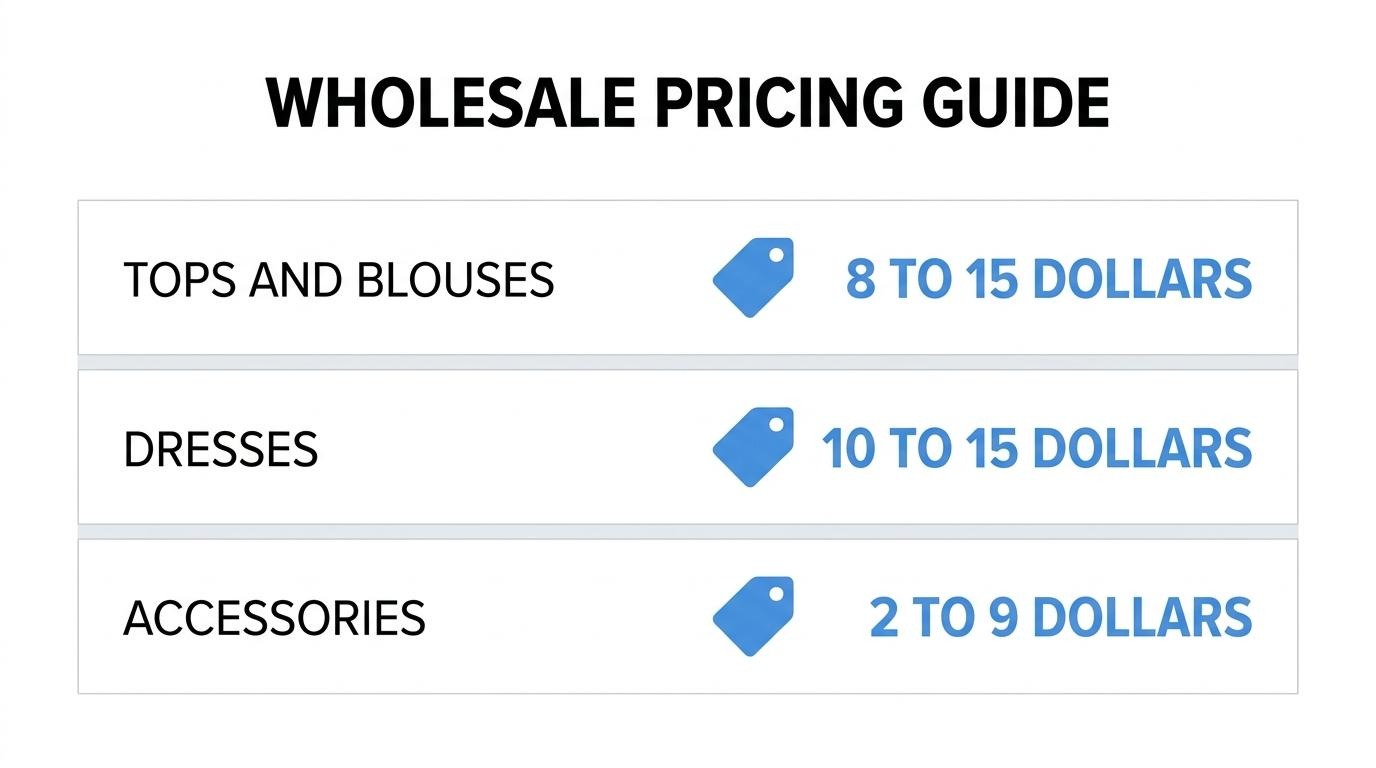
Wholesale boutique tops and blouses typically cost between $8 and $15 per piece at base wholesale pricing, with tiered discounts reducing that cost further at higher order volumes. According to Good Stuff Apparel, a Los Angeles wholesale fashion destination operating since 1985, buyers unlock graduated savings: 10% off at $100, 15% off at $150, 20% off at $250, 25% off at $325, and 30% off at $375 in total spend.
These tiers mean a $10 top could drop to $7 per unit on a larger order. For boutique owners working with tight margins, consolidating top purchases into a single larger order often yields better unit economics than placing several small reorders.
Wholesale boutique dresses cost roughly $10 to $15 per piece from most LA-based suppliers, though pricing varies by fabric weight, construction, and embellishment. Tasha Apparel, for example, lists dress styles at $14.25 per piece and advertises tiered discounts of 15%, 20%, and 25% that apply as order value increases. All items are sold in packs of usually six pieces.
Dresses carry higher per-unit costs than tops because they require more material and labor. However, they also support higher retail markups, often 2.5x to 3x wholesale cost. Prioritizing styles with broad seasonal appeal helps reduce the risk of unsold inventory eating into those margins.
Wholesale boutique accessories cost significantly less per unit than apparel, with many items priced between $2 and $9 per piece. Suppliers like Tasha Apparel include wholesale fashion jewelry and accessories alongside their clothing lines, and marketplace platforms often set lower minimums for accessory orders. FashionGo, for instance, requires just $100 for accessories and jewelry vendors compared to $300 for apparel.
Accessories serve a strategic role beyond their low unit cost. They increase average order value at retail without requiring significant inventory investment. Stocking complementary pieces alongside core apparel categories is one of the simplest ways to improve per-transaction revenue.
Understanding wholesale price tiers across categories makes margin planning more predictable when selecting suppliers.
You find trending wholesale boutique styles on B2B wholesale marketplaces, LA Fashion District suppliers, trade shows, and social media trend-tracking tools. Each source offers different advantages for spotting emerging styles before they peak.
The most reliable starting points are online wholesale platforms that aggregate vendors and update inventory daily. FashionGo, OrangeShine, and Faire each surface bestseller data and new arrivals from hundreds of vendors, giving boutique buyers a real-time window into what is moving. Wholesale directories like Wholesale Central list suppliers across dozens of apparel subcategories, from plus size clothing to vintage and formalwear, making it easier to spot niche trends gaining traction.
Los Angeles remains the epicenter of domestic wholesale fashion sourcing. Suppliers such as Bloom Wholesale, Tasha Apparel, and Good Stuff Apparel ship directly from the LA Fashion District, where proximity to designers and manufacturers means new styles hit catalogs weeks before they appear on mass-market retail sites.
Beyond supplier platforms, boutique owners track trends through:
Relying on a single source creates blind spots. The most consistently well-stocked boutiques combine marketplace trend data with social listening and their own sell-through analytics to validate which styles deserve a reorder. Understanding where to find trends is one thing; confirming a supplier is legitimate before placing an order is equally critical.
You vet a new wholesale boutique supplier by verifying business credentials, ordering samples before committing, and checking independent reviews. The following subsections cover license verification, sample evaluation, and what ratings reveal.
You verify a supplier's business license by requesting their registration documents and cross-referencing them against state databases. Licensing requirements vary significantly by state. According to the State of North Carolina, there is no single generic business license that ensures compliance with all requirements; some businesses may be subject to several state requirements while others may not be subject to any.
Because regulations differ, take these steps when verifying a supplier:
A valid license alone does not guarantee product quality, but its absence is a clear disqualifier.
You request and evaluate sample orders by placing a small test purchase before committing to bulk inventory. Samples reveal fabric weight, stitching consistency, color accuracy, and how garments hold up after washing.
When evaluating a sample order, focus on these criteria:
Not every supplier offers samples. Some sell only in pre-set packs, so ordering the smallest available pack serves the same screening purpose. Skipping this step is one of the most common and costly mistakes new boutique owners make.
Supplier reviews and ratings tell you how consistently a wholesaler delivers on quality, shipping timelines, and customer service after the sale. Star ratings provide a quick snapshot, but the written details matter more.
Prioritize these signals when reading reviews:
A supplier with a handful of negative reviews among hundreds is normal. A pattern of the same complaint across different buyers, however, signals a risk worth avoiding. With supplier credibility confirmed, the next consideration is whether to source domestically or overseas.
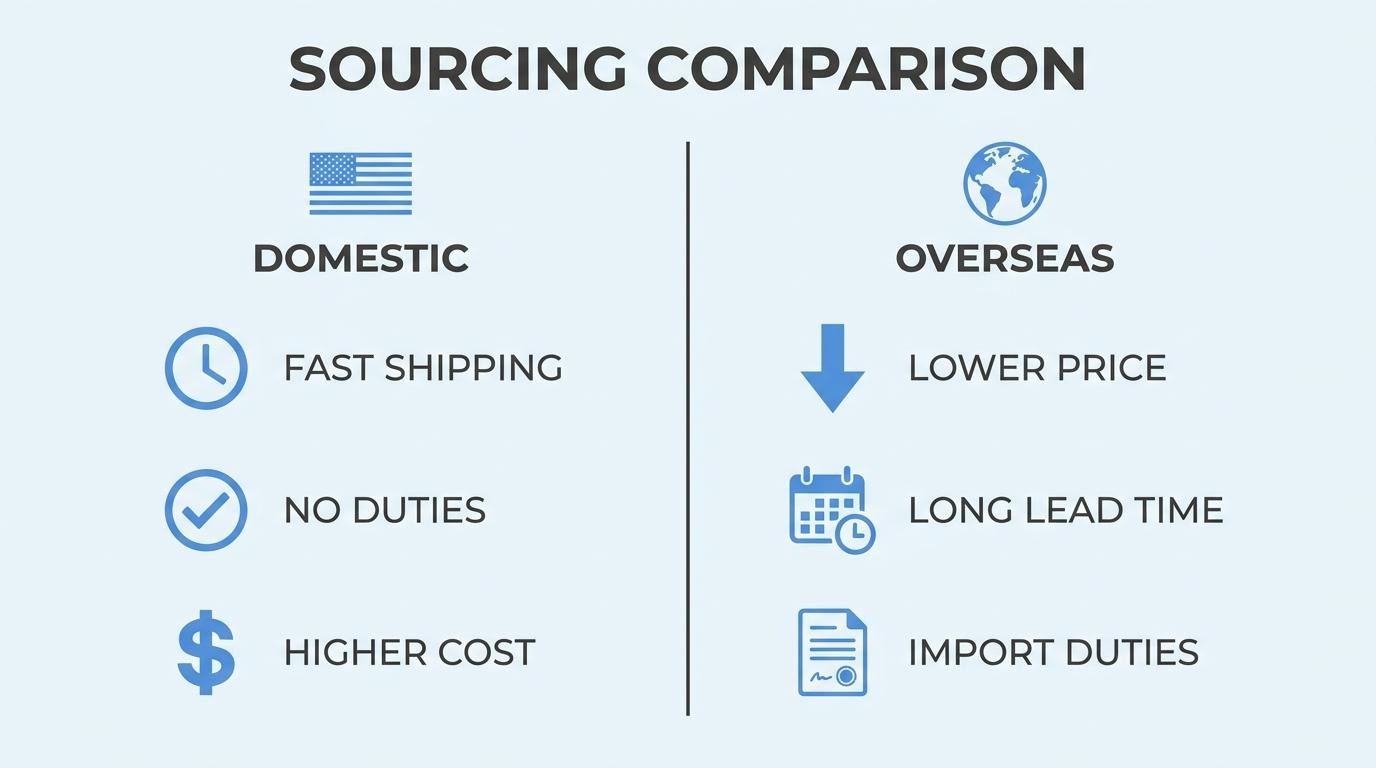
The differences between domestic and overseas suppliers center on lead times, import compliance, cost structure, and supply chain resilience. Each sourcing path creates distinct trade-offs for boutique buyers.
Domestic suppliers, primarily concentrated in hubs like the Los Angeles fashion district, ship within days and eliminate customs paperwork entirely. Overseas suppliers typically offer lower per-unit costs but introduce import duties, longer transit times, and regulatory complexity. The Harmonized Tariff Schedule of the United States, administered by U.S. Customs and Border Protection, sets tariff rates and statistical categories for all merchandise imported into the country, according to the United States International Trade Commission. Every overseas clothing shipment must be classified under the correct HTS code before clearing a U.S. port of entry.
Beyond tariffs, textile imports carry origin-of-manufacture rules. U.S. Customs and Border Protection applies a "yarn-forward" rule for NAFTA-qualifying textile and apparel articles, meaning the yarn used to form the fabric must originate in a NAFTA country to receive preferential duty treatment. Boutique owners importing from non-NAFTA regions face standard duty rates that vary by fiber content, garment construction, and country of origin.
The practical differences break down across several dimensions:
For most boutique owners carrying limited capital, domestic sourcing reduces risk at the expense of slightly higher unit costs. Overseas suppliers make more sense once order volumes justify the compliance overhead and longer cash-to-inventory cycles. The right balance often involves a mix: domestic partners for fast-turn, trend-responsive restocks and overseas vendors for staple categories with predictable demand.
Understanding these sourcing trade-offs directly affects how boutique owners protect their margins when calculating wholesale-to-retail pricing.
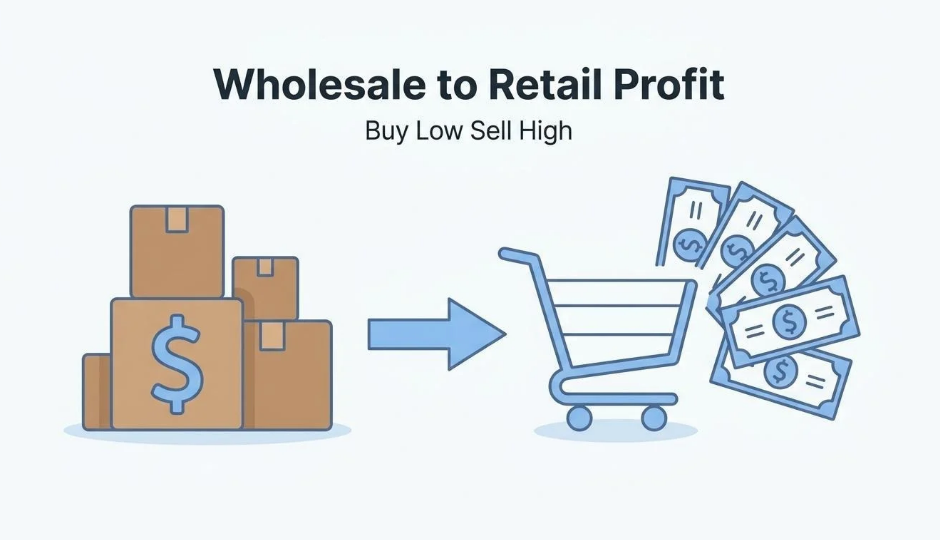
You calculate profit margins on wholesale boutique items by subtracting your total cost per unit from your retail selling price, then dividing that difference by the retail price. The subsections below cover the core formula, the hidden costs that erode margins, and a practical markup example.
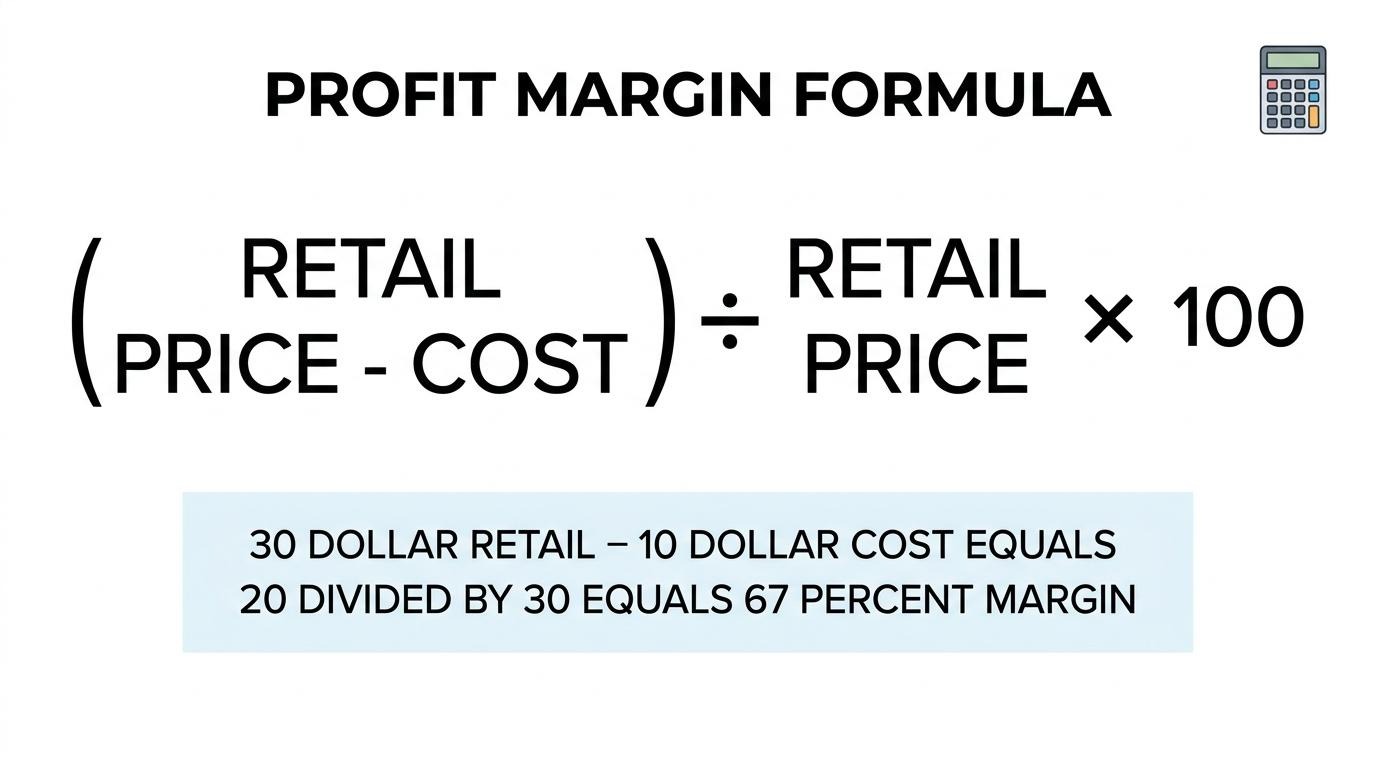
The basic profit margin formula for boutique clothing is: (Retail Price − Cost of Goods) ÷ Retail Price × 100. If a wholesale dress costs $10.00 and retails at $30.00, the gross margin is 66.7%. Cost of goods includes the wholesale unit price plus inbound shipping and any applicable duties. Boutique owners commonly target a 50% or higher gross margin to cover operating expenses and still generate profit. According to the U.S. Bureau of Labor Statistics, clothing stores saw margin productivity increase 3.1% annually over the 2007–2022 period, confirming that pricing discipline compounds over time. Tracking this formula per SKU, not just per order, reveals which items actually contribute to the bottom line.
Hidden costs that lower your actual margin include carrying costs, shrinkage, markdowns, and transaction fees. Inventory carrying cost covers storage, insurance, taxes, handling, and the opportunity cost of capital tied up in unsold stock. According to the National Retail Federation's 2023 National Retail Security Survey, the average shrink rate rose to 1.6% in FY 2022, representing $112.1 billion in retail losses. Platform transaction fees, return shipping on defective goods, and end-of-season markdowns further compress what started as a healthy gross margin. Factoring these expenses into your per-unit cost calculation gives a realistic net margin rather than an inflated gross figure.
You set retail prices using wholesale cost and desired markup by applying a multiplier to your landed cost. A common starting point is the keystone markup: multiply the wholesale cost by two. For a top purchased at $8.00, keystone pricing sets the retail price at $16.00, yielding a 50% gross margin before hidden costs. Higher perceived-value items such as dresses or outerwear often support a 2.5× to 3× multiplier, while basics and commoditized styles may need to stay closer to 2×. The right multiplier depends on your brand positioning, competitor pricing, and the overhead costs discussed above.
Understanding margin mechanics at the SKU level positions boutique owners to make sharper purchasing decisions when evaluating wholesale suppliers.
The legal requirements that apply to buying wholesale in the US include obtaining a resale certificate, registering for a sales-and-use-tax number, and ensuring all apparel meets federal labeling rules. Requirements vary by state.
A resale certificate is required by most wholesale suppliers before they sell to you tax-free. This document indicates the purchaser intends to resell the item and report tax on the final sale. According to the California Tax Service Center, registered sellers may avoid sales tax by giving their supplier adequate documentation in the form of a resale certificate.
Without a properly completed exemption certificate on file, the seller is obligated to collect tax for the state in which the goods are delivered. Several wholesale platforms enforce this at registration; Bloom Wholesale, for example, requires a valid resale certificate or business license before approving a B2B account.
State registrations required for wholesale buyers vary because each state sets its own rules. In Georgia, any entity meeting the definition of a "dealer" must register for a sales-and-use-tax number regardless of whether sales are online, out of state, wholesale, or exempt. Some states, like California, require a seller's permit specifically tied to the product category. Others have no single generic business license; North Carolina notes that some businesses may be subject to several state requirements while others face none.
Before placing your first wholesale order, confirm requirements with your state's department of revenue. Overlooking a single registration can trigger back-tax liability, so treating this step as non-negotiable is worth the upfront effort.
Labeling laws that apply to wholesale clothing in the US are governed primarily by the Federal Trade Commission and the Code of Federal Regulations. According to the FTC, most textile and wool products must have a label listing fiber content, country of origin, and the identity of the manufacturer or another business responsible for marketing the item.
Care labels are also mandatory. Manufacturers and importers must attach care instructions so they can be seen or easily found when the product is offered for sale, including either a washing instruction or a drycleaning instruction. If you private-label wholesale goods, labeling compliance shifts to you. Verifying that every garment meets these standards before listing protects against FTC enforcement actions and customer disputes.
With legal foundations in place, the next step is managing inventory efficiently across every sales channel.
You manage wholesale inventory across multiple channels by centralizing stock data so every sales point reflects the same counts in real time. The subsections below cover omnichannel tracking challenges, manual reorder risks, and how SHOPLINE unifies boutique inventory.
Selling online and in-store complicates stock tracking because each channel draws from the same physical inventory without automatically communicating sales to the other. A dress sold at a pop-up booth may still show "in stock" on the website for hours, leading to oversells and canceled orders. According to GS1 US, standardized data communications help increase supply chain visibility, reduce losses, and improve profitability through enhanced inventory management. Without a consistent data language linking every point of sale, boutique owners end up reconciling spreadsheets manually each night, which invites errors that compound as channel count grows.
Wholesale reorders that are manual and disconnected create two costly problems: stockouts on bestsellers and overstock on slow movers. When a boutique owner tracks inventory in one spreadsheet, places wholesale orders through email, and logs sales from a separate POS, reorder timing relies on memory rather than data. Inventory management determines how much to order and when to order, as defined by the University of Kentucky. Disconnected workflows delay that decision, tying up capital in excess goods while popular SKUs sit at zero. For most boutiques, the margin between profitable and unprofitable often comes down to reorder speed, not supplier price.
SHOPLINE unifies boutique inventory without extra tools by housing commerce, POS, and stock management inside a single platform with one shared data layer. When a unit sells online, in-store counts update instantly, and the same applies in reverse. Reorder alerts, sales velocity data, and channel-level stock views all live in the same system, so owners skip the spreadsheet-to-email reorder cycle. This removes the sync issues that typically require separate inventory apps or middleware to solve.
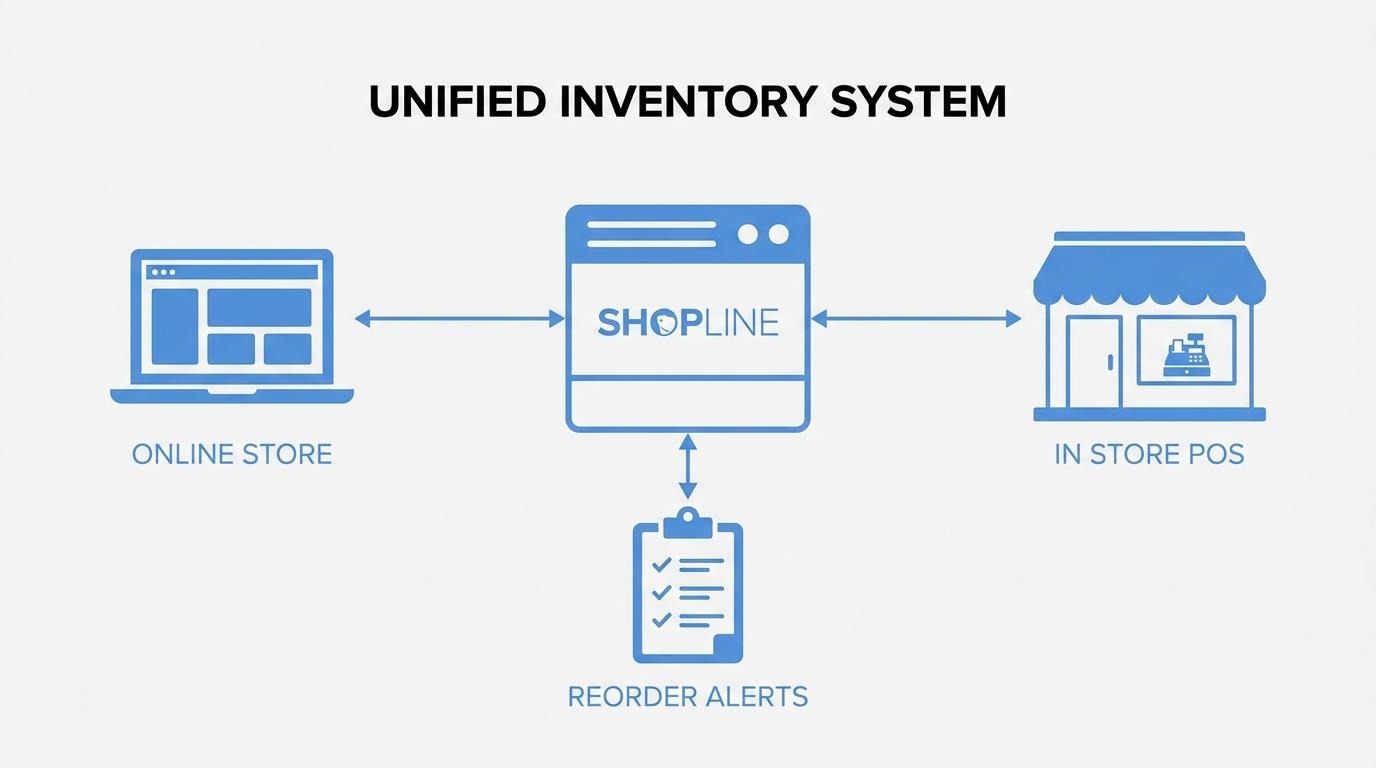
The key takeaways about wholesale boutique suppliers center on five decisions that protect margins and simplify operations:
Efficient inventory management boosts profitability and enhances visibility by keeping a steady inventory flow, as noted by the University of Tennessee's Global Supply Chain Institute. Choosing the right suppliers is only half the equation; pairing them with a unified system turns sourcing decisions into sustainable growth.