The best ecommerce platforms for small business are software systems that power online selling while supporting catalog management, checkout, payments, SEO, and order fulfillment. The right platform shapes total cost of ownership, daily operations, and long-term scalability.
This guide covers platform selection criteria, head-to-head comparisons of ten leading options, pricing and fee structures, multichannel and SEO capabilities, the trade-offs between all-in-one and app-stack approaches, and safe migration planning.
We break down what small businesses should evaluate before committing, including built-in marketing and CRM tools, scalability as revenue grows, transaction fee models, unified customer data for retention, and POS integration for omnichannel selling. Each factor carries different weight depending on your business model and growth stage.
The ten platforms we compare span a wide range: SHOPLINE, Shopify, BigCommerce, WooCommerce, Squarespace, Wix eCommerce, Adobe Commerce, Ecwid, Big Cartel, and Shift4Shop. Entry-level plans range from $0 to $35 per month, while per-transaction fees vary from 0% to 3.3% depending on provider and tier. We map these costs side by side so you can evaluate total cost of ownership rather than sticker price alone.
Beyond pricing, we examine how each platform handles selling across social media, marketplaces, and physical retail; which ones offer the deepest native SEO tooling; and how integration ecosystems differ in size and data connectivity. For brands running multiple disconnected tools, we detail the hidden costs of app fragmentation and when consolidating into a unified system measurably improves customer retention.
Finally, we walk through platform migration timelines, data transfer logistics, and the SEO and checkout risks to plan for before switching.
Choosing the right ecommerce platform matters because it determines your total cost of ownership, operational efficiency, and ability to scale revenue without outgrowing your infrastructure. The wrong choice locks a small business into costly workarounds, fragmented data, and migration headaches that compound over time.
An ecommerce platform is the software that makes it possible for a business to sell online. According to a University of Kansas Open Textbook on small business management, the core platform should support basic requirements such as custom styling, SEO, credit card processing, promotions, catalog management, analytics, product browsing, checkout, and order management. When any of these capabilities are missing or bolted on through third-party tools, complexity grows faster than revenue does.
The stakes are higher than they appear at launch. Before the pandemic, only 8.1% of businesses were selling products and services online, according to a study published in Heliyon via PubMed Central. Since then, digital commerce has become the primary sales channel for millions of small businesses, and the global B2B ecommerce market alone will grow at a 14.5% compound annual growth rate through 2026, per the International Trade Administration at the U.S. Department of Commerce. That rapid expansion means a platform decision made today will either support or constrain years of growth.
Small businesses face a unique tension: they need enterprise-grade capabilities in areas like multichannel selling, CRM, and marketing automation, but they rarely have the budget or team to manage a sprawling app stack. A UK Department for Science, Innovation and Technology report found that business risk profile, clarity of use case, affordability, and regulation were widely reported to exert strong influence on adoption decision-making. For small businesses specifically, affordability and clarity of use case carry disproportionate weight because every dollar and hour spent managing tools is a dollar and hour not spent acquiring customers.
Platform choice also shapes the customer experience across every touchpoint. As Marcos Galperin noted in a Stanford Graduate School of Business interview, "In addition to breadth and depth you have to have a seamless user experience, which means finding, buying, paying, and receiving products across platforms." That seamlessness depends directly on whether your platform unifies or fragments the buying journey.
For most small businesses operating at or approaching meaningful revenue, the real question is not which platform has the most features on a comparison chart. It is which platform reduces operational drag so the team can focus on growth rather than tool management. The sections ahead break down the specific criteria, from built-in marketing tools and scalability to transaction fees and unified customer data, that separate a platform that grows with you from one you will eventually need to leave behind.
Small businesses should look for an ecommerce platform that combines marketing tools, scalable infrastructure, transparent pricing, unified customer data, and POS capabilities. The following subsections break down each factor.
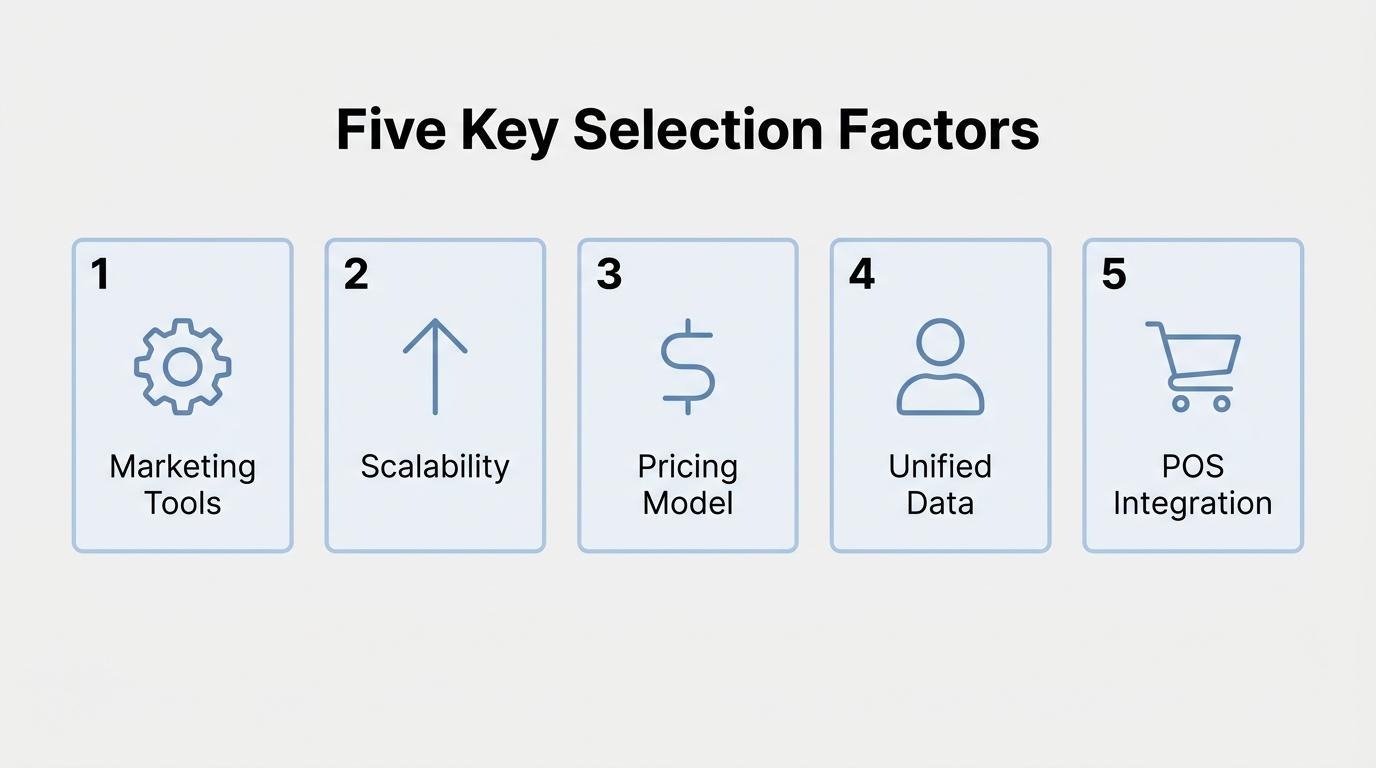
Built-in marketing and CRM tools are critically important because they eliminate the need to stitch together separate email, automation, and customer management apps. According to a University of Kansas Open Textbook on small business management, a core ecommerce platform should support promotions, analytics, and order management alongside the storefront itself.
Platforms that include email campaigns, abandoned cart recovery, and customer segmentation natively reduce both monthly costs and the operational friction of syncing data between disconnected tools. For most small businesses under $5M in revenue, the gap between a platform with native marketing and one requiring third-party add-ons can represent thousands of dollars annually, plus hours of manual reconciliation.
Scalability plays a decisive role because the platform a business chooses at $10K per month in revenue must still perform at $100K per month without a forced migration. According to the International Trade Administration at the U.S. Department of Commerce, the global B2B ecommerce market will grow at a 14.5% compound annual growth rate through 2026, signaling that small businesses riding this wave need infrastructure that expands with demand.
Key scalability factors to evaluate include:
Transaction fees and pricing models compare across three main structures: flat monthly subscriptions, per-transaction percentage fees, and hybrid models combining both. Some platforms charge additional gateway maintenance fees when merchants use third-party payment processors instead of the platform's native gateway.
Monthly plan costs for small business tiers typically range from $0 to $79 across major platforms, while per-transaction fees range from 0% to 3.3% depending on the plan and provider. According to the Volusion Help Center, merchants not using Volusion Payments Powered by Stripe face gateway maintenance fees of 1.25% on the Personal Plan and 0.65% on the Professional Plan. These layered costs add up quickly, making total cost of ownership the metric that matters most, not the sticker price alone.
Unified customer data matters for retention because it connects every touchpoint, including online purchases, email interactions, and in-store visits, into a single customer record. Without this unified view, retention campaigns rely on incomplete information, which leads to generic messaging and missed opportunities for personalized follow-up.
When purchase history, browsing behavior, and support interactions live in one place, businesses can segment audiences precisely and trigger lifecycle campaigns based on actual behavior. According to a 2021 study published in Sustainability (MDPI), organizations that deliver a seamless experience across channels maintain competitiveness and ensure a sustainable future. Fragmented data across five or more tools is one of the most common reasons small brands plateau on repeat purchase rates.
A small business should prioritize POS integration when it sells through both online and physical channels, such as a retail storefront, pop-up events, or farmers markets. Disconnected POS and ecommerce systems create duplicate inventory counts, split customer profiles, and manual reconciliation tasks that consume hours each week.
Businesses generating even 10-15% of revenue from in-person sales benefit from a platform where online and offline transactions share the same inventory and customer data layer. This matters most for verticals like food and beverage, fashion, and home goods where omnichannel selling is standard. Choosing a platform with native POS eliminates one of the most common pain points brands encounter when scaling past their first channel.
With platform selection criteria defined, the next step is comparing specific platforms side by side.
The best ecommerce platforms for small businesses are SHOPLINE, Shopify, BigCommerce, WooCommerce, Squarespace, Wix eCommerce, Adobe Commerce, Ecwid, Big Cartel, and Shift4Shop. Each platform serves different business models, budgets, and growth stages.
SHOPLINE is an all-in-one ecommerce platform that unifies commerce, CRM, marketing automation, subscriptions, and POS inside a single system. The Starter plan begins at $29/mo with a 14-day free trial requiring no credit card. Built-in features include SmartPush email marketing, AI tools, inventory management, checkout, and multi-channel selling across your online store and social commerce. SHOPLINE Payments accepts Visa, MasterCard, American Express, Apple Pay, and Google Pay. According to a Google Cloud case study, SHOPLINE merchants achieved a 250% increase in order conversion rates through faster networks and data-driven marketing insights. For scaling DTC brands tired of stitching together separate tools, this shared-data-layer approach eliminates common sync issues.
Shopify is a hosted ecommerce platform offering four pricing tiers: Basic at $29/mo, Grow at $79/mo, Advanced at $299/mo, and Plus from $2,300/mo. Core features across all plans include inventory management, social and marketplace selling, customer segmentation, email campaigns, marketing automations, abandoned checkout recovery, and built-in fraud analysis. The Shopify App Store provides over 16,000 apps for store customization. This extensive ecosystem makes Shopify a strong fit for merchants who prefer assembling specialized tools, though app costs can compound as a business scales.
BigCommerce is an ecommerce platform with built-in enterprise features at mid-market pricing. Plans range from Core at $29/mo (billed annually) to Performance with custom pricing starting at $1,499/mo. Native capabilities include multi-currency support, customer groups and segmentation, abandoned cart recovery, a built-in blog, professional reporting, POS integrations, and marketplace and social channel connections. BigCommerce validates PCI DSS compliance annually across all 12 requirements. Orders processed through embedded payment providers incur no additional fees, which keeps costs predictable for growing catalogs.
WooCommerce is a free, open-source ecommerce plugin for WordPress with over 7 million active installations. The core platform costs nothing, but hosting typically runs $25 to $350/mo depending on traffic and performance needs. Extensions range from $29 to $299/year each. According to WordPress.org, merchants can sell physical goods, digital downloads, subscriptions, bookings, memberships, and affiliate items through developer-vetted extensions. WooCommerce suits technically comfortable teams who want full control over their stack, though total cost of ownership rises quickly once hosting, security, and premium extensions are factored in.
Squarespace is a design-forward ecommerce platform known for its polished templates and managed hosting. A 14-day free trial is available, and annual billing saves up to 36%. Transaction fees are 2% on the entry-level commerce plan and 0% on higher tiers. Built-in features include SEO tools, unlimited products, gift cards, subscriptions, abandoned cart recovery, point of sale, and customer accounts. Squarespace Payments accepts Klarna, Afterpay, Apple Pay, ACH, and all major credit cards. The platform's fully managed cloud hosting delivers 99.9% uptime. For brand-conscious small businesses prioritizing visual storytelling, Squarespace remains one of the most intuitive options available.
Wix eCommerce is a website-builder-based platform with ecommerce functionality starting at $17.77/mo for the Light plan and scaling to $159.77/mo for Business Elite (annual billing). A free plan is also available. Wix supports over 100 payment providers, including credit cards, wallet payments, buy-now-pay-later, and cryptocurrency. The Wix App Market offers more than 800 web apps for extending store functionality. Wix Payments complies with PCI DSS standards. This platform works well for small businesses that want drag-and-drop simplicity, though merchants with complex catalog or multi-channel needs may find the commerce toolset limiting at higher volumes.
Adobe Commerce is an enterprise-grade, self-hosted ecommerce platform built on the open-source Magento framework. It provides deep customization through PHP-based architecture, multi-store management, advanced catalog rules, and B2B-specific features such as custom pricing, quote workflows, and requisition lists. Pricing is custom and typically starts well above other platforms on this list, making it best suited for businesses with dedicated development resources. Smaller teams without in-house developers face steep implementation and maintenance costs. Adobe Commerce fits complex operations that have outgrown simpler hosted solutions, but it is rarely the right starting point for early-stage small businesses.
Ecwid is an embeddable ecommerce widget that adds a store to any existing website, social page, or marketplace listing. Plans start at $5/mo for Starter and scale to $149/mo for Unlimited, with zero per-sale fees on all tiers. Ecwid integrates with over 70 payment options and provides product, order, and customer profile management. According to an AMP Project case study, Ecwid merchants increased sales from abandoned shopping carts by 82% using AMP for email. This embed-anywhere approach is ideal for small businesses that already have a website and want to layer on commerce without rebuilding from scratch.
Big Cartel is a minimalist ecommerce platform built for independent artists and makers. After a 7-day free trial, plans cost $15/mo for Platinum and $30/mo for Diamond. Big Cartel charges no additional transaction fees; payments process through PayPal and Stripe. Features include physical and digital product sales, shipping label printing, order tracking, in-person selling, inventory tracking, discounts, and Google Shopping integration. According to a Backblaze case study, Big Cartel has hosted over one million websites through which independent shop owners have sold more than $2.5 billion in creative work. For small-catalog creators who value simplicity over feature depth, Big Cartel delivers exactly what is needed.
Shift4Shop is a hosted ecommerce platform that offers a free plan for U.S. merchants who process payments through Shift4. The platform includes built-in features such as product management, order processing, customer relationship tools, and marketing capabilities. Shift4Shop supports a range of store templates and provides API access for custom integrations. Its zero-monthly-cost model, tied to using Shift4 as the payment processor, makes it appealing for budget-conscious small businesses looking to minimize fixed overhead. However, merchants who prefer flexibility in choosing their payment gateway may find this requirement restrictive.
With each platform's core strengths outlined, comparing their pricing side by side reveals how monthly costs and fees stack up across tiers.
These ecommerce platforms compare on pricing across a wide range, from free open-source options to plans exceeding $2,000 per month. Monthly fees, transaction charges, and hidden costs like hosting or extensions vary significantly by provider.
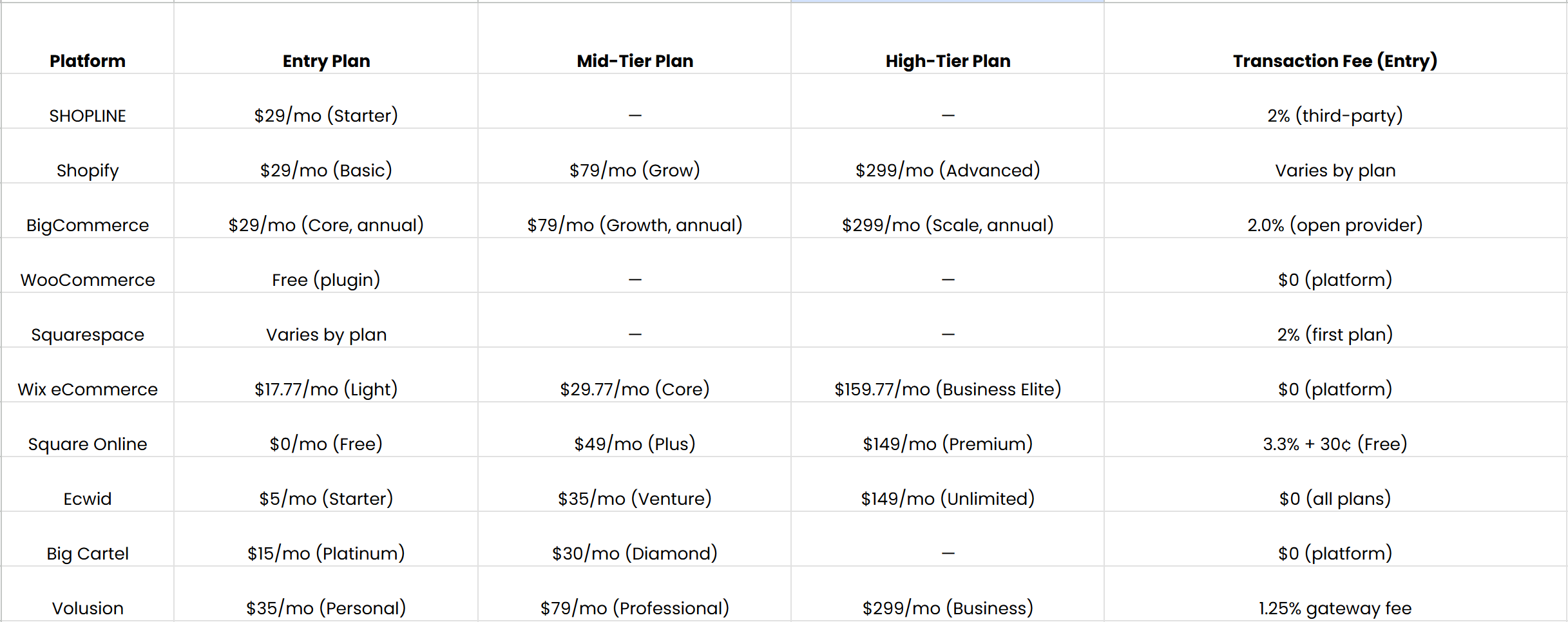
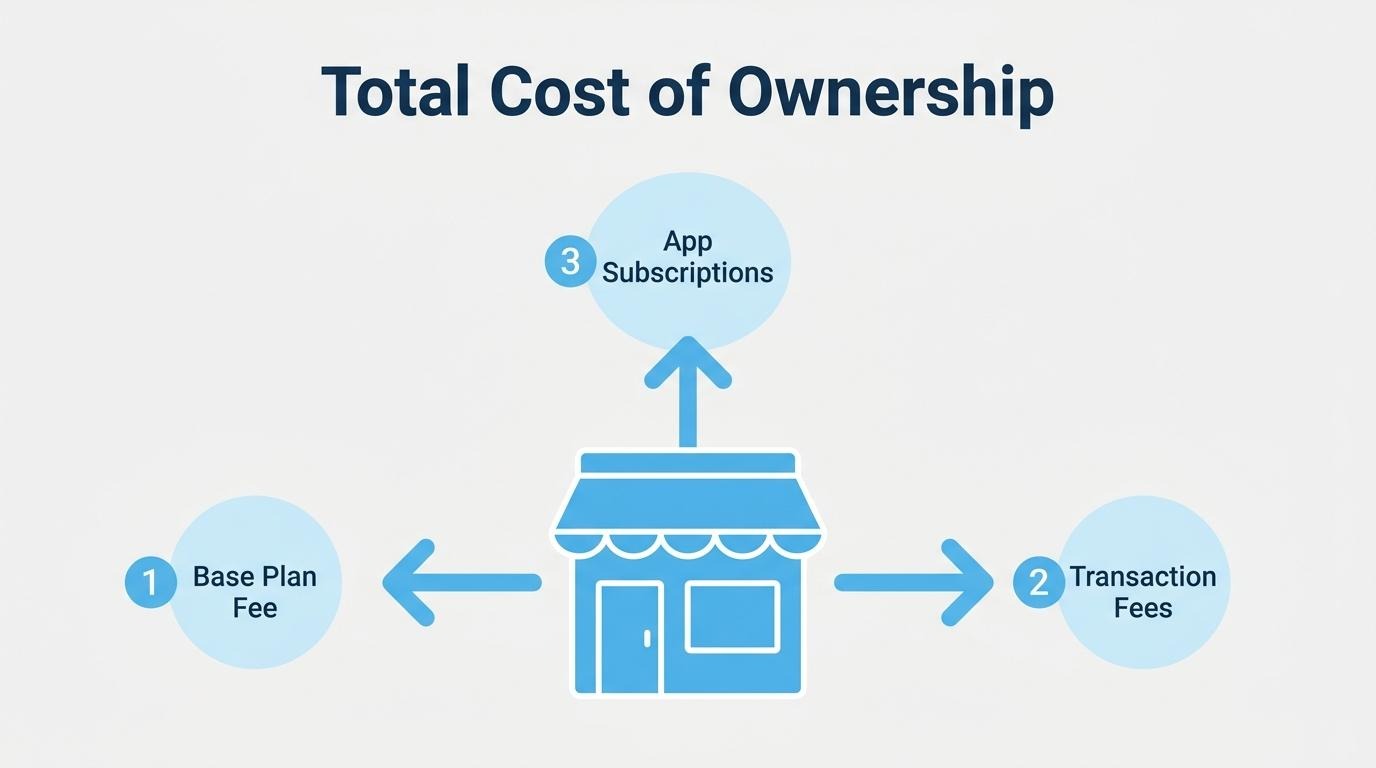
Sticker price alone does not reflect total cost of ownership. WooCommerce's free plugin, for instance, requires separate hosting at $25 to $350 per month plus extensions at $29 to $299 per year each, according to WooCommerce's own pricing page. Similarly, Volusion charges gateway maintenance fees of 1.25% on its Personal plan when merchants do not use Volusion Payments Powered by Stripe.
Platforms with zero platform transaction fees, such as Ecwid and Big Cartel, still pass through payment processor charges from Stripe or PayPal. Square Online's free tier carries the highest processing rate at 3.3% plus 30 cents per transaction, which adds up quickly at volume.
For scaling DTC brands evaluating true costs, the app-stack layer matters as much as the base subscription. When CRM, marketing automation, and subscriptions require separate paid tools, monthly expenses can quietly double or triple the advertised plan price. Platforms that bundle these features natively tend to deliver more predictable costs as order volume grows.
With pricing structures mapped, the next comparison point is how each platform handles multichannel selling.
These platforms handle multichannel selling by connecting your online store to social media, marketplaces, and in-person POS systems, though the depth of integration varies significantly. Below is a comparison of how each platform approaches multichannel commerce.
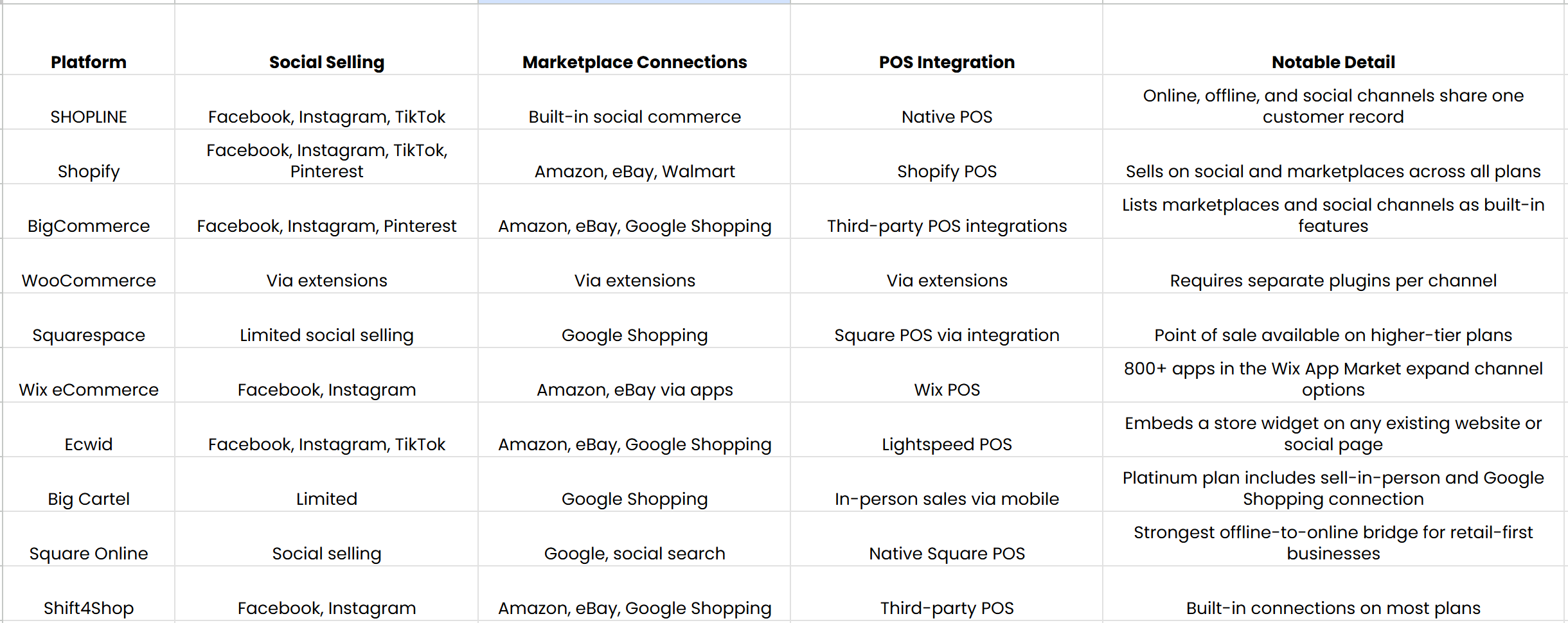
According to a 2021 study published in Sustainability (MDPI), organizations beyond retailing are embracing omnichannel strategy to maintain competitiveness, deliver seamless cross-channel experiences, and ensure a sustainable future.
The real differentiator for small businesses is not how many channels a platform lists, but whether customer data stays unified across those channels. Platforms that treat each channel as a separate silo force merchants to reconcile orders, inventory, and customer profiles manually. For brands scaling past their first few hundred orders per month, that fragmentation becomes an operational bottleneck worth evaluating early.
With multichannel reach established, the next factor to evaluate is how each platform helps customers find your store organically.
The platforms offering the best built-in SEO tools are those that include editable meta tags, clean URL structures, auto-generated sitemaps, and structured data without requiring third-party apps. Here is how the leading options compare.
According to the University of Kansas Open Textbook on small business management, a core ecommerce platform should support basic requirements such as search engine optimization (SEO), catalog management, analytics, and product browsing. That baseline makes SEO tooling a standard expectation, yet the depth of implementation varies considerably across platforms.
Built-in SEO tools on ecommerce platforms generally cover several core capabilities:
Shopify includes editable meta fields, automatic sitemaps, canonical tags, and structured data for products. Its blogging engine supports content marketing, though advanced technical SEO adjustments often require apps or theme-level code edits. WooCommerce, built on WordPress, offers the deepest SEO flexibility through full control over sitemaps, robots.txt, heading hierarchy, and schema; however, this control typically requires extensions like Yoast or RankMath plus ongoing maintenance.
BigCommerce provides native SEO features such as customizable URLs, automatic 301 redirects when URLs change, microdata for rich snippets, and a built-in blog. Squarespace includes SEO tools, clean URLs, SSL certificates, and auto-generated sitemaps across all plans. Wix eCommerce offers an SEO setup checklist, editable meta tags, structured data, and robots.txt editing. Square Online bundles SEO tools into its website builder across all plan tiers, including its free plan.
For small businesses that want SEO handled natively without assembling plugins, platforms with deeper out-of-the-box coverage reduce both setup time and ongoing technical debt. The real differentiator is not whether a platform "has SEO" but whether it handles structured data, redirects, and crawl management without forcing you into a third-party app for each feature.
With SEO capabilities mapped, the next consideration is how integrations and app ecosystems extend each platform's functionality.
Integrations and app ecosystems differ in size, openness, and how deeply third-party tools connect to each platform's core commerce data. The range spans from marketplaces with thousands of apps to platforms with tightly curated, smaller extension libraries.
Shopify operates the largest ecommerce app ecosystem. According to the Shopify App Store, the platform offers over 16,000 apps covering everything from email marketing and loyalty programs to inventory sync and fulfillment automation. This breadth gives merchants nearly unlimited customization options, though managing multiple paid apps introduces subscription costs and potential data silos that compound as a store scales.
WooCommerce takes a different approach through its open-source extension model. With over 7 million active installations reported by WordPress.org, WooCommerce merchants access developer-vetted extensions for subscriptions, bookings, memberships, and digital downloads. Each extension typically costs $29 to $299 per year, so total costs depend entirely on how many a merchant installs.
BigCommerce emphasizes built-in features that reduce app dependency. Its core plans include multi-currency support, customer segmentation, abandoned cart recovery, POS integrations, and marketplace connections without requiring third-party apps. When merchants do need extensions, BigCommerce maintains a curated app marketplace focused on enterprise-grade integrations.
Wix eCommerce provides the Wix App Market with over 800 web apps, covering design tools, marketing, analytics, and payments. While smaller than some competitors, the ecosystem is tightly integrated with the Wix editor, which simplifies installation for non-technical users.
Squarespace Commerce relies on a selective integration approach rather than a large open marketplace. Key connections include Mailchimp, Zapier, and native tools for SEO, gift cards, and subscriptions. This curated model keeps the experience streamlined but limits flexibility for merchants needing specialized third-party tools.
Ecwid integrates with over 70 payment options and connects to existing websites, social channels, and marketplaces. Its embeddable widget model means merchants can add commerce functionality to platforms they already use without rebuilding from scratch.
Big Cartel and Volusion offer the most focused ecosystems. Big Cartel connects to PayPal, Stripe, and Google Shopping; Volusion supports four payment gateways including Volusion Payments powered by Stripe, PayPal, Authorize.net, and NMI.
For scaling DTC brands running five or more third-party tools, ecosystem size alone is not the deciding factor. The real question is whether each integration shares customer data cleanly or creates another silo that requires manual reconciliation. Platforms with natively unified data layers tend to reduce operational overhead more effectively than those requiring merchants to stitch tools together, even when those tools individually perform well.
Understanding how integration depth shapes daily operations leads directly into the trade-offs between all-in-one platforms and app-stack approaches.
The pros and cons of an all-in-one vs app-stack approach center on cost transparency, operational efficiency, and customer data continuity. The sections below examine hidden expenses, workflow fragmentation, and retention outcomes.
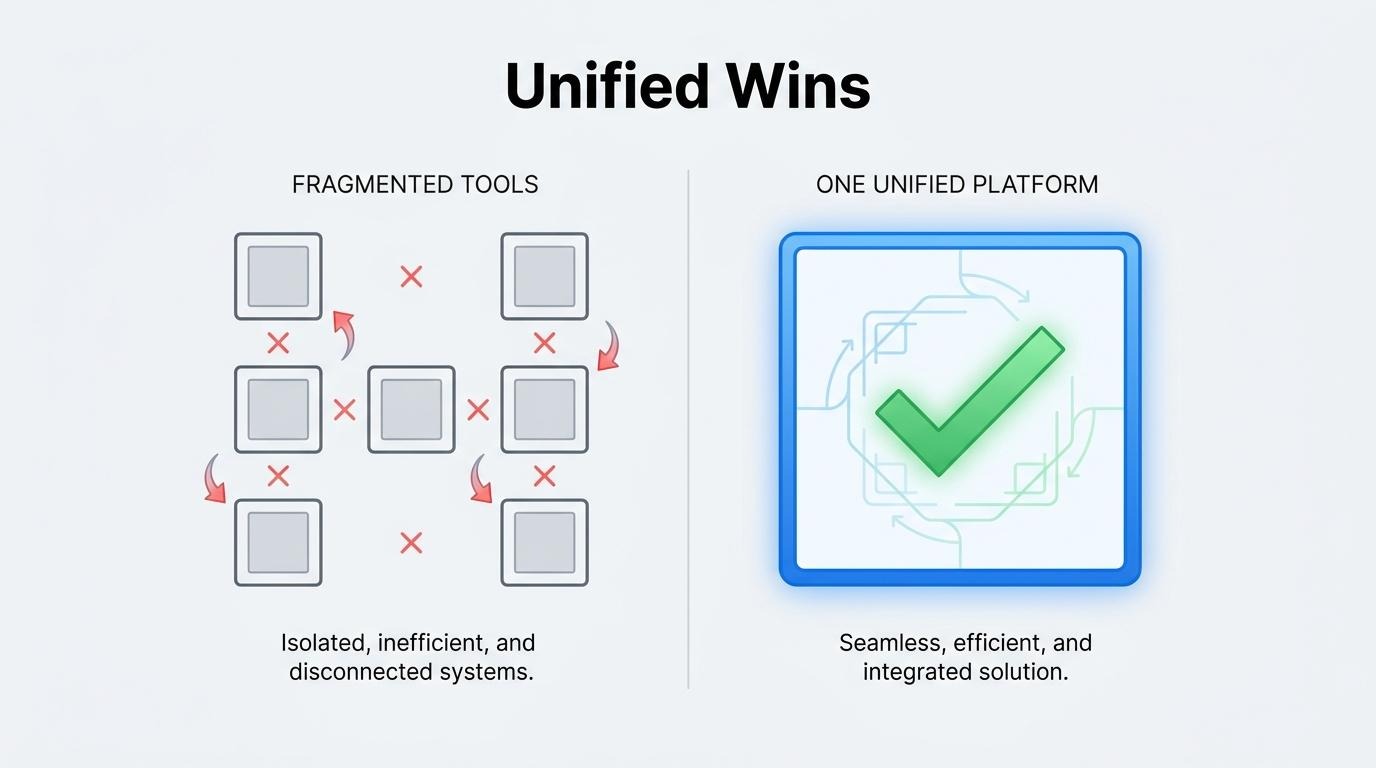
The hidden costs that come with managing multiple apps include recurring subscription fees, integration maintenance, and data-sync troubleshooting that rarely appear in initial budget projections. Each added tool carries its own billing cycle, and small per-app charges compound quickly across five to fifteen integrations.
Common hidden cost sources include:
According to WooCommerce's own pricing documentation, extensions alone cost $29 to $299 per year each, on top of hosting fees ranging from $25 to $350 per month. For a scaling brand running multiple extensions, these à la carte costs can quietly exceed the price of a unified platform. Auditing total cost of ownership quarterly, not just platform sticker price, is one of the most practical habits a growing merchant can build.
Tool fragmentation affects day-to-day operations by forcing teams to switch between disconnected dashboards, manually reconcile data, and troubleshoot sync failures instead of executing on growth. When inventory, marketing, CRM, and checkout live in separate systems, even routine tasks demand extra steps.
Operational friction from fragmented tools typically surfaces as:
As Marcos Galperin noted in a Stanford Graduate School of Business interview, "in addition to breadth and depth you have to have a seamless user experience, which means finding, buying, paying, and receiving [products] across platforms." That principle applies internally, too: when staff experience friction, customers eventually feel it through slower responses and mismatched information.
Consolidating tools improves customer retention when fragmented data prevents a brand from delivering consistent, personalized experiences across channels. Once online purchases, in-store visits, and marketing interactions share a single customer view, lifecycle campaigns can trigger based on actual behavior rather than partial records.
Retention improvements typically become measurable after consolidation when:
A 2021 study published in Sustainability (MDPI) found that organizations adopting unified cross-channel strategies maintain competitiveness and deliver seamless experiences that support long-term sustainability. For brands approaching $1M or more in annual revenue, the retention gap caused by tool fragmentation often costs more than the migration effort required to consolidate.
With the trade-offs between unified and modular setups clarified, the next step is understanding how to move between platforms safely.
You migrate from one ecommerce platform to another by exporting your store data, preparing the new environment, transferring records, and redirecting URLs. The subsections below cover what transfers, how long it takes, and which risks to plan for.
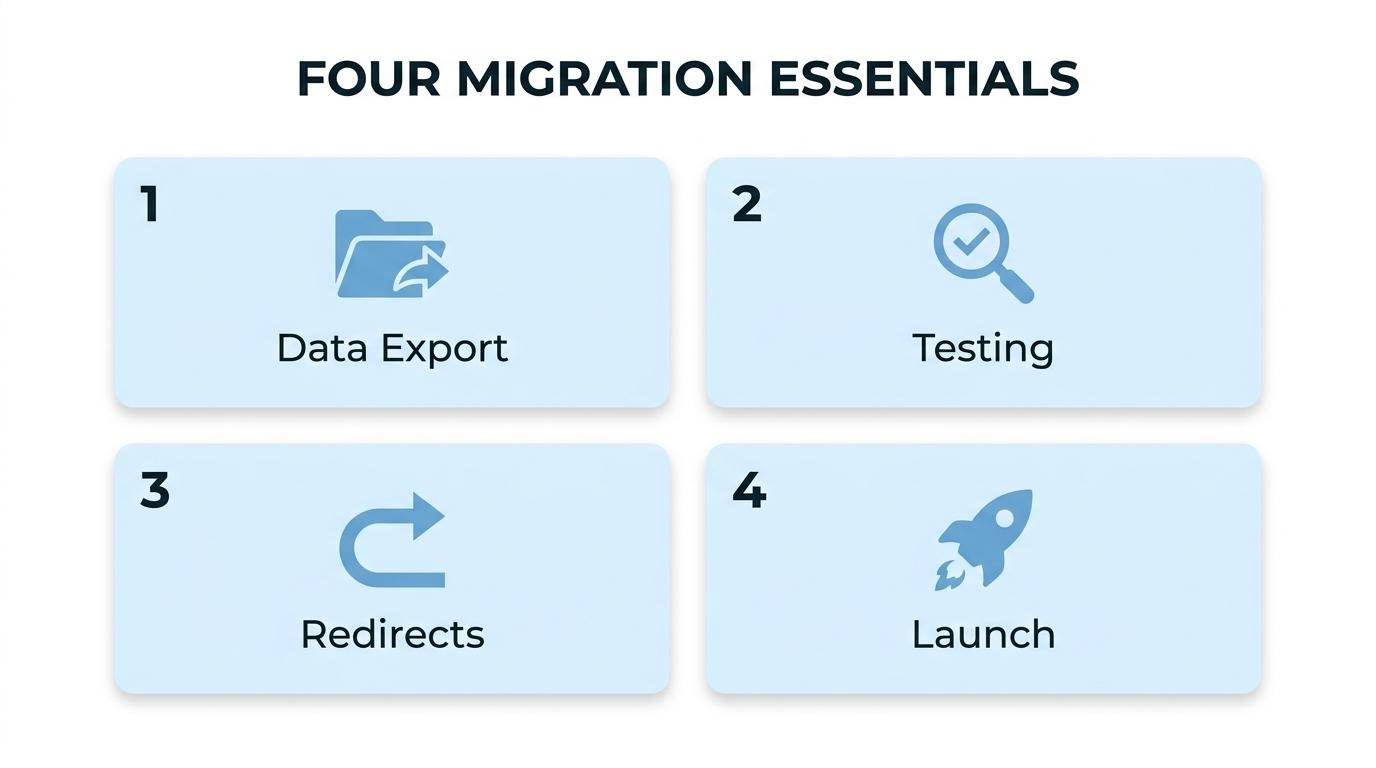
The data and settings that transfer during a migration typically include product catalogs, customer records, order history, and basic site content. Most platforms support CSV or API-based exports for these core data types.
Elements that commonly transfer:
Settings that often require manual recreation include theme customizations, app-specific configurations, automation workflows, and third-party integrations. Payment gateway credentials must be re-established on the new platform, and subscription billing data may need special handling if the original setup relied on third-party apps. For brands running complex stacks, this is where migration planning earns its value; the less you rely on external tools, the less you need to rebuild.
A typical platform migration takes two to twelve weeks, depending on store complexity, catalog size, and the number of integrations involved. A small store with fewer than 500 products and minimal customizations can often migrate in under two weeks. Stores with thousands of SKUs, custom themes, multiple sales channels, and layered automation workflows frequently need six to twelve weeks for a clean transition.
Key timeline factors include data cleanup before export, theme design or configuration on the new platform, testing checkout and payment flows, and setting up 301 redirects. Rushing a migration to save a week often creates months of cleanup. Planning buffer time for QA across devices, payment processors, and shipping logic is consistently the difference between a smooth launch and a costly rollback.
The risks you should plan for before switching platforms include SEO disruption, data loss, checkout downtime, and broken integrations. According to Google Search Central, if you change your site's URL structure, you must ensure navigation works without 404 error pages.
Critical risks to address:
Running a parallel staging environment, where the new store is fully tested before the DNS switch, eliminates most launch-day surprises. With migration risks accounted for, the next consideration is what changes when commerce, CRM, and marketing operate inside one system.
Consolidating commerce, CRM, and marketing into one system eliminates data silos, reduces app-stack costs, and gives operators a single customer record across channels. Below, see how SHOPLINE approaches this and the key takeaways from this guide.
SHOPLINE reduces app-stack costs by bundling commerce, CRM, lifecycle marketing automation, native subscriptions, and POS into a single platform with a shared customer data layer. Instead of paying separately for email marketing, subscription management, a CDP, and point-of-sale software, scaling DTC brands operate from one system at one subscription price.
SHOPLINE Starter begins at $29/mo and includes SmartPush email marketing, built-in AI tools, multi-channel selling, checkout, and inventory management. SHOPLINE Payments accepts Visa, MasterCard, American Express, Apple Pay, and Google Pay natively, so there is no need for a separate payment gateway integration.
According to a Google Cloud case study, SHOPLINE merchants achieved a 250% increase in order conversion rates through faster networks and data-driven marketing insights. For brands spending $500 to $2,000 per month on disconnected tools, that consolidation represents meaningful savings and operational simplicity.
The key takeaways about the best ecommerce platforms for small business center on five decision-guiding principles:
The best ecommerce platform is the one that fits your current revenue, operational complexity, and growth trajectory without forcing you to rebuild in 18 months. Results may vary depending on implementation, industry, and scale.