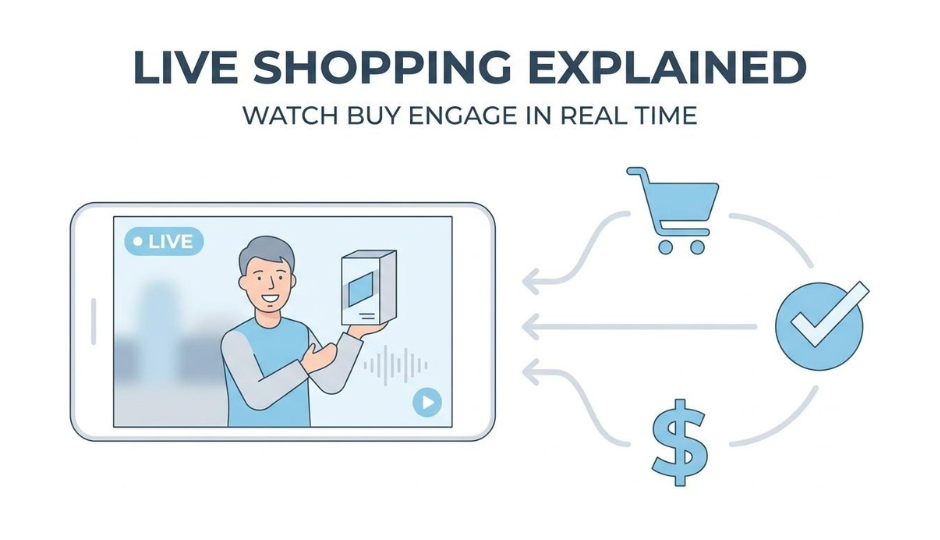
Live shopping is real-time video commerce where hosts demonstrate products, answer viewer questions, and enable instant purchases through integrated checkout. The format merges entertainment with transaction, creating urgency through limited-time offers and exclusive drops while capturing behavioral data directly within the streaming session.
This guide covers the evolution and growth of live commerce, its core benefits for DTC brands, livestream formats and platform options, the step-by-step process for launching a selling event, and performance measurement and scaling strategies.
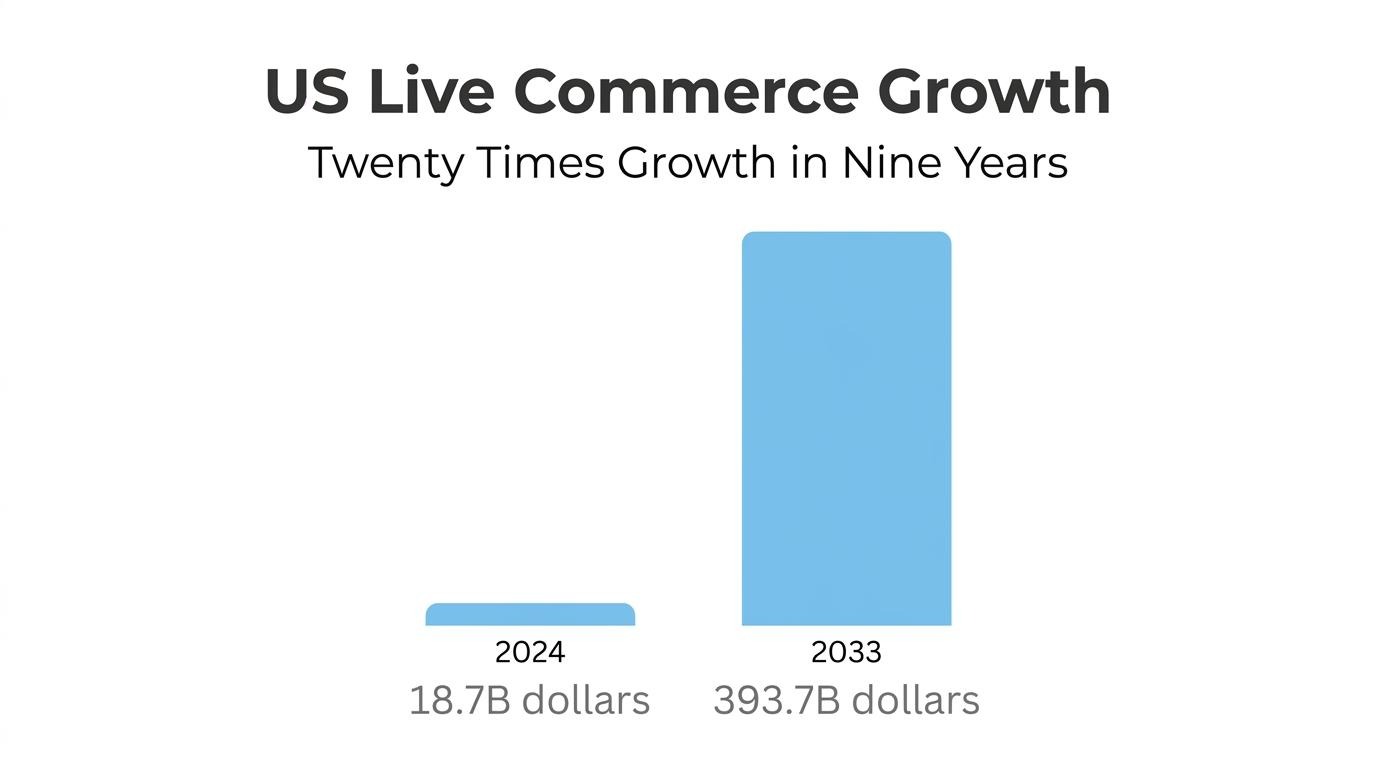
Live commerce traces from 1980s television networks like HSN through to China's Taobao Live in 2016, which first linked livestream broadcasts with ecommerce stores. In the United States, the market generated over $18.7 billion in 2024 and is projected to reach $393.7 billion by 2033, driven by platform investment and consumer demand for real-time product interaction.
For DTC brands, live shopping delivers conversion rates approaching 30 percent (up to ten times conventional ecommerce), lower product return rates in brand-hosted sessions, real-time trust building through unscripted demonstrations, and first-party data collection that feeds segmentation without relying on third-party cookies.
The format spans five distinct types: one-to-many broadcasts, one-to-one personal shopping, auction-style streams, shoppable tutorials, and influencer-hosted events. Platforms range from TikTok Shop and Instagram to dedicated marketplaces like Whatnot and brand-owned storefronts.
Launching a livestream event requires selecting fewer than ten camera-friendly products, choosing a trained host, promoting across owned channels, configuring shoppable overlays, engaging viewers through two-way interaction, processing orders in real time, and following up within 24 hours. Tracking viewer-to-buyer conversion, average order value, engagement rate, and revenue per session reveals which combinations justify repeating.
Scaling without tool sprawl depends on whether your infrastructure unifies stream data, customer profiles, and order management in one system rather than fragmenting across disconnected apps.
Live shopping in ecommerce is real-time video broadcasting where hosts demonstrate products, answer viewer questions, and enable instant purchases through integrated checkout. The format merges entertainment with transaction, creating urgency through limited-time offers and exclusive drops. Also called live commerce, shoppable video, or livestream shopping, the concept combines interactive engagement features such as chat and reactions with direct purchasing capabilities embedded in the stream itself.
The roots of this format stretch back decades. As Rick Watson, an ecommerce strategy consultant, notes: "Live Shopping traces its roots to the 80's, when HSN used late-night TV to sell goods to consumers." What has changed is the medium and the mechanics; today's digital iterations layer interactivity, data capture, and frictionless checkout on top of that original broadcast-selling model, making it far more measurable and scalable for DTC brands operating online.
Live shopping evolved from TV to digital streams through a three-decade progression: 1980s television networks, 2016 Chinese ecommerce integration, and subsequent global platform adoption.
The format originated in the 1980s when television shopping networks like HSN (Home Shopping Network) used late-night TV to sell goods directly to consumers. These broadcasts established the core model of host-led product demonstrations paired with real-time purchasing. According to Rick Watson, an ecommerce strategy consultant, "Live Shopping traces its roots to the 80's, when HSN used late-night TV to sell goods to consumers."
The digital leap came in 2016 when Taobao Live launched in China, pioneering the approach of linking an online livestream broadcast with an ecommerce store so viewers could watch and shop simultaneously. This shift replaced phone-in orders with integrated checkout, chat-based interaction, and algorithmic audience targeting. From that point, social platforms across Asia and eventually the United States adopted similar mechanics, transforming passive television viewership into participatory digital commerce.
Understanding this lineage matters for brands today because the underlying psychology never changed; what shifted was the technology layer enabling real-time engagement at scale.
Live shopping is growing in the United States because shifting consumer habits, platform investment, and proven category fit are converging at scale. That trajectory reflects how quickly real-time video shopping is moving from niche novelty to mainstream channel.
Several factors fuel this acceleration. Social platforms now embed native checkout into live broadcasts, reducing friction between discovery and purchase. Younger demographics, already comfortable with short-form video, treat livestreams as both entertainment and shopping. Meanwhile, categories with high visual and tactile appeal perform especially well in this format. As Deborah Weinswig, CEO and founder of Coresight Research, notes: "I think live shopping is always going to be better suited to certain categories, and we're seeing that with apparel and beauty being the top two."
For brands operating at scale, this growth signals more than a marketing trend. It represents a shift in how consumers expect to interact with products before buying, one that rewards brands already investing in real-time engagement infrastructure.
The key benefits of live shopping for DTC brands include higher conversion rates, lower return rates, real-time trust building, urgency-driven purchases, and first-party data collection.
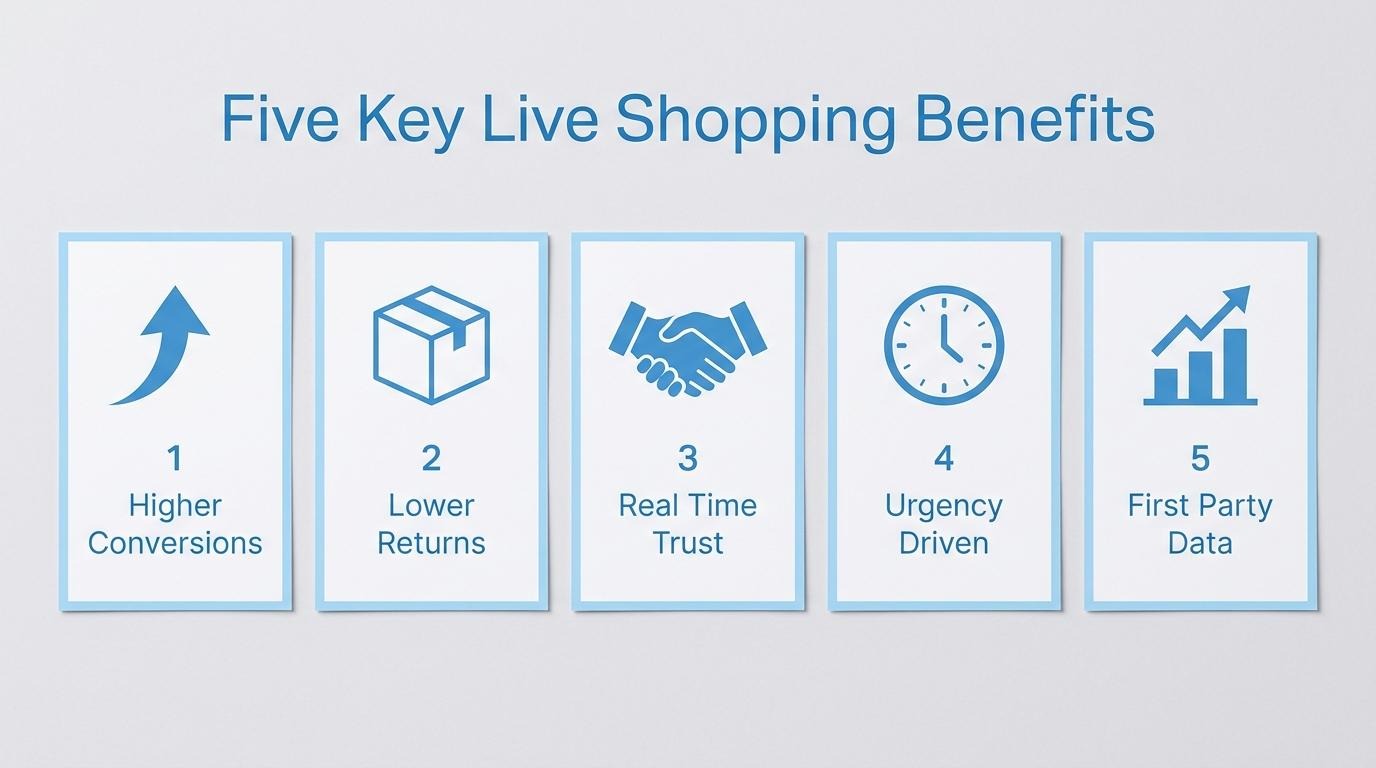
Live shopping increases conversion rates by combining real-time product demonstration with instant checkout, removing the friction between discovery and purchase. According to McKinsey, companies report live commerce conversion rates approaching 30 percent, up to ten times higher than the 2–3 percent average in conventional ecommerce. Instagram reports that live shopping events show conversion rates up to 23% higher than static posts. The interactive format lets viewers ask questions mid-stream, which resolves objections that would otherwise cause cart abandonment. For DTC brands already battling rising acquisition costs, this conversion lift makes each marketing dollar significantly more productive.
Live shopping reduces product return rates by giving viewers a realistic, unfiltered look at products before purchase. When hosts demonstrate sizing, texture, color accuracy, and functionality on camera, buyers make more informed decisions. According to research published on SSRN, product return rates are lower in brand-hosted live shopping sessions compared to those led by influencer broadcasters. This distinction matters: brands controlling the narrative can set accurate expectations rather than relying on hype-driven endorsements. Avoiding common pitfalls, such as featuring too many products per session or using untrained hosts, further ensures viewers leave with clear expectations about what they ordered.
Live shopping builds real-time customer trust by creating unscripted, transparent interactions between brands and buyers. Unlike polished product photography or pre-recorded ads, livestreams expose products under real conditions. Viewers watch hosts handle items, answer tough questions without delay, and demonstrate features without editing. This vulnerability signals authenticity. When a host acknowledges a product limitation or addresses a concern honestly on camera, it establishes credibility that static content cannot replicate. For DTC brands without physical retail presence, this real-time dialogue serves as the digital equivalent of an in-store conversation with a knowledgeable associate.
Live shopping creates urgency and impulse purchases through limited-time offers, exclusive drops, and the ephemeral nature of live broadcasts. Livestream commerce merges entertainment with transaction: hosts demonstrate products, answer questions, and enable instant purchases through integrated checkout, all within a time-bound window. Viewers understand that once the stream ends, the deal or exclusive product may disappear. Countdown timers, real-time inventory displays, and flash discounts amplify this scarcity signal. The social proof of watching other viewers purchase in real time further accelerates buying decisions that might otherwise stall for days in a traditional ecommerce funnel.
Live shopping generates first-party customer data by capturing real-time interactions, purchase behaviors, chat engagement, and product preferences directly within the streaming session. According to Firework, DTC brands gain a significant advantage because this data collection happens without relying on third-party cookies or external platforms. Every question asked, product clicked, and purchase completed feeds directly into a brand's customer profile. With the U.S. live commerce market generating USD 18,715.1 million in revenue in 2024, the volume of behavioral signals available through these sessions is substantial. For brands managing lifecycle marketing from a single data layer, this stream of intent data becomes fuel for segmentation and retention.
The types of live shopping formats are one-to-many broadcasts, one-to-one personal shopping, auction-style livestreams, shoppable tutorials, and influencer-hosted livestreams. Each format serves a different audience size, product category, and engagement goal.
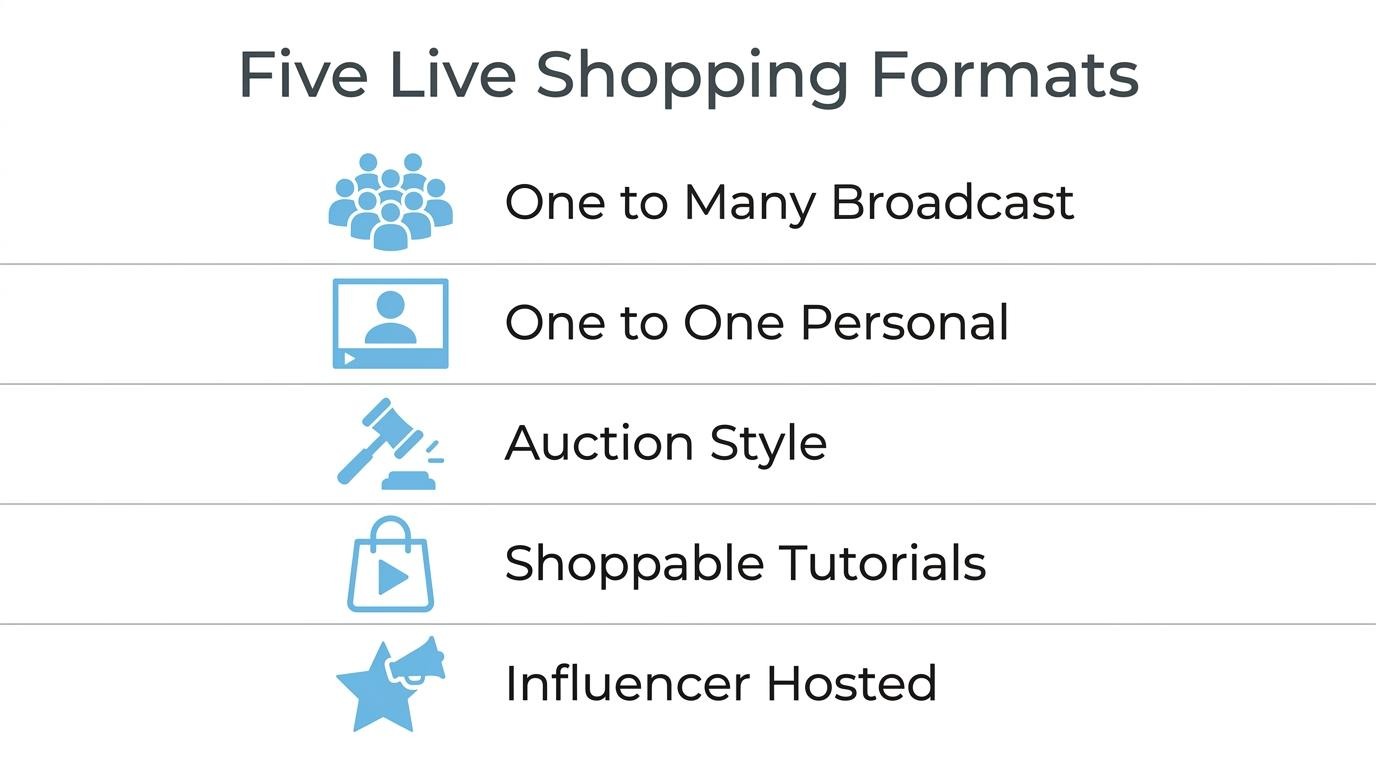
One-to-many broadcast is the most common live shopping format. A single host presents products to hundreds or thousands of simultaneous viewers through a real-time video stream. This format mirrors traditional television shopping but adds interactive elements, such as live chat, emoji reactions, and clickable product cards that enable instant checkout. Brands typically use one-to-many broadcasts for product launches, flash sales, and seasonal promotions where broad reach and urgency drive volume. The format works best when paired with limited-time offers that create buying pressure across a large audience simultaneously.
One-to-one personal shopping is a live commerce format where a single associate or stylist connects with one customer via video call. This format replicates the in-store consultation experience digitally. High-consideration categories benefit most, including luxury goods, jewelry, furniture, and custom apparel. The shopper receives personalized product recommendations, real-time styling advice, and the ability to ask detailed questions before purchasing. For brands selling premium products, this format tends to produce higher average order values than broadcast-style streams because the interaction builds individual trust and removes uncertainty around fit, color, or quality.
Auction-style livestreams are live shopping events where products sell through real-time competitive bidding. A host presents items one at a time, and viewers place bids via chat or integrated bidding tools. According to EMARKETER, live commerce platform Whatnot reported that shoppers spent over $75 million on its platform on Black Friday 2025, three times the previous year's total. This format thrives in collectibles, vintage goods, sneakers, and trading cards, where scarcity and competition heighten perceived value. The countdown pressure of live bidding generates urgency that fixed-price formats cannot replicate.
Shoppable tutorials and demonstrations are live shopping formats where hosts teach viewers how to use a product while enabling real-time purchases. A makeup artist demonstrating a skincare routine, a chef cooking with specific kitchen tools, or a fitness trainer showcasing gear are common examples. Viewers watch the product in action, ask questions about application techniques, and buy directly without leaving the stream. This format works particularly well for beauty, wellness, home, and food categories because it answers "does this actually work?" in real time. Educational framing also reduces post-purchase regret and lowers return rates.
Influencer-hosted livestreams are live shopping events led by creators who bring their existing audience to a brand's products. The influencer's established trust and personality drive viewer engagement, while the brand provides inventory and checkout infrastructure. TikTok Shop accounted for nearly 20% of the US social commerce market in 2025, according to EMARKETER, with nearly half of TikTok users being TikTok Shop buyers. Influencer-hosted streams excel at reaching new customers and generating top-of-funnel awareness. However, brands should recognize that product return rates tend to be higher in influencer-led sessions compared to brand-hosted ones, making host selection and product-audience alignment critical.
With format selection clarified, the next consideration is which platforms support these experiences.
The platforms that support live shopping in the US include social media networks, dedicated marketplaces, and brand-owned storefronts. TikTok Shop dominates social commerce, while specialized platforms like Whatnot serve auction-style categories. Instagram, YouTube, and Facebook offer native live shopping features, and independent ecommerce platforms enable brands to host streams directly on their own sites.
TikTok Shop accounted for nearly 20% of the US social commerce market in 2025, with nearly half of TikTok users (48.9%) being TikTok Shop buyers, according to EMARKETER. The platform charges sellers a 6% referral fee on most categories plus payment processing fees ranging from 1.02% to 3.78%. Whatnot, a dedicated live commerce marketplace, reported that shoppers spent over $75 million on its platform during Black Friday 2025, three times the previous year's total.
The major platforms break down by type:
For brands already managing inventory, CRM, and marketing across multiple tools, hosting livestreams on a brand-owned storefront consolidates the customer journey into one system. With equipment and production decisions ahead, the next section covers the technical setup required for a successful stream.
The equipment you need for live shopping includes a camera, a microphone, a video encoder, a streaming platform, and a stable internet connection. These four core components work together to deliver a professional broadcast that keeps viewers engaged and ready to purchase.
According to Dacast, a complete live streaming setup requires four main components: a video/audio source (camera and microphone), a video encoder (hardware or software), a streaming platform, and a stable internet connection. Each element plays a distinct role in broadcast quality.
Essential live shopping equipment includes:
Beyond hardware, the technology layer matters equally. Integrated checkout overlays, real-time product pinning, and chat moderation tools turn a passive broadcast into a shoppable experience. Brands running live commerce at scale often benefit from platforms where the storefront, inventory, and customer data live in one system, eliminating sync issues between separate streaming apps and the store backend.
With the right equipment secured, the next step is planning the actual livestream event itself.
The steps to launch a livestream selling event include choosing products, selecting a host, promoting the event, configuring your stream layout, engaging viewers live, processing orders in real time, and following up after the broadcast ends.
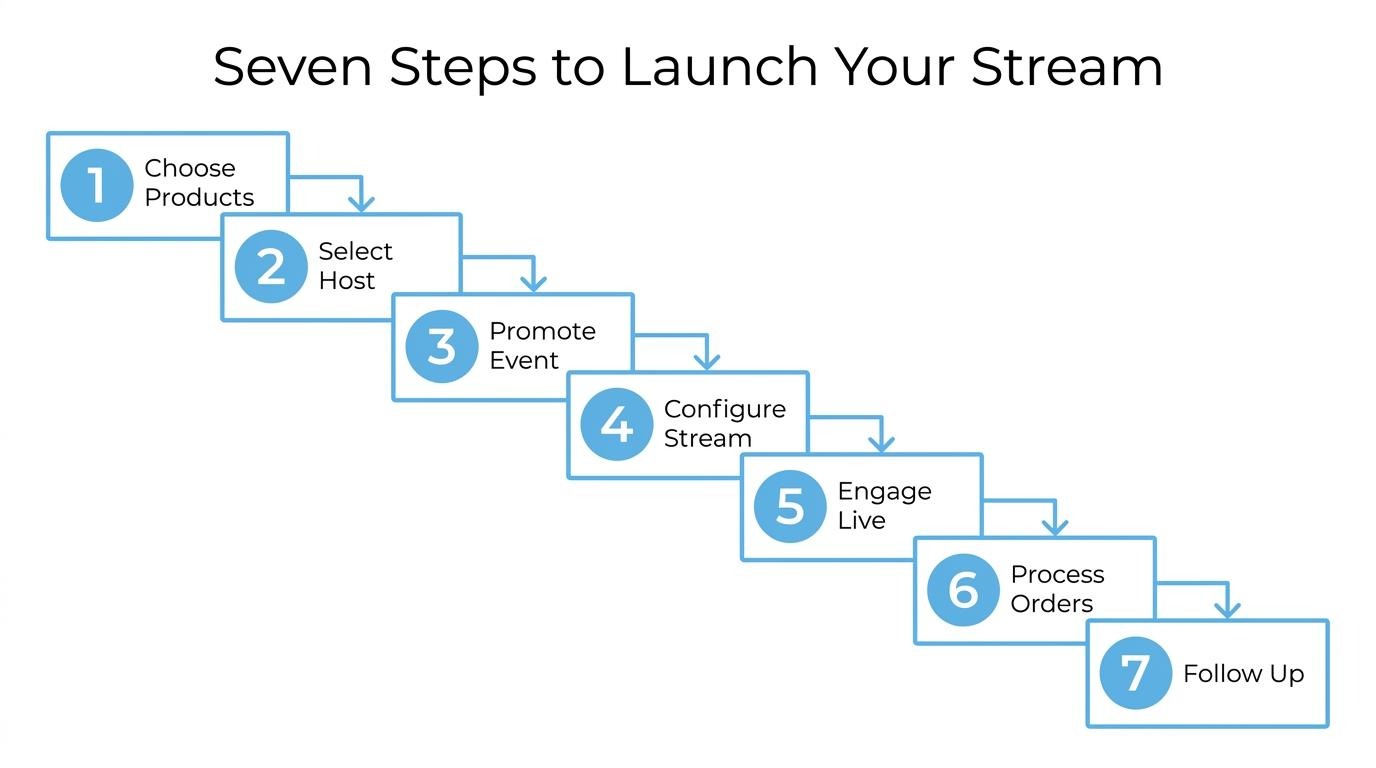
You choose products for a livestream event by selecting items that demonstrate well on camera and benefit from real-time explanation. Visual categories like apparel, beauty, and home goods perform strongest because viewers can see fit, texture, and application in motion. Start with fewer than ten items per session to maintain focus and avoid overwhelming your audience. Prioritize products with strong margins, limited-edition appeal, or new arrivals that create urgency. Each item should have a clear "show moment," whether that is a before-and-after transformation, an unboxing reveal, or a live styling demonstration.
You pick the right host or presenter by evaluating on-camera energy, product knowledge, and ability to respond naturally to live chat. The host drives the entire experience; an untrained presenter who cannot engage effectively is one of the most common livestream selling mistakes. Brand founders work well for authenticity, while experienced creators bring built-in audiences. Whoever hosts should rehearse transitions between products, practice answering objections spontaneously, and maintain conversational pacing throughout the session. For brands running frequent streams, rotating between internal team members and external creators keeps content fresh without over-relying on a single personality.
You promote a live shopping event before it starts by building anticipation across owned and social channels at least five to seven days in advance. Effective pre-promotion tactics include:
Cross-channel consistency matters. Every touchpoint should communicate the same time, same featured products, and same value proposition so viewers know exactly what to expect.
You set up your stream layout and product links by configuring your broadcasting environment and integrating shoppable elements before going live. Position your camera at eye level with consistent lighting, and ensure product display areas are uncluttered and well-lit. Overlay product cards, pricing, and purchase buttons directly within the stream interface so viewers can buy without leaving the broadcast. Test every product link before the event starts, confirming that each click routes to the correct SKU with accurate inventory counts. A clean layout with visible calls-to-action reduces friction between interest and checkout.
You engage viewers during the livestream by creating two-way interaction that makes the audience feel involved in the session. Acknowledge viewers by name when they comment, answer questions about sizing or ingredients immediately, and run time-limited offers that reward those watching live. Polls, giveaways, and "comment to unlock a deal" mechanics sustain attention across longer broadcasts. Pacing also matters; alternate between product demonstrations, Q&A segments, and flash promotions every few minutes to prevent drop-off. The goal is interactive broadcasting where viewers feel like participants, not passive spectators.
You handle orders and checkout in real time by integrating instant purchasing capabilities directly into the livestream interface. Viewers should be able to tap a product overlay, add to cart, and complete payment without navigating away from the broadcast. According to AVIXA's live streaming equipment guide, high-quality real-time broadcasting relies on mirrorless cameras or DSLRs with clean HDMI output paired with lavalier or shotgun microphones for clear audio, ensuring the technical foundation supports seamless purchasing moments. Backend systems must sync inventory counts live so sold-out items disappear from the stream automatically.
You follow up with attendees after the stream ends by sending post-event communications that convert lingering interest into purchases. Within 24 hours, email viewers a recap with product links, highlight clips, and any exclusive post-stream offers. Repurpose stream footage as shoppable video content on product pages, social feeds, and retargeting ads to extend the event's revenue lifespan well beyond the live window.
With your launch steps defined, tracking performance metrics reveals which elements drive the strongest results.
The metrics you should track to measure live shopping success include viewer-to-buyer conversion rate, average order value, engagement rate and watch time, and revenue per livestream session.
You measure viewer-to-buyer conversion rate by dividing the number of purchasers during a livestream by total unique viewers, then multiplying by 100. This metric isolates how effectively your stream turns passive watchers into customers. According to McKinsey & Company, companies report live commerce conversion rates approaching 30 percent, up to ten times higher than the 2–3 percent average in conventional ecommerce. Tracking this per session reveals which hosts, products, and formats drive the strongest purchase intent. For most brands, even a 5–10 percent viewer-to-buyer rate signals strong content-commerce alignment.
You track average order value (AOV) during livestreams by dividing total livestream revenue by the number of orders placed within the session window. Comparing livestream AOV against your standard site AOV reveals whether real-time demonstrations, bundles, or limited-time offers encourage larger cart sizes. Higher AOV during streams often correlates with product bundling, tiered discounts introduced mid-broadcast, and host-driven upsells. Monitoring this metric session over session helps identify which promotional tactics consistently lift basket size without relying on deep discounting.
You evaluate engagement rate and watch time by tracking chat messages, reactions, shares, and product clicks per viewer, alongside median session duration. High engagement with short watch time suggests compelling hooks but weak retention; the inverse points to passive audiences. Average watch time benchmarks how well your content holds attention through the full product lineup. These signals, taken together, indicate whether viewers find enough value to stay and interact, which directly predicts conversion likelihood in future streams.
You assess revenue per livestream session by calculating total gross sales generated during and immediately after the broadcast window, typically within a 24-hour attribution period. This metric combines conversion rate and AOV into a single performance figure that accounts for production effort. Comparing revenue per session across different time slots, hosts, and product categories surfaces your highest-performing combinations. For brands running weekly streams, tracking this trend line month over month reveals whether your live commerce program is scaling or plateauing.
With clear performance benchmarks established, avoiding common execution mistakes protects these results.
The common mistakes you should avoid in livestream selling include overly broad content, showcasing too many products, waiting for viewers before starting, and using untrained hosts.
According to Bambuser, common live shopping pitfalls include overly broad content, waiting for viewers to join before starting the main content, featuring too many products in one session, and using untrained hosts who cannot engage effectively. Each of these errors undermines the real-time urgency and focused engagement that make livestream commerce effective.
Specific mistakes to avoid:
For brands running complex operations across multiple channels, these errors compound quickly when livestream data sits in a separate silo from the rest of the customer journey. Keeping content focused and hosts prepared becomes significantly easier when stream performance feeds directly into the same system tracking orders and customer behavior.
You scale live shopping without adding more tools by consolidating commerce, customer data, and marketing into a single platform. The sections below cover unified data handling and key takeaways from this guide.
SHOPLINE handles live commerce data without a separate CDP or multi-app stack by unifying storefront transactions, customer profiles, and marketing automation within one shared data layer. When a viewer purchases during a livestream, that interaction ties directly to the same customer record used across email, POS, and repeat-purchase flows.
This matters because live commerce is scaling fast. According to Statista, approximately 49 million U.S. consumers will use live commerce in 2025. At that volume, brands running separate tools for streaming analytics, CRM, and order management face sync failures and fragmented profiles. SHOPLINE resolves online and offline purchase data to a single customer record, so post-stream follow-up sequences, inventory updates, and lifetime value calculations operate from one source of truth without reconciliation.
The key takeaways about live shopping and livestream selling steps are:
Since Taobao Live pioneered shoppable livestreams in China in 2016, according to EMARKETER, the format has matured into a proven commerce channel now accelerating in the United States. For brands already managing real operational complexity, the deciding factor is whether your infrastructure can absorb stream-generated data without adding another tool to the stack.