
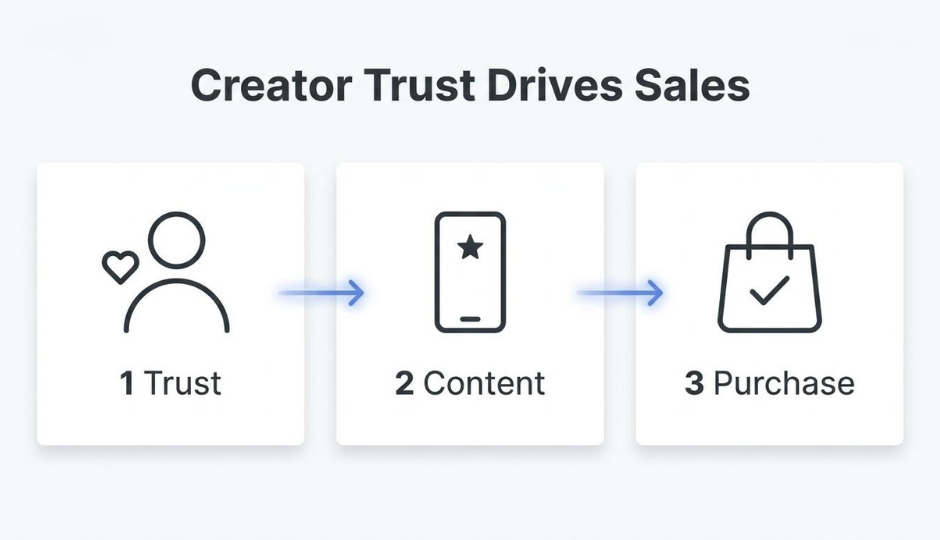
Ecommerce influencer marketing is a commercial model where brands partner with social media creators to promote products to engaged audiences, converting follower trust into measurable online sales. This guide covers influencer tiers and how they perform, campaign strategies that drive revenue, platform selection for ecommerce, creator vetting and pricing, ROI measurement and attribution, and the legal, scaling, and retention systems that sustain long-term growth.
Influencer tiers range from nano creators with the highest engagement rates to mega influencers built for broad visibility, and each tier serves a distinct role depending on whether your campaign targets direct conversions or top-of-funnel awareness. Matching creator scale to campaign objectives is what separates profitable programs from wasted spend.
Proven strategies like affiliate partnerships, discount code campaigns, product seeding, brand ambassador programs, and influencer-generated ad creative each compress the path from content to checkout in different ways. The strongest ecommerce brands layer multiple strategies rather than relying on a single format.
Platform choice shapes results significantly; Instagram offers mature shopping infrastructure, TikTok drives algorithmic discovery and impulse purchases, YouTube delivers long-form content with extended shelf life, and Pinterest captures high-intent planners in visual categories.
Finding the right creators requires evaluating audience demographics, vetting engagement authenticity against fake follower rates, and assessing content style for brand fit. Pricing spans from roughly $500 per post for nano creators to $45,000 or more for celebrities, with performance-based models reducing upfront risk.
Measuring ROI through multi-touch attribution, tracking KPIs beyond revenue, and calculating customer lifetime value by cohort reveals the true return on influencer spend. Compliance with FTC disclosure rules, scalable operational systems, and post-click retention workflows through unified platforms like SHOPLINE determine whether influencer programs compound into sustained, profitable growth.
Influencer marketing matters for ecommerce brands because it converts trusted creator audiences into paying customers at a pace traditional advertising cannot match. Below, the key drivers explain this shift.
Influencer marketing is a commercial model wherein brands promote their products or services through influencers, transforming the followers of these influencers into customers. This direct path from content to purchase compresses the traditional awareness-to-conversion funnel. Rather than interrupting a browsing session with a display ad, influencer partnerships embed product discovery inside content people actively chose to watch.
Social commerce is accelerating this effect. According to McKinsey, US social commerce sales were expected to reach nearly $80 billion by 2025, representing 5 percent of total US ecommerce. That growth signals a structural change in how consumers find and buy products: discovery, evaluation, and checkout increasingly happen within the same social feed.
For scaling ecommerce brands, this matters for several practical reasons:
For brands operating at a meaningful revenue scale, the real advantage is not just reach. It is the ability to acquire customers through a channel where trust is already established, then retain them through unified data and lifecycle systems. Brands that treat influencer marketing as a one-off tactic miss this compounding effect; those that integrate it into their acquisition strategy build a repeatable growth lever.
Understanding why influencer marketing drives ecommerce growth sets the stage for how the mechanics actually work in practice.
Ecommerce influencer marketing works by connecting brands with content creators who promote products to their engaged audiences, driving traffic and sales through trusted recommendations. The process follows a structured cycle from goal-setting through creator partnerships to measurable conversions.
Brands begin by defining campaign objectives, such as awareness, traffic, or direct sales. They then identify creators whose audience demographics and content style align with their target customer. Once a partnership is established, the influencer produces authentic content featuring the brand's products, distributed across platforms like Instagram, TikTok, or YouTube.
The core mechanism transforms social trust into purchase intent. Rather than interrupting consumers with traditional ads, influencer content reaches audiences through creators they already follow and trust. This content typically includes trackable elements:
Each touchpoint captures conversion data, allowing brands to measure which creators, platforms, and content formats generate the strongest return. According to a 2024 study published in ScienceDirect, multi-touch attribution (MTA) assigns credit to multiple touchpoints along the customer journey, addressing the limits of single-touch models that undercount influencer contributions.
What makes this model distinct from traditional advertising is the feedback loop. Creators share real-time audience reactions, comment sentiment, and engagement patterns with brands, informing product development and future campaign direction. The relationship is collaborative rather than transactional; the most effective programs treat influencers as strategic partners, not ad placements. Understanding the specific influencer tiers available helps brands match the right creator scale to their goals and budget.
The types of ecommerce influencers are nano, micro, macro, and mega creators, each defined by follower count, engagement behavior, and cost. The following tiers help brands match campaign goals to the right partnership level.
Nano influencers are creators with 1,000 to 10,000 followers. Their audiences tend to be tight-knit and highly engaged, often centered around a specific niche such as sustainable skincare, pet accessories, or local food. According to Bizkol, nano creators hold the highest average engagement rate on Instagram at 4.5 percent, compared to roughly 1.2 percent for mega creators. That gap makes nano influencers especially effective for ecommerce brands testing new products or entering niche markets on a limited budget. The trade-off is smaller reach per post, which means brands typically need to activate multiple nano creators simultaneously to generate meaningful volume.
Micro influencers are creators with 10,000 to 50,000 followers. They combine niche credibility with enough reach to move measurable sales volume. According to Socially Powerful, micro influencers record an average engagement rate of 1.81 percent, compared to 1.24 percent for mid-tier creators. This engagement advantage, paired with moderate audience size, makes micro influencers one of the most cost-efficient tiers for ecommerce campaigns focused on direct conversions. For most scaling DTC brands, micro influencers represent the sweet spot where authentic audience trust and commercial viability overlap consistently.
Mid-tier influencers are creators with 50,000 to 500,000 followers. They offer a balance of reach and audience intimacy that neither smaller nor larger tiers replicate cleanly. A 2024 study published in the Journal of Brand Strategy found that TikTok influencers with smaller followings drive significantly higher engagement, while mid-tier creators provide the reach needed for broader awareness campaigns. Ecommerce brands often use mid-tier influencers for product launches where visibility matters as much as conversion rate. This tier works well when a brand has outgrown nano and micro partnerships but is not yet ready for six-figure macro deals.
Macro influencers are creators with 500,000 to 1,000,000 followers. Their content reaches a broad, diverse audience across multiple demographics and interest segments. Ecommerce brands typically partner with macro influencers for large-scale product launches, seasonal campaigns, or brand awareness pushes where wide exposure outweighs per-follower engagement. Engagement rates at this tier are lower than micro or mid-tier levels, so macro partnerships work best when the campaign goal is top-of-funnel visibility rather than direct response. Expect higher production quality, more structured negotiations, and longer lead times compared to smaller tiers.
Mega influencers and celebrities are creators with over 1,000,000 followers. They deliver massive reach in a single post, making them suited for high-visibility brand moments, global launches, or cross-market campaigns. However, engagement rates at this tier are the lowest across all categories, and costs can exceed $45,000 per post. Audience trust is often more diffuse, since followers connect with the persona rather than a specific product niche. For ecommerce brands, mega partnerships work best as part of a layered strategy where broad awareness at the top is supported by micro and nano creators driving conversions below.
With influencer tiers defined, selecting the right campaign strategy determines how each tier delivers results.
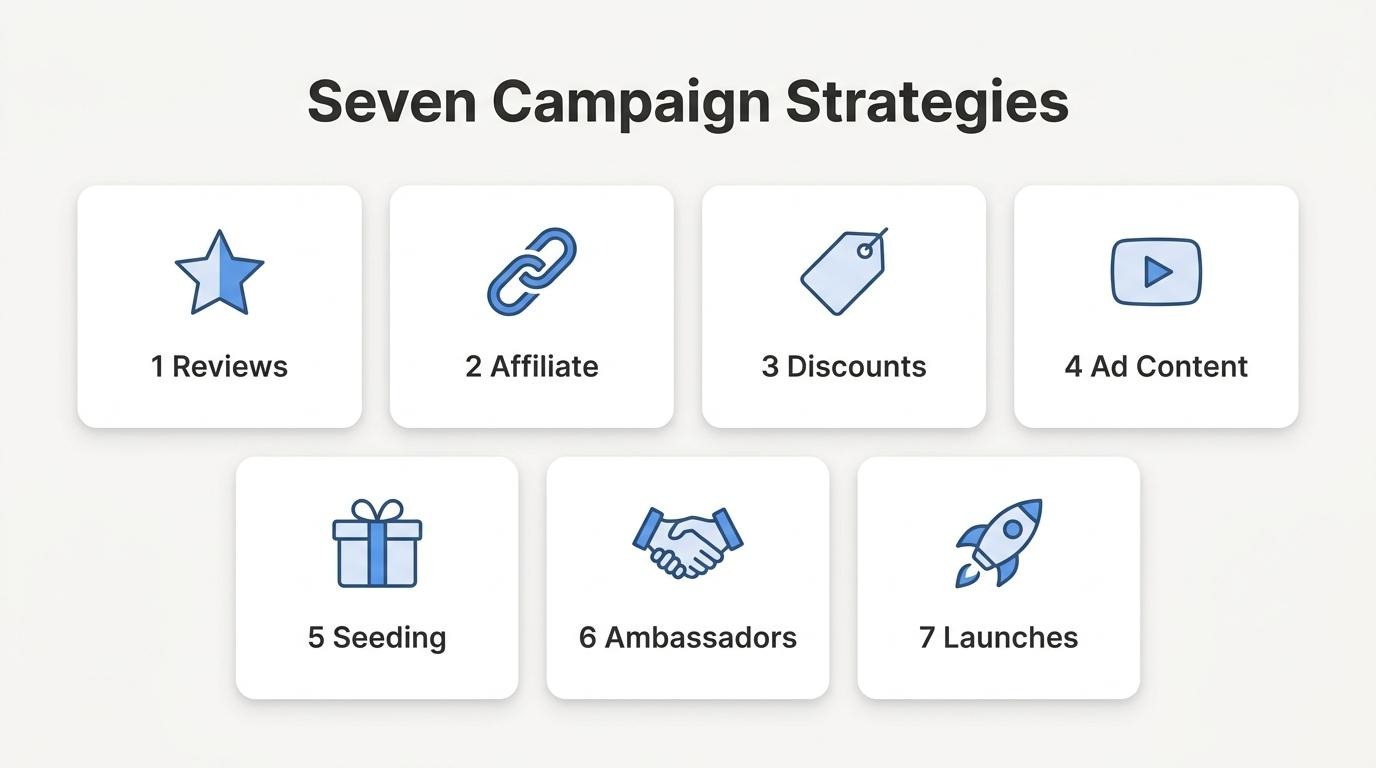
The most effective influencer marketing strategies for ecommerce include sponsored product reviews, affiliate partnerships, discount code campaigns, influencer-generated ad creative, product seeding, brand ambassador programs, and influencer-led product launches.
Sponsored product reviews drive ecommerce sales by pairing authentic creator demonstrations with direct purchase pathways. An influencer films or photographs themselves using the product, shares honest impressions, and links to the product page. This format works because it compresses the discovery-to-decision journey into a single piece of content.
The review functions as both social proof and product education simultaneously. Audiences who trust the creator treat the review as a peer recommendation rather than an advertisement, which lowers purchase hesitation. For best results, brands should give creators enough creative freedom to maintain credibility while ensuring key product benefits are covered.
Affiliate-based influencer marketing works by compensating creators with a commission for each sale they generate through a unique tracking link or code. The brand pays only when a conversion occurs, which ties spend directly to revenue.
This performance model reduces upfront risk for ecommerce brands. Creators receive ongoing incentive to promote products because their earnings scale with sales volume. According to IGI Global research, influencer marketing campaigns can generate a substantial $245,000 in Earned Media Value, highlighting the significant non-direct revenue impact that extends beyond tracked affiliate conversions. Brands typically set commission rates between 5% and 30%, depending on product margins and creator tier.
Discount codes and exclusive offers perform well because they create urgency and give audiences a tangible reason to purchase immediately. Each influencer receives a unique code, which serves dual purposes: incentivizing the buyer and attributing the sale to the correct creator.
Time-limited offers amplify this effect by adding scarcity. Codes also provide clean attribution data, making it straightforward to compare performance across multiple creators in the same campaign. One often overlooked advantage is that personalized codes make followers feel like insiders, which strengthens the perceived relationship between creator and audience. Brands should test different discount structures, such as percentage-off versus fixed-amount, to find what resonates with each creator's audience.
Influencer-generated content works as paid ad creative by repurposing creator-produced videos and images as sponsored ads across social platforms. The brand runs the content through its own ad account, combining the creator's authentic style with precise audience targeting.
This approach typically outperforms polished studio ads because the content looks native to the platform feed. Viewers scroll past obvious advertisements, but creator-style content earns attention. Brands negotiate usage rights upfront, then A/B test different creator assets against each other. The strongest-performing clips get scaled with a paid budget behind them. For ecommerce brands running large volumes of paid social, this strategy turns one influencer partnership into a reusable library of ad assets.
Product seeding campaigns build organic buzz by sending free products to selected creators without requiring a paid post in return. The brand invests only the product cost, and any content the creator shares is genuinely voluntary.
Because there is no contractual obligation, posts that do appear carry stronger authenticity signals. Audiences recognize the difference between a sponsored placement and a creator who chose to feature something they received. The trade-off is lower predictability; not every seeded product generates content. Brands mitigate this by seeding in volume, targeting creators who already align with their aesthetic or niche. When a seeded post goes viral, the cost-per-impression is effectively zero beyond the product itself.
Brand ambassador programs create long-term value by establishing ongoing partnerships with creators who represent the brand consistently over months or years, rather than through one-off posts. Repeated exposure builds familiarity and trust with the ambassador's audience.
According to Launchmetrics, 53% of all brand value themes were directly driven by the ambassador, while 47% were driven by the influencer in shorter-term collaborations. This distinction matters: ambassadors weave the brand into their identity, producing deeper audience association than a single sponsored mention ever could. Long-term contracts also give brands more predictable content calendars and often include better per-post rates compared to one-off deals.
Influencer-led product launches build momentum by coordinating multiple creators to post about a new product within a compressed timeframe, creating the appearance of widespread organic excitement. The concentrated burst of content floods social feeds and triggers algorithmic amplification.
Brands typically structure these launches in phases: teaser content before the launch date, unboxing or first-impression posts on launch day, and follow-up reviews in the days after. This sequenced approach sustains visibility beyond a single news cycle. Giving select creators early access also generates exclusivity, which their audiences respond to with heightened curiosity. For ecommerce brands, pairing influencer launch content with a dedicated landing page converts that momentum into measurable first-week sales.
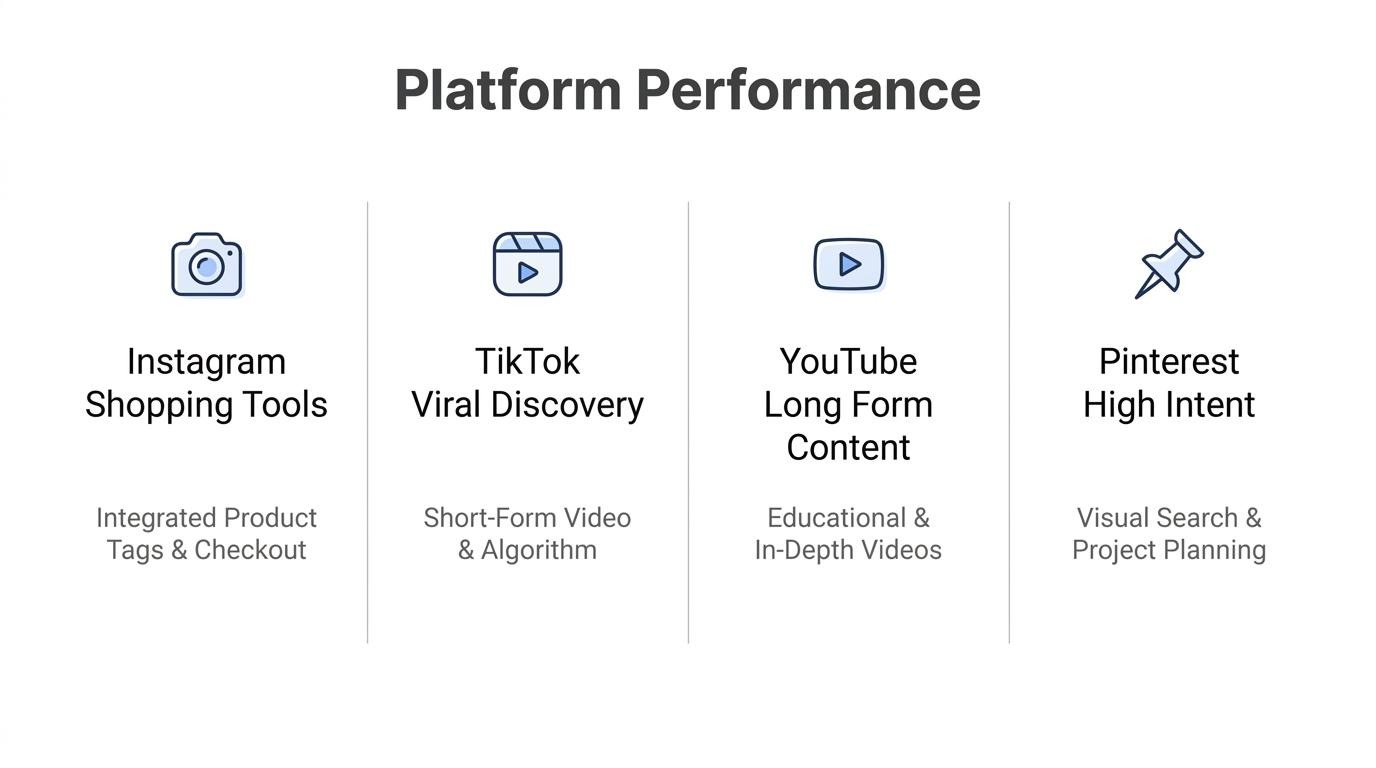
The social platforms that work best for ecommerce influencer campaigns are Instagram, TikTok, YouTube, and Pinterest. Each platform serves a distinct role in the purchase funnel, from discovery to conversion.
Instagram performs as the most established ecommerce influencer marketing platform, combining visual discovery with native shopping infrastructure. Instagram Shopping enables in-app checkout, and according to Capital One Shopping, the platform's checkout conversion rate sits at 2.7%, competitive with traditional ecommerce benchmarks.
Reels and Stories give creators flexible formats for product demonstrations, while shoppable tags let followers purchase without leaving the app. The platform's mature creator ecosystem also means brands can find influencers across every tier and niche with relative ease. For brands selling visually driven products in fashion, beauty, or home goods, Instagram remains the default starting point for influencer partnerships.
TikTok performs as the highest-growth ecommerce influencer platform, driven by algorithmic discovery that surfaces creator content far beyond a creator's existing follower base. According to Archive, TikTok influencer posts maintain a 3.5% average engagement rate despite experiencing a 34% decline and facing significant regulatory challenges in the US.
TikTok Shop has accelerated the platform's commerce capabilities dramatically. Short-form video content on TikTok tends to generate impulse purchases, particularly among younger demographics. The platform rewards authenticity over polish, which means micro and nano creators often outperform heavily produced brand content.
YouTube performs as the strongest platform for long-form, high-consideration ecommerce influencer content. Product reviews, tutorials, and unboxing videos on YouTube carry significant purchase influence because viewers actively seek out this content during the research phase of buying decisions.
Videos remain discoverable through search for months or years, giving influencer collaborations a longer content lifespan than any other social platform. YouTube Shorts adds a short-form layer for quick product highlights. The platform works especially well for higher-priced products where buyers need detailed information before committing. Conversion tracking through affiliate links in video descriptions provides clear attribution for ecommerce brands measuring ROI.
Pinterest performs as a high-intent discovery platform for ecommerce influencer campaigns, particularly in home decor, fashion, food, and wedding categories. Users on Pinterest are often in active planning or shopping mode, which makes creator content more likely to drive downstream purchases than on platforms where users browse passively.
Product Pins link directly to ecommerce storefronts, shortening the path from inspiration to checkout. Pinterest content also has an exceptionally long shelf life; pins continue generating traffic for months after initial posting. The platform's influencer ecosystem is smaller than Instagram's or TikTok's, but competition for attention is also lower, making it a strong fit for niche ecommerce brands.
Choosing the right platform mix depends on your product category, audience demographics, and campaign goals.
You find the right influencers for your ecommerce store by evaluating audience alignment, vetting engagement authenticity, and assessing content style. The following subsections break down each step.
You evaluate audience alignment and demographics by comparing an influencer's follower base against your target customer profile. Key demographic factors to review include:
Request audience insight reports directly from creators or use influencer discovery platforms that surface demographic breakdowns. Selecting based on audience size alone is one of the most common mistakes brands make in influencer marketing, according to a 2025 analysis by Pathfinders Advertising. A smaller creator whose followers mirror your ideal customer profile will consistently outperform a larger one with a mismatched audience.
You vet engagement quality and authenticity by analyzing interaction patterns beyond surface-level follower counts. According to research published in the UAI Journal of Economics, Business and Management, fake follower rates reach 30–40% on certain platforms, making thorough vetting essential.
Signals that indicate genuine engagement include:
Auditing tools can flag suspicious activity, but manual review of recent posts remains one of the most reliable methods for confirming authenticity.
You assess content style and brand fit by reviewing a creator's existing content for visual quality, tone, and thematic consistency with your brand identity. Start by examining:
The strongest influencer partnerships feel organic to the creator's audience, not forced. When content style and brand identity align naturally, promotional posts blend into the creator's feed, which builds trust rather than triggering ad fatigue. With the right influencers identified, the next step is understanding what these partnerships cost.
Ecommerce influencer marketing costs range from a few hundred dollars per post for nano creators to $45,000 or more for mega influencers. The sections below break down pricing by tier and explain performance-based compensation models.
Nano and micro influencers typically charge between $500 and $2,000 per Instagram post in 2025, according to impact.com pricing data. Micro influencers with larger followings within the 10,000 to 50,000 range command rates closer to the upper end of that spectrum, while nano creators with under 10,000 followers often fall near the lower bound.
Despite modest per-post costs, these smaller creators frequently deliver stronger returns on a per-dollar basis. Brands that work with 10 or more nano and micro creators in a single quarter see 22 percent higher new customer acquisition than brands working with a single mega creator on a similar total budget. Spreading spend across multiple smaller partnerships, rather than concentrating it on one large name, is often the smarter allocation for ecommerce brands focused on acquisition efficiency.
Mid-tier influencers typically charge between $1,000 and $5,000 per Instagram post, depending on follower count, niche authority, and content format. Creators in the 50,000 to 500,000 follower range sit in this bracket.
Rates increase for multi-asset deliverables. A single static post costs less than a package combining a Reel, Story sequence, and permanent grid post. Video-first formats and platform exclusivity windows also push pricing higher. For ecommerce brands, mid-tier creators offer a practical middle ground: enough reach to move meaningful volume, with engagement rates that still outperform macro-tier averages. Negotiating bundled content packages rather than one-off posts typically improves the cost-per-acquisition math at this level.
Macro and mega influencers typically charge $5,000 to $45,000 or more per post. Creators with 200,000 to 1 million followers fall into the macro tier, while mega influencers and celebrities exceeding 1 million followers routinely command rates above $45,000 for a single Instagram placement.
These rates reflect reach, not necessarily conversion efficiency. Engagement rates decline as audience size grows, so cost-per-engagement and cost-per-acquisition rise significantly compared to smaller tiers. Macro and mega partnerships make the most sense for brand awareness campaigns, product launches requiring broad visibility, or categories where social proof from a recognizable name directly influences purchase decisions. For pure performance goals, most ecommerce brands achieve better unit economics at lower tiers.
Performance-based compensation works by tying influencer payment to measurable outcomes, such as sales, clicks, or app installs, rather than charging a flat fee per post. Common structures include:
This approach aligns incentives between brand and creator. It reduces upfront risk for the brand while giving high-performing influencers the opportunity to earn more than a standard flat rate. Understanding which compensation model fits your campaign goals sets the foundation for accurately measuring influencer marketing ROI.
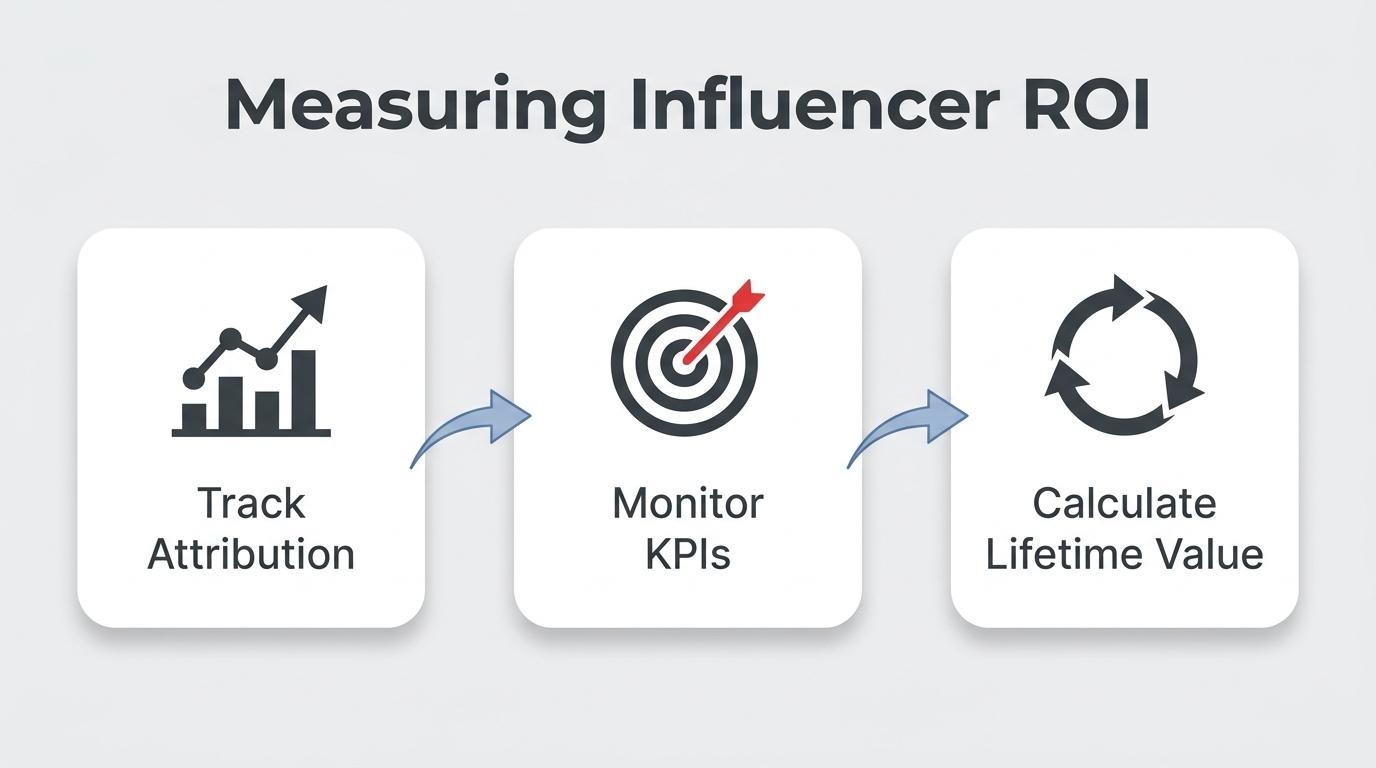
You measure influencer marketing ROI for ecommerce by combining attribution models, performance KPIs, and customer lifetime value analysis. The following subsections cover which attribution frameworks track influencer sales, which metrics matter beyond revenue, and how to calculate long-term value from influencer-acquired customers.
Attribution models that track influencer-driven sales include last-click, first-click, and multi-touch attribution (MTA). Last-click attribution assigns full credit to the final touchpoint before purchase, while first-click credits the initial discovery interaction. Both approaches oversimplify the buyer journey.
According to a study published in ScienceDirect, researchers proposed multi-touch attribution as a methodology that assigns credit to multiple touchpoints along the customer journey, addressing the limits of single-touch models. MTA distributes conversion value across every interaction, from an influencer's Instagram post to a retargeting ad to the final checkout click.
For ecommerce brands running campaigns across several creators and platforms simultaneously, MTA provides the most accurate picture of which influencers actually drive revenue versus which simply introduce awareness.
The KPIs you should track beyond revenue include:
Revenue alone misses the full funnel. A campaign that generates moderate direct sales but high engagement and saves often compounds over weeks as content resurfaces algorithmically.
You measure lifetime value from influencer-acquired customers by tagging each cohort at acquisition and tracking their repeat purchase behavior over 6 to 12 months. The core formula is: average order value multiplied by purchase frequency multiplied by average customer lifespan.
Segment influencer-acquired buyers separately from paid ad or organic cohorts. Compare their repeat purchase rate, average order value on subsequent purchases, and time between orders. Influencer-referred customers often show higher retention because the creator's endorsement builds pre-purchase trust that carries into the post-purchase relationship.
This cohort-level analysis reveals whether a campaign that looked break-even on first purchase actually generates strong returns over time, making it one of the most overlooked metrics in influencer program evaluation. Understanding long-term value also shapes smarter decisions about influencer compensation structures and campaign scaling.
Common ecommerce influencer marketing mistakes to avoid include choosing creators based on follower count alone, neglecting audience alignment, skipping engagement vetting, over-scripting content, and ignoring post-campaign measurement.
According to Pathfinders Advertising, picking an influencer based on audience size alone ranks among the nine most common mistakes brands make in influencer marketing. A large following means little if the creator's audience does not match your target customer profile or if engagement signals indicate low-quality interactions. Brands also frequently undermine results by micromanaging creative output, which strips the authenticity that makes influencer content effective in the first place.
Other mistakes that erode campaign performance include:
Most of these errors stem from treating influencer marketing as a media buy rather than a partnership. Brands that invest in vetting, creative freedom, and proper attribution consistently outperform those chasing vanity metrics. With common pitfalls identified, the next step is building systems that scale creator partnerships efficiently.
You scale an influencer program by building repeatable systems, standardizing workflows, and expanding your creator roster strategically rather than simply increasing spend. Scaling requires moving beyond ad hoc campaigns toward structured processes that support consistent output as volume grows.
According to Forbes, scaling an influencer program isn't just about running bigger campaigns or working with more creators; it requires both a new strategy and repeatable systems. This means documenting outreach templates, standardizing briefs, centralizing performance data, and creating tiered compensation structures that work across dozens or hundreds of partnerships simultaneously.
Brands that treat scaling as a systems problem rather than a budget problem build more sustainable programs. Key components of a scalable influencer operation include:
For brands managing influencer data alongside storefront and CRM information, platforms with a shared data layer, such as SHOPLINE, can consolidate campaign tracking within the same system that handles customer records and lifecycle marketing. This eliminates the need to reconcile influencer performance across disconnected tools. As your creator network grows, the legal framework governing those partnerships becomes equally important to get right.
The legal and disclosure rules that apply to influencer marketing center on FTC endorsement guidelines, platform-specific ad labeling requirements, and age-directed content restrictions. Non-compliance carries financial penalties and reputational damage.
The FTC requires influencers to clearly and conspicuously disclose any material connection to a brand. This includes paid partnerships, gifted products, affiliate commissions, and any form of compensation. Disclosures must appear where viewers can easily notice them, not buried below the fold or hidden in hashtag strings. Labels such as #ad or #sponsored should be placed at the beginning of a caption or within the first few seconds of a video.
Enforcement is active. In 2024 alone, the FTC returned $337.3 million to consumers through enforcement actions, according to data reported by the Federal Trade Commission. That same year, the FTC sent warning letters to two trade associations and 12 online health influencers who failed to make adequate disclosures in social media posts. These actions signal that both brands and individual creators face regulatory scrutiny.
Content directed at children under 12 requires more than a simple "ad" label upfront, per guidance from the Advertising Standards Authority. Stricter rules apply because younger audiences cannot distinguish promotional content from organic posts.
Brands should build compliance into every influencer contract. Key provisions to include are:
Relying on influencers to self-regulate disclosure is one of the most avoidable risks in this space. Brands that embed compliance requirements directly into agreements, and audit published content regularly, protect both their reputation and their budget from preventable enforcement actions.
Understanding disclosure obligations is essential before scaling creator partnerships into a broader customer acquisition strategy.
You turn influencer traffic into repeat customers by capturing first-party data at the point of click, then nurturing those visitors through lifecycle marketing tied to a unified customer record. The sections below cover how SHOPLINE consolidates this workflow and the key takeaways from this guide.
SHOPLINE unifies influencer campaign data by housing commerce, CRM, and marketing automation inside a single system with a shared customer data layer. When an influencer-driven visitor lands on a SHOPLINE storefront, their browsing behavior, purchase history, and attribution source resolve to one customer record automatically.
This eliminates the common pain of reconciling data across separate tools like a standalone CDP, an email platform, and a third-party affiliate tracker. Because lifecycle marketing automation is native, brands can trigger post-purchase flows, win-back sequences, and subscription prompts directly from the same system that captured the initial sale.
For brands running influencer programs at scale, this consolidation reduces both operational overhead and the data fragmentation that typically erodes repeat-purchase rates.
The key takeaways about ecommerce influencer marketing center on strategic alignment, measurement rigor, and retention-focused execution. The most actionable lessons from this guide include:
The brands that treat influencer marketing as a lifecycle channel rather than a one-time awareness play are the ones that sustain profitable growth beyond the initial campaign spike.
.png)
.png)
.png)

