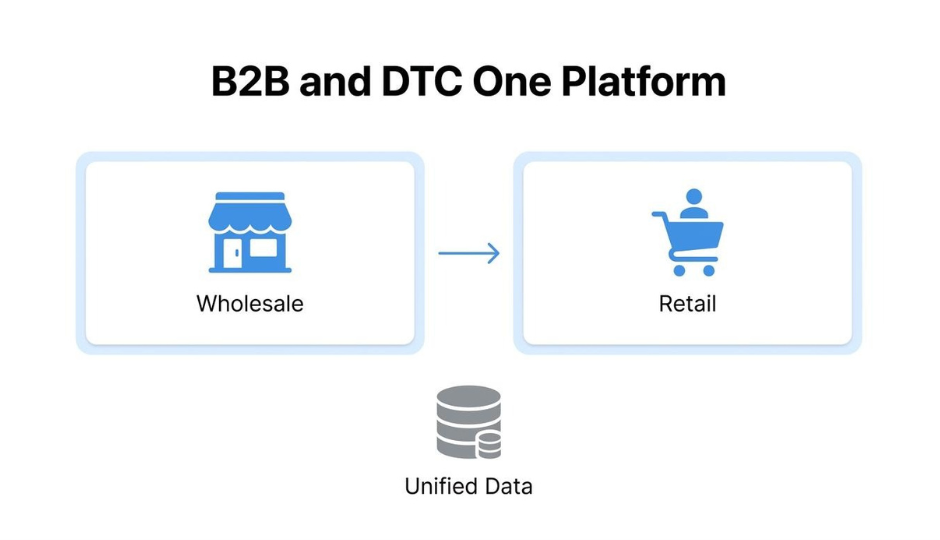
Running B2B and DTC on one ecommerce platform means consolidating wholesale and retail operations into a single system that shares inventory, customer data, and order management while enforcing channel-specific pricing, checkout logic, and fulfillment rules.
This guide covers the strategic case for dual-channel selling, the structural differences between B2B and DTC ecommerce, platform capabilities and architecture required to serve both audiences, operational configuration for pricing, catalogs, and checkout flows, data unification and marketing segmentation, risks of running disconnected systems, and what migration to a consolidated platform actually involves.
Both B2B and DTC ecommerce markets are expanding rapidly, and brands that sell through only one channel leave significant revenue uncaptured. Wholesale buyers now expect consumer-grade digital experiences, which makes operating both channels from a shared storefront a cost and efficiency advantage rather than a luxury.
B2B and DTC transactions differ in fundamental ways across catalog visibility, pricing logic, checkout complexity, and account structure. B2B orders involve tiered pricing, net payment terms, purchase order approvals, and multi-buyer company accounts; DTC transactions settle immediately with fixed retail prices and single-user profiles. A viable platform must handle both simultaneously without one corrupting the other.
Serving both channels requires storefront-level separation, unified order management, a shared customer data layer, and role-based access controls. Unified customer data prevents the fragmented profiles that inflate acquisition costs, distort reporting, and block effective lifecycle marketing across buyer types.
Platform architecture determines long-term viability. Single-platform models with natively connected commerce, CRM, and pricing logic outperform bolted-together app stacks, which break down as pricing complexity, data volume, and order frequency scale. Inventory fragmentation, disjointed reporting, and compliance exposure are the primary operational risks when channels remain split.
Migration requires data cleanup, ERP connectivity, phased rollouts, and realistic timelines; brands that treat these as sequential steps avoid the delays that derail most replatforming projects.
Brands sell B2B and DTC from the same store to consolidate operations, reduce tech stack costs, and unify customer data across both channels. The sections below cover market growth driving this shift, rising buyer expectations, and the operational advantages of a single-storefront model.
B2B and DTC ecommerce markets are both expanding at rates that make single-channel selling a missed opportunity. According to Elogic Commerce, US B2B ecommerce site sales reached $2.297 trillion in 2024, up 10.5% year-over-year, with projections hitting $3.027 trillion by 2028. The DTC ecommerce market is expected to grow from approximately $163 billion in 2024 to nearly $595 billion by 2033. Brands that serve only one side leave significant revenue on the table. Running both channels from a single storefront eliminates the duplicate infrastructure that separate systems require.
B2B buyers increasingly expect the same frictionless digital experience they get as consumers. 73% of B2B buyers expect the same online experience they enjoy in B2C, from real-time stock visibility to one-click reorders. Millennials and Gen Z now make up 71% of B2B buyers, up from 64% in 2022, which accelerates demand for intuitive, self-service purchasing. When wholesale and retail share one storefront, the brand invests once in UX improvements that serve both audiences rather than maintaining parallel experiences at double the cost.
Running B2B and DTC on separate platforms creates fragmented inventory, inconsistent pricing, and disconnected customer records. A unified store eliminates the need to reconcile data between systems, reduces app licensing fees, and gives operations teams a single source of truth for orders, fulfillment, and reporting. For brands scaling past the $1M revenue mark, this consolidation is often what separates manageable growth from operational drag. One system serving both channels means fewer integration points to maintain, faster campaign execution, and a cleaner path to understanding true customer lifetime value across buyer types.
Understanding why brands consolidate sets the stage for examining how B2B and DTC channels actually differ in their requirements.
The core differences between B2B and DTC ecommerce span catalogs, pricing, checkout workflows, and account structures. Each area requires distinct logic that a single platform must handle simultaneously.
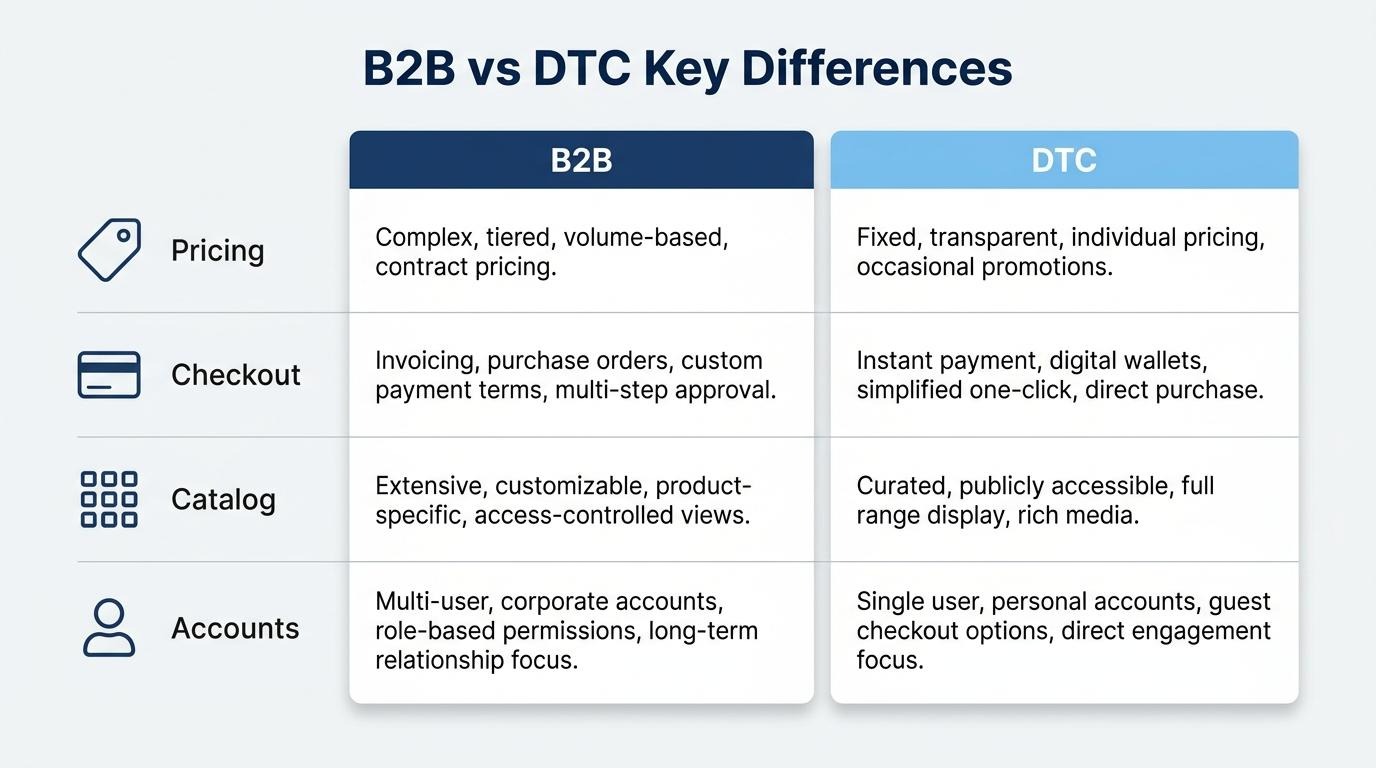
Product catalogs for B2B vs DTC buyers differ in visibility, structure, and purchase logic. DTC catalogs display a universal product assortment with fixed retail prices visible to every visitor. B2B catalogs restrict access to authenticated buyers and surface account-specific assortments.
Key distinctions include:
According to Commercetools, B2B companies achieve high-value orders from a narrower audience, while DTC addresses more potential buyers at a lower value per order. This asymmetry means the same SKU often requires two completely different catalog presentations.
Pricing and payment logic for B2B orders changes from a single retail price to a layered system of commercial terms. DTC pricing is straightforward: one price, immediate payment at checkout.
B2B pricing involves multiple variables:
Payment terms also diverge significantly. According to Rigby, B2B payment terms define when and how a buyer pays: Net 30 means payment is due 30 days after invoice, Net 60 means 60 days, and so on. DTC transactions, by contrast, settle instantly via credit card or digital wallet. For brands serving both audiences, the platform must enforce these parallel pricing engines without one corrupting the other.
Checkout and fulfillment workflows diverge because B2B orders carry operational complexity that DTC transactions do not. A DTC checkout is linear: add to cart, enter shipping details, pay, and receive confirmation.
B2B checkout layers in additional requirements:
Fulfillment also splits. DTC orders ship individual parcels to consumers, while B2B orders may involve palletized freight, scheduled delivery windows, or warehouse-to-warehouse transfers. One-click reordering benefits both channels, but the underlying fulfillment logic remains distinct. Treating these as identical workflows is where most single-platform implementations fail first.
Customer account expectations differ by channel in scope, permissions, and data depth. A DTC account is simple: one person, one login, order history, and saved addresses. A B2B account represents an entire organization with multiple buyers, approval hierarchies, and spending limits tied to a single company profile.
B2B accounts require:
According to CDP.com, a customer data platform unifies behavioral, transactional, and identity data from every digital touchpoint into persistent customer profiles. This unification matters most when both account types coexist, because without it, the same buyer purchasing personally and professionally appears as two unrelated records. Understanding these structural differences clarifies what platform capabilities dual-channel brands actually need.
You need storefront flexibility, unified order management, a shared customer data layer, and role-based access controls. The following sections break down each capability area.
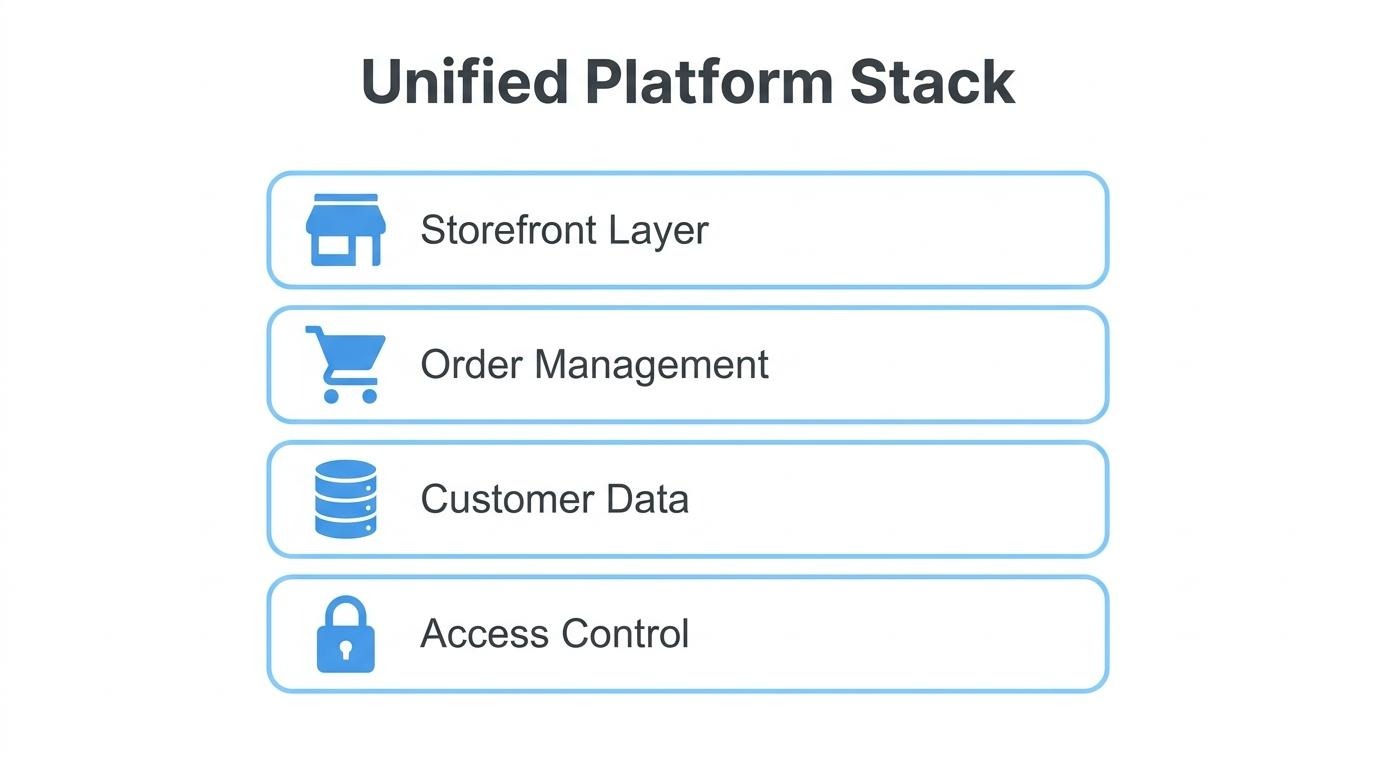
Storefront features that support dual-channel selling include password-protected B2B portals, consumer-facing product pages, and the ability to show different catalogs and pricing to different buyer types from a single domain. Headless architecture allows checkout workflows to be built with custom UI while integrating backend rules and validations via APIs, according to BetterCommerce. A dual-channel storefront also needs flexible orchestration layers that pull data from PIM, ERP, and CRM systems to serve contract pricing, tiered discounts, and custom catalogs alongside standard retail listings. Without this storefront-level separation, B2B buyers see consumer pricing and DTC shoppers encounter wholesale-only interfaces.
Order management functions that handle B2B and DTC together must process two fundamentally different transaction types within one system. The B2B checkout process is more complex, involving multiple layers of order approvals, billing and shipping combinations, customized pricing, quote management, and credit line validation, according to Commercetools. DTC orders, by contrast, follow a simpler path: single buyer, immediate payment, and standard shipping. A unified OMS needs to route each order type through its own workflow while drawing from shared inventory. For most brands selling into both channels, the order management layer is where consolidation either saves time or creates chaos.
The CRM and customer data requirements that apply across both channels center on a unified customer data platform. A CDP for ecommerce unifies behavioral, transactional, and identity data from every digital touchpoint into persistent customer profiles that power personalization, lifecycle marketing, and revenue optimization in real time, according to CDP.com. Without this unification, commerce platforms, email service providers, paid media stacks, and analytics tools each hold only a partial view of the customer. Personalized recommendations powered by unified customer data consistently drive 10 to 30 percent of ecommerce revenue, per McKinsey research. A shared data layer is not optional; it is the foundation that makes dual-channel selling operationally viable.
Mixed teams need granular, role-based access controls that separate B2B operations from DTC management while keeping both connected to the same underlying data. Integrated B2B suites offer core commerce, CRM, payments, and marketplace capabilities natively connected with a single data model, ensuring teams access the same real-time information, according to Oroinc.com. Practically, this means:
With the right permissions structure in place, choosing the correct pricing and catalog configuration becomes the next critical decision.
You structure pricing and catalogs for two audiences by layering tiered B2B price lists over standard DTC retail pricing, then assigning buyer-specific catalogs that control product visibility. The sections below cover volume-based pricing setup, catalog segmentation, and multi-currency tax handling.
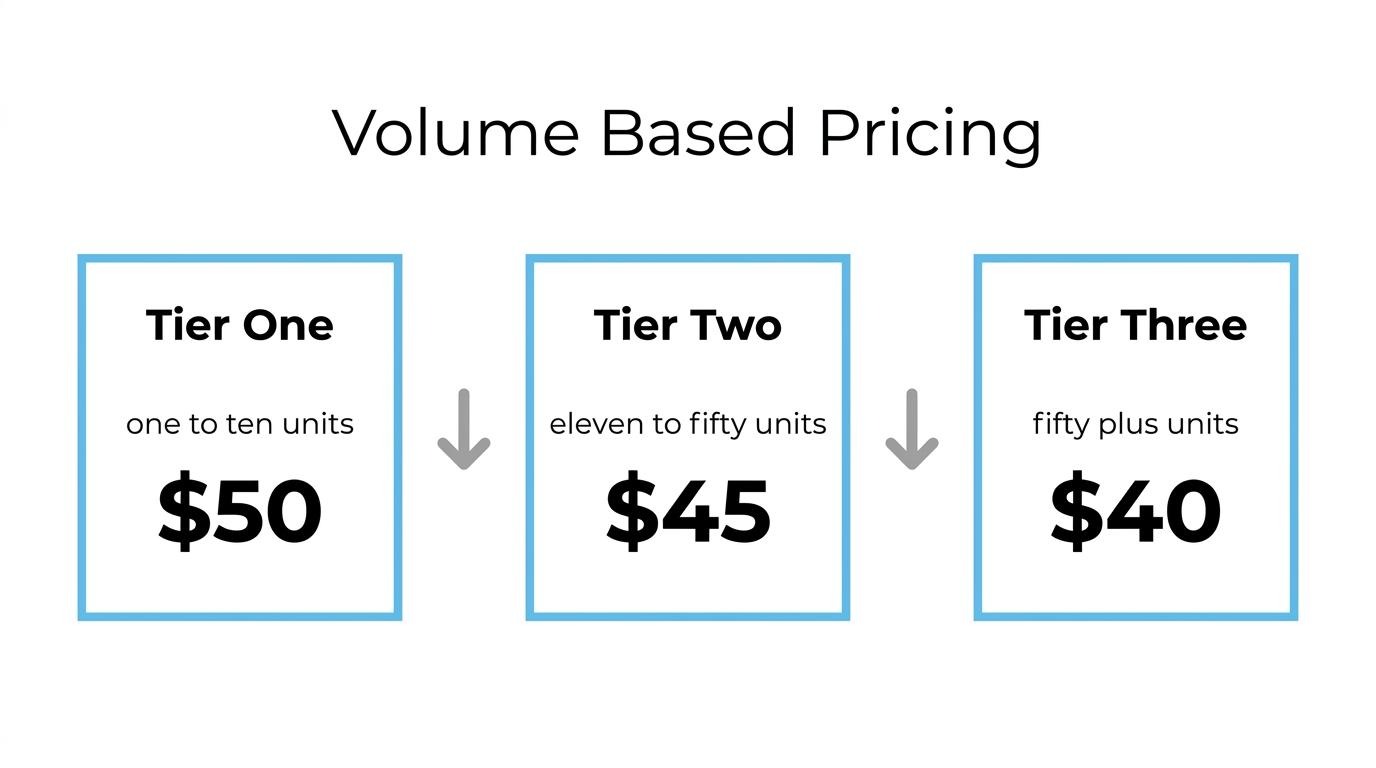
You set up tiered and volume-based B2B pricing by configuring quantity thresholds that automatically adjust unit prices as order size increases. This approach rewards larger commitments while protecting margin on smaller orders.
According to Virto Commerce, multi-tier pricing dominates B2B because it balances standardization at scale with individualization at the account level, though it breaks down without automation. Effective tiered pricing typically layers several elements:
Without automated rules governing these layers, pricing inconsistencies push buyers back to manual ordering channels where a sales rep confirms every quote. For brands scaling both B2B and DTC, building tier logic directly into the platform eliminates spreadsheet-driven errors.
You display different catalogs to different buyers by assigning curated product collections to specific customer groups, so each buyer type sees only relevant products and pricing after login. B2B catalogs offer a flexible way to manage and customize product pricing for different customer segments, according to the SHOPLINE Help Center.
A typical dual-audience catalog setup involves:
Fixed price discounts override percentage discounts within the same catalog, allowing you to balance broad wholesale markdowns with precise pricing on high-margin or promotional items. This layered control matters most when certain products carry exclusive distribution agreements or minimum advertised price requirements that differ by channel.
You handle currency and tax rules across channels by configuring region-specific settings that apply the correct currency display, tax calculation, and compliance logic based on buyer location and account type. B2B and DTC transactions often follow different tax treatment, so a single rule set rarely works for both.
Key distinctions to manage include:
Automating these rules inside the platform prevents manual tax errors that compound across hundreds of orders. With catalog and pricing logic already segmented by buyer type, layering in channel-specific tax and currency rules completes the foundation for a clean checkout experience.
You manage separate checkout flows on one platform by configuring distinct rules for B2B and DTC transactions within a shared backend. The sections below cover net terms for wholesale buyers, consumer payment processing, and order routing to the correct fulfillment workflow.
A B2B checkout with net terms works by allowing authorized wholesale buyers to place orders and defer payment to an agreed-upon date. Net 30 means payment is due 30 days after invoice; Net 60 extends that window to 60 days. According to the SHOPLINE Help Center, only authorized B2B companies can proceed to B2B checkout, which requires complete company location address, contact information, and associated customer details before an order is submitted.
The checkout validates credit lines and applies pre-negotiated pricing before generating an invoice with a purchase order number. Approval workflows may involve multiple stakeholders within the buying organization, adding layers that a standard consumer checkout never encounters. For brands managing both channels, keeping this complexity contained within the same platform prevents invoice data from fragmenting across disconnected tools.
A DTC checkout with consumer payments works by processing immediate transactions through credit cards, digital wallets, and buy-now-pay-later options at the point of purchase. There is no invoicing step, no PO number, and no approval chain. The buyer adds items to cart, enters shipping details, pays, and receives an order confirmation within seconds.
Speed and simplicity define this flow. According to Commercetools, offering one-click reordering or recurring order subscriptions can simplify the process and increase retention for both B2B and B2C companies. The consumer checkout prioritizes minimal friction: fewer form fields, guest checkout options, and real-time payment confirmation. Running this alongside a B2B flow on the same platform means shared inventory visibility without shared complexity at the point of sale.
You route orders to different fulfillment workflows by tagging each transaction with its channel type at checkout, then applying channel-specific rules for picking, packing, and shipping. B2B orders typically involve palletized shipments, freight carriers, and scheduled delivery windows. DTC orders route to parcel carriers for individual packaging and faster transit.
A unified order management system reads the channel tag and triggers the correct workflow automatically. This prevents warehouse teams from applying consumer packaging to a 500-unit wholesale order, or shipping a single candle via freight. When both channels pull from the same inventory pool in real time, stock allocation stays accurate across every open order. Unified fulfillment routing is where checkout architecture connects directly to operational execution.
Customer data fragments into incomplete, conflicting profiles when B2B and DTC operate on separate systems. Without a unified data layer, the same buyer can appear as multiple unrelated records, distorting personalization, inflating acquisition costs, and creating blind spots across both channels.
When B2B and DTC platforms store data independently, each system holds only a partial view of customer behavior. A wholesale buyer who also shops the DTC storefront generates two disconnected profiles: one with order history and contract terms, the other with browsing behavior and consumer purchase data. Neither system sees the full picture.
According to CDP.com, without identity resolution, customers browsing on mobile, adding to cart on desktop, and completing a purchase through an email link appear as three separate users, undermining personalization and inflating acquisition costs. This same fragmentation compounds across channels when B2B and DTC data live in different databases.
Split systems create several specific problems:
A unified data layer resolves these issues by tying every interaction, whether wholesale reorder or consumer browse session, to a single persistent profile. B2B buyers are twice as likely to share data with a supplier when it leads to personalized experiences, which only works when both channels feed the same record.
For brands operating at scale, split customer data is not just an inconvenience; it is a structural barrier to accurate lifecycle marketing, reliable forecasting, and consistent buyer experiences. Consolidating both channels onto one platform with a shared data model eliminates the reconciliation problem entirely, turning fragmented signals into a complete customer view that both teams can act on.
You unify marketing across B2B and DTC segments by segmenting campaigns around buyer type and controlling promotion visibility per channel. The subsections below cover lifecycle segmentation and cross-channel promotion management.
You segment email and lifecycle campaigns by buyer type using a customer data platform that tags each profile with its channel context, purchase behavior, and account type. A CDP enables dynamic customer segmentation based on real-time behavioral signals, automatically moving customers through lifecycle stages and triggering stage-appropriate campaigns. B2B accounts might enter a reorder nurture sequence after their first wholesale purchase, while DTC buyers receive post-purchase upsell flows tied to browsing history.
According to CDP.com, lifecycle-aligned messaging improves email revenue per recipient by 2-3x compared to broadcast campaigns. This gap widens when B2B and DTC audiences receive the same generic sends, because purchase motivations, order cadences, and decision timelines differ sharply between the two. Separating these flows at the data layer, not just the template level, is what makes segmentation sustainable as catalog and audience size grow.
You run promotions without conflicting across channels by gating each offer to its intended buyer segment through catalog-level controls and audience rules. Wholesale buyers should never see a DTC flash sale that undercuts their negotiated pricing, and retail customers should not stumble onto volume discount thresholds meant for trade accounts.
Practical safeguards include:
When catalog, email, and storefront promotions all reference the same segmentation layer, conflicts become exceptions rather than recurring fires. With marketing aligned by buyer type, the next consideration is which platform architecture sustains both channels long-term.
The platform architecture that supports both channels best is one that keeps B2B and DTC logic, data, and storefronts inside a single system. The sections below compare single-platform versus multi-tool approaches, identify when app stacks fail, and outline the integration gaps that appear when B2B is bolted onto a DTC store.
A single-platform approach consolidates commerce, CRM, pricing, and fulfillment into one data model, while a multi-tool stack stitches separate best-of-breed apps together through APIs and middleware.
Integrated B2B suites offer core commerce, CRM, payments, and marketplace capabilities natively connected with a single data model, simplifying operations and ensuring teams access the same real-time information, according to Oroinc.com. A multi-tool stack, by contrast, creates sync dependencies between every app pair; each new connector introduces a potential failure point.
The performance gap compounds over time. Brands using CDP-driven cart recovery on unified platforms report 15–25% improvements in recovery rates compared to rules-based approaches, per CDP.com research. That lift comes from having behavioral, transactional, and identity data in one place rather than reconciling fragments across disconnected tools. For dual-channel brands at scale, the single-platform model typically delivers faster execution and cleaner data with fewer ongoing maintenance costs.
An app-stack model breaks down for dual-channel brands when pricing complexity, data volume, and operational speed outpace what disconnected tools can synchronize reliably.
Multi-tier pricing dominates B2B because it balances standardization at scale with individualization at the account level, but it breaks down without automation, according to Virto Commerce. When tiered pricing, net terms, and customer-specific catalogs each live in separate apps, every price change requires manual updates across multiple systems. Errors compound: one mismatched sync can surface the wrong price to a wholesale buyer while simultaneously showing stale inventory to a DTC customer.
The breaking point usually arrives when the cost of maintaining integrations, resolving data conflicts, and troubleshooting sync failures exceeds the cost of consolidating onto a single system.
The integration gaps that appear when bolting B2B onto a DTC store typically involve:
These gaps widen as order volume grows, turning what started as manageable workarounds into persistent operational drag. Understanding these architectural trade-offs helps clarify the risks that surface once both channels are live.
Running both B2B and DTC channels on disconnected systems creates three major operational risks–inventory fragmentation, distorted reporting, and regulatory exposure. Each risk compounds when your tools don’t talk to each other.
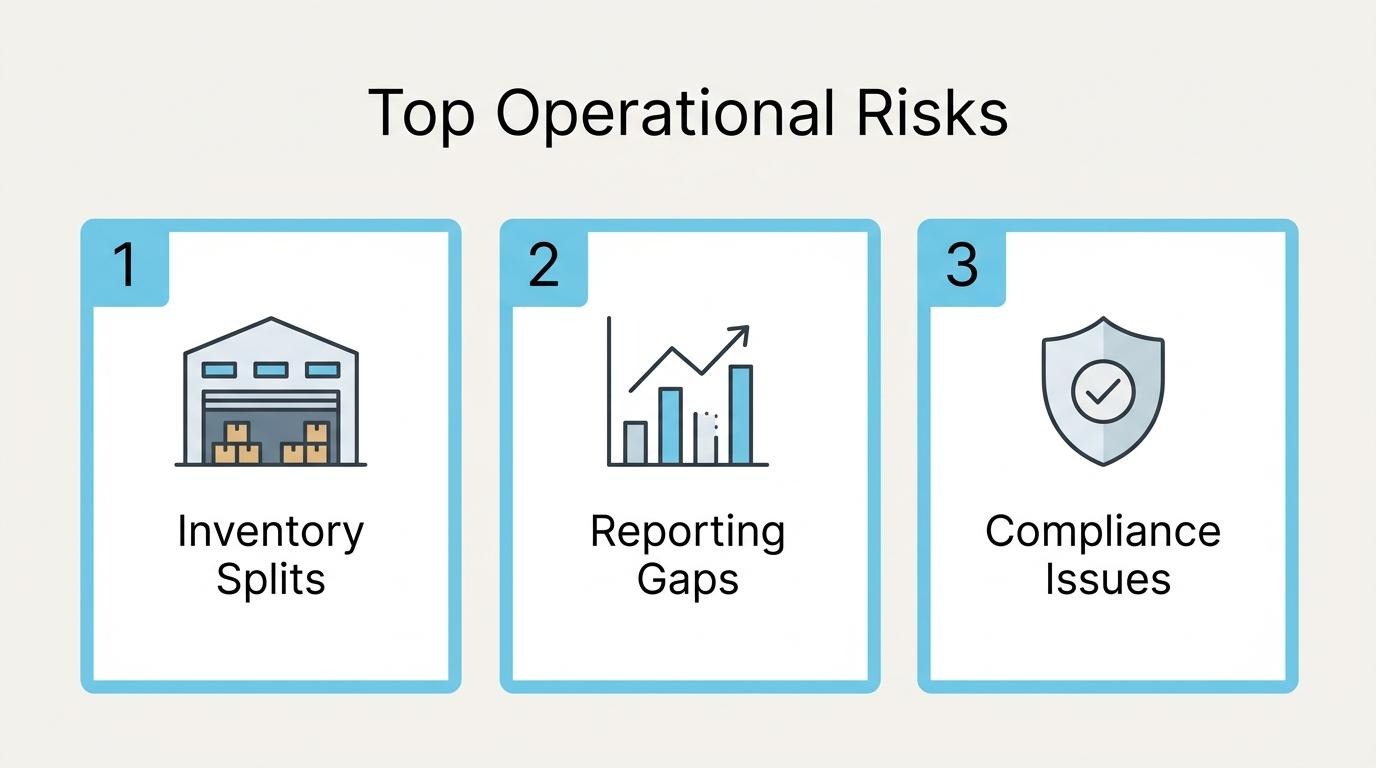
Inventory that is not shared across channels creates overselling on one side and deadstock on the other. A wholesale order can claim the last 500 units while the DTC storefront still shows them in stock, triggering cancellations and eroding buyer trust.
According to Oroinc.com, unified commerce succeeds when every team and channel pulls from a single system, eliminating conflicting answers or lag and ensuring buyers see the right pricing and inventory. Without that single source of truth, warehouse teams spend hours reconciling mismatched counts manually. For brands running both channels at any meaningful volume, split inventory data is the operational risk most likely to damage customer relationships before anyone on the team notices.
Disjointed reporting distorts channel performance by splitting revenue, cost, and customer metrics across separate dashboards that never reconcile. B2B margin looks strong in one system while DTC acquisition costs balloon in another, yet no single view reveals whether the business is actually profitable per customer across both channels.
This fragmentation leads to flawed decisions: marketing overinvests in a channel that appears high-performing only because returns and fulfillment costs sit in a different report. Finance teams waste cycles manually stitching spreadsheets instead of analyzing trends. When each channel owns its own analytics silo, leadership operates on incomplete data, which is arguably more dangerous than having no data at all.
The compliance risks that come with separate B2B and DTC systems center on fragmented customer identity, inconsistent data records, and broken ERP connectivity. According to CDP.com, without identity resolution, customers browsing on mobile, adding to cart on desktop, and completing a purchase through an email link appear as three separate users, undermining personalization and inflating acquisition costs. That same fragmentation creates real regulatory exposure: duplicate customer records make GDPR or CCPA deletion requests unreliable, and tax calculations applied inconsistently across systems can trigger audit flags.
Data quality and ERP connectivity remain core blockers for B2B ecommerce, with ERP sync being crucial for a B2B site to become a real revenue channel. Separate systems multiply every compliance surface area. Understanding these operational risks clarifies why platform architecture matters so much during migration.
Migration to a unified platform involves auditing existing data, mapping integrations, planning phased rollouts, and training staff on consolidated workflows. The process spans licensing, development, testing, and ERP connectivity.
Most B2B ecommerce replatforming projects take longer than planned. According to Uncap, those that fail or run months over schedule almost always share the same root issues: unclear scope, poor data quality, and underestimated integration complexity.
Replatforming requires significant upfront investment across licensing, development, data migration, integration, testing, launch monitoring, and staff training. Each phase carries dependencies that compound when timelines slip or requirements shift mid-project.
Data quality and ERP connectivity remain the core blockers. A B2B site cannot become a real revenue channel if product data is incomplete, pricing rules are inconsistent, or inventory counts lag behind the ERP. Brands that treat data cleanup as a pre-migration step, not a parallel task, avoid the most common delays.
If a legacy platform lacks the compatibility or flexibility to integrate with modern systems, replatforming is the smarter long-term investment. The cost of maintaining aging infrastructure, patching workarounds, and managing tool sprawl eventually exceeds the migration investment itself.
For brands already running five or more disconnected tools across B2B and DTC, the migration question is less about whether to consolidate and more about sequencing the move to minimize disruption.
With migration mechanics addressed, the next step is understanding what changes operationally once both channels share one system.
When B2B and DTC share one system and one dataset, brands eliminate data silos, reduce app-stack complexity, and operate both channels from a single source of truth. The sections below cover how SHOPLINE handles this natively and the key takeaways for unified dual-channel selling.
SHOPLINE handles dual-channel selling without an app stack by consolidating B2B and DTC commerce, CRM, and marketing automation inside one platform with a shared customer data layer. Key native capabilities include:
According to the SHOPLINE Help Center, the B2B catalog feature is available on the SHOPLINE Enterprise plan. Because catalog assignment, pricing logic, and checkout routing live in the same system as the DTC storefront, there is no sync gap between separate tools. For brands running five to fifteen apps just to approximate this setup, consolidation into one platform removes the reconciliation burden entirely.
The key takeaways about running B2B and DTC on one platform center on data unification, operational simplicity, and channel-specific flexibility within a shared system:
Running both channels from one dataset is not just a technical preference–it is the operational foundation that separates brands that scale efficiently from those that drown in tool management. Results may vary depending on implementation, industry, and scale.