
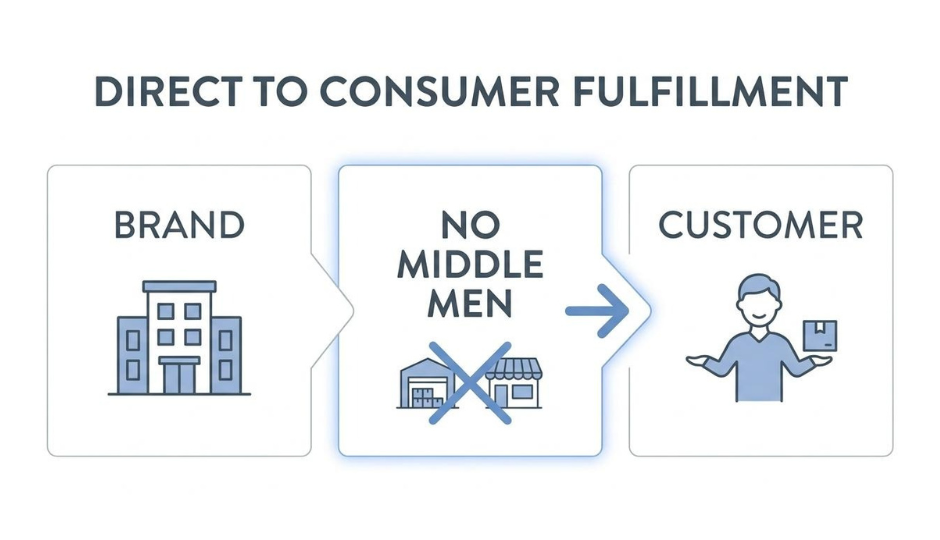
DTC fulfillment is the complete process of receiving, processing, and shipping orders directly from a brand to individual consumers, bypassing wholesalers, distributors, and retail intermediaries entirely.
This guide covers the core definition and strategic rationale behind DTC fulfillment, its key operational benefits, the most common challenges brands face at scale, the step-by-step process for building a fulfillment operation, and how technology and platform architecture shape long-term performance.
Brands choose DTC fulfillment because it places every customer touchpoint under direct control, from packaging and delivery speed to post-purchase communication. That ownership also unlocks first-party data on purchase behavior, return patterns, and reorder timing that wholesale channels never provide.
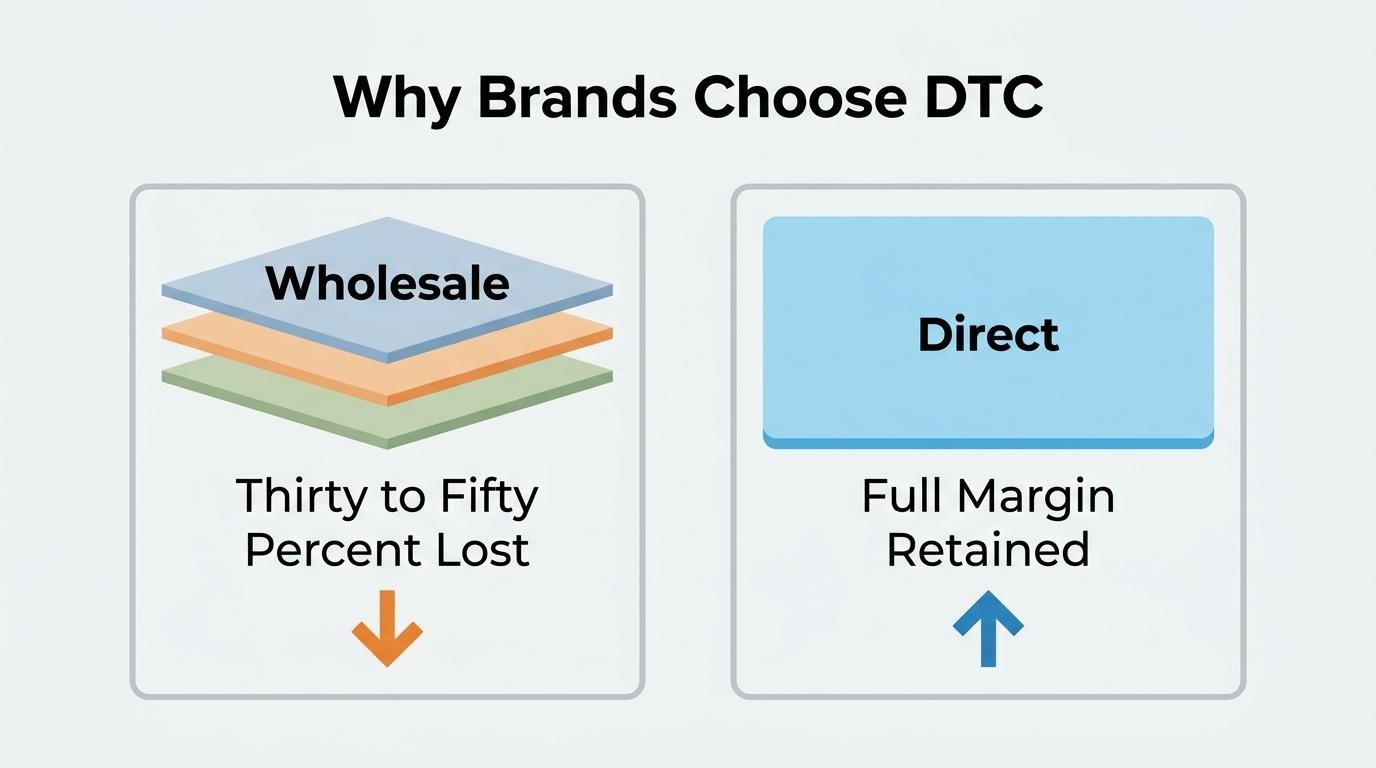
On the margin side, removing intermediaries eliminates the 30–50% revenue share typically lost to distributors and retailers. Consumer demand supports this shift: the majority of younger buyers prefer purchasing directly from brands rather than through traditional retail–a preference that’s reshaping how entire categories go to market.
Operationally, DTC fulfillment introduces real challenges. Inventory shrinkage, last-mile shipping costs that account for over half of total delivery spend, return rates averaging 19–20% across ecommerce, and fragmented tech stacks all create drag that compounds with volume.
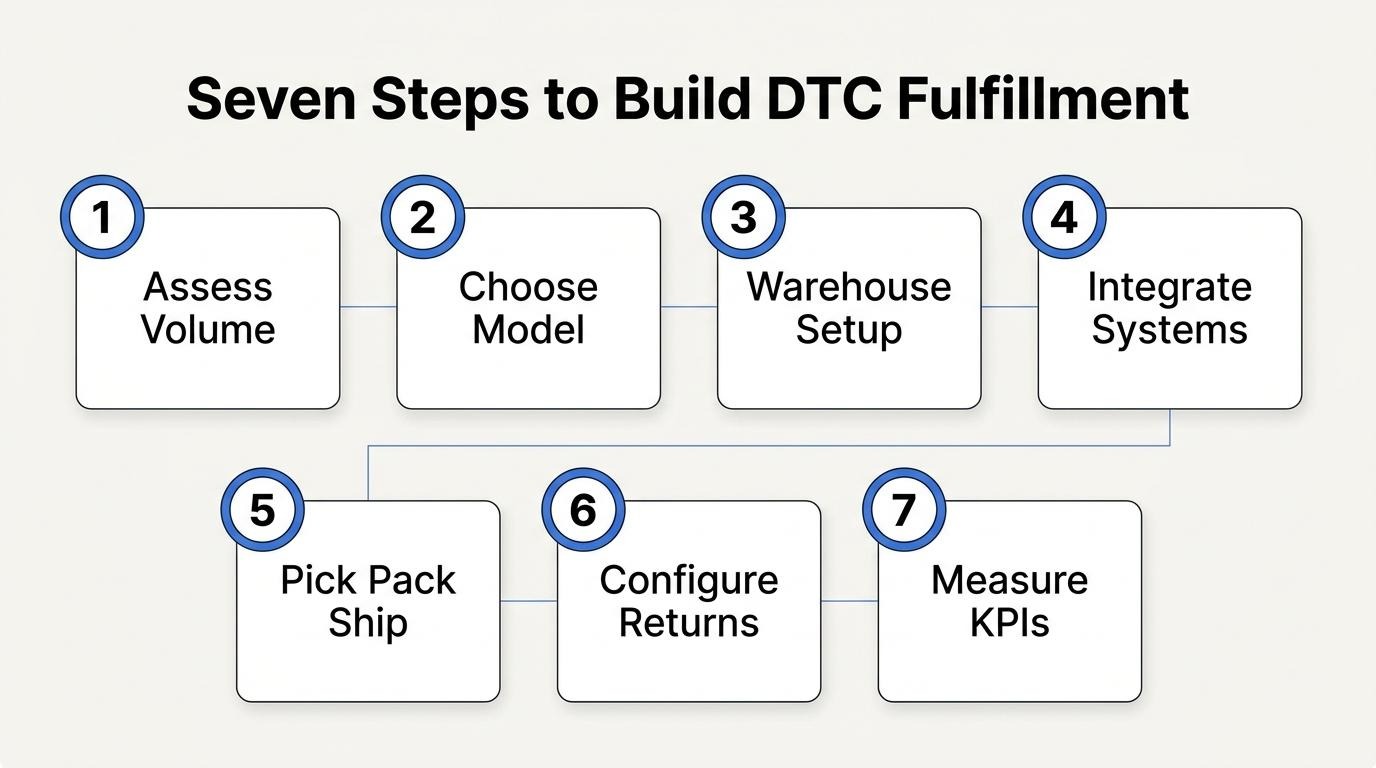
Building a reliable process requires structured decisions across seven stages: assessing order volume and SKU complexity, choosing between in-house and 3PL models, designing warehouse layout by product velocity, integrating order management with the storefront, standardizing pick-pack-ship workflows, configuring reverse logistics, and tracking fulfillment KPIs post-launch.
At scale, the technology layer connecting these stages determines whether operations run smoothly or break down. Unified commerce platforms that consolidate orders, inventory, CRM, and reporting into a single system reduce the sync gaps and manual reconciliation that slow fulfillment execution.
DTC fulfillment in ecommerce is the end-to-end process of receiving, processing, and shipping orders directly from a brand to individual consumers, bypassing wholesalers, distributors, and retail intermediaries. The brand controls every operational step: inventory storage, order processing, picking and packing, shipping, and returns handling.
This model differs from wholesale fulfillment, where brands ship bulk quantities to retailers who then sell to end customers. In DTC fulfillment, each order is a single-consumer transaction, which means higher order frequency, smaller package sizes, and direct accountability for delivery speed and unboxing experience.
Inventory accuracy is especially critical in this model, since stock discrepancies directly affect individual customer orders rather than bulk shipments to retail partners. According to the National Retail Federation, inventory shrinkage represents approximately 1.6% of sales, a gap between book inventory and physical count that can cascade into overselling, canceled orders, and eroded trust when every transaction is consumer-facing.
For scaling brands, DTC fulfillment is both an operational function and a strategic lever. It determines how quickly products reach customers, how much control the brand retains over presentation and data, and how efficiently returns flow back through the supply chain.
Brands choose DTC fulfillment over wholesale or retail because it eliminates intermediaries, giving sellers direct control over pricing, customer relationships, and brand experience. The revenue case is equally compelling: according to Deposco, DTC now accounts for up to half of overall revenue for 86% of manufacturers and retailers, with 82% of leaders projecting 10–25% growth over the next 12 months. Wholesale and retail channels require margin concessions to distributors and retailers, typically 30–50% of the final price. DTC fulfillment lets brands capture that full margin while owning every touchpoint from purchase to doorstep delivery. For brands already operating at scale, this shift also consolidates fragmented customer data that wholesale relationships never provide.
The key benefits of DTC fulfillment include greater control over customer experience, richer first-party data, higher profit margins, and faster product launches. Each advantage compounds as brands scale beyond wholesale dependence.
DTC fulfillment gives brands more control over customer experience by placing every touchpoint, from packaging design to delivery speed, under one roof. When a retailer or marketplace handles fulfillment, the brand loses influence over how products arrive, how issues get resolved, and what the unboxing moment communicates.
Owning the fulfillment process lets brands:
This level of control is difficult to replicate when fulfillment sits outside the brand's operation. For scaling DTC brands, consistency across every order builds the kind of trust that drives repeat purchases.
Owning fulfillment improves customer data and retention by connecting purchase behavior, shipping preferences, and service interactions into a single first-party dataset. When a third party fulfills orders, critical signals like return reasons, delivery feedback, and reorder timing often stay siloed or inaccessible.
Direct fulfillment captures granular data at every stage:
This data feeds lifecycle marketing, inventory planning, and personalization. Brands that consolidate fulfillment and customer data into one system, rather than reconciling exports from disconnected tools, act on insights faster. That speed gap between data capture and execution is where retention gains actually materialize.
DTC fulfillment increases profit margins by eliminating the wholesale markup, distributor fees, and marketplace commissions that sit between the brand and its customer. Every intermediary removed returns margin directly to the business.
Consumer demand supports this shift. According to Insider Intelligence, 56% of consumers worldwide say a better price is the top incentive to buy directly from brands, which means DTC pricing can stay competitive while preserving healthier margins than wholesale channels allow.
Margin improvements compound across several areas:
For brands operating at scale, even modest per-order margin gains accumulate into significant annual profit differences.
DTC fulfillment enables faster product launches by removing the retailer gatekeeping process that traditionally slows go-to-market timelines. Wholesale channels require buyer meetings, purchase orders, planogram approvals, and seasonal windows before a new product reaches shelves.
With owned fulfillment, the launch timeline compresses:
This speed advantage also reduces financial risk. Instead of committing to large wholesale runs, brands can test smaller batches, gauge demand through their own channels, and scale production based on actual sell-through rates. Faster iteration cycles keep product lines aligned with shifting consumer preferences.
With these benefits established, the operational challenges of managing DTC fulfillment in-house introduce a different set of decisions.
The biggest challenges of DTC fulfillment include inventory management errors, rising shipping costs, multi-channel routing complexity, returns processing bottlenecks, and fragmented tech stacks. Each creates operational drag that compounds as order volume grows.
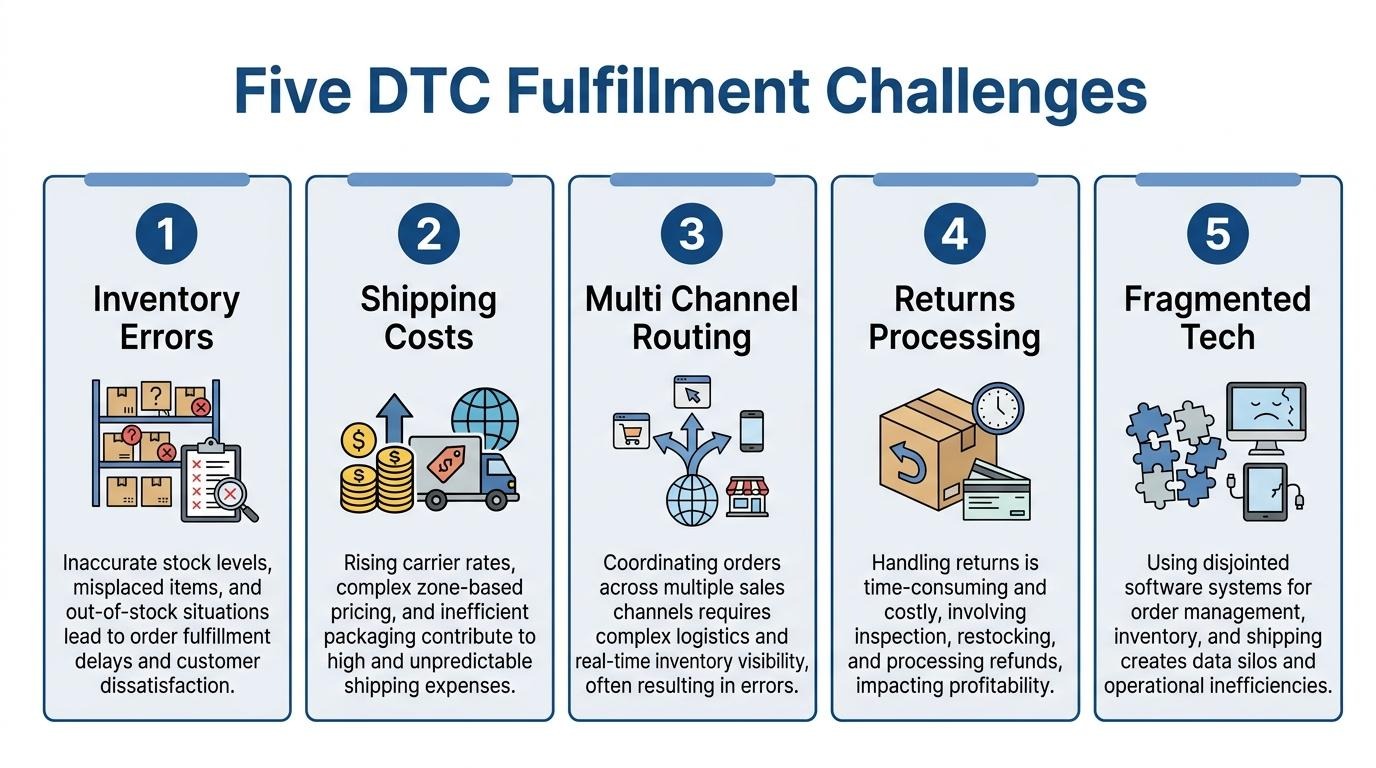
Inventory management errors hurt DTC operations by creating stockouts, oversells, and fulfillment delays that erode customer trust. When book inventory diverges from physical counts, orders route against phantom stock, triggering cancellations and refunds.
The National Retail Federation estimates inventory shrinkage at approximately 1.6% of sales, a gap that widens as SKU counts increase without centralized visibility. Warby Parker addresses this by managing hundreds of SKUs through proprietary software that integrates ecommerce and retail inventory into a single centralized system.
For brands operating across online and physical channels, the root issue is rarely a single miscount. Disconnected inventory systems create compounding inaccuracies that surface as customer-facing failures at the worst possible moment: checkout.
Shipping costs become difficult to control at scale because last-mile delivery now accounts for 53% of total shipping costs, according to Ringly's 2026 shipping analysis. As order volume rises, so does geographic dispersion, zone-based surcharges, and dimensional weight pricing.
Consumer expectations add pressure from the demand side. Eighty-eight percent of consumers prioritize free shipping over fast shipping when given the choice. Absorbing that cost requires either margin sacrifice or higher average order values.
Carrier rate negotiations, warehouse proximity to customers, and packaging optimization all help, but none fully offset the structural reality: shipping a single parcel to a single doorstep is inherently expensive, and each incremental order does not reduce that per-unit cost the way wholesale pallets do.
Multi-channel order routing creates complexity because each sales channel generates orders with different data formats, fulfillment priorities, and inventory pools. A brand selling through its own storefront, marketplaces, and retail locations must reconcile these streams in real time to avoid overselling or misallocation.
Real-time system integration between a WMS, OMS, and sales channels is critical; daily batch uploads are no longer sufficient for modern omnichannel fulfillment. When synchronization lags even by hours, inventory counts drift across channels, and the resulting errors cascade into picking, packing, and customer communication.
The operational burden here is not just technical. Every additional channel multiplies the routing rules, exception handling, and support workflows a fulfillment team must manage daily.
Returns processing is a bottleneck for DTC brands because ecommerce return rates average 19 to 20.5% across all product categories, roughly two to three times the brick-and-mortar rate of 5 to 8.9%, according to EightX's 2026 analysis. Apparel return rates reach 20% to 40%, making reverse logistics a constant operational drain for fashion-focused DTC brands.
Each return requires:
Without a structured reverse logistics workflow, returned inventory sits in limbo, tying up capital and warehouse space while customers wait for resolution.
A fragmented tech stack slows down fulfillment by forcing data to pass through multiple disconnected systems before an order can ship. When the OMS, WMS, shipping platform, and CRM operate as separate tools with API bridges or manual syncs, each handoff introduces latency and error risk.
This is where tool sprawl becomes an operational liability rather than just a cost problem. A brand running separate platforms for inventory, shipping labels, customer communication, and returns management creates five potential failure points for every single order. On platforms built around a shared data layer, such as SHOPLINE, order and customer data live in one system, removing sync gaps that commonly slow fulfillment execution.
With fulfillment challenges mapped, the next step is building a process that addresses each one systematically.
The steps to build a DTC fulfillment process span seven stages, from initial volume assessment through post-launch measurement. Each step below covers a specific operational decision.
You assess order volume and SKU complexity by auditing current monthly orders, active SKU count, and seasonal demand patterns. This baseline determines warehouse sizing, staffing needs, and whether automation is justified.
Key metrics to evaluate include:
Brands with fewer than 50 SKUs and steady volume can operate simpler workflows. Those managing hundreds of SKUs with variable velocity need inventory segmentation and potentially SKU rationalization to keep fulfillment efficient.
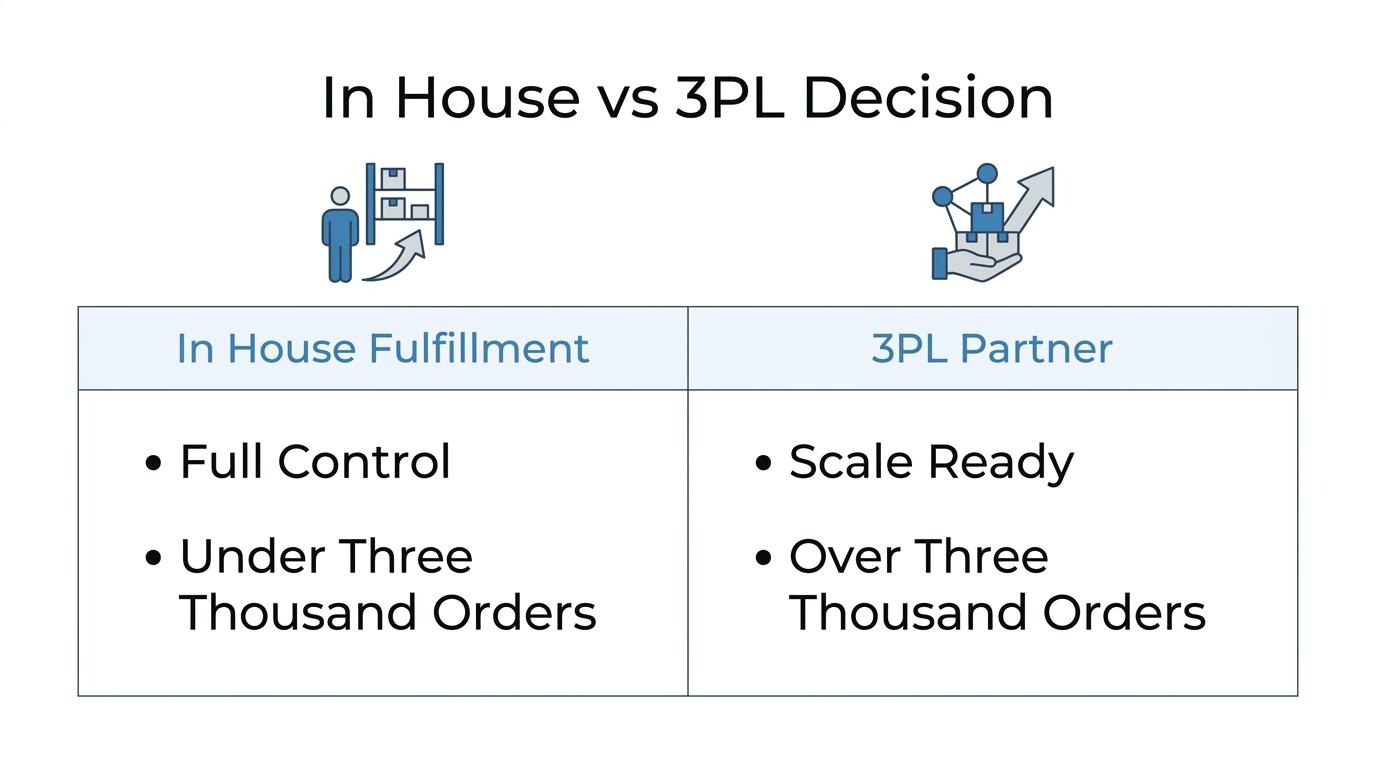
You choose between in-house and third-party fulfillment by weighing order volume, capital availability, and operational control requirements. In-house fulfillment suits brands that need direct quality oversight and custom packaging. Third-party logistics providers (3PLs) suit brands prioritizing speed-to-scale without warehouse investment.
According to GPA Logistics Group, the minimum threshold where 3PL outsourcing typically becomes cost-effective is approximately 3,000 orders per month. Below that volume, in-house operations often cost less per order. Above it, 3PL infrastructure, negotiated carrier rates, and distributed warehousing can reduce per-unit costs significantly. The right choice depends on where a brand sits on its growth curve; many operators start in-house and transition as complexity compounds.
You set up warehouse layout and inventory systems by organizing storage zones around SKU velocity and implementing a warehouse management system (WMS) for real-time tracking. According to AMZ Prep's DTC fulfillment guide, effective warehouse layout requires storing A-class SKUs nearest to packing stations, B-class SKUs slightly farther, and C-class SKUs in the back to accelerate fulfillment speed.
Core setup steps include:
You integrate order management with your storefront by connecting your order management system (OMS) to your ecommerce platform through real-time APIs or native integrations. This connection ensures that every order, inventory update, and fulfillment status syncs automatically between the storefront and warehouse.
Real-time integration matters because daily batch uploads create inventory discrepancies, overselling, and delayed shipping notifications. The OMS should push order data to the WMS the moment a customer completes checkout, then pull tracking information back to the storefront for customer-facing updates. Brands running multiple sales channels need a single OMS that consolidates orders from web, marketplace, and POS into one queue. On platforms with built-in order management, including SHOPLINE, this consolidation happens natively without requiring separate middleware.
You establish picking, packing, and shipping workflows by defining standardized procedures for each stage and training staff to execute them consistently. Picking methods depend on order profile: single-order picking works for low volume, while batch or zone picking reduces travel time at higher volumes.
Workflow elements to standardize include:
Each handoff between pick, pack, and ship should include a scan verification step. This catches errors before packages leave the facility, which is critical when ecommerce return rates average 19 to 20% across categories.
You configure returns and reverse logistics by building a structured process that handles return authorization, inspection, restocking, and refund triggers. A clear returns policy published on the storefront sets customer expectations, while backend workflows determine how returned items re-enter inventory or get disposed of.
Key configuration decisions include:
Category-specific return rates vary widely; apparel sees 20 to 40% while beauty stays within 4 to 12%. Tailoring reverse logistics to product type prevents bottlenecks and controls costs.
You measure fulfillment KPIs after launch by tracking operational metrics that reveal speed, accuracy, and cost efficiency across every stage of the process.
Essential KPIs to monitor include:
These metrics should feed into dashboards updated in real time, not reviewed monthly. Consistent measurement surfaces problems early, whether that is a rising error rate at a specific pick zone or shipping cost creep during peak periods. With fulfillment KPIs in place, the next decision is whether to scale operations in-house or through a 3PL partner.
Whether you should use in-house fulfillment or a 3PL for DTC depends on your monthly order volume, SKU complexity, and operational capacity. Each model carries distinct trade-offs across cost, control, and scalability.
In-house fulfillment suits brands that need direct control over packaging, quality checks, and the unboxing experience. It works best when order volumes are manageable enough for an internal team to pick, pack, and ship without consistent bottlenecks. Brands with highly customized or fragile products often benefit from keeping fulfillment internal, where they can enforce standards firsthand.
3PL outsourcing becomes the stronger option once shipping volume outpaces internal capacity. According to GPA Logistics Group, the minimum threshold where 3PL outsourcing typically becomes cost-effective is approximately 3,000 orders per month. Below that mark, the per-unit fees and onboarding costs of a third-party provider often erode any efficiency gains.
Key factors that should guide the decision include:
Many scaling DTC brands adopt a hybrid approach: handling flagship or subscription orders internally while routing standard shipments through a 3PL. This balances brand experience with operational efficiency.
For brands already managing fulfillment complexity across channels, the technology layer connecting your storefront, inventory, and order management matters as much as the fulfillment model itself. The next section covers how technology shapes every stage of DTC fulfillment.
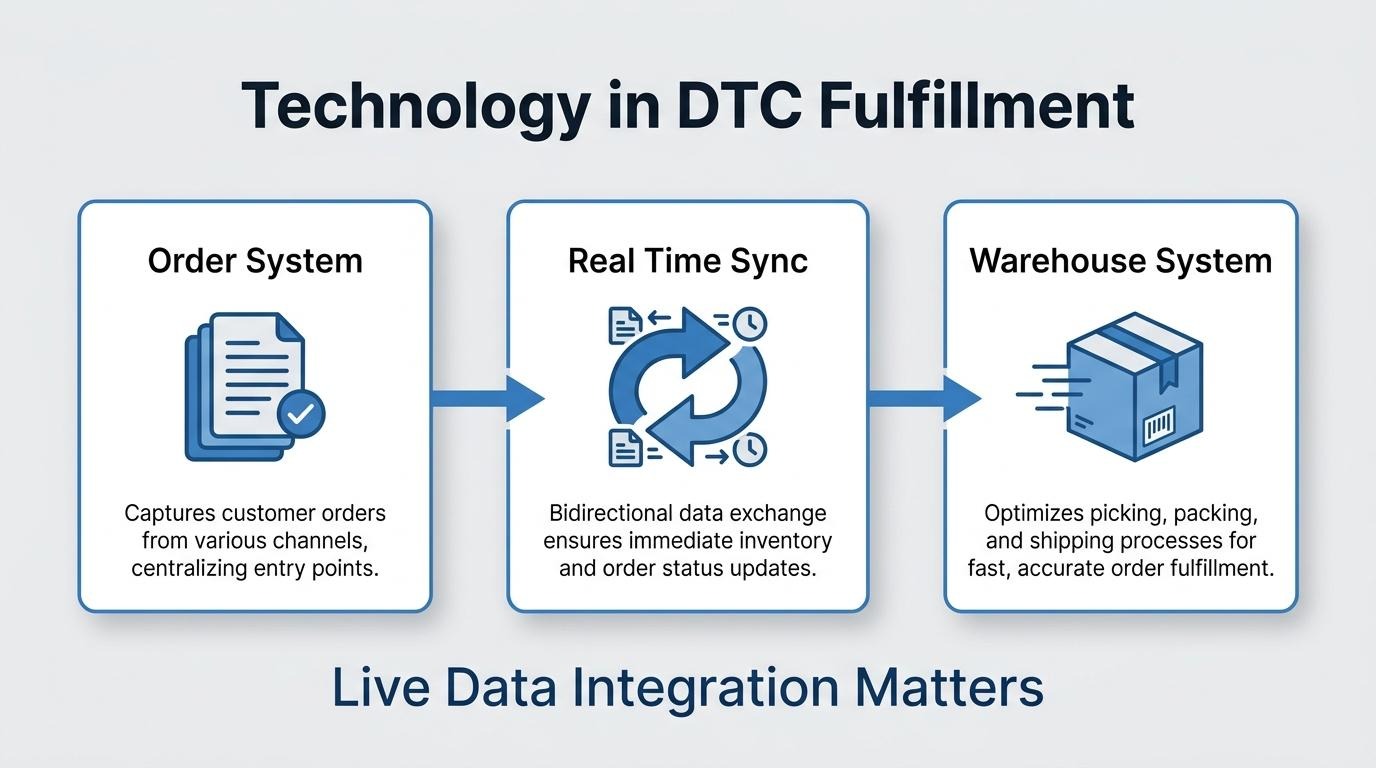
Technology plays a central role in DTC fulfillment by connecting order management, inventory tracking, and shipping into a single coordinated workflow. The systems that matter most include warehouse management software, order management platforms, and real-time integrations between sales channels.
Real-time system integration between a WMS, OMS, and sales channels is critical for modern fulfillment operations. According to GoBolt, daily batch uploads are no longer sufficient for omnichannel fulfillment; live data synchronization ensures that inventory counts, order status, and shipping updates reflect actual conditions across every channel simultaneously. Without this integration layer, overselling, delayed shipments, and misrouted orders become routine problems that erode customer trust.
A warehouse management system automates inventory positioning, pick-path optimization, and stock-level alerts. An order management system centralizes orders from multiple storefronts, marketplaces, and POS terminals into one queue. When these systems share data in real time, fulfillment teams can:
For scaling DTC brands, the gap between disconnected tools and a unified system compounds with every additional SKU and sales channel. Fragmented tech stacks force manual reconciliation, which slows cycle times and introduces errors at precisely the stage where speed matters most. Brands that consolidate fulfillment technology into fewer, better-integrated systems tend to operate with lower overhead and fewer order exceptions per thousand shipments.
Understanding how technology underpins fulfillment becomes especially relevant when orders follow recurring schedules rather than one-time purchases.
DTC fulfillment differs for subscription orders by requiring automated recurring billing, predictable inventory forecasting, and cycle-based pick-and-pack workflows that standard one-time order fulfillment does not need. The core differences span churn management, inventory cadence, and system integration.
Subscription fulfillment operates on a recurring cycle rather than a single transaction. Each billing period triggers a new fulfillment event automatically, which means the warehouse must pre-allocate inventory days or weeks before shipment dates. This predictability is an advantage for demand planning, but it also introduces unique risks. If a SKU goes out of stock mid-cycle, every subscriber expecting that item is affected simultaneously, unlike one-time orders where stockouts impact individual buyers at random intervals.
Churn tracking requires a different measurement framework than standard order metrics. According to Recharge, subscriber churn rate is calculated at the customer level, meaning a customer must be completely inactive to be considered "churned." This distinction matters operationally because a subscriber who pauses or skips a cycle is not churned, and their inventory allocation must remain flexible rather than released.
Key operational differences between subscription and standard DTC fulfillment include:
For brands managing subscriptions through third-party apps bolted onto a separate storefront, synchronization gaps between the subscription tool and the fulfillment system are a common failure point. Missed renewal triggers or delayed inventory updates can cascade into late shipments and increased churn. Platforms that handle subscriptions natively within the same system as order management reduce this integration risk considerably.
Understanding subscription-specific fulfillment mechanics prepares brands for the broader infrastructure question: how a unified platform approach changes DTC operations overall.
DTC fulfillment changes significantly when it runs on a unified commerce platform, primarily by eliminating data silos between orders, inventory, and customer records. Below, we cover how SHOPLINE consolidates DTC operations and the key takeaways from this guide.
SHOPLINE handles DTC order and customer data without a multi-tool stack by consolidating commerce, CRM, marketing automation, subscriptions, and POS into a single system with a shared customer data layer. Instead of syncing a separate OMS, email platform, subscription app, and point-of-sale terminal, every transaction resolves to one customer record.
Brands using unified commerce platforms see up to 20% higher customer retention rates compared to those running disconnected systems, according to industry data on platforms that replace fragmented tools with a single environment for POS, inventory, and reporting. This consolidation removes the reconciliation work that slows fulfillment teams operating across five or more tools.
For scaling DTC brands dealing with tool sprawl, a single-system approach is one of the most practical paths to reducing operational friction without sacrificing data granularity.
The key takeaways about DTC fulfillment benefits, challenges, and steps are:
According to Deposco, DTC order fulfillment now accounts for a significant share of overall brand revenue, making these operational fundamentals essential rather than optional. The brands that treat fulfillment as a strategic function, not just a logistics task, are the ones positioned to scale without compounding inefficiency.
.png)
.png)
.png)

