
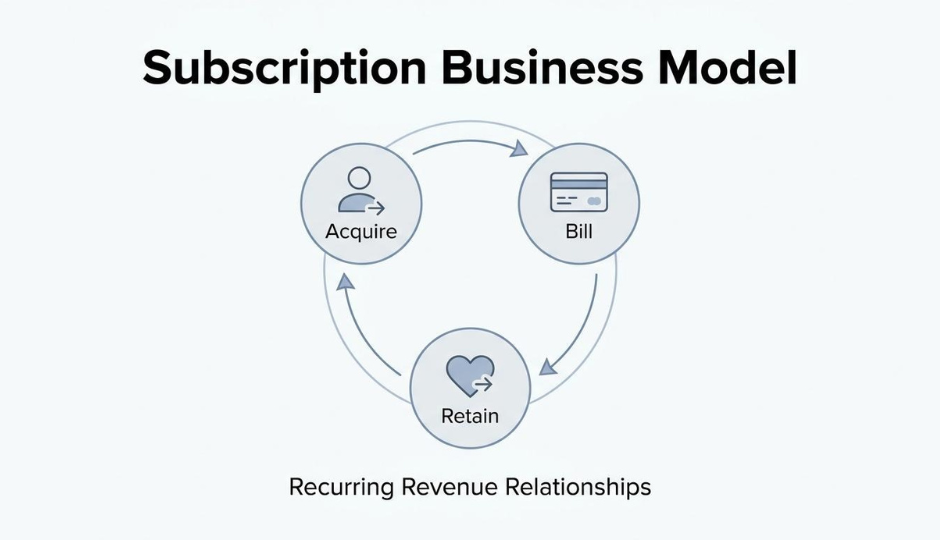
A subscription business model is a revenue model where customers pay a recurring fee, typically monthly or annually, to access a product or service. This structure replaces one-time transactions with ongoing customer relationships that produce predictable, repeating revenue streams.
This guide covers how subscriptions operate mechanically, the distinct model types available, why DTC brands gain specific financial advantages, performance measurement, industry applications, common threats to profitability, retention strategies, pricing, and the technology infrastructure required to run subscriptions at scale.
The operational mechanics follow a continuous cycle: brands acquire subscribers through compelling value propositions, automate recurring billing and fulfillment, then invest in retention to extend customer lifespan. Subscription-based models report significantly higher lifetime value than one-time purchase models because each additional month compounds the return on the original acquisition investment.
Five model types serve different value propositions: replenishment automates consumable reorders, curation delivers brand-selected discovery, access unlocks gated content or benefits, SaaS provides cloud software on recurring billing, and membership combines payment with community belonging and escalating perks.
For DTC brands specifically, subscriptions stabilize cash flow, reduce effective acquisition costs over time, and generate first-party behavioral data that powers personalization without reliance on third-party cookies. However, these advantages face real headwinds; more than half of Americans plan to cut subscriptions in 2026, making perceived relevance and flexible management essential to survival.
Measuring performance through MRR, churn rate, ARPU, and CLV gives brands the diagnostic framework to identify retention gaps early. Profitable pricing, consolidated technology stacks, and native platform integration then determine whether subscription operations scale cleanly or fragment under operational weight.
A subscription business model is a revenue model where customers pay a recurring fee, typically monthly or annually, to access a product or service. Rather than generating income through one-time transactions, this model builds ongoing customer relationships that produce predictable, repeating revenue streams.
According to a 2025 study published in the Journal of Business Research, the subscription business model is characterized by three core design rules: customer-orientation, interfunctional coordination, and digitalization, which collectively strengthen venture viability. These principles distinguish subscriptions from traditional retail by embedding continuous value exchange into the commercial relationship.
The defining attributes of a subscription business model include:
This structure shifts the business objective from acquiring new buyers for every sale to retaining existing subscribers across multiple billing periods. The economic logic favors depth of relationship over breadth of reach.
For brands scaling beyond initial traction, this model's emphasis on digitalization and interfunctional coordination means subscription operations touch nearly every department: product, marketing, fulfillment, finance, and customer support must align around the subscriber lifecycle rather than discrete campaigns.
Understanding these defining characteristics establishes the foundation for how a subscription business operates in practice, from initial acquisition through recurring billing and long-term retention.
The subscription business model works step by step through a continuous cycle of acquiring subscribers, billing and fulfilling orders on a recurring schedule, and retaining customers to maximize lifetime revenue.
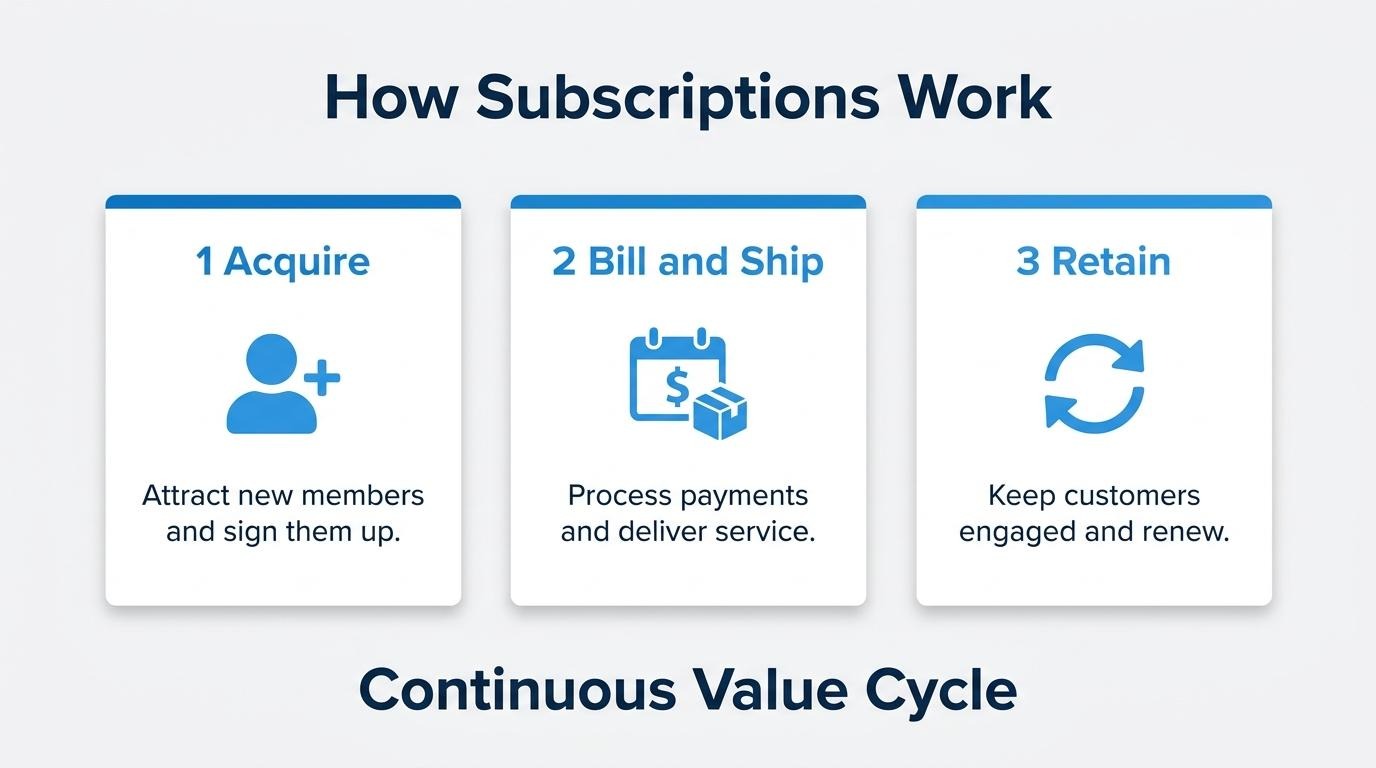
A brand acquires subscribers initially by offering a compelling value proposition that converts one-time visitors into recurring customers. Common acquisition tactics include:
The Subscription Value Loop framework, developed by Reforge, positions Value Creation as the first stage: brands must clearly articulate what unique, ongoing benefit subscribers receive that a single purchase cannot deliver. Without a differentiated value proposition, acquisition costs climb and trial-to-paid conversion rates collapse.
Recurring billing and fulfillment operate through automated systems that charge customers on a set cadence and trigger order processing without manual intervention. The billing engine handles:
Once billing confirms payment, fulfillment systems pick, pack, and ship the order automatically. For brands scaling beyond a few hundred subscribers, this cycle grows more complex; integrated platforms that unify billing with inventory and shipping data eliminate the sync failures common in multi-tool setups.
Subscriber retention drives long-term revenue by extending the active lifespan of each customer relationship, compounding the value of the original acquisition investment. According to Rivo, subscription-based models report 2-3x higher Customer Lifetime Value than one-time purchase models specifically because they extend customer lifespan.
Retention transforms the economics of every subscriber cohort. Each additional month a customer remains active reduces the effective cost of acquisition and increases margin contribution. Brands that invest in flexible management options, personalized communication, and loyalty incentives create friction against cancellation while reinforcing perceived value.
Understanding these operational mechanics clarifies why the model suits certain product categories better than others.
The types of subscription business models are replenishment, curation, access, SaaS, and membership. Each model structures recurring revenue around a different value proposition.
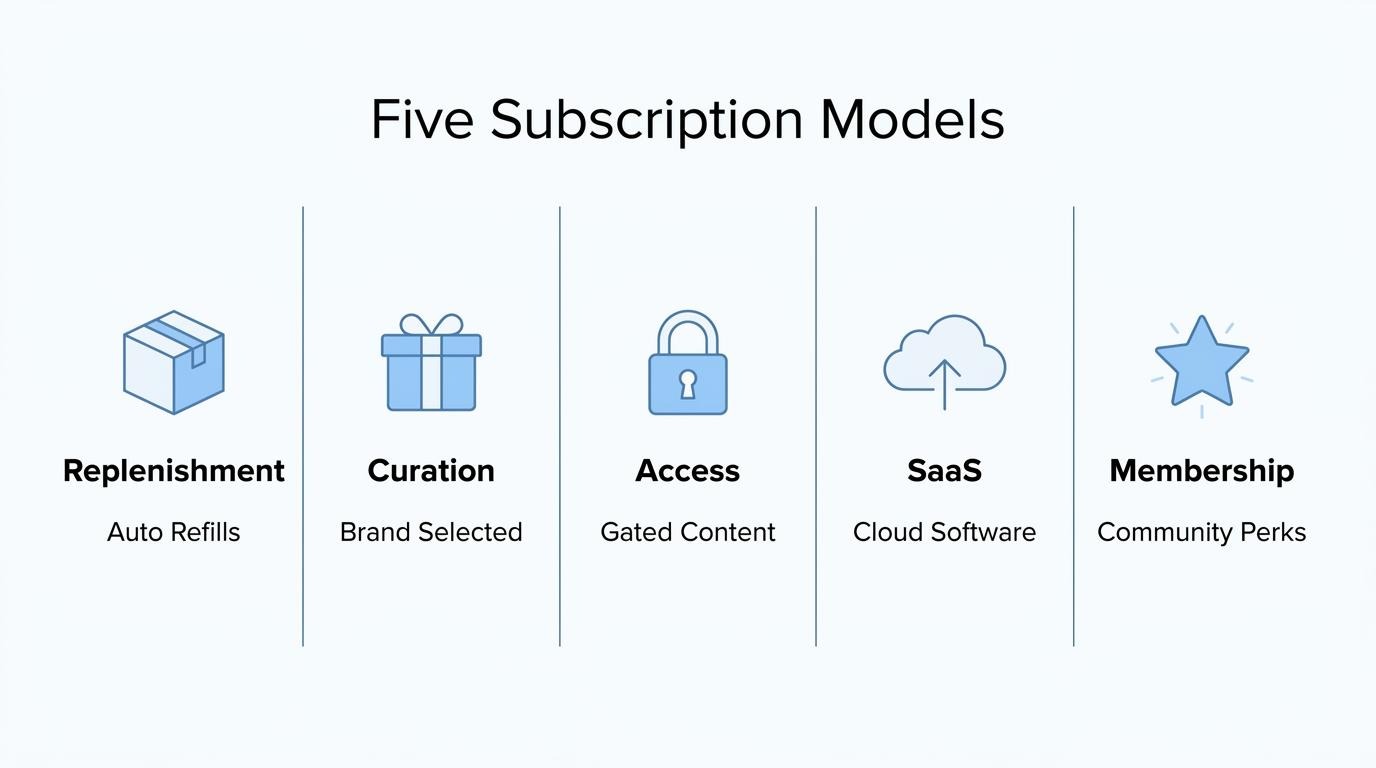
Replenishment subscriptions automate the reorder of consumable products on a recurring schedule. Customers subscribe to items they use predictably, such as razors, coffee, vitamins, or skincare refills. The value proposition centers on convenience and guaranteed supply without manual reordering. According to a 2023 study at Universidade Nova de Lisboa, subscription refill services for complexion products decrease customer acquisition costs and increase retention. For brands selling high-frequency consumables, this model converts one-time buyers into predictable recurring revenue with minimal decision fatigue on the customer's side.
Curation subscriptions deliver a selection of products chosen by the brand on behalf of the subscriber. The subscriber pays for discovery and surprise; the brand selects items based on preferences, seasonal themes, or expert recommendations. Common examples include beauty boxes, snack assortments, and book selections. This model works because it transforms product discovery into an ongoing experience rather than a single transaction. Curation subscriptions tend to carry higher churn than replenishment models because perceived novelty fades over time, making personalization and variety essential to long-term retention.
Access subscriptions grant subscribers entry to gated content, tools, or exclusive benefits unavailable to non-subscribers. Examples include streaming platforms, online course libraries, and members-only pricing tiers. The recurring fee unlocks ongoing access rather than ownership of a physical product. This model thrives when the content or benefit library grows continuously, reinforcing the subscriber's perceived value. For DTC brands, access subscriptions often take the form of exclusive early releases, subscriber-only pricing, or premium educational content tied to the product category.
SaaS subscriptions provide cloud-based software on a recurring billing cycle, typically monthly or annually. Salesforce reported record revenue of $41.5 billion for fiscal year 2026, a 10% increase year-over-year, illustrating the scale this model enables. SaaS subscribers pay for continuous access to a platform, including updates, support, and infrastructure. Pricing often tiers by usage, seats, or feature access. Because the software itself is the product and switching costs are high, SaaS subscriptions achieve lower monthly churn rates than physical-product models.
Membership subscriptions combine recurring payment with community belonging, exclusive perks, or loyalty rewards. Members pay for status and accumulated benefits rather than a single product or service. Examples include warehouse club memberships, premium loyalty tiers, and creator community access. The distinction from access subscriptions is the emphasis on identity and belonging alongside tangible benefits. For scaling DTC brands, membership models layer well on top of existing product lines, turning loyal customers into a defined community with ongoing financial commitment.
With these model types defined, the next section explores why subscriptions work specifically for DTC brands in 2026.
The subscription model works for DTC brands in 2026 because it delivers predictable revenue, higher lifetime value, lower acquisition costs, and richer customer data. The following sections break down each advantage.
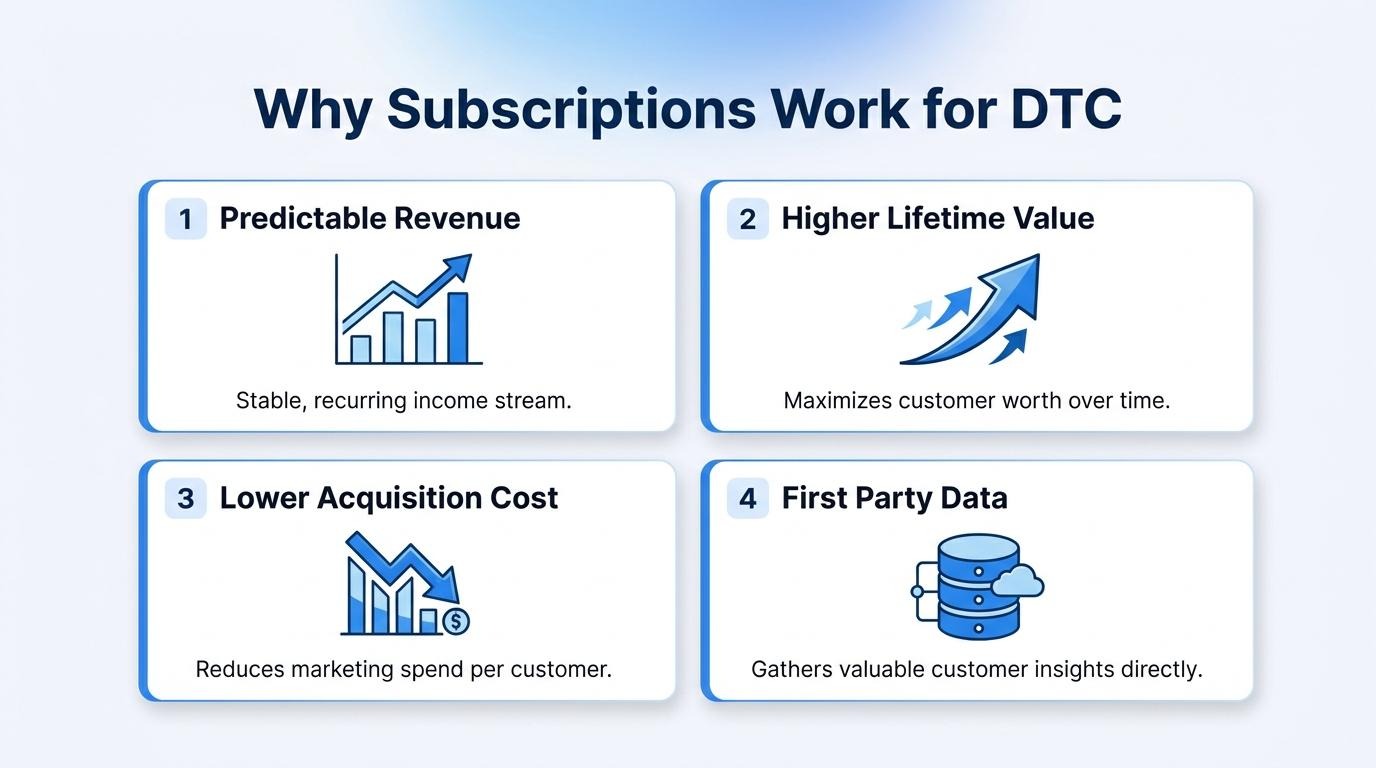
Predictable recurring revenue stabilizes cash flow because it converts uncertain one-time sales into contractual payment cycles. DTC brands can forecast monthly income with high accuracy, enabling confident inventory purchases, marketing budget allocation, and hiring decisions. When revenue arrives on a known schedule, brands reduce dependence on promotional spikes or seasonal demand. This financial visibility also strengthens positioning with lenders and investors who value revenue predictability over gross volume. For brands operating at scale, stable cash flow removes the feast-or-famine dynamic that forces reactive decision-making.
Subscription revenue increases Customer Lifetime Value because recurring payments extend the revenue relationship beyond a single transaction. According to Rivo, subscription-based models report 2–3x higher CLV than one-time purchase models by extending customer lifespan.
The mechanics are straightforward: a customer paying monthly for 14 months generates far more value than one who buys once and never returns. With DTC acquisition costs rising approximately 60% between 2019 and 2024, maximizing revenue per acquired customer becomes essential. The global subscription economy market was estimated at roughly $624 billion in 2025 and projected to reach nearly $739 billion in 2026, according to Research and Markets. For DTC operators, CLV gains from subscriptions offset rising ad costs without requiring new customer volume.
Subscribers generate lower customer acquisition costs over time because the initial CAC is amortized across multiple billing cycles rather than a single purchase. A brand spending $50 to acquire a customer who stays subscribed for 12 months effectively pays $4.17 per transaction, compared to $50 for a one-purchase buyer. Longer subscriber tenure also produces organic referrals and word-of-mouth, reducing reliance on paid channels. Research from Universidade Nova de Lisboa found that subscription refill services in beauty specifically decrease customer acquisition costs while increasing retention. As tenure grows, the effective CAC approaches zero on incremental revenue from that customer.
First-party data from subscribers improves personalization because recurring interactions generate continuous behavioral signals, including purchase frequency, product preferences, skip patterns, and engagement timing. This data feeds segmentation and lifecycle messaging without relying on third-party cookies or platform algorithms.
According to a 2026 EMARKETER report, personalization at scale tops the data activation investment list at 38%, followed by real-time campaign optimization at 35%. Subscriber data makes both achievable because brands own the full purchase history and preference graph. Each billing cycle adds signal depth, enabling increasingly precise product recommendations and communication timing that one-time buyers simply cannot provide.
With first-party data advantages established, the next step is measuring how these subscription benefits translate into trackable performance metrics.
The key metrics for measuring subscription performance are monthly recurring revenue, churn rate, average revenue per user, and customer lifetime value. Each metric reveals a different dimension of business health.
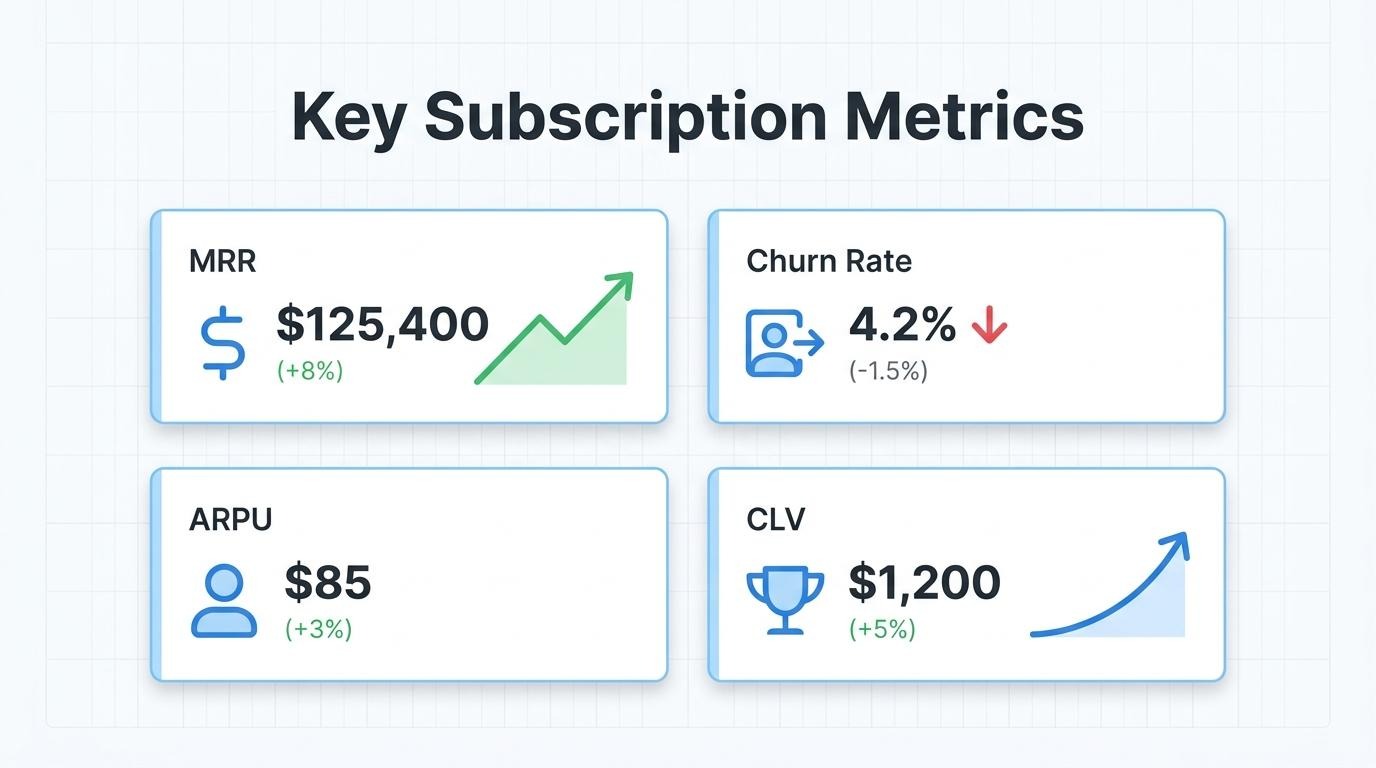
Monthly recurring revenue (MRR) tells you the predictable income your subscription business generates each month. MRR is calculated by multiplying the total number of active subscribers by the average revenue per account. This metric serves as the baseline for forecasting cash flow, planning inventory, and measuring growth velocity month over month.
Tracking MRR also exposes expansion and contraction patterns. Upgrades, cross-sells, and add-ons contribute to expansion MRR, while downgrades and cancellations reduce it. The net change between these forces determines whether the business is truly scaling or simply replacing lost subscribers with new ones.
Churn rate reveals the percentage of subscribers who cancel within a given period, making it the clearest signal of product-market fit and delivery satisfaction. A rising churn rate typically indicates misaligned value perception, poor onboarding, or subscription fatigue.
According to a 2026 analysis by Eightx, monthly churn rates vary significantly by vertical: meal kits range from 8–15%, coffee subscriptions 5–10%, beauty boxes 8–14%, and supplements 5–8%. These benchmarks help brands contextualize whether their cancellation rate reflects a category norm or a fixable retention gap. For most DTC brands, reducing churn by even one percentage point compounds into meaningful revenue over a 12-month window.
Average revenue per user (ARPU) indicates how much each subscriber contributes financially on a monthly or annual basis. ARPU is calculated by dividing total subscription revenue by the number of active subscribers during that period.
This metric highlights whether pricing, upsell strategies, and tier structures are working. A flat or declining ARPU suggests subscribers are clustering at lower tiers, while growing ARPU signals successful expansion revenue. Brands that pair ARPU tracking with cohort analysis can identify which acquisition channels attract higher-value subscribers and allocate spend accordingly.
Customer lifetime value (CLV) shows the total revenue a subscriber generates across their entire relationship with the brand, making it essential for growth planning. CLV is typically calculated by multiplying ARPU by average subscriber lifespan (in months), then subtracting the cost to serve.
When CLV exceeds customer acquisition cost by a healthy ratio, the business can reinvest aggressively in growth. Subscription-based models report 2–3x higher CLV than one-time purchase models by extending customer lifespan, according to data from Rivo. This multiplier effect is precisely why subscription performance measurement starts with understanding how long subscribers stay and how much they spend before they leave.
Understanding these metrics collectively positions brands to diagnose issues early and invest in the retention strategies that move the needle.
The industries that benefit most from subscriptions in 2026 are beauty, food and beverage, fashion, and health and wellness. Each vertical leverages recurring revenue differently based on product consumption cycles and personalization potential.
Beauty and skincare brands use subscriptions primarily through replenishment models and curated discovery boxes. Complexion products, serums, and SPF run on predictable usage cycles, making auto-refill programs a natural fit. Curated boxes introduce subscribers to new products monthly, driving trial and cross-sell. According to Fortune Business Insights, the global beauty subscription box market was valued at USD 2.26 billion in 2024 and is projected to grow to USD 2.77 billion by 2025. Refill subscriptions reduce acquisition costs because brands retain customers longer without repeated ad spend. Personalized skin profiles, built from subscriber quiz data and purchase history, keep product selections relevant across renewal cycles.
Food and beverage brands use subscriptions through meal kits, coffee deliveries, snack boxes, and specialty ingredient programs. Coffee subscriptions perform particularly well because consumption is daily and preferences are stable once established. Meal kits appeal to convenience-driven households willing to pay a premium for pre-portioned ingredients. Snack and specialty food boxes lean on curation, rotating seasonal or regional items to maintain novelty. The key challenge in this vertical is churn; without consistent product quality and delivery reliability, subscribers cancel quickly. Brands that pair flexible skip-or-swap options with freshness guarantees tend to sustain longer subscriber tenure than rigid fixed-schedule programs.
Fashion and apparel brands use subscriptions through styling services, capsule wardrobe deliveries, and VIP membership access tiers. Styling subscriptions ship curated selections based on fit profiles, with subscribers keeping what they want and returning the rest. Capsule programs deliver seasonal essentials on a quarterly cadence, reducing decision fatigue. VIP memberships grant early access to drops, exclusive colorways, or members-only pricing. Morten Suhr Hansen notes that in 2026, the most important competitive parameter for subscriptions will be "perceived relevance over time," which is especially critical in fashion where taste shifts seasonally. Brands that update style algorithms with each return signal maintain higher perceived relevance.
Health and wellness brands use subscriptions through vitamin regimens, supplement stacks, protein deliveries, and personalized wellness protocols. Daily-use products like probiotics, collagen, and multivitamins align perfectly with replenishment cycles because consumers run out at predictable intervals. Personalized quiz-based programs assign custom formulations, which increases switching costs and reduces churn. This vertical benefits from strong retention; supplements typically see monthly churn rates between 5% and 8%, among the lowest across subscription categories. The compliance factor is unique here: subscribers who see health improvements from consistent use are far less likely to cancel than those purchasing discretionary products.
With industry-specific dynamics established, the next step is understanding what challenges threaten subscription profitability.
Subscription businesses face challenges including subscriber churn, subscription fatigue, and fulfillment complexity. Each threat intensifies as the business scales.
Subscriber churn threatens profitability by eroding recurring revenue faster than new acquisitions can replace it. Even small monthly churn compounds dramatically over a year; a 5% monthly rate means losing over half the subscriber base in twelve months. Churn also inflates effective customer acquisition costs, since each lost subscriber forces reinvestment in replacement campaigns. For most subscription brands, reducing churn by even one percentage point has a larger profit impact than acquiring net-new customers at the same cost. This makes retention infrastructure, not just acquisition spend, the primary lever for sustainable margin.
Subscription fatigue affects conversion rates by making consumers hesitant to add another recurring commitment. According to a 2026 survey reported by WITN, more than half of Americans (52%) plan to cut back on their subscription services due to rising costs and fatigue. When prospects already feel over-subscribed, converting them requires a higher perceived-value threshold than it did even two years ago. Brands that fail to communicate immediate, tangible differentiation at the point of signup face longer decision cycles and lower trial-to-paid conversion. For operators scaling in this environment, the signup experience itself becomes a retention tool.
Fulfillment and logistics complexity scales with growth by multiplying SKU variations, shipping cadences, and inventory forecasting demands simultaneously. A brand shipping 500 boxes monthly operates differently than one shipping 50,000, where partial shipments, address changes, and delivery exceptions compound into operational drag. According to PM Toolkit's 2026 SaaS benchmarks, Scale-stage companies target an LTV:CAC ratio of 4:1 to 8:1, a ratio that fulfillment cost overruns can quickly erode for physical subscription brands. Consolidating subscription management, inventory, and order routing within a single system reduces the sync failures that fragment operations across disconnected tools.
Understanding these challenges clarifies why retention strategies deserve equal investment alongside acquisition.
Strategies that reduce churn and increase subscriber retention focus on flexibility, personalization, and loyalty mechanics. The following subsections cover how each approach works.
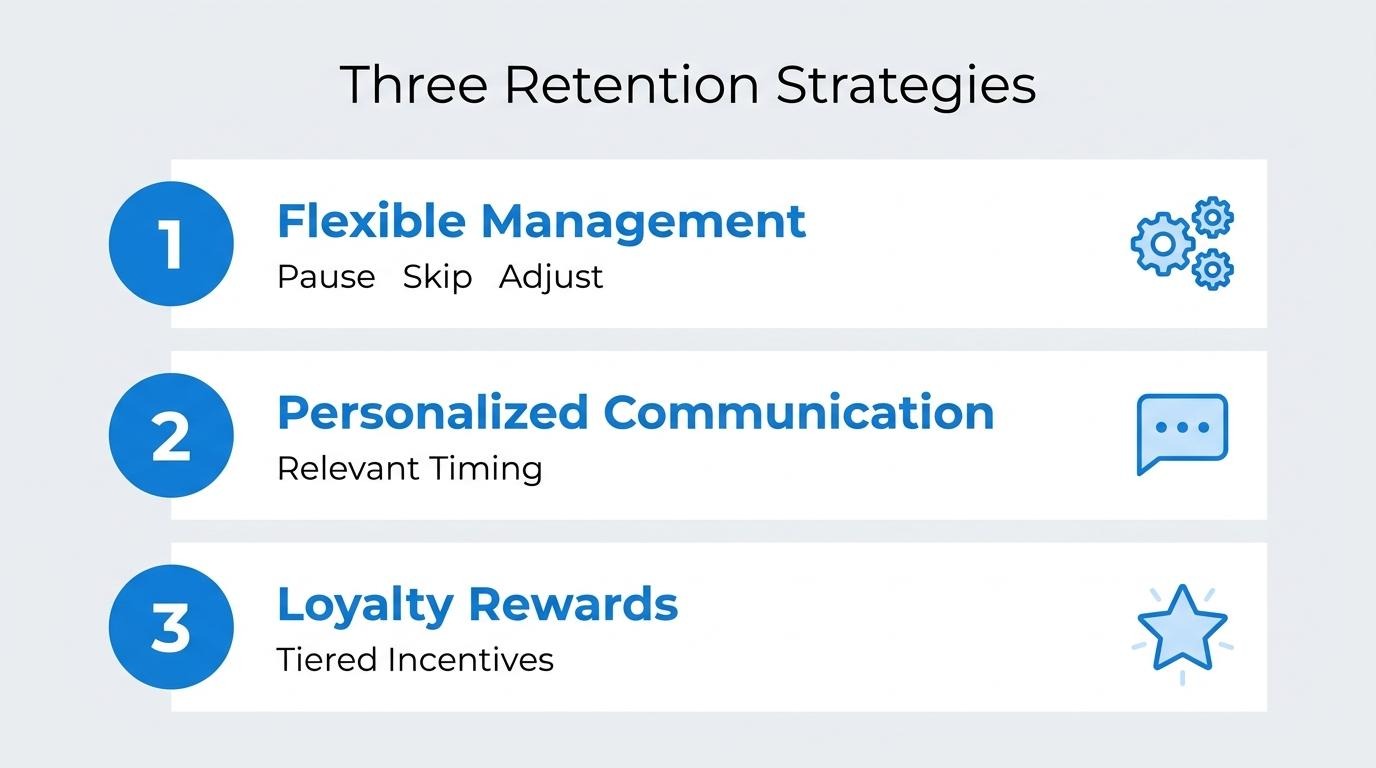
Flexible subscription management lowers cancellations by giving subscribers control over frequency, pausing, and plan adjustments before they reach the cancellation page. The FTC finalized its "Click-to-Cancel" rule on October 16, 2024, requiring cancellation to be as easy as signup. Brands that comply while also offering skip, swap, or pause options intercept churn at the moment of intent. Common flexibility features include:
For brands managing high subscriber volume, building these controls natively into the commerce platform eliminates the lag and friction that third-party app stacks introduce.
Personalized communication keeps subscribers engaged by delivering relevant content, product recommendations, and timing based on individual behavior data. According to a 2026 EMARKETER report, personalization at scale tops the data activation investment list at 38%, followed by real-time campaign optimization at 35%. Effective personalized touchpoints include:
When lifecycle marketing runs inside the same system as subscription data, segmentation becomes automatic rather than requiring manual syncs between disconnected tools.
Loyalty incentives and tiered rewards extend tenure by increasing the perceived cost of leaving. Subscribers who accumulate points, unlock exclusive tiers, or earn tenure-based discounts develop switching costs that passive subscriptions lack. Effective reward structures include:
Morten Suhr Hansen noted that in 2026, the most important competitive parameter for subscriptions is "perceived relevance over time." Tiered rewards operationalize that relevance by making each additional month more valuable than the last.
With retention mechanics in place, pricing strategy determines whether those subscribers remain profitable.
You price a subscription offer profitably by aligning your recurring fee with delivered value while maintaining margins that cover acquisition costs, fulfillment, and churn losses. Profitable pricing requires balancing three factors: cost structure, perceived value, and competitive positioning.
A cost-plus floor ensures every shipment covers COGS, shipping, and platform fees. Value-based pricing then sets the ceiling according to what subscribers willingly pay for convenience, curation, or access. The gap between floor and ceiling is your margin lever.
Key pricing components include:
Testing pricing quarterly against actual churn data reveals whether your offer delivers enough perceived value at its price point. If churn spikes after a price increase, the value gap has widened; if retention holds, there is often room to capture more. Brands that treat pricing as a static launch decision rather than an ongoing optimization lever consistently leave margin on the table.
With pricing strategy established, the technology stack behind your subscription business determines how efficiently you can execute billing, fulfillment, and retention at scale.
A subscription business in 2026 is powered by a technology stack that integrates billing, customer data, usage tracking, and automation into a unified system. The core components include CRM platforms, configure-price-quote (CPQ) tools, usage metering engines, and AI-driven billing architectures.
According to Rewiring Enterprise Revenue Systems (via Google Books), modern subscription technology stacks in 2026 require integrated components including CRM, CPQ, usage metering engines, and AI-driven billing architectures. This complexity reflects how subscription pricing has evolved beyond flat monthly fees into hybrid models combining usage, tiers, and add-ons.
The essential layers of a subscription tech stack include:
For brands scaling past their first few thousand subscribers, the decision between assembling these layers from separate vendors or operating within a single platform has real operational consequences. A fragmented stack introduces data sync failures, reconciliation overhead, and slower response times when pricing or retention strategies need adjustment. Brands running consolidated systems avoid these friction points entirely, which matters most when subscription logic needs to interact with storefront, CRM, and marketing in real time.
Subscription management runs more efficiently when it operates inside the commerce platform, eliminating data sync failures, reducing app costs, and keeping the customer record unified. The following sections cover how SHOPLINE handles this natively and summarize the key takeaways from this article.
SHOPLINE handles native subscriptions by building recurring purchase functionality directly into its commerce platform, so merchants configure billing cycles, manage subscriber accounts, and process renewals without installing separate apps like Recharge or Bold. Because subscriptions share the same customer data layer as the storefront, CRM, and marketing automation, there is no reconciliation step between disconnected systems.
This architecture means subscription events (sign-ups, skips, cancellations, renewals) feed the same customer record that powers lifecycle marketing and POS. For brands running at scale, removing the middleware layer between billing and commerce eliminates one of the most common failure points in a multi-tool stack.
The key takeaways about the subscription business model are:
For brands operating at $1M+ in annual revenue, the subscription model works when the underlying system unifies billing, customer data, and retention mechanics in one place rather than distributing them across a dozen tools.
.png)
.png)
.png)

