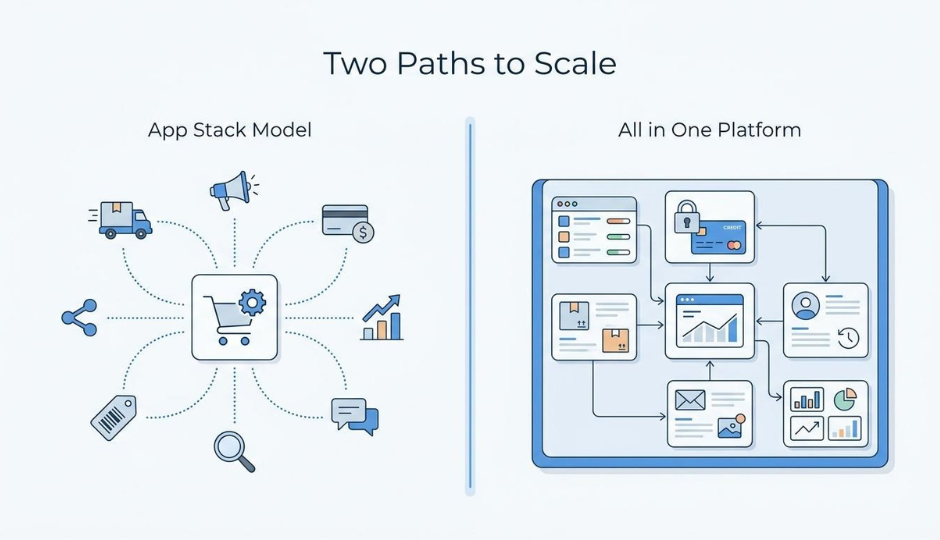
Scaling an ecommerce business past $1M in revenue forces a platform architecture decision: app-dependent systems like Shopify or all-in-one platforms that bundle commerce, CRM, and marketing natively.
We cover the structural differences between these two models, what each includes out of the box, how total cost shifts across revenue tiers, the way each handles customer data and omnichannel operations, and what brands should evaluate before replatforming.
Shopify delivers a core storefront and checkout, then relies on third-party apps for email marketing, subscriptions, loyalty, and CRM. All-in-one platforms build those same functions into a single system with a shared data layer. Both architectures support the essentials; where they diverge is in how deeply those features connect to each other.
Cost compounds quickly on app-dependent setups. Monthly app spend alone can range from a few thousand dollars at $1M revenue to tens of thousands at $20M+, layered on top of base platform fees. All-in-one pricing consolidates those capabilities into one subscription, removing redundant vendor contracts and integration maintenance.
Customer data fragmentation is the operational risk that surfaces most at scale. Disconnected apps create blind spots in segmentation, weaken retention campaigns, and force teams into manual data reconciliation instead of growth work. Unified platforms resolve every interaction to a single customer record, making lifecycle marketing and omnichannel POS operate from one source of truth.
Migration between platforms carries real risks around data integrity, SEO continuity, and team adaptation. For brands where tool management consumes more bandwidth than actual optimization, understanding these trade-offs is the first step toward a clearer scaling path.
The difference between Shopify and an all-in-one ecommerce platform is how core functions are delivered. Shopify relies on third-party apps; all-in-one platforms build those functions natively. Below, each model's mechanics and their shared ground are broken down.
Shopify's app-dependent model works by providing a core storefront and checkout, then requiring merchants to install third-party apps for extended functionality. Email marketing, subscriptions, loyalty programs, advanced analytics, and CRM each typically require a separate paid app.
Each app operates on its own data silo. As Ohad Michaeli notes, "Every Shopify app in your stack has valuable data. None of them share it with each other. This creates a massive blind spot for merchants." The result is a modular system where flexibility comes at the cost of fragmentation. Merchants gain access to thousands of specialized tools, but managing integrations, syncing data, and troubleshooting conflicts between apps becomes an operational burden that compounds as order volume grows.
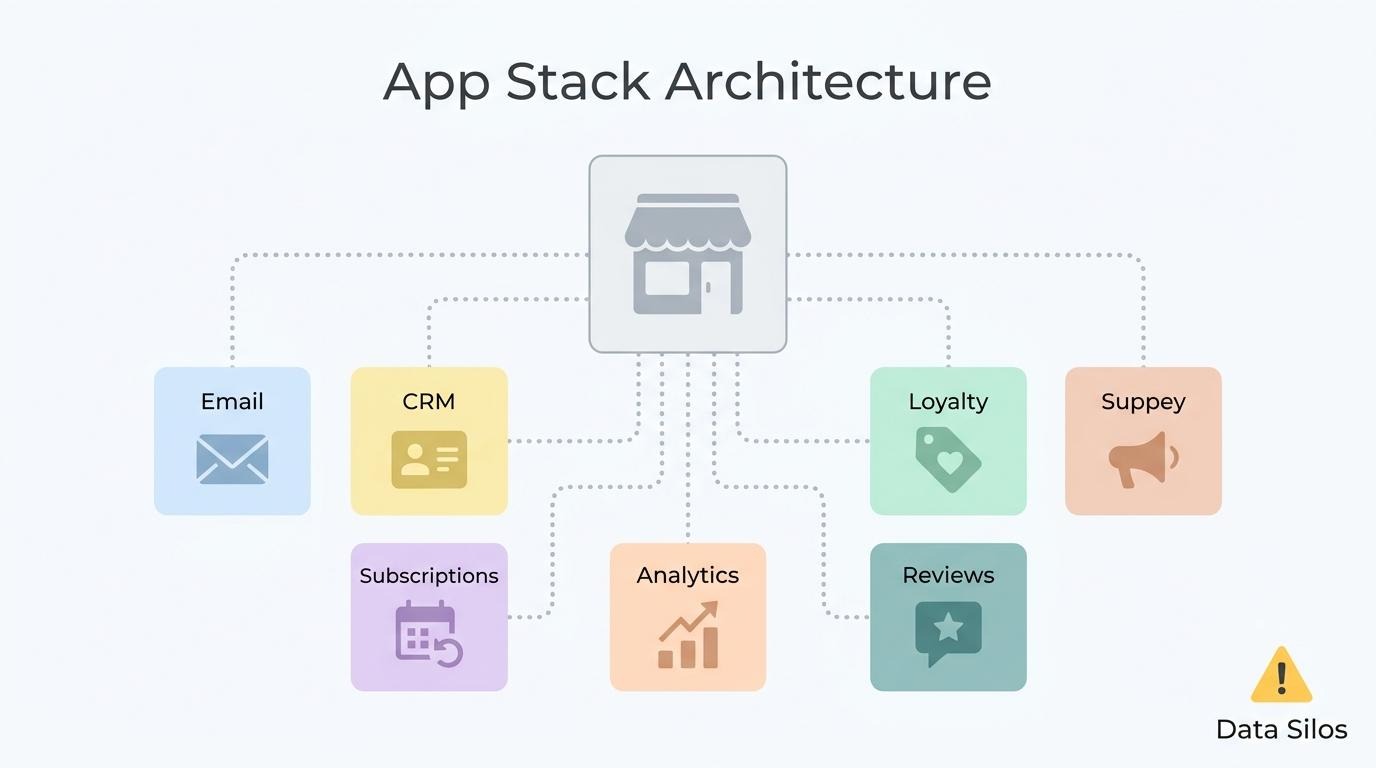
An all-in-one platform handles the same functions natively by building commerce, CRM, marketing automation, subscriptions, and POS into a single system with a shared data layer. Instead of installing separate apps for email campaigns, loyalty mechanics, or recurring billing, these capabilities ship as first-party features tied to one customer record.
This architecture eliminates the sync issues that surface when five or more disconnected tools attempt to reconcile customer profiles. Segmentation, lifecycle triggers, and cross-channel reporting draw from the same unified dataset rather than stitched-together exports. For scaling brands, fewer vendor relationships and a single login reduce day-to-day operational drag considerably. The trade-off is less granular customization compared to choosing best-of-breed point solutions for each function.
The two approaches overlap in core features that every ecommerce operation requires: hosted storefronts, secure checkout, product catalog management, payment processing, basic analytics, and mobile-responsive themes. Both Shopify and all-in-one platforms support multi-currency selling, discount and promotion tools, shipping label generation, and tax calculation.
Order management, inventory tracking, and customer account creation are standard on either architecture. SEO controls, blog publishing, and basic reporting also come built in across both models. Where the models diverge is not in whether these functions exist, but in how deeply they connect to each other and whether advanced capabilities require additional tools or subscriptions.
Understanding this structural distinction sets the stage for comparing what each platform includes out of the box as brands scale past their first million in revenue.
Each platform includes a different scope of native features for scaling brands. Shopify ships core storefront and checkout tools but relies on apps for CRM, marketing automation, and subscriptions. All-in-one platforms bundle these functions natively.
The storefront and checkout features that come standard on Shopify include a theme-based storefront builder, product catalog management, a hosted checkout, SSL certificates, discount codes, abandoned cart recovery emails, and basic analytics. Shopify also provides multi-currency support, manual order creation, and gift cards across all plans.
What Shopify does not include natively is where the gaps appear. Advanced checkout customization requires Shopify Plus or third-party scripts. Upsell flows, post-purchase offers, and A/B testing on checkout pages typically depend on paid apps. For brands scaling past initial revenue milestones, these additions become operational necessities rather than optional extras.
The storefront and checkout features that come standard on all-in-one platforms typically include theme-based storefronts, hosted checkout, SSL, and discount tools, similar to Shopify's baseline. Where they differ is in bundling checkout customization, upsell flows, and post-purchase logic as native features rather than app add-ons.
Many all-in-one platforms also include built-in A/B testing for product pages and checkout sequences. Because these tools share a single data layer with CRM and marketing modules, conversion optimization operates on real customer behavior rather than aggregated third-party data. For brands running high order volume, this consolidation removes a common integration bottleneck.
The CRM and customer data tools that ship natively differ significantly between the two approaches. Shopify provides basic customer profiles, order history, tags, and segmentation filters. It does not include a native CRM; brands typically add Klaviyo, HubSpot, or a standalone CDP to manage lifecycle data and build unified customer records.
All-in-one platforms ship with a built-in CRM that ties purchase history, browsing behavior, email engagement, and support interactions to a single customer record. This eliminates the reconciliation work that fragmented tools require. According to a 2024 LayerFive analysis, fragmented marketing data costs brands over $200,000 yearly, while unified data platforms can boost ROI by up to 72%.
Marketing automation is built in on most all-in-one platforms and added via apps on Shopify. Shopify offers basic email campaigns, with SMS marketing available in select countries, through Shopify Messaging, but advanced automation sequences, segmentation-triggered campaigns, and behavioral targeting require third-party tools like Klaviyo, Omnisend, or Postscript.
All-in-one platforms typically include lifecycle automation covering welcome sequences, abandoned cart recovery, post-purchase follow-ups, and win-back campaigns as standard features. SHOPLINE, for instance, covers the entire user lifecycle natively with preset templates for welcome emails, order confirmations, abandoned carts, abandoned products, abandoned checkouts, and customer reactivation. When automation and CRM share the same database, trigger logic executes on real-time customer data without sync delays.
The POS and omnichannel features available without add-ons vary by platform architecture. Shopify offers Shopify POS as a first-party product with inventory sync and in-store checkout.
According to a 2024 LivePerson report, retailers who deployed unified commerce platforms saw up to 15% revenue growth and a 25% reduction in operational costs. All-in-one platforms that include native POS resolve in-store and online transactions to the same customer record automatically, enabling consistent loyalty tracking and cross-channel marketing without bolting on extra tools.
With native features compared, the next consideration is how total cost shifts as brands scale past $1M in revenue.
Total cost for a DTC brand scaling past $1M depends on platform architecture and revenue tier. App-stack models like Shopify Plus carry compounding costs, while all-in-one platforms bundle features into a single fee. The following breakdowns cover three revenue tiers and a direct pricing comparison.
A Shopify Plus app stack at $1M to $5M revenue typically costs between $3,300 and $5,800 per month when platform fees and third-party apps are combined. Shopify Plus starts at $2,300 per month as a base platform fee. According to Eightx, typical monthly app spend for Shopify merchants runs $1,000 to $3,500 at the $1M to $5M revenue band.
That app layer covers essentials most scaling brands need: email marketing, subscription management, loyalty programs, reviews, and analytics. Each app carries its own billing cycle, data silo, and support channel. At this tier, app costs may seem manageable, but the fragmentation they introduce compounds quickly as order volume grows.
A Shopify Plus app stack at $5M to $20M revenue ranges from $7,300 to $17,300 per month. The $2,300 base platform fee remains, but monthly app spend jumps to $5,000 to $15,000 as brands add more specialized tools. Customer data platforms, advanced segmentation tools, A/B testing software, and subscription apps all enter the stack at this stage.
The real cost at this tier is not just financial. Each new app introduces integration maintenance, potential data conflicts, and vendor management overhead. Brands running 10 to 15 apps simultaneously spend significant internal hours troubleshooting sync issues rather than optimizing growth. For operators at this revenue band, the hidden labor cost often rivals the subscription fees themselves.
A Shopify Plus app stack at $20M to $50M+ revenue costs between $22,300 and $82,300 per month. Shopify Plus charges $2,300 per month plus a variable platform fee at this GMV level, while app spend alone reaches $20,000 to $80,000 monthly. At this scale, brands typically run enterprise-grade tools for:
Each tool negotiates enterprise contracts independently, creating a web of annual commitments and overlapping data collection. The financial exposure is significant, but the operational drag of maintaining 15 to 20 disconnected systems is what most commonly triggers replatforming conversations at this stage.
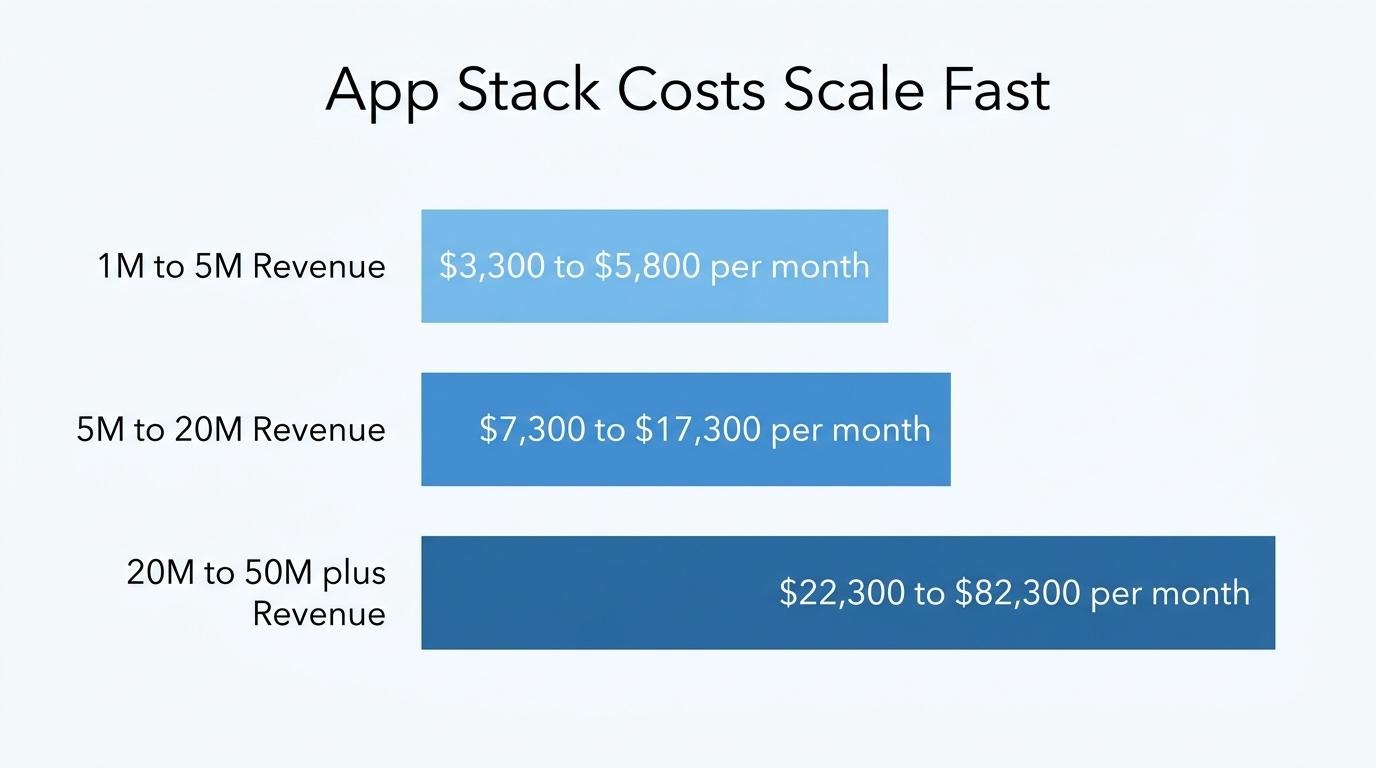
All-in-one platform pricing compares favorably because it consolidates commerce, CRM, marketing automation, subscriptions, and POS into a single monthly fee, eliminating the compounding app layer. Where a Shopify Plus merchant at $5M to $20M revenue may spend $7,300 to $17,300 monthly across platform and apps, an all-in-one platform bundles those capabilities natively.
According to LivePerson, retailers who deployed unified commerce platforms saw up to 15% revenue growth and a 25% reduction in operational costs. That operational savings comes from removing redundant vendor contracts, eliminating integration maintenance, and consolidating customer data into one record. For brands evaluating total cost of ownership, the comparison is not just subscription price against subscription price; it is the full cost of running fragmented tools versus a single system.
With cost structures clarified across tiers, the next consideration is how each architecture handles customer data at scale.
Each approach handles customer data at scale very differently. App-dependent models fragment data across disconnected tools, while unified platforms consolidate everything into a single customer record. The following sections cover data silos, segmentation impact, and retention consequences.
Customer data across 10+ Shopify apps becomes fragmented into isolated silos. Each app collects its own slice of customer behavior, yet none of these tools automatically share data with one another. Purchase history lives in one app, email engagement in another, subscription status in a third, and loyalty data in a fourth.
This fragmentation creates blind spots. Marketing teams cannot build a complete customer profile without manually exporting, reconciling, and stitching data from every tool. As order volume grows, these manual reconciliation workflows break down. Segments become outdated, personalization relies on incomplete records, and teams spend operational hours on data hygiene instead of strategy. For brands running at scale, this isn't a minor inconvenience; it's a structural limitation baked into the app-stack model.
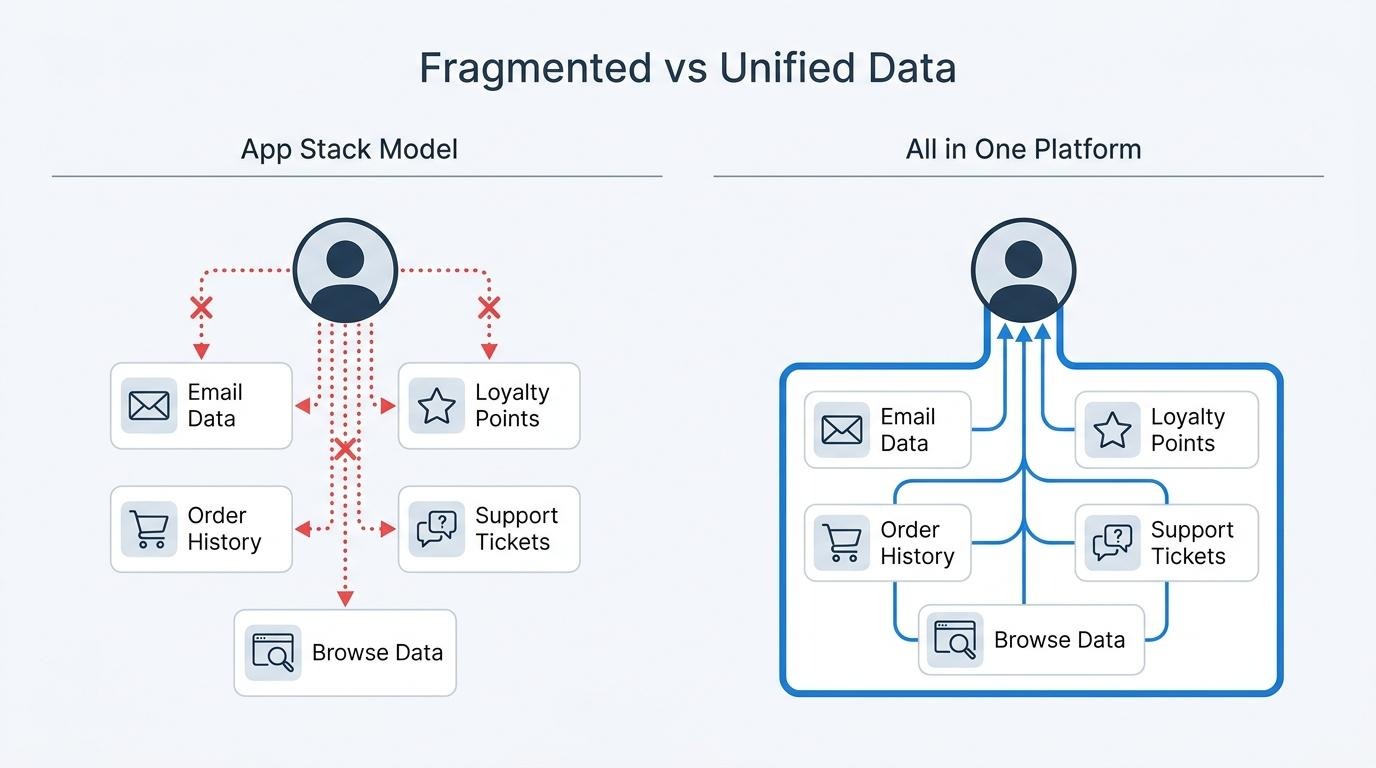
A unified data layer changes segmentation and targeting by consolidating every customer interaction into a single record. When commerce, CRM, email, subscriptions, and POS all write to the same database, segments update automatically based on real-time behavior across channels.
This eliminates the reconciliation step that app-stack setups require. Marketers can build segments using conditions that span purchase frequency, email engagement, subscription tenure, and in-store activity, all without exporting data between tools. According to a LayerFive analysis, fragmented marketing data costs brands over $200,000 yearly, while unified platforms can boost ROI by up to 72%. Targeting precision improves because the underlying data is complete, current, and consistent. For brands selling across online and offline channels, this single-record architecture is arguably the most operationally significant advantage a unified platform provides.
Fragmented data affects retention and LTV by limiting a brand's ability to act on complete customer signals. When lifecycle triggers depend on partial data, reactivation campaigns miss lapsed subscribers, post-purchase flows ignore in-store buyers, and loyalty rewards fail to account for cross-channel spend.
Unified data reverses this dynamic. Retention campaigns reference the full customer timeline, so win-back sequences target genuinely at-risk customers rather than those who simply purchased through a different channel. LTV calculations become accurate because every transaction, regardless of where it occurred, resolves to one profile. The cumulative cost of fragmentation compounds over time as inaccurate segments suppress repeat purchase rates and inflate acquisition spend to compensate. Brands that consolidate their data layer typically see retention improvements not from better creative, but from finally seeing the customer clearly.
Understanding how data architecture shapes retention leads naturally to how each platform handles omnichannel and POS integration.
Each platform supports omnichannel and POS integration differently depending on how customer data flows between channels. The sections below compare Shopify's POS data sharing with the unified approach all-in-one platforms take.
Shopify POS shares transaction data with the online store, but the customer profile that results is only as complete as Shopify's native data layer allows. The moment a brand layers in third-party apps for loyalty, email marketing, reviews, or subscriptions, each app holds its own slice of customer behavior. As Ohad Michaeli notes, "Every Shopify app in your stack has valuable data. None of them share it with each other. This creates a massive blind spot for merchants." The POS may record an in-store purchase, yet the loyalty app, the email platform, and the subscription tool each maintain separate records. What appears to be a unified profile is often a partial view stitched across disconnected systems.
All-in-one platforms sync in-store and online data by resolving every transaction, browse event, and support interaction to a single customer record. Because commerce, CRM, POS, and marketing automation share one database, there is no reconciliation step between tools. An in-store purchase updates the same profile that tracks online browsing, email engagement, and subscription status. This eliminates the blind spots that emerge when POS data sits in one system while loyalty and retention data sit in another. For brands operating both physical and digital channels, a shared data layer turns omnichannel from a channel-count metric into an operational advantage tied to every customer interaction.
Brands at scale should expect significant operational complexity from managing multiple disconnected tools, manual workarounds, and data reconciliation tasks. The sections below cover typical tool counts, the workflows that break first, and how consolidation reduces daily burden.
A typical Shopify brand at $5M+ manages around 10 separate tools across its daily operations. These commonly include:
Each tool carries its own login, billing cycle, update schedule, and support channel. At this revenue tier, the coordination cost across these tools often demands dedicated ops headcount just to keep integrations functioning, not to grow the business.
The manual workflows that break first as order volume grows are data reconciliation, inventory syncing, and customer communication sequencing. When a brand processes 200 orders per day across disconnected tools, mismatches between the OMS, shipping platform, and email triggers become daily fires rather than occasional inconveniences. Loyalty point calculations drift when the rewards app cannot read subscription data in real time. Return requests pile up when the helpdesk lacks order context from the storefront. These breakdowns are not bugs in any single tool; they are structural consequences of running parallel systems that were never designed to share a common data layer.
Tool consolidation reduces day-to-day ops burden by eliminating the integration layer that scaling brands must otherwise maintain manually. According to a LivePerson report, retailers who deployed unified commerce platforms saw up to a 25% reduction in operational costs. Fewer tools mean fewer vendor relationships, fewer API connections to monitor, and fewer data discrepancies to troubleshoot. When CRM, marketing automation, and order management share a single system, triggered workflows fire from one source of truth rather than requiring middleware to pass data between apps. For ops teams stretched thin at scale, consolidation recovers hours previously spent on maintenance and redirects them toward growth work.
Understanding operational complexity sets the stage for evaluating what migration actually involves.
Migration risk when switching platforms depends on the direction of the move and the safeguards a brand puts in place. The common risks fall into data integrity, SEO continuity, and operational downtime.
The common migration risks moving off Shopify include data fragmentation, third-party app dependency, and URL structure changes that can disrupt organic traffic.
Because Shopify's operational data often lives across multiple disconnected apps, each tool holds its own slice of customer, order, or subscription history. Extracting and reconciling that data into a single migration package requires careful mapping. Key risks include:
For brands running 10 or more apps, the migration surface area grows with every tool, making a phased audit essential before any data leaves the source environment.
The common migration risks moving to an all-in-one platform center on workflow adaptation, feature parity gaps, and team retraining.
While data consolidation is generally simpler when the destination is a single system, operational risks still exist:
The trade-off is straightforward: consolidation reduces long-term complexity, but the transition window itself demands rigorous testing against live operational scenarios.
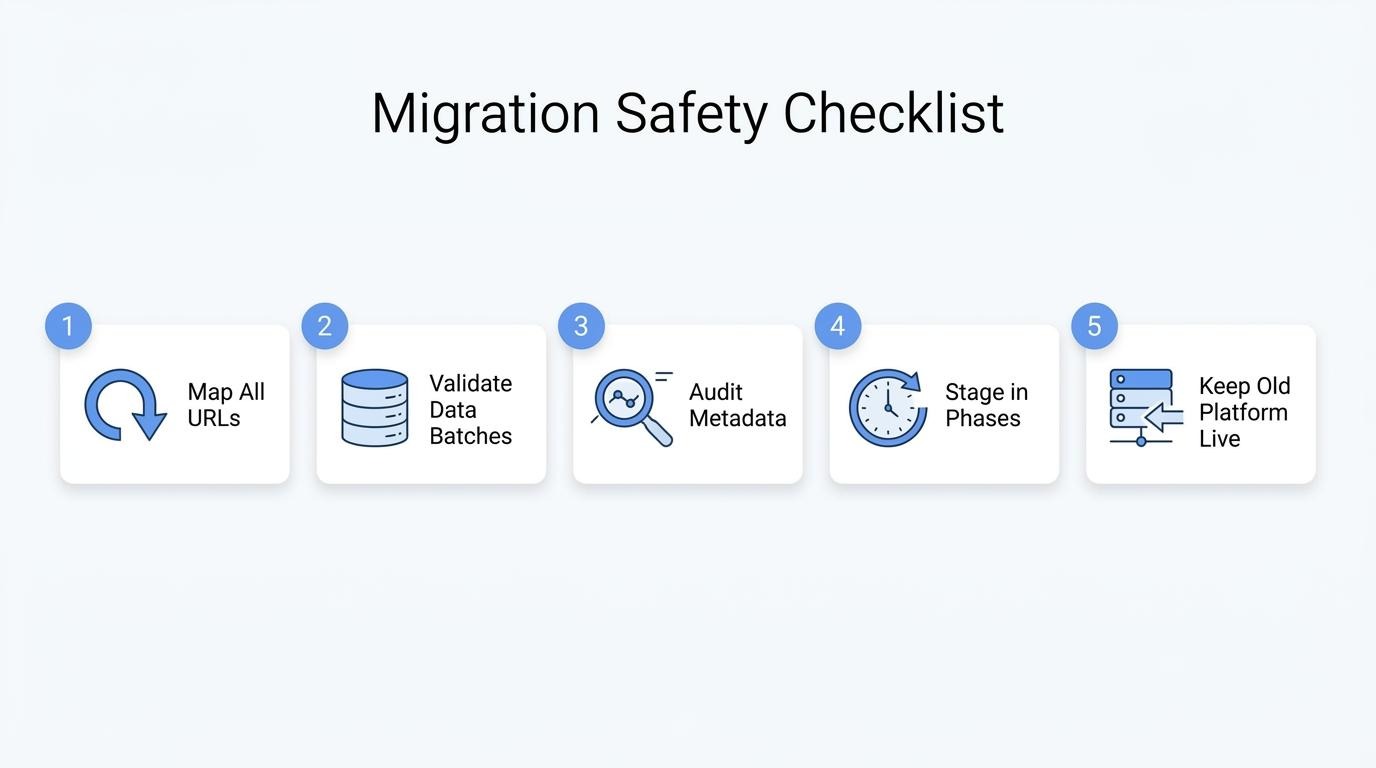
Brands protect SEO and customer data during migration through systematic URL mapping, 301 redirect plans, and staged data validation.
According to a NIX United analysis of ecommerce replatforming, transferring large volumes of product, customer, and order data introduces the risk of data loss or corruption. Preventing this requires a structured approach:
For brands weighing this transition, platforms with a shared data layer, such as SHOPLINE, can simplify the destination side by consolidating customer, order, and marketing data into one system rather than requiring re-integration across multiple tools. A disciplined migration plan is ultimately what separates a smooth replatform from a costly disruption.
Platform architecture directly determines how effectively a brand can execute retention marketing. The two models below show how app-stack setups and native CRM/email systems differ in lifecycle campaign execution.
Lifecycle marketing inside an app-stack setup works by connecting separate tools for email, SMS, loyalty, subscriptions, and customer data through third-party integrations. Each app collects its own behavioral data, but syncing that data across platforms requires manual configuration or middleware.
This fragmented structure creates practical limitations for retention campaigns:
Every additional integration point introduces a potential failure point. For brands running 8 to 12 apps, coordinating a single lifecycle flow across tools demands ongoing developer time and QA effort that compounds as order volume grows.
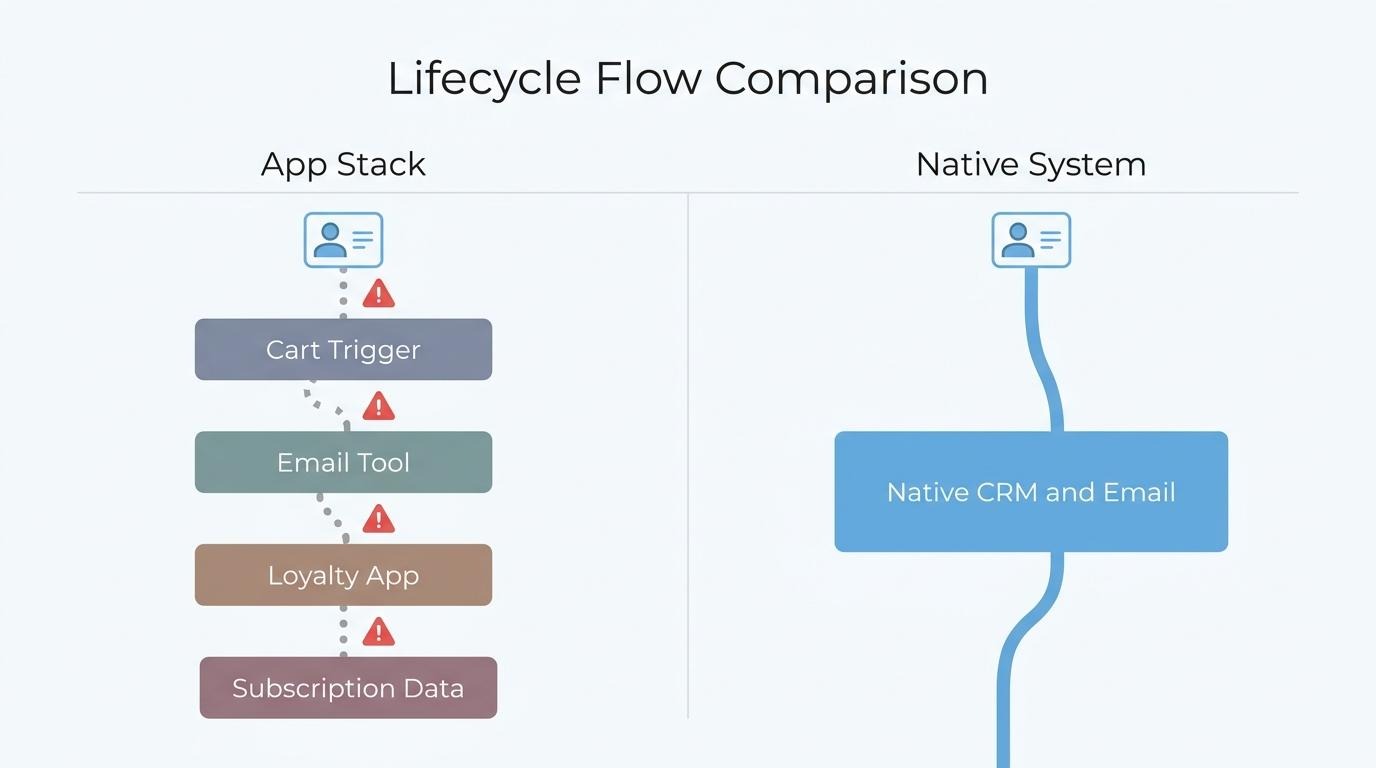
Lifecycle marketing works when CRM and email are native by operating from a single customer record that captures purchase history, browsing behavior, subscription status, and channel interactions without syncing between separate systems. Triggers fire from the same data layer that processes the order.
According to a LayerFive analysis, fragmented marketing data costs brands over $200,000 yearly, while unified marketing data platforms can boost ROI by up to 72%. Native architecture eliminates that fragmentation at the structural level.
Practical gains of a unified lifecycle system include:
For scaling DTC brands, this architectural difference often determines whether retention programs run reliably or break under volume. With retention architecture in place, the next consideration is what brands should evaluate before committing to a platform shift.
Brands hitting a scaling ceiling should consider data migration risk, total cost of ownership, and whether consolidating tools onto a unified platform solves the operational bottlenecks driving the move. The sections below cover what changes with a unified system and the key takeaways for scaling brands.
What changes when commerce, CRM, and marketing live in one system is the elimination of data silos between tools. SHOPLINE consolidates storefront, customer data, lifecycle marketing, subscriptions, and POS into a single platform with one shared customer record. This means segmentation, automation triggers, and purchase history resolve to the same profile across online and offline channels.
According to a LivePerson report, retailers who deployed unified commerce platforms saw up to 15% revenue growth and a 25% reduction in operational costs. For brands spending thousands monthly on disconnected apps, that operational simplification alone can justify the switch.
The practical shift is fewer vendor contracts, no cross-app syncing failures, and faster execution on retention campaigns. Results may vary depending on implementation, industry, and scale.
The key takeaways about Shopify vs all-in-one ecommerce platforms for scaling brands are:
For brands at $1M and above, the decision is less about features and more about whether the operational cost of managing a multi-tool stack outweighs the switching cost of consolidation. The strongest candidates for replatforming are brands where fragmented data is visibly hurting retention and where team bandwidth is consumed by tool management rather than growth.