A subscription ecommerce model is a business structure where customers pay on a recurring basis to receive products or services at regular intervals, replacing one-time transactions with predictable, ongoing revenue. The model operates across three core formats: replenishment, curation, and access memberships.
This guide covers the financial case for subscriptions, model types and vertical fit, platform and pricing infrastructure, customer acquisition and retention, performance measurement, fulfillment logistics, legal compliance, and scaling strategy.
Recurring revenue stabilizes cash flow by converting sporadic purchases into forecastable income streams. Subscriptions also compound customer lifetime value across multiple billing cycles and lower effective acquisition costs through built-in referral loops, where referred subscribers convert and retain at significantly higher rates than other channels.
Three subscription formats serve distinct purchase motivations. Replenishment automates reorders for consumables on predictable schedules. Curation delivers personalized product discovery through themed selections. Access memberships charge recurring fees for exclusive perks like member pricing or early product drops. Each carries a different retention profile, and the right choice depends on product type and consumption cycle.
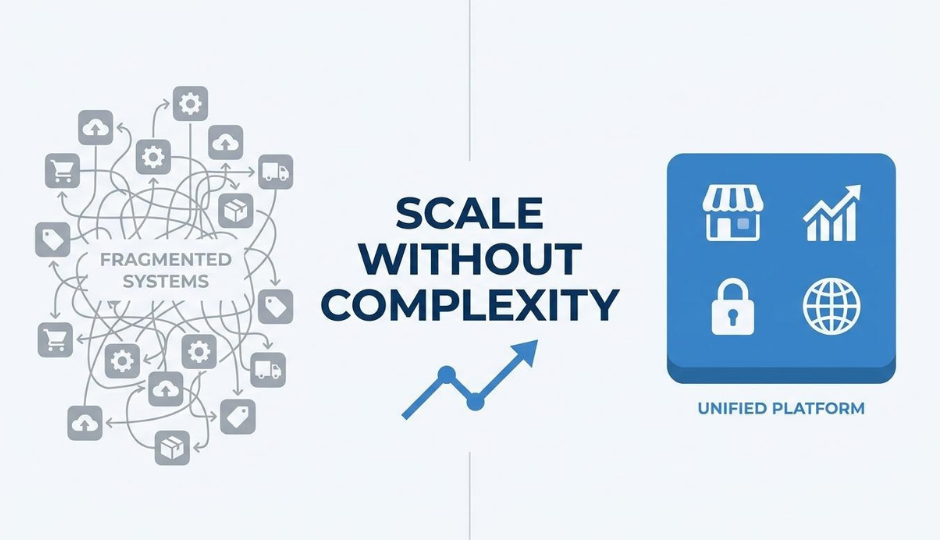
Launching requires a platform with native recurring billing, a unified customer data layer, and built-in retention tools. Bolting on separate subscription apps introduces sync failures, added fees, and fragmented reporting that compound as SKU counts grow. Pricing structure matters equally; graduated discount tiers, flexible billing frequencies, and automated dunning for failed payments protect both conversion rates and long-term margins.
Retaining subscribers past the first 90 days is critical, since nearly half of all cancellations cluster in that window. Skip, swap, and pause controls function as proven retention levers, while proactive lifecycle emails and loyalty rewards layered onto subscription tenure create compounding reasons to stay. Accurate churn calculation, cohort analysis, and compliance with FTC and state auto-renewal laws round out the operational foundation that separates scalable subscription businesses from fragile ones.
A subscription ecommerce model is a business structure where customers pay on a recurring basis to receive products or services at regular intervals. Rather than relying on one-time transactions, this model builds predictable revenue through ongoing customer relationships. The concept spans three core formats: replenishment, curation, and access memberships.
The subscription ecommerce market has expanded rapidly over the past decade. According to a 2018 McKinsey report, subscription ecommerce grew by more than 100 percent a year over the preceding five years, with the largest retailers generating more than $2.6 billion in sales in 2016, up from $57.0 million in 2011. That trajectory has only accelerated since; the share of firms citing subscription models in SEC filings climbed from 20.7% in 2002 to 48.7% in 2023, reflecting how deeply recurring revenue has embedded itself across industries.
At its core, the model works by converting a single purchase decision into an ongoing commitment. Customers agree to a delivery cadence, whether weekly, monthly, or quarterly, and receive products automatically until they pause or cancel. This shifts the business dynamic from constantly re-acquiring buyers to retaining existing ones, which fundamentally changes how brands allocate marketing spend and forecast demand.
For scaling ecommerce brands, the subscription model is less about novelty and more about operational leverage. Predictable order volumes simplify inventory planning, reduce fulfillment variability, and create a revenue baseline that supports more confident investment decisions. The sections that follow break down the specific business advantages, subscription types, and step-by-step mechanics of building this model from the ground up.
An ecommerce brand should launch a subscription model to stabilize cash flow, grow customer lifetime value, and reduce acquisition costs. The sections below break down each financial advantage.
Recurring revenue improves cash flow predictability by converting sporadic one-time purchases into scheduled, forecastable income streams. When customers commit to weekly, monthly, or quarterly billing cycles, brands can project revenue with far greater accuracy than traditional transactional models allow.
This predictability extends beyond top-line forecasting. Knowing how much revenue arrives each cycle lets operators plan inventory purchasing, marketing spend, and hiring with confidence rather than reacting to volatile sales patterns. According to the International Trade Administration, global B2C ecommerce revenue is expected to grow to $5.5 trillion by 2027 at a 14.4% compound annual growth rate, driven largely by the shift toward recurring purchase models.
For brands navigating seasonal demand swings, that baseline of committed subscribers acts as a financial floor beneath every month's performance.
Subscriptions increase customer lifetime value by extending the duration and frequency of each customer relationship. Instead of a single transaction, each subscriber generates revenue across multiple billing cycles, compounding their total contribution over time.
According to a 2022 Recharge industry report, subscription merchants achieved 12% customer lifetime value growth despite inflation pressures, while monthly recurring revenue increased by 7% in the same period. These gains happened not because subscribers spent dramatically more per order, but because they stayed longer and purchased more consistently.
This is one of the most underappreciated advantages of the model. Even modest improvements in retention duration can multiply LTV significantly, making every dollar spent on acquisition work harder over the customer's full lifecycle.
A subscription model lowers customer acquisition costs by increasing retention rates and amplifying organic referral channels. When subscribers stay longer, the cost of acquiring each one gets amortized across more billing cycles, effectively reducing CAC on a per-revenue basis.
Referrals accelerate this further. According to Deloitte research, referred customers in subscription models are 4x more likely to make a purchase and have a 37% higher retention rate compared to customers acquired through other channels. That built-in referral loop means existing subscribers recruit new ones at a fraction of paid acquisition costs.
The financial ripple effect is substantial. A 2023 study by Matthew Hagerty at Boston College found that within-firm adoption of subscription models reduces cash holdings by 2.3–2.6% of assets relative to pre-adoption baselines, freeing capital for reinvestment in growth rather than reserves.
With acquisition economics in place, the next step is choosing which subscription model fits your product and audience.
The main types of subscription ecommerce models are replenishment, curation, and access (membership). Each serves a different purchase motivation and retention profile.
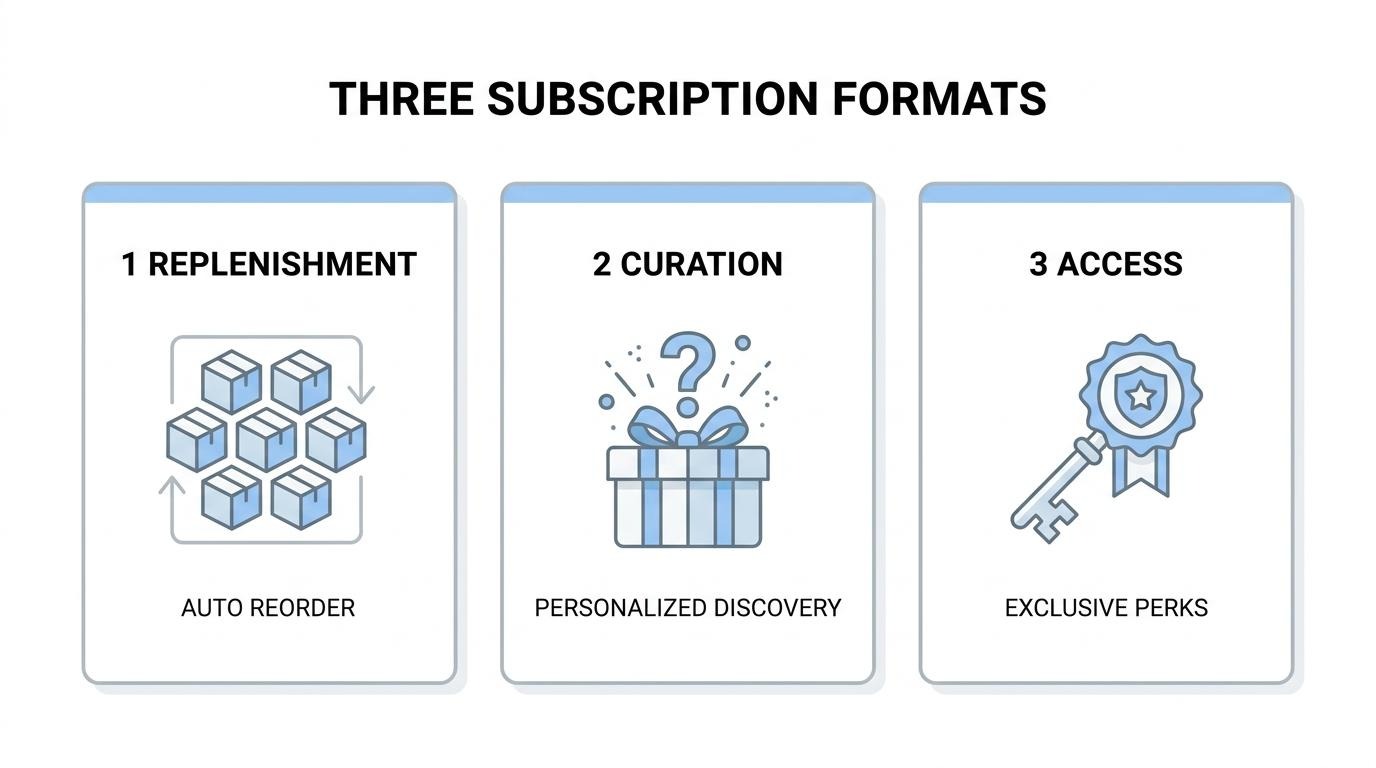
Replenishment subscriptions automate the reorder of consumable products customers use on a predictable schedule. Household essentials, pet food, vitamins, and coffee are common categories. The value proposition is simple: convenience and never running out.
According to McKinsey & Company research, curation services hold 55% of total subscriptions, replenishment accounts for 32%, and access subscriptions represent 13%. Despite a smaller share by subscriber count, replenishment models generate outsized revenue per account because reorder cycles are consistent and predictable. Retention rates also tend to be the strongest among the three types, since the underlying need is habitual rather than novelty-driven. For brands selling consumables, this is often the lowest-risk entry point into recurring revenue.
Curation subscriptions deliver a personalized selection of products, often as a themed box, on a recurring basis. The core appeal is discovery; subscribers pay for surprise, variety, and expert selection they would not assemble themselves. Beauty boxes, snack samplers, and book clubs are typical examples.
Because the value hinges on novelty rather than necessity, curation models face higher churn than replenishment. Subscribers who feel the selections become repetitive or misaligned with their preferences cancel faster. Successful curation brands invest heavily in personalization algorithms and feedback loops to keep each delivery feeling fresh. This model rewards brands with broad product catalogs or strong supplier relationships that enable rotating, high-perceived-value assortments.
Access or membership subscriptions charge a recurring fee in exchange for exclusive benefits, such as member-only pricing, early product access, gated content, or free shipping. Unlike replenishment and curation, the subscriber is not necessarily receiving a physical product each cycle; they are paying for ongoing privileges.
Costco's membership model illustrates the long-term stickiness of this approach, with a worldwide renewal rate of 89.8%. Access models work well when the perceived savings or exclusivity clearly exceed the membership cost. They also layer effectively on top of replenishment or curation, creating hybrid structures where subscribers receive both products and perks.
Choosing the right model depends on product type, purchase frequency, and the kind of value your customer base prioritizes most.
Subscriptions perform strongest in verticals where products are consumable, replenishable, or discovery-driven. Beauty, food and beverage, fashion, and home goods each offer distinct subscription structures worth evaluating.
A beauty or skincare brand is subscription-ready when its products have a predictable consumption cycle and encourage routine-based repurchasing. Serums, moisturizers, cleansers, and SPF products deplete at roughly the same rate each month, making replenishment subscriptions a natural fit.
Curation also works well here. Skincare routines evolve with seasons, skin concerns, and new ingredient trends, giving brands a reason to introduce discovery boxes alongside core replenishment. The combination of high repeat-purchase intent and strong emotional attachment to results makes beauty one of the most subscription-compatible verticals. Brands that pair routine products with personalized recommendations tend to see the lowest friction at signup.
Food and beverage brands see high subscription adoption because consumable products create a natural, recurring purchase cycle that aligns perfectly with replenishment models. According to Market.us, the food and beverage category dominates subscription commerce with over 30% market share across the industry, reflecting strong product-market fit for consumable replenishment.
Several factors drive this dominance:
One underappreciated accelerator is how invisible subscription spending has become. The average American manages 8.2 active subscriptions yet estimates spending only $86 of the actual $219 per month. That perception gap suggests consumers adopt food subscriptions almost reflexively once the initial signup feels low-risk. For operators, this means reducing friction at checkout matters more than over-explaining value.
Fashion and apparel brands can structure recurring offers through curation boxes, seasonal capsule drops, or membership-access models rather than traditional replenishment. Unlike consumables, clothing does not deplete on a fixed schedule, so the subscription mechanic must create anticipation instead of convenience.
Effective structures include:
Apparel subscriptions tend to carry higher churn than consumables, so layering personalization and flexible skip options into the model is critical from day one.
Home goods brands benefit from a subscription model when their catalog includes consumable or maintenance-driven products with a regular replacement cadence. Air filters, cleaning supplies, candles, laundry detergent, and water filters are strong candidates because usage patterns are consistent and reordering is a chore customers willingly automate.
The broader opportunity is substantial. According to McKinsey, the subscription ecommerce market grew by more than 100% annually over five years, with the largest retailers generating over $2.6 billion in sales by 2016, up from $57 million in 2011. Home goods brands that position subscriptions around household maintenance routines tap into that momentum without requiring the novelty factor that curation-heavy verticals depend on.
With vertical fit established, the next step is choosing a platform and tech stack that supports recurring billing natively.
The platform and tech stack you need to launch subscriptions should include native recurring billing, a shared customer data layer, and built-in retention tools. Below, we cover core feature evaluation, the cost of tool sprawl, and why unified data matters.
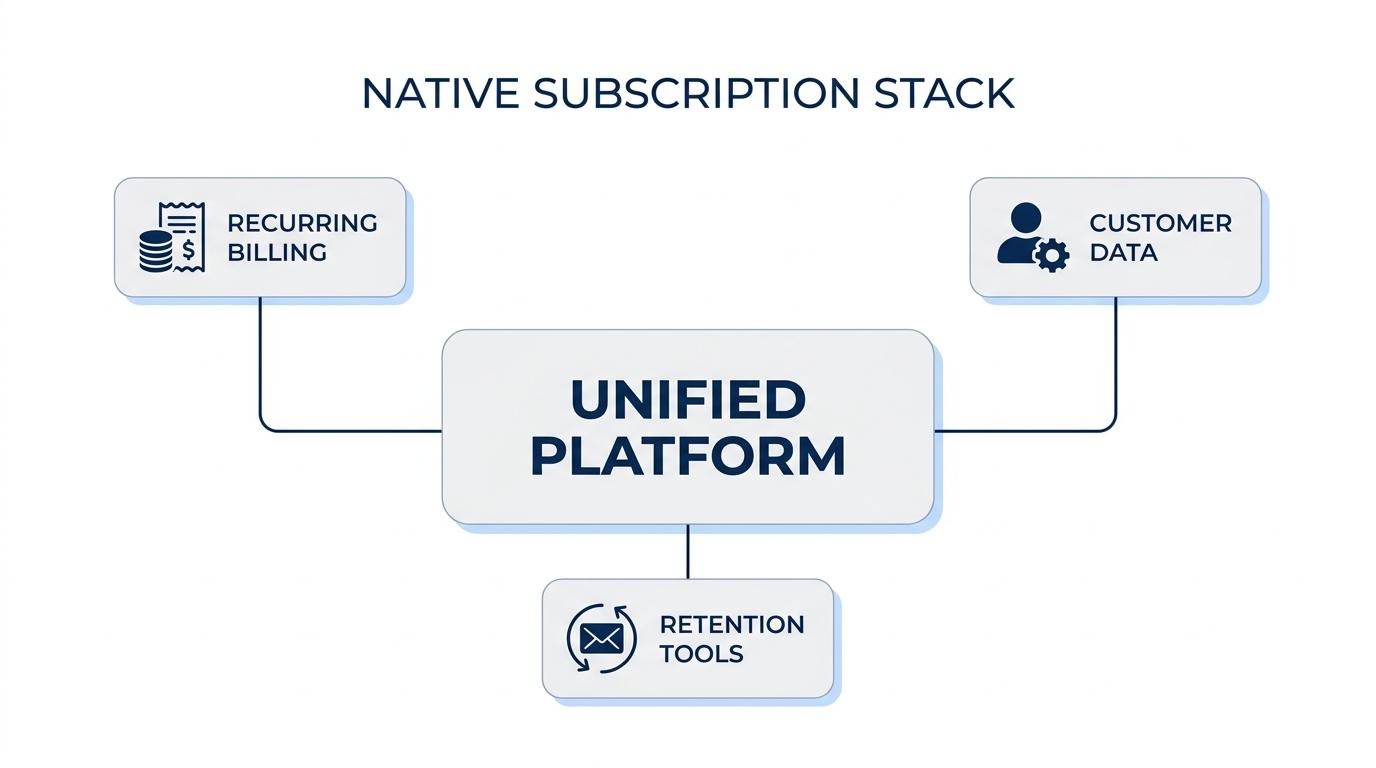
The core platform features you should evaluate first are native recurring billing, flexible subscription management (skip, swap, pause), automated dunning for failed payments, and a unified customer record that connects subscriptions to marketing and CRM data. A platform lacking native subscription support forces reliance on third-party apps, which introduces sync failures and added per-transaction fees. Prioritize platforms where subscription logic, checkout, and customer profiles share a single backend. For brands approaching seven figures in recurring revenue, the ability to manage billing cycles, discount tiers, and retention flows without developer intervention separates scalable infrastructure from duct-taped workarounds.
Native subscription functionality reduces tool sprawl by eliminating the need for separate billing apps, retention plugins, and middleware that accumulate as a brand scales. According to a 2025 Xenoss analysis, unifying data platforms can cut infrastructure costs by up to 40% while eliminating security risks associated with API and product sprawl. Each bolted-on tool adds its own login, data format, and failure point. When subscriptions run natively inside the commerce platform, billing events, customer profiles, and lifecycle triggers share a single system. This is one of the clearest cases where consolidation pays for itself: fewer vendor contracts, fewer integration breakpoints, and faster execution on retention campaigns.
A unified customer data layer supports subscription ops by resolving every interaction, whether online purchase, in-store visit, or subscription renewal, into a single customer record. SKU expansion without operational fragmentation requires a unified data model where subscriptions, CRM, and marketing coexist to maintain a single customer view, according to research published in the International Journal of Computer Trends and Technology. Without this, brands running separate tools for email, billing, and analytics end up with conflicting churn numbers and misattributed revenue. A shared data layer makes cohort analysis accurate, lifecycle automation responsive, and forecasting reliable. With the right platform architecture in place, pricing and billing strategy becomes the next lever to optimize.
Subscription pricing and billing structure determines both conversion rate and long-term retention. The subsections below cover discount tiers, billing frequency options, and failed payment recovery.
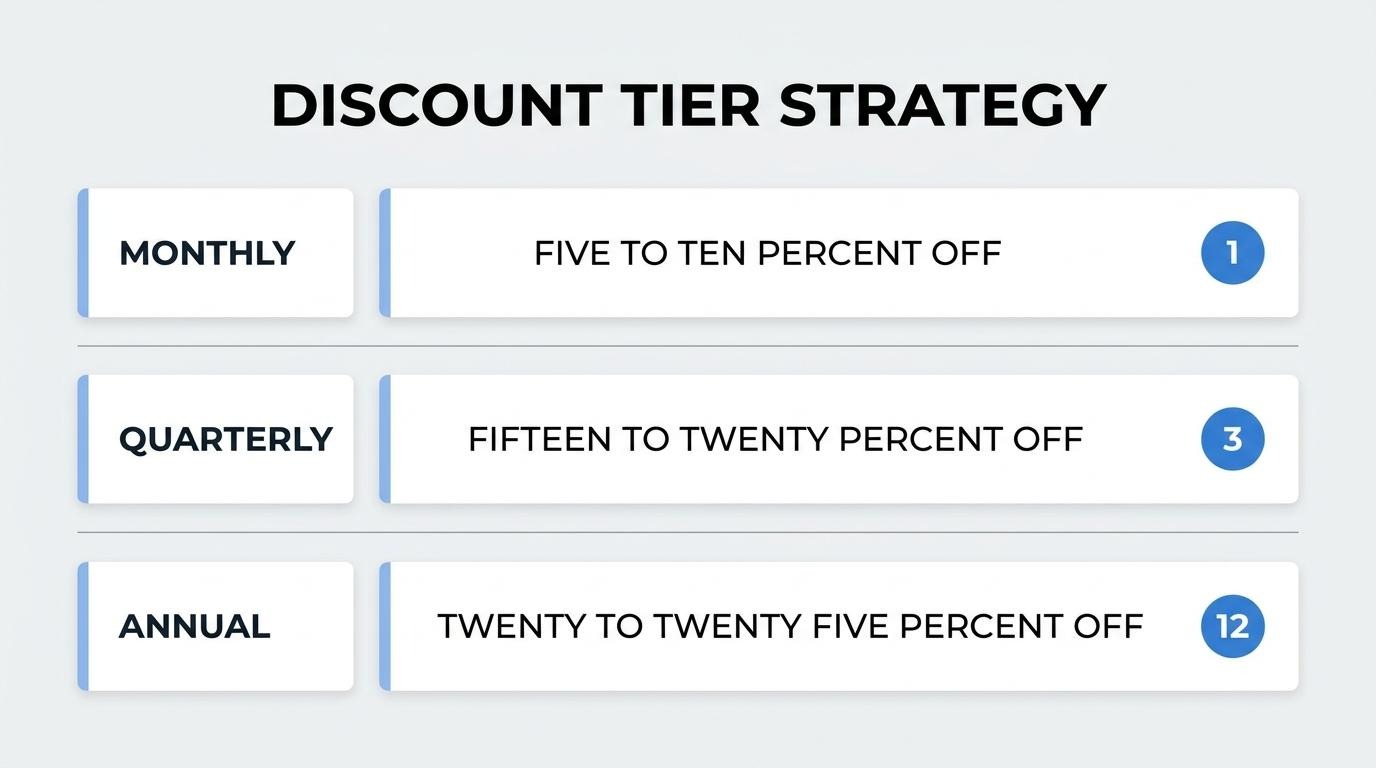
You should set discount tiers for subscribe-and-save offers based on commitment length and order frequency, balancing enough savings to motivate signup without eroding margin. A potential tiered structure may look like this:
Starting at the lower end lets you test price sensitivity before scaling discounts upward. Avoid flat discounts across all tiers; graduated savings reward loyalty and incentivize longer commitments, which directly reduce churn. For most consumable verticals, a 15% baseline discount converts well without training customers to expect deep markdowns on every order.
The billing frequency options you should offer subscribers depend on product consumption cycle and customer preference, though most brands benefit from offering at least two intervals. According to a 2023 analysis by Eightx, annual billing plans can cut monthly churn by 60–80%, with monthly plans churning at 5–8% while annual plans for the same product churn at only 0.5–1.5%.
Effective frequency options include:
Letting subscribers choose their cadence, rather than forcing a single interval, reduces early cancellations driven by product accumulation.
You handle failed payments and dunning management through automated retry logic, customer notifications, and account updater tools that recover revenue before a subscription lapses. According to Eightx, involuntary churn accounts for 30–40% of total churn, driven primarily by billing failures that are recoverable with proper dunning sequences.
A solid dunning workflow includes:
Treating failed payments as a recoverable ops problem rather than lost revenue is one of the highest-ROI retention levers available to subscription brands. With billing and pricing foundations in place, the next step is designing a checkout flow that converts browsers into subscribers.
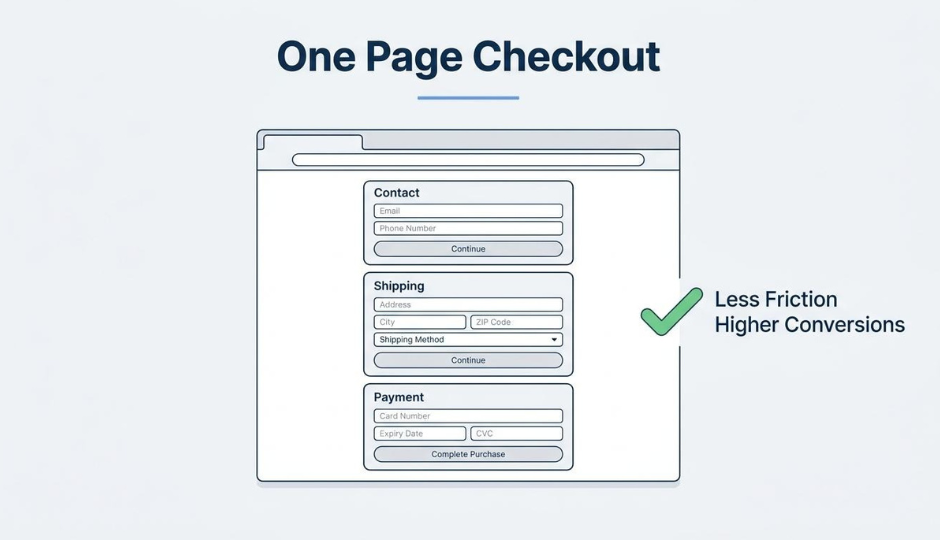
You design the subscription signup and checkout flow by reducing friction at every step, from product page to order confirmation. The following sections cover conversion-driving checkout elements, one-time versus recurring purchase presentation, and account-gating strategy.
The checkout elements that increase subscription conversion rates are those that reduce hesitation and clarify the recurring commitment before a customer clicks "place order." Effective elements include:
Each element should answer a potential objection before it forms. For most brands, the biggest conversion killer is ambiguity about what "subscribe" actually commits the customer to; making terms visible at checkout, not buried in fine print, resolves this directly.
You should present one-time versus recurring purchase options side by side on the product page, with the subscription option visually emphasized through a highlighted border or default selection. According to a 2022 Recharge industry report, 32.4% of customers become subscribers when merchants simply offer the option, representing a substantial conversion opportunity for brands currently selling only one-time purchases.
Effective presentation requires a few key principles:
Forcing customers to hunt for the subscription option buries the most profitable conversion path. The choice architecture should make subscribing feel like the obvious, lower-risk decision without hiding the alternative.
You should gate subscription perks behind account creation only after the first purchase is complete, not before. Requiring account creation before checkout introduces friction at the moment of highest purchase intent, which increases cart abandonment.
The most effective gating sequence is:
Perks worth gating include personalized product recommendations, exclusive member pricing on add-ons, and self-service subscription controls. Perks not worth gating are basic order tracking or receipts, since withholding these frustrates customers without driving meaningful account creation.
For scaling brands managing subscriptions alongside CRM and marketing, the account itself becomes the hub where customer data consolidates into a single view, making post-purchase gating both a better user experience and a stronger data strategy.
You acquire your first subscription customers by converting existing one-time buyers, running targeted paid campaigns, and launching referral programs. Each channel works differently depending on your stage and audience.
You convert existing one-time buyers into subscribers by presenting the recurring option at the right moment in their purchase journey. According to a 2022 Recharge industry report, 32.4% of customers become subscribers when merchants simply offer the option, representing a substantial conversion opportunity for brands with only one-time purchases.
Effective conversion tactics include:
Timing matters more than discount size. A buyer who has already reordered the same product twice is signaling subscription intent, and a well-placed prompt converts far more reliably than a blanket discount to cold traffic.
Paid acquisition strategies that work for subscription offers focus on conveying long-term value rather than single-purchase urgency. Standard ecommerce ads optimized for one-time conversions often attract deal-seekers who churn quickly, so the creative and targeting need to shift.
Strategies that align with subscription economics include:
Cost per acquisition runs higher for subscriptions, but the math changes when you factor in lifetime value. Optimizing paid spend toward subscriber retention cohorts, not just initial conversions, is where most early subscription brands underinvest.
Referral programs accelerate early subscriber growth by turning satisfied subscribers into acquisition channels. According to Deloitte, referred customers in subscription models are 4x more likely to purchase and have a 37% higher retention rate compared to customers acquired through other channels.
High-performing subscription referral programs share a few traits:
For brands still building their first subscriber base, referrals compound quickly because each new subscriber becomes another potential referrer. With retention and churn strategies in place, the next priority is measuring what keeps those subscribers active.
You retain subscribers and reduce churn by combining proactive lifecycle communication, flexible order management, timely win-back campaigns, and layered loyalty rewards. The following subsections cover each tactic.
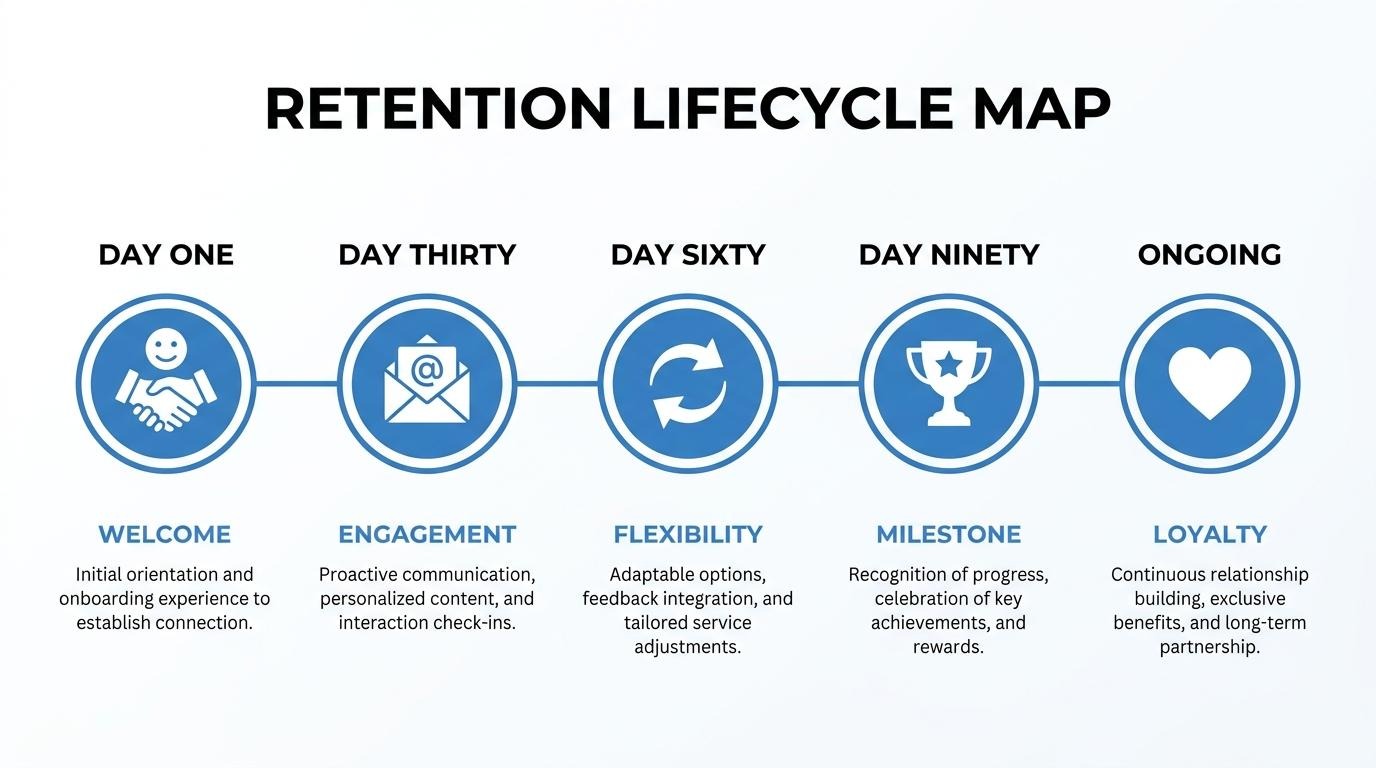
Lifecycle email flows keep subscribers engaged by delivering the right message at each stage of the subscription journey. A structured sequence typically includes:
Since most cancellations cluster in the first 90 days, front-loading value through early lifecycle emails is one of the highest-leverage retention moves a subscription brand can make.
Letting customers skip or swap orders lowers cancellation by removing the all-or-nothing decision that forces subscribers to either accept an unwanted shipment or cancel entirely. When subscribers can pause, skip a cycle, or swap a product, they stay active instead of churning.
The first 90 days are the critical window. According to Eightx, 44% of all subscription cancellations happen within that period, with 60–70% of subscribers typically lost between the first and third orders. Offering skip-a-month flexibility alone can lift retention by 22% in categories like coffee, where 28% of cancellations occur within three months.
Self-service order controls are no longer optional; they are a baseline expectation that directly protects recurring revenue.
You should trigger win-back campaigns 30–45 days before a subscriber's predicted churn event, not after they cancel. Proactive outreach at this stage recovers significantly more subscribers than reactive offers at the cancellation point.
A practical win-back sequence includes:
According to a McKinsey-cited analysis, proactive intervention 30–45 days before a likely churn event saves 3.4x more subscribers than reactive intervention at cancellation. Waiting until a subscriber clicks "cancel" means most of the retention opportunity has already passed.
Loyalty rewards layer onto a subscription to boost retention by creating incremental value that compounds with each renewal cycle. Subscribers already commit to recurring purchases; points, tiers, or exclusive perks give them a tangible reason to stay longer.
Effective loyalty layering structures include:
The key is tying reward accumulation directly to subscription tenure rather than one-time spend. When canceling means forfeiting accrued benefits, the switching cost rises naturally. Brands that integrate loyalty and subscription data within a single system can automate these triggers without manual segmentation or third-party app dependencies.
You measure and optimize subscription performance by tracking recurring revenue KPIs, calculating churn accurately, and analyzing cohort-based retention trends. The following sections cover essential metrics, churn calculation methods, and cohort analysis techniques.
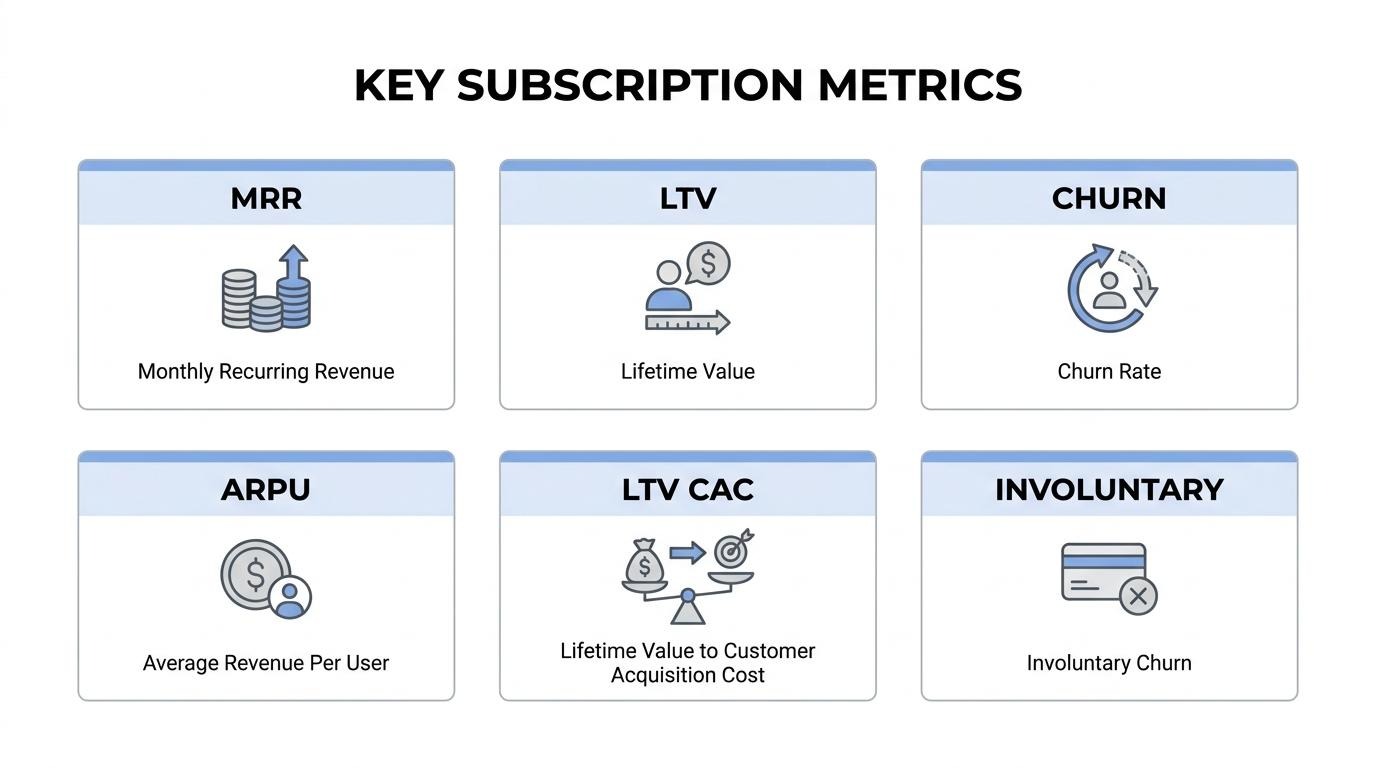
The KPIs you should track for a subscription business fall into three categories: revenue health, retention strength, and acquisition efficiency. Each metric isolates a different lever for growth.
Tracking these metrics in isolation misses the point. The real value comes from reading them together, where a rising MRR paired with declining ARPU, for example, signals volume growth masking a pricing problem.
You calculate subscriber churn rate by dividing the number of subscribers lost during a period by the number of active subscribers at the start of that same period, then multiplying by 100. This produces a percentage that reflects the pace of customer attrition.
Accuracy depends on separating voluntary churn (active cancellations) from involuntary churn (failed payments). According to Eightx, monthly churn benchmarks vary significantly by category: replenishment models sit at 5–8%, curation runs 10–15%, and meal kits range from 8–15%. Without this segmentation, aggregate churn obscures which problem needs solving.
Proactive intervention 30–45 days before a likely churn event saves 3.4x more subscribers than reactive intervention at cancellation. This makes predictive flagging far more valuable than post-cancellation win-back efforts alone.
Cohort analysis methods that reveal retention trends over time include time-based cohorts, behavioral cohorts, and acquisition-channel cohorts. Each groups subscribers by a shared characteristic, then tracks their retention curve across subsequent periods.
The standard visualization is a retention matrix: rows represent cohorts, columns represent months since signup, and each cell shows the percentage still active. Declines that steepen between months one and three across all cohorts point to an onboarding problem, not a product problem. With fulfillment logistics shaping the subscriber experience, optimizing order cycles becomes the next operational priority.
Subscription fulfillment and logistics require syncing recurring order cycles with inventory systems and choosing shipping cadences that minimize operational friction. The following subsections cover inventory coordination and shipping frequency strategies.
You should coordinate recurring order cycles with inventory by integrating your subscription platform directly with inventory management so that each renewal triggers automated stock checks, allocation, and replenishment signals. Without this connection, recurring orders create blind spots: stock runs out mid-cycle, backorders spike, and fulfillment teams scramble.
Real-time demand sensing closes that gap. According to JIT Transportation, omnichannel retailers with seamless system integration can reduce forecast errors and lower inventory levels while speeding up fulfillment times through real-time demand sensing. The key is treating subscription orders as predictable demand units. Since renewal dates and quantities are known in advance, inventory planning shifts from reactive purchasing to scheduled procurement.
For brands managing both one-time and recurring orders, a unified data model prevents the two demand streams from competing for the same inventory pool.
Shipping cadence options that reduce fulfillment complexity include fixed-date batch shipping, interval-based cycles, and subscriber-selected delivery windows. Each approach trades flexibility for operational efficiency in different ways.
Fixed-date batch shipping consolidates all subscription orders into one or two ship dates per month. This is the simplest model because it lets fulfillment teams pick, pack, and ship in concentrated runs rather than processing orders daily. A 2025 study published in the International Journal of Physical Distribution & Logistics Management found that accurate demand forecasting significantly reduces errors in order-picking performance and resource allocation in micro-fulfillment centers, which is especially relevant when batching high volumes on set dates.
Most brands starting out should default to fixed-date batching and only introduce flexible cadences once their fulfillment infrastructure can absorb the added complexity. With logistics workflows defined, the next step is ensuring your subscription model meets legal and compliance requirements.
Subscription ecommerce businesses must comply with federal auto-renewal disclosure rules and a growing patchwork of state cancellation laws. The two key areas are FTC requirements and state-level regulations.
The FTC requires auto-renewal disclosures that clearly present all material terms before a consumer completes a subscription purchase. Under the final "Click-to-Cancel" rule announced in 2024, the Federal Trade Commission mandates that sellers make cancellation at least as simple as the original signup process.
Key requirements include:
Brands that bury cancellation behind phone trees or multi-step retention funnels while offering one-click signup are the exact pattern this rule targets. Building a frictionless cancel flow from day one is not just compliant; it actually strengthens subscriber trust and reduces forced churn.
State-level subscription cancellation laws affect your flow by imposing additional consent, notice, and cancellation requirements that often exceed federal standards. California and New York lead with the most prescriptive rules, and both states updated their laws in 2025.
Notable state requirements include:
According to a 2024 SSRN analysis by Matthew Hagerty at Boston College, the FTC estimates that approximately 2% of a subscription firm's value is sensitive to regulatory interventions targeting cancellation frictions and behavioral mechanisms. That number may seem small in isolation, but for a brand doing $10M in annual recurring revenue, it represents meaningful exposure.
For brands selling across multiple states, the safest approach is designing your subscription flow around the strictest applicable standard. Scaling a subscription model becomes far simpler when compliance is built into the system architecture from the start.
You scale a subscription model past initial launch by expanding your product catalog strategically, adding offline sales channels at the right time, and maintaining unified customer data across every touchpoint. According to Cashfree, subscription businesses collectively achieved a 17.5% growth rate compared to 3.8% for the S&P 500 over the past decade, a 4.6x performance advantage for recurring revenue models.
You expand subscription SKUs without fragmenting ops by keeping all product data, recurring billing logic, and customer records inside a single unified system. Every new SKU added through a disconnected tool introduces sync failures, inventory mismatches, and disjointed reporting. The scale of the opportunity justifies getting this right: according to Research and Markets, the subscription e-commerce market reached an estimated $859.52 billion in 2026 and is projected to expand to $5,350 billion by 2030, representing a 58% CAGR.
A structured approach prevents operational sprawl as the catalog grows:
Brands that bolt on separate subscription apps per product line create exactly the fragmentation that erodes margins at scale. Consolidation before expansion is almost always the smarter sequence.
You should add an offline or POS channel to subscriptions when your customer acquisition costs online plateau and in-person touchpoints can convert or retain subscribers more efficiently. Retail locations, pop-ups, and events create opportunities to sign customers into recurring plans face-to-face, which often yields higher initial commitment than digital-only funnels.
The timing signals that indicate readiness include:
The critical requirement is that POS transactions resolve to the same customer profile used online. Without that data link, offline sign-ups become orphaned records that cannot trigger lifecycle automations or contribute to accurate LTV calculations.
You maintain a single customer view as channels multiply by resolving every transaction, subscription event, and support interaction to one customer record regardless of where it originates. This means online purchases, POS sales, email engagement, and subscription modifications all feed into the same profile.
The most common failure point is running separate databases per channel. When the ecommerce platform holds one customer record and the POS system holds another, retention campaigns target incomplete profiles and churn analysis becomes unreliable.
Key requirements for a unified customer view include:
For brands operating at this level of complexity, platforms with a native shared customer data layer, including SHOPLINE, eliminate the reconciliation work that typically requires a separate CDP or custom integrations. Understanding this data architecture sets the stage for building subscriptions without bolting on extra tools.
You build subscriptions without bolting on extra tools by choosing a platform where recurring billing, customer data, and marketing automation share a single system. The sections below cover how SHOPLINE unifies these functions and the key takeaways for launching a subscription model from scratch.
What changes is the elimination of the data fragmentation that forces scaling brands to reconcile subscriber behavior across disconnected apps. On SHOPLINE, subscription management, CRM, and lifecycle marketing automation coexist within one shared customer data layer. Every recurring order, skip request, and engagement signal writes to the same customer record rather than syncing between separate tools.
This matters operationally because a single customer view lets brands trigger retention flows, segment by subscription tenure, and surface churn risk signals without exporting data between platforms. Brands running $1M+ in recurring revenue often find that consolidation removes the hidden costs of maintaining integrations, resolving data conflicts, and troubleshooting sync failures between a subscription app, an email platform, and a separate CRM. SHOPLINE is one path for brands ready to move past that multi-tool complexity.
The key takeaways about building a subscription ecommerce model from scratch center on five practical principles:
The brands that treat subscriptions as a system, not a feature bolted onto a storefront, are the ones positioned to scale recurring revenue without scaling operational friction alongside it.