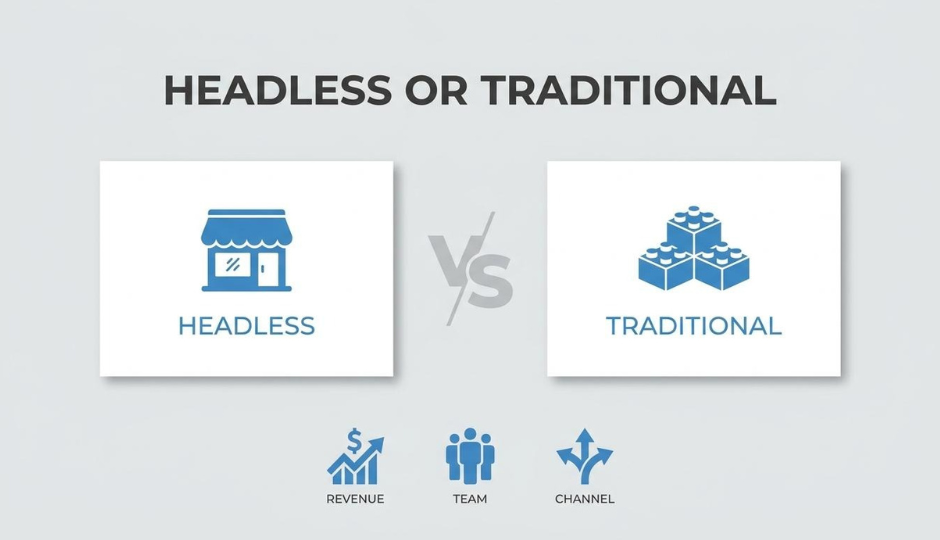
Choosing between headless commerce and traditional commerce means matching your ecommerce architecture to your business's revenue, technical capacity, and growth trajectory. Headless commerce separates the frontend presentation layer from the backend commerce engine through APIs; traditional commerce keeps both layers coupled in a single system.
This guide covers architectural differences between the two approaches, the advantages and disadvantages of each, the evaluation factors that determine which fits your business, and how unified platforms bridge the gap between simplicity and flexibility.
Headless and traditional architectures connect their frontends and backends in fundamentally different ways. Headless systems use REST, GraphQL, and specialized APIs so each layer operates independently, while monolithic platforms package everything into one codebase. That structural distinction drives every downstream difference in performance, cost, and team requirements.
Headless commerce delivers stronger frontend flexibility, native omnichannel support, and faster page loads; brands switching to headless report up to 2x improvement in load speed and meaningful conversion lifts. Traditional commerce platforms generally offer faster setup, lower initial costs, and simpler workflows, making them well-suited for small teams without dedicated development resources, while headless commerce typically requires more technical investment upfront in exchange for greater flexibility and scalability.
Both architectures carry real drawbacks. Headless increases development costs, demands larger technical teams, and creates tool sprawl as each capability requires its own API connection, while traditional platforms restrict storefront customization.
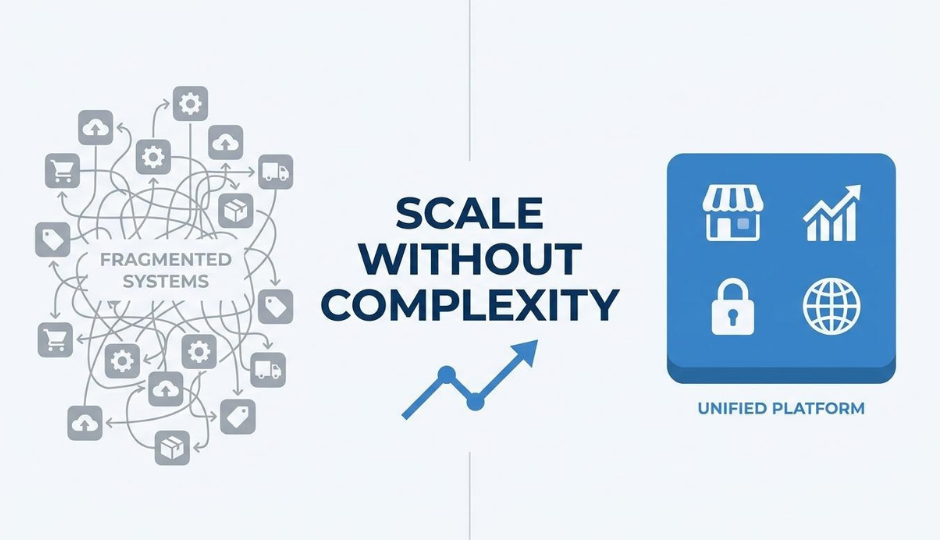
Five factors narrow the decision: annual revenue, in-house technical capacity, channel strategy, tool stack complexity, and launch timeline. For brands that have outgrown monolithic tools but lack the resources for a fully decoupled stack, unified platforms that consolidate commerce, CRM, and marketing into a single shared data layer offer a practical middle path.
Headless commerce is an e-commerce architecture that separates the frontend presentation layer from the backend commerce engine, allowing each to operate and evolve independently. This decoupled structure connects the two layers through APIs, giving development teams the freedom to build custom storefronts without touching order processing, inventory, or payment logic.
Unlike traditional monolithic platforms where the storefront and backend ship as a single unit, headless commerce treats the visual experience as interchangeable. A brand can swap its entire frontend framework, launch a new mobile app, or push content to a smart display, all while the same backend handles transactions, fulfillment, and customer data.
The core concept of headless commerce involves separating the customer-facing interface from the operational logic like order processing and inventory management, allowing each to function independently. Communication between these decoupled layers is facilitated through APIs, with typical providers offering a combination of REST, GraphQL, and specialized APIs for checkout and payments.
This separation creates a clear division of labor. Frontend developers choose their preferred frameworks and tools without backend constraints. Backend engineers optimize performance, security, and data workflows without worrying about how changes affect the storefront display. Both teams ship faster because neither blocks the other.
For scaling brands dealing with multi-channel complexity, headless commerce offers a structural advantage: the ability to deliver tailored experiences across websites, mobile apps, and emerging touchpoints from a single commerce engine. That flexibility, however, comes with tradeoffs in cost and technical requirements, which the sections ahead examine in detail.
Traditional commerce is an ecommerce architecture where the frontend and backend operate as a single, coupled system. Everything from the storefront design to inventory management, checkout, and order processing lives inside one unified codebase.
This structure defines how most small and mid-sized businesses launch online stores today. The sections below cover how monolithic platforms work, what they include out of the box, and which business profiles they suit best.
A monolithic platform works by packaging the presentation layer, business logic, and database into one tightly integrated application. When a shopper browses a product page, the same system renders the page, checks inventory, processes the cart, and handles payment.
Companies offering monolithic solutions typically provide a system where the frontend and backend are coupled, meaning everything is packed together, which makes it easy to set up and manage even without a technical background. Changes to the storefront, however, require working within the platform's built-in templates and tools because the layers cannot be modified independently.
A traditional commerce platform includes a bundled set of features that cover the full online selling workflow:
Platforms like WooCommerce and BigCommerce are common examples. Monolithic services like these are a popular choice for smaller businesses and projects due to their simplicity and usually cheaper maintenance costs. For brands that need a functional store without developer resources, this bundled approach removes the need to assemble separate tools.
Brands that are early in their ecommerce growth, operate with small teams, or lack dedicated developers should consider traditional commerce. The architecture suits businesses that prioritize speed to market and operational simplicity over deeper frontend customization.
Traditional platforms work well when a brand sells through one or two channels, manages a straightforward product catalog, and does not yet face the scaling pressures that come with high traffic volumes or complex omnichannel requirements. For teams generating under $1 million in annual revenue, the lower upfront cost and minimal technical overhead often outweigh the customization trade-offs. Once operational complexity grows, though, the constraints of a monolithic system become harder to work around.
Headless architecture differs from traditional architecture in how the frontend and backend relate to each other. Headless systems decouple these layers entirely, while traditional platforms keep them tightly bound. The subsections below explain how each approach connects its components and moves data.
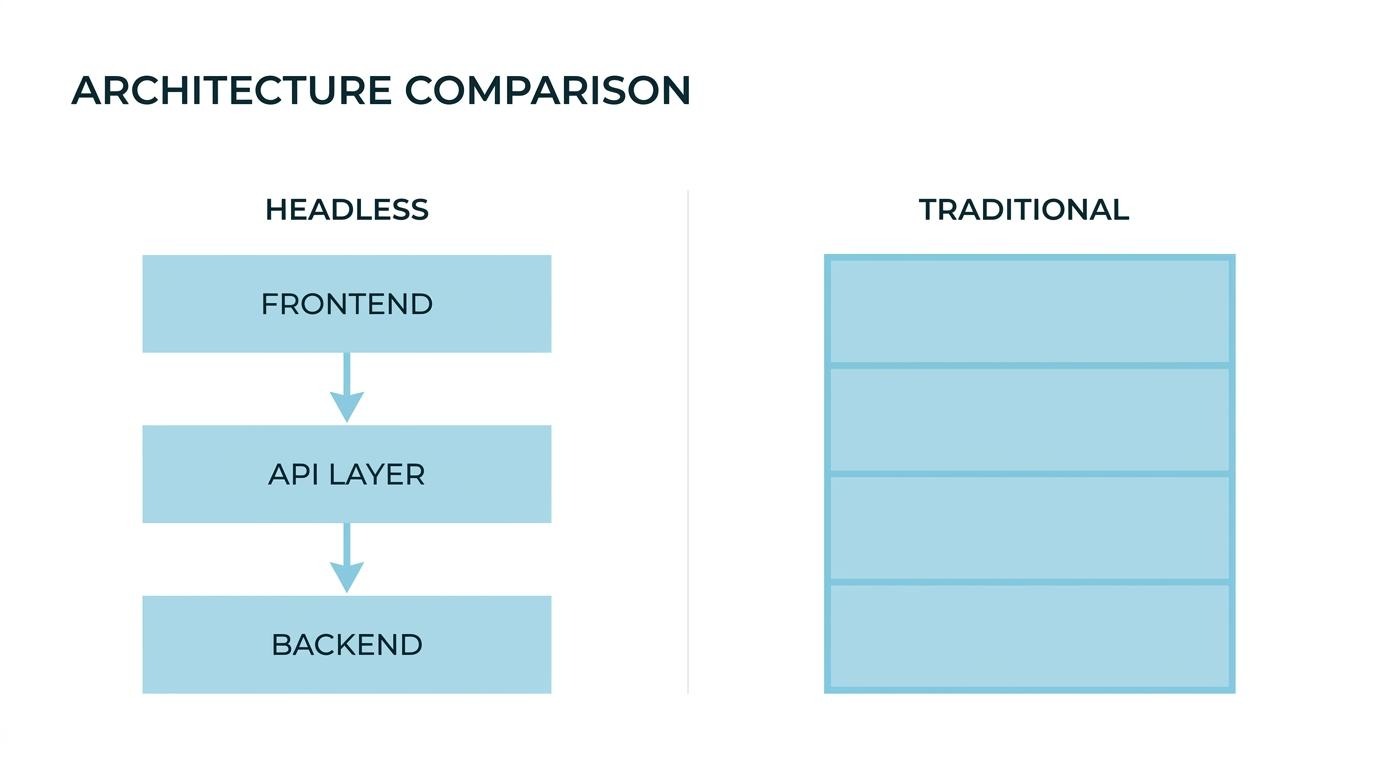
The frontend and backend connect in headless commerce through APIs. Headless commerce separates the customer-facing interface from backend operations like order processing and inventory management, allowing each layer to function independently. Communication between these decoupled layers is facilitated through a combination of REST, GraphQL, and specialized APIs for functions such as checkout and payments.
This separation accelerates development because frontend and backend teams work independently. Changes to the storefront do not affect backend performance, and vice versa. For brands managing frequent design iterations or A/B tests, that independence removes a significant bottleneck from the release cycle.
The frontend and backend connect in traditional commerce through a single, coupled system. Monolithic platforms package the presentation layer and operational logic together, so every storefront change passes through the same codebase that handles inventory, checkout, and order fulfillment. This tight coupling makes initial setup straightforward, even for teams without deep technical expertise.
The tradeoff is rigidity. Because both layers share one architecture, updating the frontend often requires coordinating with backend release cycles. As transaction volume grows, monolithic systems face increasing difficulty isolating issues, which can slow updates and complicate integrations. For smaller catalogs and simpler operations, though, that simplicity can be a genuine advantage.
Data flows between systems differently depending on whether the architecture is decoupled or monolithic. In headless setups, each service communicates via API calls; the storefront requests product data, pricing, or customer records from independent backend microservices, and each response travels through a defined API endpoint. This approach enables faster feature development, more integrated personalized experiences, and more performant, reliable systems.
In traditional platforms, data flows through a single internal pathway. The frontend reads directly from the same database that powers checkout and fulfillment, which simplifies the data layer but limits how quickly teams can introduce new touchpoints or third-party integrations.
Understanding these structural differences clarifies why performance, cost, and team requirements diverge between the two models.
The key advantages of headless commerce are greater frontend flexibility, native omnichannel support, faster page performance, and rapid customization. The following sections break down each advantage.
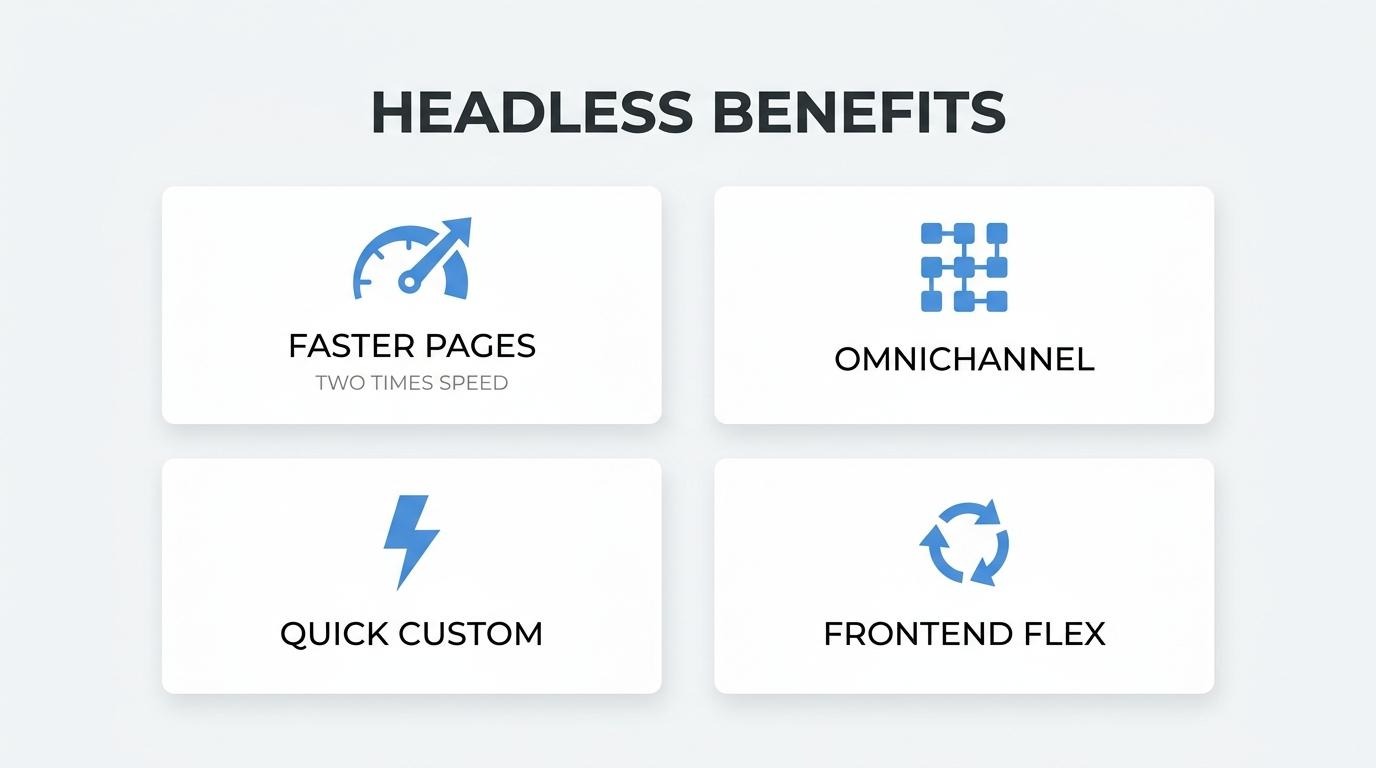
Headless commerce improves frontend flexibility by decoupling the presentation layer from backend logic, letting teams build custom interfaces with any framework or technology. Composable commerce extends this further, allowing companies to plug, customize, and integrate best-of-breed solutions instead of relying on rigid, monolithic platforms. According to Apollo Technical, brands that switch to headless commerce report an average 2x improvement in page load speed and meaningful lifts in conversion rate. Gymshark, Nike, and SKIMS have all cited improvements in load time and conversions from headless deployments. For brands that have outgrown template-based storefronts, this level of design control is often the single biggest motivator.
Headless commerce supports omnichannel experiences by exposing backend services through APIs, so the same product catalog, pricing, and inventory data can power any customer-facing channel simultaneously. A single backend can serve a website, mobile app, voice assistant, in-store kiosk, or social storefront without duplicating logic. A Gartner study predicts that by 2025, just about 70% of new digital commerce experiences will be built using a headless approach, largely because of this channel versatility. True omnichannel, however, requires more than just decoupled architecture; it demands unified customer data behind those channels, which is where many headless implementations might fall short without deliberate data-layer planning.
Headless commerce handles performance and speed by isolating the frontend from backend processing, enabling static page generation, edge caching, and lightweight rendering. Industry analyses suggest that headless and decoupled frontend architectures can improve page load performance by approximately 20–50% compared to traditional monolithic systems, with Largest Contentful Paint (LCP) improvements often ranging from 0.6 to over 1 second in optimized implementations. Because UX research consistently shows that even a 1-second delay in load time can increase bounce rates by around 32%, these performance gains can have a meaningful impact on engagement and revenue outcomes when properly implemented. Speed is arguably the most underrated competitive advantage in ecommerce; a fast storefront compounds benefits across SEO rankings, ad quality scores, and checkout completion rates simultaneously.
Headless commerce enables faster customization by letting frontend and backend teams work independently, so design changes will not require backend redeployment. Headless commerce enables retailers to extend product, pricing, and inventory data across multiple customer-facing channels through API-driven architecture. While traditional platforms also support multichannel selling, headless systems make it easier to deliver consistent experiences across websites, mobile apps, in-store interfaces, and emerging touchpoints by decoupling the frontend from backend services. New landing pages, campaign-specific storefronts, or regional variations can launch in days rather than weeks. This parallel development workflow is what makes headless particularly valuable during high-velocity periods like product drops or seasonal campaigns, where speed to market directly impacts revenue capture.
Understanding these advantages clarifies when headless architecture earns its added complexity.
The key advantages of traditional commerce center on ease of use, lower upfront costs, and lean operational requirements. The sections below cover why traditional platforms are easier to launch, cheaper initially, and simpler for small teams.
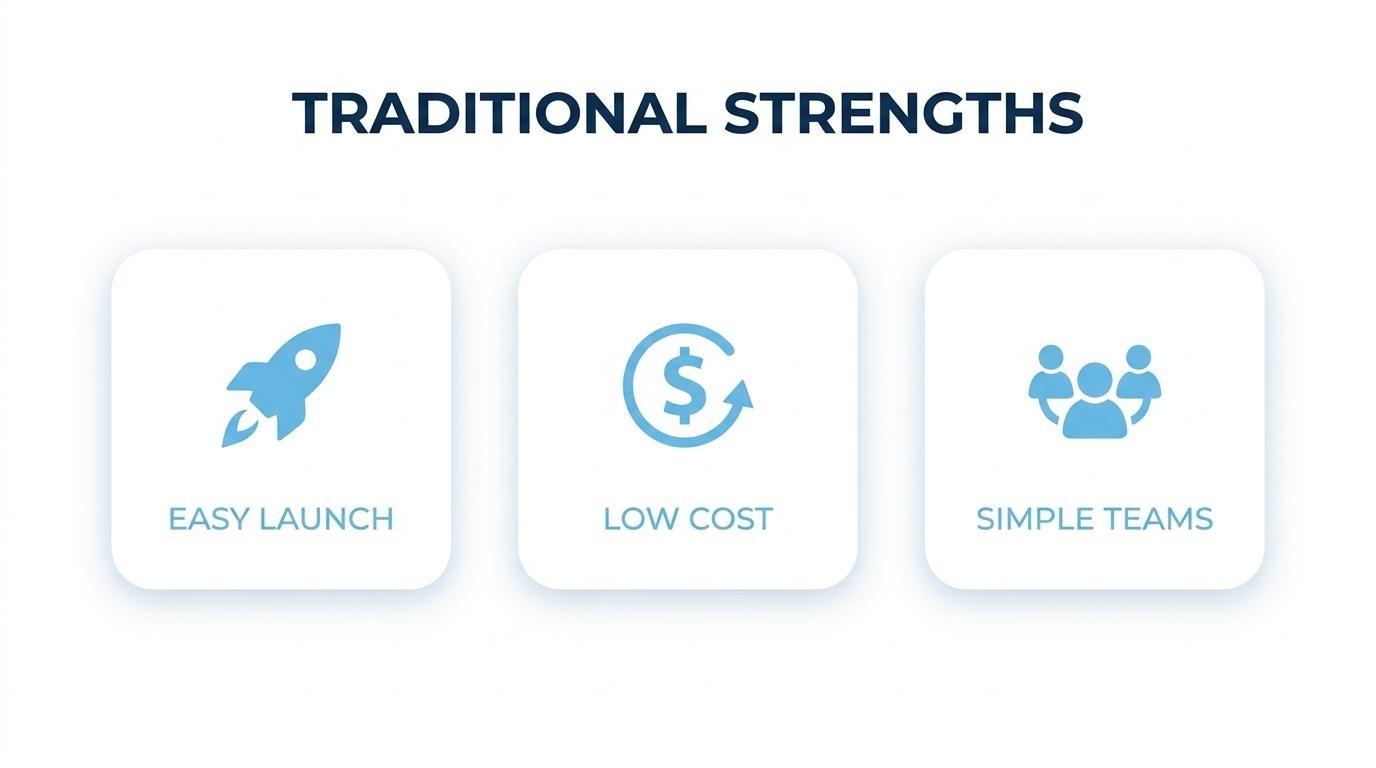
Traditional commerce is easier to launch and manage because the frontend and backend ship as a single coupled system. Everything from the storefront to checkout to inventory lives in one package, so store owners can configure and run operations often without writing code or hiring developers, while headless commerce is developer-dependent by design.
A bundled approach means drag-and-drop editors, pre-built templates, and guided setup wizards handle the work that would otherwise require a development team. For brands focused on selling rather than building infrastructure, that simplicity shortens the path from signup to first sale considerably.
Traditional commerce costs less to operate initially because monolithic platforms bundle hosting, security, and core features into a single subscription. Monolithic services like WooCommerce and BigCommerce are a popular choice for smaller businesses due to their simplicity and usually cheaper maintenance costs.
This cost advantage, however, has limits. Customization can be restricted on traditional platforms, and complex workflows sometimes require multiple apps, which leads to increased transaction fees and app costs over time. The initial savings are often real for early-stage operations, but brands should plan for different infrastructure needs as their business scales and needs grow beyond what the base platform provides.
Traditional commerce is simpler for small teams because one or two non-technical operators can handle the entire storefront. Key reasons include:
A team of two to five people can realistically manage product listings, order fulfillment, and basic marketing without highly specialized technical roles. This operational simplicity makes traditional commerce the practical starting point for most brands, though teams often revisit the decision once revenue complexity outpaces what a monolithic setup handles natively.
Understanding these advantages provides the baseline for evaluating where traditional platforms fall short.
The disadvantages of headless commerce center on higher costs, staffing demands, and integration complexity. The sections below break down how development expenses, team requirements, and tool sprawl affect operations.
Headless commerce increases development costs because separating the frontend from the backend requires custom-building features that monolithic platforms include out of the box. Every storefront component, from checkout flows to content rendering, must be developed, tested, and maintained independently.
The tradeoff for the flexibility of headless architecture is increased complexity and development time compared to monolithic alternatives. Custom API integrations, frontend frameworks, and hosting infrastructure all add to the initial investment. Ongoing maintenance costs also run higher since updates to one layer can require coordination across multiple services or teams. For brands without substantial development budgets, these compounding expenses can erode the ROI that headless flexibility promises.
Headless commerce requires larger technical teams because the decoupled architecture demands specialized roles that monolithic platforms consolidate. Frontend developers, backend engineers, DevOps specialists, and API integration experts all become necessary when the presentation layer operates independently from commerce logic.
In a monolithic system, often a single developer or small team can manage the entire stack through a unified admin interface. Headless setups split that responsibility across front and backend. Someone must build and maintain the storefront framework, another might manage API connections, and dedicated operations staff must monitor uptime across distributed services. This staffing reality can make headless impractical for lean teams and significantly increase payroll overhead before the architecture delivers any competitive advantage.
Managing multiple integrations creates tool sprawl because headless commerce relies on connecting best-of-breed services through APIs for functions that monolithic platforms handle natively. Each capability, whether search, payments, CMS, analytics, or personalization, often requires a separate vendor and a dedicated integration.
As the number of connected tools grows, so does operational complexity:
For scaling brands already managing 5–15 tools, headless architectures can amplify the fragmentation problem rather than solve it. Understanding these integration risks helps clarify when traditional or unified platforms may better fit your operations.
Traditional commerce platforms create friction in two key areas: storefront customization and scalability. The sections below cover how rigid templates restrict design and why traditional systems like monolithic architecture often break down at higher scale.
Traditional commerce limits storefront customization because the frontend and backend are tightly coupled, locking merchants into predefined templates and theme constraints. Changing layouts, checkout flows, or page structures often requires working within the platform's built-in editor rather than building freely.
Complex workflows sometimes require multiple apps to achieve what a custom-built frontend handles natively, and each added app increases transaction fees and ongoing costs. For brands with distinct visual identities or unconventional buyer journeys, these restrictions force compromise. As operations grow, monolithic architecture often limits scalability, slows updates, and makes integrations complex, leading to performance issues. This rigidity becomes a real liability once a brand's experience requirements outpace what the template system was designed to support.
Traditional platforms, particularly monolithic architectures, can struggle at higher revenue scale. According to Upstart Commerce, monolithic e-commerce platforms struggle to scale effectively, becoming slow and sometimes unresponsive as traffic increases, which can lead to customer dissatisfaction and lost sales.
The root issue is structural. When every component shares one codebase, a traffic spike on the storefront can degrade backend operations like inventory sync and order processing simultaneously. Isolating and resolving performance bottlenecks becomes difficult because changes to one part risk destabilizing others. For brands pushing past initial growth stages, this ceiling often surfaces during high-traffic events like product launches or seasonal promotions. Evaluating platform architecture before hitting these limits saves costly emergency migrations later.
Understanding where traditional platforms fall short sets the stage for identifying which factors matter most when choosing between architectures.
The factors you should evaluate before choosing an approach include annual revenue, in-house technical capacity, channel strategy, tool stack complexity, and timeline to launch. Each factor helps shape which architecture fits your business.
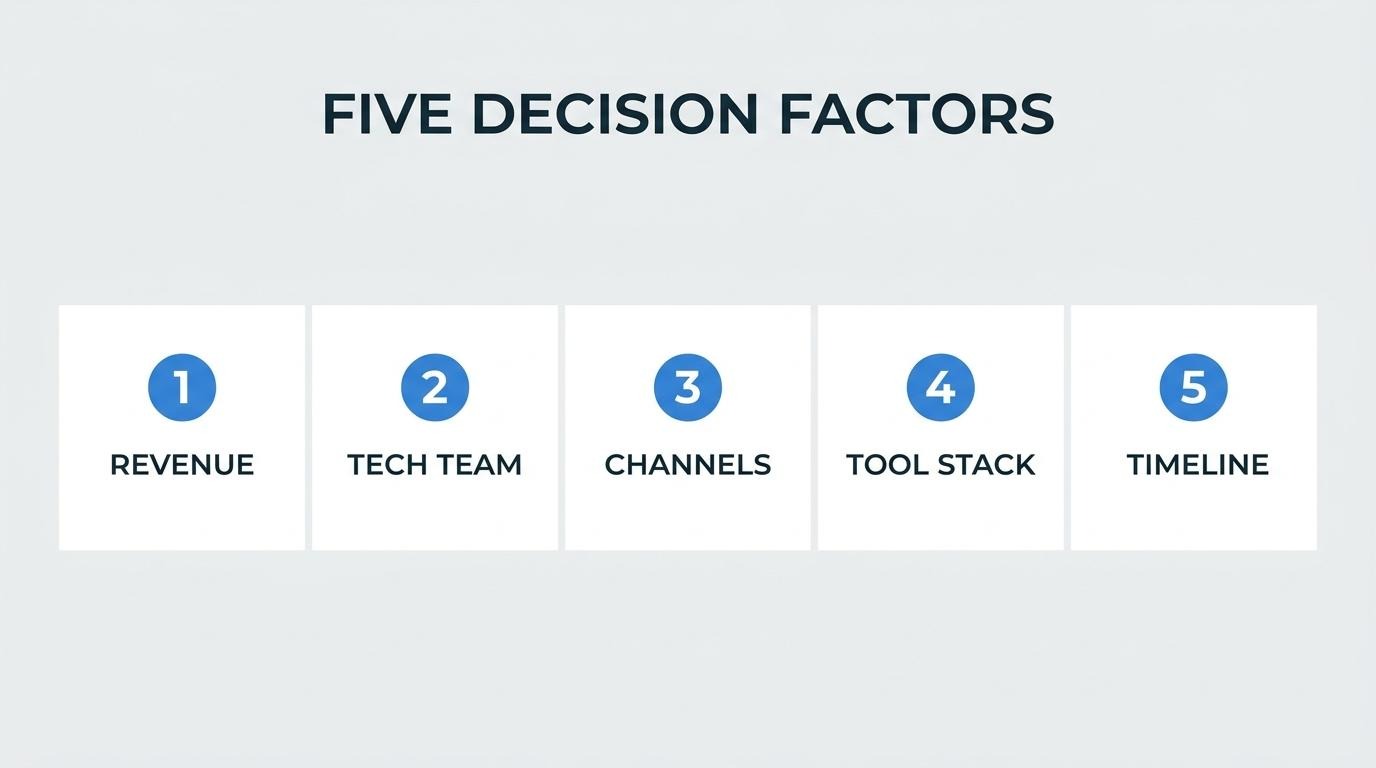
Annual revenue can influence architectural decisions by shaping how much engineering investment a business can justify. GTMnow describes small and medium-sized businesses as typically operating with 5–25 employees and around $5–10 million in annual revenue. At this stage, the cost and complexity of implementing a fully custom headless frontend may outweigh its performance benefits for many teams, particularly those with limited technical resources. As businesses scale and generate higher revenue, the potential returns from performance optimization and conversion improvements can become more meaningful relative to the required infrastructure investment, making more flexible architectures increasingly viable.
Your in-house technical capacity affects the decision by determining whether you can build, maintain, and iterate on a decoupled frontend without external dependency. Headless commerce requires dedicated frontend developers, DevOps engineers, and API integration specialists working continuously, not just at launch. If your team lacks these roles, you will depend on agencies for every storefront change, which slows execution and increases cost. Traditional platforms bundle the frontend and backend together, so a small team can manage updates without writing code. For brands with growing technical teams but not full engineering departments, a unified platform that offers API access alongside built-in tools often strikes the most practical balance between customization and operational speed.
Your channel strategy affects the decision by defining how many distinct customer-facing touchpoints your storefront must serve. Brands selling exclusively through a single website rarely need the architectural separation headless provides. When commerce extends across mobile apps, in-store kiosks, social storefronts, and marketplace integrations, a decoupled frontend allows each channel to pull from shared backend logic without duplicating infrastructure. However, multichannel does not automatically require headless. Unified platforms that consolidate online, offline, and social data can support omnichannel operations without the overhead of managing separate frontend builds per channel. The deciding factor is whether your channels demand unique presentation layers or share enough structure to run from one system.
Your app and tool stack complexity affects the decision by revealing whether your current architecture creates operational friction or runs efficiently. According to Close.com, SMB buyers make decisions faster and with less complexity compared to enterprise or mid-market businesses. That speed advantage can erode when a brand runs 10 to 15 disconnected tools for email, subscriptions, loyalty, POS, and analytics. Headless architecture adds even more integration points, since every frontend service requires its own API connection. For brands already struggling with tool sprawl, moving to headless can multiply the problem. Consolidating onto a platform where core commerce functions share a single data layer often reduces complexity more effectively than decoupling the frontend.
Your timeline to launch affects the decision by constraining which architecture is realistic to deploy within your window. Traditional platforms can go live in days or weeks because themes, checkout, and hosting come preconfigured. Headless builds typically require three to six months of development before launch, covering frontend design, API integration, testing, and DevOps setup. If your business needs to be selling within 30 days, headless is not a viable starting point. Brands with longer planning horizons and dedicated engineering resources can absorb the extended build cycle. For teams operating under time pressure, launching on a traditional or unified platform first and migrating later preserves momentum without sacrificing long-term flexibility.
Clarifying these five factors narrows the architecture decision from abstract preference to operational fit.
Headless commerce is the right choice when a brand's growth demands outpace what a coupled frontend-backend system can deliver. The scenarios below cover the revenue scale, technical readiness, and channel complexity that justify the investment.
Headless architecture often fits best when several conditions align:
Brands that lack dedicated developers, operate on a single sales channel, or sit below the $5M revenue mark will likely spend more on headless infrastructure than they recoup in flexibility. The architecture rewards complexity; without it, the overhead is hard to justify.
Understanding when headless fits clarifies when a traditional approach may serve better.
Traditional commerce systems, often implemented as monolithic platforms, are often the preferred choice when a business prioritizes speed to launch, low upfront costs, and simplicity over deep frontend customization. The scenarios below outline when a traditional platform might fit best.
Traditional commerce works well for businesses that meet several specific conditions:
For many early-stage and growing brands, the operational simplicity of a coupled frontend-backend system outweighs the flexibility gains of decoupled architecture. The real question is not whether traditional commerce is "good enough" permanently; it is whether the business has reached the complexity threshold where its limitations start costing revenue. Integrated or monolithic e-commerce platforms can help SMEs focus on growth by reducing operational and technical complexity, particularly in the early stages where dedicated IT resources are limited. However, increasing business scale and complexity often introduces new demands over time.
Understanding when traditional fits clarifies the opposite scenario: when unified platforms can bridge the gap between simplicity and flexibility.
A unified platform can deliver flexibility without headless complexity by consolidating commerce with CRM and marketing capabilities into one system. A 2026 article on PageSpeed Matters cited that the biggest shift in 2026 is the rise of composable and hybrid architectures that blend traditional and headless approaches, and platforms such as SHOPLINE reflect this shift by offering integrated functionality alongside API-driven extensibility. The following sections cover what changes operationally and the key takeaways for making the right architecture choice.
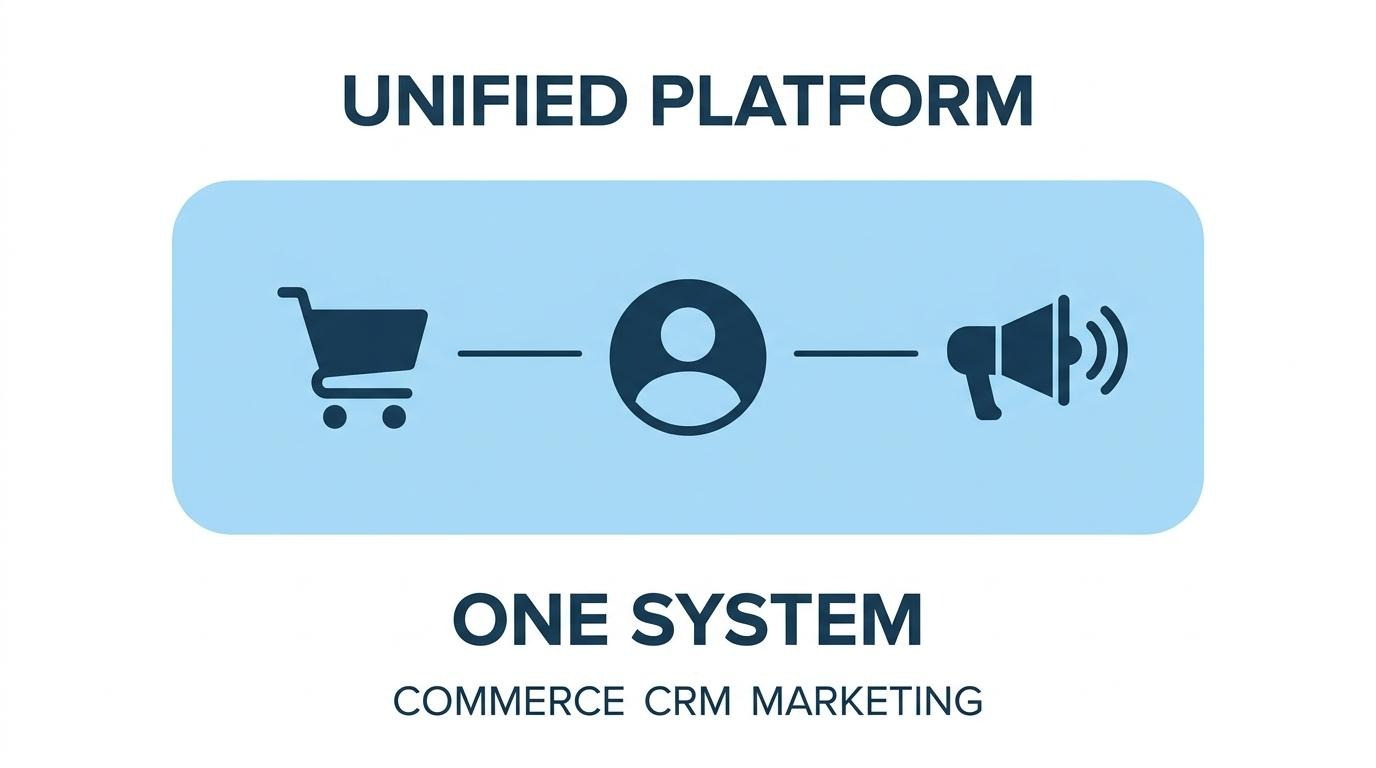
What changes when commerce, CRM, and marketing live in one system is the elimination of fragmented data silos and redundant integrations, replacing the patchwork of disconnected tools that most scaling brands inherit. According to a 2024 study by Hassan Al-Ababneh published on ResearchGate, integrating digital commerce technologies into the architecture of modern e-commerce platforms seems to indicate a positive correlation with key performance indicators of marketing effectiveness depending on the level of digitalization of CRM systems. By bringing commerce, CRM capabilities, and marketing automation into a single ecosystem, modern e-commerce platforms can help brands streamline workflows, gain clearer customer insights, and enhance overall marketing performance.
In a thesis on e-commerce for Häme University of Applied Sciences, Harsh Chahal states that SMEs often find commercial monolithic systems prohibitively expensive, overly complex, or insufficiently adaptable, especially when lacking dedicated IT resources or cost flexibility. Because SMEs often value solutions that reduce technical overhead, an integrated SaaS platform like Shopline can help sidestep this by bundling core functions natively, allowing for faster implementation, and allowing businesses to add capabilities incrementally as their needs evolve. Additionally, AI and ML capabilities embedded within a combined commerce-CRM system can empower data-driven marketing campaigns without requiring separate CDP or automation subscriptions.
For brands operating between $1M and $50M in revenue, this consolidation is often more practical than either a rigid monolith or a fully headless build. SHOPLINE is one platform that handles commerce, CRM, marketing automation, and POS inside a single system with a shared data layer, removing the sync issues that come with stitching five to fifteen separate tools together.
The key takeaways about choosing between headless and traditional commerce center on matching architecture to operational reality, not chasing trends:
The right choice is never universal. It depends on your team size, growth trajectory, channel strategy, and tolerance for operational complexity. Results may vary depending on implementation, industry, and scale.