
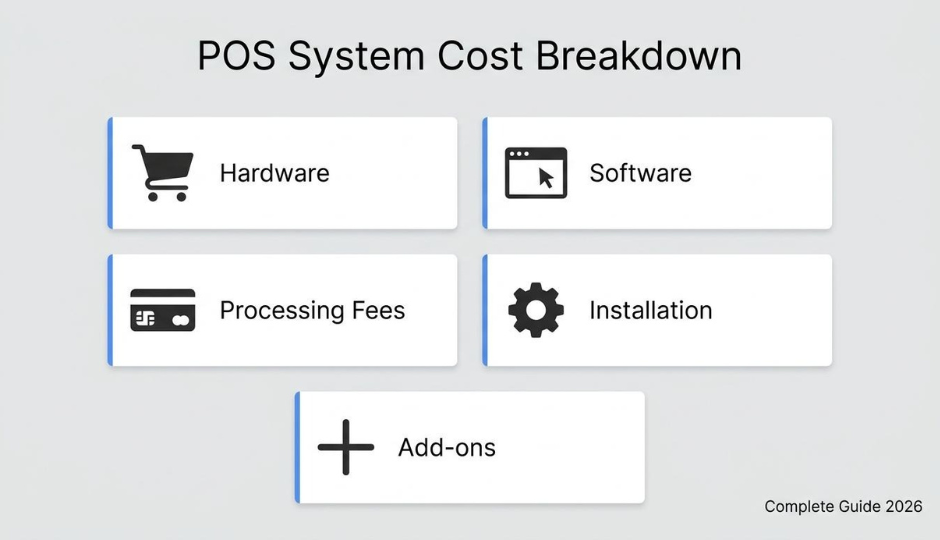
A POS system cost in 2026 includes hardware, software subscriptions, payment processing fees, installation, compliance, and ongoing maintenance. Total expenses frequently exceed initial vendor quotes, with some merchants reporting implementation costs 72.6% higher than first estimates.
This guide covers cost components and hardware pricing, business-type and pricing-model breakdowns, hidden fees and total cost of ownership, cost reduction strategies and switching budgets, and platform consolidation benefits.
Hardware ranges from $49 for a mobile card reader to $1,699 for a full countertop station, while software subscriptions run $0 to $99+ per month depending on feature depth. Payment processing fees between 2.6% + 10¢ and 2.9% + 15¢ per transaction represent the largest ongoing operational expense for high-volume sellers.
Costs shift dramatically by business type. Retail stores, restaurants, DTC brands with physical locations, pop-ups, and multi-location operations each face distinct pricing structures; a five-location business paying $100 per month per site spends $6,000 annually on software alone before hardware or compliance enters the equation.
Hidden charges including early termination fees ($200 to $500), PCI compliance and security-related costs ($1,000 to $10,000 annually depending on business complexity), staff training, and data migration add thousands that initial quotes omit. Over a three-year window, these layers compound significantly beyond year-one projections.
Unified commerce platforms that consolidate POS, CRM, and marketing into one system deliver a 22% improvement in total cost of ownership compared to fragmented app stacks. Consolidation eliminates redundant subscriptions, integration maintenance, and data reconciliation labor that scaling brands accumulate across disconnected tools.
The main cost components of a POS system are hardware, software subscriptions, payment processing fees, installation, and add-ons. Each category carries distinct pricing structures that affect your total investment.
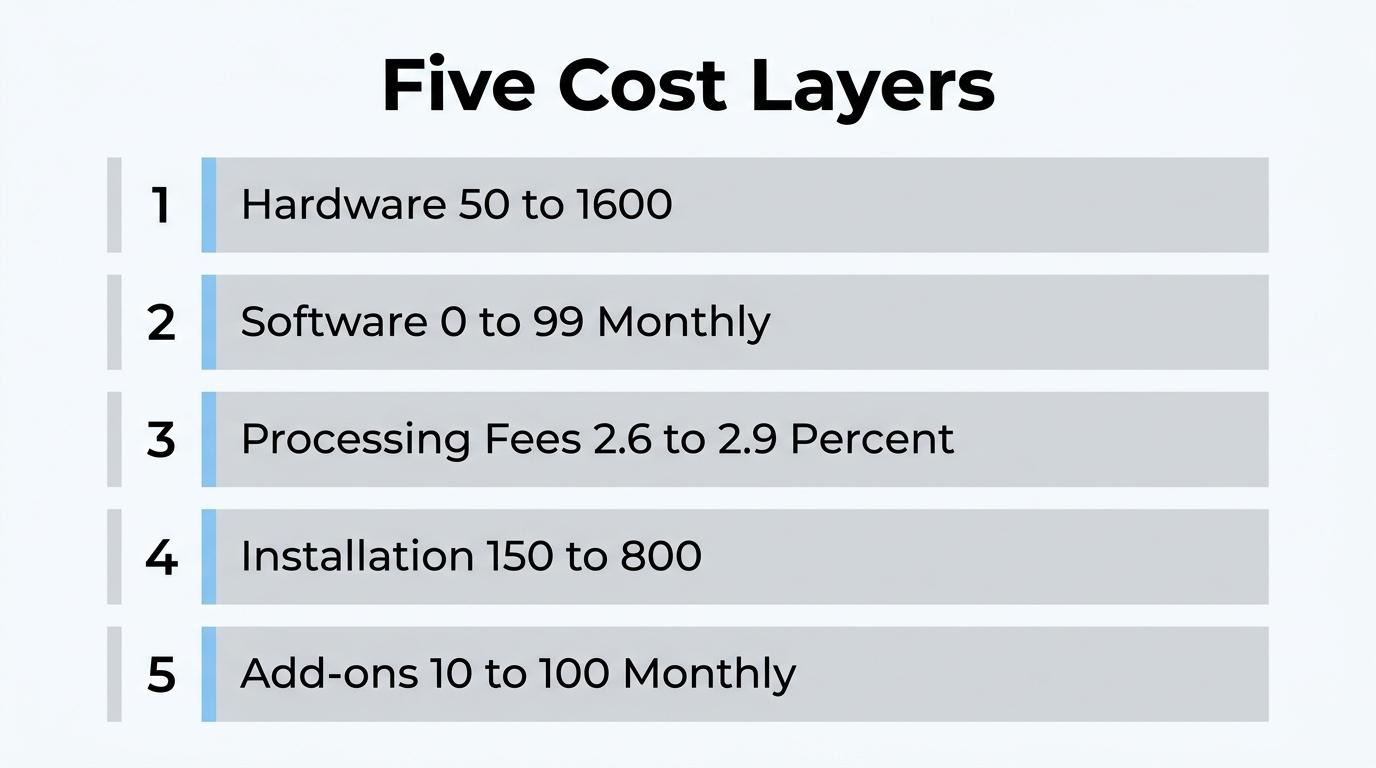
POS hardware costs range from under $50 for basic card readers to over $1,600 for full countertop stations. The specific price depends on device type and vendor tier.
According to GITNUX, Clover hardware costs range from $499 for the Clover Mini to $1,699 for the Clover Station Duo. Square offers entry-level readers at $49, while terminals run $299 and full registers reach $799. Hardware remains a significant upfront barrier for smaller merchants, particularly in high-growth mobile payment markets where digital transaction volume is scaling rapidly but physical infrastructure still requires capital outlay.
For scaling brands running multiple locations, hardware costs multiply quickly. Evaluating whether a vendor locks you into proprietary devices or supports flexible peripherals can save thousands over a three-year period.
POS software subscriptions cost between $0 and $99+ per month depending on feature depth and vendor. Free tiers exist but typically limit functionality, while full-featured plans carry meaningful monthly fees.
According to G2, Revel Systems software subscriptions are priced at $99 per month for a feature-packed POS and business management solution. Mid-tier options from providers like Square and Lightspeed start around $60 to $69 per month per location. Costs scale with:
The subscription tier you choose should match your operational complexity. Overpaying for unused features wastes budget, but underpaying forces workarounds that cost more in staff time.
Payment processing fees cost between 2.6% + 5¢ and 2.9% + 15¢ per transaction for most POS providers in the United States. These fees apply to every sale and represent the largest ongoing operational cost for high-volume merchants.
In-person tap, chip, and swipe transactions typically carry lower rates than online or keyed-in payments. Flat-rate pricing simplifies forecasting but may cost more at scale compared to interchange-plus models. Key variables include:
Cross-border e-commerce adoption in regions like Southeast Asia is also driving proximity payment infrastructure changes as merchants seek to lower per-transaction costs across offline POS environments.
POS installation and setup costs range from $150 to $800, according to Paloma POS. These fees are often omitted from initial vendor quotes, making them one of the most common budget surprises for new buyers.
Setup costs typically cover:
Some cloud-based POS systems reduce installation costs by offering self-guided setup, while enterprise solutions with on-site technicians charge at the higher end. Always request an itemized setup quote before signing any contract.
Add-ons and integrations cost anywhere from $10 to $100+ per month each, depending on the tool and vendor ecosystem. Common paid add-ons include:
These incremental costs compound quickly. A merchant running five paid integrations at $30 to $50 each adds $150 to $250 monthly on top of base software fees. For brands at scale, this fragmentation is precisely what drives operators toward platforms where POS, CRM, and marketing live in one system rather than across a disconnected app stack.
Understanding each cost layer individually prevents sticker shock when calculating total cost of ownership across a multi-year timeline.
POS system costs vary significantly by business type, with retail stores, restaurants, DTC brands, pop-ups, and multi-location operations each facing distinct pricing structures. The sections below break down typical costs for each scenario.
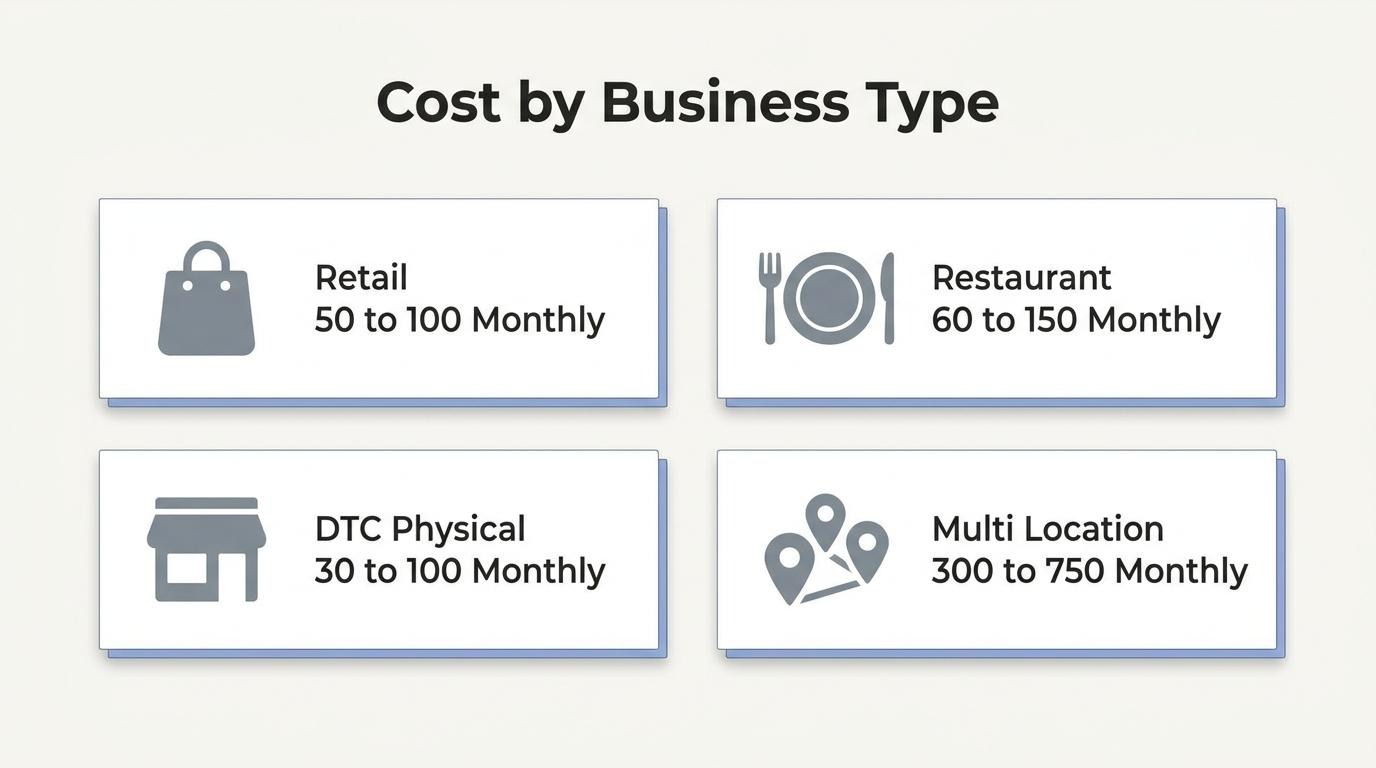
A POS system for a retail store typically costs $50–$100 per month for software, $200–$800 for hardware, plus processing fees of 2.5–2.9% per transaction. Retailers with both online and physical channels face higher total costs when inventory systems operate in silos. According to a 2026 CrediLinq e-commerce trend report, fragmented systems create operational friction that can cost large-scale sellers millions of dollars annually due to lack of real-time inventory visibility.
For mid-market retail brands running omnichannel operations, the real cost driver is not the POS subscription itself; it is the accumulated expense of syncing disconnected tools. Retailers who evaluate POS cost purely on monthly fees often underestimate the operational drag of maintaining separate inventory, CRM, and sales systems.
A POS system for a restaurant typically costs $60–$150 per month for software, $500–$2,000 for kitchen display and terminal hardware, and 2.5–3.5% per transaction in processing fees. Restaurants face unique cost layers including tableside ordering devices, kitchen printer integrations, and tip management modules that add $20–$50 monthly per feature.
Dissatisfaction with current systems is widespread. According to a 2026 LinkedIn restaurant technology report, 44% of restaurant brands are looking to replace their existing POS system with a new provider in 2026. This churn signals that many restaurants find their current cost-to-value ratio unsustainable, often due to rigid contracts and underdelivering feature sets.
A POS system for a DTC brand with physical locations typically costs $30–$100 per month for software, plus $200–$800 in hardware per location, with processing fees around 2.6–2.9% per tap or swipe. The critical cost factor for DTC brands is whether the POS shares a customer data layer with the online storefront.
When POS and e-commerce operate as separate systems, brands pay twice: once for each tool's subscription, and again in lost revenue from fragmented customer profiles. A unified system that resolves online and in-store purchases to one customer record eliminates reconciliation costs and enables lifecycle marketing across channels without additional middleware.
A POS system for a pop-up or event typically costs $0–$30 per month for software (many providers offer free tiers) and $49–$299 for a mobile card reader or portable terminal. Processing fees remain standard at 2.6–2.9% per transaction. Total upfront investment for a basic pop-up setup ranges from $49 to $350.
The key cost consideration here is flexibility. Long-term contracts and annual billing make little sense for temporary retail. Pop-up operators should prioritize month-to-month plans or pay-per-transaction models that avoid early termination fees. Hardware portability also matters; a lightweight mobile reader eliminates the need for counter-mounted equipment that cannot travel between events.
A POS system for a multi-location business typically costs $60–$150 per month per location for software, $500–$2,000 per location in hardware, and adds compliance overhead that single-location businesses often avoid. According to Kiteworks, small businesses can expect to invest between $1,000 and $10,000 annually for PCI DSS compliance to avoid potential breach costs and penalties.
Per-location licensing multiplies quickly. A five-location operation paying $100 per month per site spends $6,000 annually on software subscriptions alone, before hardware, processing fees, or compliance costs. Multi-location brands benefit most from platforms that bundle POS with centralized inventory and customer data, since maintaining separate systems across locations compounds both cost and operational complexity.
With business-type costs defined, pricing model structure determines how those costs are billed and scaled.
POS system costs vary significantly depending on the pricing model a provider uses. The four dominant models are monthly subscriptions, pay-per-transaction plans, one-time licenses, and free tiers with hidden costs.
A monthly subscription POS costs between $60 and $99 per month per location for mid-tier plans in 2026. Square for Retail and Square for Restaurants offer "Plus" plans starting at $60 per month per location, while Revel Systems charges $99 per month for its full-featured POS and business management solution, according to G2. These recurring fees typically cover software updates, cloud hosting, and customer support. For scaling multi-location brands, subscription costs multiply per terminal or location, making it essential to model total annual software spend before committing.
A pay-per-transaction POS costs a percentage of each sale rather than a fixed monthly fee. Square charges 2.6% + 10¢ per in-person transaction on most plans, according to DPL's 2025 pricing guide. This model suits low-volume sellers because there is no baseline subscription expense during slow periods. However, high-volume merchants often find that cumulative transaction fees exceed what a flat monthly subscription would cost. As RevenueML reports, executive leaders are increasingly moving "Pricing Architecture" to the top of their 2026 agendas, replacing all-inclusive models with tiered and outcome-based structures that blend transaction fees with subscription tiers.
A one-time license POS costs a single upfront payment, typically ranging from $500 to $2,000+ depending on feature depth and terminal count. Unlike subscriptions, this model eliminates recurring software fees. The trade-off is significant: merchants bear full responsibility for updates, security patches, server hosting, and long-term maintenance. Annual costs for self-managed infrastructure, including PCI compliance and hardware upkeep, can quietly approach or exceed subscription pricing within two to three years. This model appeals most to businesses with in-house IT resources and predictable, stable operational requirements.
A free POS plan costs nothing in monthly software fees but generates revenue for the provider through elevated payment processing rates, hardware purchases, and paid feature upgrades. Square's free plan, for example, charges 2.6% + 10¢ per tap, dip, or swipe. Merchants also pay for hardware such as the $49 Square Reader or $299 Square Terminal. Add-ons like advanced reporting, loyalty programs, and multi-location management sit behind paid tiers. For brands processing significant volume, the higher per-transaction fees on free plans often surpass what a $60 to $99 monthly subscription would cost with lower processing rates.
With pricing models clarified, understanding hidden fees reveals the true long-term cost.
Hidden costs with a POS system include early termination fees, hardware repairs, PCI compliance charges, staff training, and data migration. Each adds to your total cost of ownership beyond the quoted price.
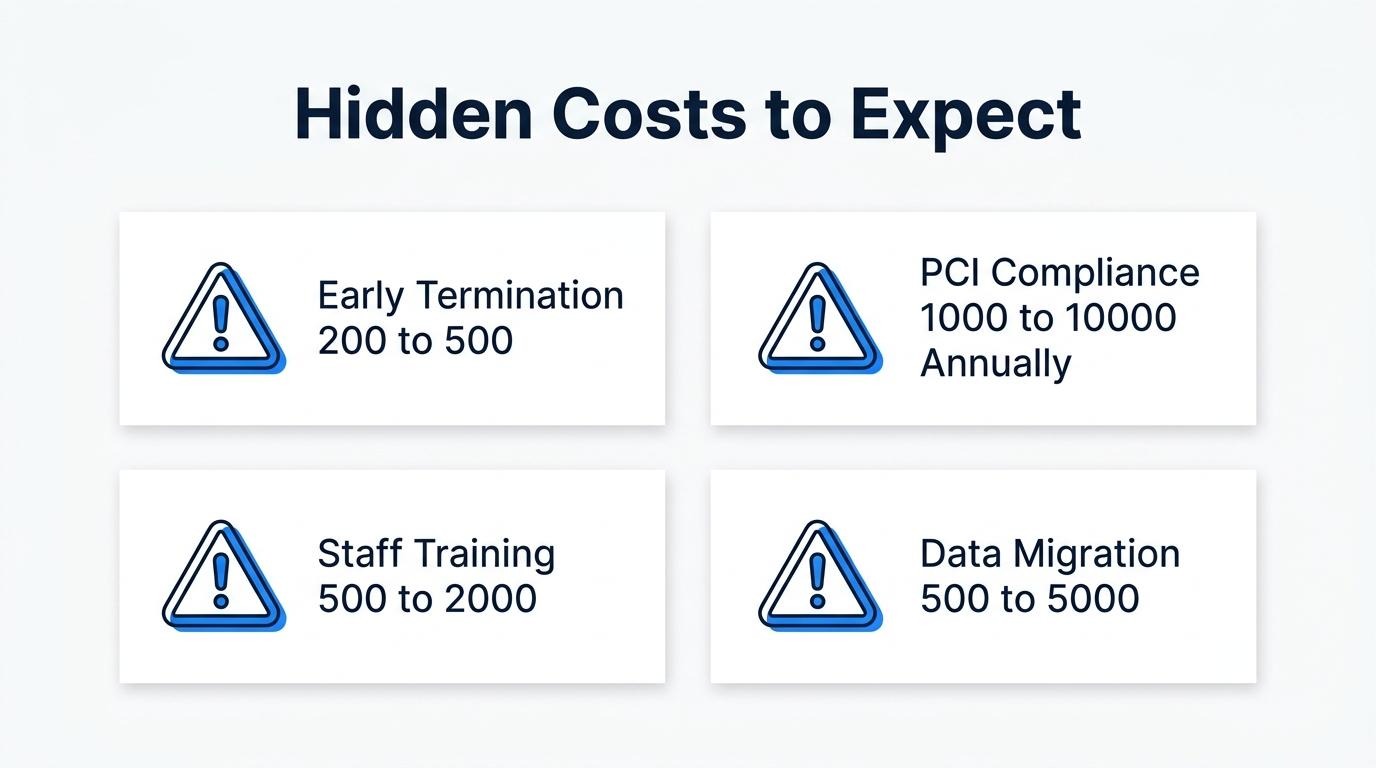
Early termination fees for POS software or processing contracts typically range from $200 to $500. These penalties apply when you cancel before a contract term expires, whether you're leaving a payment processor or switching POS platforms entirely. According to TCANG, this range represents the standard penalty across most providers, though some contracts calculate the fee based on remaining months multiplied by a fixed rate. Always review cancellation clauses before signing. For scaling brands evaluating multiple systems, choosing a month-to-month or annual plan without lock-in eliminates this risk entirely.
POS hardware replacement and repair costs add up quickly once terminals, printers, or card readers move past warranty coverage. Touchscreen terminals typically need replacement every three to five years, and out-of-warranty repairs often cost 30–50% of the original device price. Thermal print heads wear out with high transaction volumes, barcode scanners degrade from daily use, and cable connections loosen over time. Budgeting 10–15% of your initial hardware investment annually for maintenance and eventual replacement keeps these expenses predictable rather than disruptive.
Compliance and PCI fees cost between $1,000 and $10,000 per year for small businesses, depending on transaction volume and environment complexity. Some POS providers also charge a separate PCI compliance program fee of approximately $250 per year per device. According to RedSecLabs, a PCI DSS compliance investment of $60,000 can be weighed against potential penalties and breach costs ranging from $1.2M to $2.5M. These fees cover vulnerability scans, self-assessment questionnaires, and network security standards. Skipping compliance to save money is a false economy; the penalty exposure dwarfs the annual investment.
Staff training costs for a new POS system typically range from $500 to $2,000 per location, depending on system complexity and team size. This includes initial onboarding sessions, workflow configuration walkthroughs, and ongoing refresher training as features update. Cloud-based systems with intuitive interfaces reduce training hours significantly compared to legacy terminals with complex navigation. The real cost extends beyond instructor fees; lost productivity during the learning curve adds indirect expense. Scheduling training during off-peak hours and using vendor-provided video resources helps minimize operational disruption.
Data migration fees cost between $500 and $5,000 depending on the volume of records, number of integrations, and data complexity involved. Moving customer profiles, transaction histories, inventory databases, and loyalty program data from one POS to another requires careful mapping and validation. Some vendors include basic migration in onboarding packages, while others charge hourly rates for custom transfers. Incomplete or corrupted data during migration creates downstream issues with reporting accuracy and customer records. Brands consolidating fragmented systems into a unified platform should factor migration as a one-time cost that pays back through cleaner, centralized data.
With hidden fees mapped, understanding hardware costs by device type helps you build a more accurate total budget.
POS hardware costs vary significantly by device type, ranging from under $50 for basic card readers to $800+ for full countertop registers. The following breakdowns cover each major device category.
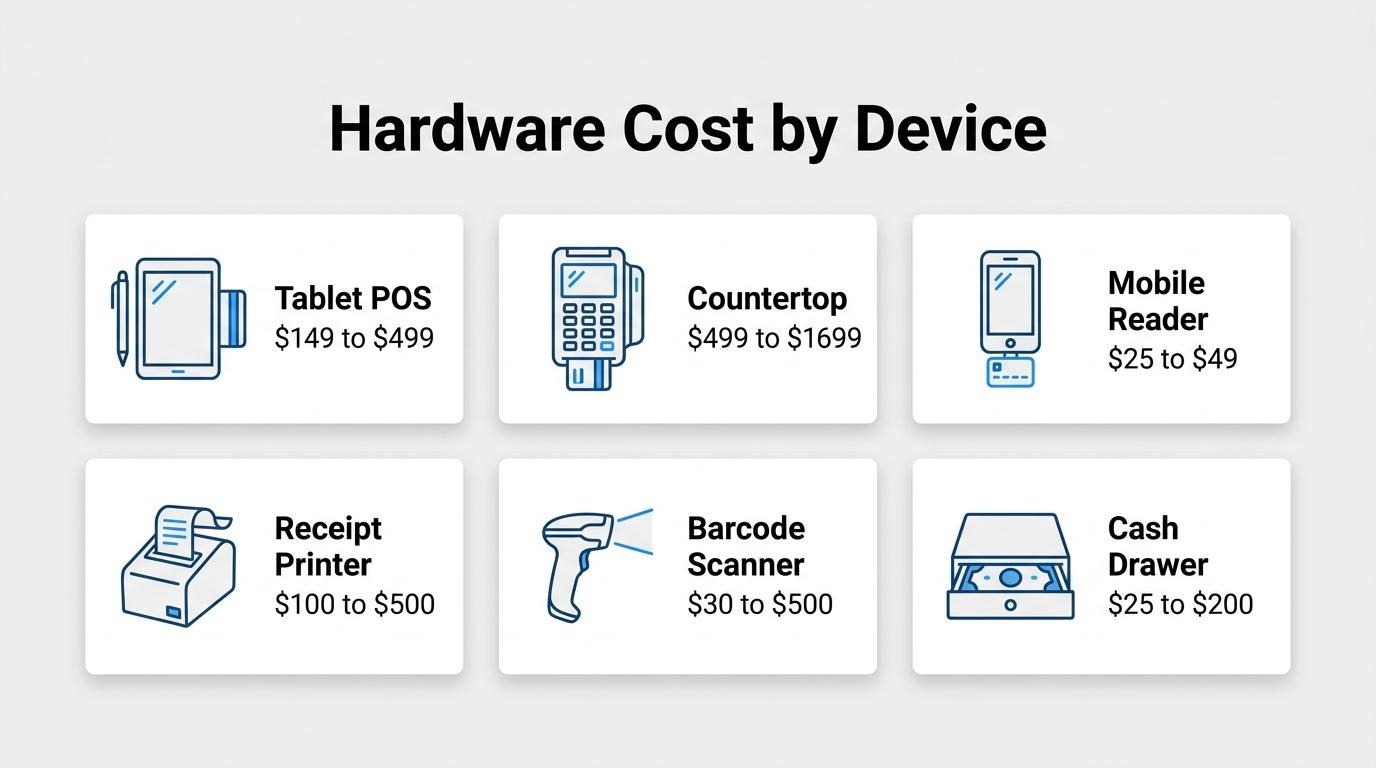
A tablet-based POS terminal costs between $149 and $499 depending on the brand and included accessories. Square's Stand, which pairs an iPad with a built-in card reader, is priced at $149. Shopify's POS Terminal, a purpose-built tablet device accepting tap, chip, and swipe payments, costs $349. These prices typically cover the terminal hardware only; the tablet itself may require a separate purchase. For scaling brands running multiple registers, tablet-based systems offer a lower per-station cost than traditional countertop units while maintaining full POS functionality.
A countertop POS terminal costs between $499 and $1,699 for a complete unit. Square's Register, an all-in-one countertop system with dual screens, is priced at $799. Clover hardware ranges from $499 for the Clover Mini to $1,699 for the Clover Station Duo, which includes a customer-facing display. These fixed units suit high-volume retail and restaurant environments where durability and screen real estate justify the premium. For multi-location operators, countertop terminals represent the largest single hardware line item, making it worth comparing bundled pricing against à la carte purchases.
A mobile card reader costs between $25 and $49 for most entry-level devices. Square's Reader is priced at $49, while Shopify's Tap & Chip Reader also costs $49. According to Expert Market, SumUp offers card readers starting from £25 plus VAT for UK small businesses, illustrating how pricing varies by region. Mobile readers are the most affordable POS hardware category, making them ideal for pop-ups, events, and businesses testing in-person sales before committing to a full terminal setup.
A receipt printer costs between $100 and $500 depending on connectivity and print technology. Thermal receipt printers, the most common type for POS systems, typically fall in the $150 to $350 range. Key price factors include:
Budget-tier USB printers start near $100, while commercial-grade network printers from brands like Epson or Star Micronics reach $400 to $500.
A barcode scanner costs between $30 and $500 depending on scan type and durability. Basic 1D laser scanners for retail start around $30 to $80. Two-dimensional (2D) imagers capable of reading QR codes and mobile screens typically range from $100 to $300. Ruggedized models built for warehouse or high-volume environments can exceed $400. Wireless Bluetooth scanners cost $20 to $50 more than their wired equivalents. For most single-location retailers, a mid-range 2D scanner in the $100 to $200 bracket balances speed, compatibility, and longevity.
A cash drawer costs between $25 and $200 for most POS-compatible models. Standard-duty drawers suitable for low-to-moderate transaction volumes start around $25 to $60. Heavy-duty commercial drawers with steel construction and multiple bill compartments range from $80 to $200. Key considerations include:
Cash drawers remain one of the least expensive POS peripherals, though businesses handling high cash volumes should invest in commercial-grade models to reduce jamming and wear.
With individual device costs mapped out, the next consideration is how processing fees compound on top of this hardware investment.
Payment processing fees vary by provider based on transaction type, pricing model, and volume thresholds. The differences between major POS providers are outlined below.
Provider
In-Person Rate
Online Rate
Fee Structure
Square
2.6% + 10¢
2.9% + 30¢
Flat-rate
Stripe
2.7% + 5¢
2.9% + 30¢
Flat-rate
SumUp
2.75%
2.9% + 15¢
Flat-rate
Toast
Custom
N/A
Tiered/custom
Clover
Custom
Custom
Tiered/custom
According to a 2025 analysis published in the Pakistan Journal of Social Sciences, Stripe Terminal charges a flat rate of 2.7% + 5¢ per in-person transaction, while Square's standard in-person rate sits slightly lower at 2.6% + 10¢. SumUp charges 2.9% + 15¢ for online payment link transactions, making it competitive for low-volume sellers but potentially costlier at scale.
Flat-rate providers like Square and Stripe offer predictability; every transaction costs the same percentage regardless of card type. Custom or tiered providers like Toast and Clover negotiate rates based on monthly volume, which can yield savings for high-transaction businesses but introduces billing complexity.
For scaling brands processing across both online and in-store channels, the gap between providers compounds quickly. A merchant doing $100,000 monthly in card-present sales pays roughly $300 more per month at 2.9% versus 2.6%. That annual difference funds additional tooling or marketing spend. Choosing a provider whose processing fees align with your dominant transaction type (in-person versus online) matters more than chasing the lowest advertised rate.
With processing fees established per provider, the next step is calculating total ownership costs over time.
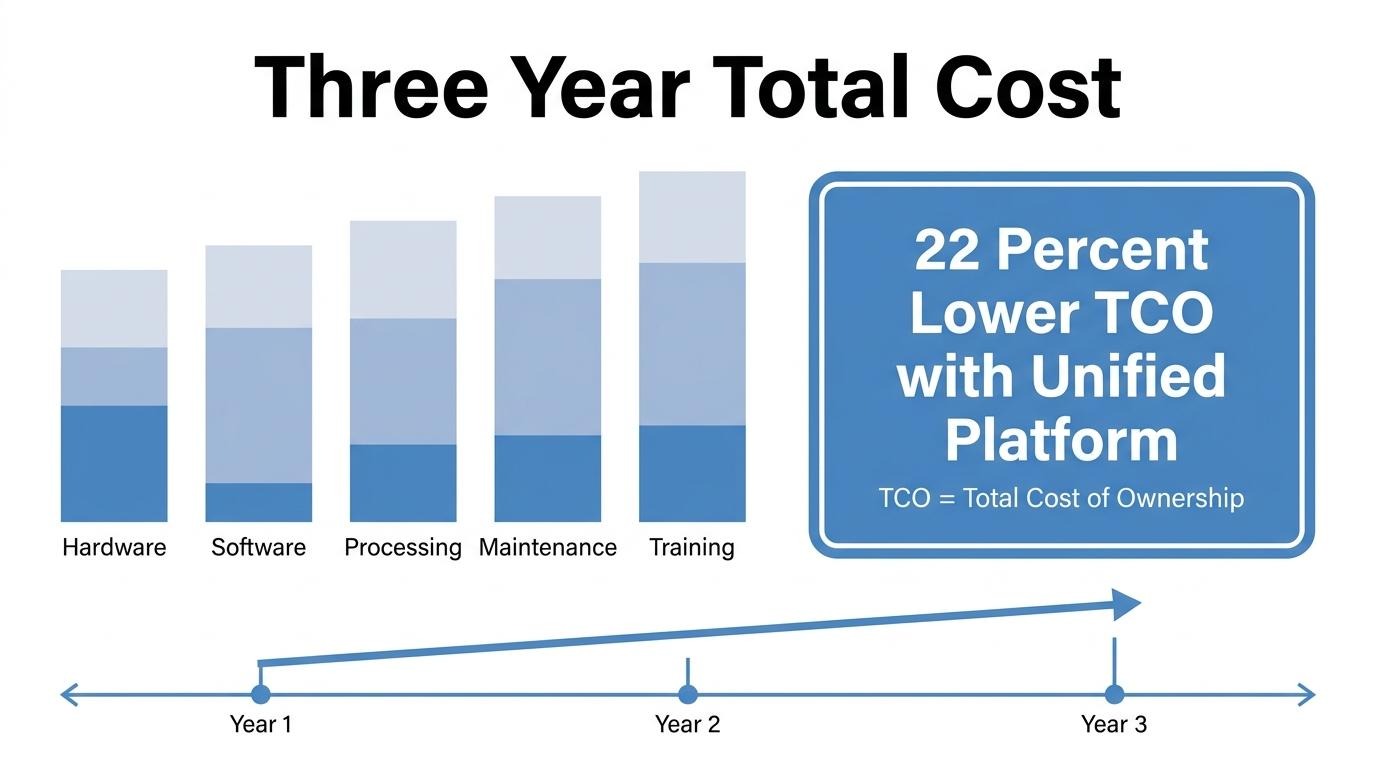
The total cost of ownership for a POS system over three years includes acquisition, annual operating costs, maintenance, training, and potential downtime. These categories compound over time, making the three-year view significantly higher than first-year quotes suggest.
TCO components accumulate across five layers:
According to a Shopify TCO analysis, brands utilizing unified commerce platforms see a 22% improvement in Total Cost of Ownership on average compared to those using fragmented application stacks. This gap widens over three years because fragmented setups accumulate separate subscription fees, integration maintenance, and data reconciliation labor that unified systems avoid entirely.
For scaling brands running multiple tools, the three-year TCO difference between a consolidated platform and an app-stack approach often exceeds the switching cost itself. Factoring in all five cost layers before committing to a system prevents budget overruns that typically emerge in year two.
With total ownership costs mapped, the next step is identifying where to reduce them.
You can reduce your overall POS system costs by consolidating tools, negotiating processing rates, avoiding hidden fees, and choosing platforms that unify commerce operations. The strategies below cover contract tactics, platform consolidation, and volume-based savings.
Consolidating your tech stack lowers POS costs by eliminating redundant subscriptions, reducing integration maintenance, and creating a single data environment. Brands utilizing unified commerce platforms see a 22% improvement in Total Cost of Ownership on average compared to those using fragmented application stacks, according to Shopify's TCO analysis. Fragmented systems force merchants to pay separately for POS, CRM, marketing automation, and inventory sync. Each tool adds its own monthly fee, requires developer time for integrations, and creates data reconciliation overhead. Replacing five or more tools with one platform that handles commerce, POS, and customer data natively removes those compounding costs. For brands processing meaningful volume across online and offline channels, consolidation is typically the single highest-impact cost reduction available.
Negotiating payment processing rates saves money by reducing the per-transaction percentage or flat fee applied to every sale. Most providers publish standard rates, but merchants processing higher volumes can request custom pricing. Strategies that work:
Small differences in processing fees accumulate quickly. A merchant processing $500,000 annually saves $1,000 for every 0.2% rate reduction negotiated.
You can avoid hidden fees in POS contracts by auditing the full agreement before signing, asking about second-year cost changes, and confirming cancellation terms. Common fees that surprise merchants include:
Request a complete fee schedule that covers year one and year two. Ask explicitly whether rates, compliance charges, or platform fees change after the introductory period.
Choosing annual billing reduces POS expenses by locking in a lower effective monthly rate compared to month-to-month plans. Most POS providers offer 10% to 25% discounts when merchants commit to annual contracts. This trade-off works best for established businesses with predictable needs, where the risk of switching mid-year is low. Before committing, confirm that the annual plan does not include early termination penalties if business needs change. Pairing annual billing with a unified platform that covers multiple functions compounds savings further, since you lock in one discounted rate rather than paying monthly premiums across several separate tools.
With cost reduction strategies in place, budgeting for a POS switch becomes more predictable.
You should budget for data migration, early termination fees, new hardware, staff retraining, and potential downtime costs when switching POS systems. The following areas cover the most commonly underestimated expenses.
Migration and downtime costs together typically range from $500 to $2,000 or more for small to mid-size businesses. Data migration involves transferring product catalogs, customer records, transaction histories, and loyalty data to the new system. Downtime during the cutover period means lost sales, especially for high-volume retailers.
According to a 2026 study published in the Journal of Computer Science and Technology Studies, some merchants report implementation costs for new systems being 72.6% higher than initial estimates. Planning a phased rollout, running parallel systems briefly, and scheduling the switch during low-traffic periods all reduce this budget impact.
You should set aside $200 to $500 for contract exit fees when leaving your current POS provider. Early termination fees for POS software or processing contracts typically fall within this range, according to TCANG's analysis of average POS system costs.
Some providers also charge equipment lease buyout penalties or require you to return hardware in specific condition. Before switching, review your existing contract's termination clause, notice period requirements, and any remaining hardware lease obligations. Factoring these costs early prevents budget surprises that delay the transition.
Retraining staff on a new POS system costs between $500 and $5,000, depending on team size, system complexity, and training method. Costs include lost productivity during the learning curve, formal training sessions, and potential temporary staffing during the transition.
Cloud-based systems with intuitive interfaces generally require less training time than legacy terminals. For multi-location businesses, costs scale with headcount; a 20-person retail team may need two to three full training days. Budgeting for ongoing refresher training after launch helps prevent costly operational errors during peak sales periods.
With switching costs mapped, the next step is understanding what consolidation eliminates entirely.
Consolidating POS, CRM, and marketing into one platform eliminates the sync issues and redundant costs that fragmented app stacks create. The sections below cover how SHOPLINE approaches this consolidation and the key cost takeaways for 2026.
SHOPLINE handles POS costs without requiring a separate app stack by building point-of-sale, CRM, and marketing automation into a single system with a shared customer data layer. Online and offline transactions resolve to one customer record, removing the need to pay for standalone loyalty apps, email platforms, or customer data tools on top of your POS subscription.
SHOPLINE POS Lite is available for $390 per year for merchants on the Starter, Essential, or Premium plans. This pricing bundles inventory sync, customer profiles, and in-store checkout into the same platform that runs the storefront. For brands operating at scale, this consolidation means fewer vendor contracts, one less data reconciliation step, and a simpler compliance surface since customer payment data lives in fewer systems.
The key takeaways about POS system costs in 2026 are that total expenses frequently exceed initial estimates, pricing models are shifting toward tiered and outcome-based structures, and unified platforms offer measurable TCO advantages over fragmented stacks.
Core lessons from this playbook:
For scaling DTC brands, the most expensive POS decision in 2026 is not overpaying on any single line item; it is locking into a fragmented system that compounds costs at every new location, channel, or campaign.
.png)
.png)
.png)

