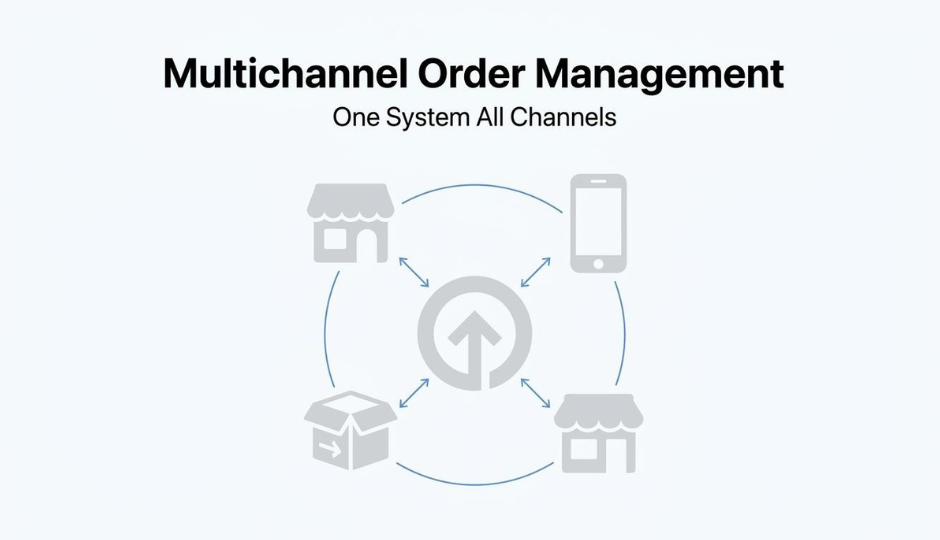
Multichannel order management is the process of managing and fulfilling orders across multiple sales channels by centralizing inventory and order data into a single platform. These channels span online stores, marketplaces like Amazon and eBay, social commerce platforms, and physical retail locations.
This guide covers how multichannel order management works technically, why scaling DTC brands need it, the core features and supported channels of an OMS, the operational problems it solves, and how to choose and measure the right solution.
Real-time inventory sync, automated order routing, and centralized dashboards form the technical foundation. Webhooks, event buses, and reservation logic update stock levels the moment a purchase occurs, while routing engines assign each order to the optimal fulfillment node based on proximity, availability, and cost.
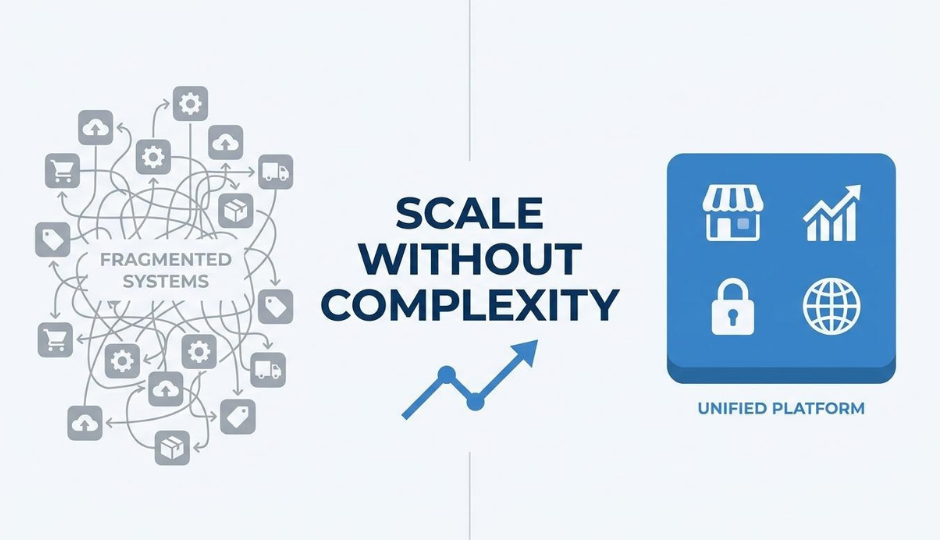
Growing brands face compounding complexity as each new channel introduces its own order formats, tax rules, and fulfillment SLAs. Fragmented data across disconnected systems leads to overselling, incorrect shipments, and manual bottlenecks that worsen during peak periods.
A complete OMS unifies order dashboards, inventory management, multi-warehouse logic, channel-specific pricing, and automated customer communications into one operational layer. It must connect DTC storefronts, marketplaces, social commerce, POS, and wholesale portals with bidirectional data flow.
Centralized systems eliminate overselling through reservation logic, reduce split shipments via intelligent routing, consolidate customer records into single profiles, and remove manual data entry that compounds errors at scale.
Selecting the right solution requires evaluating integration depth, real-time inventory visibility, native analytics, and whether a standalone OMS or built-in platform fits your stack. Tracking order accuracy rate, fulfillment speed by channel, and inventory turnover validates performance against benchmarks.
Multichannel order management is the process of managing and fulfilling orders across multiple sales channels by centralizing inventory and order data into a single platform. These channels include online stores, marketplaces such as Amazon and eBay, social commerce platforms, and physical retail locations.
Rather than operating each channel as a separate silo with its own inventory counts and order workflows, a multichannel order management system unifies this data. According to Kibo Commerce, the approach works by consolidating order capture, payment verification, and fulfillment coordination into one centralized process regardless of where the customer originally placed the order.
The distinction matters because channel proliferation creates compounding complexity. Each new sales channel introduces its own order formats, tax rules, and fulfillment expectations. Without centralization, brands end up reconciling data manually between disconnected systems. For scaling DTC operations already selling across a branded website, Amazon, and social storefronts, this fragmentation becomes the primary bottleneck to operational efficiency and accurate inventory visibility.
Multichannel order management works by capturing orders from every sales channel, routing them to optimal fulfillment locations, syncing inventory in real time, and processing returns through a centralized system.
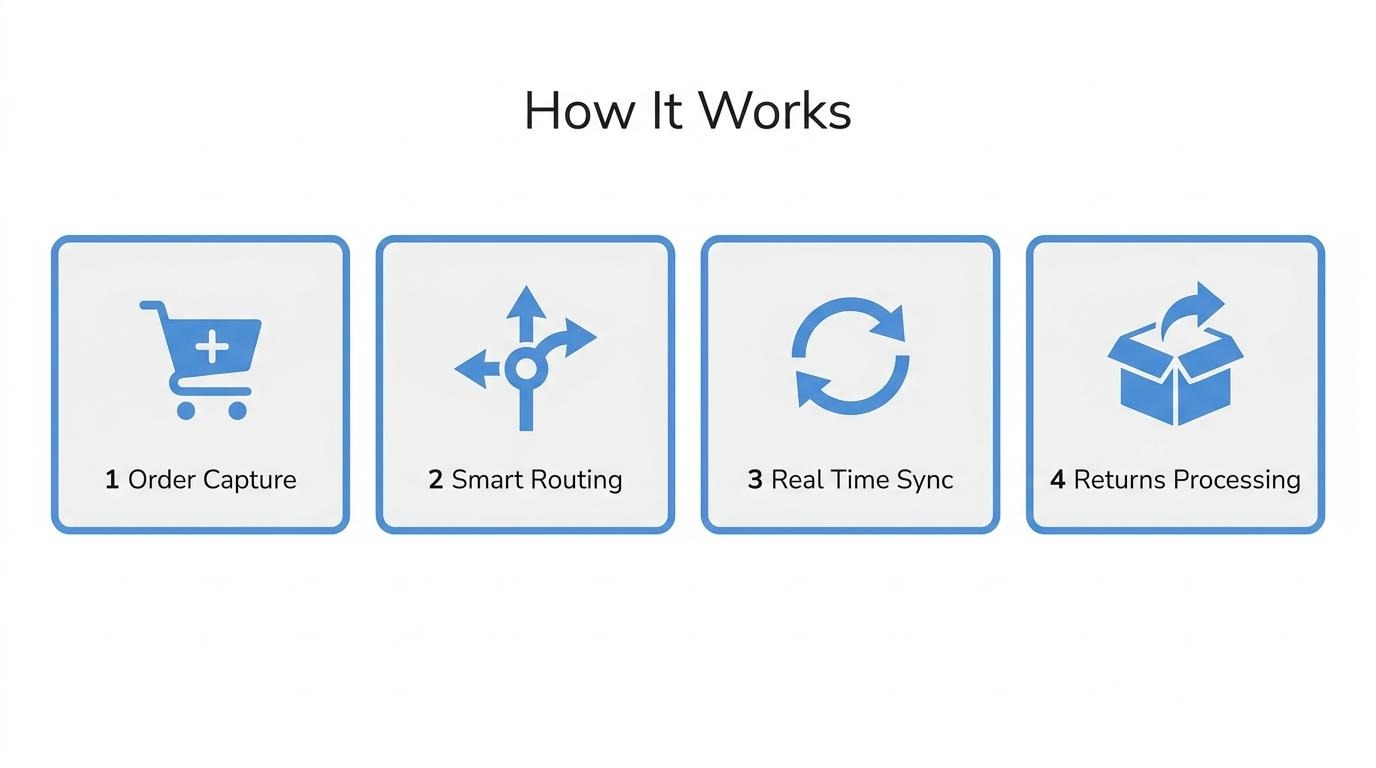
Orders are captured across multiple sales channels by centralizing inventory and order data into a single platform that connects online stores, marketplaces, and physical locations. Unified order management systems enable brands to manage all orders from a single codebase, connecting formerly siloed sales channels into one operational view.
This centralization matters because high-scale data flows across multiple channels demand architectural strategies that maintain competitiveness in a real-time marketplace. Without that unified capture layer, each channel operates independently, creating data fragmentation. According to Avalara, businesses selling through multiple channels generate 190% more revenue than single-channel sellers, but face increased complexity in managing sales tax nexus across different jurisdictions. For brands at scale, consolidating order capture into one system is the foundation everything else depends on.
Centralized order routing assigns fulfillment locations by evaluating predefined business rules, such as proximity to the customer, warehouse stock levels, and shipping cost, then directing each order to the optimal node. The goal is speed: order fulfillment speed is measured as total time from order receipt to shipping, with elite providers aiming for a 24 to 48-hour turnaround, according to ShipBob.
Routing logic becomes especially critical for cross-border orders. Shipping strategy and customs compliance requirements continue to evolve in 2026, meaning the routing engine must factor in international regulations alongside domestic efficiency. Brands that rely on static fulfillment rules rather than dynamic routing consistently underperform on delivery timelines.
Real-time inventory sync prevents overselling by updating stock levels across all shop and marketplace channels simultaneously the moment a purchase occurs. According to Xictron, this synchronization utilizes webhooks, event buses, and reservation logic to ensure no two customers can purchase the last unit of the same SKU on different channels.
Reservation logic is the key mechanism here. When a customer adds an item to cart or initiates checkout, the system temporarily reserves that unit, preventing competing transactions from claiming the same stock. Without this event-driven architecture, latency between channel updates creates windows where overselling becomes inevitable, particularly during flash sales or peak traffic periods.
Returns and exchanges are handled across channels by routing each return request through the same centralized system that managed the original order, regardless of where the purchase occurred. This means a customer who bought on a marketplace can initiate a return through the brand's website, or vice versa, with inventory automatically restocked to the appropriate location.
The system tracks the original order's channel, payment method, and fulfillment source to determine the correct return path. Effective cross-channel returns processing requires real-time inventory updates so that returned units become available for resale immediately, reducing dead stock and improving turnover rates.
With order capture, routing, inventory sync, and returns unified under one workflow, the next consideration is why scaling DTC brands specifically need this infrastructure.
Growing DTC brands need multichannel order management because expanding sales channels multiplies operational complexity, fragments data, and overwhelms manual processes. The subsections below cover why multiple channels create complexity, how fragmented data causes fulfillment errors, and why manual processing limits scaling.
Selling on multiple channels creates operational complexity because each platform introduces its own order formats, fulfillment rules, inventory pools, and tax requirements. A brand listing products on its own storefront, Amazon, TikTok Shop, and a wholesale portal must reconcile different data structures, shipping expectations, and return policies simultaneously. According to Fortune Business Insights, the global multichannel order management market was valued at USD 4.18 billion in 2025 and is projected to reach USD 11.34 billion by 2034 at a 12.2% CAGR, reflecting how rapidly this operational burden is growing. Without a centralized system, each new channel compounds the coordination challenge rather than simply adding revenue.
Fragmented data leads to fulfillment errors because disconnected systems create conflicting stock counts, mismatched order details, and delayed updates between channels. When inventory records in one platform do not reflect sales from another, overselling and incorrect shipments follow. According to Inymbus, manually handling fulfillment deductions costs between $30 and $50 per claim, while automated systems reduce that cost to less than $5 per claim. Scattered data also means customer addresses, SKU mappings, and pricing can drift out of sync silently, compounding the error rate as order volume grows.
Manual order processing limits scaling because human throughput cannot keep pace with exponential order growth across channels. Staff copying data between dashboards, manually updating spreadsheets, and individually routing orders introduce bottlenecks that worsen during peak periods. Key limitations include:
For brands approaching the $1M to $10M revenue range, these constraints often signal the need for a unified system where orders, inventory, and customer data consolidate automatically rather than through an expanding app stack.
The core features of a multichannel order management system include a unified order dashboard, centralized inventory management, automated order routing, multi-warehouse fulfillment logic, channel-specific pricing and tax rules, and customer communication automation.
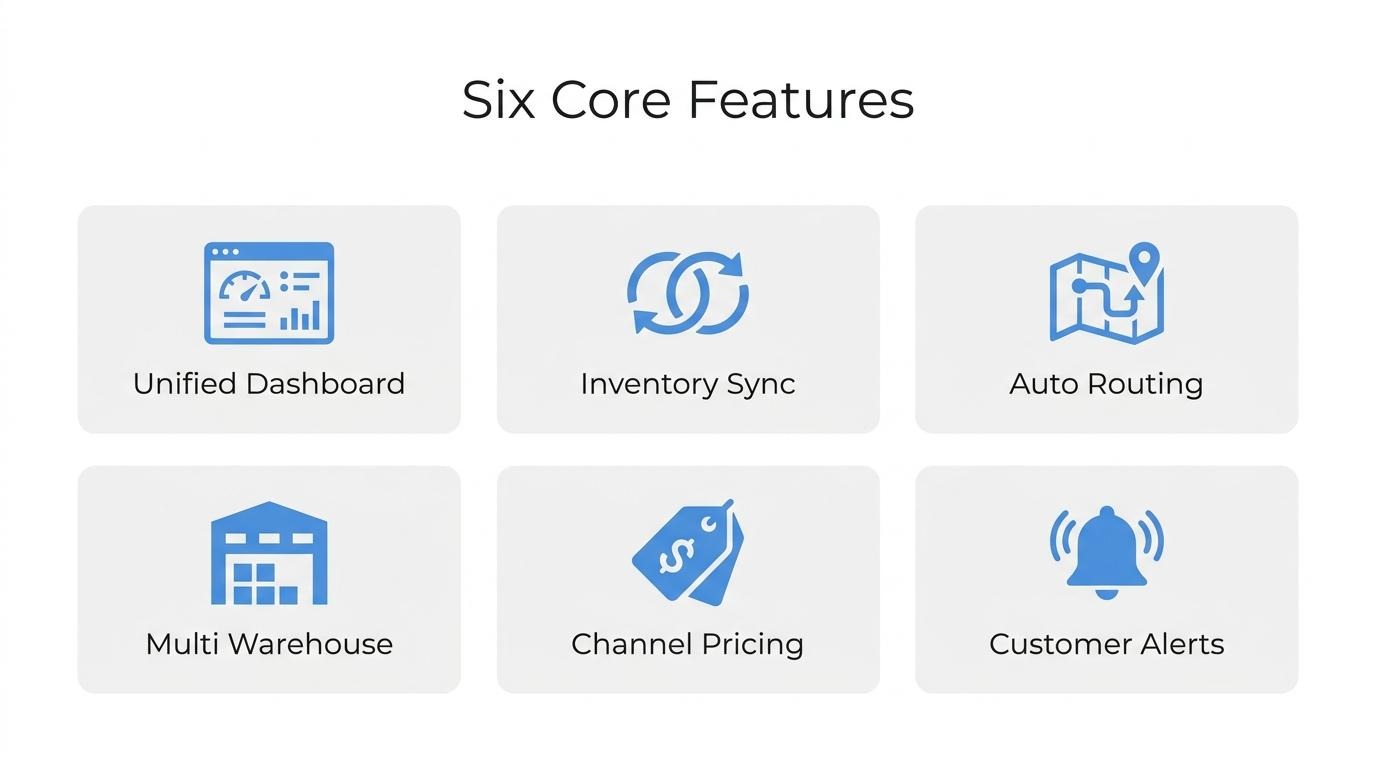
A unified order dashboard consolidates orders from every sales channel into a single interface. Rather than toggling between marketplace portals, storefront backends, and POS terminals, operators view all incoming orders in one place. This eliminates the fragmentation that, according to a 2023 Netguru analysis, causes approximately 46% of businesses to face operational disruptions because their order management systems are scattered and lack integration. A single dashboard also accelerates exception handling; flagged orders, partial payments, and address mismatches surface immediately instead of hiding in channel-specific queues.
Centralized inventory management synchronizes stock levels across all channels in real time. According to a PubMed Central study, modern OMS solutions provide centralized inventory management that allows for real-time records across participating institutions, promoting transparency and stock sharing. This means a unit sold on Amazon instantly reduces available quantity on the DTC storefront and in-store POS. Without centralization, brands risk overselling during peak periods or tying up capital in safety stock buffers that mask poor visibility.
Automated order routing assigns each incoming order to the optimal fulfillment node based on predefined business rules. The system evaluates factors such as proximity to the shipping address, warehouse stock availability, carrier cost, and delivery speed commitments. This removes manual decision-making from the fulfillment workflow. For brands processing hundreds of daily orders across channels, automated routing is what separates same-day dispatch from a backlog of unrouted tickets waiting on human judgment.
Multi-warehouse fulfillment logic enables an OMS to split, merge, or redirect orders across multiple distribution points. When a single warehouse cannot fulfill a complete order, the system determines whether to split-ship from two locations or wait for a transfer. Joint ERP systems facilitate this cross-channel inventory management, article tracking, and customer communication, which Emerald Insight research identifies as essential for transitioning from multichannel to omnichannel retail logistics.
Channel-specific pricing and tax rules allow brands to maintain distinct pricing structures per marketplace or storefront. Each channel may require:
This granularity prevents margin erosion from flat pricing applied uniformly across channels with different cost structures.
Customer communication automation triggers order-related messages without manual intervention. Confirmation emails, shipping notifications, delivery updates, and return instructions send automatically based on order status changes. This consistency matters across channels; a customer purchasing through Instagram checkout expects the same post-purchase communication quality as someone buying on the DTC site. Automated communication reduces support tickets, builds trust, and keeps buyers informed throughout the fulfillment cycle.
With core features established, the next consideration is which specific sales channels an OMS should connect.
A multichannel OMS should support DTC websites, marketplaces, social commerce platforms, in-store POS, and wholesale/B2B channels. Each channel type requires distinct order handling logic.
DTC website orders are managed by routing them directly from the brand's owned storefront into a centralized order management system. The OMS captures payment verification, applies shipping rules, and assigns fulfillment locations based on inventory proximity. Because DTC orders carry no marketplace fees or third-party commission structures, they offer brands the highest margin per transaction. The system must handle channel-specific promotions, subscription renewals, and bundled products without manual intervention. For scaling brands running high volume, a platform where the storefront and order management share the same backend eliminates sync delays that fragment the customer experience.
Marketplace orders from Amazon and eBay are managed through API integrations that pull order data into the central OMS in real time. Each marketplace enforces its own fulfillment SLAs, return policies, and seller performance metrics, so the OMS must map channel-specific rules to internal workflows. According to Cin7, integration gaps between inventory systems and Amazon FBA lead to significant overselling incidents during peak sales periods. The system should reconcile marketplace fees, handle FBA versus merchant-fulfilled routing decisions, and sync tracking numbers back to the marketplace automatically. Without this bidirectional data flow, inventory accuracy degrades rapidly across channels.
Social commerce orders from Instagram and TikTok are managed by connecting native shopping features on each platform to the OMS through dedicated integrations. These channels generate impulse purchases with shorter consideration cycles, requiring fast fulfillment turnaround. The OMS must ingest orders placed through in-app checkout, attribute them to the correct marketing campaign, and apply platform-specific tax and shipping logic. Given that U.S. mobile shoppers spent $564 billion in 2024 according to Omnisend, social commerce represents a growing share of order volume that demands the same inventory visibility as any other channel.
In-store POS orders are managed alongside online orders by unifying both into a single inventory and customer data layer. The OMS must decrement stock in real time regardless of whether a sale occurs at a register or on the website. This prevents scenarios where an item sold in-store remains listed as available online. Ship-from-store, buy-online-pick-up-in-store, and endless aisle capabilities all depend on the POS feeding transaction data into the same system that governs digital fulfillment. Brands operating physical retail without this unification routinely encounter inventory discrepancies that erode customer trust.
Wholesale and B2B orders are managed through workflows that accommodate bulk quantities, negotiated pricing tiers, net payment terms, and custom catalogs. Unlike DTC transactions, B2B orders often require approval chains, purchase order matching, and volume-based discount logic. Gartner projected that online marketplaces would account for 75% of B2B procurement spending, making OMS support for these workflows essential rather than optional. The system must segregate B2B inventory allocations from retail stock, generate invoices against payment terms, and handle reorder automation for recurring accounts.
With channel-specific workflows defined, the next step is understanding the problems this infrastructure solves.
Multichannel order management solves overselling, shipping delays, fragmented customer records, and manual data entry errors. The following subsections break down each problem and how centralized systems address it.
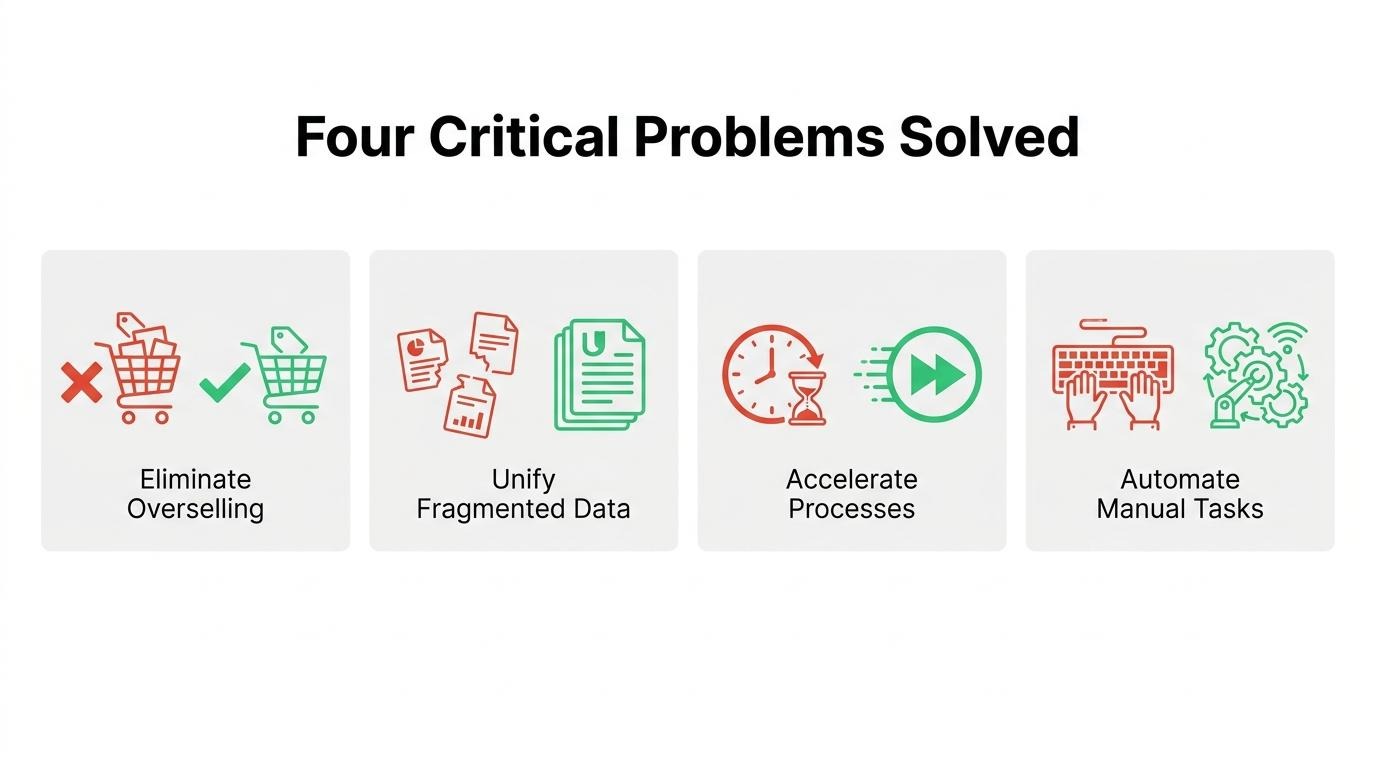
It eliminates overselling across channels by synchronizing inventory in real time so that a sale on one platform instantly reduces available stock everywhere else. Without this synchronization, a product listed on both a DTC store and Amazon can sell simultaneously when only one unit remains, forcing cancellations and damaging customer trust.
Integration gaps between inventory systems and marketplace fulfillment services are a common trigger. When stock counts update on a delay, even a few minutes of lag during a flash sale can create dozens of phantom orders. Centralized reservation logic holds units the moment a checkout begins, releasing them only if the transaction fails. For brands selling at volume across five or more channels, this automated safeguard is the only reliable way to prevent revenue loss from cancelled orders and negative marketplace reviews.
It reduces shipping delays and split shipments by routing each order to the fulfillment location closest to the customer that holds all required items in stock. Intelligent routing logic evaluates warehouse proximity, carrier rates, and item availability before assigning a fulfillment path.
Without centralized routing, a two-item order might ship from two separate warehouses, doubling shipping costs and extending delivery windows. Predefined business rules can prioritize single-shipment fulfillment by identifying locations with complete inventory for that order. When no single location holds every SKU, the system weighs whether splitting or transferring stock is faster and cheaper. This decision happens in seconds rather than requiring a fulfillment team member to check spreadsheets manually.
It unifies customer order history by consolidating purchases from every channel into a single record tied to one customer profile. A shopper who buys through Instagram, places a reorder on the website, and picks up in-store appears as one customer rather than three separate entries.
This unified view enables support teams to resolve issues faster because they see full context without toggling between platforms. It also feeds marketing automation with accurate purchase frequency, average order value, and product preferences per customer. Fragmented records, by contrast, lead to redundant outreach, incorrect loyalty tier placement, and missed cross-sell opportunities. For brands operating at scale, a shared customer data layer is what turns transactional interactions into relationship-driven retention.
It decreases manual data entry and human error by automating the transfer of order, inventory, and pricing data between systems. According to research from Liberty University, manual inventory operations often result in incorrect pricing across different inventory classes and financial impacts from record errors.
Every manual touchpoint introduces risk:
Automation removes these touchpoints entirely. Orders flow from checkout to fulfillment without human re-entry, and inventory adjustments propagate across all connected channels instantly. The compounding effect matters most at scale; a 1% error rate across 500 daily orders means five problems to resolve every day, each consuming staff time and eroding customer confidence.
With fulfillment automation handling data flow, brands can redirect operational bandwidth toward growth initiatives instead of error correction.
You choose the right multichannel order management solution by evaluating integration depth, inventory visibility, analytics capabilities, and architectural fit. The following subsections cover each criterion.
The integration capabilities you should evaluate include native connectors to your active sales channels, payment gateways, shipping carriers, and ERP or accounting systems. Pre-built integrations reduce development time, while API access determines how well the OMS adapts as your channel mix evolves. Prioritize platforms offering bidirectional data sync rather than one-way imports, since real-time communication between systems prevents order lag and stock discrepancies during peak volume. Webhook support and event-driven architecture signal a modern integration layer capable of handling concurrent updates across channels without manual intervention.
The non-negotiable inventory visibility features are real-time stock counts across all locations, safety stock thresholds, and intelligent fulfillment routing. According to Active Cloud Solutions, essential OMS features include the ability to determine the best fulfillment path based on global inventory availability and predefined business rules. Without location-level visibility, split shipments increase and delivery promises become unreliable.
Key non-negotiable capabilities include:
Native analytics and reporting is critical because it eliminates the delay between operational events and decision-making. When reporting lives inside the OMS, teams can monitor fulfillment speed, order accuracy, and channel-level margins without exporting data to external BI tools. Embedded dashboards surface anomalies faster; if one channel's return rate spikes or a warehouse's processing time drifts, operators see it immediately. For brands managing holiday volume spikes, this immediacy often determines whether corrective action happens in hours or days.
A standalone OMS makes sense when your existing tech stack is deeply customized and a full migration is impractical. Brands running proprietary ERP systems or highly specialized warehouse software often need a dedicated OMS that plugs into those systems without replacing them. According to Mordor Intelligence, 67.6% of the multichannel order management market is shifting toward cloud-based solutions to accommodate scaling pressures and holiday volume spikes, which favors platforms that consolidate rather than add complexity. For brands already managing five or more disconnected tools, a built-in platform that unifies orders, inventory, and customer data inside one system reduces ongoing maintenance burden considerably.
With selection criteria established, tracking the right KPIs validates whether your chosen solution delivers measurable results.
The KPIs you should track for multichannel order management include order accuracy rate, average fulfillment speed by channel, and inventory turnover across locations. These metrics reveal operational health and capital efficiency.
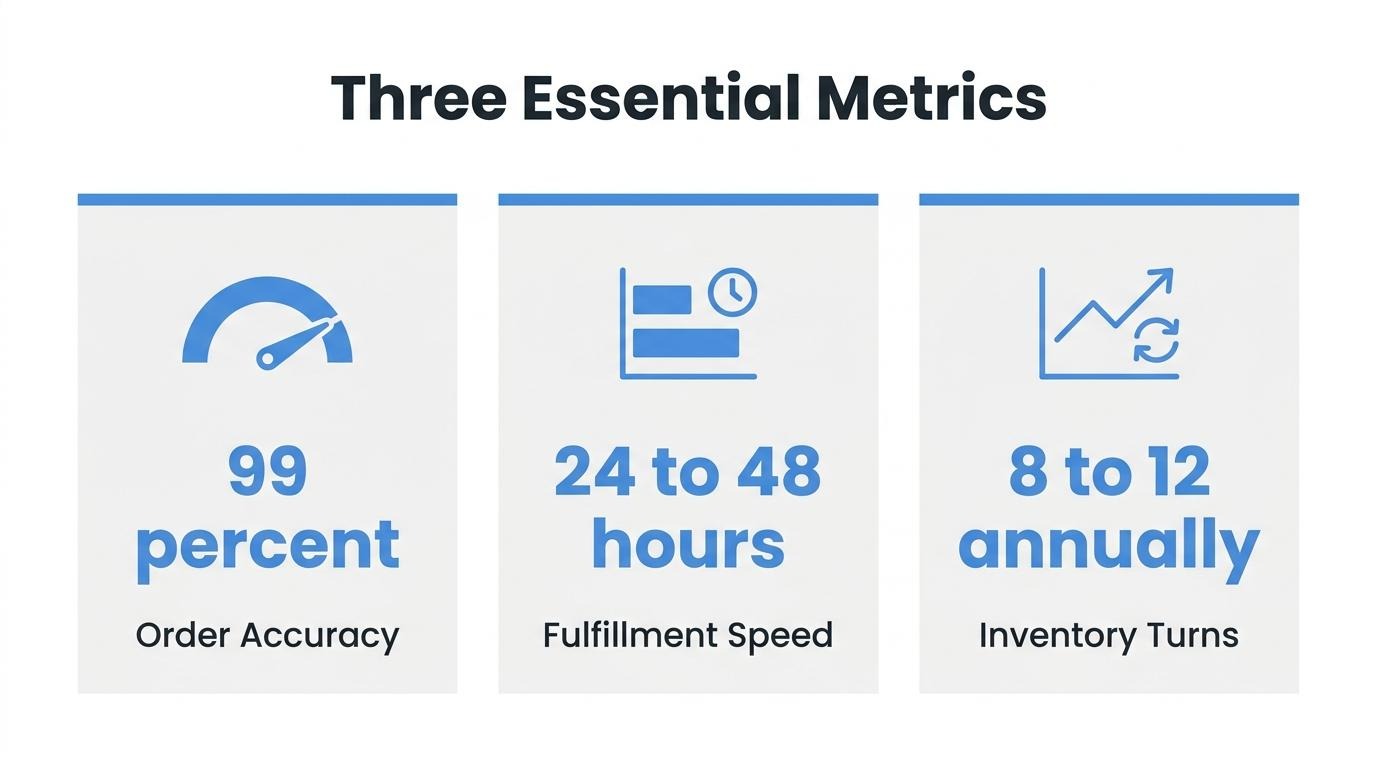
You measure order accuracy rate by dividing the number of error-free orders by total orders shipped, then multiplying by 100. The industry benchmark sits at 99% or higher. According to Fulfyld, even a single fulfillment error can cause 1 in 5 customers to stop ordering from a brand, making this metric a direct indicator of customer retention risk.
Tracking accuracy by channel rather than in aggregate exposes where specific breakdowns occur, whether in picking, packing, or channel-specific labeling requirements.
You track average fulfillment speed by channel by measuring the elapsed time from order receipt to carrier handoff, segmented per sales channel. Each channel carries different customer expectations; marketplace buyers often expect faster turnarounds than DTC website shoppers due to platform-level delivery promises.
Key steps for channel-level tracking:
Consistent channel-by-channel visibility prevents slower workflows on one platform from dragging down overall delivery performance.
You monitor inventory turnover across locations by calculating cost of goods sold (COGS) divided by average inventory value at each warehouse or fulfillment node. According to OmneeLab, typical benchmarks range from 8 to 12 turns annually, with higher ratios indicating stronger capital efficiency and lower carrying costs.
Location-level segmentation matters because a single blended turnover number hides imbalances. One warehouse may turn inventory 10 times while another sits at 4, signaling misallocated stock that ties up working capital.
With KPI baselines established, the next step is connecting order data to customer insights and marketing workflows.
Order management changes from a logistics function into a customer intelligence engine when it shares a platform with CRM and marketing. Below, we cover how SHOPLINE handles this natively and summarize the key takeaways from this guide.
SHOPLINE unifies orders, customer data, and fulfillment natively — running commerce, CRM, marketing automation, subscriptions, and POS inside a single system with a shared customer data layer. Every transaction, whether from a DTC storefront, social channel, or physical retail location, resolves to one customer record rather than requiring reconciliation across separate tools.
This architecture reduces the sync gaps that typically emerge between a standalone OMS, a separate email platform, and a third-party CDP. Purchase history, browsing behavior, and fulfillment status feed the same lifecycle marketing engine that triggers post-purchase flows. For brands operating at $1M to $50M+ in annual revenue, consolidating these functions reduces both app-stack costs and the manual ops burden that fragments execution speed.
The key takeaways about multichannel order management are:
According to a Gartner prediction, 75% of B2B procurement spending would occur via online marketplaces by 2023, reinforcing why robust multichannel management strategies are no longer optional for scaling brands. The shift toward customer-centric, omnichannel operations means order management must integrate with CRM and marketing to deliver seamless experiences across digital and physical channels without friction.