A merchant account is a specialized bank account that allows a business to accept credit and debit card payments, serving as the temporary holding point where approved transaction funds sit before transferring to the merchant's primary bank account.
This guide covers the card payment lifecycle and transaction parties, merchant account types and fee structures, the application and underwriting process, how merchant accounts compare to payment service providers, provider selection and risk management, online versus in-store processing differences, and unified commerce integration.
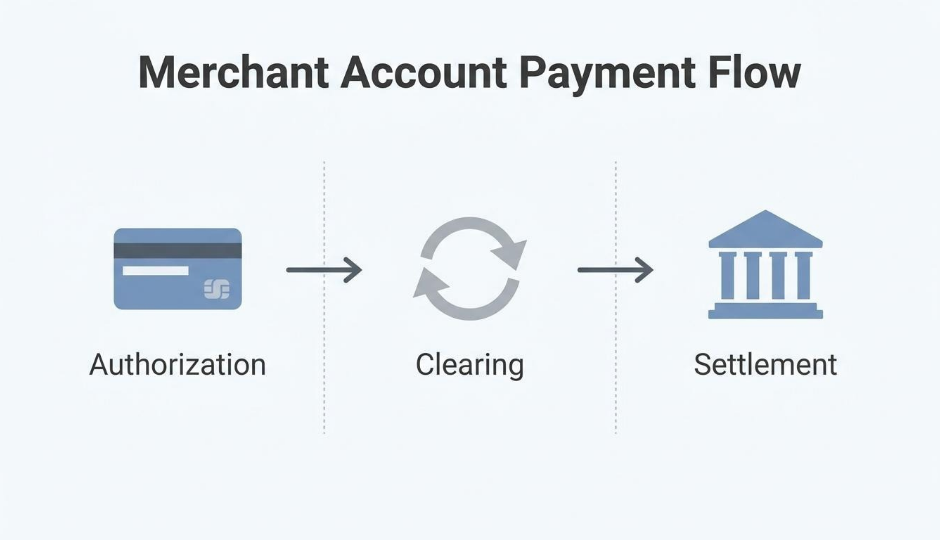
Every card transaction moves through three stages: authorization, clearing, and settlement. Each stage involves distinct parties, including acquiring banks that hold the merchant relationship, issuing banks that approve or decline purchases, card networks that route data between institutions, and payment processors that handle the technical infrastructure.
Merchant accounts come in dedicated, aggregated, high-risk, ecommerce, and retail/POS varieties. Dedicated accounts offer negotiable pricing and greater control at higher volumes, while aggregated accounts under payment service providers simplify onboarding through shared account structures.
Fees layer across interchange charges set by card networks, assessment fees paid to those networks, processor markups, monthly account fees, chargeback costs, and PCI compliance charges. Selecting the right pricing model, particularly interchange-plus versus flat-rate, directly affects margin protection as transaction volume grows.
Approval requires submitting business documentation and passing underwriting review, with denial rates reaching 48% to 56% at major banks. Risk management spans chargeback prevention, PCI DSS v4.0 compliance, and avoiding account freezes triggered by unusual processing patterns.
Online and in-store channels differ sharply in fraud exposure, verification methods, and fee structures. Connecting both channels through a unified commerce platform consolidates payment data, customer records, and inventory into one system, turning payment processing from an isolated function into a growth lever.
A merchant account is a specialized bank account that allows a business to accept credit and debit card payments from customers. Unlike a standard business checking account, it serves as a temporary holding point where card transaction funds sit after a sale is approved but before they transfer to the merchant's primary bank account. The acquiring bank or payment processor that provides this account assumes financial risk on the merchant's behalf, which is why approval requires underwriting.
Every time a customer taps, swipes, or enters card details online, the merchant account is the mechanism that makes that exchange possible. According to the Office of the Comptroller of the Currency, merchant processing is the settlement of credit and debit card payment transactions by banks for merchants through various card associations. Without this intermediary account, businesses would have no way to receive funds routed through card networks.
For any business selling products or services, whether in a physical store or through an ecommerce storefront, a merchant account is foundational infrastructure. It connects the business to the broader card payment ecosystem, including acquiring banks, issuing banks, card networks, and payment processors. The sections that follow break down how transactions flow through this system, who the key parties are, and what costs and risks merchants should expect.
A merchant account processes card payments through three sequential stages: authorization, clearing and settlement, and gateway transmission. Each stage involves distinct parties and data exchanges.
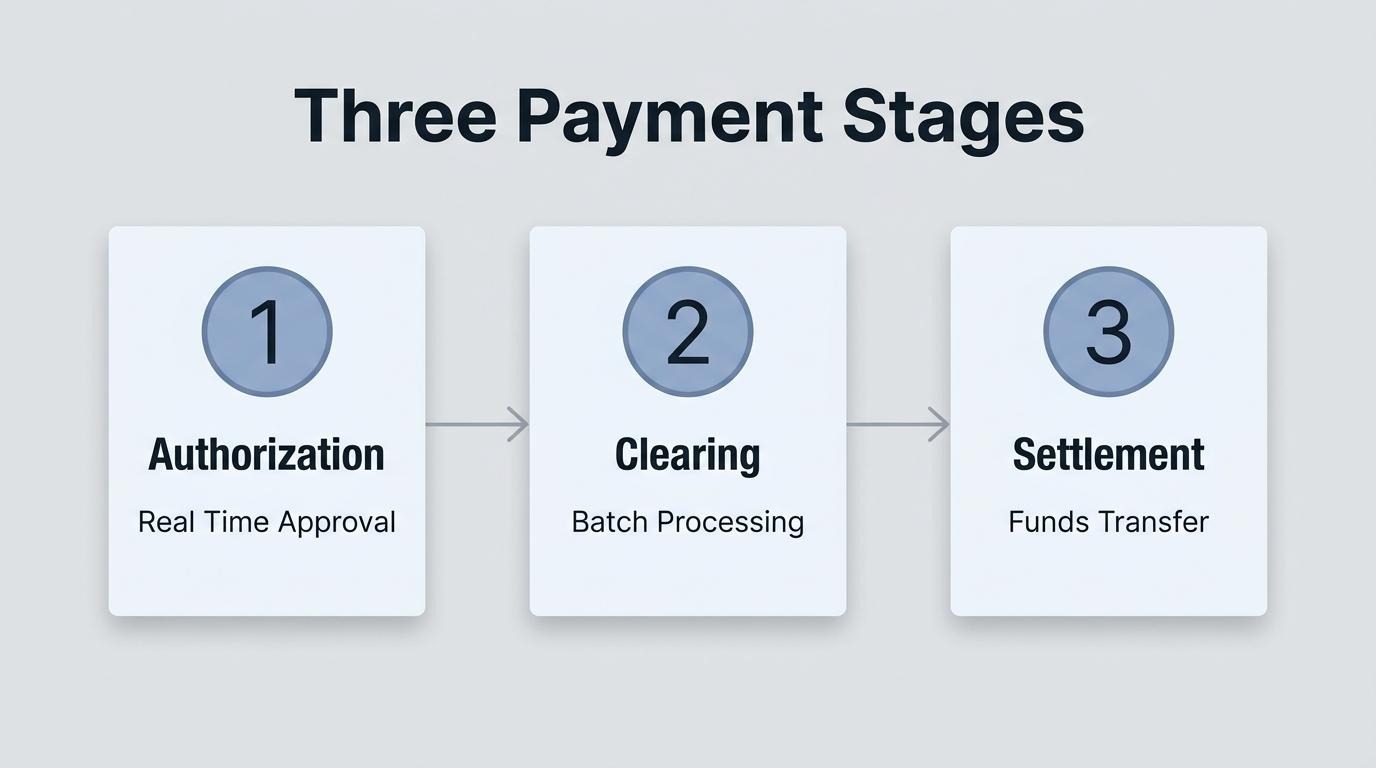
Authorization is the real-time verification step that approves or declines a transaction before the purchase is finalized. When a customer taps, swipes, or enters card details, the payment processor encrypts the transaction data and routes it to the card network. The card network forwards the request to the issuing bank, which checks the cardholder's available credit, verifies the card status, and runs fraud screening. Within seconds, the issuing bank sends an approval or decline code back through the same chain. According to the Office of the Comptroller of the Currency, authorization is the process of approving or declining a transaction before a purchase is finalized or cash is disbursed. A successful authorization places a temporary hold on the cardholder's funds but does not yet move money.
Clearing and settlement is the process that transfers funds from the cardholder's issuing bank to the merchant's acquiring bank. After a merchant captures authorized transactions throughout the day, those transactions are grouped into a batch file. The acquiring bank submits this batch through the card network, which calculates interchange fees and routes each transaction to the corresponding issuing bank. According to Stripe, card authorizations typically last 5 to 10 days but can sometimes extend up to 30 days, so the merchant acquirer must submit batches for settlement promptly. Once the issuing bank releases the funds (minus interchange), the acquiring bank deposits the net amount into the merchant account. For most businesses, settlement completes within one to three business days.
The payment gateway plays the role of a secure digital bridge that connects a merchant's checkout to the payment processor. It encrypts sensitive card data at the point of entry, tokenizes the information, and transmits the authorization request to the processor. For online transactions, the gateway replaces the physical card terminal entirely. As of 2025, according to Red Stag Fulfillment, Stripe commands roughly 20.8% to 29% of the global online payment processing sector, illustrating how central gateway infrastructure has become to ecommerce. Choosing a gateway that integrates tightly with your merchant account and storefront reduces latency and checkout friction. Understanding how each stage works sets the foundation for evaluating the parties involved in every transaction.
The key parties in a card payment transaction are the acquiring bank, the issuing bank, the card network, and the payment processor. Each performs a distinct function in moving funds from cardholder to merchant.
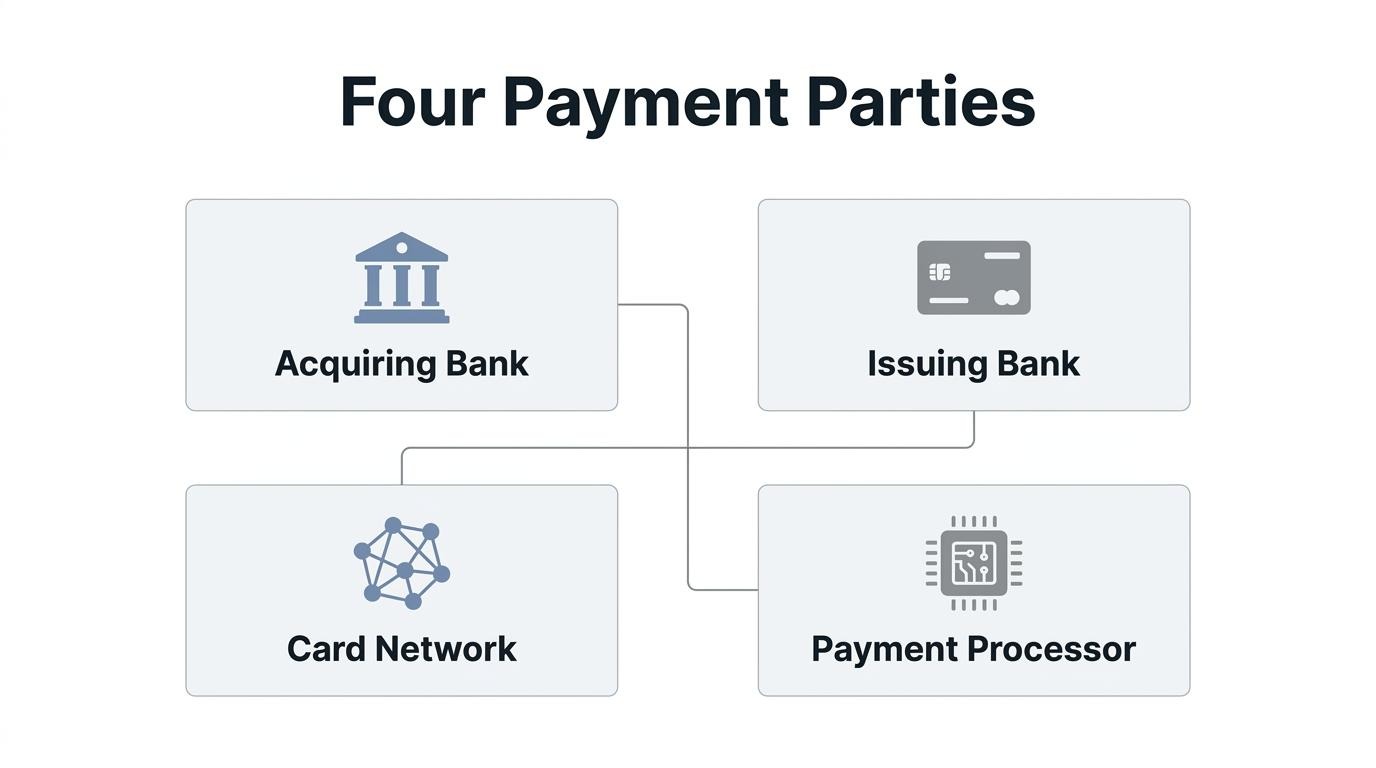
The acquiring bank maintains the merchant account and manages fund settlement on the merchant's behalf. It receives transaction data from the merchant, routes authorization requests through the card network, and deposits approved funds into the merchant's account after clearing.
According to the Office of the Comptroller of the Currency, authorization is the process of approving or declining a transaction before a purchase is finalized, and if an acquiring bank employs a third-party processor, that processor usually prepares the ACH file facilitating payment. The acquirer also assumes financial liability for chargebacks, which makes its underwriting standards central to merchant approval. For merchants processing significant volume, the acquiring bank relationship often determines both fee structure and payout timing.
The issuing bank is the financial institution that provides the cardholder with their credit or debit card and manages the associated account. When a transaction authorization request arrives, the issuing bank verifies the cardholder's available funds or credit limit, checks for fraud indicators, and sends an approval or decline response back through the card network.
After settlement, the issuing bank transfers the transaction amount (minus interchange fees) to the acquiring bank. It also handles cardholder disputes, initiating chargebacks when customers contest charges. Because the issuing bank controls the approval decision, its fraud detection thresholds and risk policies directly affect a merchant's authorization success rate.
Card networks serve as the communication infrastructure connecting acquiring banks and issuing banks during every transaction. Visa, Mastercard, American Express, and Discover each operate proprietary networks that route authorization requests, set interchange fee schedules, and enforce operating rules for all participants.
According to the Federal Reserve Banks, in "dual message" payment networks like card networks, a payment authorization request flows through the network before clearing, while interbank settlement is the discharge of obligations arising in connection with those payments. Card networks do not issue cards or hold merchant accounts; they govern the rules and technical standards that make interoperability possible across thousands of financial institutions.
The payment processor handles the technical infrastructure that captures, encrypts, and transmits transaction data between the merchant, acquiring bank, and card network. It manages the real-time communication required for authorization and prepares batch files for clearing and settlement.
Processors also provide merchants with point-of-sale terminals, payment gateway integrations, and reporting dashboards. While the acquiring bank holds the merchant relationship and assumes financial risk, the processor executes the operational mechanics. Some acquirers operate their own processing systems; others outsource to third-party processors. For merchants evaluating providers, understanding which entity handles processing versus which holds the account clarifies where to direct integration questions, fee negotiations, and support requests.
The types of merchant accounts are dedicated, aggregated, high-risk, ecommerce, and retail/POS. Each type serves a different business model, risk profile, and sales channel.
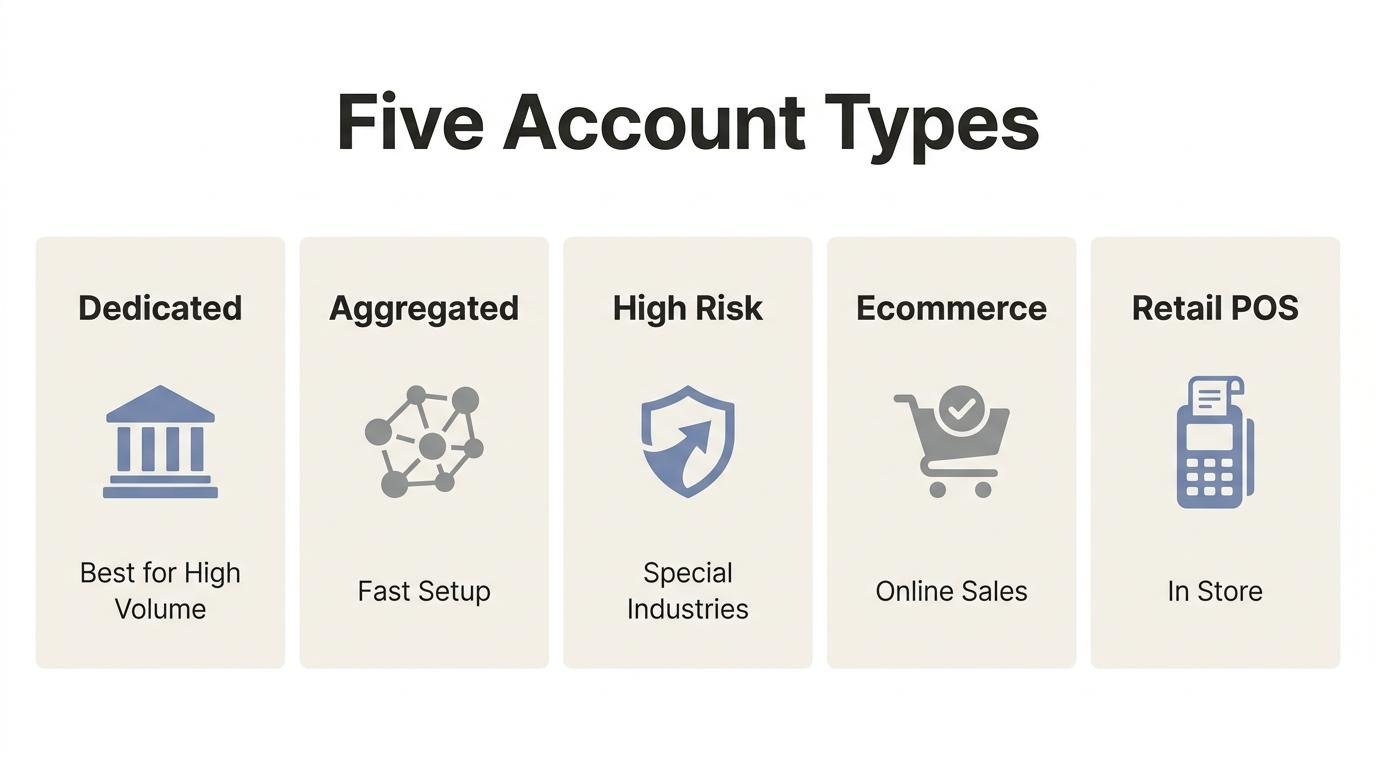
A dedicated merchant account gives a business its own unique account with an acquiring bank. According to Adyen, this structure provides more customization and better rates at higher volumes compared to an aggregated account. The merchant holds a direct relationship with the acquirer, which means greater control over processing terms, reserve requirements, and fee negotiations. Businesses processing large transaction volumes or operating in industries with specific compliance needs benefit most from this arrangement. Approval typically requires full underwriting, including credit checks and financial documentation, so the onboarding timeline is longer than aggregated alternatives.
An aggregated merchant account pools multiple businesses under a single master merchant account managed by a payment service provider. Instead of undergoing individual underwriting, each business operates as a sub-merchant beneath the provider's umbrella. Setup is fast, often requiring only basic business information and identity verification. However, because many merchants share one account, the provider applies broad risk policies. This can lead to sudden holds or freezes if transaction patterns appear unusual. Aggregated accounts work well for lower-volume sellers and newer businesses that need quick access to card acceptance without the overhead of a dedicated setup.
High-risk merchant accounts serve businesses in industries with elevated chargeback rates, regulatory scrutiny, or reputational concerns, such as travel, nutraceuticals, and subscription billing. Providers classify merchants as high-risk based on factors like industry type, processing history, and average ticket size. According to 2Accept, 98% of high-risk merchants who complete a full application with all required documentation get approved, with the 2% rejection rate driven by incomplete documentation or extreme risk profiles. Fees are higher than standard accounts, often including rolling reserves and steeper per-transaction rates. Thorough documentation during the application phase is the single most effective step toward approval.
Ecommerce merchant accounts are designed for businesses that accept card-not-present transactions through online storefronts. These accounts integrate with a payment gateway that encrypts and transmits transaction data between the online checkout and the acquiring bank. Because card-not-present transactions carry higher fraud risk than in-person sales, ecommerce accounts require stronger fraud prevention tools, such as address verification, 3D Secure authentication, and velocity checks. Providers also tend to apply tighter chargeback monitoring. For brands selling across multiple digital channels, choosing an ecommerce merchant account that connects cleanly to a unified backend prevents data fragmentation as order volume scales.
Retail and POS merchant accounts support in-person card-present transactions processed through physical terminals, mobile readers, or integrated point-of-sale systems. Card-present transactions benefit from lower interchange rates because chip and contactless reads reduce fraud exposure compared to online payments. These accounts typically include hardware provisioning, terminal management, and support for tap-to-pay and mobile wallets. Businesses operating both online and in-store should evaluate whether their retail merchant account can share customer and transaction data with their ecommerce setup; without that connection, reporting and inventory stay siloed across channels.
Understanding which account type fits your sales model is the first step; the next consideration is what fees each structure carries.
The fees associated with a merchant account include interchange fees, assessment fees, processor markup, monthly account fees, chargeback fees, and PCI compliance fees. Each fee type is covered below.
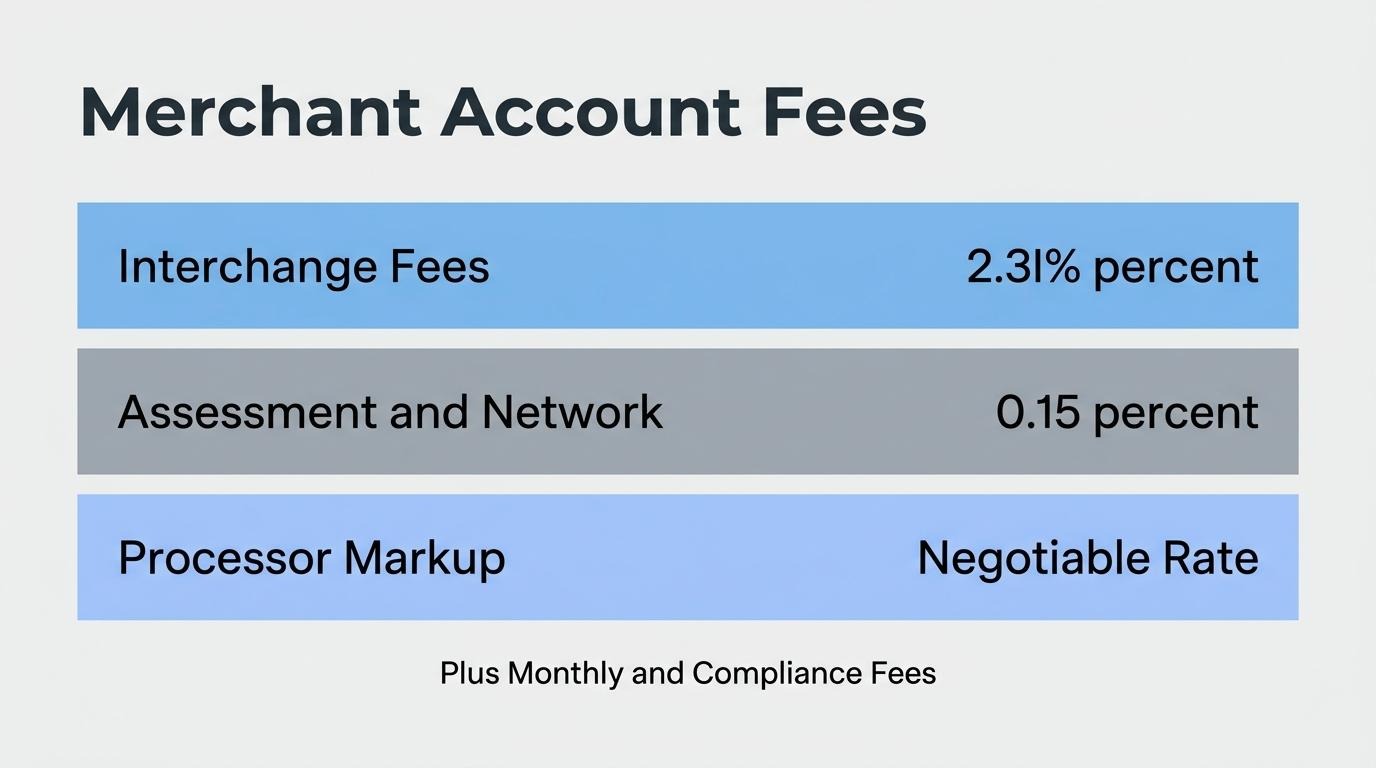
Interchange fees are per-transaction charges set by card networks and paid to the issuing bank. They represent the largest portion of card processing costs. Rates vary based on several factors:
These fees are non-negotiable; the card networks publish rate schedules that apply uniformly to all merchants. Interchange-plus pricing models separate this cost from the processor's margin, giving merchants clearer visibility into what they actually pay per transaction.
Assessment fees are small percentages charged by card networks (Visa, Mastercard, Discover, American Express) on total monthly transaction volume. Unlike interchange, which goes to the issuing bank, assessments go directly to the network itself. These fees typically range from 0.13% to 0.15% of volume for Visa and Mastercard, though exact rates shift periodically.
According to a 2026 StrictlyZero guide, the average credit card interchange fee in the U.S. reached approximately 2.36% in 2025 and remains at a similar level in 2026. Assessment fees stack on top of that interchange cost. Because assessments are also non-negotiable, understanding the combined interchange-plus-assessment baseline helps merchants evaluate whether a processor's markup is competitive.
The processor markup fee is the amount your payment processor charges above interchange and assessment costs for handling transactions. This is the only truly negotiable component of your processing fees.
Markup structures vary by pricing model:
For merchants processing significant volume, interchange-plus pricing typically delivers the lowest effective cost because it separates the processor's margin from the base fees set by card networks.
Monthly and statement fees are recurring charges billed by the processor regardless of transaction volume.
You apply for and get approved for a merchant account by submitting business documentation, passing an underwriting review, and meeting the provider's risk criteria. The subsections below cover required documents, evaluation criteria, and typical approval timelines.
The documents you need to apply for a merchant account typically include:
Incomplete documentation is one of the most common reasons applications stall, so assembling every item before submission saves significant time.
Underwriting criteria that providers evaluate focus on assessing the financial and operational risk your business presents. Underwriters analyze several core factors:
For businesses with higher volume, demonstrating stable financials and low chargebacks often matters more than the industry category alone.
Merchant account approval takes anywhere from one to two business days for low-risk applications to several weeks for high-risk or complex businesses. Standard underwriting for straightforward retail or ecommerce merchants often concludes within three to five business days when documentation is complete.
Approval is far from guaranteed, however. According to 2024 data from ByzFunder, approval rates at large banks dropped to 44%, with small banks approving 52% of applications, resulting in a 48–56% denial rate. Businesses flagged as high-risk, those with thin credit history, or applicants submitting incomplete files face the longest delays and highest rejection probability.
Choosing the right provider from the start becomes critical once you understand these approval dynamics.
The difference between a merchant account and a payment service provider is the account structure. A merchant account is a dedicated banking relationship you apply for individually; a payment service provider pools many businesses under one shared account. Below, the key distinctions cover account ownership, onboarding speed, and which model fits different business stages.
A dedicated merchant account gives your business its own underwriting relationship with an acquiring bank. You submit financial documents, undergo credit evaluation, and receive an account tied exclusively to your transactions. This structure typically offers negotiable interchange-plus pricing and higher processing limits, which benefit brands with established volume. The trade-off is a longer approval timeline, sometimes taking days or weeks, along with monthly fees and potential early termination penalties.
A payment service provider operates differently. According to NerdWallet, through a PSP, businesses get access to a shared merchant account, which removes the need to apply for a dedicated merchant account. Services like Square and Stripe onboard merchants in minutes with flat-rate pricing and minimal documentation. For early-stage businesses or those with low monthly volume, this simplicity is valuable. However, shared account structures carry a higher risk of sudden holds or freezes, since the provider manages fraud exposure across all merchants in the pool.
The practical decision comes down to scale and control. Key differences include:
For brands processing significant monthly volume, a dedicated merchant account almost always delivers better economics and fewer disruptions. Choosing the right provider means matching your current transaction profile to the structure that protects both margins and cash flow.
You choose the right merchant account provider by evaluating contract terms, pricing models, integration capabilities, and security standards. The following subsections break down each criterion.
The contract terms you should evaluate include agreement length, early termination fees, and auto-renewal clauses. Many providers lock merchants into multi-year contracts with cancellation penalties ranging from flat fees to liquidated damages based on remaining months. Look for month-to-month agreements or contracts with clearly defined exit provisions.
Review the fine print on rate adjustment clauses, which allow processors to increase fees after a set period. Reserve requirements, where the provider holds a percentage of sales as collateral, also deserve scrutiny. For scaling brands processing significant volume, negotiating these terms upfront prevents costly surprises later.
The pricing model that works for your transaction volume depends on whether your sales are high-frequency, low-ticket or lower-frequency, high-ticket. There are three common pricing models:
Interchange-plus typically delivers the lowest effective rate once monthly volume exceeds a few thousand transactions. Flat-rate simplicity loses its advantage as volume grows because it bundles a high markup into every swipe.
The integration capabilities you should look for include compatibility with your ecommerce platform, POS hardware, accounting software, and inventory management tools. A provider's API quality determines how smoothly transaction data flows between systems without manual reconciliation.
Prioritize providers offering pre-built connectors for your existing stack, along with well-documented APIs for custom workflows. Webhook support for real-time transaction notifications, multi-currency processing for international sales, and support for digital wallets all reduce friction at checkout. When payment data syncs natively with your storefront and back office, operational overhead drops significantly.
The security and PCI compliance standards that matter are PCI DSS certification, end-to-end encryption, tokenization, and fraud monitoring tools. PCI DSS v4.0 introduced 64 new requirements, and according to the PCI Security Standards Council, 51 of those future-dated requirements became effective as of March 31, 2025.
Your provider should handle the heaviest PCI compliance burden through validated infrastructure, point-to-point encryption, and tokenized card storage. Confirm whether the provider includes PCI compliance assistance or charges a separate non-compliance fee. Real-time fraud detection using velocity checks, AVS matching, and 3D Secure authentication adds critical layers beyond baseline compliance.
Matching these security standards to your operational needs sets the foundation for managing broader merchant account risks.
Common merchant account risks include chargebacks, account holds or freezes, and PCI DSS non-compliance. Each threat can drain revenue or interrupt payment processing entirely.
You prevent and handle chargebacks by combining clear transaction practices with proactive dispute management. According to ClearSale, processor chargeback fees run $20–$50 per dispute, but all-in merchant costs average $110 per chargeback when factoring in lost merchandise, labor, and penalty exposure.
Effective prevention strategies include:
For scaling brands, treating chargebacks as a cost-of-doing-business line item is a mistake. Every dispute that crosses the monitoring threshold puts the entire merchant account at risk.
Account holds or freezes are caused by activity that deviates from the risk profile established during underwriting. Acquirers monitor transaction patterns continuously, and sudden changes trigger automated reviews.
Common triggers include:
Maintaining consistent processing patterns and keeping your provider informed before major sales events, such as a product launch or seasonal promotion, reduces the likelihood of unexpected freezes.
You stay PCI DSS compliant by meeting the security requirements that apply to your specific merchant level and transaction environment. According to the PCI Security Standards Council, 51 of the 64 new requirements in PCI DSS v4.0 became effective as of March 31, 2025, meaning merchants must now satisfy these updated controls.
Key compliance actions include:
Non-compliance penalties from card brands can range from $5,000 to $100,000 per month, making ongoing compliance far cheaper than remediation after a breach.
With risk controls in place, the next consideration is how processing differs between online and in-store sales channels.
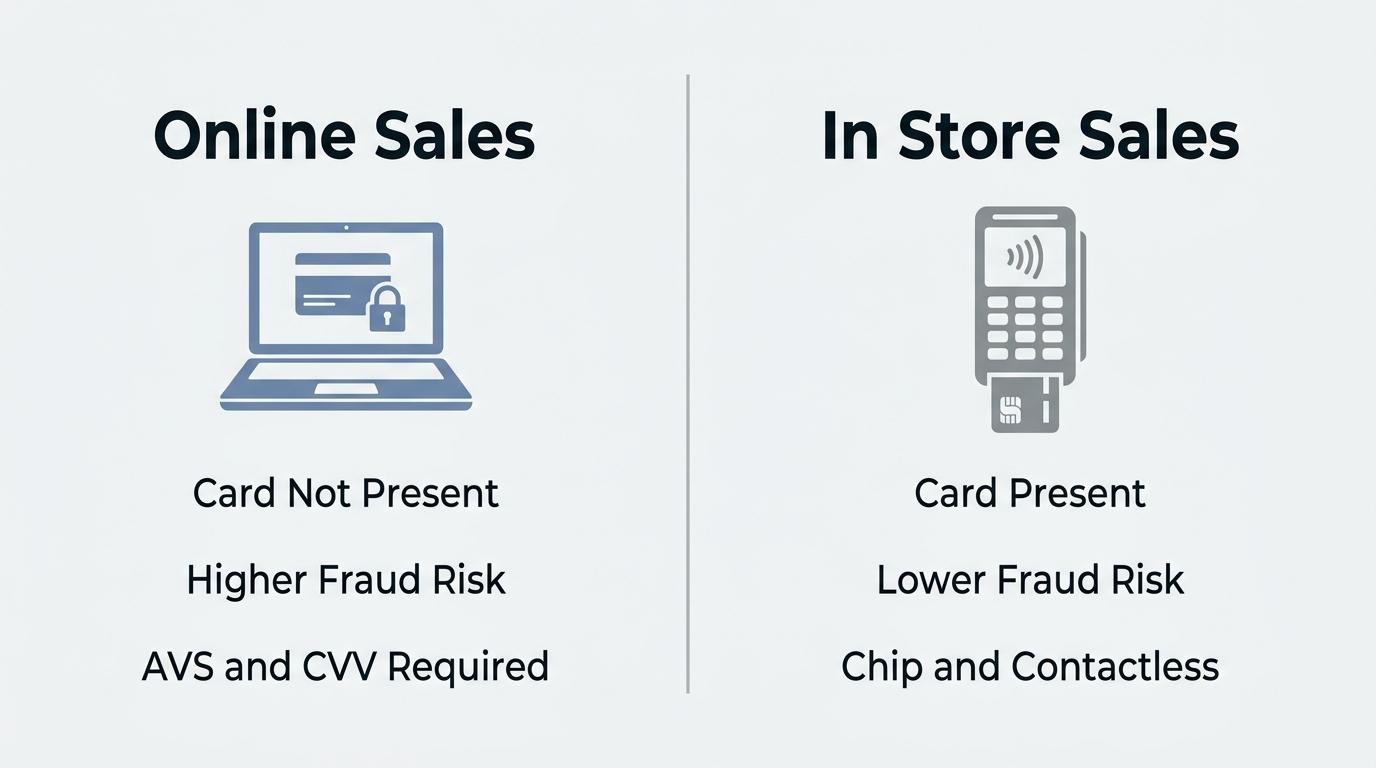
A merchant account works differently for online versus in-store sales primarily in how card data is captured, verified, and secured. The core authorization-clearing-settlement cycle remains the same, but the entry point, fraud profile, and technical requirements diverge significantly between the two channels.
In-store (card-present) transactions rely on physical interaction between the card and a POS terminal. The chip or contactless reader captures encrypted card data directly, which provides strong cardholder verification. Because the card is physically present, interchange rates tend to be lower and fraud risk is reduced.
Online (card-not-present) transactions require a payment gateway to encrypt and transmit card data entered manually by the buyer. Without physical verification, merchants must layer in additional fraud prevention tools such as AVS checks, CVV matching, and 3D Secure authentication. According to a 2024 report from the Federal Reserve Bank of Kansas City, the card-not-present fraud loss rate on single-message networks more than doubled from 2021 to 2023, rising from 5.4 basis points to 12.8 basis points.
Key differences between the two channels include:
For brands selling across both channels, the operational challenge is not just accepting payments in each environment but keeping transaction data, customer records, and inventory synchronized. Disconnected systems create reconciliation headaches that compound as order volume grows. Understanding how a unified commerce platform consolidates these payment flows can eliminate much of that friction.
Card payment processing fits into a unified commerce platform by connecting transaction data, customer records, and inventory within a single system. Below, we cover what changes when payment and customer data share one environment, followed by key takeaways on merchant accounts.
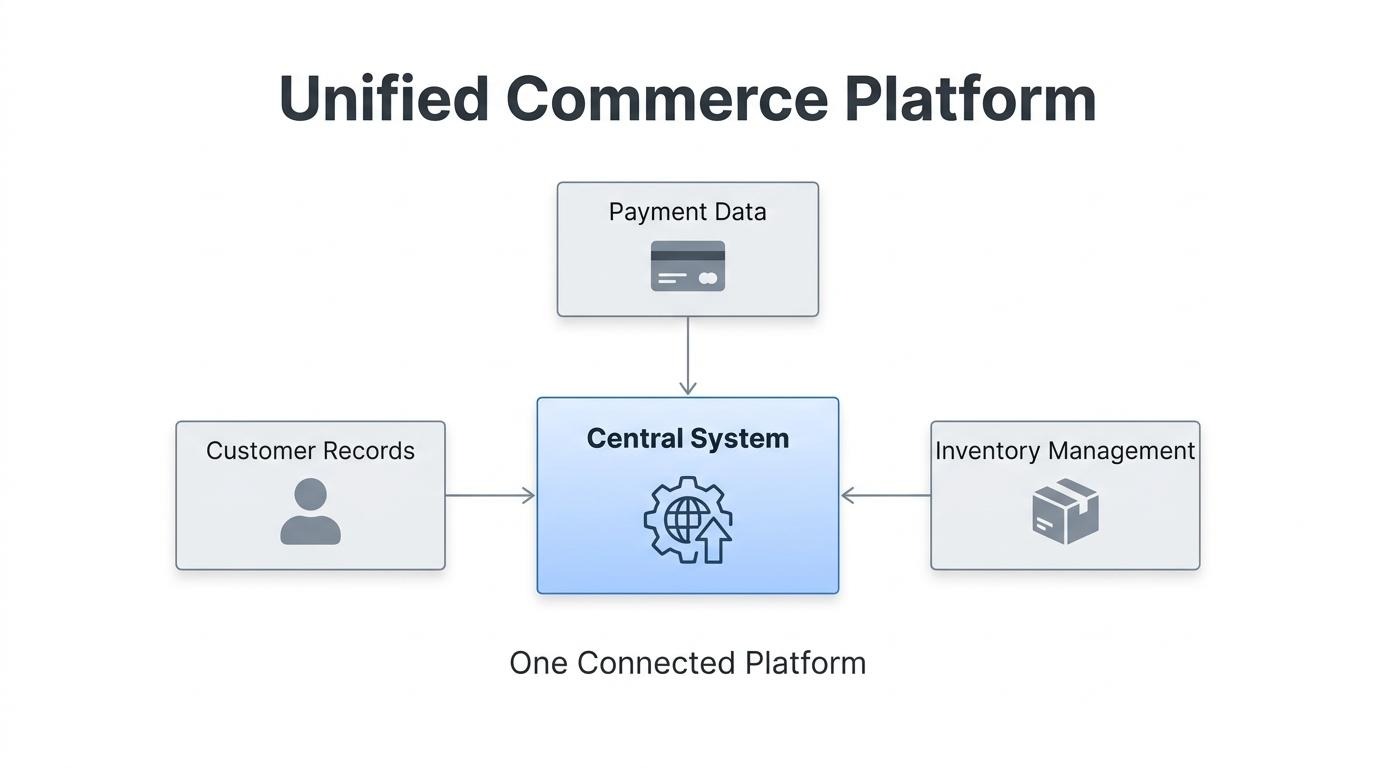
When payment data and customer records live in one system, every transaction automatically enriches a single customer profile. Purchase history from online checkouts and in-store POS terminals resolves to one record, eliminating the reconciliation work that fragmented tool stacks create.
This consolidation strengthens both personalization and fraud detection. A unified view lets merchants flag anomalies across channels in real time, which matters given the scale of payment fraud: according to Recorded Future's 2024 Annual Payment Fraud Intelligence Report, 269 million card records and 1.9 million stolen US bank checks were posted on dark and clear web platforms that year, with card-not-present data dominating.
Centralizing payment data alongside CRM and inventory also removes the manual syncing that slows operators down at scale. For brands processing significant volume across multiple channels, platforms built around a shared customer data layer (SHOPLINE, for example) keep online, offline, and lifecycle data tied to one record rather than scattered across separate tools.
The key takeaways about merchant accounts and card payments center on three areas: infrastructure understanding, cost management, and strategic integration.
For scaling brands, the merchant account is not just a payment tool; it is the connective tissue between revenue capture, customer intelligence, and operational efficiency. Results may vary depending on implementation, industry, and scale.