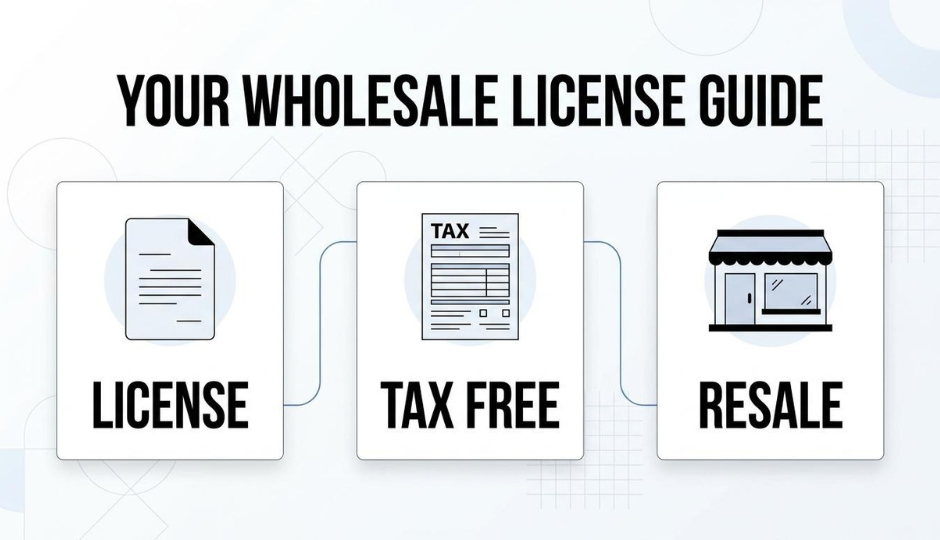
A wholesale license is a state-issued credential that authorizes a business to purchase goods in bulk for resale without paying sales tax on those transactions. Each state administers its own version of this license under names like seller's permit, vendor's license, or wholesale certificate.
This guide covers licensing fundamentals, eligibility by business model, application requirements, state-by-state cost and regulatory differences, and ongoing compliance obligations.
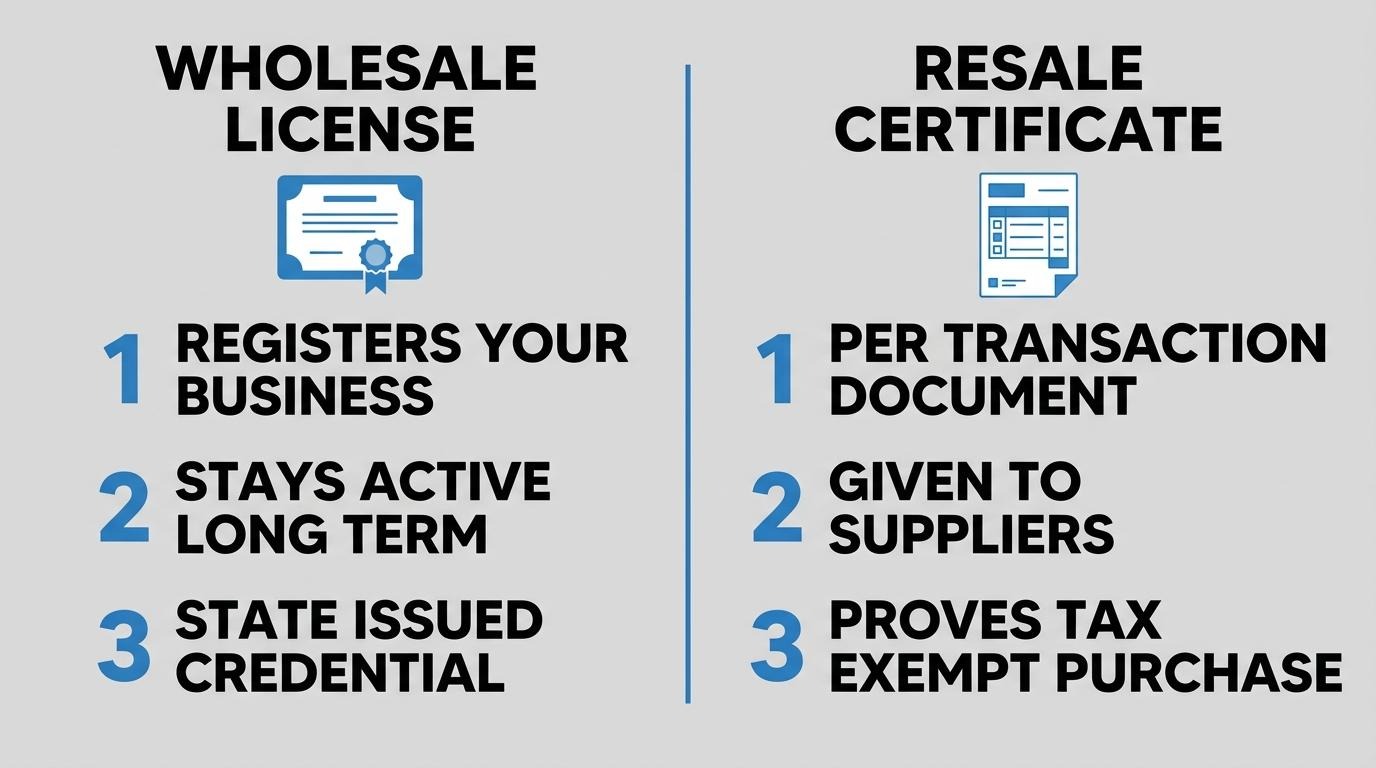
A wholesale license is not a business license or a resale certificate; each serves a distinct legal function. The license registers your business as an authorized reseller, while a resale certificate is a transaction-level document presented to suppliers to justify why sales tax was not collected on a specific purchase. Confusing the two is one of the most common errors new wholesalers make.
Eligibility extends beyond traditional brick-and-mortar distributors. Online-only sellers, manufacturers selling their own products at wholesale, and dropshippers who collect payment from buyers all fall under licensing requirements in most states. The sales channel is irrelevant; the taxable activity triggers the obligation.
Before applying, every business needs a registered legal entity and a federal EIN. State applications are submitted through designated revenue department portals, with approval timelines ranging from immediate to several weeks depending on the jurisdiction and application completeness.
Costs range from $0 in states like California, Texas, New York, and Florida to $100 in Connecticut. Five states (Alaska, Delaware, Montana, New Hampshire, and Oregon) have no general sales tax, though some still impose licensing or gross-receipts obligations. Renewal cycles vary from permanent permits to annual filings, and every license holder must submit sales tax returns on schedule, even during periods with zero taxable sales.
A wholesale license is a state-issued credential that authorizes a business to purchase goods in bulk for resale. The specifics vary by state, but the core function remains the same: it identifies your business as a legitimate reseller. Below, we cover how this license differs from a resale certificate and what happens if you operate without one.
A wholesale license differs from a resale certificate in both purpose and function. The wholesale license (often called a seller's permit, vendor's license, or wholesale certificate depending on the state) registers your business with the state as an entity authorized to sell goods. A resale certificate, by contrast, is a transaction-level document you hand to a supplier to explain why sales tax was not collected on a specific purchase.
According to the Texas Comptroller of Public Accounts, a resale certificate serves as the seller's evidence for why sales tax was not collected and must be retained in the seller's books for four years; a customer's sales tax permit number alone does not substitute for it.
Key distinctions include:
- A wholesale license is tied to your business registration and remains active for a set period (or indefinitely, depending on the state).
- A resale certificate is tied to individual purchases and must contain specific details: business name, address, permit number, property description, a resale statement, the date, and the purchaser's signature.
- States without a general sales tax, such as Montana, New Hampshire, and Oregon, do not issue standard resale certificates, though businesses in those states may still use a business registry resale certificate for out-of-state purchases.
Confusing the two is a common mistake. The license opens the door; the certificate handles the tax exemption on each qualifying transaction.
Selling wholesale without a license exposes your business to fines, permit revocation, and potential criminal penalties. The exact consequences depend on the state where you operate.
In most jurisdictions, a seller's permit is legally required before you make taxable sales. As the California Department of Tax and Fee Administration states, any business engaged in selling tangible personal property must obtain a seller's permit, and this permit is not the same as a business license; the two are separate requirements.
There is one nuance worth noting: in states like Michigan, wholesalers who sell exclusively to other wholesalers or retailers (never to final consumers) are not making retail sales, so sales tax registration may not be required. However, this exemption is narrow. If any portion of your sales reaches end consumers, or if you sell through online marketplaces, you likely need the permit.
Operating without proper credentials also makes it nearly impossible to present valid resale certificates to suppliers, which means you pay sales tax on inventory you intend to resell. For most wholesale businesses, that cost alone justifies the registration effort.
Understanding these foundational distinctions sets the stage for determining whether your specific business type requires a wholesale license.
Any business that buys goods in bulk for resale, rather than personal use, typically needs a wholesale license. The specific requirement depends on your business model, sales channel, and state regulations. Below, three common scenarios clarify when this license applies.
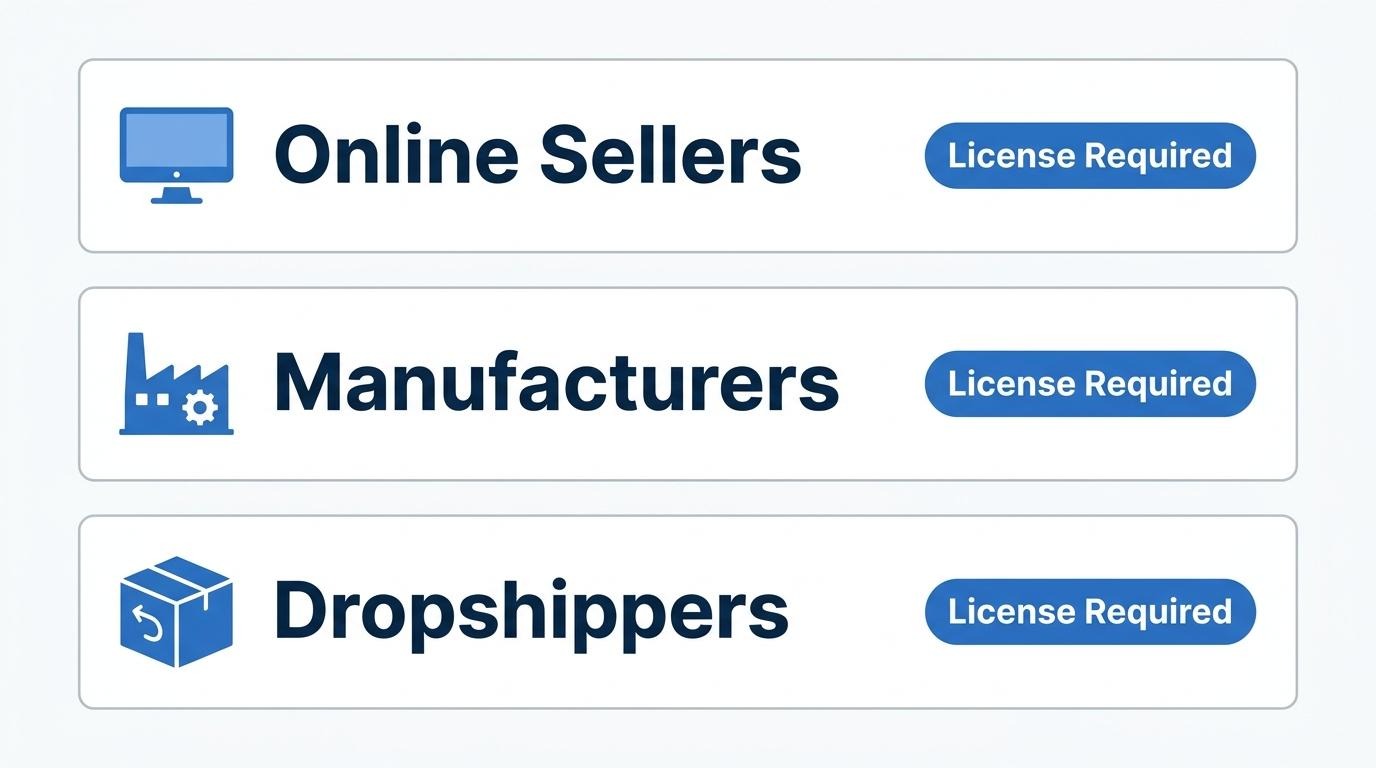
Online-only sellers need a wholesale license if they purchase inventory for resale, regardless of whether they operate a physical storefront. Selling through a website, marketplace, or social channel does not exempt a business from state licensing requirements. According to the Idaho State Tax Commission, sellers making taxable sales in Idaho must obtain a seller's permit, even without a brick-and-mortar location. Most states apply the same logic: the sales channel is irrelevant; the taxable activity triggers the permit obligation. If you stock and resell products online, expect to register.
Manufacturers who sell their own products at wholesale do need a wholesale license in most states. Producing goods does not replace the obligation to register for sales and use tax when those goods enter the resale supply chain. According to the U.S. Small Business Administration, the licenses and permits a business needs depend on its activities and location, and fees vary by jurisdiction. Some states impose additional requirements on manufacturers. New Hampshire, for example, requires separate licenses for tobacco manufacturers, wholesalers, or subjobbers. Remote sellers who manufacture and ship across state lines face another layer: if sales into a state meet that state's economic nexus threshold, registration to collect and remit sales tax becomes mandatory.
Dropshippers need a wholesale license when they take title to goods or collect payment from the end buyer, even if a third-party supplier handles fulfillment. Because the dropshipper is the seller of record in most transactions, states treat them like any other retailer or wholesaler obligated to collect sales tax. The key distinction is whether you are facilitating a sale or merely acting as a marketing affiliate. If customers pay you directly and you issue invoices, a seller's permit or wholesale license is almost certainly required. Skipping registration exposes the business to back taxes and penalties.
Understanding who needs a wholesale license sets the stage for knowing what qualifications each state expects before you apply.
The requirements to get a wholesale license include choosing a business structure, obtaining a tax ID number, and filing the appropriate state applications. Below, each prerequisite is covered in detail.
The business structure you need before applying is any legally recognized entity registered with your state. According to the U.S. Small Business Administration, you must choose a business structure before you register your business with the state, and most businesses will also need a tax ID number and appropriate licenses.
Accepted structures include:
- Sole proprietorship
- General or limited partnership
- Limited liability company (LLC)
- Corporation (S-corp or C-corp)
Texas illustrates how structure affects documentation: sole owners submit a Social Security number, partnerships provide SSNs or EINs for each partner, and corporations need a file number from the Secretary of State plus SSNs for every officer or director. A NAICS code is required regardless of structure. Forming the entity first prevents delays in every subsequent registration step.
Yes, you need an EIN to get a wholesale license in most cases. An Employer Identification Number, issued by the IRS, serves as the federal tax ID that state revenue departments require on sales-tax permit applications. Sole proprietors without employees can sometimes use a Social Security number instead, but partnerships, corporations, and LLCs must have an EIN before applying.
The IRS issues EINs online, for free, with immediate approval. One critical sequencing detail: if you are forming a corporation or LLC, file the entity with the secretary of state before applying for the EIN. Skipping that step can delay the application. For wholesale sellers managing multiple sales channels, having the EIN in place early keeps every downstream registration on schedule.
The state-specific requirements you should know about vary significantly in fee structure, renewal cycles, and documentation rules. No two states handle wholesale licensing identically.
Key variations include:
- Georgia requires no renewal; registration remains active as long as the business exists without ownership or structure changes.
- Mississippi issues a separate permit per location, with no expiration and no renewal while the holder stays in the same business at the same address.
- Minnesota requires a Minnesota Tax ID and Sales and Use Tax account before making taxable sales, with no stated fee.
- Texas charges no fee for its Sales and Use Tax Permit but requires it for individuals, partnerships, corporations, or any legal entity selling, leasing, or renting tangible personal property in the state.
Because these rules shift between jurisdictions, checking your state's revenue department website before starting the application prevents rejected filings. With requirements mapped, the next step is walking through the actual application process.
You apply for a wholesale license step by step by registering your business entity, obtaining a federal EIN, filing through your state's revenue department, and submitting required documents. Below, each step is broken down individually.
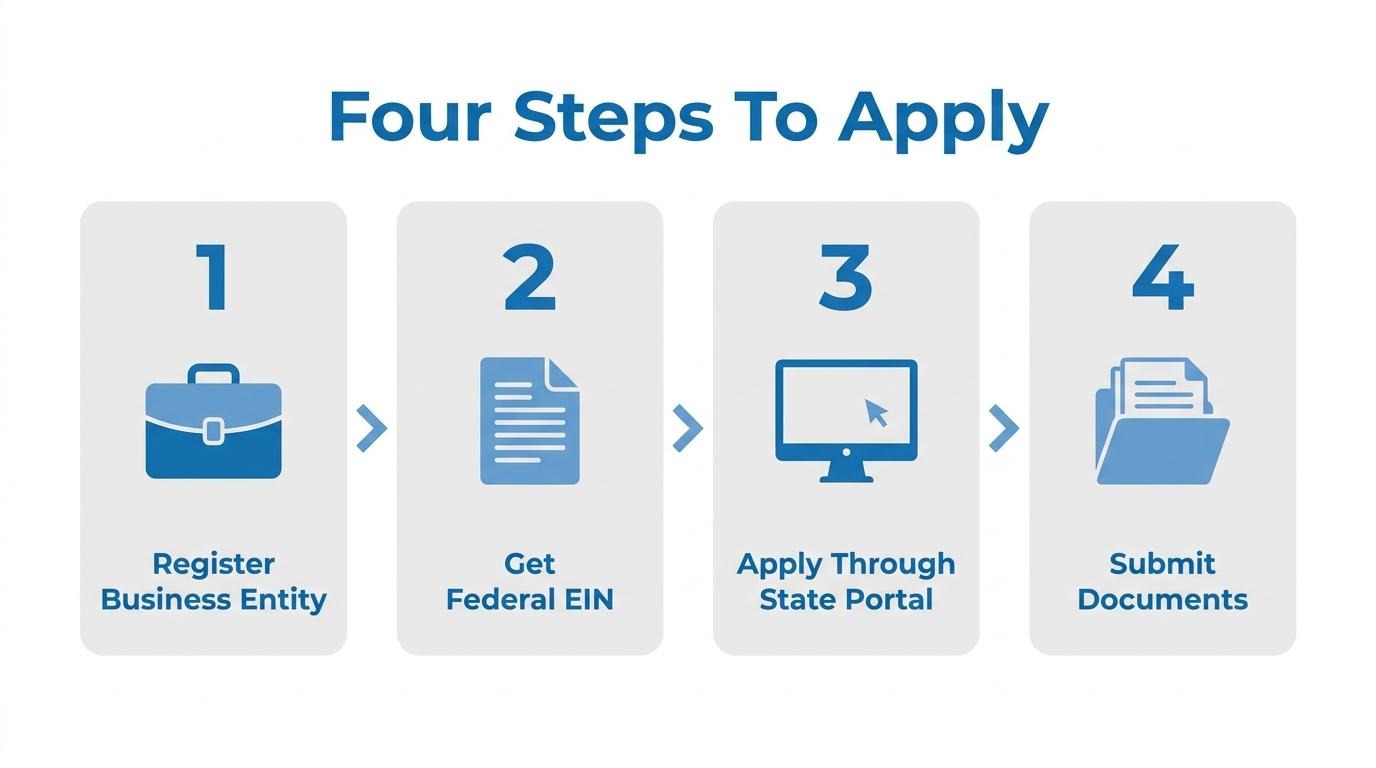
You register your business entity first by choosing a legal structure and filing with your state's secretary of state office. According to the U.S. Small Business Administration, you need to choose a business structure before registering with the state, and most businesses also need a tax ID number along with appropriate licenses and permits.
Timing matters. New York State requires registration at least 20 days before you begin making taxable sales. Operating without a valid Certificate of Authority in New York carries penalties up to $500 for the first day and up to $200 for each subsequent day, reaching a maximum of $10,000. Filing early prevents unnecessary fines and delays.
You obtain your federal EIN by applying directly through the IRS online tool. The IRS issues EINs immediately online after approval, and the application is free. If you are forming a corporation or LLC, file your entity with the secretary of state before submitting the EIN application. Skipping that step can delay processing. The EIN serves as your business's federal tax identification number, which most state revenue departments require during wholesale license registration.
You apply through your state's revenue department by submitting an online application through that state's designated tax portal. Each state operates its own system. Examples include:
- Alabama: My Alabama Taxes (MAT), free annual renewal by December 31
- Iowa: GovConnectIowa, free permit valid until canceled
- Kansas: KDOR Customer Service Center, no fee or bond required
- Nebraska: Online business registration or Form 20, no renewal needed
- Oklahoma: OkTAP portal, $20 plus a handling fee
- Vermont: myVTax, free registration with no license charge
- Wisconsin: Online BTR application, $20 initial for two years, $10 per renewal
According to the Washington State Department of Revenue, reseller permits are generally valid for four years, or two years for contractors and businesses open under 12 months. Permit costs, renewal cycles, and portal names vary significantly, so always verify directly with your state's department.
The documents you need to submit with your wholesale license application typically include your federal EIN, business formation paperwork, and owner identification. Most state applications also require your business address, NAICS code, and Social Security numbers for owners or officers.
If you are forming a corporation or LLC, complete your secretary of state filing before applying for the EIN; otherwise, according to the IRS, the EIN application may be delayed. Some states, such as West Virginia, issue permanent business registration certificates that remain valid until a legal-name, location, or ownership change occurs. Having all documents prepared before starting the application prevents processing delays.
Approval timelines for a wholesale license range from immediate to several weeks, depending on the state. California's online seller's permit system, for example, allows many applicants to receive their permit immediately after submission. States that mail physical certificates, such as Massachusetts through MassTaxConnect, add postal delivery time after digital approval.
Incomplete applications are the most common cause of delays. Missing an EIN, submitting incorrect entity information, or failing to register your business structure first can push timelines back significantly. Filing online through your state's designated portal and double-checking every field before submission gives you the fastest path to approval.
With your license secured, the next consideration is understanding what it costs across different states.
A wholesale license cost ranges from $0 to $100 depending on the state. California and Texas charge nothing, while others like Connecticut charge $100. Below is a breakdown for the most common states.
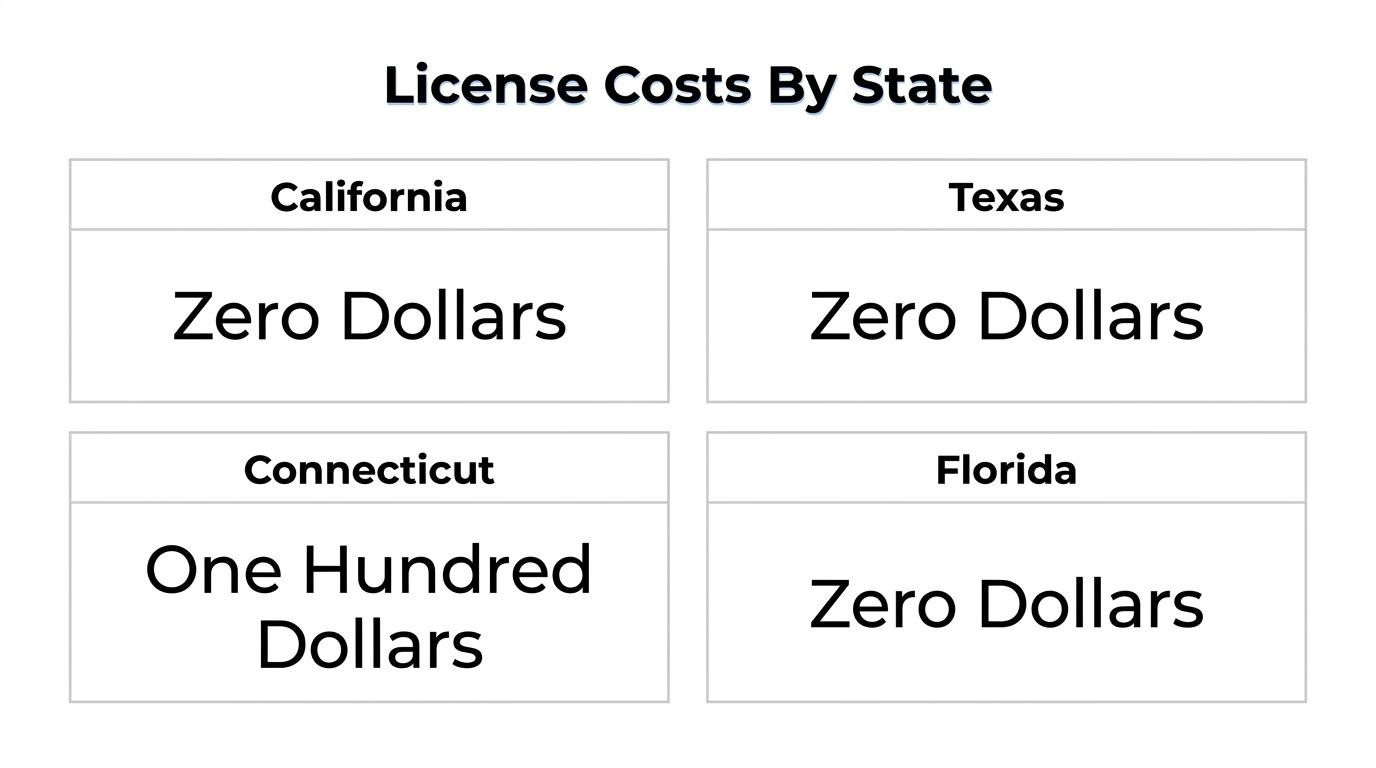
A wholesale license in California costs $0. The California Department of Tax and Fee Administration issues seller's permits at no charge, and most applicants receive approval immediately after submitting the online application. Despite the free permit, applicants should budget time for gathering required documentation. According to the California Contractors State License Board, errors on work certifications are the most common reason for application rejection. Double-checking every field before submission avoids delays that can stall your ability to buy inventory tax-free.
A wholesale license in Texas costs $0. According to the Office of the Texas Governor's Licenses and Permits Guide, there is no fee for the Texas Sales and Use Tax Permit. The permit covers individuals, partnerships, corporations, and other legal entities selling tangible personal property, leasing goods, or providing taxable services in Texas. Remote sellers and marketplace sellers may also need this permit. Applications are submitted through the Texas Comptroller of Public Accounts, where you will need your Social Security number or EIN, your entity's Secretary of State file number, and your NAICS code.
A wholesale license in New York costs $0. New York State requires businesses to register with the Tax Department at least 20 days before beginning taxable sales. After approval, the state issues a Certificate of Authority that must be displayed at your place of business at all times. There is no fee for this registration. However, operating without a valid Certificate of Authority carries steep penalties; fines can reach up to $500 for the first day and up to $200 per day thereafter, with a maximum penalty of $10,000.
A wholesale license in Florida costs $0. Businesses register for sales and use tax through the Florida Business Tax Application portal at no charge. Upon registration, the Florida Department of Revenue issues an Annual Resale Certificate that expires every December 31. This certificate allows purchases of inventory tax-free when goods are intended for resale. Because the resale certificate resets annually, marking the renewal deadline on your calendar prevents lapses that could disrupt supplier relationships.
A wholesale license cost in other states ranges from $0 to $100. Most states charge nothing, though a few impose modest fees. Key examples include:
- Arizona: $12 per location for a Transaction Privilege Tax license.
- Arkansas: $50 per sales-tax permit, paid electronically.
- Colorado: $4 to $16 depending on application timing, valid for two years.
- Connecticut: $100 for a Sales and Use Tax Permit, renewed every two years.
- Hawaii: $20 one-time fee for a General Excise Tax license covering wholesaling.
- Nevada: $15 per location for a sales-tax permit.
- Oklahoma: $20 plus a handling fee for a sales/use tax permit.
- South Carolina: $50 per Retail License, which does not expire.
- Wisconsin: $20 initially for two years, then $10 per renewal.
States like Idaho, Iowa, Kansas, New Mexico, North Carolina, Vermont, and many others charge no fee at all. According to the Alabama Department of Revenue, Alabama's Sales and Use Tax licenses must be renewed annually by December 31 through the My Alabama Taxes portal at no charge. For businesses selling across multiple states, these small per-state costs add up, making it worth mapping every jurisdiction where you have nexus before you begin operations.
Understanding licensing costs is just one factor; state-by-state regulatory differences affect renewal schedules, filing obligations, and permit structures as well.
Wholesale license requirements vary significantly by state. Some states have no sales tax and no traditional wholesale permit, while others mandate separate resale and wholesale credentials. The subsections below cover both scenarios.
The states with no general sales tax are Alaska, Delaware, Montana, New Hampshire, and Oregon. However, "no sales tax" does not always mean "no licensing requirement."
- Alaska has no state sales tax, but some municipalities levy local sales taxes, requiring businesses to register with individual local governments.
- Delaware imposes no sales tax yet requires a retail or wholesaler license and a gross-receipts tax administered by the Delaware Division of Revenue.
- Montana, New Hampshire, and Oregon have no general sales tax and do not issue standard resale certificates or wholesale permits.
Even when selling into tax-free states, multistate sellers face complexity. According to the U.S. Government Accountability Office, the 2018 Supreme Court decision in South Dakota v. Wayfair created a patchwork of remote sales tax requirements, allowing states to require collection from out-of-state businesses without a physical presence. The Multistate Tax Commission's Uniform Sales and Use Tax Resale Certificate is accepted by 36 states, which simplifies cross-border compliance but does not eliminate it.
Several states require separate resale and wholesale permits depending on the business activity. Pennsylvania, for example, issues a distinct Wholesale Certificate through myPATH, and pure wholesalers registered under it have no sales tax filing obligation. Michigan treats wholesalers differently as well; because wholesalers sell to other businesses rather than final consumers, the Michigan Department of Treasury states that sales tax registration is not required for wholesale-only operations.
In most other states, a single sales tax permit or seller's permit covers both wholesale and retail transactions, with resale certificates used at the point of purchase to document tax-exempt wholesale buys. For multistate sellers managing permits across jurisdictions, consolidating order management and compliance data into one system reduces the risk of missed filings or expired credentials.
You renew or maintain a wholesale license by following your state's specific renewal cycle and filing all required sales tax returns on time. Renewal frequency and reporting obligations vary widely by jurisdiction.
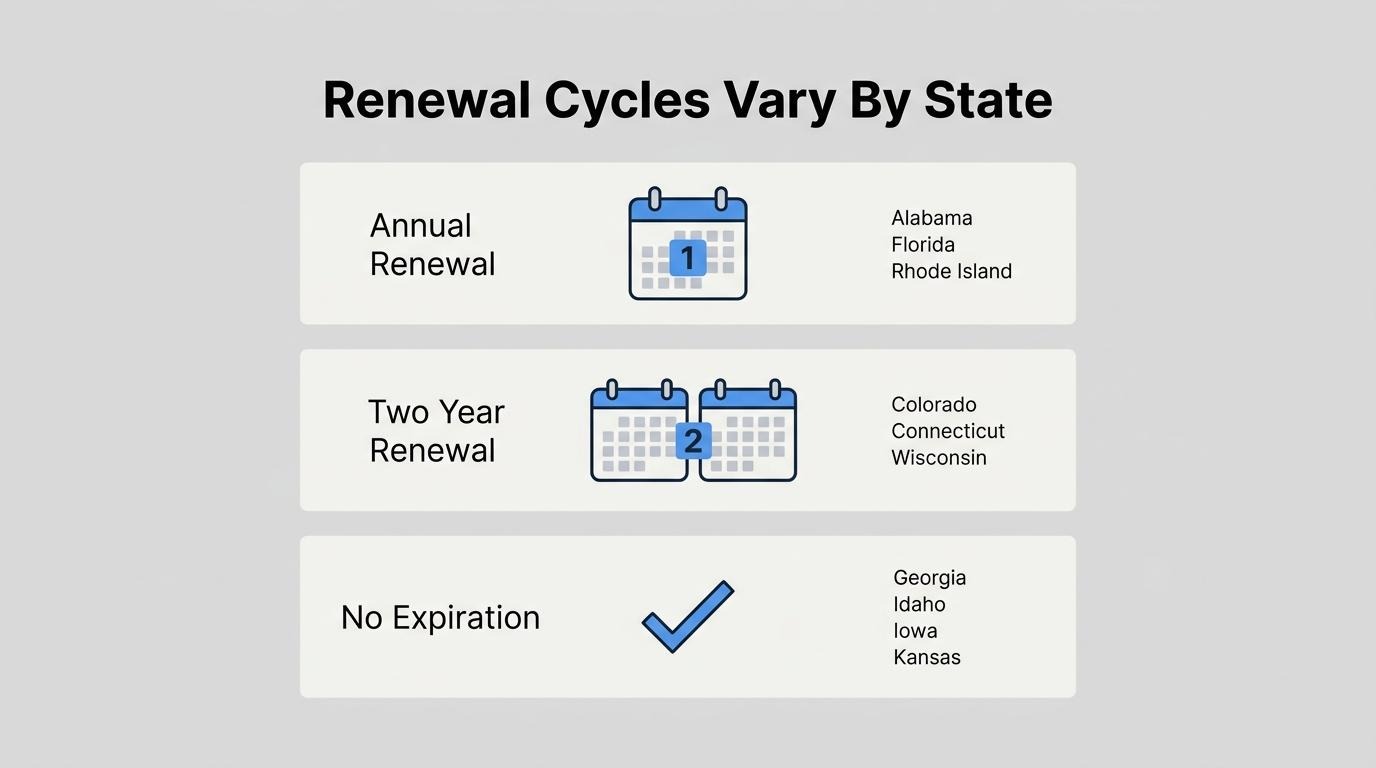
You need to renew a wholesale license on a schedule that depends entirely on your state. Some states require annual renewal, others use biennial or triennial cycles, and many issue permits that remain valid indefinitely until canceled or revoked.
States with recurring renewal cycles include:
- Annual: Alabama (by December 31), Louisiana (resale certificates valid one year), Rhode Island (expires June 30, renewal due February 1), Florida (Annual Resale Certificate expires December 31)
- Biennial: Colorado (expires at the end of each odd-numbered year), Connecticut ($100 permit expires every two years), Wisconsin ($10 renewal every two years)
- Triennial: Illinois (Certificate of Registration expires every three years)
- Four-year: Washington (reseller permits generally valid four years; two years for contractors or businesses open under 12 months)
Many states issue permits with no expiration. According to the Georgia Department of Revenue, Georgia sales-and-use-tax registration remains in effect while the business exists without ownership or structure changes. Idaho, Iowa, Kansas, Mississippi, Nebraska, and West Virginia follow similar permanent-permit models.
The reporting obligations that come with a wholesale license center on filing periodic sales and use tax returns, even when no taxable transactions occurred during the reporting period. According to the New York State Department of Taxation and Finance, businesses must file their sales and use tax return by the due date even if no taxable sales or purchases were made.
Filing frequency varies by state and sales volume; common schedules are monthly, quarterly, or annually. Failure to file on time can trigger penalties, interest charges, or permit suspension. Pennsylvania offers one exception: the state's official guidance notes that a wholesaler operating exclusively at wholesale has no filing obligation.
Tracking multistate obligations adds complexity for businesses selling across state lines, making accurate record-keeping essential for ongoing compliance.
A wholesale license allows you to purchase inventory tax-exempt and resell goods to retailers, other wholesalers, or end consumers. The subsections below cover how tax-exempt buying works and how to present your credentials to suppliers.
You use a wholesale license to buy tax-exempt inventory by presenting a valid resale certificate to your supplier at the time of purchase. The certificate signals that the goods are intended for resale, not personal use, which removes the obligation to pay sales tax on that transaction. According to the Florida Department of Revenue, businesses registered to collect sales tax receive a Florida Annual Resale Certificate that allows owners or their representatives to buy or rent property and services tax-free when items will be resold or re-rented.
Only goods purchased for resale qualify. Items bought for business use, office supplies, or personal consumption remain taxable. Misusing a resale certificate for non-resale purchases can trigger penalties and back-tax assessments.
You present your license to suppliers and distributors by furnishing a completed resale certificate directly to the vendor before or at the time of sale. According to the California Department of Tax and Fee Administration (Publication 103), any document can serve as a resale certificate provided it includes:
- The name and address of the purchaser's business
- The purchaser's seller's permit number or an explanation of why one is not required
- A description of the property being purchased
- A statement that the property is purchased for resale
- The date of the document
- The signature of the purchaser or authorized representative
Never send the certificate to the state tax agency; it stays with the supplier as their proof that sales tax was not collected. For multistate purchases, the Multistate Tax Commission's Uniform Sales and Use Tax Resale Certificate is accepted in 36 states, simplifying compliance when sourcing from vendors across jurisdictions.
Keeping organized records of every resale certificate issued is essential, since most states require suppliers to retain these documents for audit purposes.
The common mistakes you should avoid when getting a wholesale license include applying before forming your business entity, confusing a wholesale license with a business license or resale certificate, ignoring multistate nexus obligations, and submitting incomplete applications. Each error can delay approval or trigger penalties.
- Applying before registering your business entity. The IRS advises forming your corporation or LLC through the secretary of state before applying for an EIN; skipping this step delays your tax ID and, consequently, your wholesale license application.
- Confusing a wholesale license with a business license. According to the California Department of Tax and Fee Administration, a seller's permit is not the same as a business license; you must obtain each separately from different agencies.
- Assuming one state registration covers all states. Remote sellers who meet or exceed a state's sales threshold must register in that state, per the Streamlined Sales Tax Governing Board. Selling into multiple states without separate registrations creates compliance gaps.
- Submitting incomplete documentation. Missing a Social Security number, NAICS code, or partner identification number is a common rejection trigger. Gather every required document before you start the application.
- Overlooking renewal deadlines. Some states, such as Alabama, require annual renewal, while others, like Rhode Island, set a June 30 expiration. Missing a deadline can suspend your ability to buy or sell tax-exempt inventory.
- Filing zero-sales returns late or not at all. New York requires sales and use tax returns by the due date even when no taxable transactions occurred. Failing to file invites penalties regardless of revenue.
Most of these mistakes stem from treating the process as a single federal step rather than a state-by-state obligation. Building a compliance checklist before you apply saves weeks of back-and-forth with revenue departments.
With licensing squared away, the next consideration is how your wholesale operations fit into your broader commerce infrastructure.
Selling wholesale alongside DTC becomes operationally complex when orders, pricing tiers, and tax compliance live in separate tools. The sections below cover what changes when both channels share one system and the key takeaways from the licensing process.
Wholesale and DTC orders sharing one system eliminates the data fragmentation that forces manual reconciliation between separate platforms. When a single backend handles both channels, wholesale price lists, net-30 terms, and tax-exempt resale certificate validation sit alongside retail checkout and consumer promotions. Inventory counts update in real time across both order types, reducing oversells during peak periods.
This matters for licensing because multistate sales tax obligations, resale certificate records, and filing deadlines become easier to track when they feed from one data source rather than scattered spreadsheets. SHOPLINE is one option for brands consolidating wholesale and DTC into a shared system, keeping order data, customer records, and tax settings in a single layer rather than syncing between apps.
For brands scaling past the point where stitched-together tools create friction, unifying channels is less about adding features and more about removing operational drag.
The key takeaways about getting a wholesale license center on preparation, state-specific compliance, and ongoing maintenance:
- A wholesale license is a state-issued credential that authorizes tax-exempt purchasing for resale; it is not the same as a general business license or a resale certificate.
- Requirements vary significantly by state, with permit fees ranging from free to $100 and renewal periods spanning from permanent to annual.
- Every applicant needs a registered business entity and a federal EIN before applying through the state revenue department.
- Resale certificates must be collected from buyers and retained for audit periods that vary by jurisdiction.
- Operating without proper licensing carries penalties up to $10,000 in states like New York.
- Multistate sellers face additional nexus obligations triggered by the 2018 South Dakota v. Wayfair decision, which allows states to require tax collection from remote sellers without physical presence.
Treating licensing as a one-time checkbox rather than an ongoing compliance responsibility is the most common mistake brands make when entering wholesale.