Buying wholesale products for your ecommerce business means purchasing goods in bulk from manufacturers, distributors, or wholesalers at below-retail prices, then reselling them directly to consumers through your online store.
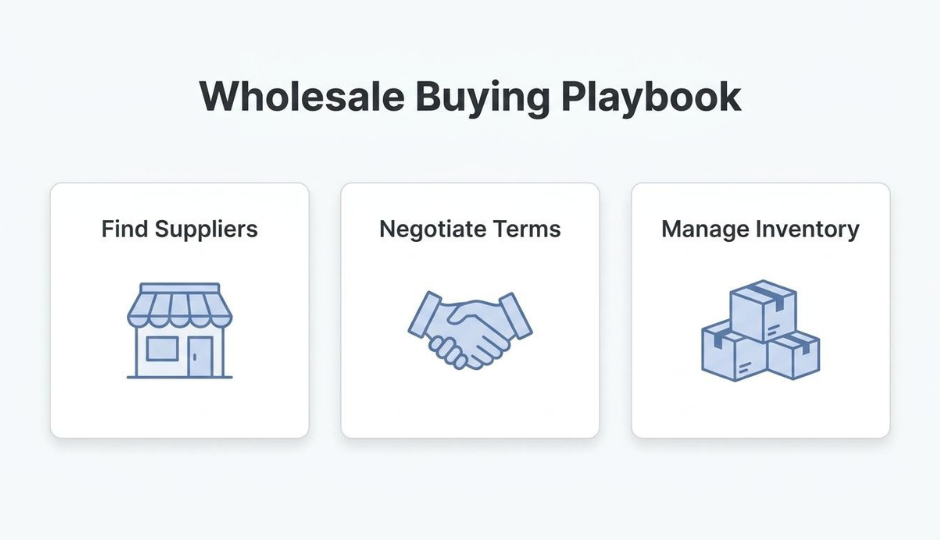
This guide covers licensing and legal setup, supplier discovery and vetting, wholesale buying models, pricing and negotiation strategy, and scalable inventory operations.
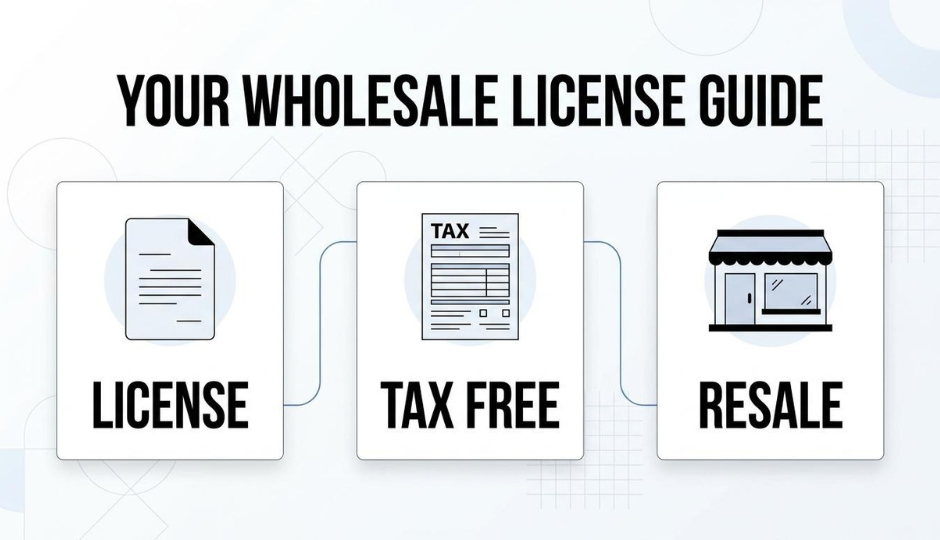
Wholesale purchasing in the United States requires specific documentation: a state business license, a resale certificate for tax-exempt buying, and a federal EIN. Each state administers its own permit process, so multi-state sellers need certificates in every jurisdiction where they source inventory.
Finding legitimate suppliers spans multiple channels, from online B2B directories and trade shows to direct manufacturer outreach and overseas sourcing agents. Vetting covers financial risk, business registration verification, and pre-shipment inspections that catch quality drift before inventory reaches your warehouse.
Five distinct buying models shape how capital and risk distribute across your business: traditional bulk wholesale, dropship, closeout and liquidation, white label and private label, and print on demand. Each carries different margin profiles, inventory obligations, and brand control trade-offs.
Negotiating favorable terms starts with understanding minimum order quantities, structuring payment timelines that match your cash flow, and building toward volume discounts through consistent ordering history. Calculating true landed cost per unit (including freight, duties, and warehousing) protects margins from silent erosion.
Selling wholesale goods profitably through DTC channels depends on setting retail margins that account for every acquisition cost, building product catalogs optimized with reviews and promotional positioning, and reordering based on actual sell-through data rather than assumptions. As order volume grows, consolidating inventory, CRM, and storefront data into one system eliminates the reconciliation delays that cause overselling across channels.
Wholesale products are goods purchased in bulk from manufacturers, distributors, or wholesalers at below-retail prices for resale. For DTC brands, wholesale buying unlocks lower per-unit costs, broader product assortment, and faster inventory replenishment. The subsections below define wholesale purchasing, explain its profit-margin advantages, and outline why this model suits direct-to-consumer ecommerce.
Wholesale products are new or used goods sold in bulk to retailers, institutions, or other businesses rather than to the general public. According to the United Nations Statistics Division, wholesale is the resale of goods without transformation to retailers, industrial users, professional buyers, or other wholesalers. This distinguishes wholesale from retail, which involves selling goods directly to consumers for personal use.
The wholesale transaction typically requires minimum purchase quantities, and buyers receive discounted pricing in exchange for ordering at volume. Categories span nearly every consumer vertical: apparel, beauty, electronics, food, and home goods are among the most common. For ecommerce operators, wholesale products form the inventory backbone that gets listed, marketed, and shipped to end customers.
DTC brands buy wholesale instead of manufacturing because it eliminates the capital investment, production timelines, and operational complexity of running a factory. Purchasing finished goods from established suppliers lets brands reach market faster while focusing resources on marketing, customer experience, and brand building.
Manufacturing in-house demands equipment, raw materials, skilled labor, and quality-control infrastructure. As the OECD notes, firms may use outsourcing to take advantage of economies of scale and the expertise of the contracting firm. Wholesale buying applies this same logic: a DTC brand sources proven products at volume pricing without bearing production risk. This approach is especially practical for brands testing new categories or expanding their catalog quickly.
Wholesale pricing affects profit margins by reducing the cost basis per unit, which widens the gap between what a brand pays and what it charges consumers. The lower the acquisition cost, the more room exists for healthy retail markups.
Margin is calculated on revenue, while markup is calculated on cost, so the two figures differ even when describing the same transaction. According to Michigan State University Extension, the usual profit margin for a manufacturer ranges from 30 to 35 percent. DTC brands reselling wholesale goods can often target similar or higher margins because they skip intermediary retail channels and sell directly to consumers. Negotiating better wholesale unit prices, consolidating shipments, and ordering above minimum thresholds all compress costs further. Even small per-unit savings compound significantly at scale, making wholesale sourcing one of the most direct levers for protecting profitability.
Understanding these fundamentals prepares you to navigate the licensing and legal requirements that govern wholesale purchasing in the United States.
Any registered business entity can buy wholesale products in the United States, provided it holds the right documentation. The specific requirements vary by state but generally include a business license, a resale certificate, and a federal Employer Identification Number (EIN).
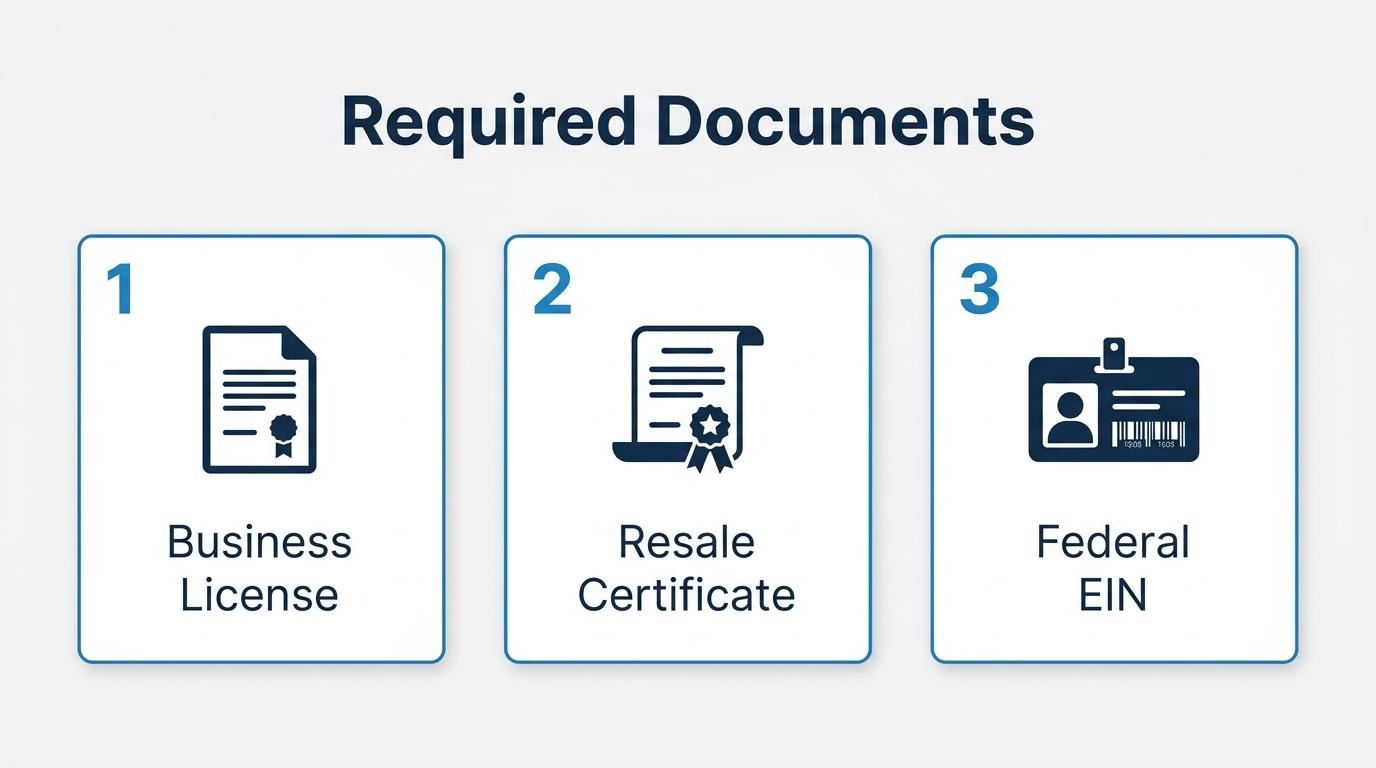
The business licenses you need to buy wholesale depend on your state and business structure. Most states require at least a general business license and a seller's permit before you can purchase goods for resale. According to the United States Census Bureau, a wholesaler is a business that sells to retailers, contractors, or other types of businesses, but not to the general public in any significant amount. Because wholesalers verify buyer legitimacy, you typically need:
Some industries, such as food, alcohol, or firearms, require additional category-specific permits.
A resale certificate is a document that allows you to purchase wholesale goods tax-free by certifying you intend to resell them. You present it to suppliers so sales tax is collected from the end customer instead. According to the California Department of Tax and Fee Administration, a seller's permit is a state license that allows you to sell items at the wholesale or retail level and to issue resale certificates to suppliers.
To obtain one, apply for a seller's permit through your state's revenue or tax agency. Once approved, you can generate resale certificates to provide at checkout with wholesale vendors. Each state has its own form, so businesses selling across multiple states may need certificates in each jurisdiction where they purchase inventory.
Yes, you need an EIN to open most wholesale accounts. An Employer Identification Number, issued by the IRS, functions as a federal tax ID for your business. Wholesale suppliers and distributors use it to verify that you are a legitimate business entity before granting access to wholesale pricing. Sole proprietors can sometimes use a Social Security number, but an EIN is strongly preferred because it separates personal and business tax obligations. Applying for an EIN is free through the IRS website, and approval is typically immediate for online applications. For any brand importing wholesale goods, the EIN also ties into customs documentation and tariff classification under the Harmonized Tariff Schedule.
With licensing, resale certificates, and an EIN in place, the next step is finding suppliers you can trust.
Legitimate wholesale suppliers are found through online directories, trade shows, direct manufacturer outreach, domestic vetting, and overseas sourcing. Each channel suits different product categories and business stages.
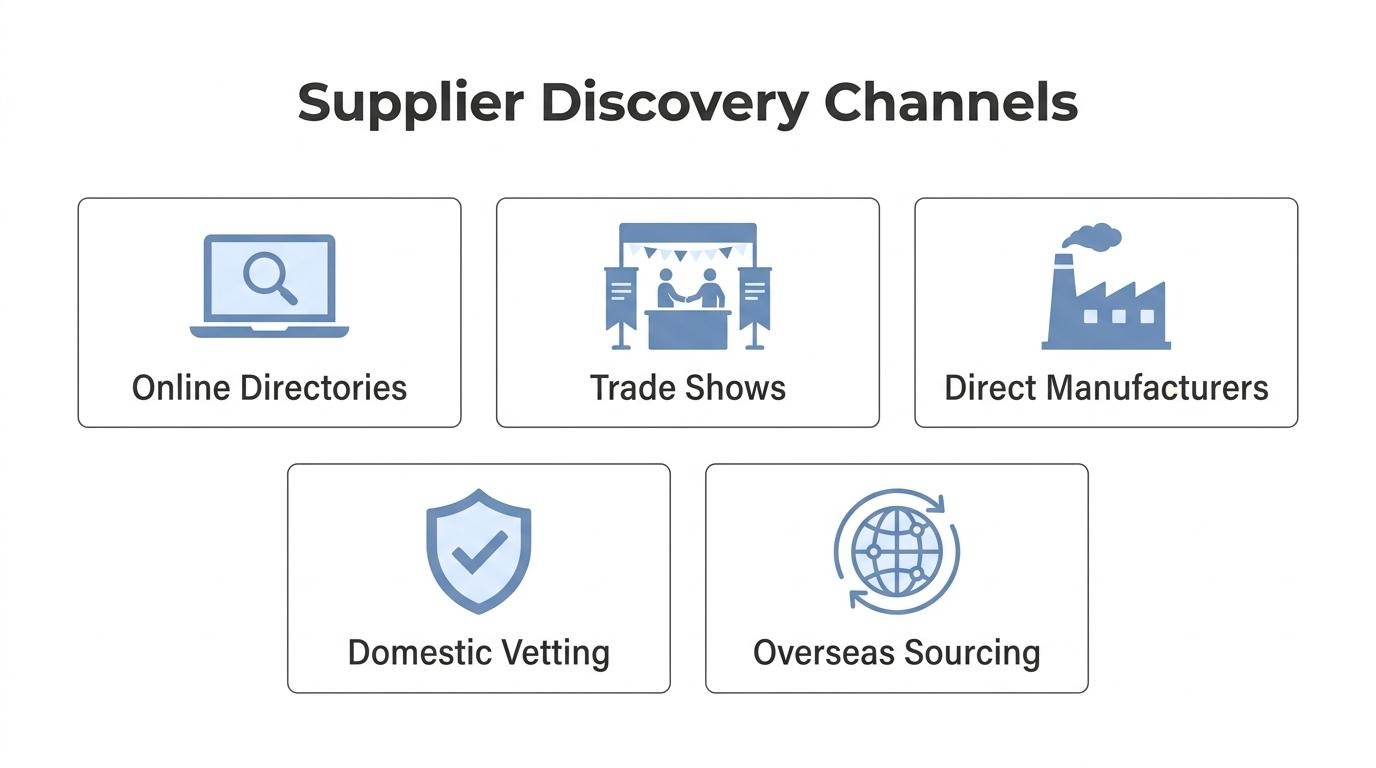
You source wholesale products through online directories by searching curated B2B platforms that connect verified wholesalers with buyers. Directories such as Alibaba, ThomasNet, Faire, and Wholesale Central aggregate supplier profiles by product category, MOQ, and region.
To evaluate directory listings effectively:
Cross-referencing directory suppliers against state business registrations adds another layer of legitimacy to your search.
You find wholesale suppliers at trade shows by attending industry-specific events where manufacturers, distributors, and wholesalers exhibit products in person. Shows such as ASD Market Week, NY NOW, and the National Hardware Show let buyers inspect product quality, negotiate pricing face-to-face, and build direct relationships.
Trade shows offer advantages that directories cannot replicate:
According to the National Protective Security Authority, due diligence on prospective suppliers should cover financial risks, reputational risks, reliability, and security. Applying that framework during in-person meetings produces stronger supplier partnerships.
You contact manufacturers directly for wholesale pricing by identifying the brands or product lines you want to carry, then reaching out through their official websites or sales departments. Most manufacturers list a "wholesale inquiries" or "become a retailer" page with application forms.
When making initial contact:
Buying directly from manufacturers often eliminates middleman markups, though MOQs tend to be higher than with wholesale distributors.
You vet domestic wholesale suppliers in the US by verifying their business credentials, order history, and operational reliability before committing funds. Start with these verification steps:
The FTC warns that pressuring you to act now is always a sign of a scam. Any supplier demanding immediate payment without providing verifiable credentials should be disqualified. Legitimate wholesalers expect due diligence and welcome it.
You source wholesale products from overseas suppliers by using international B2B platforms, attending global trade fairs, or hiring sourcing agents who specialize in specific regions. Common sourcing countries include China, India, Vietnam, and Turkey.
Key considerations for overseas sourcing:
Overseas suppliers frequently offer lower per-unit costs, but longer lead times and communication barriers require more structured inventory planning. With sourcing channels established, the next decision is choosing which wholesale buying model fits your business.
The types of wholesale buying models you should consider are traditional bulk wholesale, dropship wholesale, closeout and liquidation wholesale, white label and private label wholesale, and print on demand wholesale. Each model carries distinct trade-offs in capital outlay, inventory risk, and brand control.
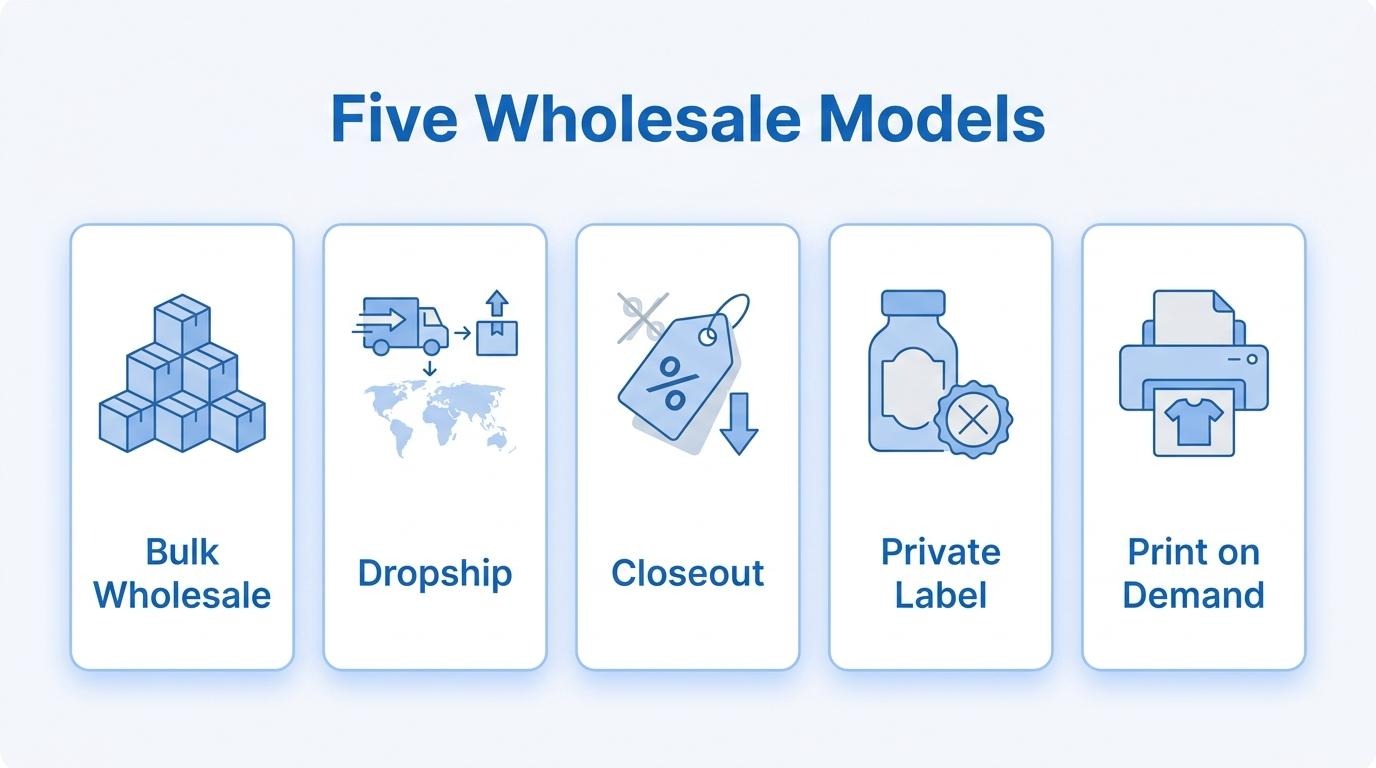
Traditional bulk wholesale is the standard model where a retailer purchases large quantities of finished goods from a supplier at discounted per-unit pricing. The buyer takes full ownership of inventory, stores it in a warehouse or fulfillment center, and ships orders directly to customers. This model delivers the lowest cost per unit but requires significant upfront capital. It works best for products with proven, predictable demand where the seller can confidently forecast sell-through rates. Warehoused goods tie up capital, so accurate demand planning is essential to avoid dead stock.
Dropship wholesale is a fulfillment model where the retailer sells products without holding physical inventory. When a customer places an order, the wholesaler or manufacturer ships directly to the end buyer. This eliminates warehousing costs and reduces upfront financial risk. However, margins are typically thinner because suppliers charge higher per-unit prices to cover individual fulfillment. The retailer also surrenders control over shipping speed, packaging quality, and stock availability. Dropship wholesale suits sellers testing new product categories or operating with limited capital, though it becomes harder to differentiate on customer experience at scale.
Closeout and liquidation wholesale involves purchasing excess, discontinued, or returned inventory at steep discounts, often 50% to 80% below original wholesale cost. Retailers can source these goods through liquidation marketplaces, auction platforms, or direct closeout deals with manufacturers clearing seasonal stock. The margin potential is high, but the trade-off is inconsistency. Product availability is unpredictable, quantities vary, and quality may be uneven with customer returns mixed into pallets. This model rewards sellers who can inspect, sort, and move inventory quickly rather than those who need a reliable, repeatable supply chain.
White label and private label wholesale are models where a retailer sells manufacturer-produced goods under its own brand name. White label products are generic items rebranded by multiple sellers, while private label products are custom-manufactured to the retailer's specifications. Both models offer higher margins and stronger brand differentiation than reselling branded goods. According to the FDA's 2010 Small Entity Compliance Guide, a distributor who contracts with a manufacturer to produce goods distributed under the distributor's own label must understand how manufacturing activities are performed to verify the product conforms to established specifications before approving it for distribution. This regulatory obligation makes supplier vetting and quality auditing critical for private label sellers.
Print on demand wholesale is a hybrid model where products are manufactured only after a customer places an order, with custom designs applied during production. Common product categories include apparel, accessories, home decor, and stationery. Like dropship wholesale, print on demand eliminates inventory risk and upfront stock investment. The key advantage is creative control: sellers can test unlimited designs without committing to bulk production runs. Per-unit costs run higher than traditional wholesale, and fulfillment timelines are longer since each item is produced individually. This model works well for niche audiences, limited-edition releases, or sellers prioritizing brand expression over volume pricing.
Understanding these buying models helps you match capital, risk tolerance, and brand goals to the right sourcing strategy before evaluating specific suppliers.
You evaluate wholesale products before committing by requesting samples, calculating true landed cost, and stress-testing quality at production volumes. The sections below cover each step.
You request and compare wholesale samples by contacting suppliers directly and ordering small quantities before placing a bulk commitment. Start by requesting samples from at least three suppliers for the same product category; this reveals differences in materials, construction, and packaging that catalog photos cannot show.
When comparing samples, evaluate them against a consistent checklist:
Pay for samples rather than accepting free ones. Free samples sometimes represent cherry-picked quality that does not reflect actual production runs. For brands scaling past early-stage operations, this small upfront cost prevents far larger losses from a mismatched bulk order.
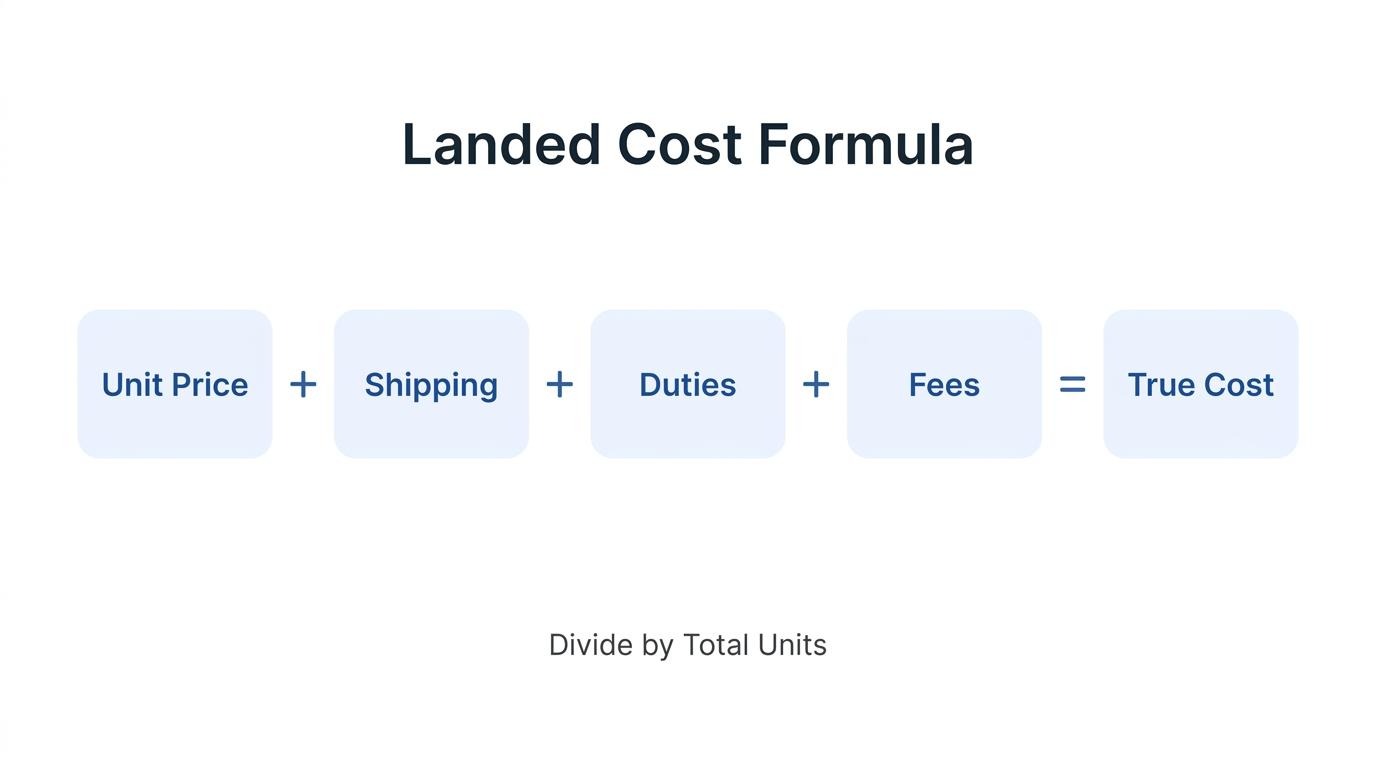
You calculate landed cost per unit by adding every expense incurred from the supplier's warehouse to your shelf. The formula is: unit price + shipping + customs duties + taxes + insurance + handling fees, divided by total units received.
According to the United States International Trade Commission, the Harmonized Tariff Schedule of the United States sets out tariff rates and statistical categories for all merchandise imported into the United States. Use your product's HTS code to determine the exact duty rate before committing to an international supplier.
Key cost components to include:
Many first-time buyers underestimate landed cost by 15–25% because they ignore duties, broker fees, and last-mile handling. Running the full calculation upfront protects your retail margin from silent erosion.
You assess product quality at scale by implementing inspection protocols that catch defects before inventory reaches your warehouse. Small sample batches often pass scrutiny, yet production runs at higher volumes introduce variability in materials, assembly, and finishing.
The ISO/IAF auditing practices guidance notes that it may be advantageous for organizations to audit external providers to establish clear lines of communication, product specifications, and delivery parameters. This applies directly to wholesale sourcing: set documented specifications covering acceptable defect rates, dimensional tolerances, and material grades before the first large order ships.
Practical quality controls include:
Consistent quality assessment protects both customer satisfaction and return rates. With product evaluation systems in place, the next step is negotiating pricing and terms that lock in favorable economics.
You negotiate wholesale pricing and terms by understanding minimum order quantities, structuring payment timelines, and building toward volume-based discounts. The following subsections cover MOQ expectations, payment negotiation with new suppliers, and strategies for earning volume discounts.
Minimum order quantities you should expect vary by product category, distribution channel, and supplier scale. According to the AbilityOne Commission's pricing policy, MOQs must be established for all products consistent with the distribution channel, contracting activity requirements, or industry standards, and prices may reflect savings in freight or volume discounts for large quantity purchases.
Typical MOQ ranges include:
Smaller retailers can often negotiate lower MOQs by accepting a higher per-unit price or by combining multiple SKUs into a single order.
You negotiate payment terms with new suppliers by establishing creditworthiness and proposing structured timelines that reduce risk for both parties. Most suppliers default to prepayment or cash on delivery for first-time buyers, then extend Net 30 or Net 60 terms after a track record forms.
Effective negotiation tactics include:
Written payment terms in your purchase agreement protect both sides if disputes arise.
You secure volume discounts over time by increasing order frequency, consolidating SKUs, and formalizing commitments through annual purchasing agreements. Suppliers reward predictability because it stabilizes their production schedules and reduces per-order overhead.
Key strategies for earning better pricing include:
For scaling DTC brands managing growing supplier relationships alongside storefront and inventory data, platforms that unify purchasing signals with sell-through analytics can inform when to trigger reorder negotiations.
You place your first wholesale order by preparing documentation, submitting a purchase order, confirming payment terms, and arranging logistics. The steps below walk through each stage from initial setup to receiving goods.
For brands managing multiple suppliers and sales channels simultaneously, running intake, inventory counts, and storefront updates through one system eliminates the reconciliation delays that come with toggling between disconnected tools.
You manage wholesale inventory without overselling by combining reorder point formulas, safety stock buffers, and real-time stock visibility across every sales channel.
Overselling occurs when available inventory falls below what has already been promised to customers. The reorder point formula prevents this: reorder point equals daily demand multiplied by lead time, plus safety stock. According to the University of Kentucky's inventory management framework, this calculation triggers replenishment before stock reaches zero.
Safety stock serves as the buffer against unpredictable demand spikes and supplier lead time variability. Factors that determine the right safety stock level include:
Warehoused goods tie up capital, so carrying excess inventory is costly. The goal is balancing enough stock to prevent stockouts against the carrying cost of holding too much. Brands selling through multiple storefronts, marketplaces, and POS locations face the highest overselling risk when each channel draws from a disconnected count.
For brands at this volume, centralizing inventory data inside one system rather than syncing between separate tools eliminates the lag that causes phantom availability. With inventory controls in place, the legal and tax structure around wholesale purchases becomes the next priority.
Wholesale buying requires attention to sales tax exemption rules and well-structured purchase agreements. The subsections below cover how tax exemptions function and what contract terms protect your business.
Sales tax exemption for wholesale purchases works by allowing registered resellers to buy inventory without paying sales tax at the point of purchase. Instead, the end consumer pays sales tax when the product is sold at retail.
To claim this exemption, you need a valid resale certificate (sometimes called a seller's permit or Certificate of Authority, depending on your state). You present this document to your wholesale supplier, certifying that the goods are purchased for resale rather than personal use. According to the New York State Department of Taxation and Finance, the Certificate of Authority gives you the right to collect tax on taxable sales and to issue and accept sales tax exemption certificates.
Key points to understand:
Maintaining organized exemption records is one of the most overlooked compliance steps for growing brands, yet it directly prevents costly audit exposure.
Your wholesale purchase agreement should include clearly defined terms covering pricing, delivery, quality standards, and dispute resolution. A written contract protects both buyer and supplier when expectations need enforcement.
Essential elements to include:
For brands scaling past their first few suppliers, formalizing these agreements early prevents the kind of ambiguity that turns minor shipping delays into major operational disruptions.
With legal and tax frameworks in place, avoiding common purchasing mistakes becomes the next priority.
The common wholesale buying mistakes you should avoid include over-ordering untested products, skipping supplier due diligence, ignoring landed cost calculations, and neglecting proper inspection at delivery. Each error compounds into margin erosion and operational drag.
For brands managing wholesale inventory across multiple sales channels, disjointed tools often cause the data gaps that make these mistakes worse. Consolidating operations early builds the visibility needed to catch problems before they erode profit.
You sell wholesale products profitably through DTC channels by setting retail margins that cover landed costs, building a catalog optimized for conversion, and reordering based on real sell-through data. The sections below break down each step.
You set retail margins on wholesale goods by calculating your total landed cost per unit, then applying a markup that covers operating expenses and leaves a target profit. The distinction matters: margin is based on revenue, while markup is based on cost, so margins are always lower than markups for the same dollar amount, as noted by the Massachusetts Department of Agricultural Resources.
A common starting point is the keystone method, which doubles the wholesale cost. However, DTC sellers should factor in shipping, storage, marketing spend, and platform fees before settling on a final price. For most product categories, aiming for a 50% or higher gross margin gives enough room to absorb promotional discounts and still remain profitable. Pricing too close to wholesale leaves no buffer for inevitable cost fluctuations.
You build a product catalog that converts by combining strong product pages with social proof and strategic promotional positioning. A study published in the International Journal of Production Research found that variables from both online reviews and promotional marketing strategies are important predictors of product demand.
Practical steps to increase catalog conversion include:
Catalog structure should guide shoppers toward best-selling and highest-margin items first, rather than presenting every SKU with equal weight.
You manage wholesale reorders based on sell-through data by tracking your sell-through rate, which measures the percentage of inventory sold within a specific period relative to what was received. This metric directly informs when and how much to reorder.
The core formula is straightforward: reorder point equals daily demand multiplied by lead time, plus safety stock. Monitoring sell-through weekly reveals which SKUs move fast enough to justify larger orders and which ones tie up capital unnecessarily. Slow movers may need markdowns or bundle inclusion rather than restocking.
For brands scaling past spreadsheet-based tracking, centralizing inventory, sales, and order data in one system removes the guesswork that leads to overstocking or stockouts.
You streamline wholesale operations by consolidating inventory, CRM, and storefront functions into a single system instead of managing disconnected tools. The following sections cover what changes with unified data and the key takeaways for buying wholesale.
What changes is that stock levels, customer records, and product listings update from a single source of truth, eliminating manual reconciliation between separate platforms. Order data flows directly into inventory counts, so overselling and stockouts become far less frequent.
For brands managing international sourcing, this matters even more. According to the World Customs Organization, the Harmonized System is used by more than 200 countries and economies as a basis for customs tariffs and international trade statistics. When product classification codes, landed costs, and tariff data live alongside your storefront catalog, compliance errors drop significantly.
The real operational shift is not just efficiency; it is decision speed. Brands running five to fifteen disconnected tools spend more time syncing data than acting on it. SHOPLINE is one option for brands consolidating inventory, CRM, and storefront into a shared data layer rather than reconciling across separate apps.
The key takeaways about how to buy wholesale products center on preparation, supplier vetting, and operational discipline:
Buying wholesale successfully is less about finding the cheapest price and more about building a repeatable procurement system that scales without multiplying manual work at every step.