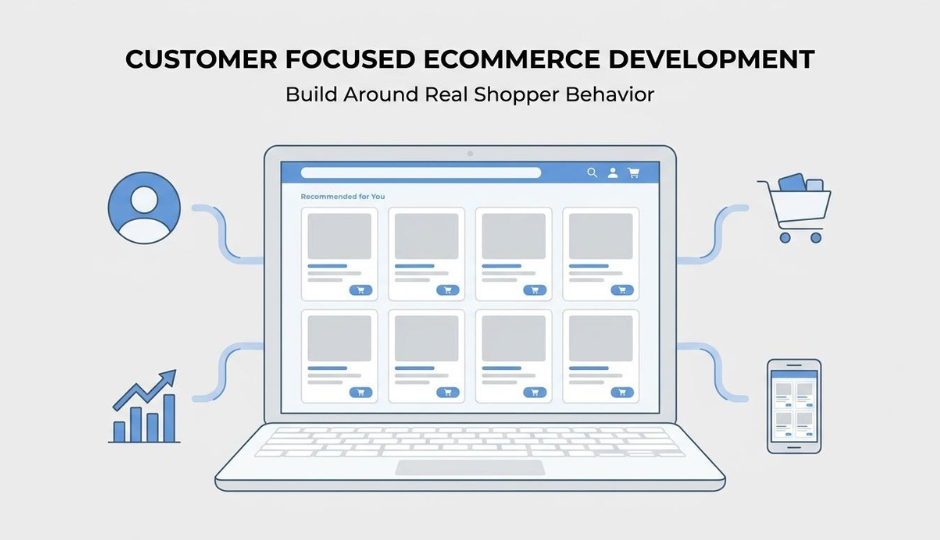
Customer ecommerce development is the practice of building and evolving an online store around actual shopper behavior, preferences, and lifecycle needs rather than internal feature checklists. It treats site experience, data architecture, and post-purchase engagement as interconnected parts of one system.
This guide covers customer-centric design principles, core development elements, data collection strategy, stage-specific growth priorities, common operational mistakes, performance measurement, and platform consolidation.
Customer-centric design starts with why this orientation matters: U.S. ecommerce sales reached an estimated $1,192.6 billion in 2024, so even small improvements in conversion or retention translate into significant revenue gains. Personalization, unified data, and streamlined checkout are the architecture decisions that capture that opportunity.
The core development elements span personalized shopping experiences powered by AI and big data, unified customer profiles built through real-time data platforms, simplified checkout flows that counter the 88.5% global cart abandonment rate, mobile-first design for the device where most discovery happens, and native loyalty and subscription mechanics that give buyers a structural reason to return.
Effective data collection fuels every element above. Behavioral signals expose navigation friction, purchase history reveals reorder timing and cross-sell patterns, and direct feedback surfaces qualitative problems that analytics alone miss; all governed by privacy frameworks like the CCPA.
Development priorities shift as brands grow. Early-stage businesses focus on clean conversion fundamentals, mid-stage brands build segmentation and lifecycle systems, and scaling operations past ten million in revenue consolidate fragmented tools into unified architecture that supports advanced personalization.
Measurement closes the loop through retention rates, on-site usability scores, and revenue-per-customer metrics like CLV. We also cover why disconnected apps, siloed data, and manual workflows are the most common barriers to sustained growth, and how consolidating storefront, CRM, and automation into one system eliminates them.
Customer-focused ecommerce development is the practice of building and evolving an online store around actual customer behavior, preferences, and lifecycle needs rather than internal assumptions or feature checklists. It treats shopper data, site experience, and post-purchase engagement as interconnected parts of one system.
This approach spans personalization, unified data architecture, streamlined checkout, and retention mechanics. Rather than bolting on tools reactively, customer-focused development aligns every technical decision with how real buyers discover, evaluate, purchase, and return to a brand. According to the U.S. Census Bureau, total ecommerce sales for 2024 were estimated at $1,192.6 billion, an increase of 8.1 percent from 2023, with ecommerce accounting for 16.1 percent of total sales. That scale makes the quality of each customer interaction a direct revenue lever. For brands operating at volume, even small friction points in navigation, checkout, or reorder flows compound into measurable losses.
Customer-focused development differs from general web development in one critical way: every architecture and design choice starts with a customer outcome, not a feature spec. The sections ahead break down why this orientation matters, what its core elements are, and how to apply it at different business stages.
Customer-centric development matters for ecommerce because it aligns every technical decision with how real shoppers browse, buy, and return. The subsections below cover market scale, the revenue impact of personalization, and why retention outweighs acquisition cost.
The ecommerce market is enormous, and still expanding. According to the U.S. Census Bureau's Q4 2024 report, total U.S. ecommerce sales reached an estimated $1,192.6 billion in 2024, an 8.1 percent increase from 2023. That volume, representing 16.1 percent of all retail sales, means even small conversion or retention improvements translate into significant revenue gains. Brands that build their sites around customer needs capture a disproportionate share of this growth, while those relying on generic, one-size-fits-all storefronts compete on price alone. When the addressable market is this large, the cost of ignoring how customers actually interact with your site compounds quickly.
Personalization is no longer optional; it is a measurable revenue driver. McKinsey research found that personalization most often drives 10 to 15 percent revenue lift, with company-specific results spanning 5 to 25 percent depending on sector and execution quality. Customer-centric development makes this possible by embedding personalization into the site's architecture rather than bolting it on through disconnected tools. Product recommendations, dynamic content, and tailored checkout flows all depend on development choices that prioritize the customer's journey over internal convenience.
Retention economics make the case even clearer. A 2024 study published in Cogent Business & Management confirmed the pivotal role of customer lifetime value in influencing financial metrics, notably market valuation. When development decisions focus on post-purchase experience, loyalty mechanics, and seamless repeat ordering, CLV rises. Sites built around acquisition alone leak value at every stage after the first purchase. For brands operating at scale, the gap between a one-time buyer and a loyal repeat customer often determines whether the business is profitable or simply busy.
For scaling DTC brands juggling multiple tools, customer-centric development is also an operational question. Fragmented stacks create data silos that make it harder to understand each customer holistically, which directly undermines the personalization and retention strategies above. Developing with the customer at the center means fewer integration gaps and faster execution on the changes that actually move revenue.
Understanding why this approach matters sets the stage for exploring the core elements that bring it to life.
The core elements of customer ecommerce development are personalized shopping experiences, unified customer data, streamlined checkout flows, mobile-first design, and built-in loyalty and subscription features. Each element addresses a specific stage of the buyer journey.
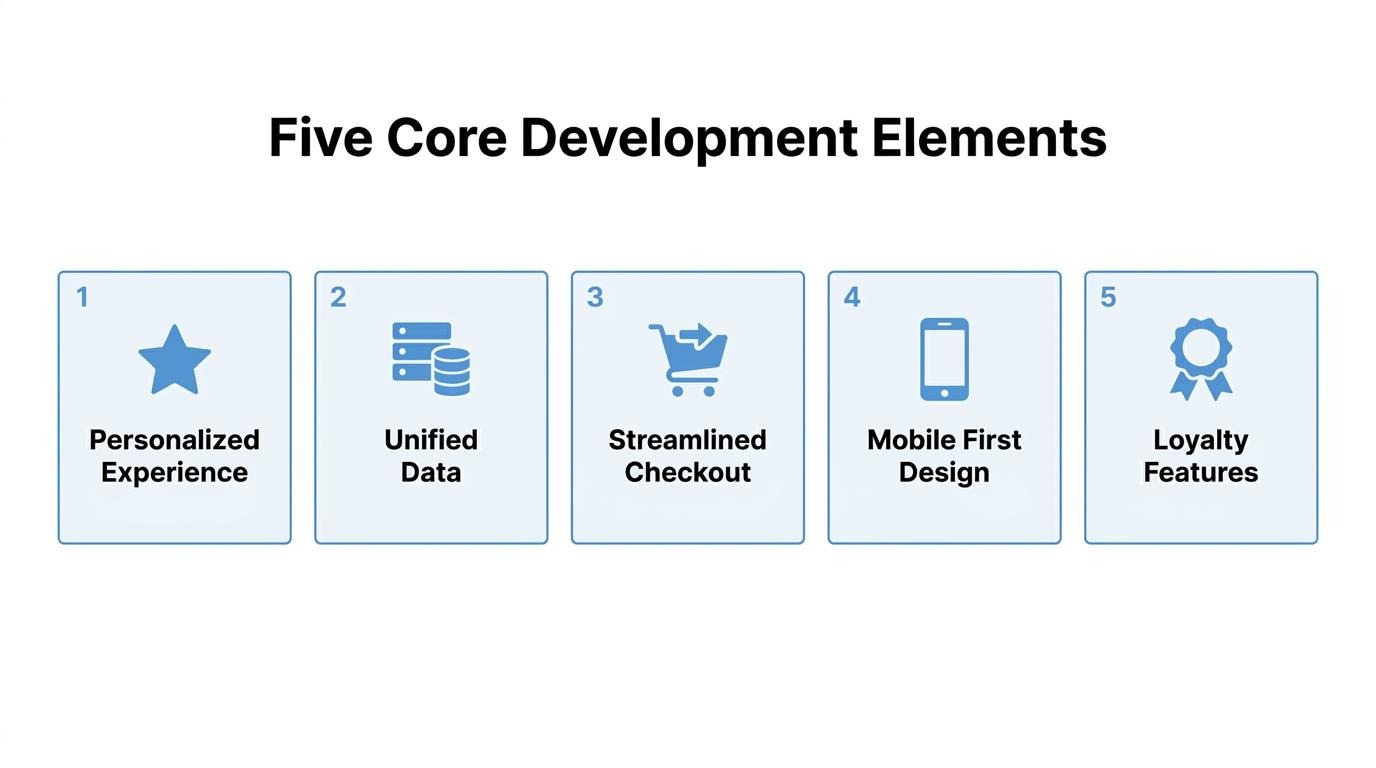
Personalized shopping experience drives conversions by matching product recommendations, content, and offers to individual customer behavior and preferences. AI and big data make this possible at scale; when customers see relevant products faster, they move from browsing to buying with less friction.
According to Pereira et al. in the Journal of Theoretical and Applied Electronic Commerce Research, emerging technologies including artificial intelligence and big data significantly impact customer experience, trust, and engagement, with personalization emerging as a fundamental driver of customer retention.
Headless commerce architecture supports this by decoupling front-end presentation from back-end systems through API-driven communication and microservices. That separation allows brands to deliver tailored experiences across web, mobile, and IoT without rebuilding core infrastructure. For brands already managing multiple customer touchpoints, investing in personalization infrastructure early pays compounding returns over time.
Unified customer data improves site performance by consolidating browsing behavior, purchase history, and channel interactions into a single customer profile that informs every system decision. When product recommendations, search results, and marketing messages all draw from one data source, pages load with relevant content instead of generic defaults.
According to the Customer Data Platform Institute, a CDP ingests data from any source, captures full detail, builds unified and persistent customer profiles, and makes that data available in real time to other systems. This real-time availability reduces redundant API calls between disconnected tools, which directly improves page responsiveness. Research published in Humanities and Social Sciences Communications found that omnichannel and standalone websites accounted for two-thirds of overall shopping behavior, reinforcing why a shared data layer across channels matters for consistent site experience.
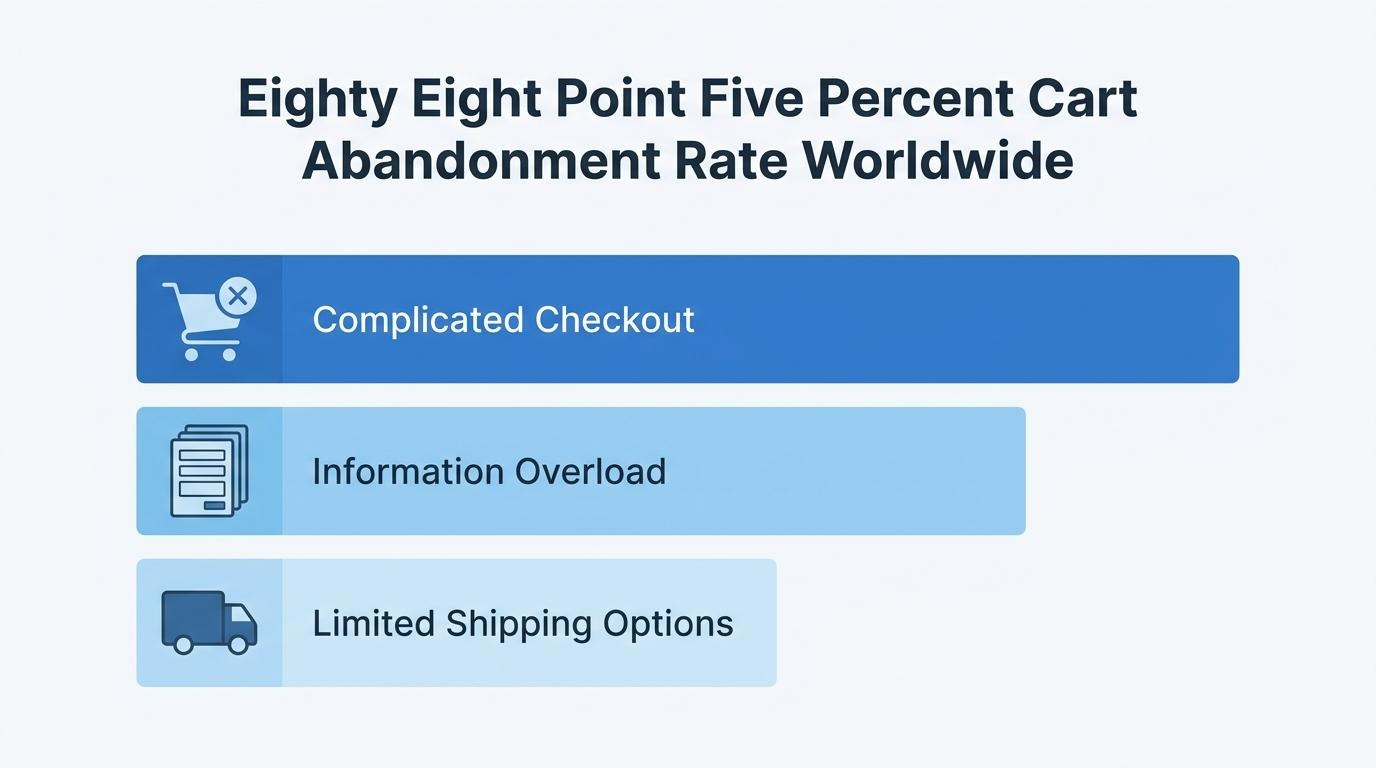
Streamlined checkout flows reduce cart abandonment by removing the friction points that cause shoppers to leave before completing a purchase. The worldwide shopping cart abandonment rate sits at 88.5%, according to a study by Ong et al. published in Frontiers in Psychology via PubMed Central (citing Statista, 2021).
Research published by BINUS University's CommIT Journal confirms that complicated checkout emerges as the most significant variable driving abandonment, alongside:
- Information overload during the payment process
- Complicated return and refund policies
- Limited shipping options at the final step
Reducing form fields, offering guest checkout, displaying shipping costs early, and supporting multiple payment methods directly counter these triggers. Every unnecessary click or unclear label in a checkout flow is a measurable leak in your conversion funnel.
Mobile-first design affects customer engagement by prioritizing the device most shoppers use to browse, compare, and buy. When layouts, navigation, and interactive elements are built for smaller screens first, touch targets stay accessible, pages load faster, and content hierarchy stays clear without pinching or scrolling sideways.
Responsive design alone is not sufficient. Mobile-first means structuring information architecture around thumb-friendly navigation, compressed image delivery, and simplified forms before scaling up to desktop. Sites that treat mobile as an afterthought force users into awkward workarounds, which increases bounce rates and suppresses time on site. For brands selling across social channels and mobile apps, this design philosophy ensures the storefront experience matches the context where discovery actually happens.
Built-in loyalty and subscription features boost retention by giving customers a structural reason to return rather than relying solely on promotional emails or paid retargeting. Native loyalty programs reward repeat purchases with points, tiers, or exclusive access, while subscription features automate recurring orders for consumable products.
According to Pereira et al. in the Journal of Theoretical and Applied Electronic Commerce Research, personalization and digital innovation are fundamental drivers of customer retention in the digital environment. When loyalty mechanics and subscription management live inside the ecommerce platform rather than as third-party integrations, the customer data stays connected to purchase history, browsing behavior, and lifetime value calculations. This eliminates sync delays between separate tools and keeps retention workflows responsive.
Understanding what customer data to collect is the next step in making these elements work together.
The customer data you should collect to inform development includes behavioral signals, purchase history, and direct feedback. Each category serves a different purpose in shaping site experience and retention strategy.
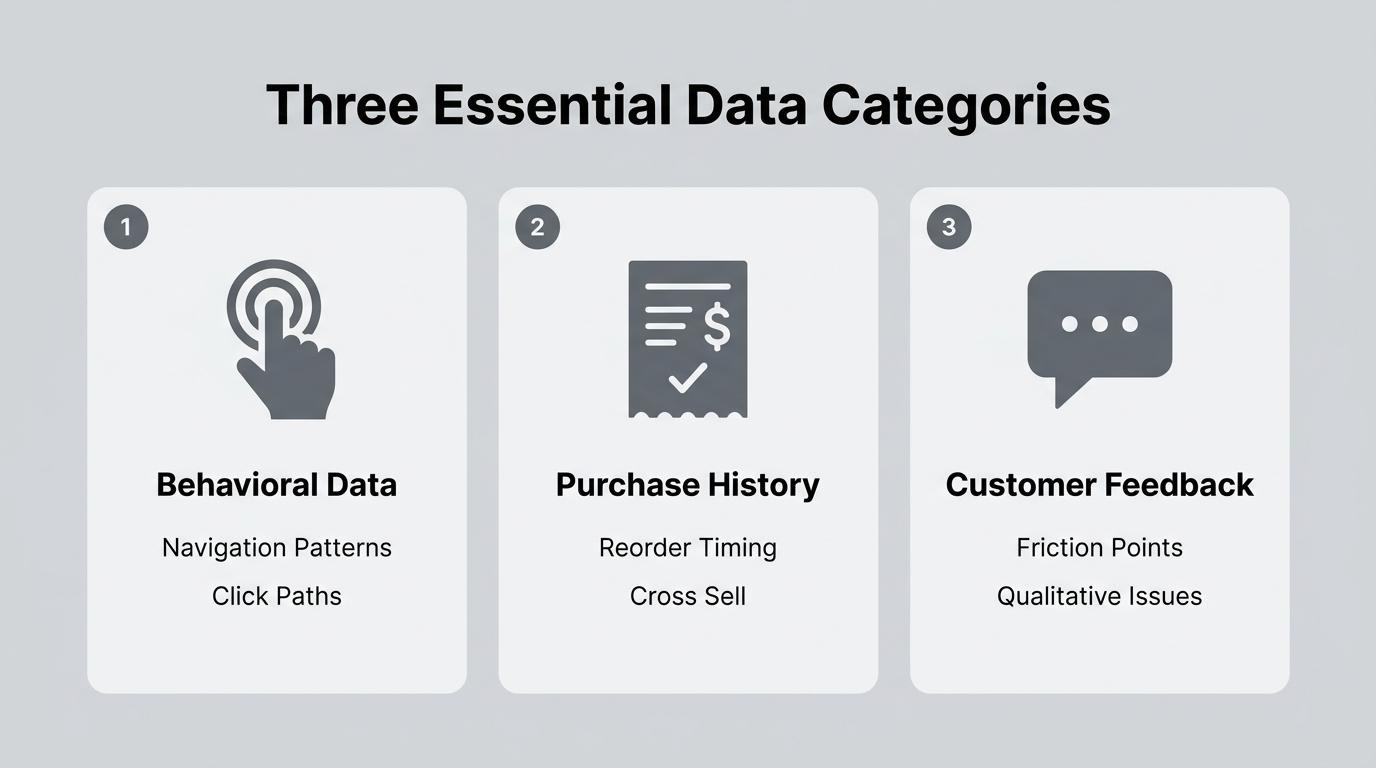
Behavioral data reveals how shoppers navigate your site by tracking actions such as page views, click paths, scroll depth, search queries, and session duration. These signals expose where visitors engage, hesitate, or abandon a flow.
According to the Federal Trade Commission, websites and shopping apps often collect personal information like names, mailing addresses, phone numbers, and emails, along with details about purchases including price, timing, and payment method. Behavioral data extends beyond these static fields into real-time interaction patterns. Heatmaps, for example, show exactly which product images or CTAs attract attention and which ones get ignored. This navigational layer is arguably the most underused dataset in ecommerce; brands that monitor it consistently spot UX problems weeks before they show up in revenue dips.
Purchase-history data shapes repeat-buy strategies by revealing buying frequency, average order value, product affinities, and reorder timing. These patterns identify which customers are one-time buyers versus high-value repeat purchasers.
Key purchase-history data points that inform repeat-buy tactics include:
- Product category sequences that show cross-sell and upsell opportunities.
- Time between orders that determines optimal re-engagement windows.
- Average order value trends that signal willingness to spend more over time.
- Discount sensitivity that indicates which segments respond to promotions versus full-price offers.
Mapping this data to lifecycle stages turns reactive marketing into predictable revenue. Without it, retention campaigns rely on guesswork rather than demonstrated customer behavior.
Feedback and survey data uncovers friction points by capturing qualitative signals that behavioral and transactional data miss, such as confusing return policies, unclear sizing, or slow support response. Post-purchase surveys, NPS scores, and on-site exit polls provide direct customer language about what frustrated them.
Boston Consulting Group recommends that companies prioritize gathering what they need to fuel customized experiences and invest in data engineering that creates a single source of truth, updated at appropriate frequency. Feedback data feeds directly into that single source by surfacing problems customers articulate themselves. One important constraint: the California Consumer Privacy Act (CCPA) grants consumers the right to know what data a business collects, to delete it, and to opt out of its sale or sharing. Every feedback collection mechanism must respect these rights.
Understanding which data to collect is only part of the equation; how you act on it depends on your business stage and growth trajectory.
Customer ecommerce development differs by business stage because each revenue tier carries distinct operational demands, data complexity, and infrastructure needs. Early-stage brands focus on foundational conversion, mid-stage brands build retention systems, and scaling brands invest in unified architecture and personalization.
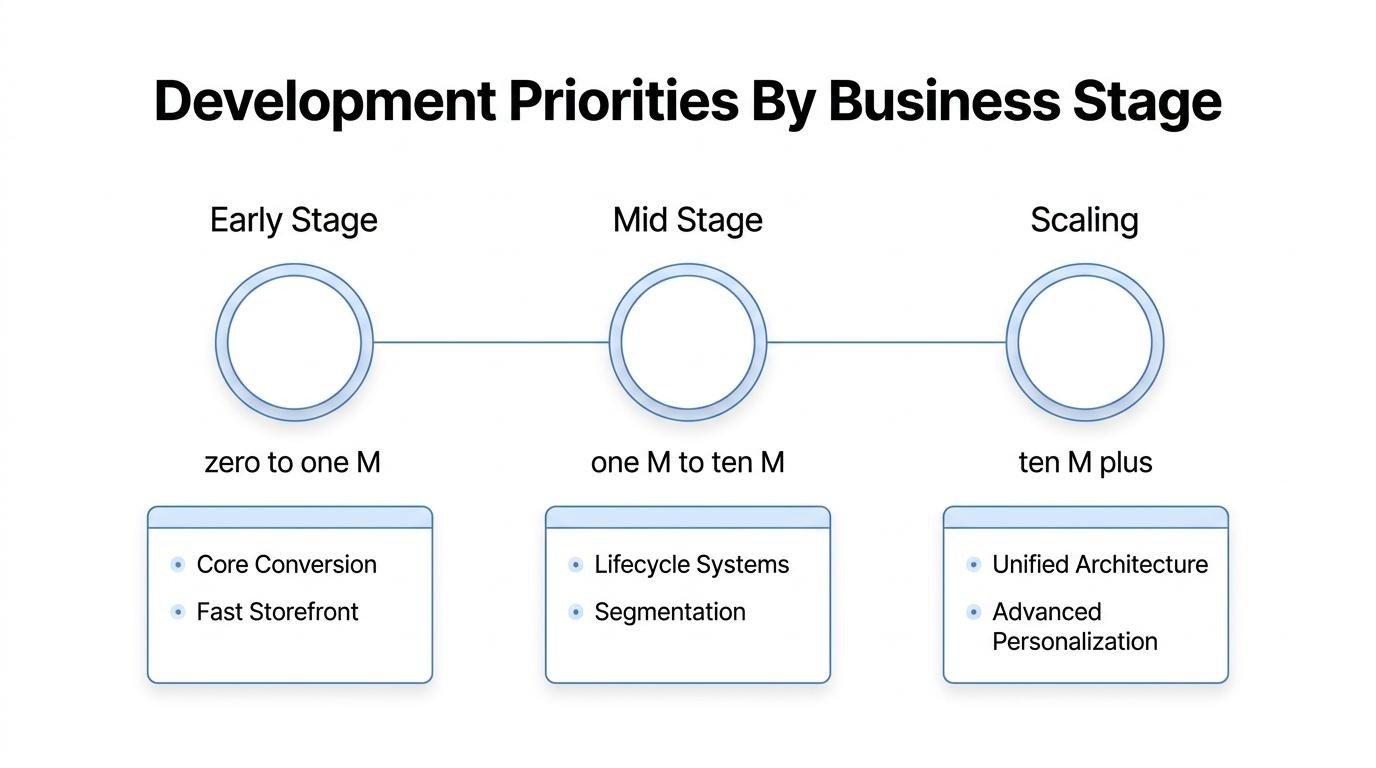
Early-stage brands should prioritize development around core conversion fundamentals before adding complexity. At this stage, the goal is validating product-market fit through a clean, fast storefront that removes purchase friction.
Key priorities for early-stage ecommerce development include:
- Building a mobile-responsive storefront with fast page loads.
- Simplifying checkout to the fewest possible steps.
- Collecting basic behavioral and purchase data from day one.
- Setting up foundational email capture and post-purchase flows.
Resist the urge to layer on advanced tooling prematurely. A lean, well-executed storefront that converts consistently is more valuable at this stage than a complex multi-app stack that fragments your data before you have enough of it to act on.
Brands at one to ten million in revenue should approach customer ecommerce development by shifting from acquisition-only tactics to structured retention and lifecycle systems. Revenue at this level typically signals enough purchase history and customer volume to make segmentation and repeat-buy strategies meaningful.
Development priorities at this stage include:
- Implementing customer segmentation based on purchase frequency and order value.
- Launching lifecycle marketing flows for win-back, cross-sell, and post-purchase engagement.
- Integrating online and offline data if physical retail or events generate sales.
- Evaluating whether the current tool stack creates data silos that slow decision-making.
According to UNCTAD, global business e-commerce sales reached nearly $27 trillion in 2022, reflecting the scale of opportunity for brands building operational maturity at this tier.
Brands scaling past ten million should evolve their stack by consolidating fragmented tools into unified systems that support advanced personalization, omnichannel operations, and real-time customer data activation. At this revenue level, the cost of disconnected apps compounds: duplicated data, inconsistent customer experiences, and manual workflows that consume operator time.
According to Deloitte Digital's "Personalizing Growth" research, brands incorporating personalization as a core experience strategy has risen 50% since 2022, with brands expecting to increase annual personalization budgets by 29% year over year. That level of investment only pays off when the underlying data architecture can support it without reconciling records across five or six separate platforms.
Scaling brands benefit most from prioritizing a shared customer data layer, native subscription and loyalty mechanics, and lifecycle automation that operates from a single system of record. Understanding measurement frameworks also becomes critical, since attributing revenue to specific development investments requires clean, unified data.
Common mistakes that undermine customer development include relying on disconnected apps, keeping online and offline data siloed, and running manual workflows past the point where they can scale. Each of these errors compounds over time, quietly eroding the unified customer view that growth depends on.
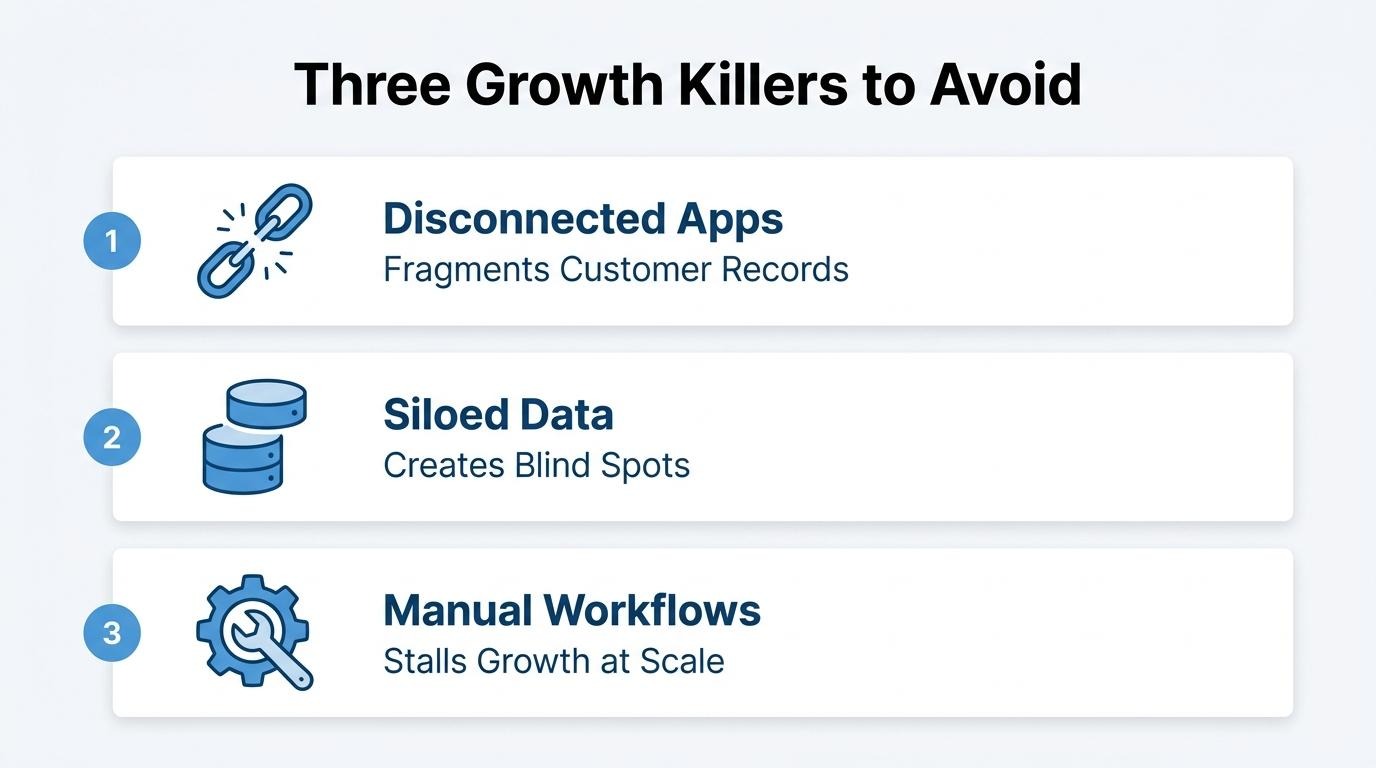
Relying on too many disconnected apps fragments customer data across systems that were never designed to share information. Each tool, whether for email, subscriptions, loyalty, or analytics, captures a partial view of customer behavior. Reconciling those views requires manual exports, middleware, or custom integrations that break when any single vendor updates its API.
The operational cost is not just financial. Teams spend hours troubleshooting sync errors instead of optimizing the customer experience. According to NASCIO survey data cited by the Texas Department of Information Resources, risk of migration ranks among the top concerns of state CIOs, and organizations increasingly seek to cluster systems under common plans to ease integration across operational lines.
For scaling ecommerce brands, this fragmentation problem intensifies with every new app added to the stack. Consolidating toward fewer, natively connected systems is almost always more sustainable than stitching together ten specialized tools that each hold a slice of the customer record.
Online and offline data staying siloed creates blind spots in customer profiles that directly weaken personalization, retention campaigns, and inventory decisions. A customer who buys in-store becomes invisible to the email automation platform, while an online browser's preferences never reach the POS system.
This disconnect means lifecycle marketing targets the wrong segments, loyalty rewards miss qualifying purchases, and reorder prompts arrive for products a customer already bought in person. The result is a disjointed experience that erodes trust and suppresses repeat purchase rates.
Brands operating both channels need a shared data layer that resolves each customer to a single record regardless of where they transact. Without that unification, even sophisticated marketing tools underperform because the data feeding them is incomplete.
Manual workflows stall growth after initial traction because tasks that worked at low volume, such as spreadsheet-based segmentation, hand-tagged orders, and copy-paste fulfillment updates, collapse under rising order counts. What once took one team member thirty minutes a day can consume an entire operations team by the time revenue crosses the mid-seven-figure mark.
The hidden cost is opportunity loss. While staff members reconcile data or trigger campaigns manually, competitors with automated lifecycle systems respond to customer behavior in real time. Automation does not just save hours; it enables the speed of execution that separates brands that plateau from those that scale.
Addressing these operational bottlenecks early, before they become entrenched, gives brands the clearest path to sustaining momentum through their next growth phase.
You measure the impact of customer-focused development through retention metrics, on-site experience indicators, and revenue-per-customer calculations. Each metric category isolates a different dimension of how development quality translates into business results.
Retention metrics that reflect development quality include repeat purchase rate, customer churn rate, and time between orders. Repeat purchase rate measures the percentage of customers who buy more than once within a defined period; a rising rate signals that site improvements are encouraging return visits. Churn rate tracks how many customers stop purchasing entirely, making it a direct indicator of whether development changes create lasting value or introduce friction. Time between orders reveals whether features like saved carts, reorder flows, and personalized recommendations shorten the repurchase cycle. Monitoring these metrics monthly helps isolate which development updates move the needle on loyalty versus those that have no measurable effect.
On-site experience metrics that track usability gains include bounce rate, pages per session, task completion rate, and checkout completion rate. Each metric captures a different layer of how visitors interact with development changes. A 2022 study published in Service Science found that perceived channel integration impacts retail brand experience, which in turn impacts service convenience, satisfaction, and patronage intention. Metrics to prioritize for usability tracking include:
- Bounce rate on key landing pages, indicating whether content and layout meet visitor expectations.
- Pages per session, revealing how intuitively the site architecture guides exploration.
- Task completion rate for flows like account creation, product filtering, and checkout.
- Core Web Vitals scores, connecting page speed and interactivity to real user experience.
Revenue-per-customer metrics that show lifetime value growth include average order value, customer lifetime value, and revenue per returning visitor. Average order value tracks whether cross-sell modules, bundling features, and dynamic recommendations increase basket size per transaction. Customer lifetime value aggregates total revenue from a single customer across their full relationship with the brand, making it the most comprehensive indicator of development ROI. According to McKinsey, personalization most often drives 10 to 15 percent revenue lift, with company-specific results spanning 5 to 25 percent depending on sector and execution ability. Revenue per returning visitor isolates how much value development improvements generate from existing customers versus new acquisition spend. For brands evaluating whether platform investments compound over time, CLV trend lines matter more than any single-month snapshot.
With clear measurement frameworks in place, the next step is choosing a platform approach that supports these metrics natively.
You should approach customer development when outgrowing a multi-tool stack by consolidating storefront, CRM, and automation into a unified system rather than attempting a risky all-at-once rebuild. The sections below cover what changes with platform unification and the key takeaways from this article.
What changes when storefront, CRM, and automation live in one system with SHOPLINE is that customer profiling, lifecycle triggers, and attribution data share a single record, eliminating the sync failures common in multi-app setups. Automated profiling uses behavioral and purchase data to predict interests and suggest relevant content aligned with each customer's profile, according to UK Information Commissioner's Office guidance on content delivery personalization.
This consolidation also removes the "big bang" migration risk. Instead of a waterfall rebuild that goes over budget and behind schedule, brands can migrate incrementally. In all-in-one platforms where commerce, marketing automation, subscriptions, and POS operate from a shared data layer, measurement methodologies like incrementality testing and aggregated attribution can run against consistent data rather than reconciled exports from disconnected tools.
For operators at the $1M to $50M stage, this single-system approach reduces both tool cost and the operational drag of managing five to fifteen separate apps.
What Are the Key Takeaways About Customer Ecommerce Development We Covered?
The key takeaways about customer ecommerce development covered in this article are:
- Customer-focused ecommerce development prioritizes unified data, personalized experiences, and streamlined checkout flows over feature quantity.
- Behavioral, purchase-history, and feedback data should inform every development decision, collected with clear consent under privacy regulations.
- Development priorities shift by business stage: early-stage brands focus on core flows, mid-stage brands invest in personalization and retention, and scaling brands consolidate fragmented stacks.
- Disconnected apps, siloed online and offline data, and manual workflows are the most common mistakes that stall growth after initial traction.
- Retention metrics, on-site usability scores, and revenue-per-customer indicators are the clearest signals that development investments are working.
Brands that treat customer development as an ongoing architecture decision, not a one-time project, build the operational foundation for sustained lifetime value growth. Results may vary depending on implementation, industry, and scale.