Wholesale product pricing is the per-unit price a manufacturer or supplier charges retailers, distributors, and resellers for bulk purchases. It functions as the foundation of every downstream pricing decision, from retail shelf price to DTC storefront price to MAP policy.
This guide covers cost analysis, pricing formulas, industry-specific margins, channel strategy, and long-term price management.
Accurate wholesale pricing starts with mapping every cost that feeds into a single unit: cost of goods sold, overhead allocation, shipping and fulfillment, and payment processing fees. Missing any category creates a floor price that slowly bleeds cash, even when sales volume looks healthy.
Five core pricing formulas, including absorption (cost-plus), keystone markup, MSRP-based, tiered volume, and competitive pricing, each suit different product categories and margin structures. Absorption pricing traces all fixed and variable production costs to the unit before adding markup, while keystone pricing uses a simple 2x multiplier that many retailers treat as the default expectation.
Target wholesale gross margins vary sharply by industry. Fashion brands typically aim for 30–50%, beauty brands for 40–60%, and food and beverage brands for 25–35%. Perishability, sourcing costs, and promotional frequency all compress or widen these ranges.
Selling through both wholesale and DTC channels requires deliberate price separation, MAP enforcement, and exclusive product assortment to prevent retail partner conflict. Minimum order quantities, volume discount tiers, and consistent pricing policies protect margins while keeping buyer relationships intact.
Wholesale pricing is not a launch-day calculation. Input costs, tariffs, and competitive shifts require regular reviews; brands that treat pricing as a living system maintain healthier margins as they scale.
Wholesale pricing is the price a manufacturer or supplier charges retailers, distributors, or other resellers for goods purchased in bulk. It matters because it determines profit margins for every business in the supply chain, from producer to end consumer.
A wholesale price is lower than the retail price because the businesses reselling the product need to mark it up to cover their own costs and earn a profit. According to the Massachusetts Department of Agricultural Resources, industry standards for margins along the supply chain typically range from 20–60% for retailers, 20–30% for distributors, and 5–15% for brokers. These layered margins mean the wholesale price you set creates a ceiling on what every downstream partner can earn.
Getting wholesale pricing right serves three purposes:
For brands selling across both wholesale and direct-to-consumer channels, the wholesale price also functions as an internal benchmark. Price it too close to your DTC price and you create channel conflict; price it too far below and you erode perceived value. The wholesale figure is not just a number on an invoice. It is the foundation every other pricing decision rests on, and miscalculating it compounds errors across the entire business.
Wholesale pricing differs from retail pricing in who pays, what volume is purchased, and how markup is applied. The sections below cover how each price tier functions, the role of markup, and the legal guardrails that govern differential pricing.
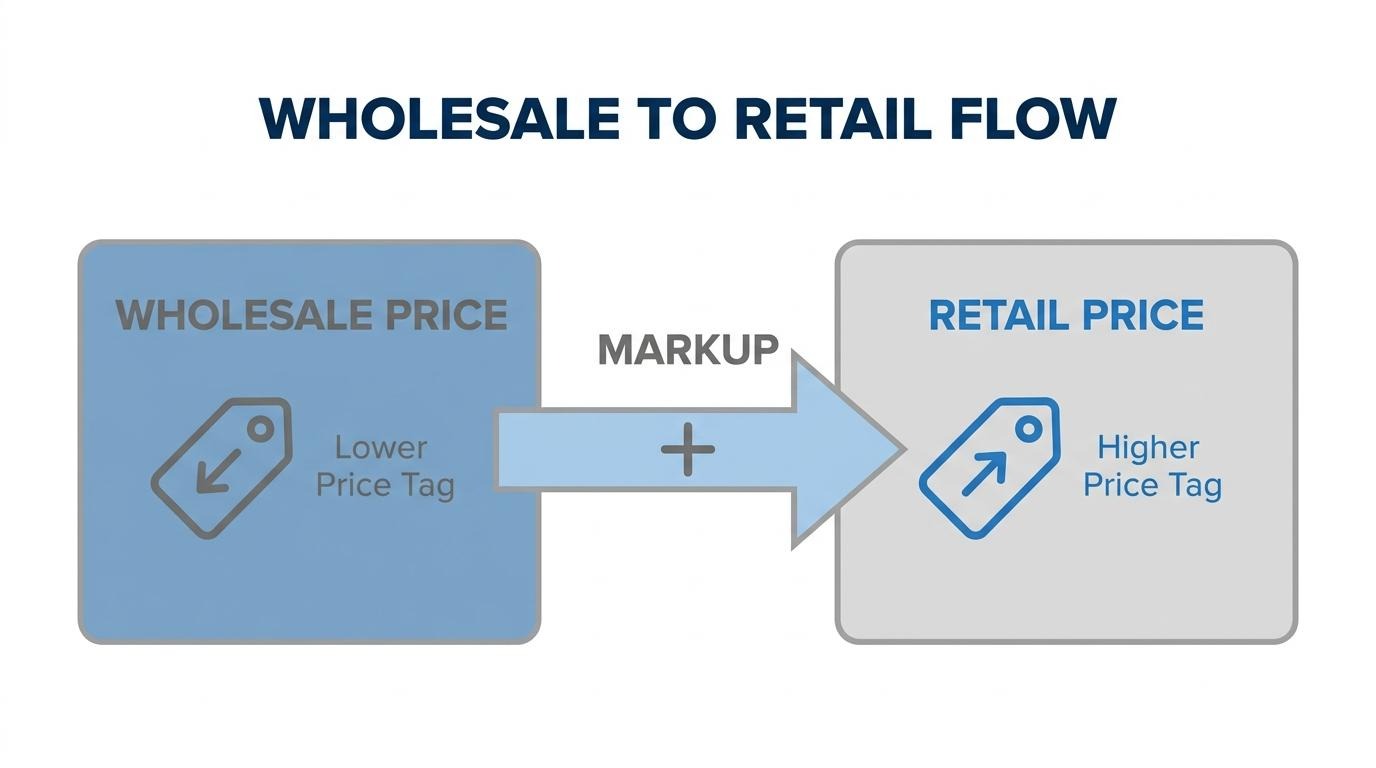
Wholesale pricing sets a lower per-unit price that manufacturers or distributors charge retailers, who then add markup before selling to end consumers. According to Virginia Tech Publishing's Fundamentals of Business, a cost-based approach on a product costing $40 might add $10 profit and charge retailers $50, while a demand-based approach could set the wholesale price at $60 if consumers willingly pay $120 retail with a 100 percent markup.
The core differences between wholesale and retail pricing include:
Keystone pricing is a retail markup strategy that doubles the wholesale price to set the retail price. As OpenStax notes, keystone pricing is the easiest method many retailers choose, simply applying a 100 percent markup to the price at which they purchased goods. If a retailer buys a product at a $25 wholesale price, the retail price becomes $50.
This convention matters for wholesale sellers because it directly shapes how you set your wholesale price. When retailers expect to keystone, your wholesale price effectively becomes the ceiling for half the final shelf price. Pricing too high at wholesale compresses the retailer's margin and makes your product less attractive to stock.
Yes, there are legal limits on pricing differences between wholesale buyers. The Robinson-Patman Act, as summarized by the Congressional Research Service, prohibited differential pricing in the sale of commodities "where the effect of such discrimination may be to substantially lessen competition or tend to create a monopoly in any line of commerce."
This means manufacturers cannot arbitrarily offer different wholesale prices to competing retailers if the price gap harms competition. Volume-based discounts and functional discounts remain legal when they reflect genuine cost savings, but discriminatory pricing without justification exposes sellers to regulatory risk. For brands scaling wholesale distribution, maintaining a defensible, consistent pricing structure across accounts is not optional; it is a compliance requirement.
Value-based pricing applies at the wholesale level when a product's perceived worth to the retailer exceeds its production cost. Rather than anchoring to cost-plus formulas, this approach prices based on the revenue potential and margin opportunity the product creates for retail partners.
As MIT Sloan Management Review states, "Suppliers that practice value-based pricing increase short- and long-term profits." This is especially relevant for brands with strong consumer demand or differentiated products that retailers cannot easily substitute. The practical challenge lies in quantifying that value with real sell-through data rather than assumptions.
Understanding how wholesale and retail pricing interact lays the groundwork for identifying every cost that feeds into your wholesale price.
The costs you must account for before setting a wholesale price include cost of goods sold, overhead expenses, shipping and fulfillment, and payment processing fees. Each category directly affects your floor price and margin viability.
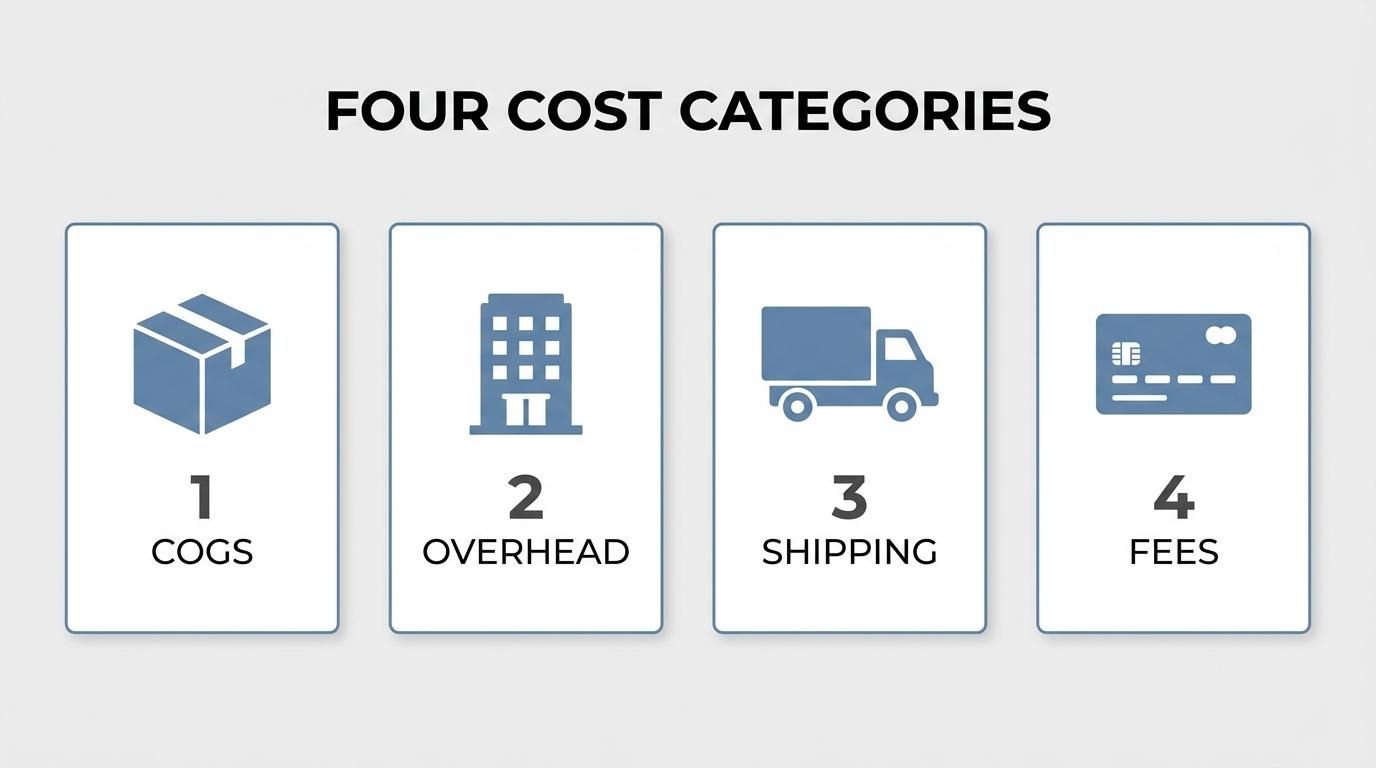
Your cost of goods sold (COGS) includes every direct expense tied to producing or acquiring a product: raw materials, manufacturing labor, packaging, and component sourcing. COGS establishes the absolute floor below which any sale generates a loss.
According to the U.S. Bureau of Labor Statistics, retail margins measure revenue by removing the cost of goods, defined as the cost paid by retailers to upstream vendors, from total sales revenue. For wholesale sellers, this means your COGS figure determines how much room exists in the supply chain for distributor, broker, and retailer markups.
Track COGS per SKU, not as a blended average. Blended figures hide unprofitable products behind high-margin ones, which erodes pricing accuracy over time.
The overhead expenses you should include are all fixed and semi-variable costs that keep your business running regardless of production volume:
These costs do not scale directly with units produced, yet they must be recovered through your pricing. Divide total monthly overhead by your expected unit volume to calculate a per-unit overhead allocation. Underestimating overhead is one of the most common reasons wholesale prices end up unsustainable; many sellers set prices that cover COGS but slowly bleed cash on operational costs.
You factor in shipping and fulfillment costs by calculating the per-unit expense for warehousing, picking, packing, and carrier fees. Key cost components include:
Fulfillment costs fluctuate with carrier surcharges, fuel prices, and seasonal demand spikes. Build these into your wholesale price as a line item rather than absorbing them as a general expense. For brands shipping both DTC and wholesale from the same facility, allocate fulfillment costs separately per channel to avoid cross-subsidizing one channel with the other.
Payment processing fees reduce your net revenue on every transaction, typically ranging from 2% to 3.5% per order depending on the payment method, processor, and transaction volume. These fees cover credit card interchange rates, gateway charges, and platform transaction costs.
According to the Massachusetts Department of Agricultural Resources, industry-standard margins along the supply chain range from 5% to 15% for brokers and 20% to 30% for distributors. When margins are already thin at the wholesale level, a 3% processing fee represents a significant share of profit.
Factor processing fees into your pricing formula before finalizing your wholesale price, not after. Treating them as an afterthought compresses margins in ways that compound across high order volumes.
With all cost categories mapped, the next step is applying these figures to a wholesale pricing formula.
The most common wholesale pricing formulas are absorption (cost-plus) pricing, keystone markup, MSRP-based pricing, tiered volume pricing, and competitive pricing. Each formula suits different cost structures and market positions.
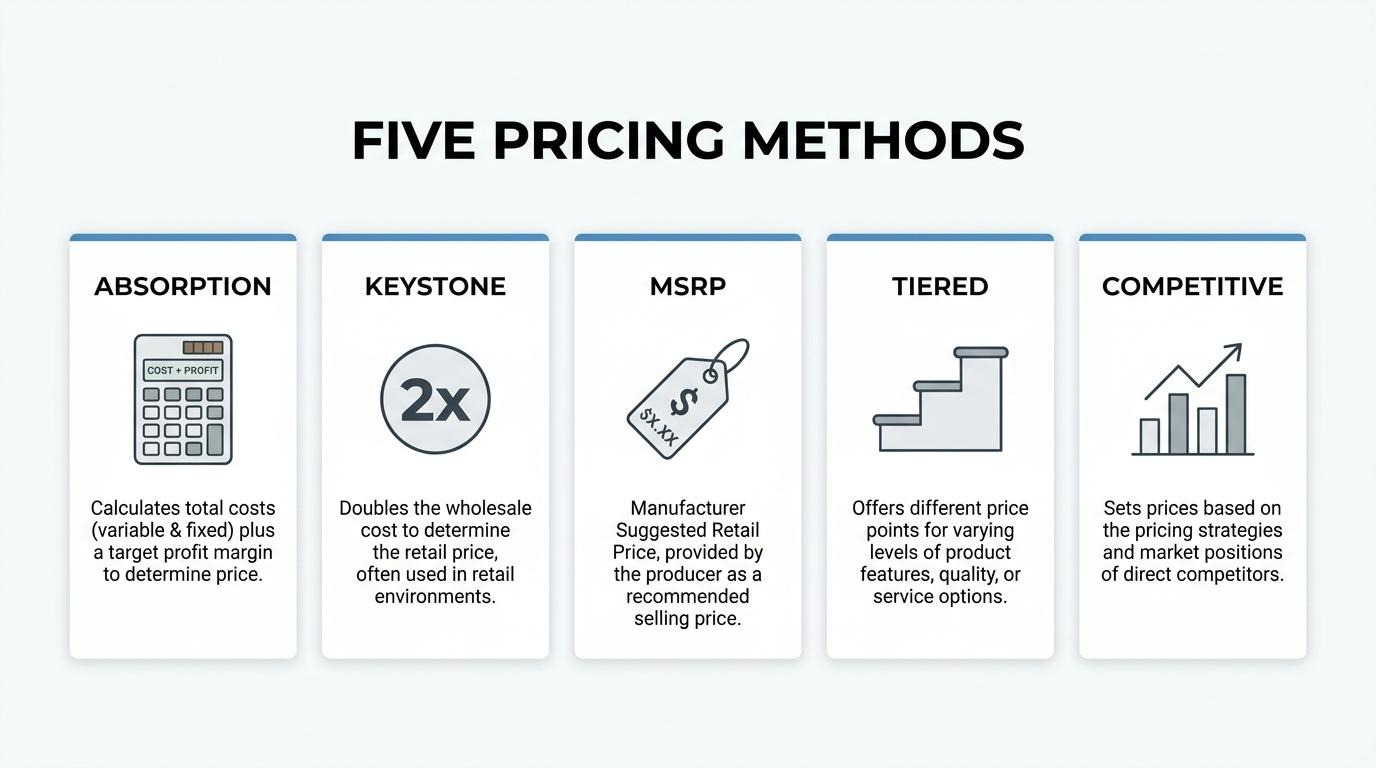
The absorption pricing method works by tracing all production costs, both variable and fixed, to each unit, then adding a standard markup to determine the wholesale price. Variable costs include raw materials and direct labor; fixed costs cover rent, equipment depreciation, and utilities. Once total per-unit cost is calculated, the seller applies a percentage or flat-dollar markup to ensure profitability.
According to Penn State Extension, cost-plus pricing determines a product's price by first calculating production cost, then adding a standard markup; for example, a cost of $1.75 plus a $1.05 markup yields a final sale price of $2.80 per jar. For most wholesale sellers, absorption pricing offers the clearest floor price, making it the safest starting point before layering in market-based adjustments.
The keystone markup formula doubles the wholesale cost to set the retail price. If a product costs $25 at wholesale, the keystone retail price is $50. Retailers rely on this simple 2x multiplier because it builds enough margin to cover operating expenses and still generate profit.
Lower wholesale costs give retailers more markup flexibility. A USDA Economic Research Service analysis of infant formula brands found that Carnation, with generally lower wholesale prices than competing brands, allowed retailers to apply a higher retail markup while still pricing below those competitors. This dynamic matters when setting your wholesale price: if your cost structure supports a lower wholesale number, retail partners gain pricing room that makes your product more attractive to stock.
The manufacturer suggested retail price (MSRP) method works backward from a recommended retail price to calculate the wholesale price. The manufacturer sets the MSRP, then applies a discount, typically 50%, to arrive at the wholesale figure. Schema.org defines MSRP as a specific price type for an offered product, distinct from list prices or temporary sale prices.
According to the Federal Trade Commission, a manufacturer may adopt a policy regarding desired price levels and deal only with retailers who agree to that policy. This legal framework gives brands some control over how products are positioned at retail, though enforcement requires consistent application across all channel partners.
Tiered or volume-based pricing works by offering lower per-unit wholesale prices as a buyer's order quantity increases. Sellers define quantity thresholds, and each tier unlocks a progressively deeper discount. A common structure might look like this:
This approach rewards larger orders, increases average order value, and helps sellers forecast production more accurately. For scaling brands managing both wholesale accounts and direct sales, tiered pricing creates clear incentives without requiring custom negotiations for every buyer.
You should use a competitive pricing formula when your product operates in a category with established market prices and limited differentiation. This method sets your wholesale price relative to what competitors charge, positioning slightly below, at parity, or above based on your brand's value proposition.
According to the University of Missouri Extension, companies pursuing market share and profit objectives use cost-plus strategy as a baseline; if the break-even price is $3.69 and the desired margin is 12%, the price is set at $4.13. Competitive pricing layers market data on top of that floor. The risk is margin erosion if competitors trigger a race to the bottom, so pairing competitive analysis with a firm cost floor protects profitability.
With these formulas as a foundation, the next step is calculating the actual profit margin each one delivers.
You calculate your wholesale profit margin by subtracting cost of goods sold from your wholesale revenue, then dividing by revenue. Target margins vary by industry, from slim food and beverage margins to higher fashion markups.
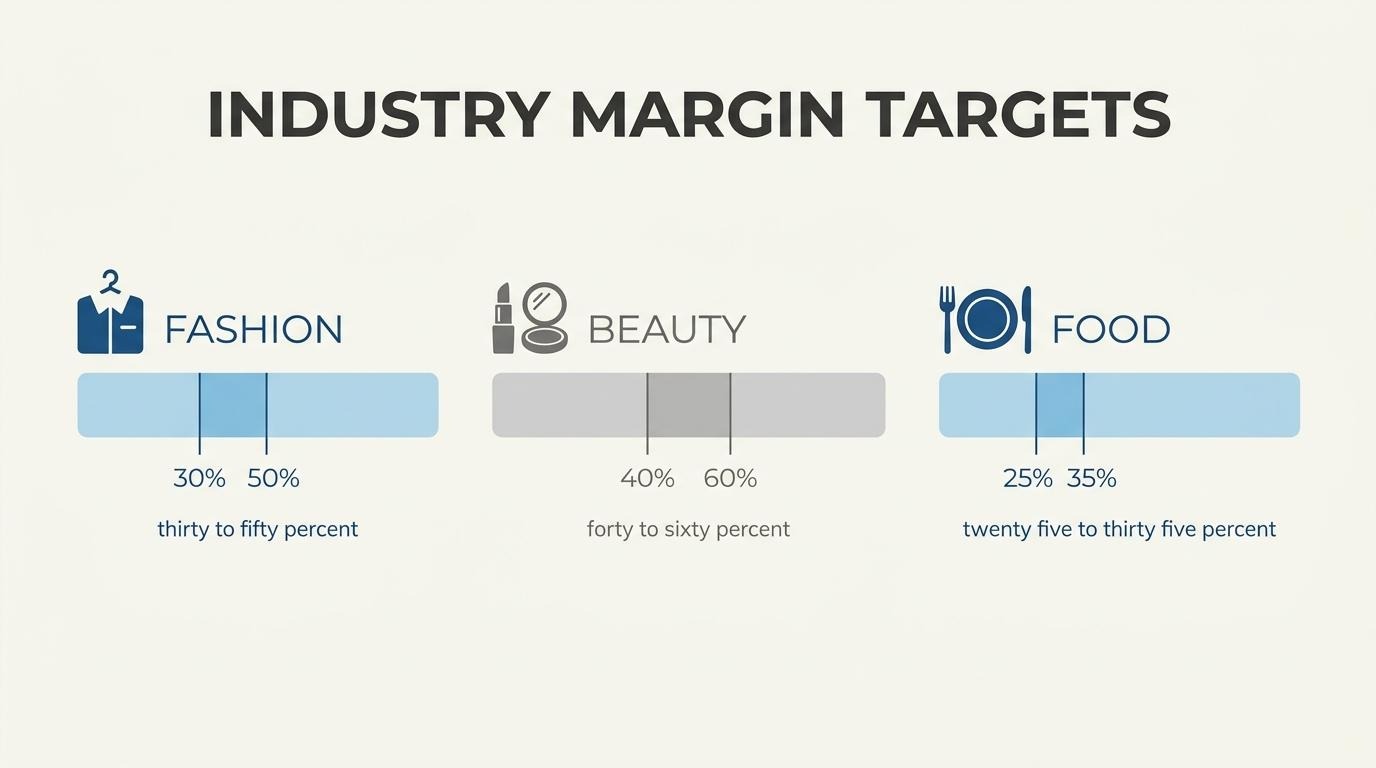
Fashion brands should target a wholesale gross margin between 30% and 50%, depending on product category, materials, and brand positioning. Premium and designer labels typically sit at the higher end because perceived value supports wider spreads between production cost and wholesale price.
Maintaining these margins has become harder in recent years. According to the 2025 USFIA Benchmarking Study, over 70 percent of surveyed fashion companies reported that higher tariffs increased sourcing costs, squeezed profit margins, and led to higher consumer prices. Brands that rely heavily on imported textiles or finished goods face the sharpest compression.
For fashion operators at scale, locking in margin protection means negotiating longer-term supplier contracts and diversifying sourcing regions before tariff changes hit.
Beauty brands should target a wholesale gross margin between 40% and 60%. Formulation costs for skincare and cosmetics are often low relative to retail price, which creates room for healthy wholesale spreads even after factoring in packaging, compliance testing, and shelf-life management.
Margins tend to cluster higher for prestige and clinical-positioned lines, where ingredient storytelling and brand equity justify premium pricing. Mass-market beauty operates closer to the 40% floor due to competitive retail pressure and higher promotional frequency.
The most overlooked margin drain in beauty wholesale is sampling and tester inventory. Brands that do not account for these costs separately often overestimate their true gross margin by several percentage points.
Food and beverage brands should target a wholesale gross margin between 25% and 35%. Perishability, cold-chain logistics, and thinner retail markups compress margins compared to fashion or beauty.
According to the National Restaurant Association, a typical restaurant operates on a pre-tax profit margin of roughly 5%, which means significant cost increases are not sustainable for most downstream buyers. This downstream reality limits how aggressively food and beverage manufacturers can price wholesale; retailers and foodservice operators simply cannot absorb large increases without passing them to consumers or switching suppliers.
Shelf-stable products with longer sell-through windows typically achieve the upper end of this range. For brands scaling perishable lines, building margin buffers for spoilage and returns is essential before committing to volume wholesale agreements.
With industry-specific margins defined, setting minimum order quantities helps protect those margins at scale.
You set minimum order quantities (MOQs) for wholesale by calculating the smallest order size that covers your production costs, preserves your target margin, and justifies fulfillment overhead. The right MOQ balances profitability with buyer accessibility.
Key factors that determine your MOQ include:
According to the U.S. Small Business Administration, negotiating favorable payment terms such as net 45, net 60, or net 90 days helps buyers manage cash flow, which can make higher MOQs more palatable since retailers retain cash longer before payment is due.
One frequently overlooked strategy is tying MOQs directly to your tiered pricing. Rather than setting a single flat minimum, structure MOQs so that each tier unlocks a lower wholesale price. This incentivizes larger orders without alienating smaller retailers who may grow into bigger accounts over time. The MOQ becomes a pricing lever, not just a logistical constraint.
With MOQs anchoring your order economics, the next consideration is how manufacturer-set price floors interact with your wholesale structure.
The relationship between wholesale price and MAP (minimum advertised price) is that wholesale price sets the manufacturer's sell-in cost to retailers, while MAP sets the lowest price retailers can publicly advertise. Together, they define the retailer's margin corridor and protect brand value across channels.
Manufacturers use MAP to protect retail margins by establishing a price floor that prevents retailers from undercutting each other in public advertising. This preserves the perceived value of the product and ensures every retailer has enough margin incentive to carry and promote the brand.
According to the Federal Trade Commission, if a manufacturer independently adopts a policy regarding a desired level of prices, the law allows that manufacturer to deal only with retailers who agree to that policy. The gap between wholesale cost and the MAP price effectively defines the minimum gross margin a retailer can expect. When this gap is too narrow, retailers lose motivation to stock the product. When it is too wide, discount-heavy advertising can erode brand positioning.
Setting MAP requires working backward from the intended retail margin, not just forward from production cost.
Wholesale price must be set before MAP because the wholesale figure determines the cost floor from which all downstream pricing decisions flow. Without a locked wholesale price, a manufacturer cannot calculate the margin retailers need or determine what advertised price floor will sustain profitability across the channel.
The sequence matters: cost of goods drives wholesale price, wholesale price informs the retailer's margin requirement, and that margin requirement shapes where MAP should land. Reversing this order risks setting a MAP that either compresses retailer margins to unsustainable levels or leaves money on the table. For brands selling through both wholesale and direct channels, aligning these figures early prevents the channel conflict that erodes partner trust.
Understanding how MAP anchors to wholesale price becomes especially important when managing pricing across both DTC and B2B channels simultaneously.
You adjust wholesale pricing for DTC and B2B channels by maintaining separate price tiers, structuring volume-based discounts, and enforcing consistent brand positioning. The subsections below cover dual-channel pricing mechanics and strategies for preventing retail partner friction.
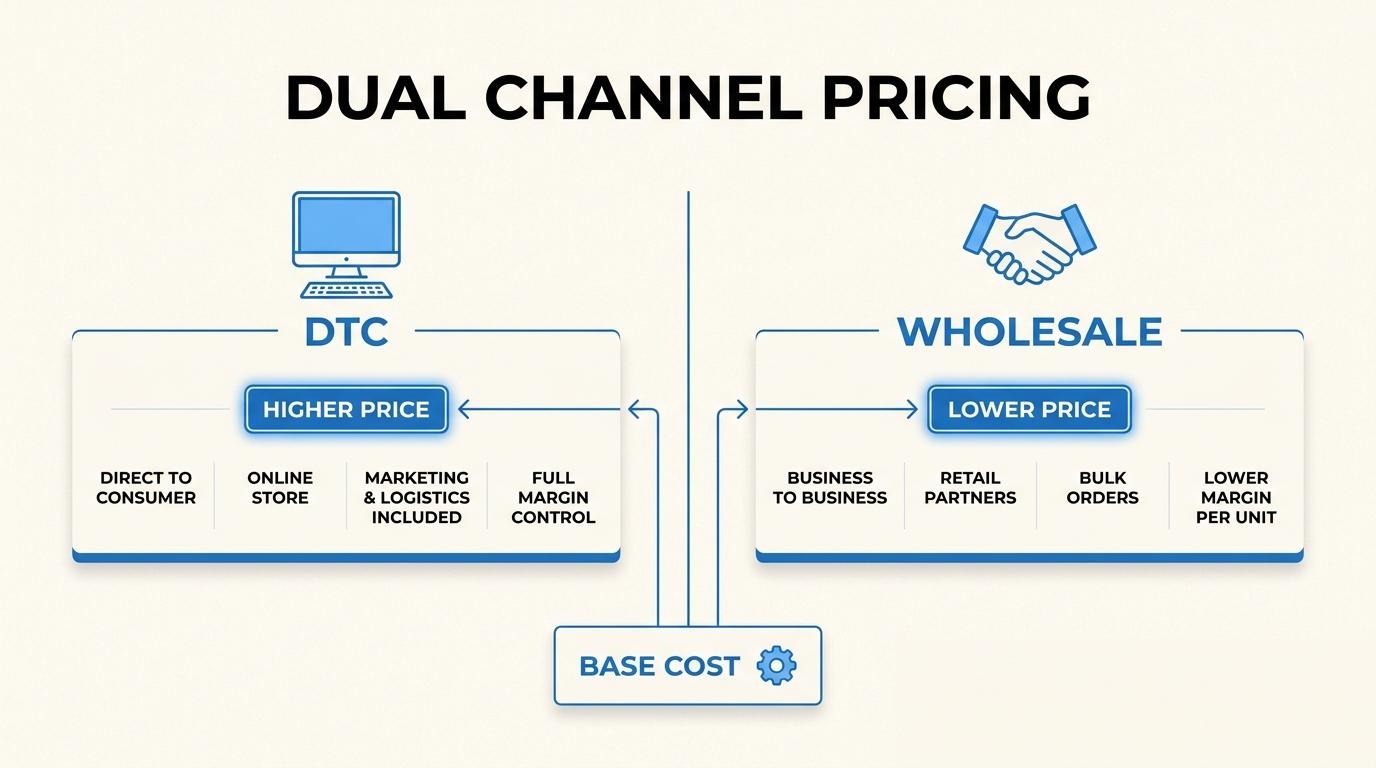
You price when selling wholesale and direct together by setting your DTC price at or above the suggested retail price, then offering wholesale buyers a structured discount below that ceiling. This preserves retailer margins while letting your brand capture higher per-unit profit on direct sales.
Profit from markup, as defined by the National Institute of Standards and Technology, is the difference between the cost of a product and its selling price. That gap must be wide enough to sustain both channels. Consider these pricing levers:
Keeping your DTC price firm signals to retail partners that you will not undercut them, which is the foundation of channel trust.
You avoid channel conflict with your retail partners by aligning pricing policies, communication, and product assortment across every sales channel. Conflict typically emerges when retailers discover your DTC site selling identical products at lower prices or running promotions that erode their margins.
Practical steps to reduce friction include:
For brands managing both channels at scale, running wholesale and DTC pricing from a single system with a shared product catalog eliminates the version-control errors that often spark disputes.
You test and validate your wholesale price point by running controlled pricing experiments, gathering retailer feedback, and comparing results against margin benchmarks before committing to a price list.
Testing a wholesale price requires more than spreadsheet math. Even a well-calculated formula can miss real-world resistance from buyers or leave margin on the table. Retailers evaluate your price against their own markup needs, competitor alternatives, and sell-through expectations. Without validation, you risk locking in a price that either repels wholesale buyers or erodes your profitability over time.
Start with a small batch approach. Offer your calculated wholesale price to a limited group of retail partners, ideally three to five accounts representing different store sizes or channels. Track their order frequency, reorder rates, and any pushback on pricing during the initial 60 to 90 days.
Key validation methods include:
The most revealing data comes from actual buyer behavior, not surveys. If retailers consistently negotiate your price down, the market is telling you something your formula missed. Conversely, if every buyer accepts immediately without discussion, you may be priced too low.
For brands managing both wholesale and DTC channels, validation also means confirming that the wholesale price leaves enough room between your direct consumer price and the retailer's shelf price. Channel conflict often surfaces during testing, not planning.
With a validated price point in hand, the next step is knowing when market conditions warrant a pricing update.
You should revisit and update your wholesale pricing whenever your input costs shift, market conditions change, or your margins no longer align with business goals. Key triggers include raw material price increases, new tariffs, inflation spikes, competitive repositioning, and channel expansion.
Wholesale pricing is not a set-it-and-forget-it decision. Static prices erode margins when costs rise and leave money on the table when demand strengthens. According to a 2023 analysis by the Board of Governors of the Federal Reserve System, nonfinancial corporate profit margins increased sharply to about 19% in 2021 Q2 and slipped back to 15% in 2022 Q4, compared to about 13% in 2019 Q4. That level of volatility makes annual or even quarterly price reviews essential for any brand selling at wholesale volume.
Common triggers that signal a pricing update include:
Most brands that treat pricing as a living process, rather than a launch-day calculation, maintain healthier margins over time. A practical cadence is reviewing wholesale prices at minimum every six months, with immediate reviews triggered by any cost increase exceeding 5% or a significant policy change like new tariffs. Reckless discounting during uncertain periods can also backfire; as the American Marketing Association has cautioned, temporary price cuts risk distorting brand positioning and confusing customers long after the promotion ends.
The discipline of regular pricing reviews becomes easier when cost data, channel performance, and margin reporting live in a centralized system rather than scattered spreadsheets. With pricing fundamentals in place, the next consideration is how wholesale pricing evolves as your brand scales.
Wholesale pricing changes as your brand scales through higher volume leverage, renegotiated supplier costs, and the need to coordinate wholesale and DTC channels without conflict. Below, we cover how to manage both pricing tiers in one system and summarize the key takeaways from this guide.
SHOPLINE manages wholesale and DTC pricing in one system by housing both storefronts, customer data, and price lists inside a single platform. Rather than syncing separate wholesale portals with a DTC storefront through third-party connectors, brands set customer-group-specific pricing from one backend. This eliminates the reconciliation errors that multiply as order volume grows.
According to a 2021 study published in the European Journal of Operational Research, manufacturers can coordinate both channels using an appropriate pricing system or contract (such as profit sharing, two-part tariffs, or wholesale discounts), which can increase the profits of both players. For brands operating at scale, having wholesale tiers, DTC retail prices, and promotional rules governed by a shared data layer prevents the margin leakage that fragmented tool stacks quietly introduce.
The key takeaways about wholesale pricing center on building a formula-driven, adaptable pricing structure from day one. The most actionable lessons from this guide include:
Wholesale pricing is not a one-time calculation. It is an operational system that scales with your brand when grounded in accurate cost data and regularly validated against market conditions.