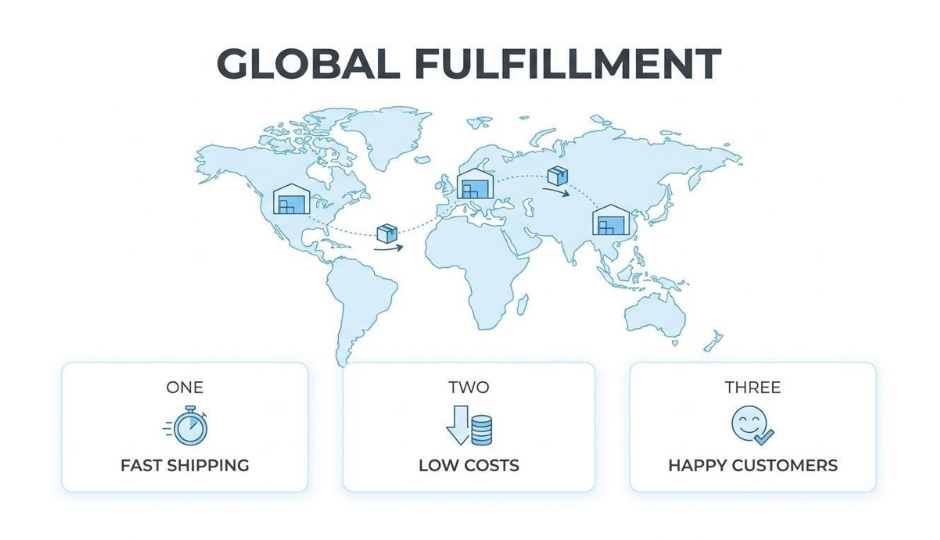
Global fulfillment is the end-to-end process of storing, picking, packing, and shipping orders to customers across international markets through a distributed network of warehouses, carriers, and technology systems. It connects inventory management, customs compliance, and last-mile delivery into a single operational workflow that serves buyers in multiple countries simultaneously.
This guide covers the strategic importance of global fulfillment for ecommerce brands, how the fulfillment process works from order routing to cross-border returns, the infrastructure and models that power a global network, the challenges brands face at scale, and how technology and product-category differences shape fulfillment decisions.
Distributed fulfillment directly impacts revenue by reducing shipping times, lowering per-order logistics costs, and improving customer experience. Positioning inventory closer to buyers shortens delivery windows from weeks to days, while smart order routing selects the optimal warehouse for each order based on proximity, stock levels, and cost.
The operational process spans automated order routing, real-time inventory synchronization across warehouses, landed cost calculation at checkout (including duties, taxes, and insurance), and regional returns management that keeps reverse logistics from eroding margins.
A functioning global network relies on core infrastructure: distributed warehouses, international carrier partnerships, centralized inventory systems, customs brokerage services, and last-mile delivery networks. Brands choose between 3PL, in-house, dropshipping, and hybrid models based on order volume, SKU complexity, and target markets.
Tariff volatility, inventory fragmentation, currency and tax variations, and inconsistent data across tools remain persistent challenges. Each compounds when operations span multiple countries without unified visibility.
Technology ties the system together. Automation accelerates order processing, real-time tracking builds buyer trust across borders, and analytics convert operational data into decisions that improve fulfillment performance. Product categories like fashion, perishables, beauty, and home goods each introduce distinct logistics demands that require tailored strategies.
Global fulfillment matters for ecommerce brands because it directly reduces shipping times, lowers logistics costs, and improves customer experience across international markets. The subsections below break down each of these advantages.
Global fulfillment reduces shipping times by positioning inventory in warehouses closer to end customers across multiple regions. When a brand stores products in only one country, international orders travel longer distances, pass through more transit hubs, and face extended customs processing.
Distributing stock across fulfillment centers in key markets shortens the last mile for each order. According to G10 Fulfillment, smart order routing logic combined with real-time inventory and location rules optimizes which warehouse fulfills each order, cutting shipping costs and preventing fulfillment errors at scale. Instead of routing every package from a single origin, the system selects the nearest stocked location automatically. For brands selling into three or more regions, this warehouse proximity is often the single largest factor in whether delivery meets customer expectations.
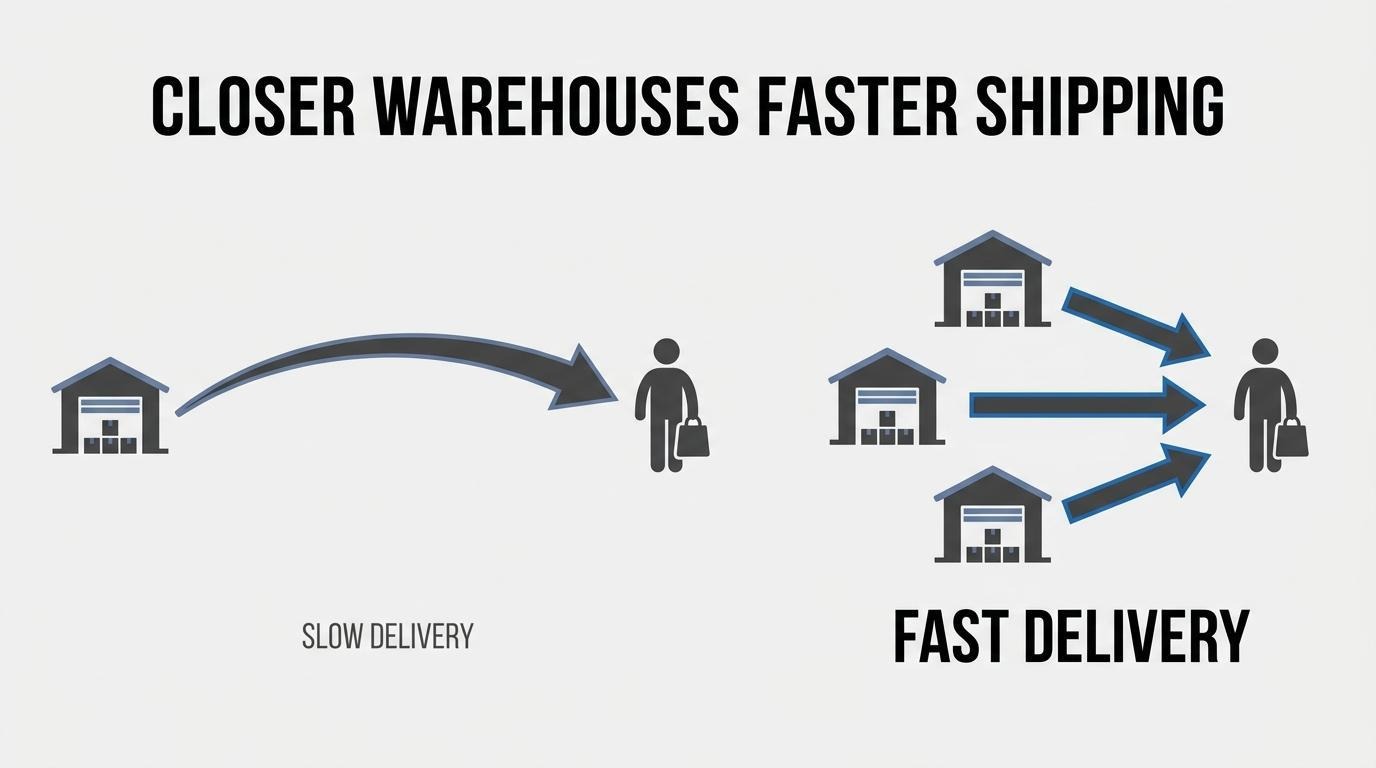
Global fulfillment lowers logistics costs by reducing per-order shipping distances, consolidating freight, and minimizing hidden expenses that compound across thousands of SKUs. Shipping consumes 15% to 20% of ecommerce revenue, with carriers charging based on dimensional weight rather than actual weight, so shorter transit routes directly shrink parcel spend.
Landed cost, as defined by DHL, is the sum of product price, transportation, customs duties and taxes, regulatory fees, and insurance. With tariffs now imposed on every shipment including small parcels, these landed costs rise significantly across global operations, according to DCL Logistics. A 2023 report from E7 Solutions found that global retailers lost $1.77 trillion to inventory distortion driven largely by data fragmentation. Consolidating fulfillment data into fewer, well-positioned nodes helps brands control both visible and hidden cost layers before they erode margins.
Global fulfillment improves customer experience by delivering faster shipping, accurate order tracking, and localized returns processing. Customers in different markets expect delivery speeds comparable to domestic standards; distributed inventory makes that possible without premium express shipping surcharges.
When orders ship from a nearby fulfillment center, transit windows shrink from weeks to days. Localized return hubs also simplify the post-purchase experience, reducing the friction that drives cart abandonment and negative reviews. For scaling DTC brands, the customer experience gap between a single-warehouse setup and a distributed global network often shows up first in repeat purchase rates and review sentiment.
Understanding why global fulfillment matters sets the foundation; the next step is examining how the process actually works from order placement to delivery.
The global fulfillment process works by coordinating order routing, inventory synchronization, customs calculation, and returns handling across multiple countries. Each step below breaks down how these stages connect.
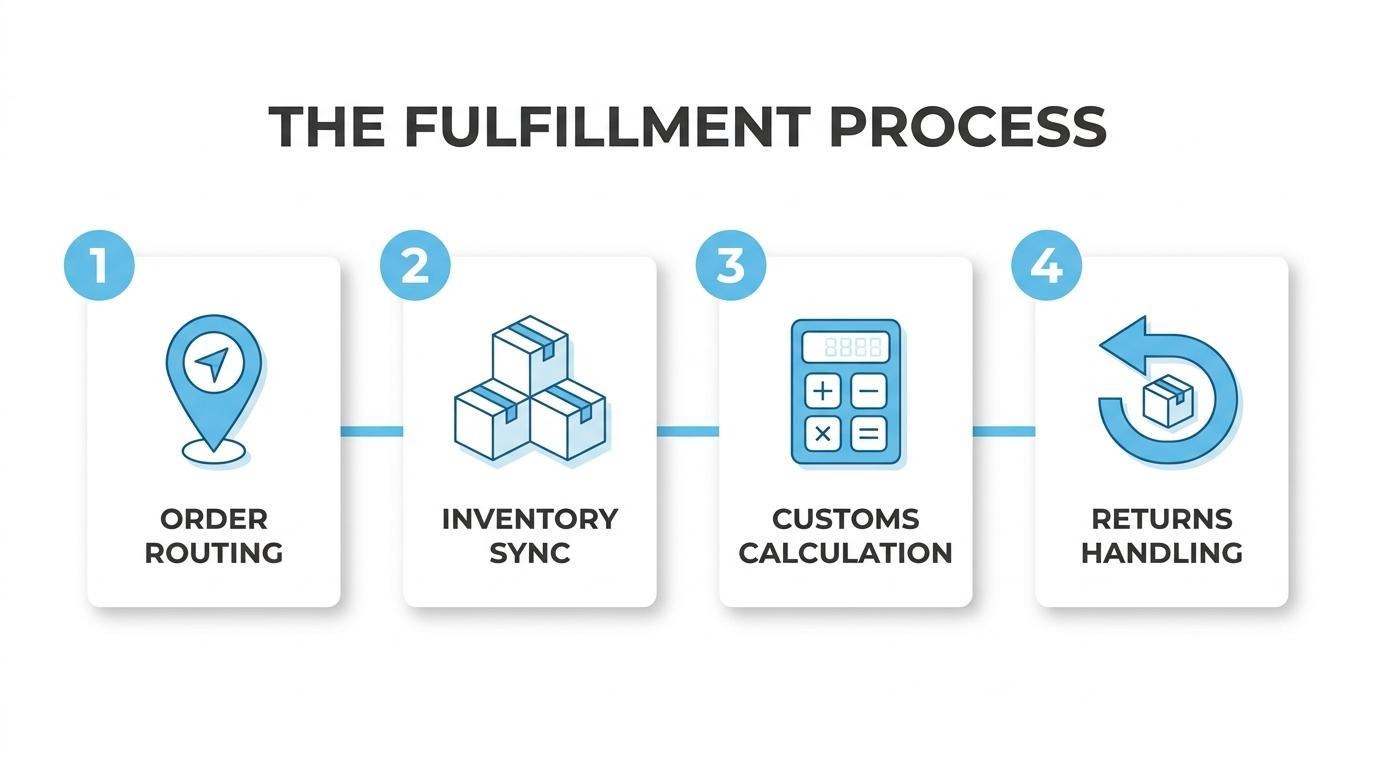
Orders are routed to the right warehouse by applying rule-based logic that evaluates customer location, stock availability, and shipping cost to select the optimal fulfillment center. The system scores each warehouse against these criteria and assigns priority rankings in real time.
Common routing rules include:
For brands operating across regions, this logic prevents bottlenecks at a single location while keeping delivery promises consistent.
Inventory syncs across multiple locations through centralized inventory management systems that update stock counts in real time as orders, returns, and restocks occur at each warehouse. Without this synchronization, brands risk overselling in one market while sitting on excess stock in another.
According to an APQC cross-industry benchmarking study of 8,660 companies, the median inventory accuracy rate sits at 95.0%. That 5% gap can translate into thousands of misrouted or canceled orders at scale. Real-time syncing closes that gap by pushing updates across every sales channel and warehouse simultaneously. Brands that treat inventory visibility as optional often discover the cost in chargebacks and lost customers rather than in dashboards.
Customs and duties are handled at checkout by calculating landed costs in real time and presenting them to the buyer before payment. This approach, often called Delivered Duty Paid (DDP), eliminates surprise fees on delivery.
The landed cost formula, as outlined by Zonos, includes product cost plus shipping and handling fees, insurance, customs duties, taxes, and other applicable fees. Integrating this calculation directly into checkout requires:
Showing duties upfront is one of the most effective ways to reduce cart abandonment on international orders.
Returns are managed across borders through regional return centers, localized return labels, and inspection workflows that process items back into sellable inventory or route them for disposal. Cross-border returns add complexity because each country has different import regulations for returned goods.
The typical cross-border returns workflow includes:
Brands without regional return infrastructure often absorb international shipping costs on every return, which erodes margins quickly. With the operational workflow defined, the next step is understanding the physical and digital components that make this network function.
The core components of a global fulfillment network are distributed warehouses, international shipping carriers, inventory management systems, customs brokerage services, and last-mile delivery networks. Each component handles a distinct operational layer.
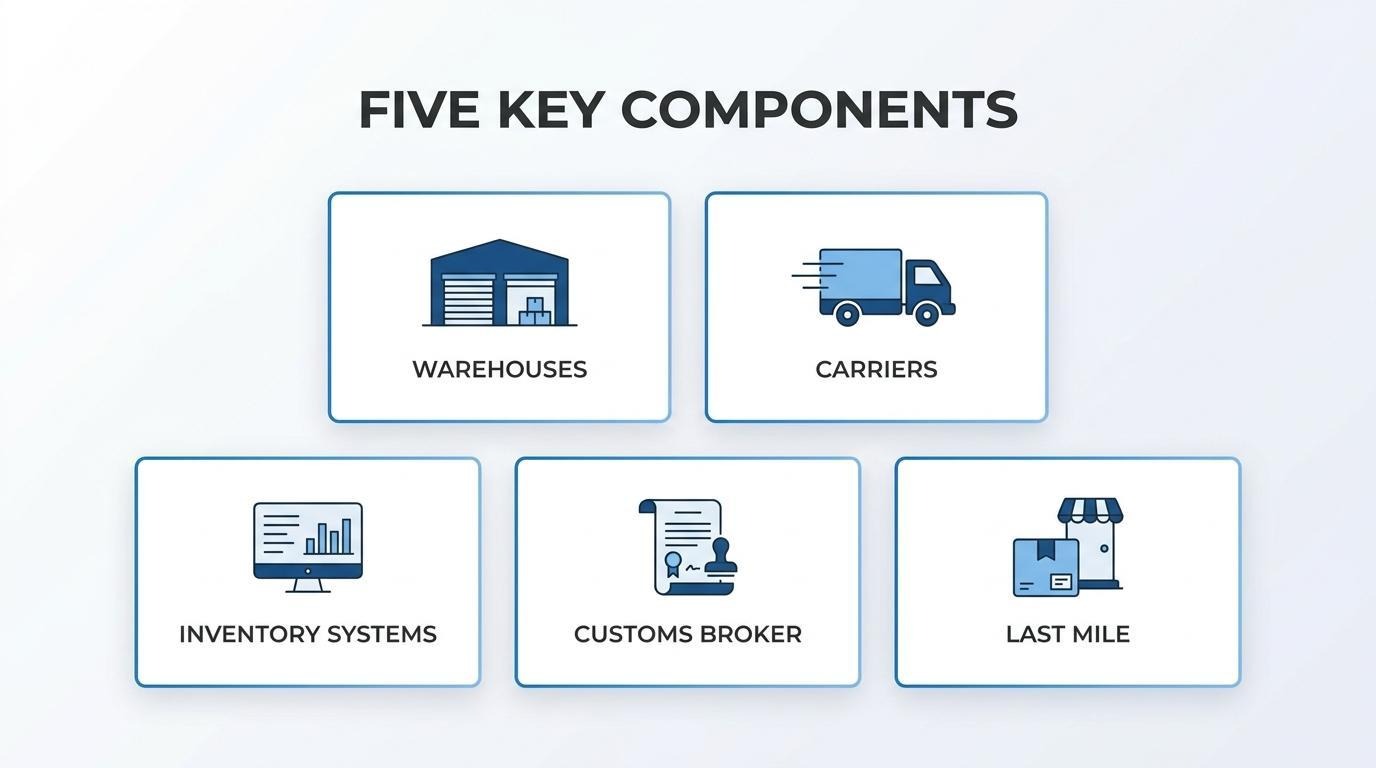
Distributed warehouse infrastructure places inventory across multiple geographic locations to reduce transit distances and delivery times. Rather than shipping every order from a single origin, brands store stock in fulfillment centers positioned near key customer clusters across regions such as North America, Europe, and Asia-Pacific. This positioning shortens shipping zones, lowers carrier costs, and enables two-to-three-day delivery windows that would be impossible from a centralized facility. For brands scaling internationally, warehouse distribution is the physical foundation every other fulfillment component depends on.
International shipping carriers and partners provide the transportation layer that moves goods between countries. A global fulfillment network typically relies on a mix of major carriers, such as DHL, UPS, and FedEx, alongside regional postal services and freight forwarders. Carrier selection depends on package weight, destination country, and required delivery speed. According to the U.S. Congressional Research Service, since January 2025, U.S. import tariffs have ranged from 10% to 41% by country of origin under IEEPA and Section 232 authorities, making carrier-level cost visibility and landed-cost calculations even more critical when selecting shipping partners.
Inventory management systems track stock levels, locations, and movement across every node in a fulfillment network. These systems sync data in real time between warehouses, sales channels, and order management platforms to prevent overselling and stockouts. Beyond forward logistics, they also coordinate returns management, which spans the full lifecycle from customer-initiated return through receiving, inspecting, grading, and routing products back into available inventory. Without centralized inventory management, brands operating across multiple locations risk fragmented data that compounds fulfillment errors at scale.
Customs brokerage and trade compliance services ensure goods clear international borders legally and efficiently. Licensed customs brokers classify products under correct tariff codes, calculate duties, and file documentation with government agencies. According to the U.S. International Trade Administration, approximately 11,000 active licensed customs brokers operate in the United States, assisting importers in meeting federal import requirements. For ecommerce brands shipping to multiple countries, trade compliance also includes managing restricted goods lists, country-specific labeling rules, and preferential trade agreements.
Last-mile delivery networks handle the final leg of fulfillment, moving packages from a local distribution point to the customer's door. This stage typically accounts for the highest per-unit cost in the entire supply chain because routes are fragmented and deliveries are individualized. Effective last-mile networks combine regional carriers, locker systems, and local courier services to balance speed with cost. For brands selling globally, partnering with last-mile providers who already have dense local coverage is often more practical than extending a single carrier's reach.
With these infrastructure components in place, the next consideration is which fulfillment model best connects them for your brand's operational needs.
The main global fulfillment models are third-party logistics (3PL), in-house fulfillment with international warehouses, dropshipping from global suppliers, and hybrid fulfillment. Each model balances cost, control, and scalability differently.
Third-party logistics (3PL) is a fulfillment model where brands outsource warehousing, picking, packing, and shipping to an external provider. The 3PL manages inventory storage, order processing, and last-mile delivery across one or more regions on the brand's behalf.
According to Mordor Intelligence, the global 3PL market is worth USD 1.22 trillion in 2026, growing at a CAGR of 5.27% to reach USD 1.57 trillion by 2031. This growth reflects how many ecommerce brands prefer delegating logistics complexity to specialists rather than building infrastructure themselves. For brands entering new international markets, 3PL providers offer an immediate distribution footprint without the capital expenditure of leasing warehouse space or hiring local staff.
In-house fulfillment with international warehouses is a model where brands own or lease fulfillment centers in target markets and manage operations directly. Multi-location fulfillment splits inventory across more than one physical location, such as regional warehouses or a combination of warehouses and retail stores.
According to Cura Group, in-house fulfillment cost per fulfilled order runs $8 to $18, while 3PL per-order costs typically decline with volume. That cost range makes this model most viable for brands with predictable, high-volume demand in specific regions. Brands selling into rapidly growing markets gain tighter quality control and faster iteration on packaging, kitting, and localized inserts, though the operational burden is considerably higher than outsourcing.
Dropshipping from global suppliers is a fulfillment model where the merchant sells products without holding inventory; the supplier ships directly to the end customer. This is the lowest-cost model to launch because it eliminates warehousing, picking, and packing expenses entirely.
However, the trade-off is reduced control over shipping speed, packaging quality, and product condition. Perishable or fragile product categories face particular risk: FAO data shows global post-harvest food losses reached 13.3% in 2023, with fruits and vegetables experiencing losses as high as 25.4% due to handling requirements. For non-perishable goods, dropshipping remains a practical entry point into new markets, though brands should vet supplier reliability carefully before scaling.
Hybrid fulfillment combines two or more fulfillment methods to optimize cost, speed, and flexibility across different markets or product lines. A brand might use in-house fulfillment for its top-selling SKUs domestically, a 3PL for European distribution, and dropshipping for low-volume specialty items.
This model suits scaling brands that have outgrown a single approach but want to avoid the capital commitment of full in-house operations everywhere. The challenge lies in keeping inventory data synchronized across multiple fulfillment partners and locations. Brands that lack a unified system for tracking stock levels across these channels risk overselling or routing errors, which makes platform-level inventory visibility a prerequisite before adopting a hybrid strategy.
Selecting the right model depends on order volume, product type, and target market priorities, which the next section explores.
Brands face challenges with global fulfillment across tariffs, inventory visibility, tax compliance, and data consistency. Each of these friction points compounds when operations span multiple countries and systems.
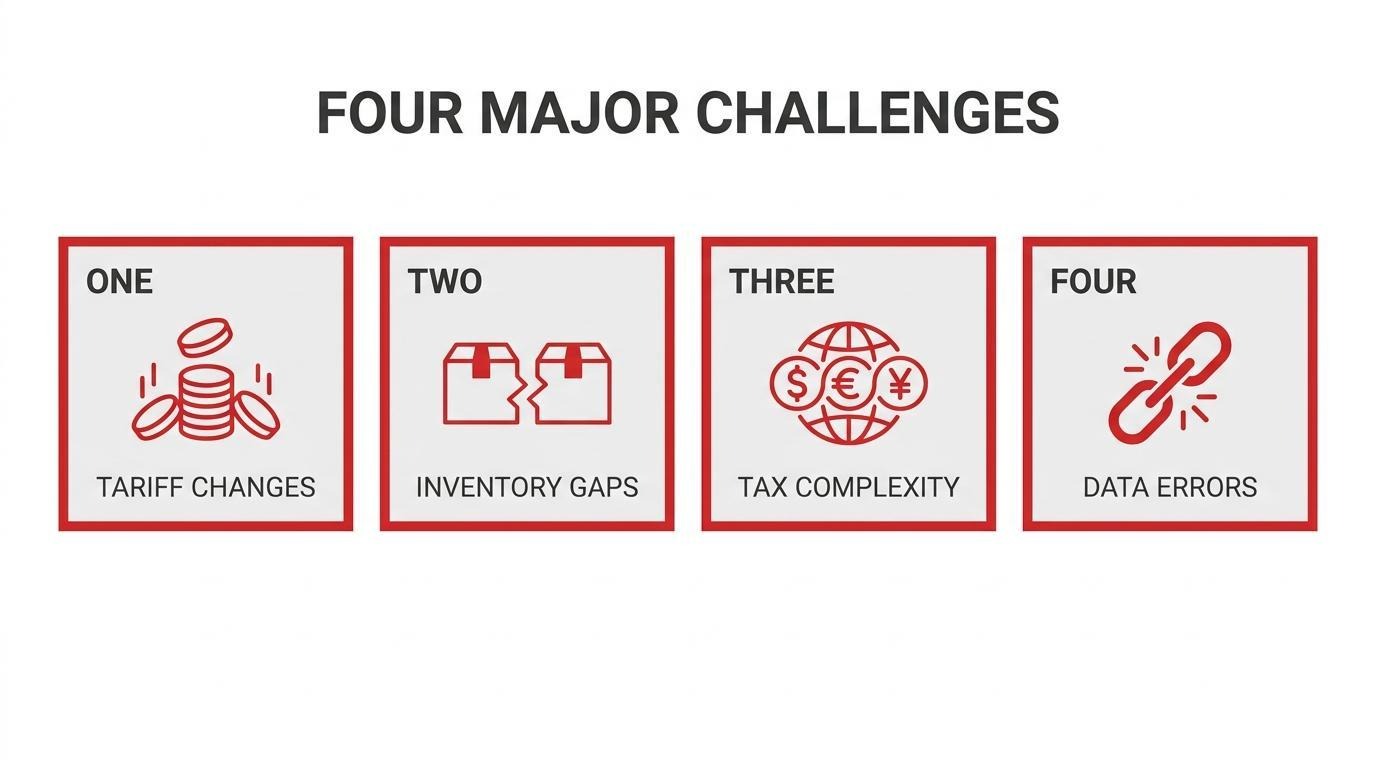
Tariffs and trade regulations create complexity by introducing unpredictable cost variables that shift frequently across markets. Since January 2025, U.S. import tariffs have ranged from 10% to 41% by country of origin under IEEPA and Section 232 authorities, according to the U.S. Congressional Research Service. These rates apply to every shipment, including small parcels, which forces brands to recalculate landed costs across thousands of SKUs. Pricing strategies, supplier sourcing decisions, and margin projections all require continuous adjustment. For brands selling into multiple countries simultaneously, each destination carries its own duty schedules and import restrictions, turning what should be routine shipping into a compliance exercise.
Inventory fragmentation leads to stockouts when stock is distributed across multiple warehouses, retail locations, or 3PL partners without unified visibility. Orders route to one location while available units sit idle in another. Without real-time synchronization, safety stock calculations break down, and popular SKUs sell out in high-demand regions while excess inventory accumulates elsewhere. The operational cost is significant; maintaining separate inventory pools across regions also ties up working capital in slow-moving stock. Brands that lack centralized inventory orchestration end up treating each fulfillment node as its own silo, which multiplies the risk of both overselling and dead stock.
Currency and tax variations affect operations by adding layered compliance requirements to every cross-border transaction. The UK charges 20% VAT, Canada applies 5% GST at the federal level, and Australia levies a flat 10% GST. Each country enforces different registration thresholds, filing frequencies, and exemption rules. Currency fluctuation compounds this; a margin-positive order at checkout can become margin-negative by settlement if exchange rates shift. Brands must calculate, collect, and remit the correct tax in each jurisdiction at the point of sale, or risk penalties and customer disputes. Manual processes rarely scale beyond two or three markets before errors mount.
Inconsistent data across tools causes errors by creating mismatches between inventory counts, order statuses, and customer records. When a brand operates separate systems for warehouse management, order routing, shipping, and returns, each tool maintains its own version of truth. According to PRIME AI, inconsistent sizing data alone drives online fashion return rates between 25% and 40%, reaching up to 75% for specific categories. Product data discrepancies ripple outward: incorrect weights trigger shipping overcharges, mismatched SKU mappings cause wrong-item shipments, and delayed sync windows allow overselling. Every disconnected tool adds a potential failure point, and at global scale, even small data lag between systems can generate costly fulfillment errors.
Understanding these challenges clarifies what to evaluate when selecting a global fulfillment solution.
You choose a global fulfillment solution by evaluating order volume, SKU complexity, destination markets, inventory visibility, and integration depth. The following subsections break down each criterion.
The order volume and SKU count you should evaluate are your current monthly shipment totals and the number of distinct products requiring storage, pick, and pack operations. High-volume brands with large catalogs need fulfillment partners that offer scalable warehouse capacity and automated pick workflows. According to Cura Group, in-house fulfillment costs $8 to $18 per order, while 3PL per-order costs decline with volume. Brands shipping fewer than a few hundred orders monthly may manage fulfillment internally, but once SKU counts climb into the hundreds or thousands, distributed inventory and automated routing become essential to maintain speed without ballooning labor costs.
The destination markets that should influence your choice are the countries and regions where your customers concentrate. Each market introduces distinct customs duties, tax registration thresholds, and import regulations. For example, the UK applies 20% VAT, Canada charges 5% GST nationally, and Australia levies a flat 10% GST, according to GetSphere. Selling into multiple regions means your fulfillment partner must support localized compliance, regional warehouse placement, and carrier networks familiar with last-mile logistics in those corridors. Prioritizing two or three high-demand markets first, then expanding incrementally, reduces compliance risk and keeps landed costs predictable as you scale internationally.
Real-time inventory visibility is critical for any brand operating across multiple fulfillment locations. Without it, overselling, stockouts, and misrouted orders become routine. A cross-industry benchmarking study by APQC found the median inventory accuracy rate at 95.0% across 8,660 companies, meaning even well-run operations lose visibility on roughly 5% of stock. For global sellers splitting inventory across regions, that gap compounds quickly. Unified inventory dashboards that sync stock levels across warehouses, sales channels, and returns processing in near real-time help prevent costly fulfillment errors and protect the customer experience.
The integration capabilities you should require are native connections between your fulfillment system and your ecommerce storefront, order management, marketing tools, and accounting software. Disconnected systems create data silos that lead to shipping errors and delayed order processing. When fulfillment, CRM, and sales channel data flow through a single system, order routing decisions happen faster and inventory counts stay accurate across every touchpoint. For scaling DTC brands running complex operations, choosing a fulfillment solution with robust API access or pre-built integrations eliminates the manual reconciliation that slows teams down as order volumes grow.
Technology plays a central role in global fulfillment by connecting automation, real-time visibility, and data analytics into a unified operational layer. The sections below cover how automation accelerates order processing, how tracking builds buyer confidence, and how analytics sharpen fulfillment performance.
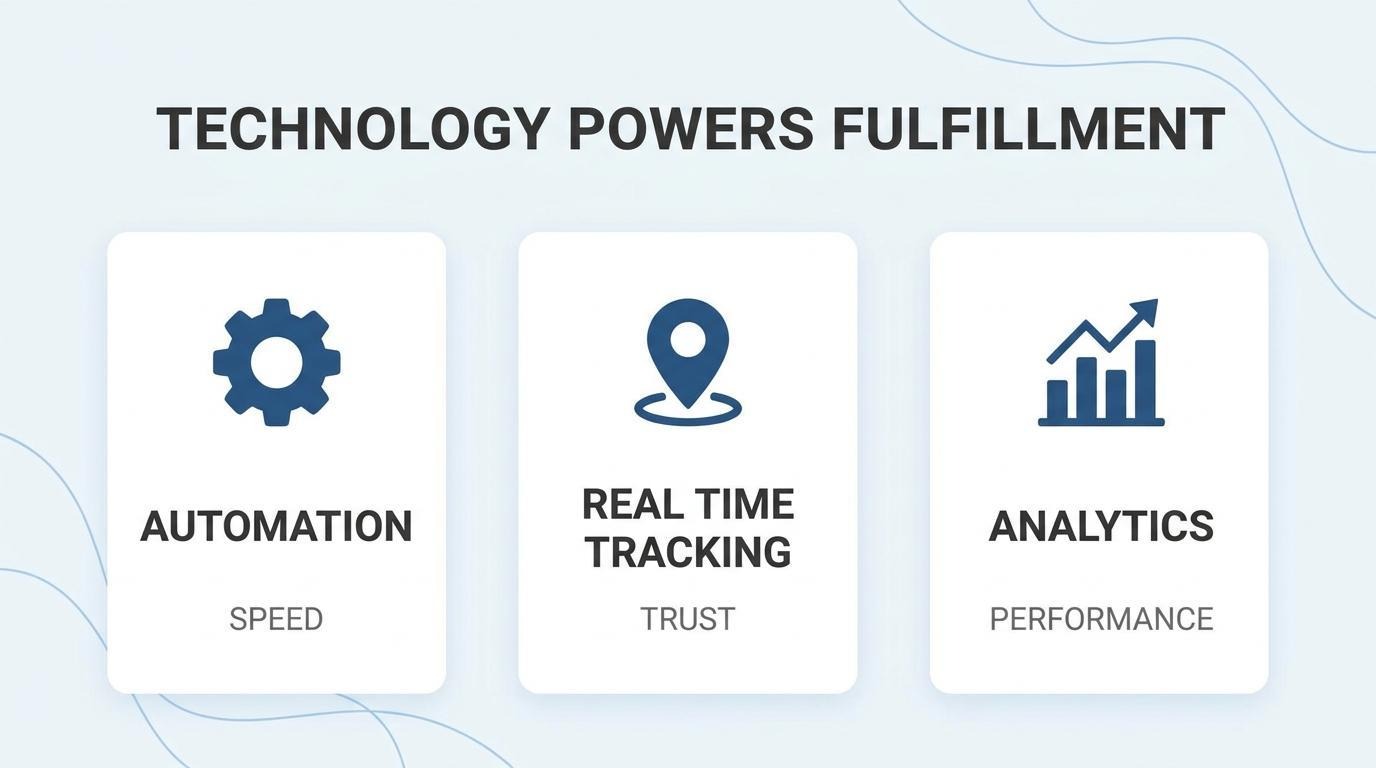
Automation streamlines order processing by replacing manual tasks with rule-based systems that route, verify, and trigger fulfillment workflows instantly. When an order enters the system, automated logic applies location rules, inventory checks, and carrier selection without human intervention.
Key processes automation handles include:
For brands managing thousands of daily SKUs across multiple regions, this speed compounds. Removing manual touchpoints at each stage reduces processing errors and cuts the time between checkout and dispatch to minutes rather than hours.
Real-time tracking builds customer trust by giving buyers continuous visibility into where their order is from dispatch to doorstep. According to Market Research Future, the live package tracking market is projected to grow at an 8.90% CAGR from 2025 to 2035, driven by increasing demand for enhanced logistics visibility.
When customers can see their shipment's exact status, especially across international borders where transit times are longer, anxiety about lost or delayed packages drops significantly. Proactive notifications at key milestones, such as customs clearance, in-country handoff, and out-for-delivery alerts, reduce inbound support tickets while reinforcing brand reliability. For cross-border orders in particular, this transparency often determines whether a first-time international buyer becomes a repeat customer.
Analytics improve fulfillment performance by converting operational data into actionable decisions across warehousing, shipping, and inventory allocation. Fulfillment analytics platforms aggregate data from order management systems, carrier APIs, and warehouse operations to surface patterns that manual review cannot catch.
The most impactful metrics to track include:
Without this layer of analysis, brands make fulfillment decisions based on assumptions rather than evidence. The difference between a good and great global fulfillment operation often comes down to how quickly teams act on what the data reveals.
With the right technology stack in place, fulfillment outcomes vary significantly by product type.
Global fulfillment differs by product category because each vertical introduces distinct logistics demands, from sizing-driven returns in fashion to cold chain requirements for perishables. The subsections below cover fashion, food, beauty, and home goods.
Fashion and apparel fulfillment differs globally because sizing inconsistencies, high return volumes, and seasonal demand cycles create unique operational pressure. According to PRIME AI, inconsistent sizing is the number one driver of refunds, with online fashion return rates between 25% and 40% overall, reaching up to 75% for specific categories and brands.
Key fulfillment challenges for fashion include:
For scaling apparel brands, pre-positioning inventory in regional fulfillment centers significantly reduces both transit times and the cost of processing cross-border returns.
The unique challenges for food and perishables center on temperature control, spoilage risk, and strict shelf-life windows that standard fulfillment infrastructure cannot accommodate. According to the Food and Agriculture Organization (FAO), approximately 526 million tonnes of food, around 12% of the global total, are lost or wasted due to insufficient refrigeration.
Critical fulfillment considerations for perishables include:
Brands shipping perishables internationally should treat cold chain logistics as a non-negotiable investment rather than an operational afterthought.
Beauty and cosmetics face regulatory hurdles because ingredient restrictions, labeling requirements, and product registration processes vary dramatically between markets. According to a 2022 MDPI study on cosmetics regulation, the EU bans more than 1,400 dangerous chemicals from cosmetics while the USA bans fewer than 20, with the EU having more than 25 approved ingredients that differ from other regions.
This regulatory fragmentation creates fulfillment complexity in several ways:
Overlooking even one market's cosmetics regulations can result in seized shipments and permanent brand damage in that region.
Home goods brands should consider dimensional weight pricing, freight classification, and reverse logistics complexity when shipping oversized items globally. Carriers charge based on the space a package occupies rather than its actual weight, which means bulky furniture and decor products face disproportionately high shipping costs.
Key considerations for oversized fulfillment include:
For home goods brands, the cost of a single oversized return can erase the margin on multiple successful orders. Understanding product category differences helps brands build fulfillment strategies that match their operational reality.
Scaling DTC brands should approach global fulfillment by consolidating fulfillment data into a unified system and applying the strategic principles covered throughout this guide. The following sections explore what changes with centralized data and summarize the key takeaways.
Fulfillment data living in one system eliminates the sync gaps between order management, inventory tracking, shipping, and returns that cause errors at scale. When inventory counts, order status, customs documentation, and customer records share a single source of truth, brands gain real-time visibility across every warehouse and market.
This matters because fragmented tools create lag. A stock update in one region may take minutes or hours to reflect elsewhere, leading to overselling, split shipments, and inaccurate delivery estimates. Unified systems apply smart order routing rules instantly, directing each order to the optimal fulfillment location based on proximity, stock levels, and cost.
For DTC brands operating across multiple markets, a consolidated data layer also simplifies tax calculations, landed cost estimates, and returns processing. SHOPLINE is one option for brands seeking this consolidation, since inventory, orders, and customer data live in the same platform rather than across disconnected tools.
The key takeaways about global fulfillment center on infrastructure, strategy, and data integration:
The brands that scale global fulfillment successfully treat it as a system, not a set of disconnected vendor relationships. Prioritizing unified data, strategic warehouse placement, and compliance-first checkout design positions any DTC operation to serve international customers profitably.