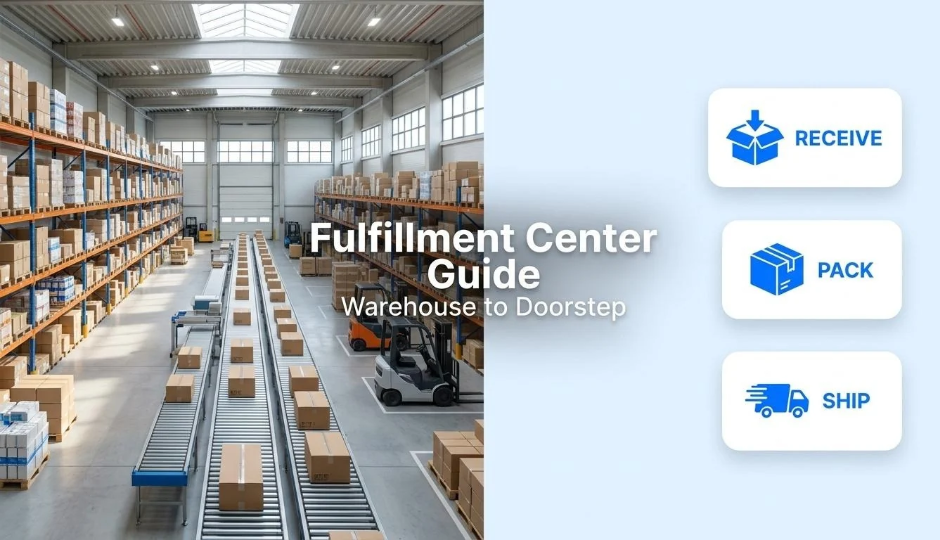
A fulfillment center is a facility that receives, stores, picks, packs, and ships individual customer orders on behalf of ecommerce sellers. Brands can operate fulfillment in-house, outsource it to a third-party logistics (3PL) provider, or use a marketplace program.
This guide covers fulfillment center operations and types, the case for outsourcing and when to do it, choosing and transitioning to a 3PL partner, pricing structures, multi-channel and subscription fulfillment, and how your ecommerce stack ties it all together.
The core workflow inside a fulfillment center spans inventory receiving, order picking and packing through methods like batch and zone picking, carrier handoff for last-mile delivery, and reverse logistics for returns. Each step directly affects delivery speed, order accuracy, and repeat purchase behavior.
Fulfillment center types range from in-house operations and 3PL warehouses to multi-channel facilities, cold-chain centers for perishable goods, and subscription box specialists. The right model depends on product category, order volume, and how many sales channels a brand operates.
Outsourcing becomes practical once order volume, storage constraints, or shipping complexity outpaces internal capacity. Distributed 3PL networks lower per-order costs through carrier leverage and place inventory closer to customers, shortening transit times without requiring brands to build infrastructure.
Choosing a provider requires evaluating geographic coverage, platform integrations, transparent pricing across pick-and-pack, storage, receiving, and return fees, plus contractual SLAs with measurable performance thresholds.
Multi-channel sellers need shared inventory pools and centralized order routing to prevent overselling across storefronts. A unified ecommerce stack, where order data, inventory, and customer records live in one system, reduces integration gaps and protects fulfillment accuracy as volume scales.
A fulfillment center processes and ships online orders on behalf of sellers. The core workflow spans receiving inventory, picking and packing orders, managing shipping and last-mile delivery, and handling returns.
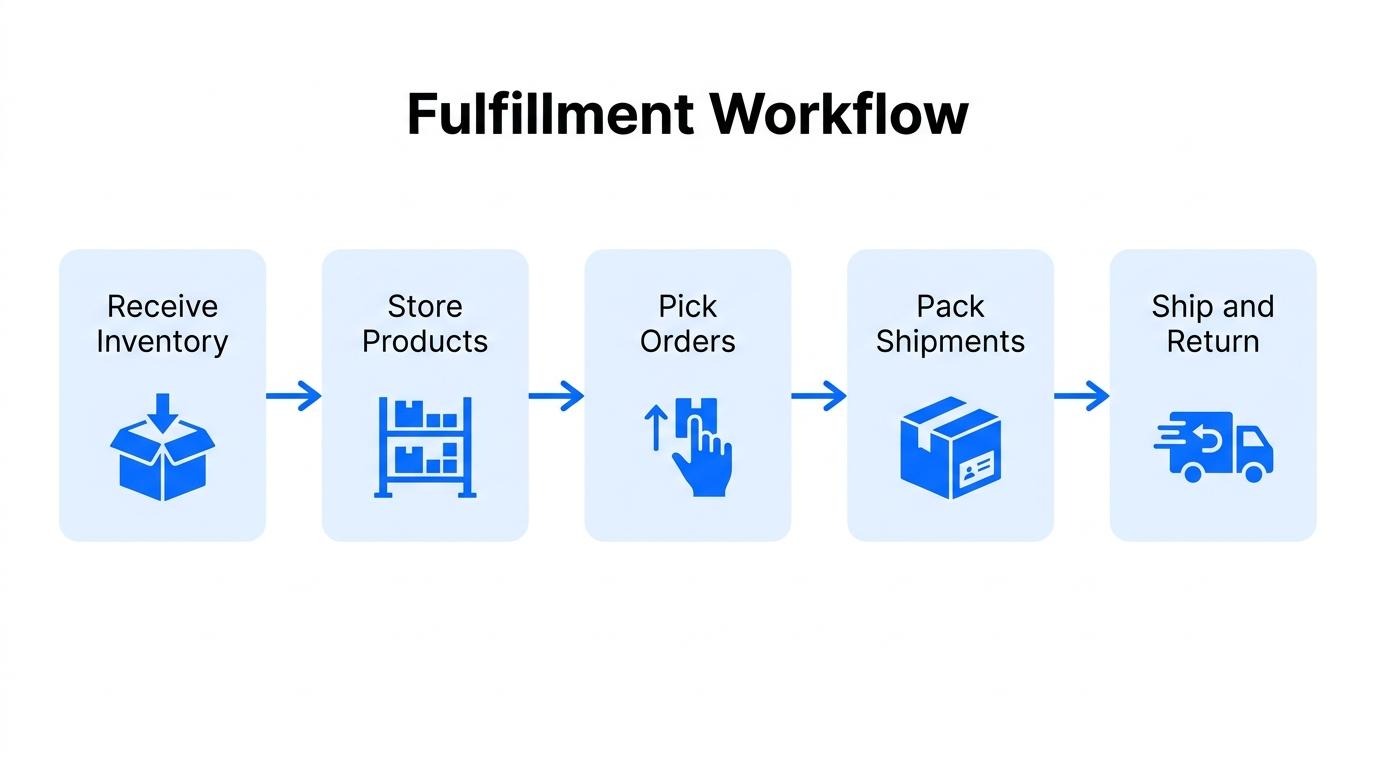
A fulfillment center receives inventory when sellers ship bulk stock to the facility for storage and order processing. According to Inbound Logistics (2024), a fulfillment center is a third-party service provider that processes and ships products directly to customers after managing the seller's inventory and storing it.
Once goods arrive, staff verify quantities against purchase orders, label items by SKU, and assign them to designated storage locations. Distributing inventory across multiple warehouse locations reduces supply chain risk while improving shipping speeds and costs. For brands scaling beyond a single facility, this multi-warehousing approach is one of the most practical ways to balance delivery performance with logistics spend.
Orders are picked and packed through systematic warehouse processes that match items to customer orders. Staff or automated systems locate each SKU in the warehouse, retrieve the correct quantity, and prepare shipments at packing stations.
Common picking methods include:
After picking, packers verify items with barcode scans, select appropriately sized packaging, and seal each shipment for dispatch.
Shipping and last-mile delivery work through a network of three key elements: the distribution center, the delivery vehicle, and the receiving point. The fulfillment center hands packed orders to carriers, who transport them through sortation hubs and ultimately to the customer's door.
AlixPartners' 2023 Home Delivery Survey found that free delivery is a critical factor in 96% of purchasing decisions, and customers expect an average 3.3-day delivery window. This suggests diminishing returns for ultra-fast logistics built on costly last-mile infrastructure. Most brands benefit more from offering reliable, free shipping within a reasonable window than from chasing next-day speed at steep operational cost.
Returns and reverse logistics are handled through a structured process that moves products backward through the supply chain. Reverse logistics covers product servicing, return processing, and recycling, extending well beyond standard outbound delivery.
According to Oracle NetSuite, the return process starts when the consumer signals they want to return a product, which should include return authorization and identification of the product's condition. From there, a fulfillment center typically follows these steps:
Efficient reverse logistics directly shapes repeat purchase behavior, making it a revenue-protection function rather than just a cost center. With returns managed, attention naturally shifts to how fulfillment centers differ from standard warehouses.
A fulfillment center is different from a warehouse in its core function: a fulfillment center actively processes and ships individual customer orders, while a warehouse primarily stores goods in bulk. The distinction centers on operational tempo, technology integration, and the range of services performed under one roof.
A warehouse holds inventory for extended periods, often serving as a staging point for bulk distribution to retailers or other businesses. Inventory enters, sits on racks or pallets, and leaves in large shipments. The operation is storage-first, with minimal per-order handling.
A fulfillment center, by contrast, operates as a high-velocity order processing hub. Inventory arrives, gets received and shelved, then moves through picking, packing, and shipping workflows every time an individual customer places an order. Many fulfillment centers also handle returns, kitting, and real-time inventory syncing with ecommerce platforms. According to Microsoft Learn, cross-docking is a warehouse process where inventory required for an order is directed straight from receipt to the correct outbound dock, while remaining stock follows the regular put-away process. This technique, common in fulfillment centers, minimizes storage dwell time and accelerates outbound throughput.
The key differences between fulfillment centers and warehouses include:
For brands selling direct-to-consumer, this distinction matters because choosing the wrong facility type creates misaligned workflows. A warehouse cannot efficiently pick and ship 500 individual orders per day; a fulfillment center is purpose-built for exactly that. Understanding which operation your business actually needs is the first step toward evaluating the types of fulfillment centers available.
The types of fulfillment centers include in-house operations, third-party logistics (3PL) providers, multi-channel facilities, specialty centers for perishable goods, and subscription box fulfillment centers. Each model serves different operational needs.
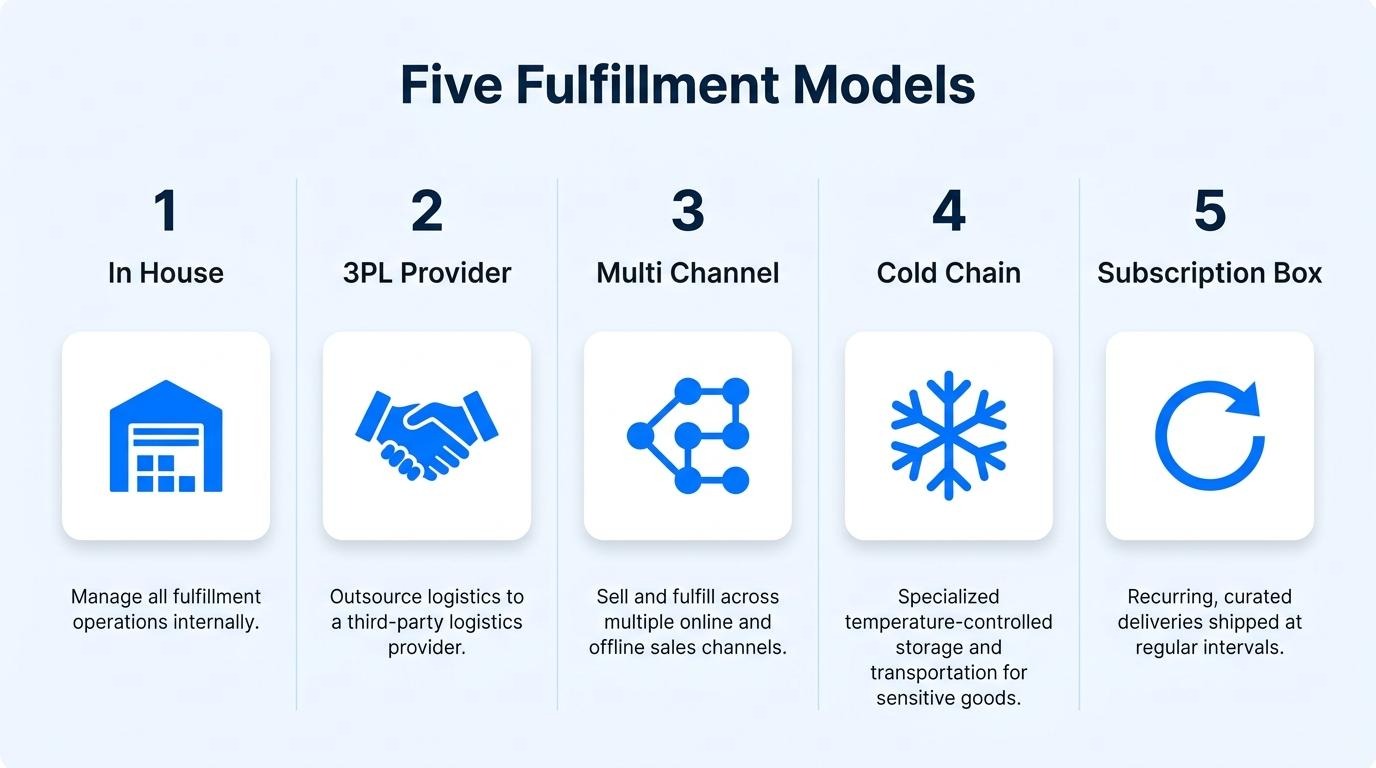
In-house fulfillment centers are warehouse facilities owned and operated directly by the brand. The company manages every step, from receiving inventory to picking, packing, and shipping orders to customers. This model gives brands complete control over quality standards, packaging customization, and shipping timelines. However, it requires significant capital investment in warehouse space, labor, equipment, and technology. For brands scaling past a few hundred orders per month, maintaining in-house operations can strain internal resources and divert focus from product development and marketing.
Third-party logistics (3PL) fulfillment centers are externally operated facilities where brands outsource warehousing, picking, packing, and shipping. As defined by Encyclopaedia Britannica, a firm may contract with an outside party to perform specific logistics services; this practice is referred to as third-party logistics. Contract logistics coordinates these providers to handle warehousing, transportation, and distribution on the brand's behalf. By consolidating inventory into larger facilities, 3PLs gain carrier negotiating leverage that most individual brands cannot achieve alone. For brands processing thousands of orders monthly, 3PL partnerships often represent the most practical path to scale without building infrastructure from scratch.
Multi-channel fulfillment centers are facilities designed to process orders from multiple sales channels through a single inventory pool. According to Amazon's provider documentation, Amazon Multichannel Fulfillment provides fast, reliable fulfillment for multiple ecommerce sales channels in as fast as two days. These centers route orders from a brand's own website, marketplaces, and retail partners through one warehouse operation. A unified inventory approach prevents overselling, reduces split shipments, and simplifies stock management across channels. Brands selling on three or more platforms benefit most from this model.
Specialty fulfillment centers for perishable goods are temperature-controlled facilities built to store and ship products requiring refrigeration or frozen storage. Cold chain logistics involves transporting temperature-sensitive items using refrigerated packaging and climate-monitored environments throughout the supply chain. These centers handle food, beverages, supplements, pharmaceuticals, and other items with strict shelf-life requirements. Specialized packaging materials, insulated containers, and expedited shipping protocols prevent spoilage during transit. Brands selling perishable products should verify a facility's cold storage certifications and temperature monitoring capabilities before committing.
Subscription box fulfillment centers are facilities specializing in recurring-order assembly, kitting, and scheduled shipments. These centers batch identical subscription configurations together for efficient assembly-line processing. Workflow design enables a continuous flow of boxes ready for components at an optimal speed while minimizing defects. Unlike standard fulfillment, subscription operations require synchronized billing cycles, custom insert management, and consistent unboxing experiences across every shipment. Choosing the right fulfillment model depends on your product type, order volume, and channel strategy.
An ecommerce brand should outsource fulfillment to lower costs, speed up delivery, and refocus internal resources on growth. The sections below cover how outsourcing reduces operational costs, improves shipping speed, and frees up internal teams.
Outsourcing reduces operational costs by shifting warehouse labor, storage, and carrier negotiations to a provider that operates at scale. Third-party logistics companies consolidate inventory into larger facilities, achieving higher productivity and lower per-order fulfillment costs. Their shipping volume also gives them negotiating leverage with carriers that most individual brands cannot match.
According to the 2024 Third-Party Logistics Study presented by Penske Logistics, the top reason shippers outsource is to improve process efficiency and productivity, cited by 83% of shippers and 89% of 3PLs; reducing operational costs followed, cited by 67% of shippers. For brands processing hundreds or thousands of orders monthly, absorbing those fixed costs internally often erodes margins faster than a variable 3PL fee structure would.
Outsourcing improves shipping speed by placing inventory closer to end customers through geographically distributed fulfillment centers. A multi-warehouse strategy shortens the distance each package travels, which directly reduces transit times and lowers per-shipment carrier costs.
According to Forbes, multi-warehousing inventory helps achieve ideal shipping speeds and costs while also reducing supply chain risk. When a brand stores stock in only one location, orders heading to the opposite coast face longer transit windows and higher zone-based rates. Distributed fulfillment eliminates that bottleneck, making two-day or three-day delivery realistic without premium carrier surcharges.
Outsourcing frees up internal teams by removing day-to-day warehouse operations from their responsibilities. Tasks such as receiving shipments, managing inventory counts, picking orders, and coordinating carrier pickups consume significant staff hours that could be redirected toward product development, marketing, and customer retention.
A 2024 systematic review published in Heliyon confirmed that the necessity to concentrate on essential company tasks is a significant motivator for logistics outsourcing, alongside cost savings and improved service. For scaling ecommerce brands, this reallocation is often the highest-value outcome of working with a fulfillment partner; operational bandwidth, not just cost, becomes the real constraint once order volume grows.
With the case for outsourcing established, timing the transition correctly determines how smoothly it unfolds.
The right time to outsource fulfillment depends on order volume thresholds, recurring operational bottlenecks, and the point where in-house capacity cannot scale cost-effectively. The sections below cover each signal in detail.
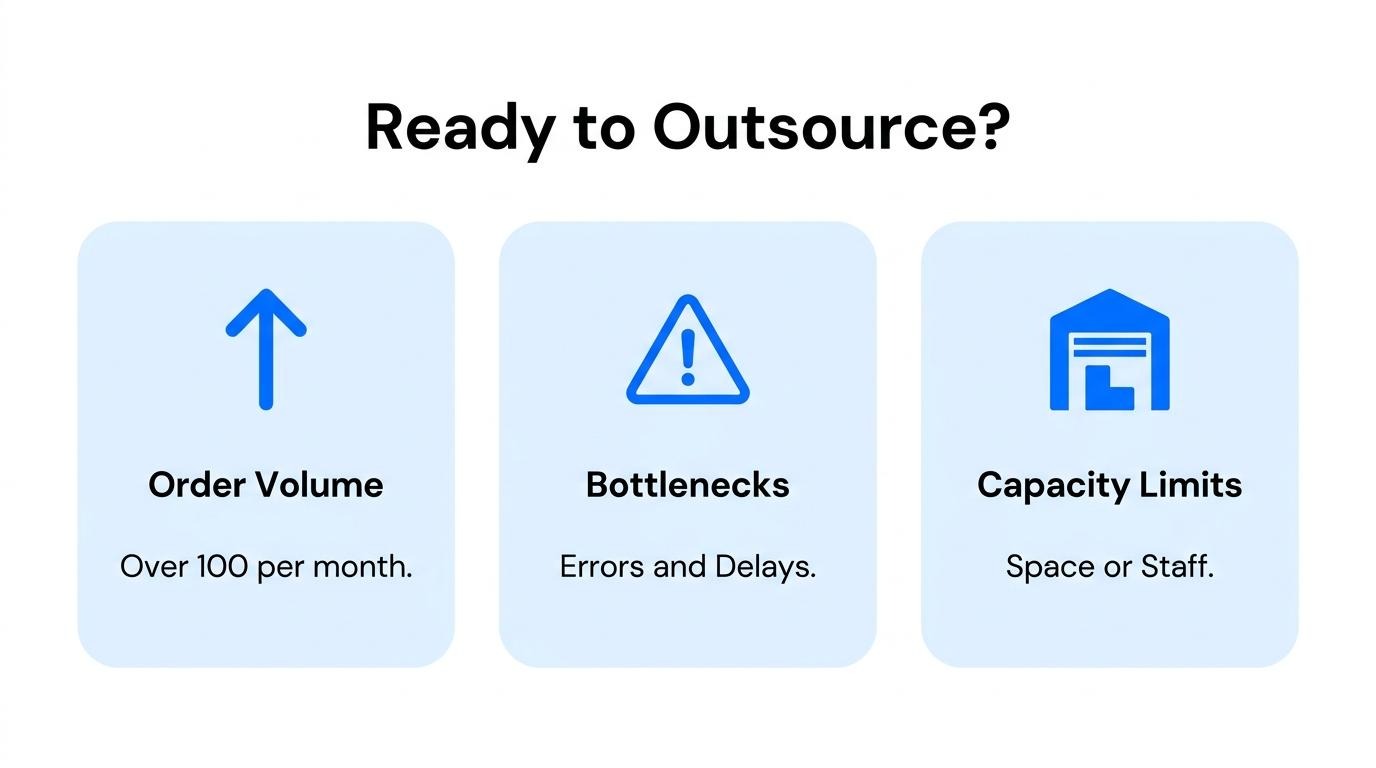
The order volume signals you should outsource include consistently exceeding 100 monthly orders while struggling to keep up, recurring packing errors, and returns processing that diverts time from growth activities. Once manual label steps and handheld scanning slow your throughput, a 3PL's automated workflows become more cost-efficient than adding headcount.
According to Red Stag Fulfillment, the average 3PL client ships roughly 3,000 to 5,000 direct-to-consumer orders per month, though small brands may start outsourcing at 500 orders while mature DTC labels exceed 20,000. If your team spends more time on logistics than on product development or marketing, that imbalance is itself a volume signal worth acting on.
The operational bottlenecks that indicate you need a 3PL include:
When these bottlenecks appear together, they compound. A single mispick triggers a return, which consumes reverse logistics labor and delays the next outbound cycle. For brands at this stage, the cost of not outsourcing often exceeds 3PL fees.
In-house fulfillment stops scaling when storage space runs out, seasonal surges require infrastructure you cannot justify year-round, and labor costs grow faster than revenue. According to The Fulfillment Lab, a clear sign is fulfilling more than 100 orders per month while running out of storage space at home or in your office.
Beyond physical constraints, internal teams hit a ceiling on carrier negotiation leverage, multi-warehouse distribution, and technology investment. A 3PL absorbs these capital demands across its client base, converting your fixed costs into variable ones that flex with demand.
Understanding when to outsource sets the stage for selecting the right fulfillment partner.
You choose the right fulfillment center by evaluating geographic coverage, technology integrations, pricing transparency, and performance guarantees. The sections below break down each criterion.
The geographic coverage you should evaluate includes the fulfillment center's proximity to your highest-density customer zones. Centers located closer to end customers reduce transit times and shipping costs. For U.S.-based brands, distributing inventory across multiple regions (West Coast, Midwest, East Coast) shortens average delivery windows. Evaluating a provider's warehouse network map against your order-density data reveals whether one location suffices or a multi-node strategy is necessary. Brands selling nationally but fulfilling from a single coastal hub often pay premium rates on cross-country shipments, which erodes margins over time.
The technology integrations you should require include real-time inventory syncing, automated order routing, and bidirectional shipping updates between your storefront and the fulfillment provider's warehouse management system. According to WooCommerce documentation, the WooCommerce REST API connects your store to external systems and services, with most integrations requiring API key generation to establish the connection. Beyond API access, confirm that the provider supports your specific ecommerce platform, order management system, and any EDI requirements for wholesale channels. Missing or brittle integrations force manual workarounds that introduce errors and delay shipments.
You assess pricing models and hidden fees by requesting a fully itemized rate card that separates receiving, storage, pick-and-pack, shipping, and return processing costs. According to ShipNetwork, many fulfillment providers charge additional fees for storage, packaging, and shipping, and without competitive pricing, these fees can quickly add up, cutting into profits. Ask specifically about surcharges for oversized items, peak-season rates, minimum order commitments, and account management fees. Comparing total landed cost per order across two or three providers gives a clearer picture than comparing line-item rates in isolation.
The SLAs and performance metrics you should track include order accuracy rate, on-time shipment percentage, average processing time, and inventory shrinkage rate. According to the Warehousing Education and Research Council (WERC) 2025 DC Measures Report, the report tracks over 30 metrics that are key to distribution professionals. Contractual SLAs should define acceptable thresholds for each metric, along with remedies when the provider falls short. Reviewing a provider's willingness to commit to measurable SLAs, rather than vague service promises, is one of the clearest indicators of operational maturity.
With evaluation criteria established, the next step is connecting your fulfillment center to your ecommerce platform.
A fulfillment center integrates with your ecommerce platform through API connections that sync inventory, orders, and shipment data in real time. The subsections below cover inventory syncs, order data flow, and tracking notifications.
Real-time inventory syncs keep stock counts accurate across every sales channel the moment a unit is sold, received, or returned. Without this synchronization, overselling and stockouts become inevitable as order volume scales.
Accurate syncs rely on API-level connections between the ecommerce platform and the fulfillment center's warehouse management system. Each transaction updates available quantities simultaneously, so the storefront never displays inventory that has already been allocated. For brands selling across multiple storefronts, this shared availability layer prevents the channel-specific silos that cause fulfillment errors and canceled orders.
Order data flow between platforms matters because it connects the purchase event to every downstream fulfillment step, from picking to delivery confirmation. When order details transfer instantly, the fulfillment center can begin processing without manual re-entry or batched uploads.
According to DHL's Logistics Trend Radar, cross-channel omnichannel platforms shared between manufacturers, retailers, and logistics providers are critical enablers of omnichannel business models and ensure a seamless customer experience. Broken or delayed data flow introduces misrouted shipments, incorrect items, and late deliveries. Research published in the Journal of Interactive Marketing confirms the stakes: late deliveries significantly decrease repurchase frequency, while early deliveries shorten the gap between orders. Tight data integration directly protects repeat purchase behavior.
Tracking and shipping notifications reach customers when the fulfillment center pushes shipment confirmation data back to the ecommerce platform or order management system after a label is created. The platform then triggers automated email or SMS updates containing the carrier tracking number and estimated delivery date.
Carrier APIs from providers like UPS supply up-to-the-minute shipment status from origin to delivery. These updates flow through the ecommerce platform's notification workflows so customers can self-serve tracking without contacting support. For brands managing multiple channels, centralizing these confirmations through one system reduces the chance of missed or duplicate notifications.
With integration architecture in place, cost structure becomes the next critical evaluation factor.
Common mistakes brands make when outsourcing fulfillment include ignoring hidden fees, skipping technology integration checks, choosing providers based on price alone, and failing to define performance benchmarks before signing a contract. These errors erode margins, create operational blind spots, and damage customer experience.
For brands operating across multiple sales channels, the cost of these mistakes compounds rapidly because each integration point is another failure surface. Understanding how outsourced fulfillment shapes the buyer's post-purchase journey matters just as much as the logistics themselves.
Outsourced fulfillment affects customer experience through delivery speed, shipping cost, order accuracy, and post-purchase communication. The sections below cover how each factor shapes buyer satisfaction and repeat purchasing behavior.
Delivery speed directly influences repeat purchase behavior. A 2025 study published in the Journal of Interactive Marketing found that late deliveries significantly decrease repurchase hazard rates, increasing the time between orders, while early deliveries shorten interpurchase intervals. Despite the pressure to ship faster, most buyers prioritize cost over velocity. According to a McKinsey survey of over 1,000 U.S. consumers, 90% are willing to wait two to three days if it means avoiding shipping fees. For most brands, consistently meeting a stated delivery window matters more than promising next-day arrival.
Shipping costs drive purchase decisions because they are the single largest delivery-related factor influencing where consumers buy. AlixPartners' 2023 Home Delivery Survey found that free delivery is a critical factor in 96% of purchasing decisions, with customers expecting an average 3.3-day delivery window. Outsourced fulfillment centers, through carrier volume discounts and distributed warehouse networks, can lower per-order shipping costs enough to make free or flat-rate shipping viable. When a brand absorbs these costs strategically, conversion rates improve and cart abandonment from sticker shock drops.
Order accuracy builds customer trust by ensuring the right product reaches the right customer on the first attempt. The American Productivity and Quality Center (APQC) defines perfect order performance as flawlessly taking and fulfilling an order, including correct allocation, on-time delivery, and an accurate invoice. Professional fulfillment centers maintain this standard through barcode-verified picking, systematic packing workflows, and real-time inventory syncs. Even one wrong item erodes confidence quickly, making accuracy the silent foundation of long-term brand loyalty.
Tracking and communication play a central role after purchase by keeping buyers informed from label creation through doorstep delivery. Automated shipping notifications, real-time carrier tracking pages, and proactive delay alerts reduce "where is my order" inquiries and build post-purchase confidence. When fulfillment systems sync tracking data back to the ecommerce platform, customer service teams can resolve issues faster. Brands that treat post-purchase communication as part of the product experience, not an afterthought, see stronger retention and fewer support tickets over time.
Understanding how fulfillment shapes customer perception helps clarify what these services actually cost.
Fulfillment center pricing typically includes per-order pick and pack fees, storage costs, inbound receiving charges, and return processing fees. The sections below break down each category.
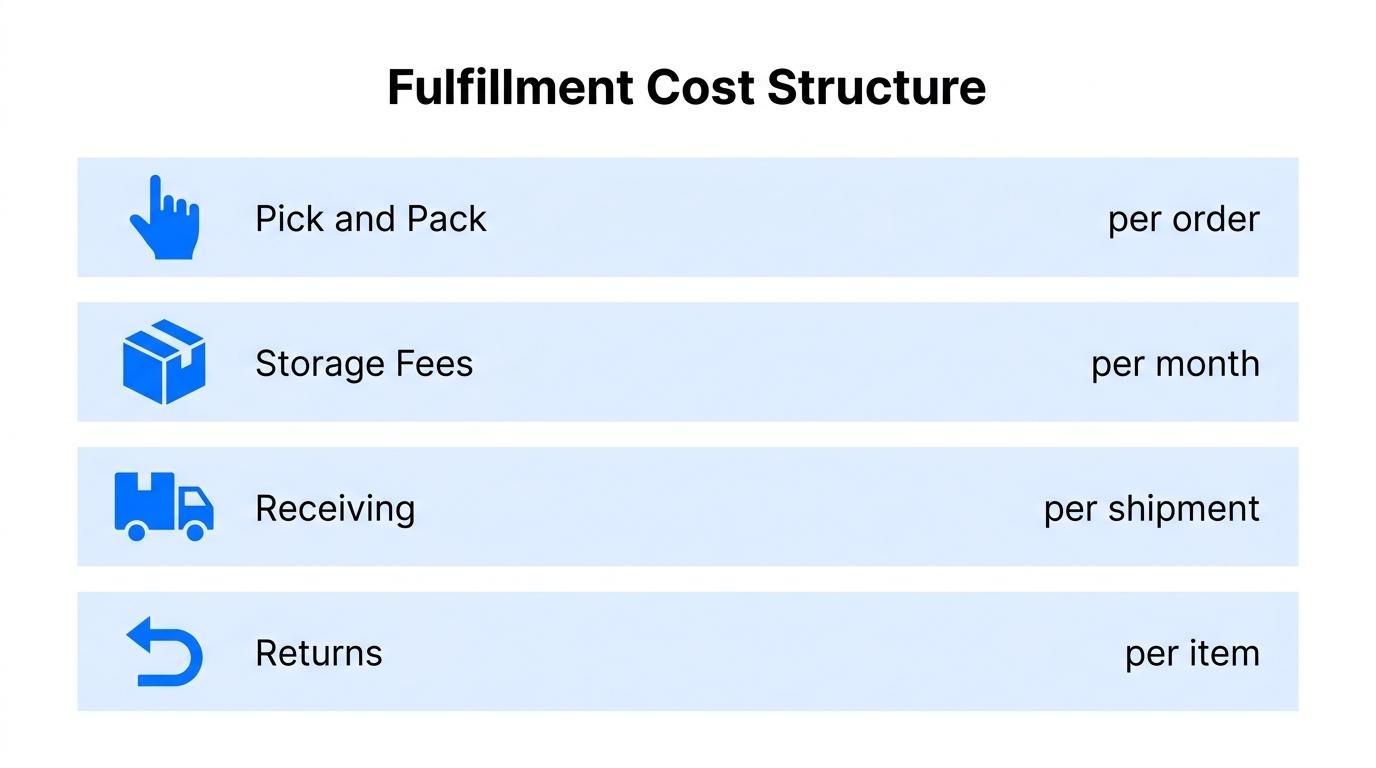
Per-order pick and pack fees are charges fulfillment centers apply for locating products in the warehouse and packaging them for shipment. These fees typically range from $0.20 to $5.00 per item, depending on the product and service provider. According to an MHI member resource, warehouse labor models break operations into four distinct functions: picking, packing, replenishment, and other operations, each carrying its own staffing cost and throughput rate.
Fees often increase when orders contain multiple SKUs, oversized items, or require custom packaging materials. Dimensional weight can also affect costs; carriers charge based on whichever is greater, dimensional or actual weight, which influences how fulfillment centers price packing for bulky, lightweight products.
Storage and warehousing fees are recurring charges for the physical space your inventory occupies inside a fulfillment center. Most providers bill using one of four unit types:
These 2023 benchmarks from the WarehousingAndFulfillment.com pricing survey showed increases across all major categories compared to the prior year. Where a provider slots your inventory matters significantly. As Georgia Tech's Warehouse & Distribution Science notes, the storage location determines how quickly and at what cost the product is later retrieved for a customer. Slow-moving SKUs pushed to less accessible zones cost less in storage but more in pick time, so the trade-off deserves attention during provider negotiations.
Inbound receiving fees are charges fulfillment centers assess for unloading, inspecting, and putting away incoming inventory. According to the 2024 Warehouse Costs and Pricing Survey, average receiving costs are:
Some providers reduce these fees when shipments arrive with clear labeling and advance shipping notices. Inventory that can be cross-docked, directed straight from receiving to an outbound staging area, may bypass storage entirely, lowering both receiving and warehousing costs for high-velocity SKUs.
Return processing fees are charges applied each time a fulfillment center receives, inspects, and dispositions a returned item. These fees typically cover return authorization verification, condition assessment, repackaging for restocking, and disposal of unsalvageable goods.
Costs vary based on product complexity and the level of inspection required. Apparel returns needing quality checks and refolding cost more than sealed electronics that only require a barcode scan. Brands with high return rates, particularly those in categories prone to bracketing, should negotiate return fee structures early, since these charges compound quickly and erode margins faster than most merchants anticipate.
With pricing categories mapped out, evaluating how fulfillment operates across multiple sales channels becomes the next priority.
You manage fulfillment when selling across multiple channels by centralizing inventory, unifying order routing, and syncing stock levels in real time across every storefront. The key tactics include shared inventory pools, multichannel fulfillment services, consolidated shipping documentation, and product kitting.
Selling through a branded storefront, marketplaces, and wholesale simultaneously introduces inventory fragmentation risk. When each channel draws from an isolated stock pool, oversells and split shipments become routine. A shared inventory model, where storefront channels share the inventory for a product or variant, prevents this by applying a single set of inventory settings across all connected sales channels.
Multichannel fulfillment programs compress delivery timelines without requiring separate warehouse agreements per channel. According to Amazon, Multichannel Fulfillment (MCF) provides fast, reliable fulfillment for multiple ecommerce sales channels in as fast as two days. Consolidation tools also reduce administrative overhead; the USPS Drop Shipment Management System (DSMS), for example, streamlines plant-verified drop shipment documentation from multiple jobs and mailing locations into electronic files.
Product kitting adds another layer of efficiency. Kitting is an inventory management strategy where multiple products are grouped, packaged, and sold together as a single offering. This simplifies SKU management across channels because the kit counts as one unit in the warehouse management system, regardless of which storefront generated the order.
For brands operating at scale across five or more sales channels, the real bottleneck is rarely the warehouse itself; it is the data layer connecting every channel to a single source of inventory truth. Platforms built around a shared customer data layer, including SHOPLINE, keep order and inventory data tied to one system rather than reconciling mismatched counts across disconnected tools. That architectural choice determines whether multichannel growth creates operational leverage or operational chaos.
Fulfillment for subscription-based ecommerce works by synchronizing recurring billing cycles with pre-scheduled inventory assembly, kitting, and batch shipping. Unlike one-off orders that trigger fulfillment individually, subscription fulfillment groups all active subscribers into a single processing window, then picks, assembles, and ships every box within a compressed timeline.
The process follows a predictable rhythm. A subscription management system charges customers on a set date, then transmits the full batch of orders to the fulfillment center. According to the Subscription Trade Association (SUBTA), the workflow should enable single-piece or continuous flow of boxes ready for components at an optimal speed, all while minimizing defects. That assembly-line approach is essential because subscription boxes often contain curated product combinations that change monthly, requiring kitting rather than simple single-SKU picks.
Key differences from standard ecommerce fulfillment include:
For brands managing subscriptions across their own storefront and marketplace channels, the billing platform, order management system, and fulfillment center must share real-time data. Without that synchronization, inventory mismatches and duplicate shipments become common failure points. Brands running subscription programs at scale benefit from platforms where subscription logic, customer data, and order routing operate within one system rather than being stitched together across separate tools.
You transition from in-house to outsourced fulfillment by auditing current operations, selecting a 3PL partner, integrating systems, running pilot orders, and executing a phased cutover. The steps below cover each stage.
You audit your current fulfillment operations by documenting every process, cost, and performance metric before approaching a 3PL. Map order volume, SKU count, storage footprint, error rates, and per-order costs. This baseline becomes the benchmark against which you measure 3PL performance after transition. Brands that skip this step lose negotiating leverage and cannot identify whether outsourcing actually improves efficiency. Capture seasonal peaks separately; they directly affect the warehousing and staffing terms a provider will quote.
You select and vet a 3PL partner by issuing a structured RFP that specifies cost presentation format, timeline expectations, and SLA requirements. According to Saddle Creek Logistics, being specific on how you want costs presented and clear on the timeline are essential steps for getting the most from a 3PL RFP. Evaluate geographic coverage relative to your customer base, technology stack compatibility, and experience with your product category. Request client references and tour facilities before signing. The cheapest quote rarely wins long-term; prioritize providers whose systems integrate natively with your ecommerce platform and whose error-handling protocols are documented.
You integrate systems and migrate data by connecting your ecommerce platform, order management system, and the 3PL's warehouse management system through APIs or EDI. Real-time inventory syncs, order routing, and tracking-number pass-back must all function before any live orders ship. As noted in a GXO Logistics SEC filing, businesses can experience temporary interruptions and incur additional costs when building IT infrastructure and transitioning data to new systems. Start integration weeks before cutover, and validate that SKU mappings, product weights, and shipping rules transfer accurately.
You run pilot orders before full cutover by routing a small, controlled batch of live orders through the 3PL while maintaining in-house fulfillment as a fallback. Test the complete cycle: order import, picking, packing, label generation, tracking updates, and return authorization. Define error-handling rules in advance, such as what happens when inventory mismatches occur, to prevent operational disruptions during scale-up. Gradually increase the percentage of orders routed to the 3PL as accuracy and speed meet your benchmarks. Most brands that skip parallel testing discover integration gaps only after customers are affected.
A phased cutover timeline typically spans four to eight weeks across distinct stages:
Rushing this timeline increases the risk of mislabeled inventory, broken tracking flows, and customer-facing errors. With a structured cutover complete, your fulfillment strategy then depends on the broader ecommerce stack powering it.
Your ecommerce stack shapes your fulfillment strategy by determining how order data, inventory, and customer records connect to warehouse operations. The sections below cover what changes when data lives in one system and the key takeaways about fulfillment centers and outsourcing.
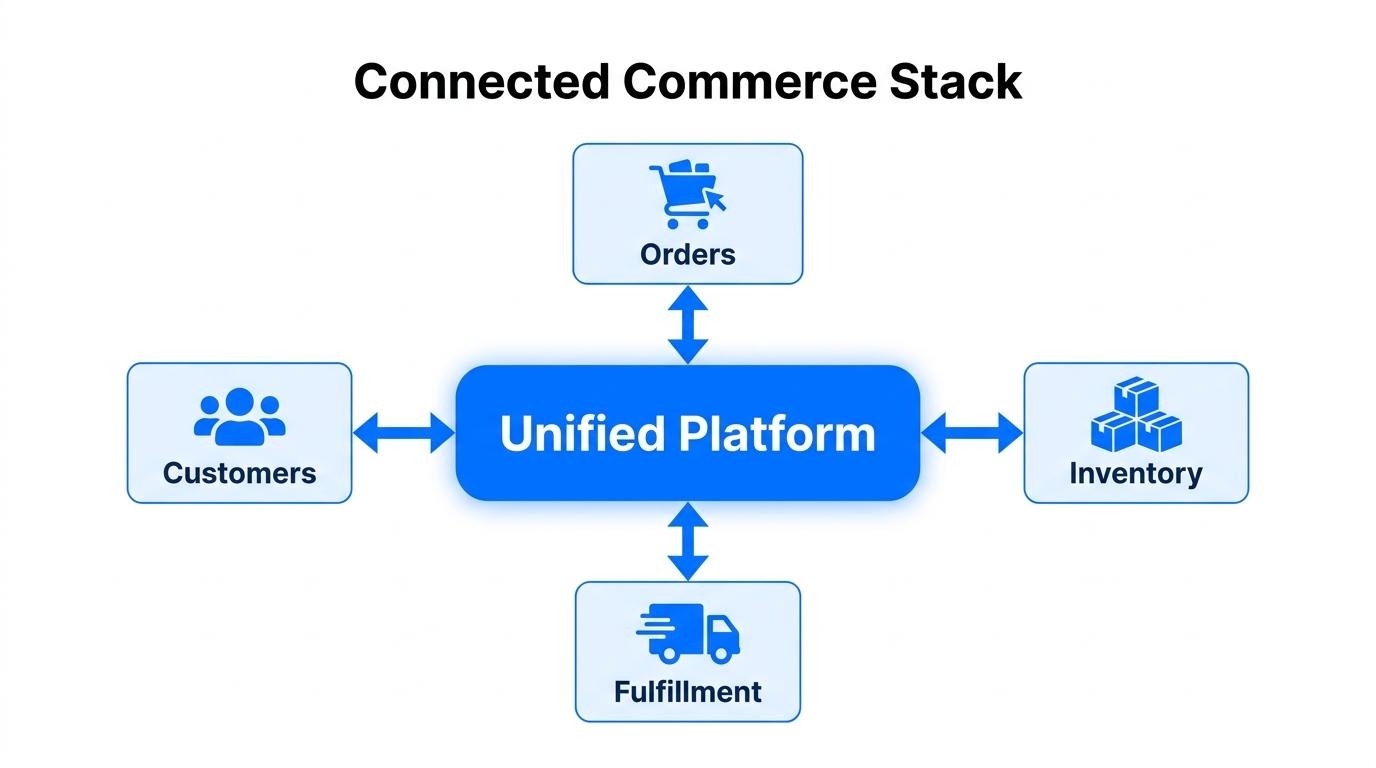
What changes when order and customer data live in one system is the speed and accuracy of every fulfillment touchpoint. An order management system captures orders from every sales channel, routes each order to the right fulfillment location, and tracks it from placement through delivery. When that OMS shares a data layer with customer records, inventory allocation happens immediately, and shipment confirmations with tracking numbers flow back to the ecommerce platform or customer service system automatically.
This matters because fulfillment errors compound across disconnected tools. Perfect order performance measures the ability to take an order correctly, allocate inventory immediately, and deliver on time with an accurate invoice. Fragmented systems introduce latency at each step. According to a 2024 Sendcloud survey of 4,000 shoppers, 77% cited past delivery experience as an important factor in deciding where to buy online.
Brands that run commerce, CRM, and order routing inside one platform eliminate the sync gaps that cause overselling, delayed tracking updates, and misrouted shipments. For scaling DTC operations managing multiple channels, consolidating these data flows is one of the most effective ways to protect fulfillment accuracy before volume outpaces the stack.
The key takeaways about fulfillment centers and outsourcing center on three decisions: what to delegate, when to transition, and how your technology ties everything together.