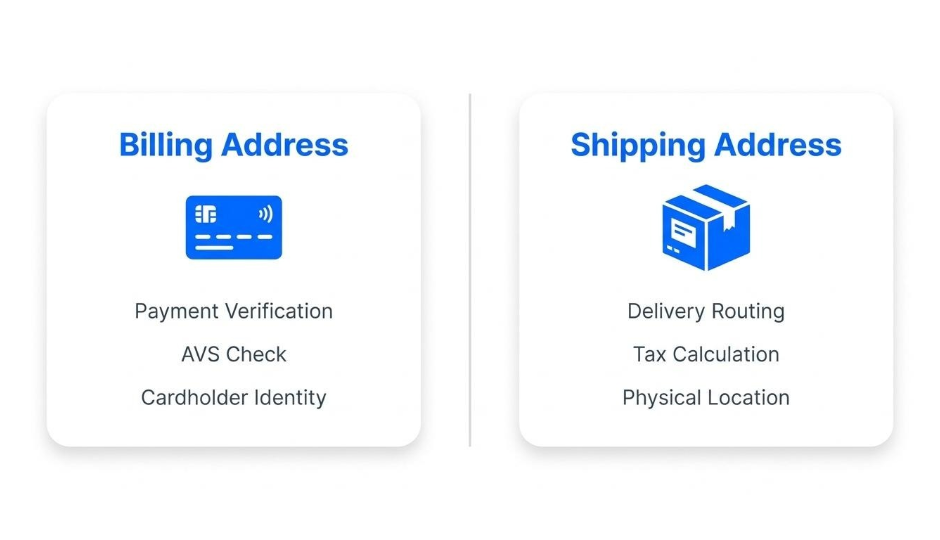
A billing address is the address registered to a customer's payment method, used to verify cardholder identity during checkout. A shipping address is the physical location where a carrier delivers the purchased item.
This guide covers address definitions and when they can differ, payment verification and fraud prevention, sales tax and VAT sourcing, common entry errors and delivery failures, and checkout design for one-time and recurring orders.
The billing address exists purely for payment security. Each transaction runs through Address Verification Service (AVS), which compares the submitted street number and ZIP code against the card issuer's records. A mismatch can trigger a decline, a manual review hold, or an elevated chargeback risk, depending on the merchant's fraud rules.
The shipping address controls where packages go and which tax rate applies. Most U.S. states follow destination-based sourcing, meaning the shipping ZIP code sets the sales tax, not the seller's warehouse location. When no delivery destination exists (digital goods, streaming subscriptions), tax engines fall back to the billing address on file.
The two addresses diverge more often than many merchants expect. Gift orders, corporate purchases, P.O. Box billing, and multi-location subscriptions all require separate entries. These mismatches are routine, not inherently fraudulent, though fraud teams layer address signals with device and behavioral data to distinguish legitimate splits from suspicious patterns.
Small errors in either field create outsized problems. Swapped addresses cause simultaneous payment failures and misrouted packages. Outdated billing details after a move trigger AVS declines. Typos in the shipping field send orders to the wrong destination or make them undeliverable entirely.
Storing both addresses in a single customer record that spans checkout, POS, and subscriptions keeps data consistent across every channel and prevents the silent mismatches that erode revenue over time.
A billing address is the address registered to a customer's payment method, such as a credit card or bank account. It connects the cardholder's identity to financial transactions and plays a central role in payment verification during online checkout.
According to the Massachusetts Institute of Technology's e-commerce glossary, a billing address is "the address to which a customer's credit card billing statement is mailed," used to help verify that the customer is the actual owner of the card. In structured data terms, Schema.org defines a dedicated billing address property for orders, reinforcing how payment processors and search engines treat this address as a distinct data entity tied to the transaction, not the delivery.
Because the billing address must match what the card issuer has on file, even small discrepancies (a missing apartment number, an outdated ZIP code after a move) can trigger payment rejections. This makes accurate billing address entry one of the quieter but more consequential steps in any checkout flow.
A shipping address is the physical location where a carrier delivers a purchased item. It determines delivery routing, shipping costs, and sales tax in most U.S. states.
According to GS1's logistic label guideline, the ship-to address is necessary for carriers to know the delivery location and deliver goods to the right destination, and this information must relate to the physical address where goods need to be delivered. Unlike a billing address, which ties to a payment method, the shipping address exists purely to guide a package from warehouse to doorstep. It can be a home, office, retail pickup point, or even a friend's residence when sending a gift.
Because destination-based tax states calculate rates from where the buyer receives the product, an accurate shipping address directly affects the final order total. Getting this field right matters for both timely delivery and correct tax collection.
Online stores ask for both a billing address and a shipping address because each serves a distinct function: one verifies the payment method, and the other directs where the package goes. The reasons span payment security, accurate delivery, and correct tax calculation.
Payment verification requires the billing address. According to MIT's e-commerce glossary, the billing address is the address to which a customer's credit card statement is mailed, and it helps verify that the customer is the actual owner of the card being used. When a store collects this address at checkout, it can run the data through the card network's Address Verification Service to flag mismatches before the charge completes.
Physical delivery requires the shipping address. As GS1's logistic label standard explains, the ship-to address must relate to the physical location where goods need to be delivered so carriers know the correct destination. Without a separate shipping field, every gift, office delivery, or forwarded order would fail.
Tax calculation depends on where the buyer receives the goods, not where the cardholder lives. Most U.S. states follow destination-based sales tax sourcing. The shipping address determines the applicable rate in the majority of transactions. When no delivery address is available (for digital goods, for example), jurisdictions like Minnesota fall back to the billing address on file.
These three functions, payment security, delivery routing, and tax compliance, each pull from a different address. Collecting both ensures the store can:
For most shoppers, the two addresses are identical, and a single checkbox can copy one to the other. But the moment a customer ships a gift, orders from a work address, or pays with a card registered in a different state, the distinction becomes essential. Separating the two fields at checkout is not redundant; it is the minimum data a store needs to process, ship, and tax an order correctly.
Understanding why both addresses matter at checkout sets the stage for a closer look at when they can, and should, differ.
Yes, your billing address and shipping address can be different. Most online stores accept mismatched addresses because gift orders, office deliveries, and P.O. Box usage all require separate entries. The key scenarios where this applies are gift shipping, P.O. Box use, and business address orders.
When you ship a gift to someone else, the billing address stays tied to your payment method while the shipping address points to the recipient's location. The card issuer verifies your billing address during checkout to confirm you are the cardholder. The carrier then routes the package to the gift recipient's shipping address independently. According to Southern Methodist University's ePayment documentation, the billing name and address must match what is on the credit card or checking account to prevent payment rejections. This means the billing address cannot change to the recipient's details; only the shipping address should reflect the gift destination. For merchants, this mismatch is entirely normal and should not trigger automatic fraud flags on gift orders.
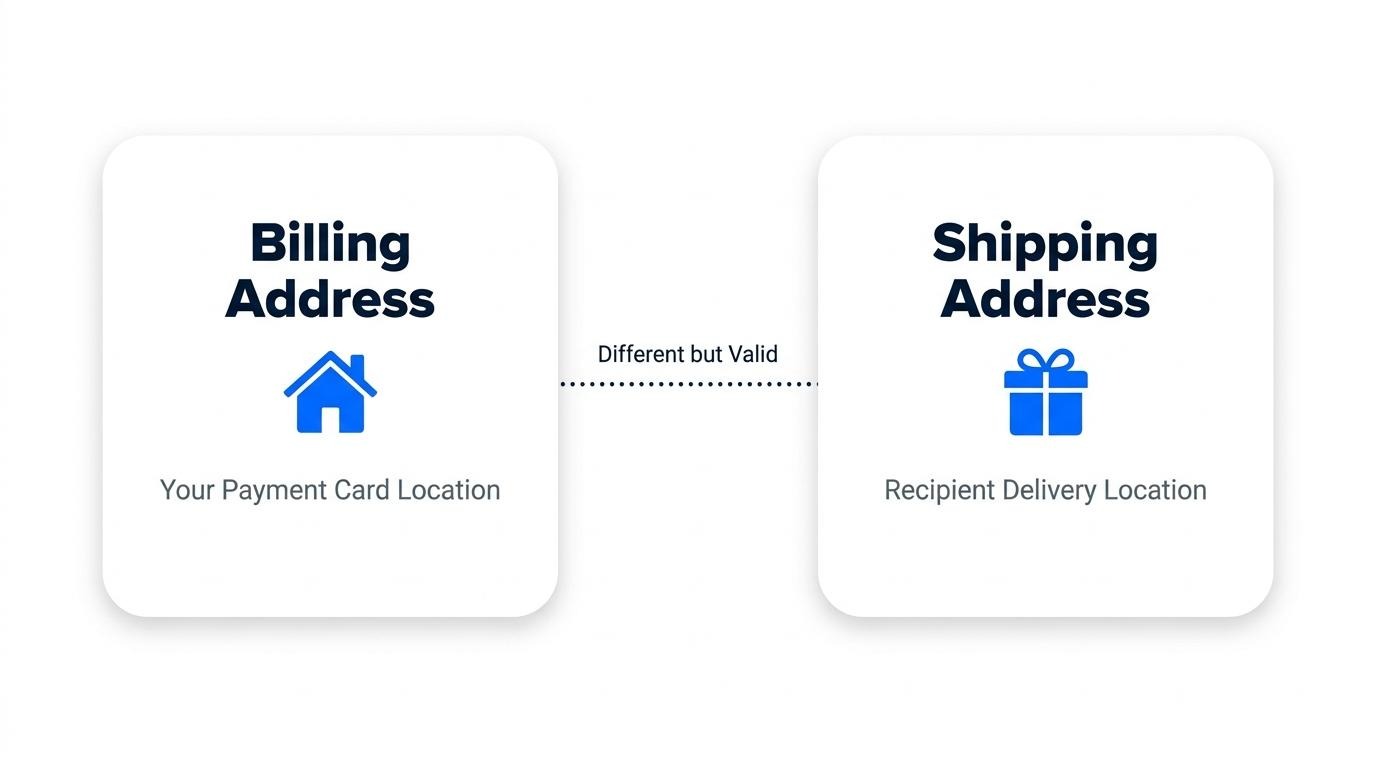
A P.O. Box works as a billing address but creates complications as a shipping address. Credit card issuers accept P.O. Boxes for billing verification because they only need to match the address on file. Shipping carriers, however, often require a physical street address for package delivery. According to a 2011 study published in Nursing Research and Practice (PubMed Central), a postmaster discarded approximately 60 envelopes mailed to P.O. Box customers because only the street address was used. This illustrates how mismatched address formats cause delivery failures. If your billing address is a P.O. Box, enter a separate physical street address for shipping. Conversely, if you receive mail at a P.O. Box, confirm that your carrier supports P.O. Box delivery before using it as the ship-to location.
Orders placed with a business address follow the same split-address logic. The billing address matches the company credit card or corporate account on file, while the shipping address directs to the warehouse, office, or employee location receiving the goods. According to GS1's logistic label guidelines, the ship-to information must relate to the physical address where goods need to be delivered. Business orders often involve a finance department address for billing and a separate operations facility for receiving. This separation is standard for B2B purchasing and does not affect payment verification, provided the billing address matches the card issuer's records.
Understanding when and why these addresses diverge helps clarify how each one affects payment processing at checkout.
Each address affects payment processing differently. The billing address verifies cardholder identity, while the shipping address plays no direct role in payment authorization. Below, we cover how billing address verification works, what AVS does, and what happens when addresses do not match.
The billing address verifies a credit card by confirming that the person placing the order is the legitimate cardholder. When a customer enters payment details at checkout, the merchant sends the billing address to the card-issuing bank. The bank compares the submitted street number and ZIP code against the address on file for that account. According to Southern Methodist University's ePayment specifications, the billing name and address must match what is on the credit card or checking account to prevent rejections. A successful match signals that the transaction is likely authorized by the actual cardholder, not someone using stolen card data. This check happens in seconds, before the order is confirmed.
Address Verification Service (AVS) is a fraud-prevention tool that card networks provide to merchants during payment authorization. AVS compares the numeric portion of the billing address and the ZIP code submitted at checkout against the cardholder's records at the issuing bank. The system returns a response code indicating a full match, partial match, or no match.
Common AVS response categories include:
Merchants set their own rules for which AVS codes to accept, flag for review, or decline. For most scaling e-commerce operations, configuring AVS thresholds is one of the simplest ways to reduce chargebacks without adding friction for legitimate buyers.
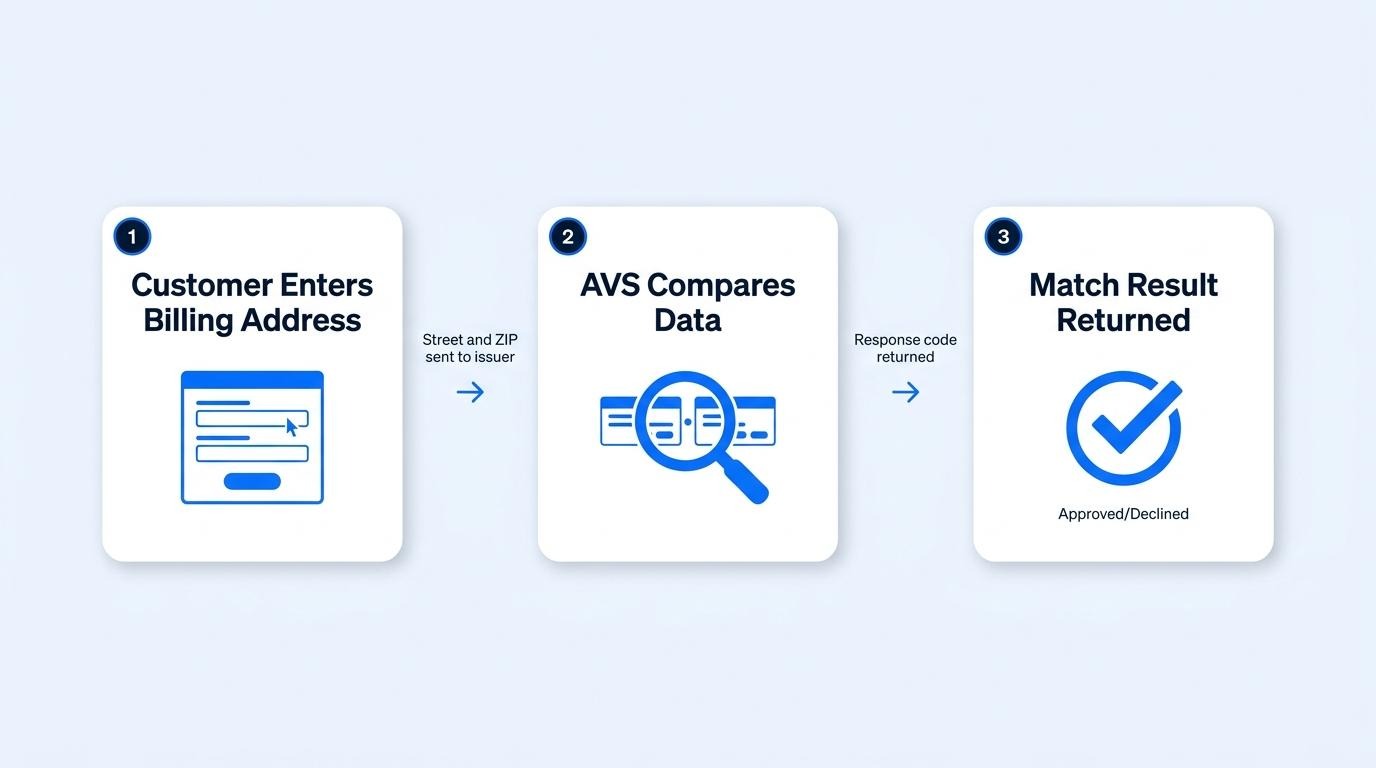
If your billing address does not match, the transaction may be declined, flagged for manual review, or processed with a warning code, depending on the merchant's fraud rules. The issuing bank sends back an AVS mismatch code, and the merchant decides how to respond.
Possible outcomes of a billing address mismatch include:
Mismatches often result from outdated addresses after a move, minor formatting differences, or typos at checkout. Keeping your billing address current with your card issuer is the most reliable way to avoid payment failures.
Understanding how billing addresses drive payment verification helps clarify why accurate address entry matters for the next concern: how each address shapes shipping and delivery outcomes.
Each address affects shipping and delivery differently: the billing address plays no direct role in where a package goes, while the shipping address determines the exact delivery destination. Carrier routing, delivery success, and return handling all depend on the shipping address.
The shipping address is the only address carriers use to route and deliver packages. According to GS1's logistic label guideline, the ship-to address must relate to the physical address where goods need to be delivered, because carriers rely on it to determine the correct destination. An incorrect or incomplete shipping address leads to failed deliveries, return-to-sender outcomes, or packages lost entirely.
The billing address, by contrast, does not appear on shipping labels. Its role ends at payment verification. A customer in Chicago can use a billing address in Chicago while shipping a gift to a recipient in Miami; the carrier only sees the Miami shipping address.
When a shipping address contains errors, consequences escalate quickly. According to the United States Postal Service, if mail cannot be delivered as addressed, USPS will attempt to return it using the return address; if no return address exists, the item is handled by the local Post Office or sent to the Mail Recovery Center. For e-commerce merchants, this means reshipping costs, customer service tickets, and potential inventory loss.
Several factors tied to the shipping address directly influence delivery outcomes:
For merchants managing high order volumes, even a small percentage of undeliverable shipments creates compounding costs. Validating the shipping address at checkout, separately from the billing address, is one of the simplest ways to reduce failed deliveries and protect margins.
Understanding how each address type impacts delivery is essential, but these same addresses also determine which tax rate applies to each transaction.
Each address affects sales tax calculation differently: the shipping address typically determines the tax rate, while the billing address serves as a fallback when no delivery location is available.
Most U.S. states use destination-based sourcing, meaning the shipping address controls which tax rate applies. According to the New York State Department of Taxation and Finance, New York's retail sales tax is a destination tax, where the point of delivery determines the rate of tax to be collected. States such as Washington, Louisiana, and New York all source sales tax to the location where the buyer receives the goods. For e-commerce sellers, this means the customer's shipping ZIP code, not the seller's warehouse location, sets the applicable rate.
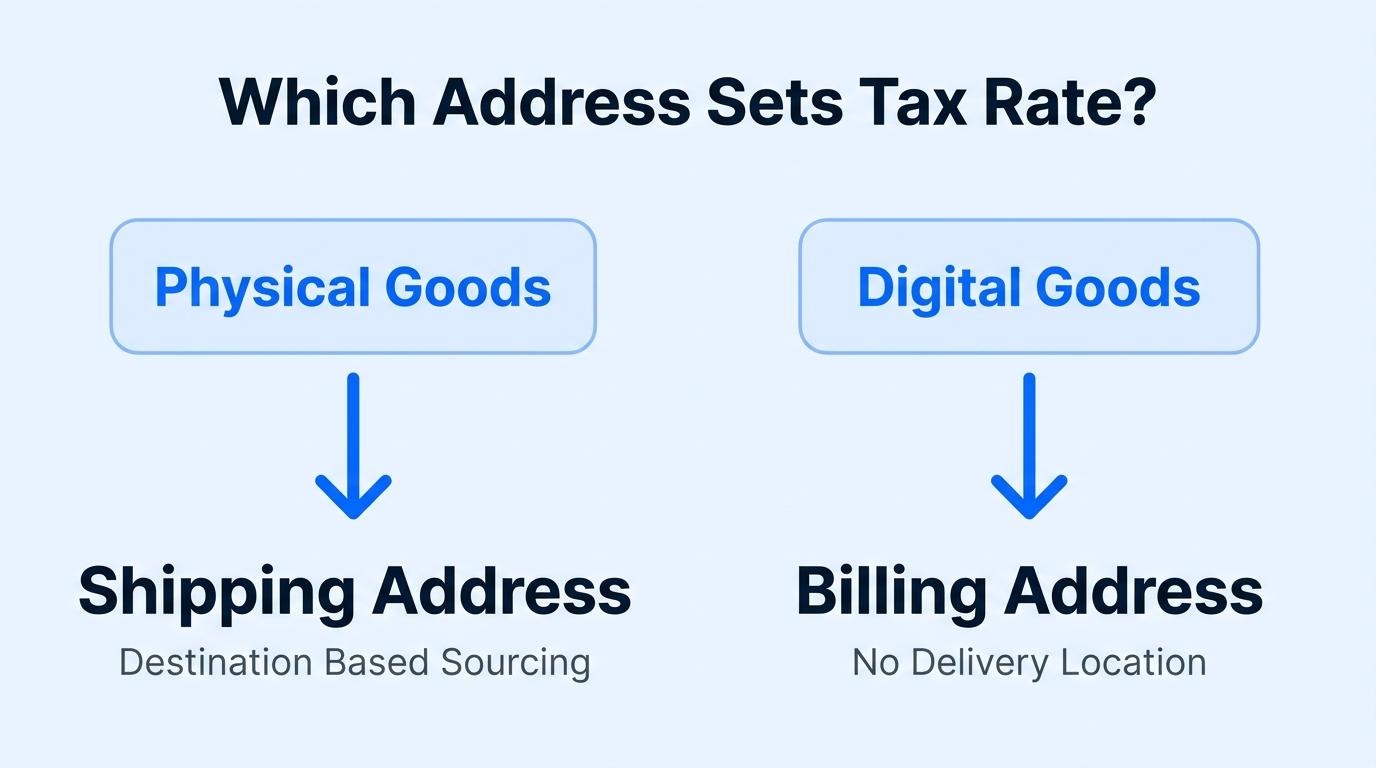
The billing address determines sales tax when no shipping address is available or applicable. Digital goods, downloadable software, and streaming subscriptions have no physical delivery destination, so tax engines often fall back to the buyer's billing address. According to the Minnesota Department of Revenue, when other sourcing methods do not apply, sellers should charge tax based on the customer's address in their records. The Streamlined Sales Tax Governing Board follows a similar hierarchy: if no delivery or receipt location exists, the address of the purchaser's payment instrument may be used, provided this is not done in bad faith.
Origin-based states handle this differently by sourcing sales tax to the seller's location rather than the buyer's. In these states, the merchant's business address determines the tax rate for in-state sales, regardless of where the package ships. Texas and certain other states apply origin-based rules for sellers operating within their borders. However, even origin-based states typically switch to destination-based sourcing for remote or out-of-state sellers. According to the Texas Comptroller of Public Accounts, remote sellers with total Texas revenue below $500,000 in the preceding twelve calendar months are not required to collect state and local use tax at all.
International VAT uses these addresses to identify the customer's location and apply the correct tax jurisdiction. The European Commission specifies that intra-Community distance sales of goods are taxed where the dispatch or transport to the customer ends, per Article 33(a) of the VAT Directive. For digital services without a physical shipment, tax authorities rely on the consumer's usual residence. HM Revenue & Customs determines the place of supply for cross-border digital services based on where the consumer lives, not where the payment originates. This distinction matters when the billing address and the customer's actual location differ, particularly for expats or travelers purchasing across borders.
Getting tax sourcing right starts with collecting accurate address data at checkout, which is where common entry errors can quietly introduce compliance risk.
Common errors when entering billing and shipping addresses include swapping the two fields, using outdated billing details, and mistyping the shipping destination. Each mistake triggers a different consequence, from payment declines to lost packages.
Swapping the two addresses means the billing address field contains the shipping destination, and vice versa. The payment processor runs the billing field through Address Verification Service (AVS), so an unrecognized entry triggers a mismatch code or outright decline. According to Southern Methodist University's ePayment documentation, the billing name and address must match what is on the credit card or checking account to prevent rejections.
Meanwhile, the carrier routes the package to whatever appears in the shipping field. If that field holds the cardholder's home address instead of the intended recipient's location, the order ships to the wrong place. For gift purchases or multi-address households, this is one of the most common yet avoidable checkout mistakes.
An outdated billing address causes a mismatch between the address you enter at checkout and the address your card issuer has on file. AVS flags this discrepancy, which can result in a soft decline, a lower fraud score, or a full transaction rejection. Customers who have recently moved are especially vulnerable because card issuers may take days or weeks to update records after a change-of-address request.
The fix is straightforward: update the billing address with your bank or credit card company before placing an order. Merchants who rely on strict AVS matching should also consider partial-match acceptance, since legitimate customers with recently changed addresses should not be blocked from completing purchases.
A typo in the shipping address sends the package to the wrong location or makes it undeliverable. According to the United States Postal Service, mail that cannot be delivered as addressed is returned to the sender using the return address; if no return address exists, it goes to the local Post Office or the Mail Recovery Center. For e-commerce orders, this means delayed fulfillment, reshipping costs, and a poor customer experience.
Common typos include transposed house numbers, misspelled street names, and missing apartment or unit numbers. Input masks and address-autocomplete tools reduce these errors significantly, particularly on mobile devices where small keyboards increase mistake rates.
With address errors addressed, the next step is understanding how both fields factor into fraud prevention.
Billing and shipping addresses affect fraud prevention by serving as cross-referenced data points that help merchants identify suspicious transactions. The mismatch patterns, velocity signals, and verification checks tied to these addresses form several layers of defense.
When a billing address fails Address Verification Service (AVS) checks, the payment processor flags the transaction before it completes. A shipping address that diverges significantly from the billing address, particularly to a high-risk region or a freight forwarding service, raises additional red flags. According to MIT's e-commerce glossary, the billing address "is used to help verify that the Customer is the actual owner of the credit card he/she is using."
Fraud teams evaluate several address-related risk signals:
None of these signals alone confirms fraud. Legitimate shoppers regularly send gifts, use work addresses, or ship to vacation homes. The real value comes from layering address verification with other behavioral data, such as device fingerprinting, order history, and IP geolocation. A single billing-shipping mismatch on a gift order during the holidays is routine; that same mismatch combined with a new account, a high-ticket item, and overnight shipping warrants scrutiny.
For merchants managing fraud rules across multiple sales channels, maintaining one consistent customer record simplifies pattern detection. When checkout, point-of-sale, and subscription data feed into the same system, address anomalies surface faster than when each channel stores addresses in a separate tool.
Understanding how addresses interact with checkout design helps merchants balance security with a smooth buyer experience.
You should handle these addresses at checkout by defaulting to a single entry with an option to separate them. The subsections below cover when auto-copying billing to shipping works best and when requiring separate fields is necessary.
Yes, you should auto-copy billing to shipping by default for most checkout flows. Pre-checking a "same as shipping" box eliminates redundant form fields, which reduces friction and speeds up completion. According to the W3C's WCAG 2.2 guidelines, an e-commerce form that lets users confirm the billing address and delivery address are the same satisfies redundant-entry accessibility standards. Input masks on the remaining address fields further reduce validation errors and abandonment, especially on mobile. For stores where the majority of orders ship directly to the buyer, a pre-checked default keeps the checkout path short without sacrificing address verification accuracy.
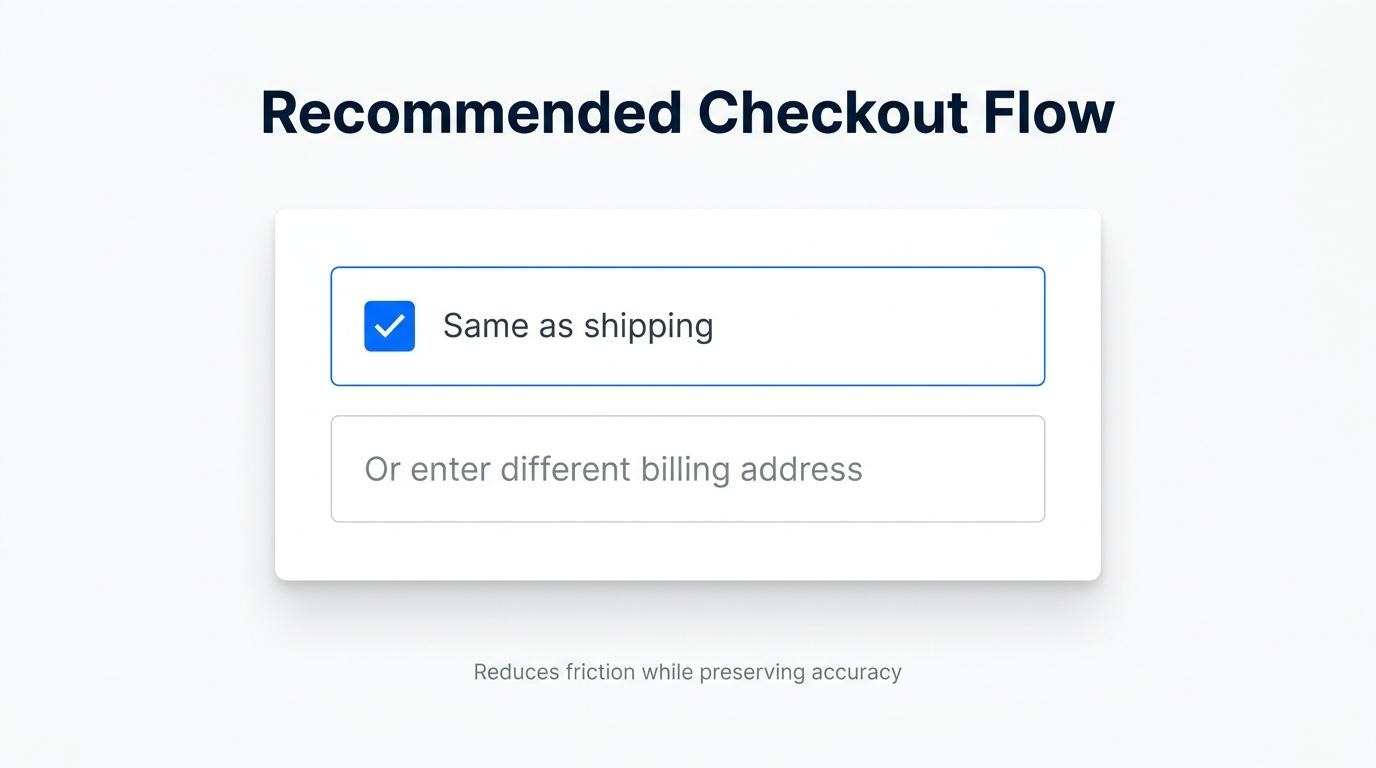
You should require separate address entry when the shipping destination regularly differs from the billing address. Common scenarios include:
Collecting both addresses explicitly ensures the correct destination reaches the carrier and the right tax jurisdiction is applied. For stores with a high percentage of gift or B2B orders, hiding the second address field behind a default checkbox risks missed delivery details and incorrect tax calculations. Balancing convenience with accuracy means surfacing the separate entry option clearly, even when the default copies one address to the other.
With checkout address logic in place, recurring orders introduce additional considerations for how these addresses are stored and updated over time.
Billing and shipping addresses work for subscriptions by serving distinct, recurring roles: the billing address verifies payment on each renewal cycle, while the shipping address directs every fulfillment shipment. Because subscriptions charge and ship repeatedly, address accuracy matters more than it does for one-time orders.
Subscription billing relies on the billing address stored with the payment method on file. Each renewal triggers an Address Verification Service (AVS) check against the card issuer's records. If a subscriber moves and updates their mailing address but not their card's billing address, the mismatch can cause the recurring charge to decline. According to Southern Methodist University's ePayment documentation, the billing name and address must match what is on the credit card or checking account to prevent rejections. Proactively prompting subscribers to confirm their billing address before each renewal cycle reduces involuntary churn from failed payments.
The shipping address, meanwhile, determines where each subscription box or replenishment shipment is delivered. Subscribers who relocate mid-cycle need a clear way to update their delivery destination without disrupting the next shipment. This is also where sales tax enters the picture; most U.S. destination-based sourcing rules calculate tax based on where the product arrives, not where the payment originates. A subscriber whose billing address is in Oregon (no sales tax) but whose shipping address is in New York will owe New York's destination-based rate on every renewal shipment.
For merchants, the operational challenge is keeping both addresses current across potentially dozens of renewal cycles. Platforms that store billing and shipping data within a single customer record, rather than fragmenting it across separate subscription apps and payment processors, reduce the risk of stale addresses causing failed charges or misrouted packages. When checkout, subscriptions, and CRM share one data layer, an address update propagates to every future order automatically.
The most common subscription address pitfalls include:
For brands running recurring revenue at scale, treating address management as a retention lever, not just a checkout field, is one of the most underrated ways to protect monthly recurring revenue.
With subscription addresses covered, the next step is understanding how a unified customer record simplifies address management across every channel.
Address management changes when checkout and CRM share one customer record by consolidating billing and shipping addresses into a single profile that updates across every touchpoint. Below, the subsections cover how Shopline handles this natively and the key takeaways for managing both address types.
Shopline handles address data across checkout, POS, and subscriptions without extra apps by storing billing and shipping addresses inside one shared customer record. When a shopper updates a shipping address during checkout, that change reflects in the CRM profile used by POS and subscription orders. Shopline's checkout lets customers check a box to automatically set the shipping address as the billing address, while still allowing a different billing address when needed. Because the CRM, storefront, and POS resolve to the same customer profile, address corrections made in any channel propagate without manual syncing or third-party connectors. For brands managing recurring orders alongside retail locations, this single-record approach eliminates the address mismatches that typically surface when billing and shipping data live in separate tools.
The key takeaways about billing address vs. shipping address center on their distinct roles and the operational impact of managing them correctly: