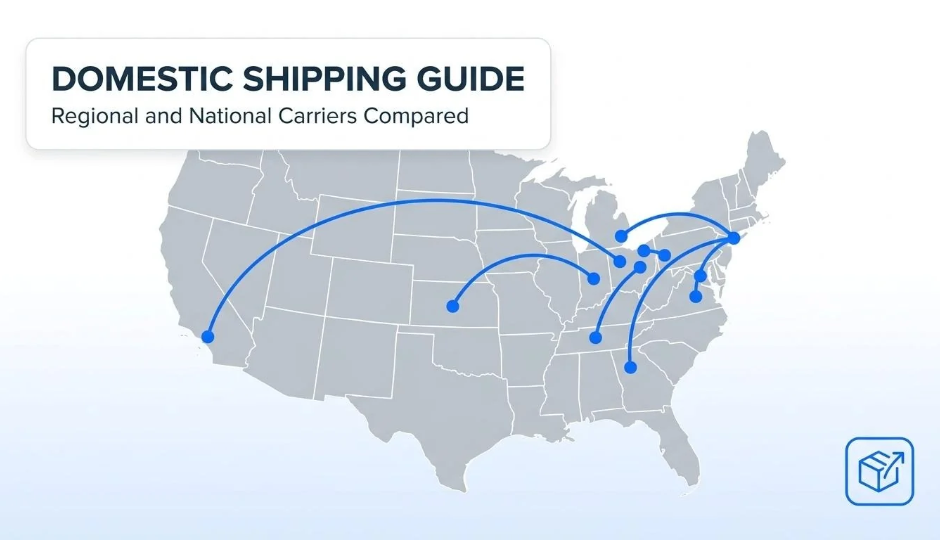
Domestic shipping is the movement of goods between locations within the United States, its territories, and possessions, with no customs clearance required for most routes. It forms the logistics backbone of every ecommerce operation selling to U.S. customers.
This guide covers domestic shipping fundamentals, regional and national carrier differences, rate and speed comparisons, cost factors for DTC brands, and how carrier choice connects to customer retention.
Domestic shipping fundamentals include which goods qualify, how the process moves from order placement through pickup, sortation, linehaul, and last-mile delivery, and where regulatory requirements like hazardous material rules or agricultural quarantine restrictions apply.
Regional carriers operate within defined multi-state footprints, offering faster one-to-two-day ground delivery and lower per-package rates in nearby zones. National carriers like USPS, UPS, and FedEx span all 50 states and U.S. territories, providing consistent coast-to-coast service with published transit standards. A multi-carrier strategy combines both, routing each shipment to the most cost-effective option based on destination, weight, and speed requirements.
Shipping costs for DTC brands hinge on three variables: dimensional weight pricing (where box size can matter more than actual weight), zone distance from origin to destination, and negotiated volume discounts that unlock tiered rate reductions. Small packaging adjustments and fulfillment location decisions compound into significant savings across thousands of monthly orders.
Carrier selection also shapes post-purchase experience. Delivery speed promises influence repeat purchases and average order value, while granular shipment tracking reduces return rates by satisfying buyers' need for reassurance. Consolidating shipping data, carrier logic, and customer records into one platform removes the reconciliation friction that slows routing decisions and weakens delivery accuracy.
Domestic shipping in ecommerce is the movement of goods between locations within one country's borders, including its territories. The sections below cover which goods qualify and how domestic shipping differs from international shipping.
The types of goods that qualify for domestic shipping include most consumer products sold through ecommerce, provided they comply with federal and state regulations. According to the United States Postal Service, domestic mail is mail transmitted within, among, and between the United States, its territories and possessions, APOs, FPOs, DPOs, and the United Nations, NY.
Certain product categories face restrictions or outright bans:
Standard consumer goods like apparel, electronics (without restricted batteries), beauty products, and home goods ship domestically without special compliance requirements.
Domestic shipping differs from international shipping in three key areas: customs requirements, regulatory complexity, and carrier competition.
International shipments crossing national borders require customs declarations, duties, and often Electronic Export Information filings when goods exceed $2,500 per commodity classification. Domestic shipments within the contiguous U.S. and most territories skip these steps entirely. Even agricultural restrictions operate differently; as the USDA's Animal and Plant Health Inspection Service notes, shipping plants from quarantined areas within the United States can still spread invasive pests to new domestic regions, a concern distinct from international phytosanitary controls.
The carrier landscape also shifts. Domestic ecommerce shippers choose among USPS, FedEx, UPS, and regional carriers competing directly for parcel volume. This competitive pressure tends to keep service quality high. A study published in Management Science analyzing 129,448 SKUs on Alibaba found that removing a high-quality delivery option reduced sales by 14.56%, illustrating how delivery service quality directly impacts ecommerce revenue regardless of market.
For scaling DTC brands, domestic shipping's lower regulatory burden and competitive carrier options create more room to optimize cost and speed simultaneously.
The domestic shipping process works through three core stages: order processing and dispatch, pickup and sortation, and linehaul with last-mile delivery. Each stage involves distinct carrier operations that determine speed and cost.
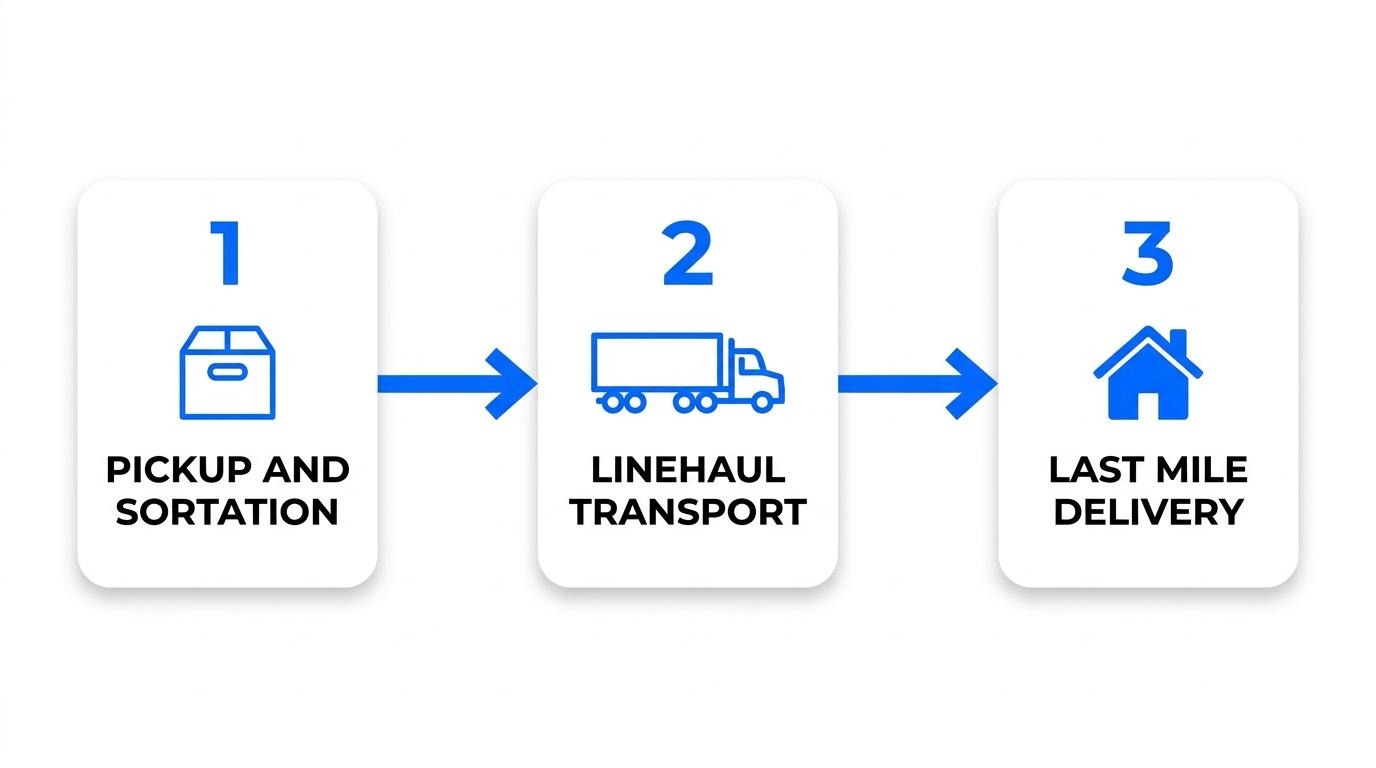
The pickup and sortation stage is when carriers collect packaged orders from warehouses or fulfillment centers and route them through sorting facilities. Carriers typically receive and process orders during the day, then ship accumulated orders in the late afternoon. According to a Southern California Association of Governments freight study, this commercial pattern of morning receiving and late-afternoon dispatch is deeply ingrained across the industry.
At sorting hubs, automated systems scan barcodes, weigh parcels, and direct each package toward the correct outbound route based on destination ZIP code. Sortation speed directly affects downstream transit times; delays at this stage ripple through the entire delivery window. For brands shipping high daily volumes, understanding carrier cutoff times helps ensure same-day dispatch rather than next-day processing.
The linehaul and last-mile stage moves packages from regional sorting hubs to final delivery at the customer's address. Linehaul refers to the long-distance transportation between distribution centers, typically via truck, rail, or air freight. Once a package reaches the destination hub closest to the recipient, last-mile delivery begins.
According to a 2024 World Economic Forum report, last-mile delivery is the transportation of goods from the final hub in the supply chain to the end recipient, and the actual distance can vary significantly depending on population density. Rural deliveries may span dozens of miles from the nearest hub, while urban last-mile routes cover shorter distances with more stops.
Last-mile is consistently the most expensive segment of domestic shipping, often accounting for the largest share of total per-package cost. Brands that understand this cost structure can make smarter decisions when comparing regional and national carrier options.
Regional carriers in domestic shipping are parcel delivery companies that operate within a defined multi-state or single-state area rather than covering the entire country. The sections below explain their typical geographic footprint and identify which regional carriers serve the United States.
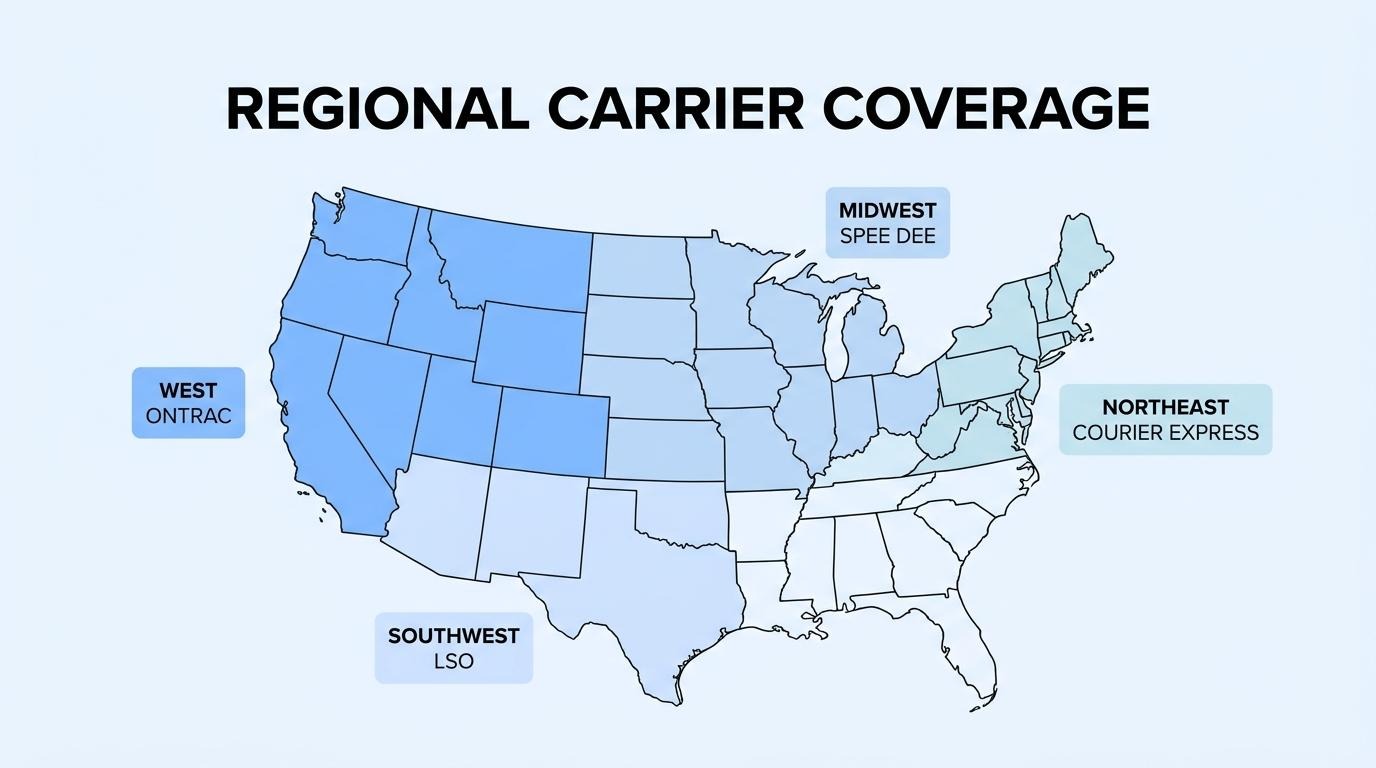
Regional carriers typically cover a contiguous cluster of states, a single metropolitan corridor, or one defined portion of the country. Most focus on areas where their hub-and-spoke networks can complete deliveries within one to two days without relying on long-haul linehaul routes. Coverage zones often align with population density; a carrier might serve the Pacific Northwest, the Southeast, or the Mid-Atlantic corridor while leaving cross-country shipments to national networks.
For DTC brands that concentrate order volume in a few states, this focused footprint is an advantage worth factoring into carrier selection.
Regional carriers operating in the United States include OnTrac, LSO (Lone Star Overnight), Spee-Dee Delivery, Better Trucks, Courier Express, and GLS US. Each serves a distinct territory:
According to the United States Postal Service, domestic mail encompasses transmissions within the United States, its territories and possessions, APOs, FPOs, DPOs, and the United Nations in New York. Regional carriers complement this national infrastructure by handling parcel volume within their specific zones, often at lower per-package rates for nearby destinations.
Understanding where each regional carrier operates helps brands match carrier coverage to their highest-density shipping zones before evaluating national alternatives.
National carriers in domestic shipping are logistics companies that operate delivery networks spanning all 50 states, U.S. territories, and every shipping zone. The sections below cover their geographic reach and the major national carriers operating in the United States.
National carriers provide geographic coverage across the entire United States, including all 50 states, rural areas, and U.S. territories such as Puerto Rico, Guam, and the U.S. Virgin Islands. Their networks connect every domestic shipping zone, from dense urban centers to remote ZIP codes.
This coast-to-coast infrastructure relies on hub-and-spoke systems: regional sortation facilities feed into national linehaul routes, which then connect to local delivery hubs for last-mile fulfillment. Because national carriers maintain this end-to-end network, they can accept shipments destined for any domestic address without handing off parcels to a secondary provider. For brands shipping to a geographically dispersed customer base, this single-network simplicity is often worth the premium over piecing together multiple regional contracts.
The national carriers that operate in the United States include:
Each carrier structures pricing, surcharges, and transit times differently, so the right choice depends on package characteristics, destination mix, and volume.
With national reach established, understanding how these carriers price their services compared to regional alternatives becomes the next consideration.
Regional and national carrier shipping rates compare differently based on zone distance, package characteristics, and surcharge structures. The sections below break down short-zone pricing, cross-country rate models, and where surcharge gaps emerge.
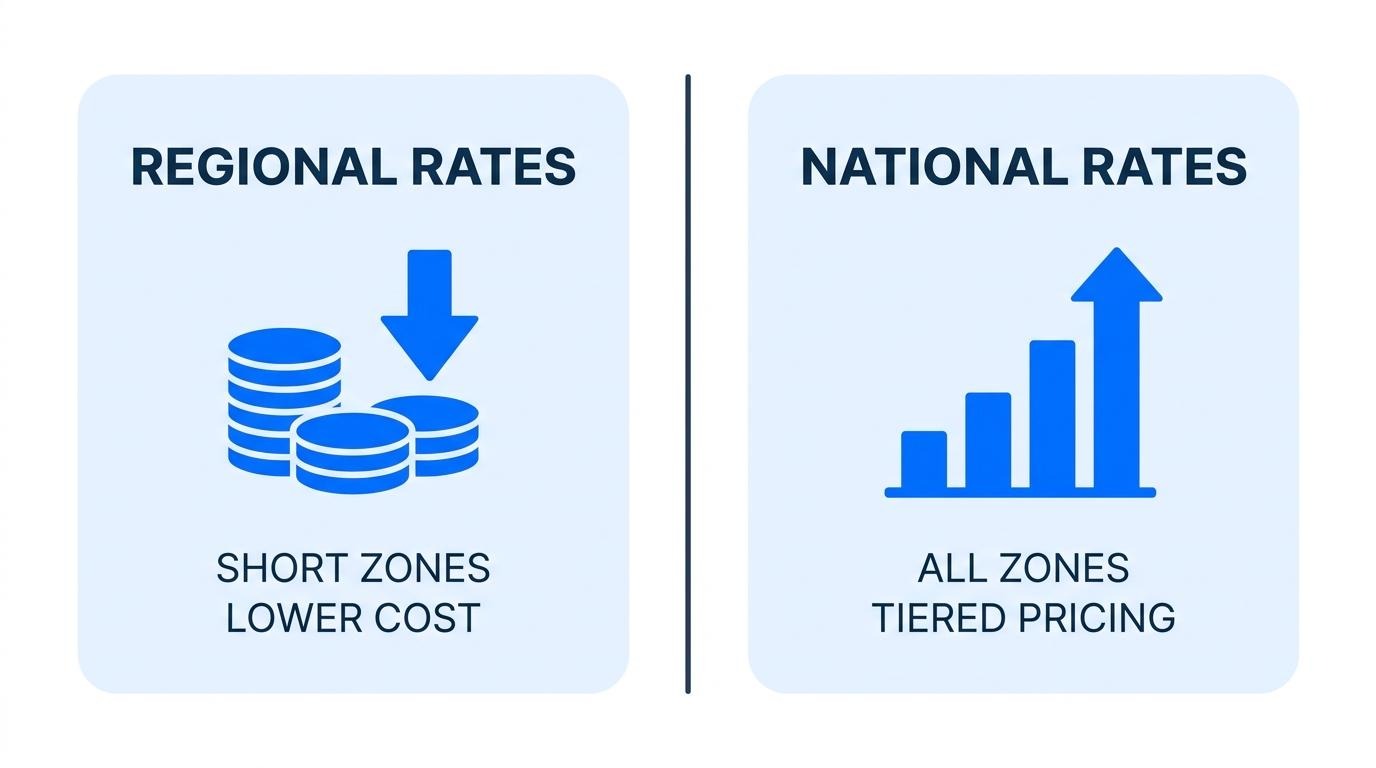
Regional carrier rates are structured for short zones around concentrated geographic networks that minimize linehaul distance. Because these carriers operate within a defined multi-state footprint, packages rarely cross more than two or three shipping zones. That shorter transit path translates into lower per-package transportation costs. Regional carriers typically price on actual weight for nearby zones, and their base rates often undercut national alternatives within that footprint. For brands shipping a high volume of orders to customers clustered in one part of the country, this zone-limited pricing model can meaningfully reduce fulfillment spend per unit.
National carrier rates are structured across all zones using tiered pricing tables that scale with distance. Each additional zone a package crosses adds incremental cost, so a shipment from New York to Los Angeles costs substantially more than one traveling a single zone. National carriers like UPS and FedEx also apply dimensional-weight calculations, charging whichever is greater: actual weight or dimensional weight. According to a May 2026 Federal Register notice, the Postal Service is changing its DIM factor to 139 to determine dimensional weight in pounds. For lightweight but bulky products, dimensional-weight pricing can raise the effective rate well above what the scale reads, making box-size optimization essential.
Surcharges differ between regional and national carriers most noticeably on delivery-area fees, residential delivery charges, and peak-season adjustments. National carriers apply delivery-area surcharges broadly. According to an April 2025 analysis by the Institute for Policy Studies, UPS and FedEx charge area surcharges for deliveries to approximately 62 percent of the nation's 42,000 ZIP codes, affecting roughly 102 million people. Regional carriers, operating in denser service areas, often waive or reduce these fees because their networks already serve those zones efficiently. Peak surcharges and fuel surcharges also tend to be lower with regional providers, though coverage limitations mean they cannot absorb overflow volume the way a national network can.
With rate structures clarified, delivery speed becomes the next factor separating these two carrier types.
Regional carriers typically deliver faster within their local zones, while national carriers maintain consistent transit times across all 50 states. The subsections below break down speed benchmarks for each carrier type.
Regional carriers deliver within their coverage areas in one to two business days for most ground shipments. Shorter distances between pickup and destination reduce the number of sortation handoffs, which compresses transit time. Because regional networks operate fewer hubs, packages spend less time sitting in processing queues overnight.
This speed advantage narrows quickly outside a carrier's core zone. According to a 2025 analysis by the Institute for Policy Studies, UPS and FedEx charge area surcharges covering approximately 62 percent of the nation's 42,000 ZIP codes, affecting roughly 102 million people. Regional carriers that avoid those surcharge zones often route packages through fewer touchpoints, but their speed guarantee simply does not extend to addresses beyond their footprint. For brands with a geographically concentrated customer base, that focused network translates into reliably faster ground delivery at lower cost per package.
National carriers deliver across the country within one to five business days depending on service tier and origin-to-destination distance. USPS, FedEx, and UPS each publish service standards that account for processing times and transportation within their networks. According to a 2026 U.S. Government Accountability Office report, USPS sets its own service standards representing the expected number of days for delivery after acceptance, providing senders and recipients with a reliable time frame.
Express tiers from national carriers typically guarantee one- to two-day delivery coast to coast, while economy ground services stretch to three to five days for cross-country routes. The tradeoff is consistency over geography: national carriers reach every domestic ZIP code with predictable, published timelines, even if ground transit runs a day or two slower than a regional carrier would manage locally.
With delivery speed expectations established, the next section examines broader service differences between carrier types.
The service differences between regional and national carriers span package tracking, claims handling, and customer support. Each area reflects how carrier size and infrastructure shape the post-purchase experience.
Package tracking differs between carrier types primarily in update frequency and granularity. National carriers like UPS and FedEx operate proprietary tracking networks with scan points at every hub, sortation facility, and delivery vehicle. This infrastructure generates frequent, real-time status updates from pickup through final delivery.
Regional carriers typically provide tracking, but scan density varies. Smaller networks mean fewer intermediate touchpoints, so updates may appear less frequently between origin and destination. However, some regional carriers compensate with proactive delivery notifications, including estimated delivery windows that rival national carrier precision within their coverage zones. For brands shipping high volumes in a concentrated geography, regional tracking quality often meets or exceeds expectations. The real gap surfaces on cross-network shipments where a regional carrier hands off to a partner for final delivery, sometimes creating visibility blind spots during the transfer.
Claims handling differs between carrier types in process complexity and resolution speed. National carriers maintain standardized, portal-based claims systems designed for high volume. Filing a damage or loss claim with UPS or FedEx follows a structured digital workflow with defined documentation requirements and processing timelines, often 5 to 10 business days for investigation.
Regional carriers generally offer a more direct claims process. Fewer layers of bureaucracy and dedicated account representatives allow faster resolution in many cases. Shippers often reach a decision-maker sooner because regional operations handle lower claim volumes. The trade-off is that regional carriers may have less formalized policies, and documentation standards can vary between providers. For DTC brands, the practical difference often comes down to whether speed of resolution or process consistency matters more for their customer experience standards.
Customer support differs between carrier types in accessibility, personalization, and channel availability. National carriers offer multiple contact methods; according to USA.gov, USPS alone accepts service complaints online, by phone, or in person at any USPS facility. UPS and FedEx similarly provide chat, phone, email, and self-service portals.
Regional carriers typically assign dedicated account managers who know a shipper's business by name. This relationship-based model means faster escalation and tailored problem-solving, though support hours and channel options may be narrower than what national carriers provide. For scaling DTC brands, the choice often hinges on volume: high-volume shippers benefit from the personal attention regional representatives offer, while brands needing 24/7 multichannel access across all time zones lean toward national carrier infrastructure.
Understanding these service-level distinctions helps brands decide when regional specialization or national standardization best fits their fulfillment needs.
An ecommerce brand should choose a regional carrier when most orders ship to customers concentrated within a defined geographic area. Regional carriers excel in specific scenarios involving cost, speed, and service quality within their coverage zones.
For brands whose customer base is geographically dispersed, a regional carrier alone will not provide full coverage, which is where pairing regional and national options becomes practical.
An ecommerce brand should choose a national carrier when orders ship to customers across all 50 states, territories, and mixed zones where regional coverage gaps would create delays. The scenarios below outline when national reach becomes essential.
National carriers like UPS, FedEx, and USPS operate infrastructure that spans the entire United States, including rural ZIP codes, Alaska, Hawaii, and U.S. territories. Brands selling nationwide need this breadth to maintain consistent delivery promises regardless of customer location. According to a 2025 analysis by the Institute for Policy Studies, UPS and FedEx charge delivery-area surcharges for approximately 62 percent of the nation's 42,000 ZIP codes, covering areas home to roughly 102 million people. These surcharges exist precisely because national carriers commit to serving hard-to-reach zones that regional providers often exclude entirely.
A national carrier makes the most sense in these situations:
For scaling DTC brands, the operational simplicity of one national carrier relationship often outweighs the per-package savings a regional carrier might offer within a limited footprint. Managing a single carrier account, one set of label integrations, and one dispute resolution process reduces the administrative overhead that compounds as order volume grows.
That said, national carrier pricing for short-zone shipments typically runs higher than regional alternatives for the same distance. Brands concentrated in one metro area may overpay by defaulting to a national provider. The next section explores how combining both carrier types offsets this trade-off.
Yes, you can use regional and national carriers together through a multi-carrier shipping strategy. This approach routes each order to the carrier best suited for its destination, weight, and speed requirement. The sections below cover what a multi-carrier strategy involves and how to split orders effectively.
A multi-carrier shipping strategy is an approach where an ecommerce brand uses two or more carriers to fulfill domestic orders, rather than relying on a single provider. The brand selects the optimal carrier for each shipment based on factors such as destination zone, package dimensions, delivery speed, and cost.
This model treats regional carriers and national carriers as complementary rather than competing options. Regional carriers handle nearby zones where they offer faster transit and lower rates, while national carriers cover long-distance shipments and remote ZIP codes. The result is a logistics network that balances cost efficiency with broad geographic reach, something neither carrier type achieves alone when used in isolation.
You split orders between regional and national carriers by establishing routing rules tied to shipment characteristics. The most common decision variables include:
Automated shipping rules within an order management system handle this routing at scale. For brands operating at volume on a unified commerce platform, keeping shipping logic, order data, and customer records in one system eliminates the manual reconciliation that slows multi-carrier execution.
Domestic shipping costs for DTC brands depend on package weight, distance traveled, and order volume. The sections below break down how dimensional weight pricing, shipping zone distance, and negotiated volume rates each influence total cost.
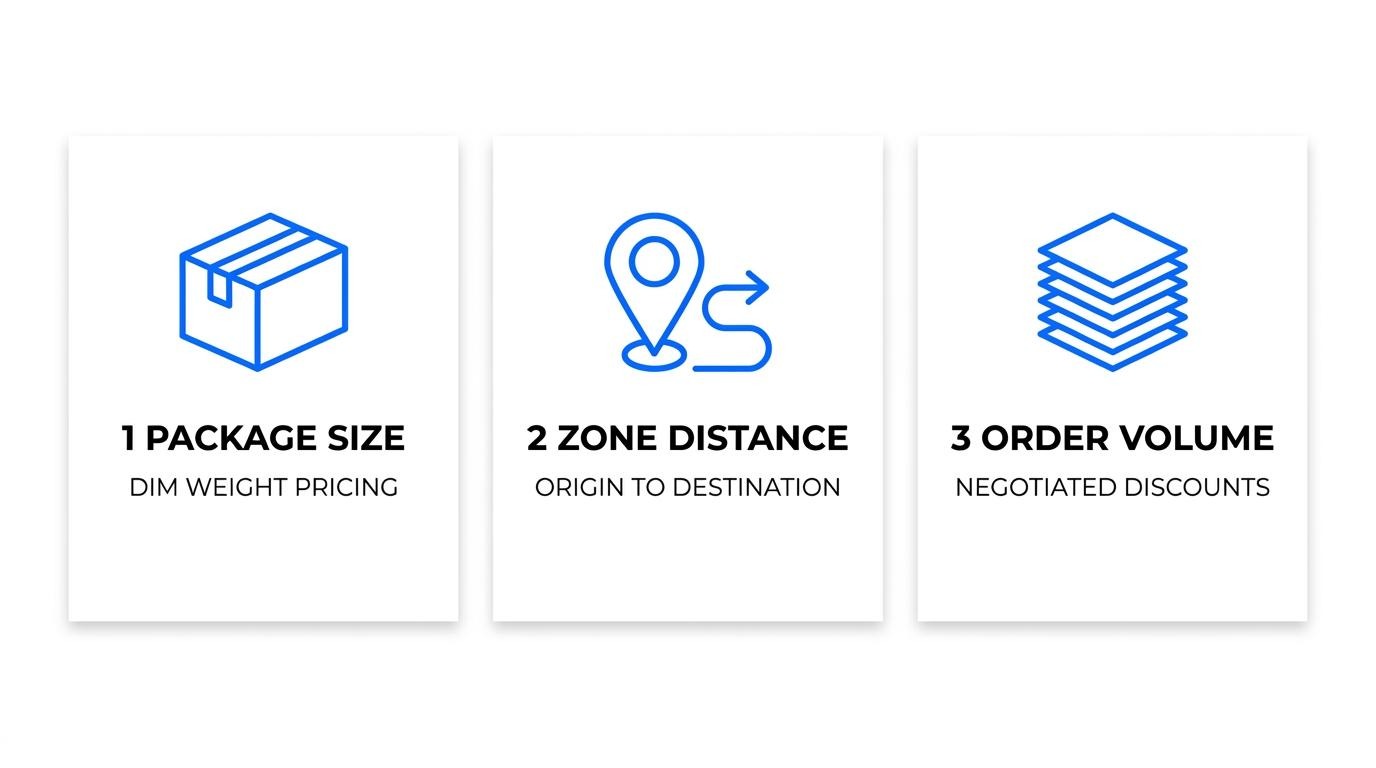
Package weight and dimensional weight affect cost by determining which measurement carriers use to price a shipment. Carriers compare actual weight against dimensional weight and charge based on whichever is higher.
Dimensional weight is calculated by dividing a package's cubic size (length × width × height) by a carrier-specific divisor. According to a May 2026 Federal Register notice, the Postal Service is changing the DIM factor to 139 to determine dimensional weight in pounds. This means lightweight but bulky items, such as pillows, lampshades, or apparel in oversized boxes, often incur higher charges than their actual weight would suggest.
DTC brands can reduce dimensional weight costs by:
Packaging optimization is one of the most overlooked cost levers for scaling brands; even small reductions in box size compound across thousands of monthly shipments.
Shipping zone distance affects cost because carriers divide the country into numbered zones based on how far a package travels from its origin. Higher zone numbers mean longer distances and higher rates.
Zone-based pricing typically spans zones 1 through 8 in the contiguous United States:
Brands shipping primarily to zones 7 and 8 pay significantly more per package than those fulfilling within two or three zones. Distributing inventory across multiple fulfillment locations shortens average zone distance, which is often the single most effective way to lower per-order shipping spend at scale.
Order volume and negotiated pricing affect cost because carriers offer tiered discounts to shippers who commit higher package quantities. As monthly or annual volume increases, per-package rates decrease through negotiated contracts.
Key volume thresholds that unlock better pricing include:
For brands managing shipping data alongside customer and order data in one system, spotting volume trends and renegotiating carrier contracts becomes far more straightforward than reconciling data across disconnected tools. Carrier selection and volume management together shape the customer experience that drives retention.
Carrier choice affects customer experience and retention by shaping delivery speed, tracking visibility, and post-purchase confidence. The sections below cover how speed expectations drive repeat purchases and how shipment visibility influences satisfaction.
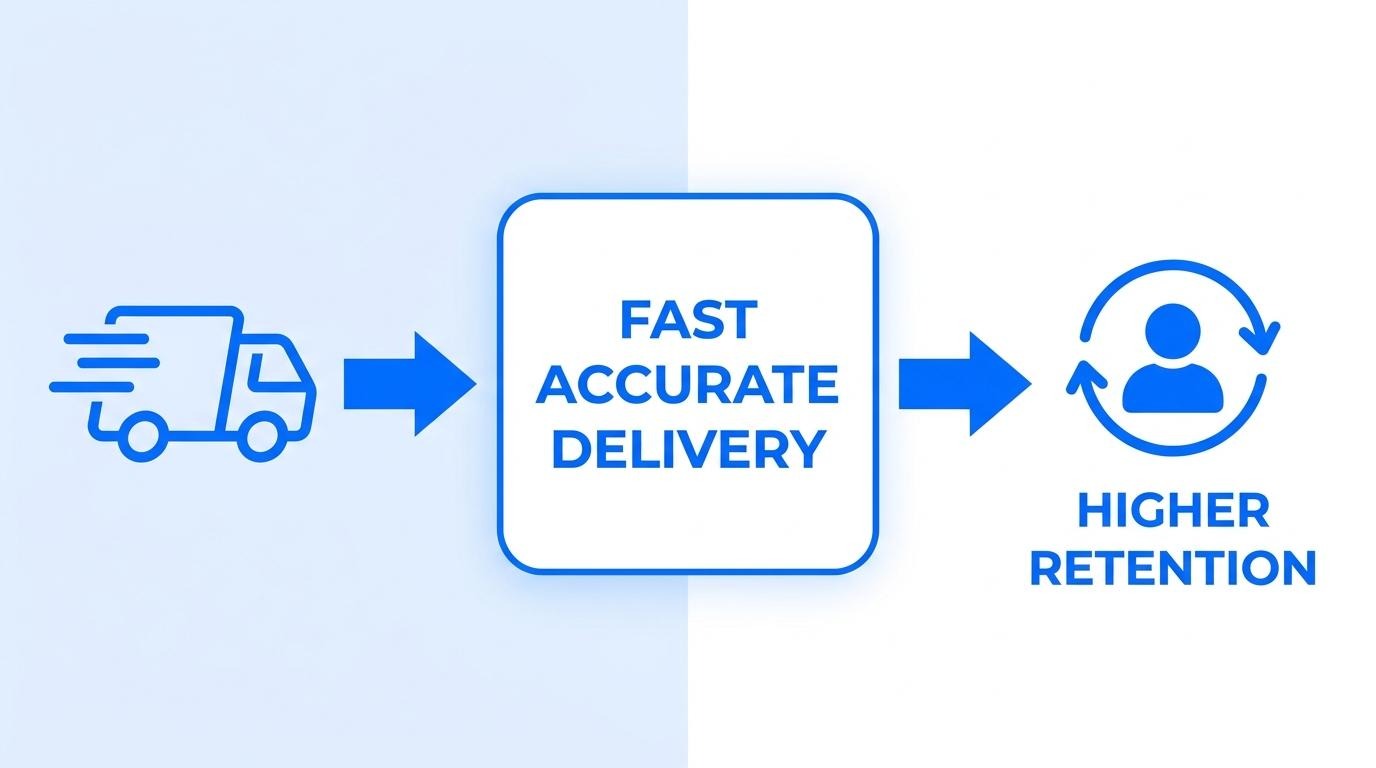
Delivery speed expectations shape repeat purchases by setting a performance benchmark that customers measure every order against. When a carrier consistently meets or beats the promised window, buyers develop trust in the brand, not just the logistics provider.
According to research highlighted by Emory University's Goizueta Business School, promising customers one day faster shipping (without changing actual delivery speed) increased sales, profits, and average order value. This finding underscores that the delivery promise itself functions as a conversion and retention lever.
Carriers that publish clear service standards, such as USPS's expected-days-to-delivery framework, give merchants a reliable baseline for setting accurate promises. Overpromising and underdelivering erodes loyalty faster than a slightly longer but honest transit window. For scaling DTC brands, selecting a carrier whose network reliably hits its stated standards is one of the highest-impact retention decisions available.
Shipment visibility influences customer satisfaction by reducing post-purchase anxiety and giving buyers a sense of control between checkout and doorstep. Real-time tracking transforms a passive wait into an informed experience.
A 2026 U.S.-shopper study published through the University of South Florida (N = 1,005) found that reassurance-driven tracking, where customers check status to confirm everything is on schedule, is negatively associated with return rates. In contrast, coordination-driven tracking, where buyers monitor shipments to plan around delivery timing, correlates with higher returns. This distinction matters: carriers offering proactive notifications (estimated delivery windows, out-for-delivery alerts) satisfy the reassurance motive before shoppers need to seek it out.
Choosing a carrier with granular, reliable tracking data directly supports the kind of visibility that keeps customers confident and less likely to initiate returns. With post-purchase expectations set, the next consideration is how shipping operations connect to the broader tech stack a brand runs on.
DTC brands should manage domestic shipping by consolidating shipping data, customer data, and carrier logic into a single platform rather than layering disconnected tools. The subsections below cover what changes with unified data and the key takeaways from this guide.
What changes is that order history, carrier performance, delivery promises, and customer behavior become visible in one place, eliminating the reconciliation work that multi-tool stacks require. Strategic information sharing between buyers and suppliers improves financial performance for both parties. According to research published in MIS Quarterly, analysis of 91 buyer-supplier logistics relationships found that strategic information flows positively impact relationship-specific performance through improved asset management, reduced operational costs, and enhanced productivity.
This matters because delivery speed promises directly influence purchase behavior. When a retailer can see real-time carrier data alongside customer order patterns, it can set more accurate delivery windows. Brands running separate shipping software, CRM tools, and storefront backends lose this visibility. Shopline is one platform where shipping data and customer records live in the same system, removing one common sync issue between fulfillment tools and the storefront.
The key takeaways about domestic shipping and regional vs. national carriers are: