
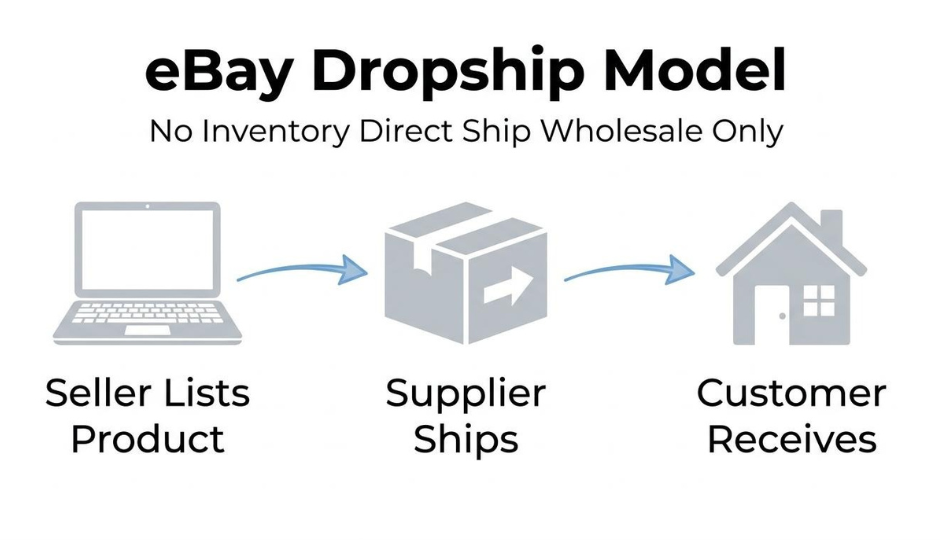
eBay dropshipping is a selling model where you list products on eBay and have a wholesale supplier ship directly to your buyer without holding inventory yourself.
This guide covers eBay's policy framework and account setup, the step-by-step launch process, supplier sourcing, automation tools, earnings expectations, risk management, and scaling strategies for moving beyond a single platform.
eBay permits dropshipping exclusively from wholesale suppliers; purchasing from another retailer to fulfill orders violates platform rules and risks account suspension. New sellers generally begin with strict limits of 10 items or $500 in monthly sales, which the platform adjusts based on performance metrics over time.
The launch process follows six sequential steps: configuring your seller account, selecting a profitable niche, vetting reliable suppliers, creating SEO-optimized listings, pricing to cover eBay's 13.25% final value fee plus per-order charges, and managing fulfillment timelines through supplier coordination.
US-based suppliers like TopDawg and Spocket offer fast domestic shipping that protects seller metrics, while wholesale directories such as SaleHoo connect sellers to thousands of verified sources. International suppliers work for higher-margin niche products when delivery windows are communicated transparently.
Automation tools across listing creation, repricing, inventory monitoring, and order fulfillment prevent the operational breakdowns that trigger cancellations and account restrictions. Professional sellers report net margins between 15% and 25% on general items, with niche categories reaching 30% to 40%.
The primary risks are supplier stockouts, late shipments, VeRO intellectual property complaints, and return logistics you never physically control. Scaling beyond beginner volume requires building feedback velocity, diversifying across multiple sales channels, and eventually consolidating fragmented tools into a unified commerce system as catalog size grows.
eBay dropshipping is a selling model where you list products on eBay and have a wholesale supplier ship directly to your buyer without holding inventory. The sections below explain how this model differs from traditional selling and what eBay's policies permit.
The eBay dropshipping model differs from traditional selling by eliminating inventory ownership, warehousing, and upfront stock purchases from the seller's responsibilities. Traditional eBay sellers buy products in bulk, store them, and ship orders themselves. Dropshippers list items they don't physically hold, forwarding orders to a wholesale supplier who ships directly to the customer.
Key differences include:
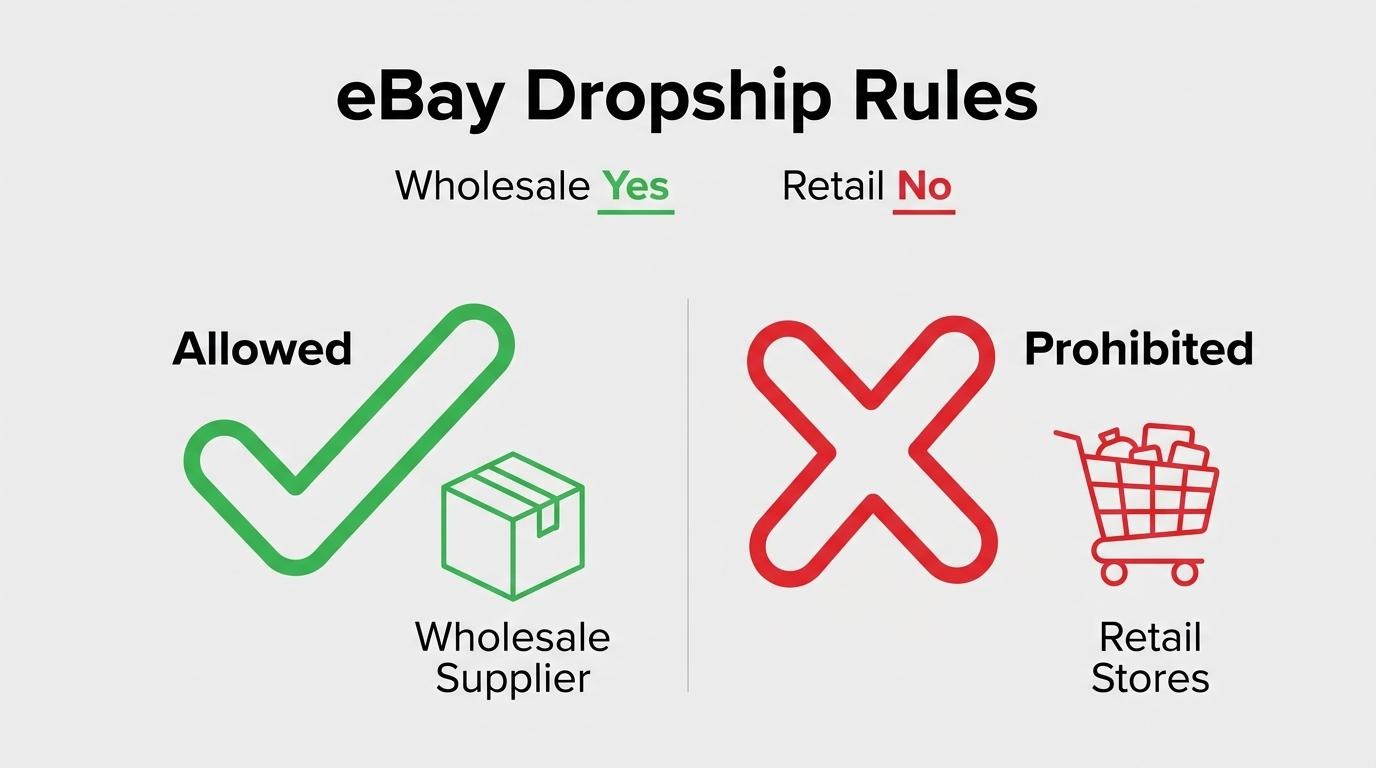
According to eBay's official policy, the platform permits dropshipping exclusively when sellers fulfill orders directly from a wholesale supplier and explicitly prohibits purchasing from another retailer or marketplace to ship to customers. This constraint makes the eBay dropshipping model fundamentally different from retail arbitrage, which many beginners confuse with legitimate dropshipping.
Yes, dropshipping is allowed under eBay's current policies, but only under specific conditions. eBay requires that sellers source products directly from wholesale suppliers or manufacturers. Purchasing an item from another online retailer (such as Amazon or Walmart) and having it shipped to your eBay buyer violates platform rules.
Sellers who break this policy risk listing removal, account restrictions, or permanent suspension. The distinction matters: wholesale-sourced dropshipping keeps you compliant, while retail-to-retail arbitrage does not.
For sellers serious about building a sustainable operation, this policy boundary is the single most important rule to internalize before listing a single product.
With eBay's policy framework clear, the next step is understanding what you need before opening your seller account.
Before you start dropshipping on eBay, you need a registered seller account with verified identity and sufficient startup capital to cover subscriptions and initial fees.
eBay sets several account requirements for new sellers. You must register a seller account with a valid email, link a payment method, and verify your identity. According to eBay Export, new sellers typically start with a monthly selling limit of 10 items or a total sales value of $500, which the platform reviews and adjusts automatically based on performance.
To begin listing, you also need:
These initial selling limits mean new dropshippers should plan product selection carefully, focusing on higher-margin items rather than volume during the early weeks.
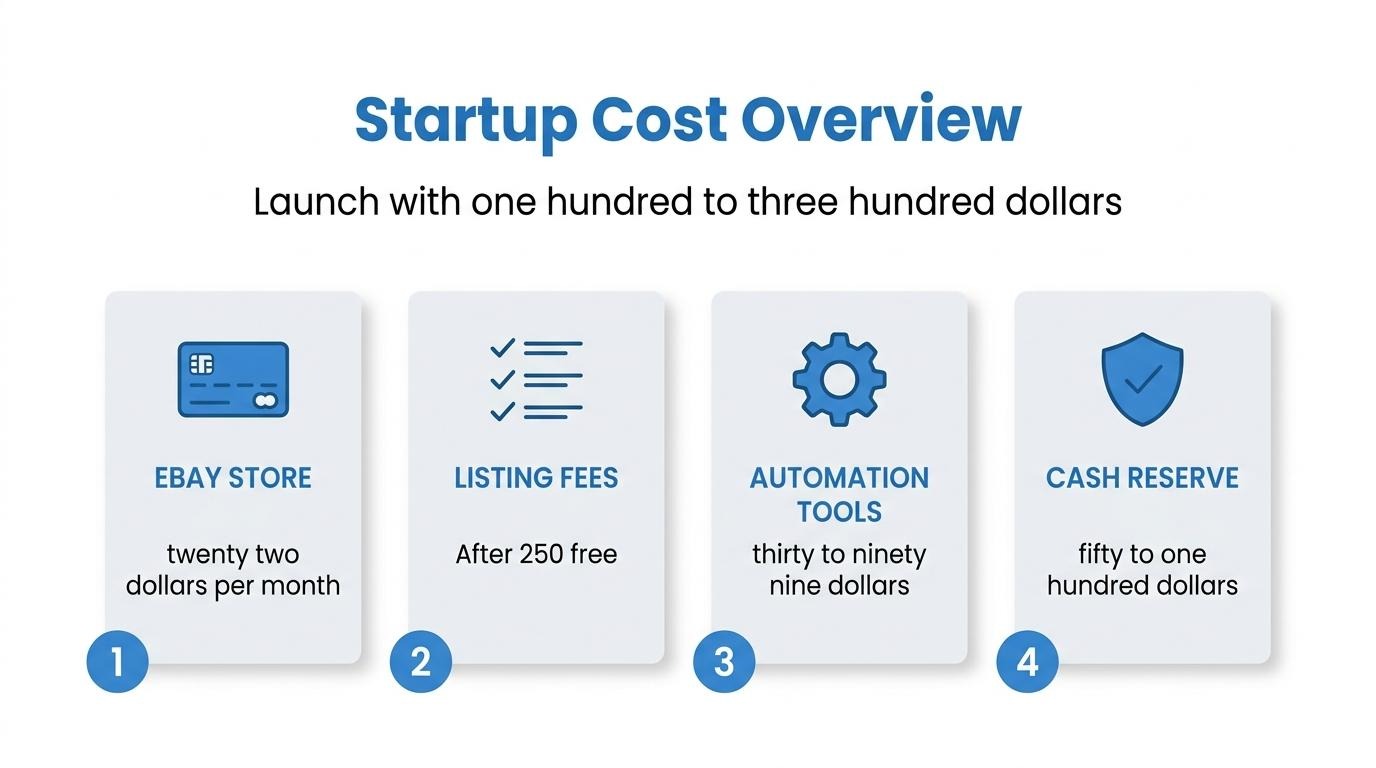
You need relatively low startup capital for eBay dropshipping compared to traditional retail models. Since you hold no inventory, upfront product costs are eliminated. Your primary expenses are platform subscriptions, listing fees, and optional software tools.
Key costs to budget for include:
Most sellers can launch with $100 to $300 in total, depending on whether they invest in paid tools immediately or start manually. For operators planning to scale beyond beginner volume, factoring in tool costs from day one prevents workflow bottlenecks later.
With account and capital requirements clear, the next step is understanding the specific process for launching your first listings.
The 6 steps to start dropshipping on eBay are: setting up your seller account, choosing a niche, finding suppliers, listing products, pricing strategically, and fulfilling orders.
You set up and optimize your eBay seller account by registering a business account, completing identity verification, and configuring your store policies for returns, shipping, and payment. Choose a store name that reflects your niche and complete all profile sections to build buyer trust.
According to eBay Seller Center, the platform charges a $0.35 insertion fee per listing once you exceed the monthly allowance of 250 zero-insertion-fee listings. Staying within this free tier while you build momentum keeps startup costs minimal. Set your return policy to 30 days and enable managed payments to appear more credible in search results.
You choose a profitable niche for eBay dropshipping by analyzing demand, competition density, and margin potential within specific product categories. Look for categories where buyers search frequently but fewer established sellers dominate.
Evaluate niches using these criteria:
Avoid oversaturated categories like phone cases or generic electronics accessories where price wars erode profit quickly.
You find reliable dropshipping suppliers by vetting wholesalers for shipping speed, inventory accuracy, and return handling before listing their products. Working with unverified sources is the fastest way to damage your eBay seller metrics.
According to a 2026 USA Today report, top US-based dropshipping suppliers such as TopDawg and Spocket are vetted for fast domestic shipping and comprehensive supplier networks. Wholesale directories like SaleHoo also connect sellers to thousands of verified sources.
When evaluating suppliers, confirm:
You list products with SEO-optimized titles and descriptions by front-loading primary keywords, including item specifics, and writing benefit-driven copy that matches buyer search intent.
eBay's search algorithm, Cassini, prioritizes keyword relevance and item specifics completion. Structure titles using this format: Brand + Product Type + Key Feature + Size/Color/Model. Fill every available item specific field, as incomplete listings rank lower in search results.
For descriptions, lead with the product's primary benefit, include exact dimensions and materials, and use natural keyword variations. Avoid keyword stuffing; Cassini penalizes titles that read as spam rather than clear product identifiers.
You price items to cover eBay fees and stay competitive by calculating total costs, including supplier price, final value fees, insertion fees, and software expenses, then adding your target margin.
Use this pricing formula: (Supplier Cost + Shipping) ÷ (1 - Final Value Fee %) + Per-Order Fee + Target Profit. Factor in automation software, which in 2026 typically costs between $29 and $99 per month according to Hustle Got Real, covering price monitoring and inventory sync.
Repricing tools help maintain competitive positioning without manually adjusting hundreds of listings. For most sellers, targeting a 20% net margin after all fees provides enough buffer for occasional returns or price fluctuations.
You fulfill orders and manage shipping timelines by forwarding customer orders to your supplier immediately after purchase and tracking delivery against eBay's shipping commitments. Dropshipping is a distribution model where vendors outsource fulfillment functions except product promotion, meaning your supplier handles picking, packing, and shipping.
Set eBay handling time to match your supplier's actual processing speed, not an optimistic estimate. Upload tracking numbers within 24 hours of supplier shipment confirmation. Late shipments trigger eBay defect metrics that restrict selling privileges.
For sellers managing more than 50 orders weekly, automation tools that sync supplier tracking directly to eBay orders eliminate manual entry errors and reduce fulfillment delays significantly.
With fulfillment systems in place, choosing the right suppliers determines long-term reliability.
The best dropshipping suppliers for eBay sellers in 2026 fall into three categories: US-based suppliers for fast shipping, international suppliers for higher margins, and wholesale directories for verified sourcing.
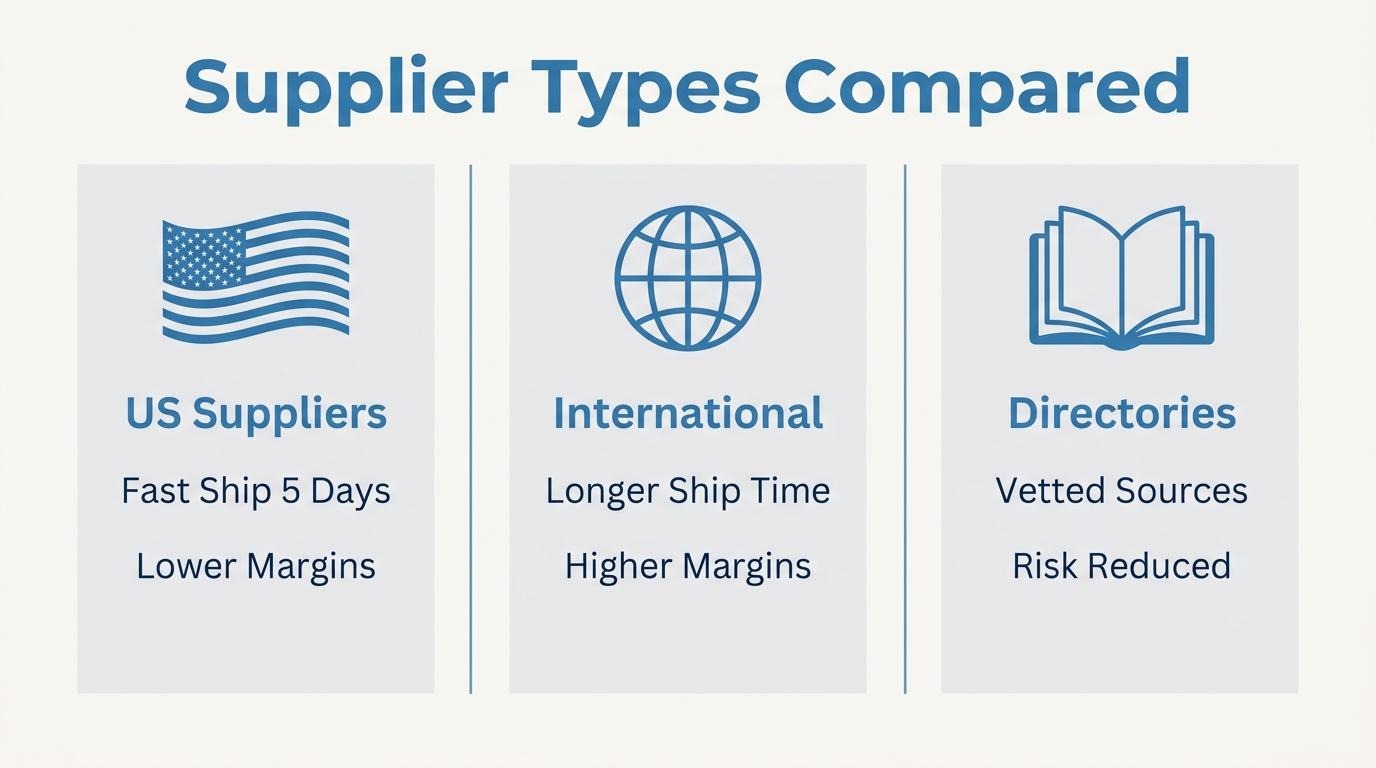
US-based suppliers offering fast domestic shipping include TopDawg and Spocket. According to a 2026 USA TODAY report, these suppliers are vetted for reliable fulfillment and comprehensive supplier networks that support delivery timelines eBay's algorithm rewards. Fast domestic shipping reduces late-shipment defects, which directly protects seller metrics. Prioritizing suppliers with US-based warehouses keeps transit under five business days for most orders, a threshold that matters more than price when building early account health.
International suppliers work for higher-margin products when the category tolerates longer shipping windows. Products such as custom jewelry, specialty electronics accessories, and niche home décor often carry 30% to 40% margins that justify extended delivery timelines. When sourcing internationally, look for suppliers who offer:
The margin advantage disappears if return rates spike due to unmet delivery expectations, so transparent shipping estimates in your listings are non-negotiable.
Wholesale directories connect you to verified suppliers by pre-screening manufacturers and distributors for legitimacy, product quality, and fulfillment reliability. SaleHoo, for example, provides access to thousands of verified suppliers, reducing the risks of working with unvetted sources. Verification matters because eBay's VeRO program allows intellectual property owners to report infringing listings, which can result in listing removal and account restrictions for sellers using unauthorized suppliers. Always cross-reference directory suppliers against VeRO's active rights holders list before listing branded or trademarked products.
With reliable suppliers in place, automation tools keep pricing, inventory, and fulfillment synchronized at scale.
eBay dropshippers need automation tools across four core functions: listing creation, repricing, inventory monitoring, and order fulfillment. Each category addresses a specific bottleneck that compounds as catalog size grows.
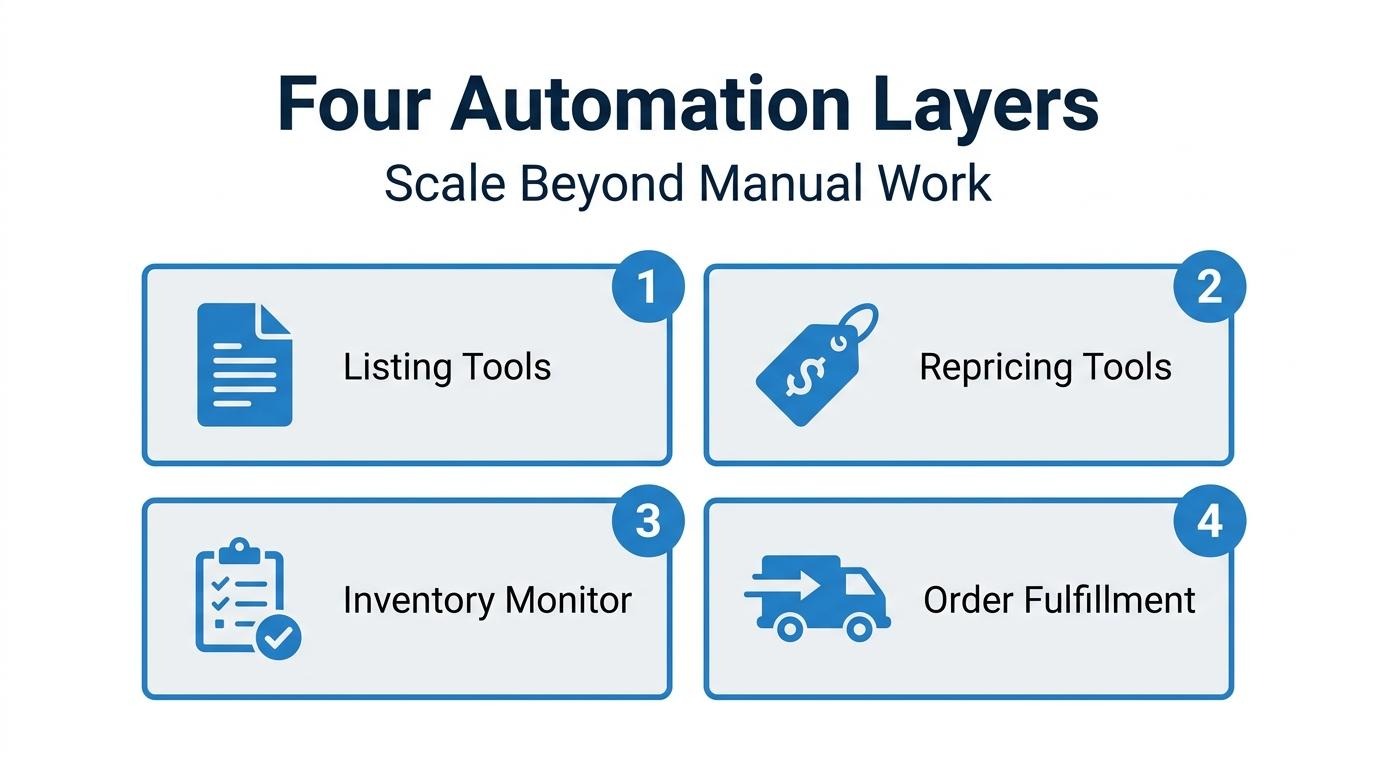
Listing automation tools save time at scale by bulk-creating, editing, and publishing product listings across large catalogs without manual entry for each SKU. These tools typically handle title optimization, item specifics population, image imports, and template application in batch processes.
For sellers managing hundreds or thousands of SKUs, manual listing becomes the first operational bottleneck. Automation platforms pull product data directly from supplier feeds, format it to eBay's requirements, and schedule publications to avoid listing limit issues. The time savings become exponential once catalog size exceeds a few dozen active listings.
Repricing tools help you win the Buy Box by automatically adjusting your prices in response to competitor changes, maintaining competitiveness without constant manual monitoring. These tools scan competitor listings at set intervals and apply rule-based or algorithmic pricing adjustments.
Effective repricers let you set floor and ceiling prices to protect margins while staying competitive. Given that eBay's algorithm weighs price heavily in search ranking, automated repricing keeps listings visible during high-competition periods. For dropshippers specifically, repricing tools must also account for supplier cost fluctuations to prevent selling below break-even.
Inventory monitoring tools prevent overselling by syncing real-time stock levels between your supplier's catalog and your active eBay listings, automatically delisting or pausing items when supplier stock drops to zero. According to a 2026 analysis by Frooition, automated inventory management tools can lead to a 32% reduction in order cancellations caused by out-of-stock items.
Since dropshippers never hold inventory, stock availability depends entirely on the supplier. Without automated monitoring, a sold-out supplier item remains live on eBay, resulting in cancellations that damage seller metrics and risk account restrictions.
Order fulfillment tools sync supplier and eBay data by automatically forwarding customer order details to your supplier, then pulling tracking information back into eBay once the supplier ships. This closed loop eliminates manual data entry between platforms.
These tools must account for eBay's fee structure when processing orders. For most product categories, eBay's final value fee includes a 13.25% charge on the total sale amount up to $7,500, plus a fixed per-order fee of $0.30 to $0.40. Fulfillment automation that factors these costs into profit calculations per order gives sellers accurate margin visibility without spreadsheet work.
With automation handling day-to-day operations, understanding realistic revenue expectations becomes the next priority.
Realistic eBay dropshipping earnings depend on your fee structure, product margins, and timeline to scale. The sections below break down expected margins after fees and the typical ramp-up period to consistent revenue.
You should expect net profit margins between 15% and 25% on general items after eBay and payment processing fees are deducted. According to AutoDS, professional eBay dropshippers in 2026 report that niche products can reach margins of 30% to 40%.
The primary fee layers that compress margins include:
After stacking these costs, a $30 item with a $20 supplier cost leaves roughly $3 to $5 in actual profit. Sellers who skip the margin math before listing often discover they are breaking even or losing money once all fees are tallied.
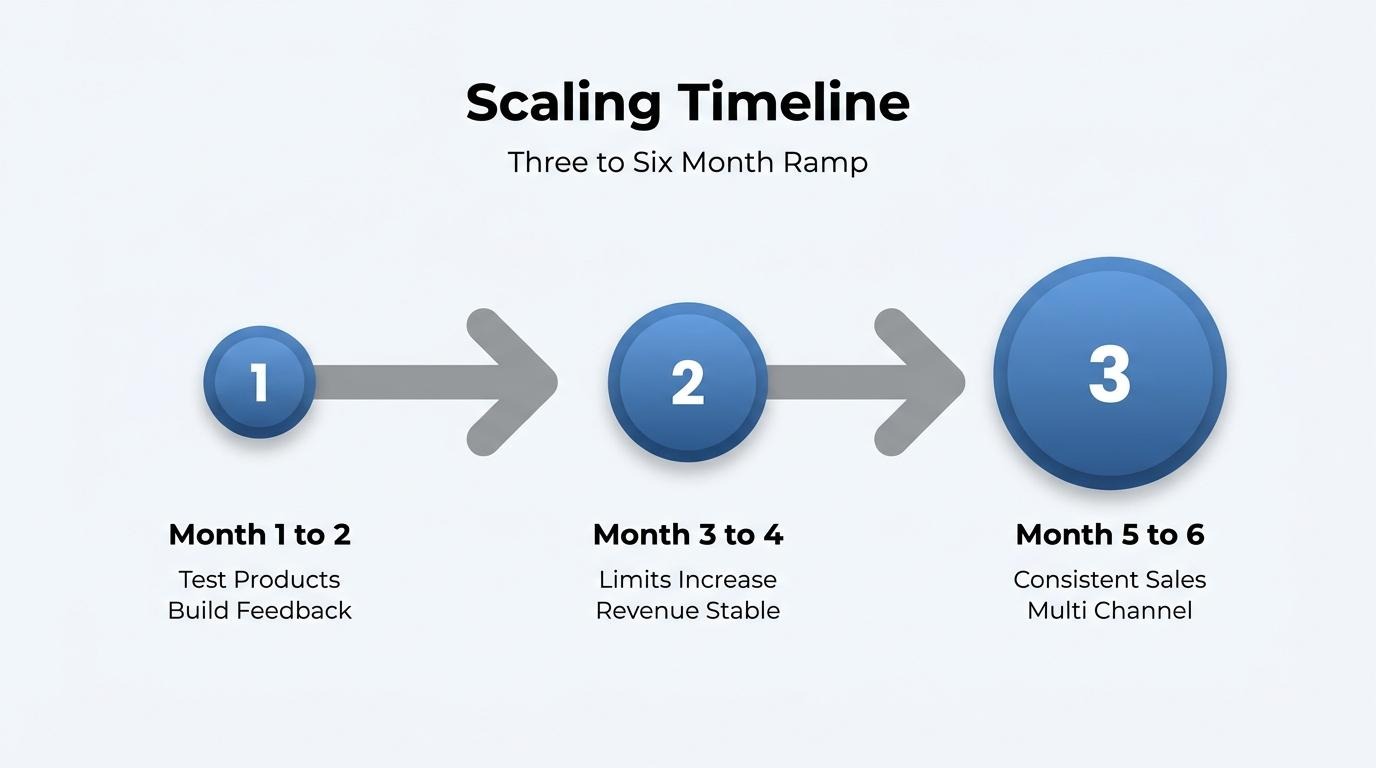
It typically takes 3 to 6 months to reach consistent monthly revenue from eBay dropshipping. New sellers face an initial constraint: eBay limits accounts to 10 items or $500 in total sales value, which the platform adjusts based on performance over time.
The ramp-up timeline breaks into phases:
Patience during the early months matters more than most sellers expect, because eBay's algorithm rewards sustained performance metrics over sudden listing surges. Those who treat months one through three as a testing phase rather than an income phase tend to build more durable revenue foundations.
With earnings benchmarks established, understanding the risks that threaten those margins becomes the next priority.
The biggest risks of dropshipping on eBay are supplier stockouts, account restrictions, and complex return logistics. Each of these can erode margins and damage seller reputation if left unmanaged.
You handle supplier stockouts and late shipments by implementing real-time inventory monitoring and maintaining backup supplier relationships. When a supplier runs out of stock after a customer places an order, the seller faces a cancellation that harms their account metrics.
According to a 2026 analysis by Frooition, automated inventory management tools can lead to a 32% reduction in order cancellations caused by out-of-stock items. Practical steps to mitigate this risk include:
The FTC requires online sellers to ship orders within 30 days if no specific delivery time is promised. Missing this window repeatedly invites both regulatory scrutiny and eBay defect strikes.
Your eBay account gets restricted when performance metrics fall below platform standards or policy violations are detected. Common triggers include high cancellation rates, late shipment percentages above threshold, intellectual property complaints through the VeRO program, and purchasing from other retailers instead of wholesale suppliers.
Restrictions range from listing limits to full suspension. Consequences include:
Prevention requires monitoring your seller dashboard daily, responding to buyer cases within 24 hours, and sourcing exclusively from wholesale suppliers. Once restricted, reinstatement demands a detailed plan of action demonstrating corrective steps. For most dropshippers, a single suspension can end a business that depends entirely on one platform.
You manage returns when you never touch inventory by establishing clear return workflows with each supplier before listing products. Because the seller never handles goods physically, every return requires coordination between buyer, seller, and supplier.
Key return management practices include:
Margins shrink quickly when return shipping costs fall on the seller. For items under $20, issuing a refund without requiring a return often costs less than processing the logistics. This approach protects seller ratings while preserving whatever margin remains on low-ticket products.
With risk mitigation strategies in place, scaling tactics help sellers grow beyond beginner volume.
Scaling beyond beginner volume requires building trust, expanding channels, and knowing when to shift fulfillment models. The following subsections cover feedback strategies, multi-channel diversification, and the inventory transition decision.
You build seller feedback quickly and sustainably by delivering consistent service, communicating proactively, and requesting reviews at the right moment. Ship orders with tracking uploaded immediately, message buyers with estimated delivery dates, and follow up post-delivery with a brief, polite review request.
Key tactics for accelerating feedback include:
Feedback velocity matters more than perfection in the early months. Sellers who hit 100+ positive reviews unlock higher listing limits and stronger Buy Box placement, creating a compounding advantage over time.
You diversify beyond eBay to reduce platform risk by selling across multiple marketplaces and your own storefront simultaneously. Relying on a single channel exposes your revenue to policy changes, account restrictions, or algorithm shifts outside your control.
According to Digital Applied's 2026 unified selling guide, unified commerce platforms provide centralized inventory and marketplace management, reducing the risk of overselling across multiple channels like eBay and Shopify. This centralized approach keeps stock counts accurate regardless of where a sale originates.
Practical diversification steps include:
For sellers already managing five or more tools, consolidating into one system that handles storefront, inventory, and customer data together eliminates the sync failures that cause overselling at scale.
You should transition from dropshipping to holding inventory when supplier reliability, margin compression, or shipping speed consistently limit your growth. The shift is not binary; most sellers begin with a hybrid approach, stocking top sellers while dropshipping long-tail items.
Clear signals that the transition is overdue:
Holding inventory introduces warehousing costs, capital risk, and fulfillment labor. However, for products with proven demand and stable supplier pricing, the margin improvement and delivery speed gains typically outweigh the added complexity. Start with your top five SKUs and expand only as cash flow allows.
Understanding when to hold stock marks the shift from operator to brand builder, which opens the door to owning your customer relationships entirely.
You move beyond eBay tool sprawl by consolidating order management, customer data, and marketing into a single unified platform. The sections below cover what changes operationally and summarize key takeaways for eBay dropshipping in 2026.
What changes is the elimination of data silos between fulfillment, CRM, and lifecycle marketing. When order data, customer profiles, and campaign triggers share one record, sellers gain real-time visibility into shipping compliance and buyer behavior without reconciling separate tools.
This matters because the FTC requires online sellers to ship orders within 30 days if no specific delivery time is promised, according to FTC Consumer Advice guidelines. A unified system surfaces fulfillment deadlines automatically rather than requiring manual checks across disconnected apps. On SHOPLINE, order and customer data live in the same system as the storefront, removing the sync issues that emerge when sellers stitch together five or more separate tools at scale.
For operators outgrowing the eBay-only model, consolidation reduces the operational risk that fragmented data creates, particularly around shipping timelines and customer communication.
The key takeaways about how to dropship on eBay in 2026 are:
Start with compliant supplier relationships and optimized listings, then layer automation as volume grows. When tool count exceeds operational clarity, consolidating into an all-in-one platform becomes the logical next step.
.png)
.png)
.png)

