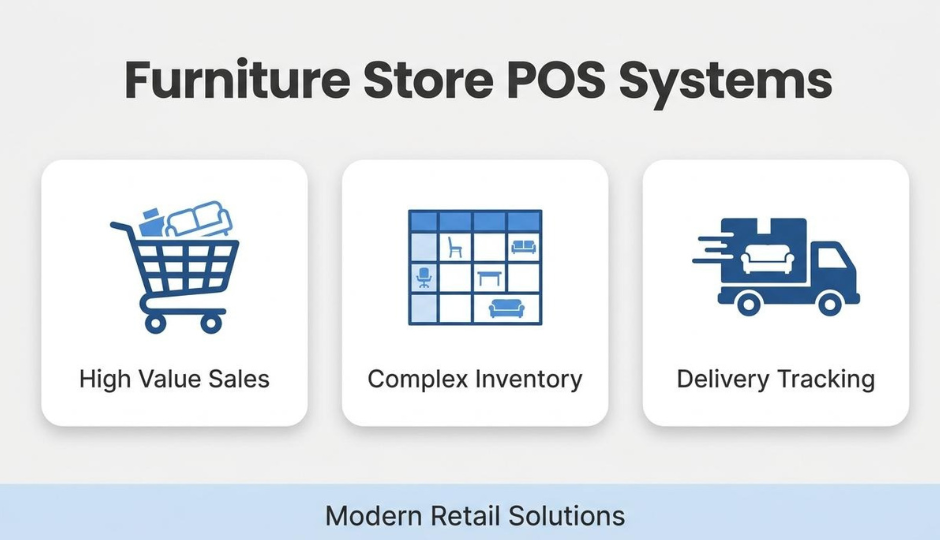
A furniture store POS system is point-of-sale software designed to handle the high transaction values, complex SKU variants, custom order workflows, and delivery logistics unique to furniture retail. Generic retail POS tools lack the depth these operations demand.
This guide covers what makes furniture retail uniquely challenging for standard POS software, eight POS platforms evaluated for furniture-specific capability, the essential features every furniture store system needs, pricing across entry-level to enterprise tiers, and how to connect online and in-store sales through unified data.
Furniture retail involves oversized items sold in dozens of fabric, finish, and configuration combinations, with purchase abandonment rates reaching 69% when delivery issues or unexpected costs appear at checkout. Standard POS systems create operational gaps because they lack support for custom order tracking, split payments, and multi-location warehouse visibility.
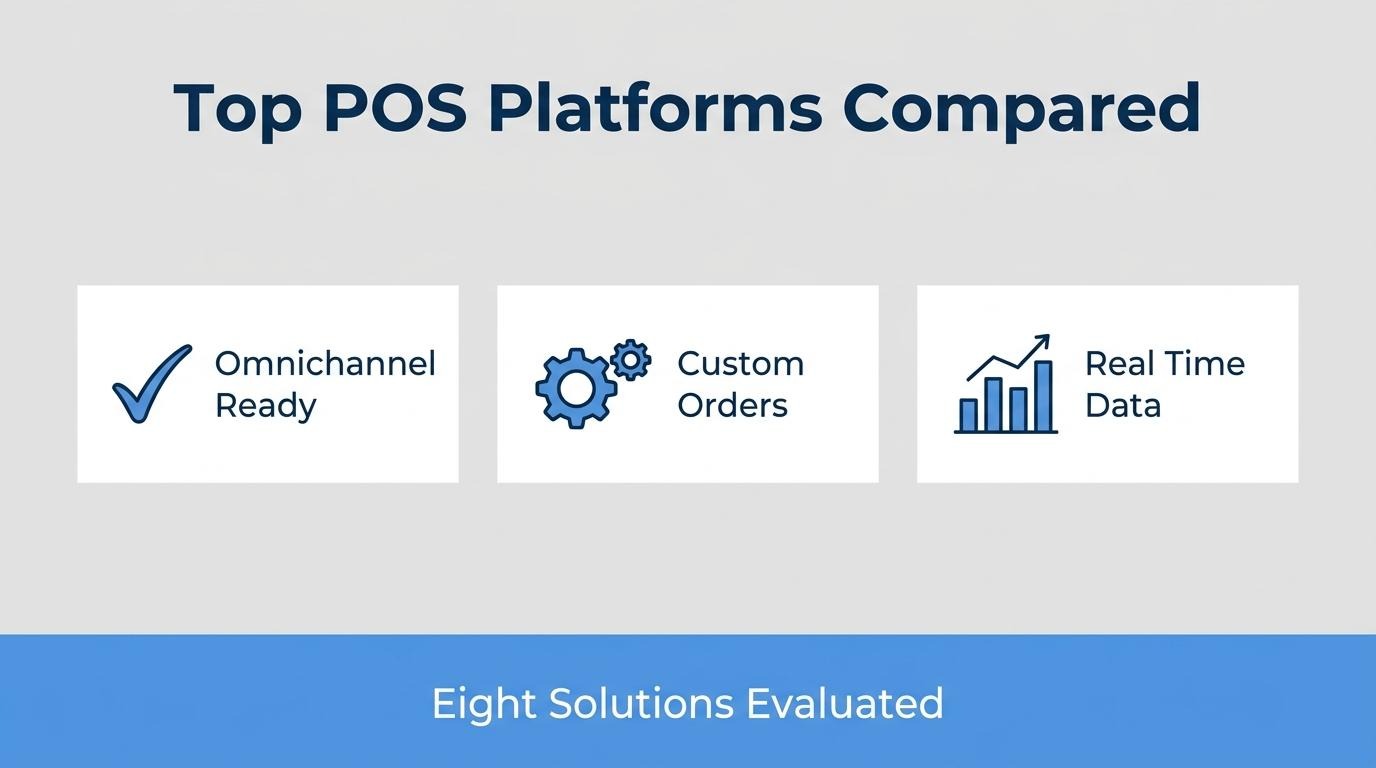
We evaluate SHOPLINE POS, Lightspeed Retail, Shopify POS, Square for Retail, STORIS, Rain POS, Clover, and Vend by Lightspeed, covering verified pricing, user reviews, and where each platform fits within furniture operations.
The features that matter most include variant-level inventory management, special order workflows with deposit tracking, integrated financing options, delivery route scheduling, real-time multi-location stock counts, and CRM that captures room-by-room purchase patterns across long buying cycles.
Pricing ranges from free plans with basic payment processing to enterprise solutions exceeding $300 per month, where the real cost lies in data migration and integration continuity rather than subscription fees alone.
Connecting showroom and ecommerce channels through real-time inventory sync eliminates overselling risk on high-value items, while unified customer profiles let shoppers move between online research and in-store purchases without friction.
Furniture stores need a specialized POS system because high transaction values, complex SKU structures, and delivery logistics exceed what generic retail software can handle. The sections below cover what makes furniture retail unique and the specific problems a standard POS creates.
Furniture retail differs from standard retail in transaction size, SKU complexity, and fulfillment requirements. Average order values are significantly higher than typical retail, requiring specialized handling for delivery success rates, a critical KPI for large-item logistics according to Ordorite.
Several factors compound this complexity:
These challenges mean furniture retailers need POS systems purpose-built for high-value, multi-variant, delivery-dependent transactions rather than tools designed for quick-turn commodity retail.
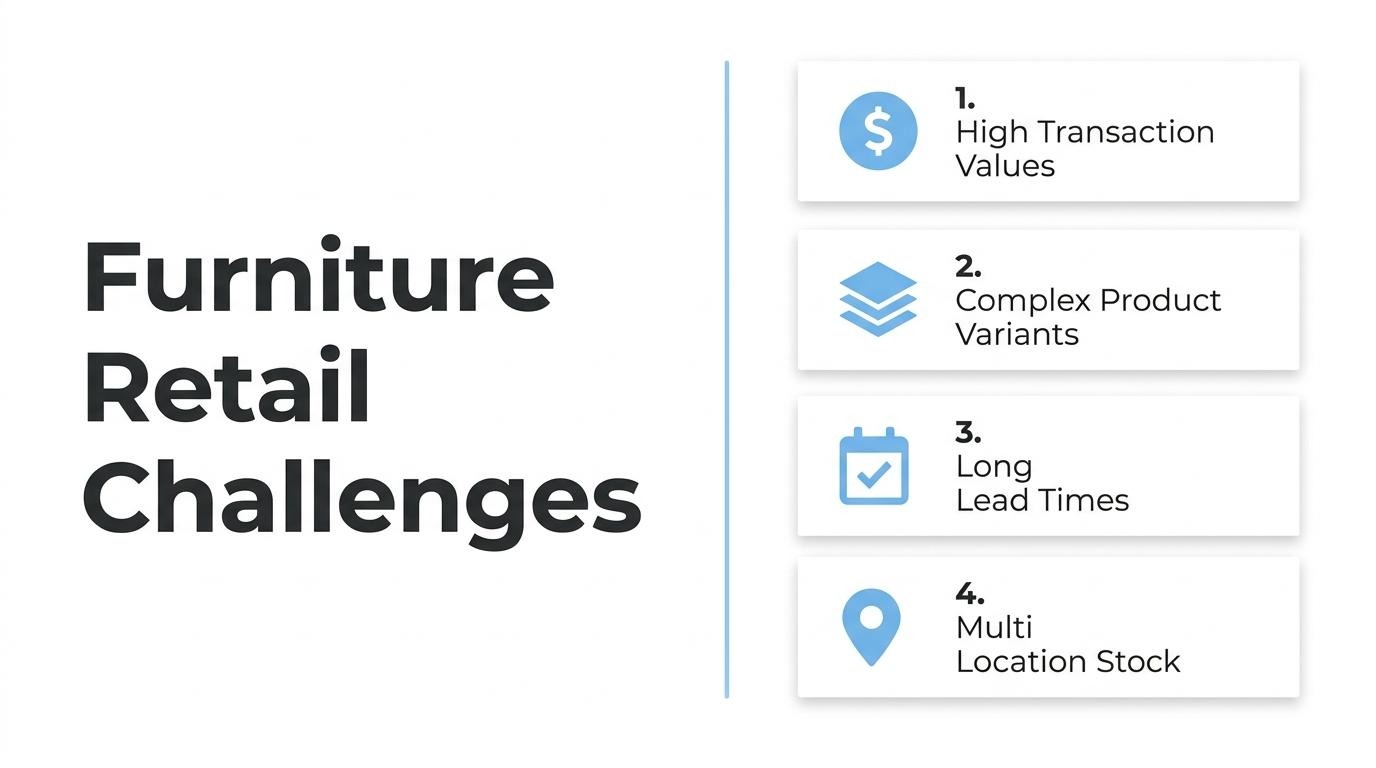
A generic POS creates operational gaps in inventory tracking, order management, and customer experience for furniture stores. Standard systems typically lack support for:
Without these capabilities, staff resort to manual workarounds, spreadsheets, and disconnected tools. Data becomes fragmented across the showroom POS, ecommerce platform, and delivery partners, making unified reporting nearly impossible. For growing furniture retailers, this fragmentation compounds with scale, turning what starts as minor friction into a serious constraint on revenue and customer satisfaction.
With the case for specialization established, the next step is evaluating which systems meet these requirements.
The best POS systems for furniture stores are platforms that handle high-ticket transactions, complex SKU variants, custom orders, and omnichannel fulfillment. Below are eight options ranked by furniture-specific capability.
SHOPLINE POS is an all-in-one commerce platform that unifies showroom sales with ecommerce through a shared customer data layer. Its "Buy in Store, Ship to Customer" feature enables furniture retailers to fulfill online orders directly from retail store inventory. The POS Lite plan starts at $390 per year when paired with a SHOPLINE Starter, Essential, or Premium plan. According to a verified G2 user review, "Shopline is a very modern, easy to use, fast ecommerce SaaS platform with a user interface familiar to people in the ecommerce space." Native CRM, marketing automation, and subscription tools eliminate the need for separate apps.
Lightspeed Retail is a cloud-based POS system built for retailers managing large catalogs across multiple locations. The basic plan starts at $89 per month billed annually, or $109 monthly. For furniture stores processing up to $34,999 per month, estimated transaction fees run approximately $200 monthly, according to Shopify's research. Advanced inventory tools support variant-heavy catalogs with detailed product matrices. Built-in analytics and supplier management help furniture retailers track margins across high-value items, though the platform requires paid add-ons for some ecommerce integrations.
Shopify POS is a unified retail solution that connects in-store hardware with Shopify's ecommerce backend. Standard plans start at $89 per month, with in-person payment fees beginning at 2.6% + 10¢. According to Shopify's research team, 65% of surveyed POS users reported significant revenue enhancements after adoption. Juliette Grant, retail operations manager at Parachute, notes the system is "super simple to pick up and easy to learn," making it practical for stores with part-time staff. Omnichannel inventory sync and built-in customer profiles support showroom-to-online selling.
Square for Retail is a flexible POS system with a free basic plan and in-person transaction fees of 2.6% + 15¢. Forbes Advisor describes it as "an excellent choice for retail shops," offering three service tiers for different business sizes. However, processing rates increased in early 2025, and NerdWallet reports that Square migrated several previously free features to paid plans. The platform works well for smaller furniture showrooms needing low upfront costs, though larger operations may outgrow its inventory depth.
STORIS is a POS system developed specifically for the home furniture industry. It provides native inventory management, warehouse operations, and delivery routing tailored to large-item logistics. On G2, STORIS holds a 4.3-star rating from 31 verified reviews. One customer on FeaturedCustomers states, "We selected STORIS because it fit our business model well, came highly recommended." For mid-size to large furniture retailers needing purpose-built delivery scheduling and floor planning tools, STORIS remains one of the most specialized options available.
Rain POS is a retail platform combining point-of-sale with integrated website management, starting at $99 per month. This pricing includes native POS and website integration along with unlimited phone and email support. A verified Capterra user mentioned that Rain POS "brought new life to my store," though some reviews note challenges with customer service responsiveness. The system suits smaller specialty furniture retailers who want a combined POS and web presence without managing separate platforms, though it lacks the deep furniture-specific logistics tools found in STORIS.
Clover is a hardware-forward POS system with a Starter plan at $16 per month for 36 months, including a countertop terminal and processing fees starting at 2.3% + 10¢. TechRadar describes it as a "dependable POS system for small and medium-sized businesses" with reasonable transaction fees. On G2, Clover holds 3.9 stars across 103 reviews, with users praising ease of use. The system works for furniture stores needing affordable, straightforward payment processing, though it lacks specialized features for custom order tracking or delivery routing.
Vend by Lightspeed is a retail POS platform that has transitioned into the Lightspeed ecosystem, with pricing and features now aligned under Lightspeed's plans. According to Merchant Maverick, Vend is "packed with retail features but is still easy to use," particularly for small boutiques needing reliable inventory tools. Ecommerce integrations are included through the Lightspeed infrastructure. For furniture stores already considering Lightspeed, Vend's legacy interface offers a familiar entry point into that ecosystem.
With specific platforms identified, the next step is evaluating which POS features matter most for furniture operations.
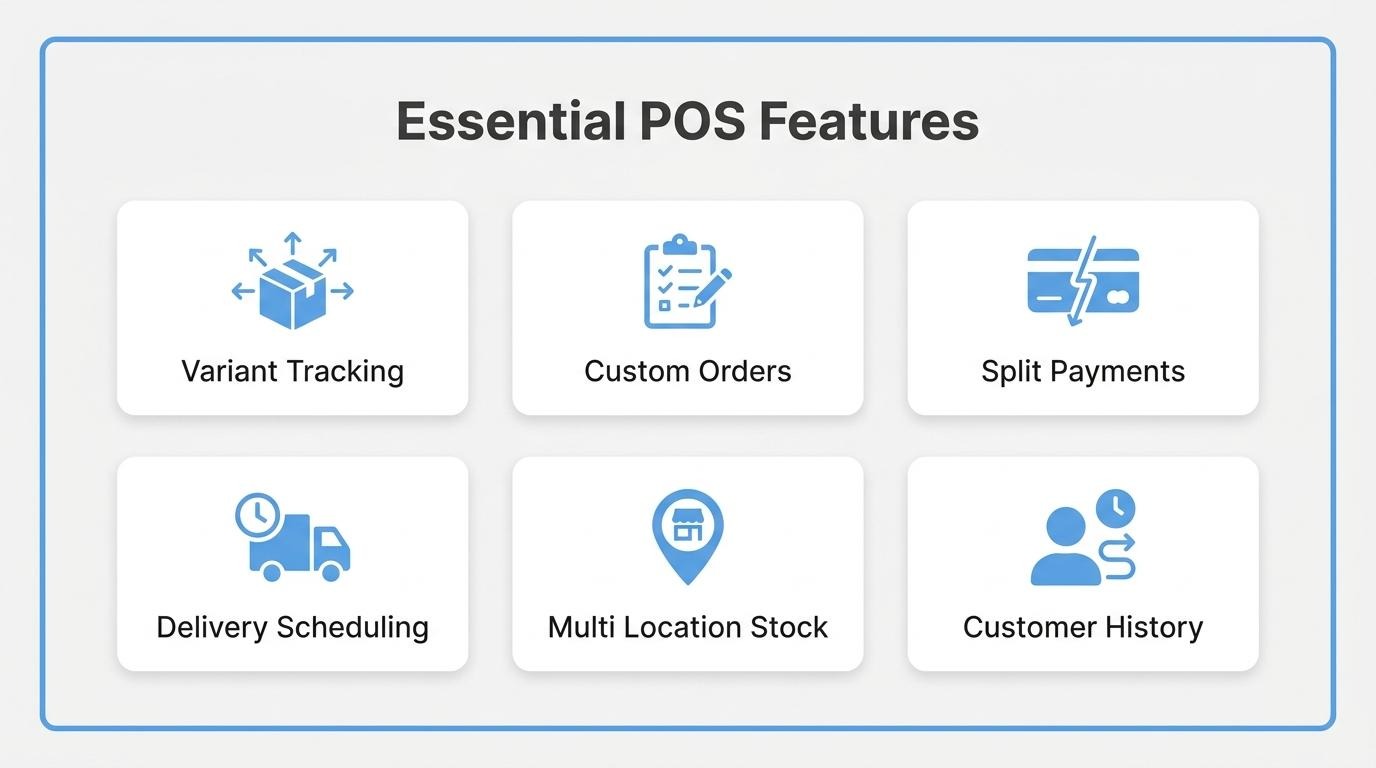
A furniture store POS system should include inventory management for large catalogs, custom order tracking, split payment and financing tools, delivery scheduling, multi-location stock visibility, and CRM with purchase history.
Inventory management for large catalog items works by organizing products across multiple dimensions, such as style, material, finish, and size, within a single SKU architecture. Furniture retailers deal with extensive variant combinations that standard retail systems cannot handle cleanly. A capable POS maps each configuration as a distinct trackable unit while grouping related variants under parent products.
Key inventory features for furniture include:
SKU complexity remains one of the most common growth challenges in furniture retail, since adding styles, variants, and swatches multiplies management difficulty exponentially.
Custom order and special order tracking is essential because furniture purchases frequently involve made-to-order configurations with extended lead times, unique material selections, and customer-specific modifications that standard order workflows cannot accommodate.
Without dedicated tracking, staff lose visibility into production timelines, deposit status, and vendor communications. A POS with custom order management ties the customer record to every specification, milestone, and partial payment in one view.
According to POS Highway, modern POS systems help furniture stores manage inventory and special orders by connecting order data directly with accounting software, significantly reducing manual entry errors for high-ticket transactions. Product pages featuring 360-degree photography achieve up to 50% higher conversion rates, making accurate order-to-inventory linking even more critical as online custom orders grow.
A POS should handle split payments and financing by supporting multiple tender types within a single transaction, including partial deposits, layaway schedules, and integrated buy-now-pay-later options. Furniture's high average transaction value makes flexible payment structures a necessity rather than a convenience.
Essential payment capabilities include:
According to Shopify's research team, financing options like Shop Pay Installments drive a 17% to 26% increase in purchase likelihood and lead to 10% larger basket sizes for high-ticket furniture items. For most furniture retailers, offering at least two financing paths at checkout removes one of the largest friction points in closing high-value sales.
The delivery scheduling and logistics features that matter most are route optimization, customer time-window selection, delivery status tracking, and white-glove service coordination. Furniture deliveries differ fundamentally from parcel shipments because items are oversized, fragile, and often require in-home assembly.
A POS with built-in delivery management should offer:
Unexpected costs or delivery issues can lead to purchase abandonment rates as high as 69% in competitive furniture markets, making transparent logistics communication a direct revenue protection tool.
Multi-location stock visibility is critically important because furniture retailers often distribute inventory across showrooms, warehouses, and distribution centers, and customers expect immediate answers about availability regardless of where they shop.
A POS with unified stock visibility enables:
Approximately 38% of consumers now use Buy Online, Pick Up In-Store services, according to Shopify's research team. This behavior demands inventory systems that bridge online browsing and physical locations seamlessly. Without this visibility, stores risk overselling, creating unnecessary backorders, and frustrating customers who expected immediate availability.
CRM and customer purchase history play a central role in furniture retail by enabling personalized service across long buying cycles, tracking room-by-room purchasing patterns, and informing follow-up outreach for complementary pieces.
Furniture purchases are infrequent but high-value, meaning each customer interaction carries significant lifetime revenue potential. A POS-integrated CRM should capture:
This data transforms one-time buyers into repeat customers by enabling staff to reference past purchases during future visits. With delivery logistics and financing handled, CRM data completes the picture by connecting every post-sale touchpoint back to the original transaction.
Furniture store POS systems cost anywhere from $0 to several thousand dollars per month, depending on store size, feature requirements, and transaction volume. Below, entry-level, mid-size, and enterprise pricing tiers are broken down by what each includes.
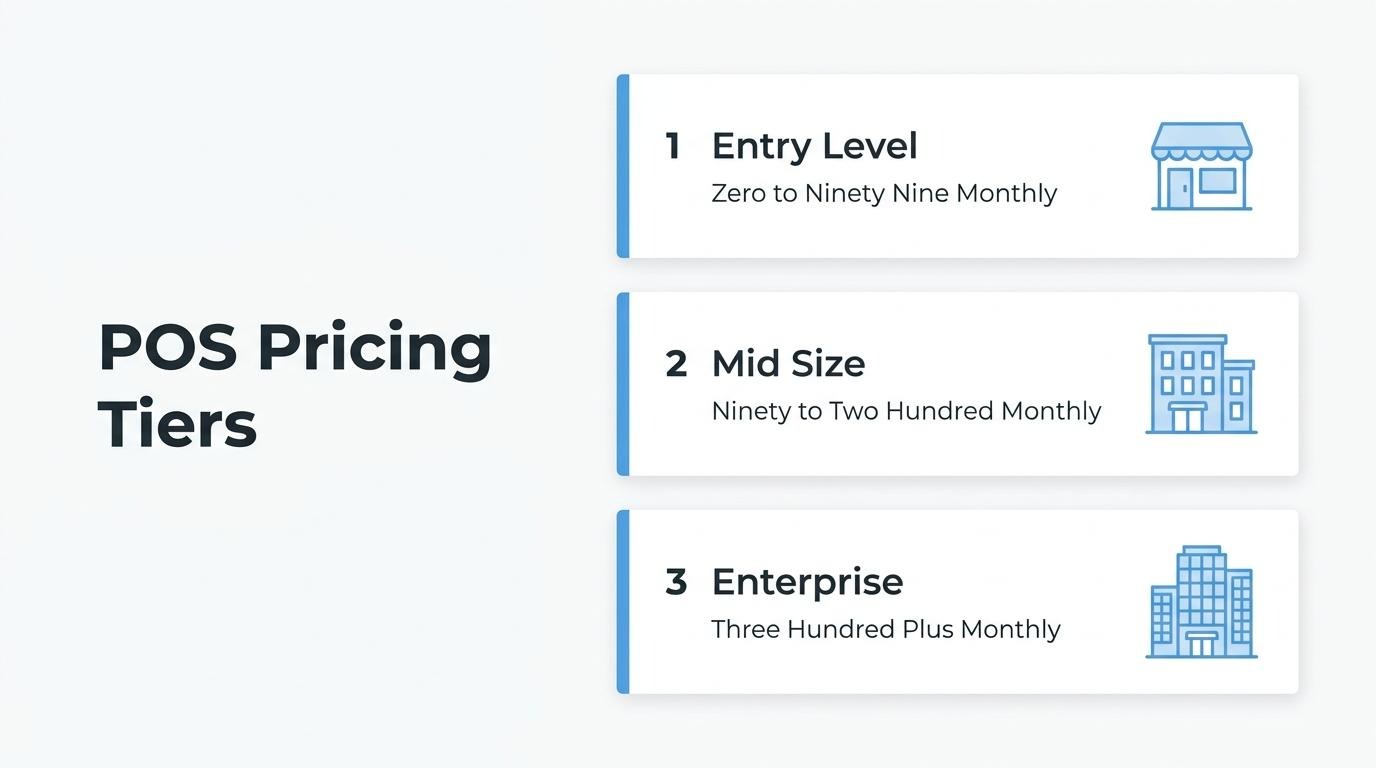
Entry-level furniture POS plans typically include basic inventory tracking, payment processing, and a single register terminal, with monthly costs ranging from $0 to $99. Square offers a free plan at 2.6% + 15¢ per transaction, while Clover starts at $16 per month. These plans suit small showrooms with limited SKUs, though furniture's low online conversion rates (below 1%, according to iEnhance research on the Home and Furniture sector) underscore the need for even entry-level systems to support in-person selling effectively. Most entry-level plans lack custom order tracking, delivery scheduling, and multi-location inventory, features that become critical as catalogs grow.
Mid-size furniture retailers should expect to pay between $89 and $200 per month for POS software, plus transaction fees. Lightspeed Retail starts at $89 per month billed annually, and Rain POS begins at $99 per month with integrated website functionality. At this tier, systems typically include:
Transaction fees add up quickly for furniture's high average order values. Lightspeed estimates stores processing up to $34,999 monthly will pay approximately $200 per month in processing fees alone. Mid-size retailers should budget for both subscription and processing costs when comparing platforms.
Enterprise-level POS solutions cost $300 or more per month, often requiring custom quotes based on location count, transaction volume, and integration complexity. Industry-specific platforms like STORIS provide native warehouse operations, delivery routing, and custom order management built specifically for furniture retail. These solutions typically involve annual contracts and implementation fees.
At this tier, the real cost driver is not the subscription itself but data migration, integration rewiring, and maintaining reporting continuity during the transition. For multi-location furniture retailers processing high-ticket transactions, the total cost of ownership includes hardware, staff training, and ongoing support fees that can push annual spend well above the base subscription price.
Understanding these cost tiers helps clarify which integration capabilities matter most when connecting online and in-store sales channels.
A furniture store POS should connect online and in-store sales through real-time inventory synchronization and a shared customer data layer across all channels.
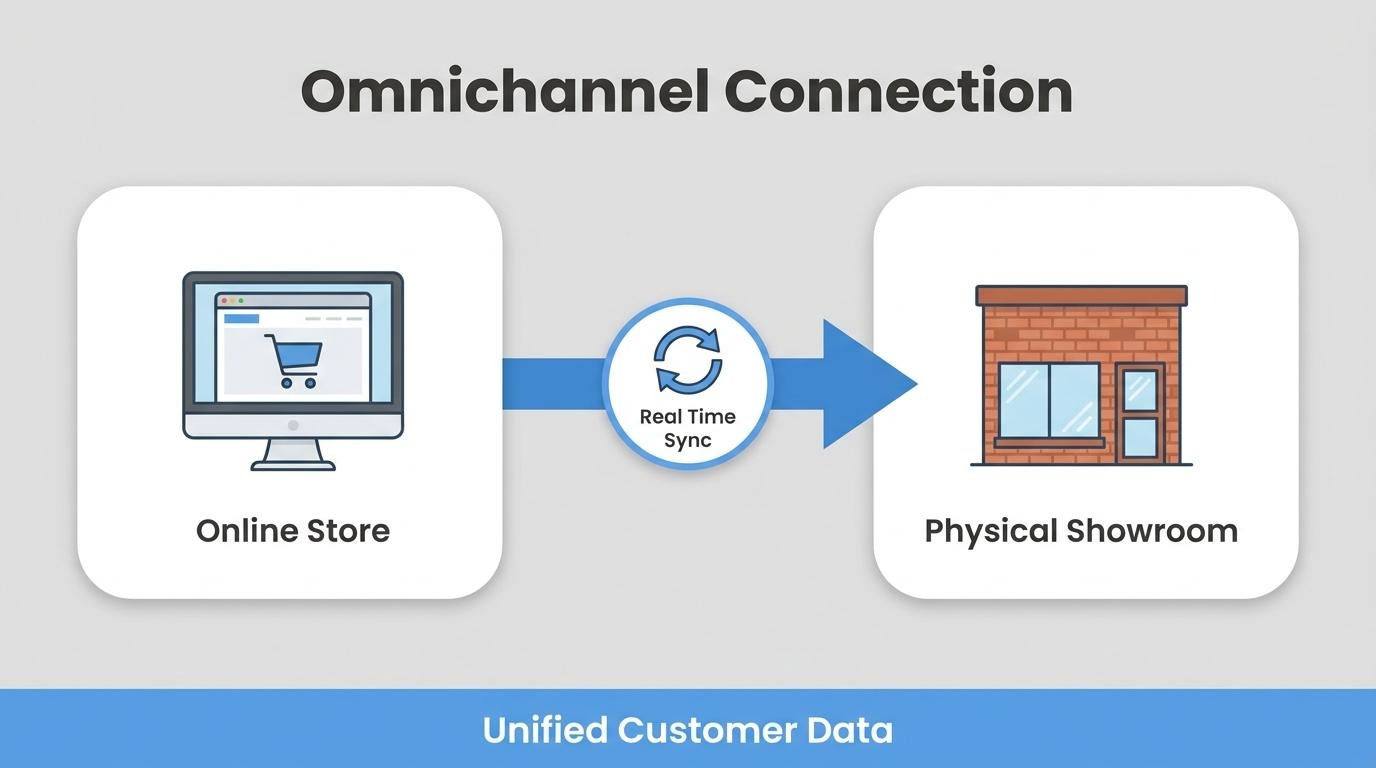
Omnichannel inventory sync matters for furniture because high-value, low-velocity SKUs require accurate stock visibility across showrooms and ecommerce storefronts simultaneously. Without real-time synchronization, a sofa displayed as available online may already be sold in-store, creating fulfillment failures on transactions that often exceed $1,000.
According to a 2025 Priority Software report, 59% of midsize retailers fail to deliver a unified omnichannel experience, often due to fragmented data across different sales channels. For furniture specifically, where a single sectional might exist in three fabric options across two warehouses and one showroom floor, disconnected systems multiply overselling risk. Synchronized inventory eliminates this by treating all channels as one pool.
Customers benefit from unified online and showroom data through consistent pricing, accurate availability, and seamless purchase flexibility regardless of where they start browsing. A shopper who researches a dining table online at midnight can walk into the showroom the next day and find that same item's specs, reviews, and stock status already accessible to the sales associate.
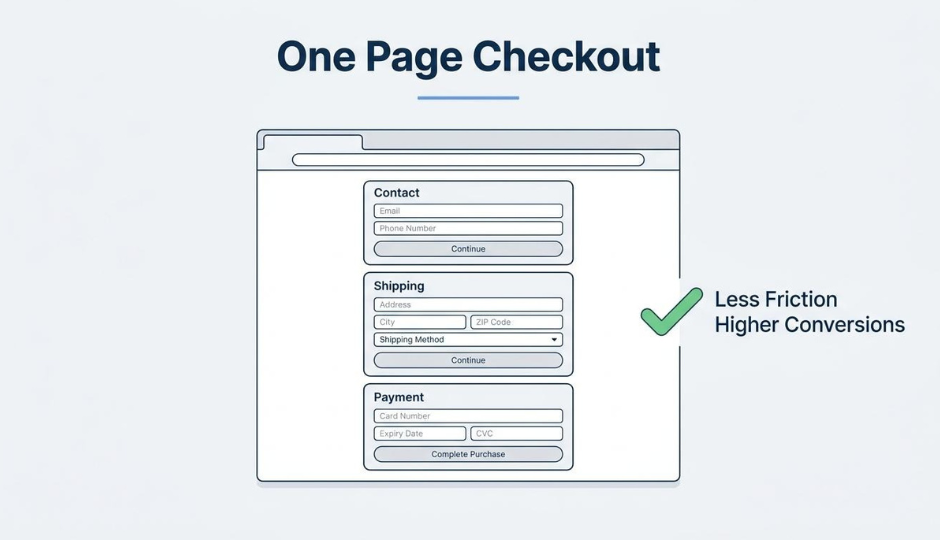
According to a 2024 Shopify Research Team report, approximately 38% of consumers now utilize Buy Online, Pick Up In-Store services, which require inventory systems that bridge online browsing and in-store purchasing. Unified data also means deposit payments started online carry over to in-store completion without re-entering customer details. For most furniture retailers, this continuity directly reduces the friction that causes high-ticket purchase abandonment.
With online and in-store channels unified, evaluating your current system's migration path becomes the next practical step.
When switching POS systems, furniture stores should evaluate data migration complexity and hardware compatibility. The subsections below cover migration challenges specific to high-ticket retail and how to assess whether existing hardware works with a new platform.
Furniture stores face data migration challenges that include transferring complex product catalogs with numerous SKU variants, preserving customer purchase histories tied to high-ticket orders, and maintaining continuity in financial reporting across accounting integrations. Unlike standard retail, furniture catalogs contain extensive configuration data: fabric swatches, custom dimensions, and special-order records that must map cleanly to a new system's data structure.
According to Dataintelo's global furniture store POS software market report, connecting POS data directly with accounting software can significantly reduce manual entry errors and ensure that financial records for high-ticket furniture transactions remain accurate. Because many retailers also fragment analytics across showroom systems, ecommerce platforms, and delivery partners, consolidating this data during migration requires careful field mapping and validation before going live.
For most furniture retailers, the migration itself poses more risk than the technical installation. Prioritizing a one-to-two-year historical data import and verifying reporting continuity before cutover prevents costly gaps in business intelligence.
You evaluate POS hardware compatibility by confirming that existing peripherals, such as barcode scanners, receipt printers, cash drawers, and payment terminals, connect with the new software's supported device list. Furniture showrooms often rely on mobile tablets for floor sales and large-format displays for product visualization, so verifying wireless connectivity and screen resolution support matters.
Key compatibility factors to check include:
Hardware that requires replacement during a POS switch adds unexpected cost. Requesting a full hardware audit from the new vendor before signing a contract is the most reliable way to avoid surprises during implementation.
Understanding migration and hardware requirements positions a store to adopt a system where POS and customer data operate as one unified layer.
A unified POS and customer data system eliminates fragmented workflows, reduces errors, and accelerates checkout. Below, SHOPLINE's approach to data unification and the key takeaways about furniture store POS systems are covered.
SHOPLINE unifies showroom and online data by running commerce, CRM, and POS within a single platform that shares one customer record across all channels. Rather than relying on middleware or third-party connectors to sync in-store transactions with ecommerce activity, SHOPLINE resolves every interaction to the same profile automatically.
According to a 2024 report by Swell, modern POS systems can deliver a 41% reduction in checkout time and a 34% decrease in billing errors, while maintaining inventory tracking accuracy above 95%. For furniture retailers managing high-ticket orders across showroom floors and online storefronts, this native unification removes the sync failures that typically emerge when separate tools attempt to share data. Purchase history, custom order status, and delivery preferences stay accessible to every team member regardless of channel.
The key takeaways about furniture store POS systems are:
According to Dataintelo, the global furniture store POS software market was valued at approximately USD 1.2 billion in 2023 and is projected to reach around USD 3.0 billion by 2032, growing at a CAGR of 10.8%. This growth reflects how critical purpose-built POS technology has become for furniture retailers navigating complex operations at scale.