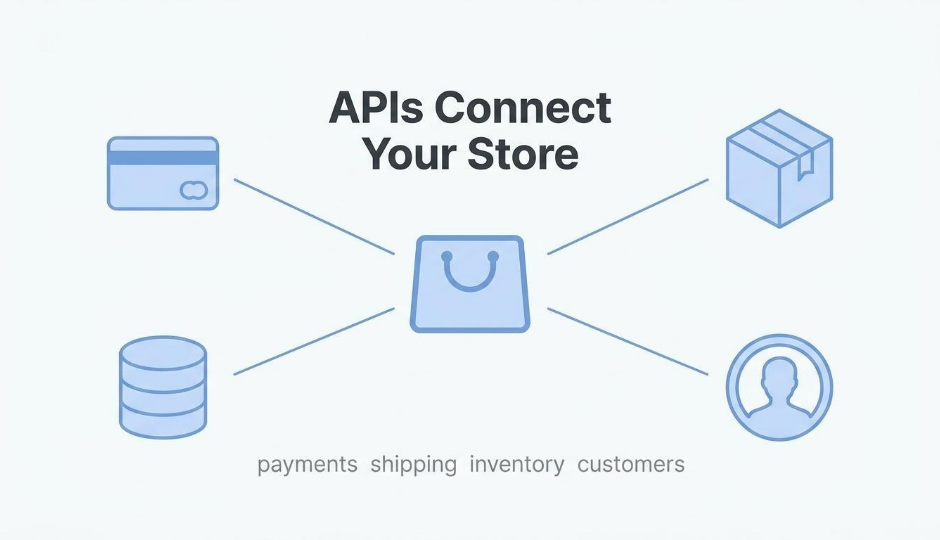
An ecommerce API connects separate software systems so they can exchange store data automatically. It handles requests between a storefront, payment processor, inventory database, shipping provider, or any other service involved in running an online store. When a customer adds an item to a cart, places an order, or triggers a shipping label, APIs carry those instructions between systems in real time.
Reliability is central to what makes these connections useful. As OpenTelemetry's observability framework explains, reliability answers the question: "Is the service doing what users expect it to be doing?" A system could have 100% uptime, yet still be unreliable if clicking "Add to Cart" for black shoes occasionally adds the wrong item. For scaling brands managing multiple integrations, even small inconsistencies compound into fulfillment errors, inventory mismatches, and eroded customer trust.
Beyond simple data transfer, ecommerce APIs standardize how systems communicate. They define which data fields are accepted, what authentication is required, and how errors are reported back. This standardization is what allows a single storefront to coordinate with dozens of services simultaneously, from tax calculation to personalized marketing, without requiring custom code for every connection.
The main types of ecommerce APIs span every operational layer of an online business, from storefront display to recurring billing. The sections below cover storefront, product catalog, cart and checkout, order management, payment gateway, shipping, customer and CRM, inventory, marketing, analytics, POS, and subscription APIs.
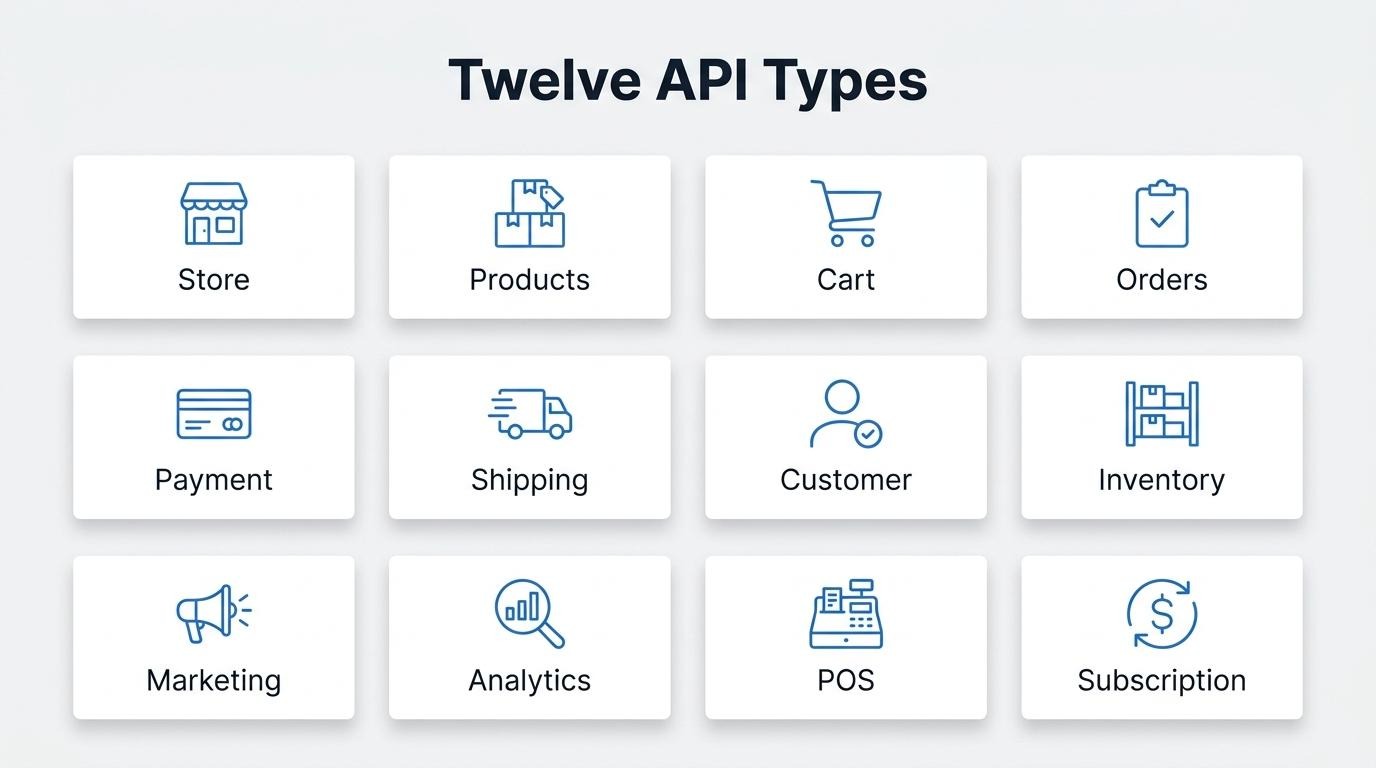
Storefront APIs control how product pages, collections, and navigation render on customer-facing channels. These APIs deliver layout data, theme assets, and localized content to web browsers, mobile apps, or headless frontends. In headless commerce setups, storefront APIs decouple the presentation layer from the backend, letting teams build custom buyer experiences without modifying core platform logic. They typically expose endpoints for page metadata, menus, search suggestions, and content blocks. For scaling brands running multiple storefronts across regions, a well-structured storefront API reduces the engineering overhead of maintaining separate codebases.
Product catalog APIs manage the creation, retrieval, updating, and deletion of product data, including titles, descriptions, images, variants, pricing, and taxonomy. These APIs enforce structured data standards that keep catalog information consistent across channels. According to GS1, the GS1 system includes technical standards for identification, automatic identification and data capture (barcodes and RFID tags), master data standards such as product catalogues, and information exchange standards like Electronic Data Interchange. Catalog APIs that align with these standards simplify syndication to marketplaces, comparison engines, and wholesale portals without manual reformatting.
Cart and checkout APIs handle the session-level logic of adding items, applying discounts, calculating totals, and processing the final purchase. The W3C Payment Request API specification standardizes a browser-level interface that allows merchants to accept one or more payment methods with minimal integration, reducing the steps needed to complete an online payment. Cart APIs expose endpoints for line-item management, coupon validation, and shipping method selection, while checkout APIs finalize the transaction by passing payment tokens to processors and confirming order creation.
Order management APIs track orders from placement through fulfillment, handling status updates, cancellations, returns, refunds, and exchanges. These APIs connect storefront transactions to warehouse systems, customer service tools, and accounting software. Structured interchange standards like UN/EDIFACT provide internationally agreed guidelines for electronic data exchange between independent systems, and order management APIs often translate between proprietary platform formats and these standardized schemas. Reliable order APIs are essential for brands processing high volumes across multiple channels.
Payment gateway APIs transmit encrypted transaction data between the merchant's checkout and the acquiring bank or payment processor. They handle authorization, capture, void, and refund operations. All payment gateway APIs must comply with PCI Security Standards, which protect payment data throughout the payment lifecycle. Common gateway integrations support credit cards, digital wallets, buy-now-pay-later providers, and regional payment methods. Gateway APIs abstract processor complexity so merchants can offer multiple payment options without building separate integrations for each.
Shipping and fulfillment APIs connect stores to carrier networks, warehouse management systems, and third-party logistics providers. Key functions include:
These APIs reduce manual handoffs between order confirmation and delivery, which becomes critical once a brand ships across multiple carriers or fulfillment centers.
Customer and CRM APIs manage buyer profiles, purchase histories, segmentation tags, and communication preferences. They expose endpoints for creating, updating, merging, and querying customer records. For brands operating across online, offline, and social channels, CRM APIs serve as the integration point where purchase data, support interactions, and engagement signals converge. Without a centralized customer API, teams often reconcile fragmented records manually, which slows targeted marketing and lifecycle automation.
Inventory management APIs track stock quantities, location assignments, reorder thresholds, and allocation rules across warehouses and sales channels. Core operations include:
Accurate inventory APIs prevent overselling, reduce stockouts, and give operations teams a single source of truth for availability.
Marketing and promotion APIs programmatically create, schedule, and manage discount codes, automatic promotions, loyalty rewards, and campaign-specific pricing rules. They enable external marketing platforms to push segmented offers directly into the storefront without manual configuration. Common endpoints handle coupon generation, minimum-spend thresholds, buy-one-get-one logic, and time-bound flash sales. For brands running lifecycle marketing at scale, these APIs eliminate the bottleneck of manually setting up promotions across tools.
Analytics and reporting APIs extract sales, traffic, conversion, and customer behavior data from the ecommerce platform into external dashboards, data warehouses, or business intelligence tools. They typically expose endpoints for querying revenue by period, product performance, funnel metrics, and cohort analysis. Rather than relying on platform-native reports alone, brands use analytics APIs to join ecommerce data with advertising spend, support tickets, and logistics costs for a unified performance view.
POS APIs bridge physical retail transactions with the ecommerce backend, syncing in-store sales, inventory adjustments, and customer records to the same system that manages online orders. Key capabilities include:
For omnichannel brands, POS APIs are what prevent the common problem of online and offline data living in separate silos.
Subscription and recurring billing APIs automate the creation, modification, and cancellation of recurring payment schedules for subscription boxes, replenishment programs, and membership plans. They manage billing cycles, retry logic for failed payments, plan upgrades or downgrades, and prorated charges. Brands that bolt on third-party subscription tools often face data fragmentation between the subscription processor and the core commerce platform. Native subscription APIs that live within the ecommerce system itself keep recurring revenue data, customer profiles, and order histories unified.
With these API types mapped, the next step is understanding how REST and GraphQL architectures shape the way these endpoints communicate.
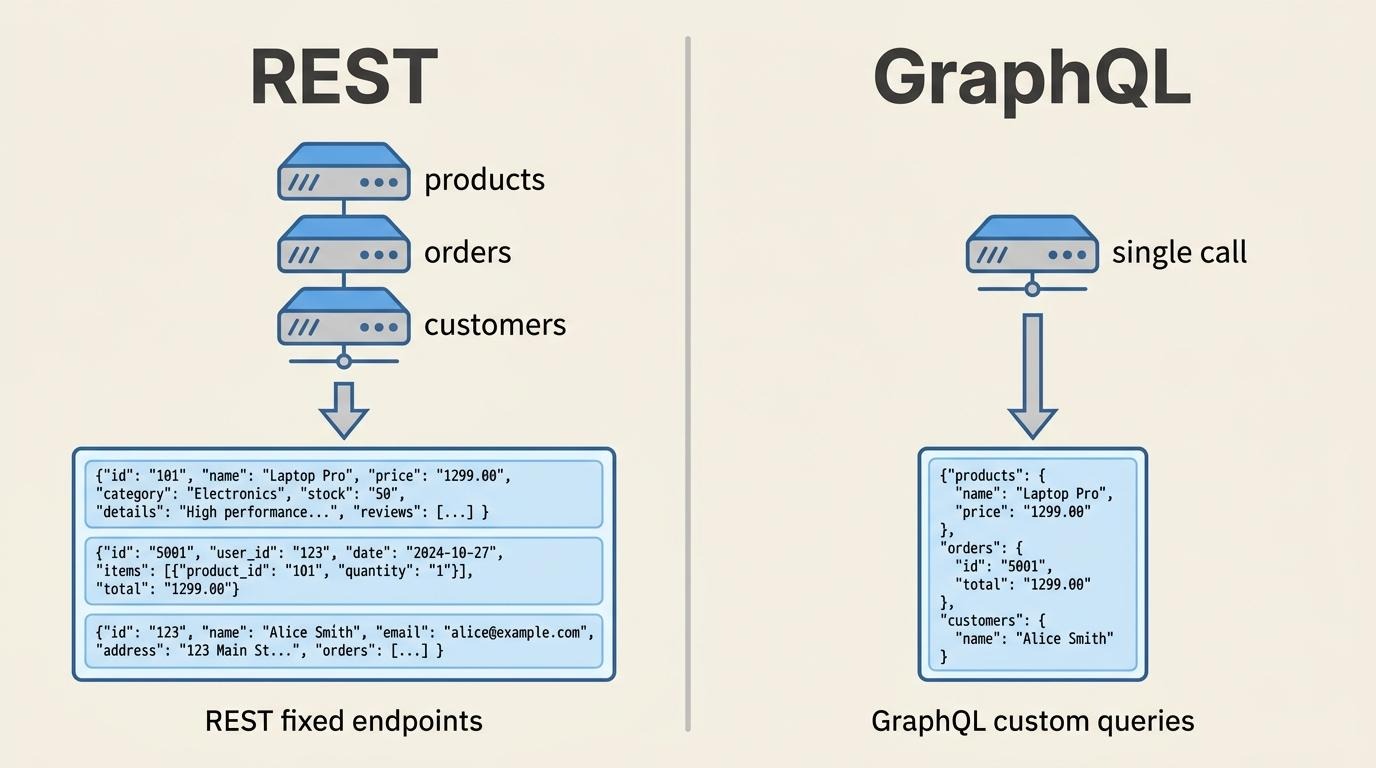
REST compares to GraphQL for ecommerce APIs through differences in data fetching, response structure, and scalability under load. REST uses fixed endpoints that return predefined data sets, while GraphQL lets clients request exactly the fields they need.
REST APIs expose individual resource URLs, such as /products/123 or /orders/456. Each endpoint returns a complete, server-defined payload. This simplicity makes REST easy to cache and broadly supported across ecommerce platforms, but it often leads to over-fetching, where the response includes fields the client does not need, or under-fetching, where multiple requests are required to assemble a single view.
GraphQL, originally created at Facebook in 2012 according to the GraphQL Foundation specification, uses a single endpoint where the client defines the exact shape of the response. A storefront can request a product's name, price, and first image in one call instead of pulling the full product object. This precision reduces bandwidth and round trips, particularly for mobile storefronts or complex product pages that pull from multiple data types.
Performance differences depend on workload. A University of Washington study found that Apollo Server GraphQL implementations demonstrated 25-67% faster average round-trip times versus REST for most operations, but showed worse scalability than REST with very high concurrent workloads. For catalog browsing and personalized storefronts, GraphQL often wins on speed; for high-traffic flash sales hammering a few endpoints, REST's caching advantages and simpler server-side handling can prove more resilient.
Choosing between them is rarely binary in practice. Many scaling ecommerce operations use both: REST for straightforward, high-volume reads like inventory sync, and GraphQL for flexible, client-driven queries on storefronts. The right choice depends on traffic patterns, team expertise, and how many downstream services each storefront call touches.
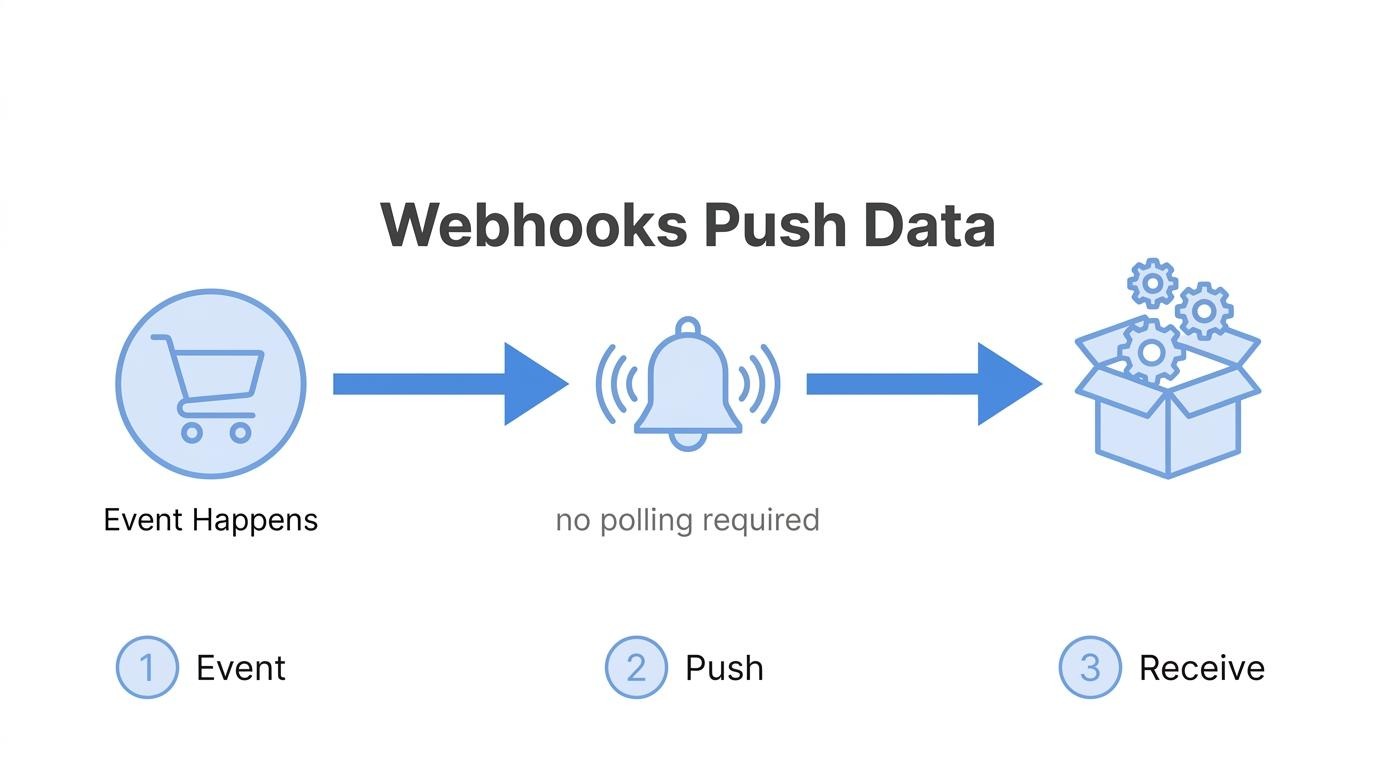
Webhooks are automated HTTP callbacks that push real-time event notifications from one system to another without requiring continuous polling. In ecommerce, webhooks notify external applications the moment a specific event occurs, such as a new order, an inventory change, or a customer update.
Unlike standard API calls where the client repeatedly asks "has anything changed?", a webhook reverses the direction. The ecommerce platform sends an HTTP POST request to a pre-registered URL whenever a subscribed event fires. This event-driven model eliminates wasted requests and delivers data within seconds of the triggering action.
Common ecommerce webhook events include:
The technical flow is straightforward. A merchant registers an endpoint URL with the ecommerce platform and specifies which events to subscribe to. When that event occurs, the platform constructs a JSON payload containing the event data and sends it to the endpoint. The receiving server processes the payload and returns a 200-status response to confirm receipt.
Reliability requires specific safeguards. If the receiving server is down or returns an error, most webhook systems implement retry logic with exponential backoff. According to the Cloud Native Computing Foundation, CloudEvents is a specification for describing event data in common formats to provide interoperability between services, platforms, and systems. Adopting standardized event formats like CloudEvents reduces the custom parsing each integration requires.
Webhooks complement REST and GraphQL rather than replacing them. REST and GraphQL handle on-demand data retrieval; webhooks handle real-time event notification. Together, they form a complete communication layer where polling-based reads and push-based updates each serve their optimal purpose. For scaling brands managing multiple sales channels, POS connections, and marketing tools, webhooks are what keep systems synchronized without manual intervention or batch-processing delays.
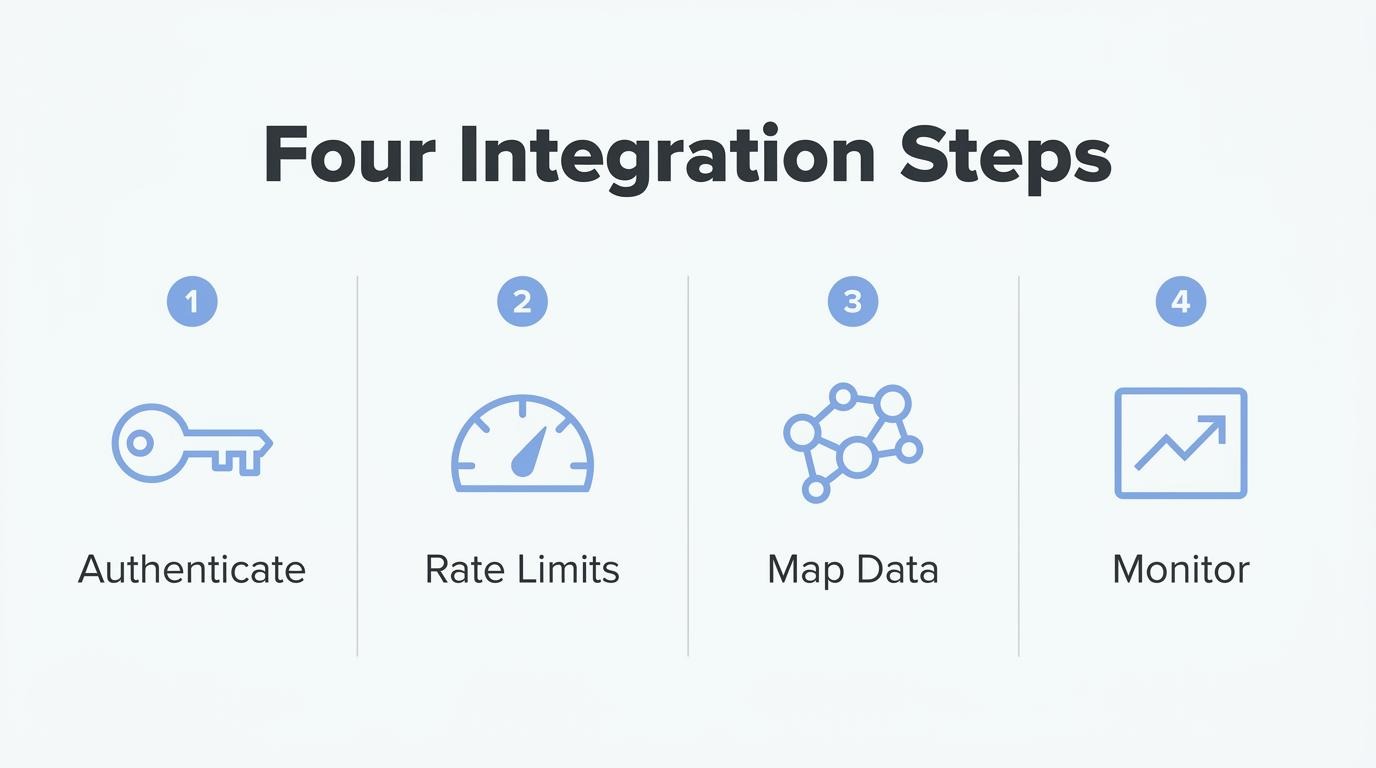
You integrate ecommerce APIs into an existing stack by authenticating requests, respecting rate limits, mapping data fields between platforms, and monitoring connections in production. The following sections cover each step.
You authenticate and authorize API requests by verifying both the calling application and the end user through layered credential mechanisms. According to a NIST Special Publication (NIST SP 800-228), there are at minimum two identities in every API communication: the software calling the API and the end user of that software, commonly handled with an API key for the application and an OAuth Bearer token for the end user.
OAuth 2.0 is the standard authorization framework for ecommerce integrations. It grants third-party applications limited access to an HTTP service without exposing user credentials directly. Practical implementation involves:
For most scaling brands, getting authentication right from the start prevents costly security rework later.
You handle rate limits and throttling by designing your integration to respect the API provider's request quotas and degrade gracefully when limits are reached. Most ecommerce APIs enforce per-second or per-minute call caps to protect system stability.
Key strategies include:
Throttling is not a bug; it is a design constraint. Integrations that treat rate limits as architectural inputs, rather than obstacles, tend to stay far more reliable at scale.
You map data between platforms during integration by aligning field names, formats, and identifiers across systems that often use different schemas. Without standardized mapping, order records, product attributes, and customer profiles fragment between your storefront, ERP, and fulfillment tools.
Established standards reduce this complexity. UN/EDIFACT, maintained by the United Nations Economic Commission for Europe, provides internationally agreed guidelines for the electronic interchange of structured data between independent systems. For event-driven architectures, the CloudEvents specification from the Cloud Native Computing Foundation standardizes event data formats to ensure interoperability across services and platforms.
Practical mapping steps include:
Skipping the canonical model step is one of the most common integration mistakes; it forces teams into brittle point-to-point field translations that break whenever either system updates its schema.
You test and monitor API connections in production by validating integration behavior in staging environments first, then tracking live performance through structured observability signals. Sandbox or staging modes, offered by most ecommerce API providers, let teams simulate order flows, payment callbacks, and inventory syncs without affecting real data.
Once live, monitoring should focus on four core metrics. According to Google's Site Reliability Engineering handbook, the four golden signals of monitoring are latency, traffic, errors, and saturation; if you can only measure four metrics of a user-facing system, these are the ones to prioritize.
Effective production monitoring includes:
With monitoring foundations in place, teams can confidently evaluate how their API architecture performs across real-world use cases.
The most common ecommerce API use cases include inventory synchronization, headless commerce, POS integration, order routing, marketing personalization, subscription management, and customer data unification. Each use case connects distinct systems to streamline operations.
APIs sync inventory across multiple sales channels by pushing stock-level updates between a central inventory system and each connected marketplace, storefront, or warehouse in near real time. When a sale occurs on one channel, the inventory API sends an updated quantity to all other channels, preventing overselling and stock discrepancies.
This synchronization typically follows a hub-and-spoke model:
For brands selling across their own storefront, Amazon, and retail partners simultaneously, API-driven inventory sync eliminates the manual reconciliation that breaks down at scale.
APIs enable headless commerce experiences by decoupling the front-end presentation layer from the back-end commerce engine. The storefront, mobile app, or any custom interface calls commerce APIs to retrieve product data, manage carts, and process orders without being locked to a monolithic template system.
This architecture gives development teams control over the customer experience while the API handles core commerce logic:
Headless commerce is particularly valuable for brands that need unique, performance-optimized storefronts across web, mobile, and emerging channels like smart displays or conversational interfaces.
APIs connect online stores with POS systems by synchronizing product catalogs, inventory counts, customer profiles, and transaction records between the digital storefront and physical retail terminals. This bidirectional data flow ensures that a purchase made in-store reflects online and vice versa.
According to MDN Web Docs, the Payment Request API reduces the steps needed to complete payment online, potentially eliminating checkout forms entirely. That same principle of streamlined transactions extends to POS integration, where APIs unify the payment and order data layer across channels.
Key data points that POS APIs typically synchronize include:
APIs automate order routing and fulfillment by evaluating order attributes, such as item location, shipping destination, and delivery speed, then directing each order to the optimal fulfillment center or logistics partner without manual intervention.
The routing logic typically follows a decision tree:
Automated order routing reduces shipping costs and delivery times simultaneously. For brands operating multiple warehouses or using third-party logistics providers, API-driven fulfillment removes the operational bottleneck of manually assigning orders.
APIs personalize marketing with customer data by feeding purchase history, browsing behavior, and segmentation attributes from commerce and CRM systems into marketing automation platforms. This data flow enables targeted campaigns based on actual customer actions rather than broad demographic assumptions.
Reliable data exchange between systems is the foundation of effective personalization. As the OpenTelemetry observability framework notes, reliability means the service consistently does what users expect; if a customer's purchase data fails to sync accurately, the personalization built on that data breaks down.
Common personalization workflows powered by APIs include:
APIs power subscription and reorder flows by managing recurring billing cycles, automated reorder scheduling, and subscription lifecycle events such as pauses, skips, and cancellations. A subscription API handles the logic of when to charge, what to ship, and how to adjust based on customer preferences.
Core subscription API functions include:
For brands where subscriptions are stitched together through third-party apps, each additional integration point adds latency and failure risk. Native subscription APIs that operate within the same commerce system reduce that complexity significantly.
APIs unify customer records across touchpoints by resolving identity data from online purchases, in-store transactions, email interactions, and social channels into a shared customer profile. Each system writes to and reads from a common data layer through API calls, maintaining a consistent view of the customer.
This unification requires several coordinated API interactions:
Unified records are only as accurate as the data architecture supporting them; without a structured approach to identity resolution and data governance, API connections alone cannot guarantee a clean single customer view.
With common use cases mapped, evaluating API documentation quality helps teams assess whether a platform's APIs can actually deliver on these workflows.
You should look for clear authentication guides, consistent endpoint references, versioning policies, error response standards, and rate limit disclosures. These elements determine how quickly developers can integrate, debug, and maintain connections between systems.
Strong ecommerce API documentation includes:
For scaling brands evaluating platforms, incomplete documentation is often a leading indicator of integration friction downstream. The best documentation reads like a contract: it tells you exactly what the API promises, what it expects in return, and what happens when something breaks.
API architectures differ between platforms in how they expose commerce data, handle extensibility, and manage the boundary between built-in features and third-party integrations. Key differences span API style, data model scope, and the degree of consolidation each platform offers.
Platforms built on a modular, app-dependent model typically expose narrow, resource-specific REST endpoints. Each installed app introduces its own API layer, authentication flow, and data silo. Inventory might sync through one app's API while subscription data lives behind another, requiring middleware or custom orchestration to unify records. This architecture works at lower complexity but creates compounding integration overhead as brands scale.
Monolithic or legacy platforms often provide broad API surface area but with rigid data models. Customization requires deep development effort, and versioning cycles can lag behind merchant needs. Migrating away means untangling tightly coupled schemas, a concern the Journal of Cloud Computing identifies as a major barrier to adoption due to lack of standardization.
All-in-one platforms take a different approach. Commerce, CRM, marketing automation, subscriptions, and POS share a single data layer, so API calls resolve against one customer record rather than reconciling across disconnected tools. Fewer integration points means fewer failure surfaces and less middleware to maintain.
When evaluating platform API architectures, the practical differences come down to:
For brands operating at $1M+ in revenue with real operational complexity, architecture choice matters more than any single API feature. A platform where five separate apps each expose their own API creates five potential breaking points on every release cycle. The most resilient API architectures are those where fewer moving parts serve the same breadth of functionality.
Understanding these architectural trade-offs helps teams anticipate where security vulnerabilities may emerge as integrations multiply.
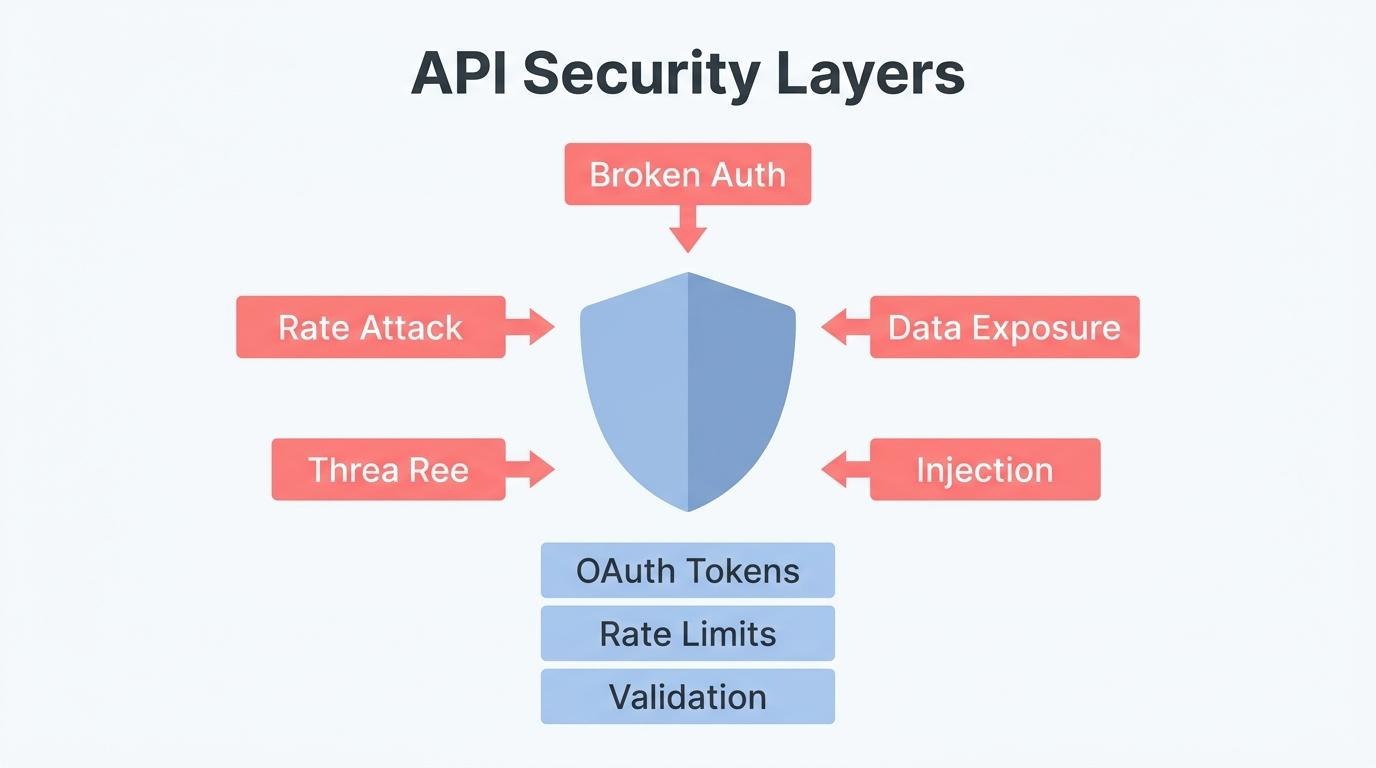
The security risks that apply to ecommerce APIs include broken authentication, excessive data exposure, injection attacks, and insufficient rate limiting. Each risk targets a different layer of the API communication chain, from identity verification to data transit.
Every API call involves at least two identities: the calling software and the end user. According to a 2024 NIST special publication on API security, there are at minimum two identities in every API communication, commonly verified through an API key for the software and an OAuth Bearer token for the end user. When either identity layer is misconfigured, attackers can impersonate legitimate clients, escalate privileges, or exfiltrate customer records. Broken authentication remains the most exploited vector because it grants access to everything downstream.
Payment-related endpoints face additional exposure. PCI Security Standards, maintained by the PCI Security Standards Council, exist specifically to protect payment data throughout the payment lifecycle. APIs that process, transmit, or store cardholder data must comply with these standards; non-compliance exposes both the merchant and customers to fraud liability.
Other common risks include:
For scaling brands managing multiple integrations, each additional third-party connection widens the attack surface. Consolidating API endpoints under fewer, well-audited systems reduces the number of authentication boundaries that need monitoring.
Understanding these risks is one side of the equation; the other is how API architecture affects the speed and reliability of the storefront itself.
Ecommerce APIs affect site performance and speed by introducing external network calls that add latency, consume server resources, and influence page load times. The subsections below cover latency sources, caching strategies, and monitoring approaches.
API latency influences page load times by adding round-trip delays between the storefront and each external service. Every API call requires DNS resolution, TLS handshake, request processing, and data transfer. When a single product page triggers calls to inventory, pricing, and personalization endpoints sequentially, those delays compound.
Parallel request execution and asynchronous loading reduce the cumulative impact. Rendering critical content first while deferring non-essential API responses keeps perceived load times low. For scaling brands managing dozens of integrated tools, each additional service endpoint contributes measurable overhead that compounds across the buyer journey.
API caching plays a central role in ecommerce speed by storing frequently requested responses closer to the user, which eliminates redundant network calls. Product catalog data, tax calculations, and shipping rate lookups are strong caching candidates because they change infrequently relative to request volume.
Common caching layers include:
Cache invalidation strategy matters as much as caching itself; stale inventory counts or outdated pricing erode trust faster than a slightly slower page load.
You monitor API performance in production by tracking latency, traffic volume, error rates, and resource saturation continuously. According to Google's Site Reliability Engineering handbook, these four golden signals of monitoring are the essential metrics for any user-facing system.
Effective monitoring practices include:
Observability tools that correlate API call traces with frontend performance metrics reveal which integrations degrade the user experience most. With performance baselines established, optimizing specific API integrations becomes a data-driven process.
Brands outgrow an app-stack API approach when integration complexity, data fragmentation, and compounding subscription costs begin to slow operations instead of supporting them. The sections below cover how a unified platform handles these needs and the key takeaways from this article.
SHOPLINE handles ecommerce API needs by building commerce, CRM, marketing automation, subscriptions, and POS into a single system with a shared customer data layer. Instead of connecting separate tools through third-party API integrations, each function operates natively within the same platform.
This architecture eliminates common sync failures between disconnected apps. Order data, inventory levels, and customer records resolve to one unified source rather than being reconciled across multiple endpoints. For scaling brands managing five or more tools, the operational cost of maintaining those integrations often exceeds the cost of the tools themselves. According to a study published in the Journal of Cloud Computing, vendor lock-in caused by lack of standardization is a major barrier to cloud computing adoption, a concern that applies equally to brands locked into fragmented app stacks.
SHOPLINE is one option for brands consolidating away from a multi-tool setup. Results may vary depending on implementation, industry, and scale.
The key takeaways about ecommerce APIs covered in this article are:
Choosing the right API strategy depends on current scale and where the business is heading. For brands already managing significant volume, prioritizing data unification over tool count tends to produce more sustainable growth.