A B2B ecommerce site becomes successful when it combines frictionless buyer experiences with the operational depth that complex business transactions demand. The factors below cover buyer expectations, essential platform capabilities, and how B2B differs from consumer-facing commerce.
B2B buyers now expect the same convenience they encounter in consumer shopping, yet they require tools built for negotiated pricing, bulk logistics, and multi-stakeholder approvals. According to MIT Sloan Management Review, corporate buyers accustomed to easy, quick, and customized online transactions from consumer-facing sites now demand the same or better customer experience in digital business transactions. That expectation gap defines the baseline: any site that forces buyers into phone calls or PDF catalogs for routine tasks loses ground to competitors offering self-service ordering, real-time inventory visibility, and account-specific pricing.
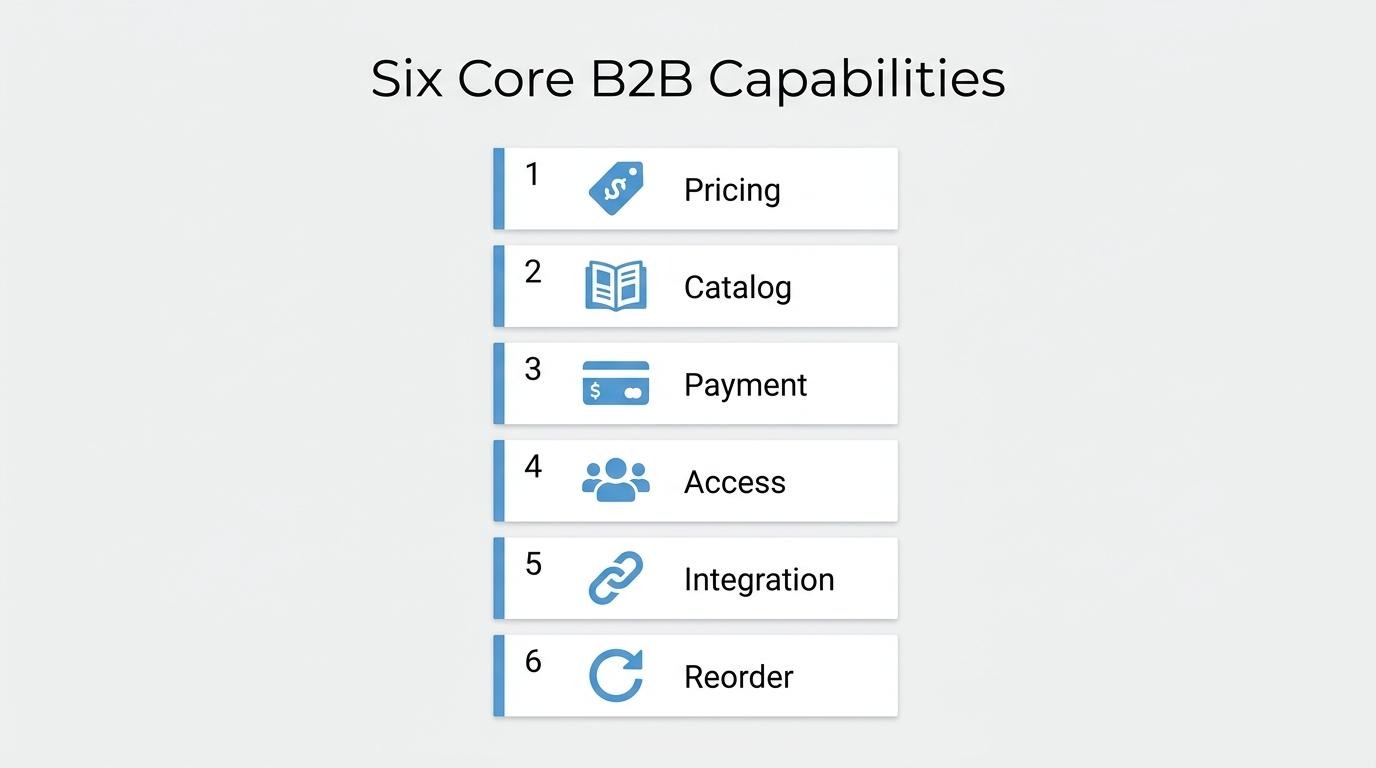
Several core capabilities separate high-performing B2B ecommerce platforms from underperforming ones:
A 2024 study published in PLOS One found that supplier service capability, logistics capability, and production capacity all positively impacted B2B performance through the mediating role of customer attention. In practice, this means a polished storefront alone is not enough; fulfillment reliability and responsive service are equally critical to conversion and retention.
The structural differences between B2B and B2C commerce also shape what "successful" looks like. As Carnegie Mellon University's eCommerce Institute notes, B2B involves more participants and more complex processes than B2C, creating a longer, more intricate value chain. Where a consumer checkout might involve a single buyer and a credit card, a B2B transaction can require contract validation, approval chains, split shipments, and invoicing against purchase orders. Successful B2B sites internalize this complexity so the buyer's experience feels simple even when the underlying workflow is not.
Security is another non-negotiable. The U.S. Small Business Administration reports that 50 percent of SMBs have been victims of a cyberattack, and over 60 percent of those attacked go out of business. For B2B platforms handling sensitive pricing, customer lists, and payment credentials, implementing standards like multi-factor authentication and encrypted data transfer is foundational, not optional.
One pattern worth noting across the strongest B2B ecommerce operations is the move toward unified data. When commerce, CRM, and marketing data sit in separate systems, teams waste cycles reconciling records and buyers receive inconsistent experiences across channels. Platforms that centralize this data layer give operators a single view of each account's purchase history, support interactions, and engagement patterns, which directly improves personalization and retention efforts.
Ultimately, B2B ecommerce success is not about replicating a B2C storefront. It requires purpose-built infrastructure for complex pricing, multi-role accounts, large catalogs, and flexible fulfillment, all wrapped in an experience that feels as intuitive as the consumer sites buyers use in their personal lives.
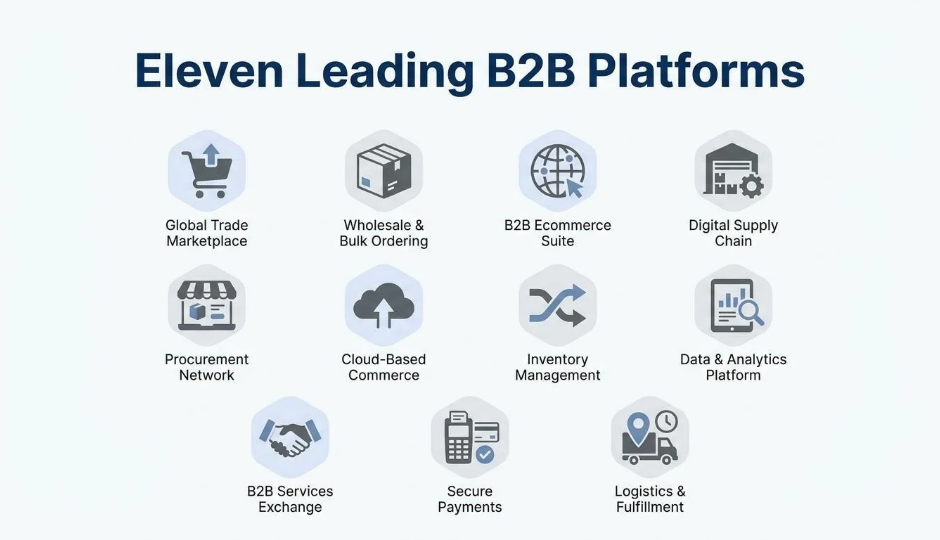
The B2B ecommerce examples that stand out are Alibaba, Amazon Business, Grainger, Faire, ThomasNet, Quill, Berlin Packaging, Uline, Ferguson, Zoro, and MSC Industrial Direct. Each demonstrates a distinct approach to digital wholesale, procurement, or industrial distribution.
Alibaba is a global B2B ecommerce platform that connects buyers and sellers across countries on a single marketplace. The platform facilitates wholesale distribution of a wide range of goods, from raw materials to finished products. Its early strategy leveraged deep insight into the unmet needs of Chinese SMEs, superior technical capabilities, and intimate knowledge of local business practices. That combination created a value proposition competitors struggled to replicate. For any B2B seller entering cross-border trade, Alibaba's model shows why understanding regional buyer behavior matters as much as catalog size.
Amazon Business is Amazon's dedicated B2B procurement marketplace. According to the U.S. General Services Administration, Amazon Business provides access to mandatory sources of supply, federally certified sellers, and robust reporting and analytics. Business buyers get multi-user accounts, approval workflows, and tax-exempt purchasing. The platform applies consumer-grade convenience to institutional procurement, which sets the bar other B2B sellers now compete against.
Grainger is a leading industrial supply distributor operating one of the most refined B2B ecommerce experiences in the MRO category. Customers can search for products by brand name, product category, or use case. According to Harvard Business School's Digital Initiative, customers fill their carts, proceed to purchase, and have materials shipped within two business days. That speed and search flexibility make Grainger a benchmark for how catalog-heavy B2B sites should handle product discovery.
Faire is an online wholesale marketplace that supplies products to small businesses and provides virtual storefronts for brands. According to Stanford Graduate School of Business, Faire's leadership brings deep financial and operational expertise to the platform's growth. The marketplace lowers risk for independent retailers through net-60 payment terms and free returns, a model that removes traditional wholesale friction. For B2B brands targeting small retailers, Faire demonstrates how reducing buyer risk accelerates marketplace adoption.
ThomasNet is a sourcing platform that connects buyers with American manufacturers and industrial suppliers. According to the U.S. Small Business Administration, ThomasNet helps small and medium businesses find and compare over 500,000 trusted American suppliers by location, company size, and other criteria. The Library of Congress identifies it as a basic source for identification of U.S. manufacturers, organized into 50,000 product classes. For any B2B brand in manufacturing, ThomasNet proves that deep, structured supplier data creates lasting platform value.
Quill is a B2B office products provider serving over one million small to medium-sized businesses. Founded in 1956 and headquartered in Lincolnshire, Illinois, Quill.com offers 24-hour access to more than 100,000 business essentials, from paper and ink to cleaning supplies and technology. The platform succeeds by combining broad product selection with a purchasing experience tailored specifically to SMB procurement needs, not enterprise complexity.
Berlin Packaging is a packaging distribution network headquartered in Chicago, Illinois. The company pairs container distribution with design and consulting services, positioning itself as a hybrid supplier rather than a pure distributor. This bundled approach shows how B2B sellers in niche verticals can differentiate by adding advisory services alongside product fulfillment, turning a commodity category into a value-added relationship.
Uline is a family-owned distributor of shipping, industrial, and packaging materials to businesses throughout North America. Founded in 1980, Uline built its reputation on same-day shipping from strategically located warehouses and a massive product catalog. The company publishes a thick printed catalog alongside its digital storefront, serving buyers who still prefer offline browsing before purchasing online. For B2B operators, Uline shows that fulfillment speed and multi-format catalog access remain powerful retention tools.
Ferguson is a Newport News, Virginia-based distributor of plumbing and building supplies. The company serves contractors, builders, and facility managers through branch locations and a robust ecommerce platform. Ferguson's digital experience lets professional buyers check local inventory, schedule deliveries, and manage project-based purchasing online. That blend of local availability with digital convenience is a model for B2B distributors with physical branch networks.
Zoro is an online MRO distributor primarily serving U.S. customers through Zoro.com. According to W.W. Grainger's 2019 Form 10-K filed with the U.S. Securities and Exchange Commission, Zoro recorded sales exceeding $625 million in 2019 and offered a broad selection of more than 3.5 million products. Zoro strips away the sales-rep model entirely, relying on competitive pricing and a self-service interface. This proves that a fully digital, no-rep B2B model can scale when the catalog is broad enough and the pricing is transparent.
MSC Industrial Direct is a national distributor of metalworking and maintenance, repair, and operations products. The company serves manufacturers, government agencies, and commercial operations through its ecommerce platform and dedicated sales teams. MSC differentiates through deep technical expertise, offering application engineering support alongside product fulfillment. For B2B brands selling complex or technical SKUs, MSC demonstrates that expert support layered into the buying journey increases average order value and customer retention.
Understanding what sets these platforms apart is useful, but the real advantage comes from identifying the shared features that drive their success.
Top B2B ecommerce sites share features that address complex pricing, high-volume ordering, personalized buying, and flexible support models. The sections below break down how leading platforms handle quotes, bulk reordering, buyer personalization, and the balance between self-service and sales assistance.
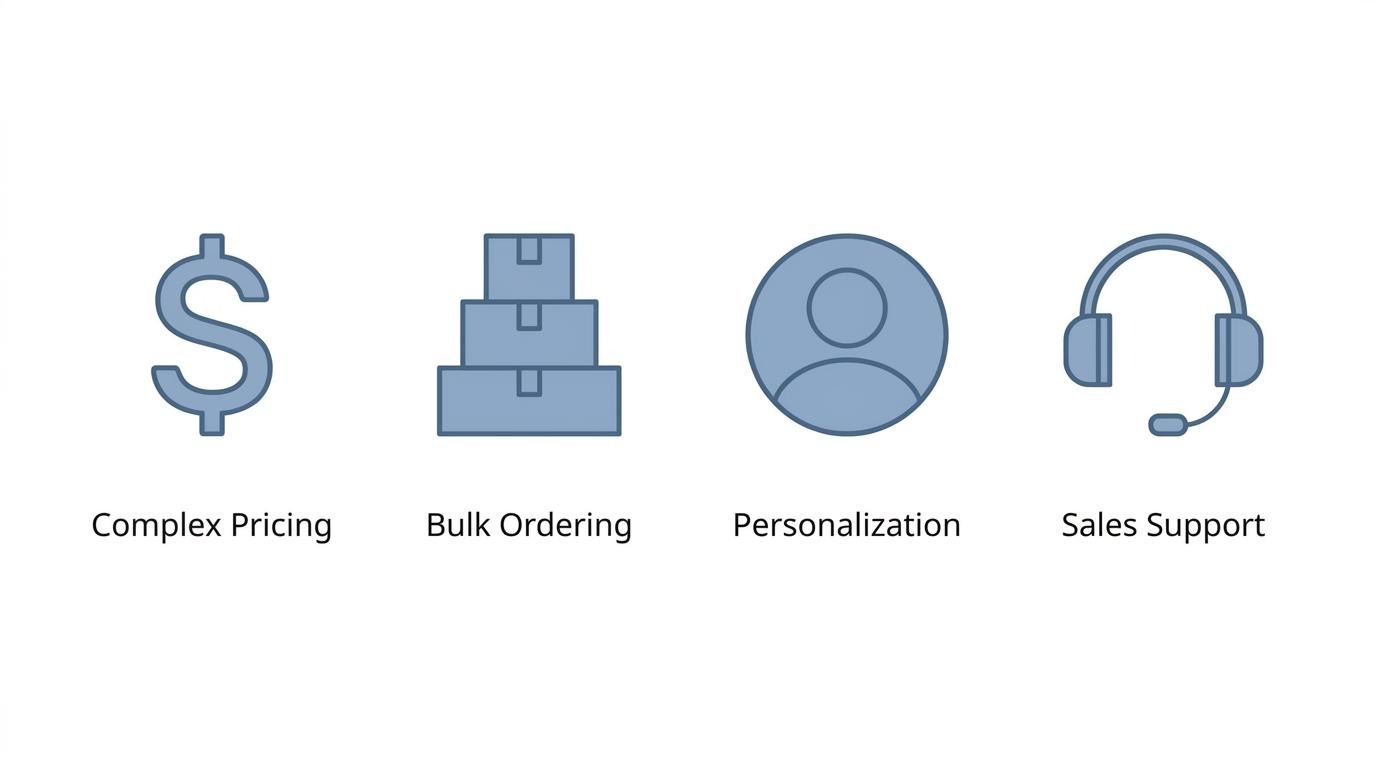
These sites handle complex pricing and quotes through customer-specific price lists, tiered volume discounts, and integrated request-for-quote (RFQ) workflows built directly into the storefront. Logged-in buyers see negotiated contract pricing rather than a single public price, which reflects the reality that B2B transactions involve variable terms per account.
Top platforms automate this by tying pricing rules to account segments:
For brands managing hundreds of price agreements, keeping this logic inside one system rather than scattered across spreadsheets and email threads eliminates the errors that erode margins.
They streamline bulk ordering and reordering by offering quick-order forms, saved order templates, and one-click reorder functionality from purchase history. B2B buyers frequently purchase the same SKUs on recurring schedules, so removing friction from repeat transactions directly increases order frequency.
Key mechanisms include:
These features compress what would otherwise be a 15-minute manual process into seconds. The most effective B2B sites treat reordering as the default experience, not an afterthought bolted onto a consumer-style cart.
They personalize the buyer experience by using account-level data to tailor catalogs, pricing, promotions, and content to each customer segment. According to MIT Sloan Management Review, corporate buyers accustomed to easy, quick, and customized consumer transactions now demand the same or better customer experience in digital business transactions.
Personalization in B2B goes beyond product recommendations:
This level of personalization is where fragmented tool stacks often break down; when purchase history, browsing behavior, and account data live in separate systems, delivering a cohesive experience becomes operationally expensive.
They integrate self-service with sales support by layering digital tools over human touchpoints, giving buyers autonomy for routine tasks while preserving access to specialists for complex needs. According to W.W. Grainger's 2019 10-K filing, Zoro generated over $625 million in sales by offering more than 3.5 million products through a primarily self-service website, demonstrating how far digital-first models can scale.
Effective integration typically includes:
Sites must also ensure these digital experiences remain accessible. The U.S. Department of Justice requires that goods and services provided online are accessible to people with disabilities, making ADA compliance a baseline requirement rather than an optional enhancement.
Understanding these shared features clarifies what separates adequate B2B sites from high-performing ones; the next consideration is how platforms manage large catalogs and product data at scale.
Catalog and product management determines how easily B2B buyers find what they need across massive inventories. The sections below cover navigation structure and search filtering strategies used by large-catalog sites.
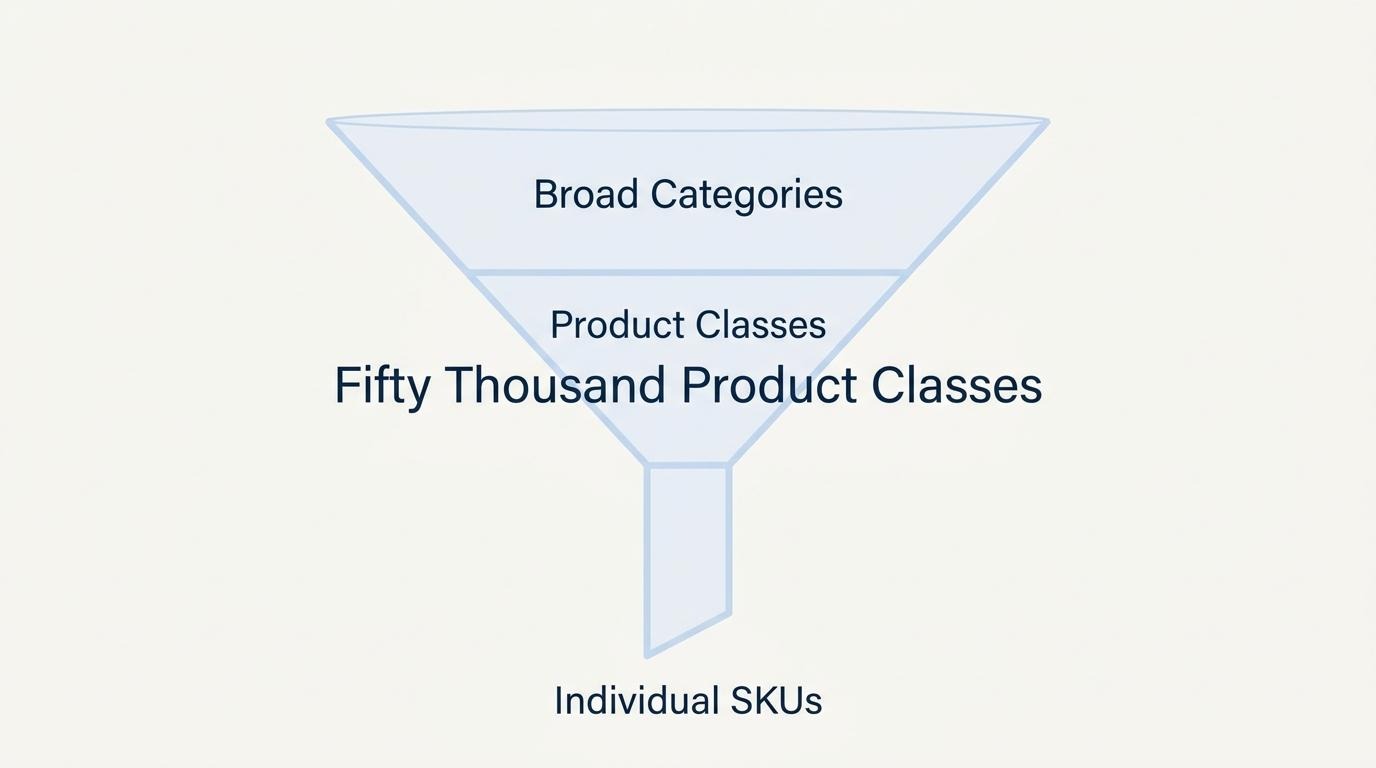
Large-catalog B2B sites organize navigation using layered category hierarchies that mirror how professional buyers think about products. Sites like ThomasNet and Grainger structure catalogs by product class, industry vertical, and application type, giving buyers multiple entry points into the same inventory.
Effective approaches include:
According to the University of Wisconsin–Madison Libraries, ThomasNet serves as the primary source of product information for roughly 157,000 North American manufacturing companies, with 135,000 trade names organized into 50,000 product classes. That scale of taxonomy only works when navigation logic matches real purchasing workflows rather than internal warehouse structures.
B2B sites use search and filtering for thousands of SKUs by combining predictive search, faceted filters, and catalog segmentation to surface relevant results quickly. Buyers searching across tens of thousands of products need precision that basic keyword matching cannot deliver.
Key filtering mechanisms include:
A Wayne State University dissertation on scalable recommendation systems found that relying on product catalog hierarchy and segments, rather than individual SKUs, improves collaborative filtering for large catalogs with transaction sparsity typical in online retailing. This segment-based approach prevents the system from breaking down when most SKU-level purchase combinations have zero overlap between buyers.
For operators managing catalogs at this scale, investing in structured product data pays off more than adding features on top of poorly organized inventories. Understanding how B2B checkout processes support these large orders is equally important.
Checkout and payment strategies drive B2B conversions by offering flexible terms, multiple payment methods, and account-based workflows tailored to business buyers. The sections below cover net terms, payment flexibility, and how account-based checkout differs from DTC.
Net terms and flexible payment options reduce friction by aligning checkout with how businesses actually manage cash flow. Unlike consumer transactions that settle instantly, B2B purchases often require invoicing cycles of 30, 60, or 90 days. Offering net terms at checkout removes a common abandonment trigger: the inability to pay immediately with a corporate credit line or purchase order.
The payment landscape itself has expanded significantly. According to a 2022 Consumer Financial Protection Bureau report, purchase options now range from QR code payments to contactless transactions at point of sale and payments fully embedded in social media feeds. B2B sellers adopting this breadth of options, including ACH transfers, trade credit, and split payments, meet buyers wherever their procurement process requires.
For scaling brands, consolidating payment workflows inside the commerce platform rather than bolting on separate invoicing tools eliminates reconciliation headaches that slow fulfillment.
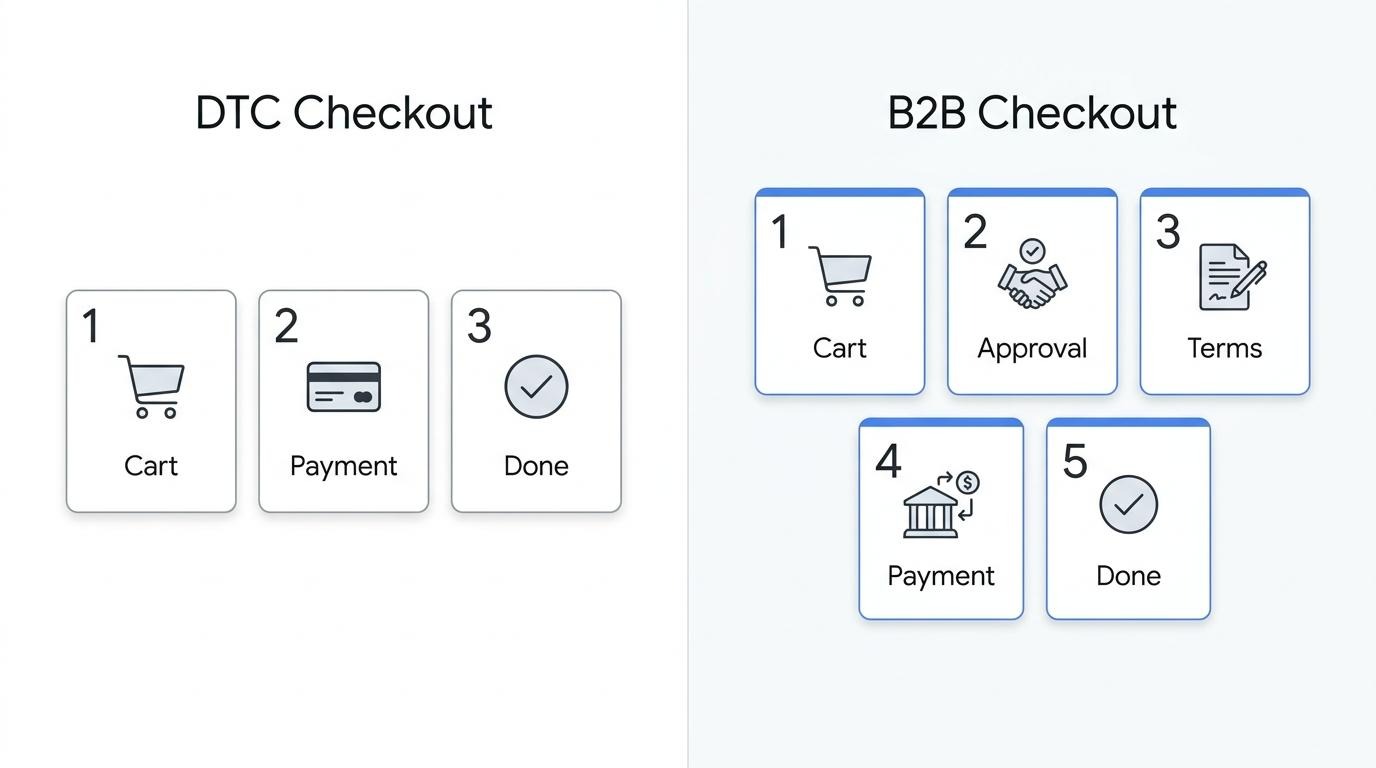
Account-based checkout differs from DTC checkout by tying the entire transaction to a pre-authenticated company profile rather than an individual guest session. Where DTC checkout optimizes for speed and minimal form fields, B2B checkout must accommodate:
This complexity creates a longer value chain than consumer transactions. The tradeoff is worthwhile: account-based checkout builds purchasing habits that drive repeat orders and higher lifetime value. Brands managing both B2B and DTC flows benefit when fulfillment and logistics share the same backend system.
Top B2B sellers handle fulfillment and logistics by combining warehouse management systems, real-time supply chain visibility, and distributed inventory networks to meet the speed and volume demands of commercial buyers. The specific approaches vary by business model, but several core practices define the leaders.
Warehouse management systems drive accuracy. B2B fulfillment at scale requires precise inventory tracking across facilities. The U.S. Department of Labor references established procedures for using warehouse management systems (WMS) to complete inventory transactions and maintain accurate records. For companies like Grainger and Uline that manage hundreds of thousands of SKUs, WMS platforms prevent stockouts and fulfillment errors that erode buyer trust.
Real-time data synchronizes the supply chain. According to the Federal Highway Administration, "Real-time data can enable better management decisions as conditions change. Real-time information, visible across the supply chain, synchronizes and coordinates critical supply chain activities." This visibility is what allows sellers like Amazon Business to promise tight delivery windows and lets distributors like Ferguson coordinate shipments across regional hubs.
Distributed inventory shortens delivery times. Leading B2B sellers position stock closer to buyers through multiple warehouses or regional distribution centers. As noted by the Harvard Business School Digital Initiative, Grainger customers can have materials shipped to their location within two business days. That speed depends on strategic inventory placement, not just carrier partnerships.
Logistics capability directly impacts performance. A study published in PLOS One found that supplier service capability, logistics capability, and production capacity all positively impacted B2B performance through the mediating role of customer attention. Fulfillment is not just an operational function; it shapes how buyers perceive and engage with a seller.
In practice, the most effective B2B logistics strategies share a pattern: invest in systems that provide real-time visibility, distribute inventory geographically, and treat fulfillment speed as a competitive differentiator rather than a cost center. For brands managing both online and offline order flows, platforms that unify commerce and operations within a single system can reduce the coordination overhead that multi-tool setups create.
With fulfillment infrastructure in place, the buyer's mobile experience becomes the next competitive frontier.
Mobile experience plays a central role in B2B ecommerce by meeting buyer expectations for on-the-go access to catalogs, ordering, and account management. As corporate buyers increasingly research and purchase from mobile devices, responsive design and mobile-optimized workflows directly influence conversion rates and repeat purchasing behavior.
According to MIT Sloan Management Review, corporate buyers accustomed to easy, quick, and customized online transactions from consumer sites now demand the same or better customer experience in digital business transactions. That expectation extends fully to mobile. A procurement manager checking inventory from a job site or approving a purchase order during travel needs the same frictionless experience available on desktop.
Mobile-optimized B2B sites prioritize several capabilities:
Sites like Grainger and Zoro demonstrate this well; field technicians and facility managers rely on mobile access to browse millions of SKUs, place orders, and confirm delivery timelines without returning to an office. When mobile experience falls short, buyers abandon carts or revert to phone calls, adding cost and slowing fulfillment cycles.
For scaling brands managing both online and offline channels, mobile also connects warehouse teams, sales reps, and buyers through a single interface. Platforms that unify commerce, CRM, and order management within one system reduce the friction of switching between disconnected mobile apps for different operational tasks.
Neglecting mobile in B2B is no longer a minor gap; it is a competitive liability. Brands that treat mobile as an afterthought risk losing buyers who now evaluate suppliers partly on digital convenience. With B2B decision-makers increasingly open to self-serve remote purchases, as noted by Kellogg Executive Education at Northwestern University, the mobile channel has shifted from optional to essential.
B2B brands are blending DTC and wholesale channels by operating branded online storefronts alongside wholesale marketplace presences. The sections below cover why sellers are launching DTC stores and how hybrid brands manage pricing consistency.
More B2B sellers are launching direct-to-consumer stores to capture margin, own customer relationships, and control brand experience. Wholesale marketplaces like Faire, an online wholesale marketplace that supplies products to small businesses and provides virtual storefronts for brands, have made it easier for sellers to maintain wholesale distribution while simultaneously building a DTC presence.
Owning a storefront gives B2B brands first-party data on end buyers, which wholesale channels rarely share. This data fuels smarter inventory decisions, targeted marketing, and stronger repeat-purchase mechanics. For brands already managing wholesale volume, adding a DTC channel often requires less incremental effort than expected, especially when commerce, CRM, and marketing live in one system rather than a patchwork of disconnected tools.
Hybrid brands manage pricing across channels by establishing clear tiering rules, gating wholesale pricing behind authenticated portals, and using real-time inventory and order data to keep margins consistent. According to the Federal Highway Administration, "Real-time data can enable better management decisions as conditions change. Real-time information, visible across the supply chain, synchronizes and coordinates critical supply chain activities."
Practical pricing management typically involves:
Without centralized visibility into pricing and stock levels, channel conflict becomes inevitable. Brands that treat pricing governance as a data problem, not just a policy problem, tend to scale hybrid models more smoothly.
With channel strategy defined, the next step is preparing for broader B2B ecommerce trends ahead.
You should prepare for AI-driven product discovery and a strategic shift toward first-party data collection. These two trends reshape how B2B buyers find products and how sellers build lasting competitive advantages.
AI is changing B2B product discovery and ordering by replacing manual catalog browsing with intelligent, context-aware search and recommendation systems. Instead of filtering through thousands of SKUs by category alone, buyers now interact with AI tools that interpret natural-language queries, surface relevant products based on purchase history, and auto-suggest reorder quantities.
A Wayne State University dissertation on scalability in online retailing found that relying on product catalog hierarchy and segments, rather than individual SKUs, for collaborative filtering dramatically improves recommendation accuracy across large catalogs with sparse transaction data. This approach is especially valuable in B2B, where catalogs often exceed hundreds of thousands of items. AI also accelerates ordering workflows by pre-populating carts, flagging contract pricing, and detecting anomalies before checkout. For B2B operators managing complex catalogs, investing in AI-powered search now is less about novelty and more about meeting the efficiency bar buyers already expect.
First-party data is becoming critical for B2B sellers because third-party tracking signals are disappearing while buyer expectations for personalization keep rising. Sellers who own their customer data can deliver tailored pricing, relevant product recommendations, and lifecycle communications without depending on external data brokers.
According to researchers at the University of Nevada, Las Vegas, customer data quality is of utmost importance for businesses today as firms attempt to merge multiple methods of communication together in integrated campaigns. In B2B, this means unifying purchase histories, quote interactions, and support tickets into a single view.
Key areas where first-party data drives advantage include:
Sellers who consolidate first-party data now will hold a structural edge as privacy regulations tighten further. With data strategies in place, applying these trends across channels becomes the next priority.
You apply B2B lessons to a multi-channel brand by unifying commerce, customer data, and marketing within a single operational system. The following sections cover what changes when these functions share one platform and the key takeaways from the B2B ecommerce examples explored throughout this article.
What changes when commerce, CRM, and marketing share one system is that fragmented customer data consolidates into a single operational view, eliminating the sync gaps that slow lifecycle execution. As noted by the University of Nevada, Las Vegas, customer data quality is of utmost importance for businesses today as firms attempt to merge multiple communication methods into integrated campaigns.
When B2B leaders like Grainger and Amazon Business unify buyer data across ordering, account management, and outreach, they can personalize pricing, automate reorder flows, and trigger retention campaigns without reconciling separate tools. The same principle applies to scaling DTC and wholesale brands: one shared data layer means every touchpoint, from storefront to POS to email, references the same customer record.
On SHOPLINE, commerce, CRM, marketing automation, and POS operate inside a single system with a shared customer data layer, which removes the reconciliation burden that multi-tool setups create at scale.
The key takeaways about B2B ecommerce examples are that the most successful sellers prioritize self-service buying, structured catalog navigation, flexible payment terms, and personalized account experiences. These patterns hold whether a brand sells industrial supplies or consumer goods across wholesale and direct channels.
The core lessons from the examples covered in this article include:
For brands operating at real volume, the gap between knowing these principles and executing them often comes down to stack architecture. Consolidating commerce, data, and marketing into fewer systems is not just an efficiency play; it determines how quickly a brand can act on the insights these B2B leaders have proven effective. Results may vary depending on implementation, industry, and scale.