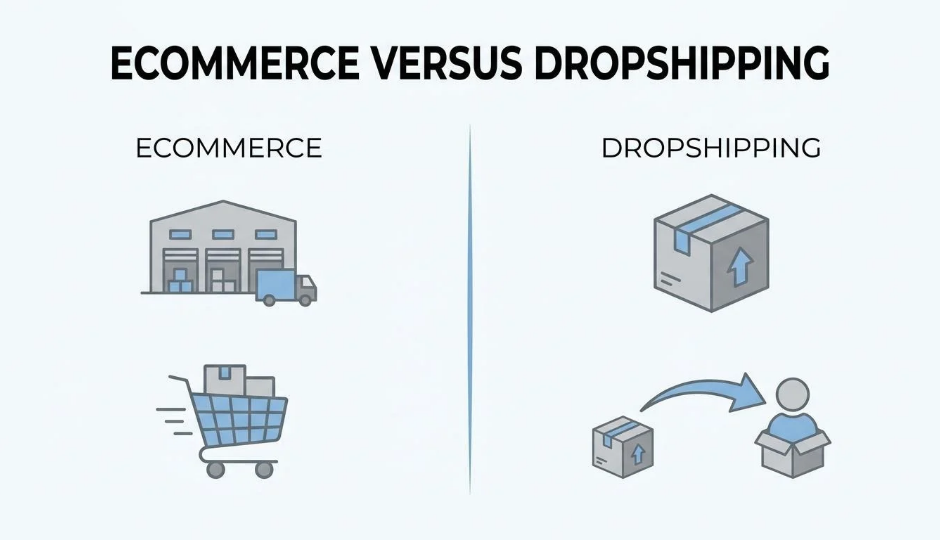
Ecommerce is the buying and selling of goods or services online, encompassing storefront management, inventory ownership, payment processing, and fulfillment. Dropshipping is a subset of ecommerce where the seller never holds inventory; instead, a third-party supplier ships products directly to the customer after each order.
This guide covers how each business model operates, how profit margins and startup costs compare, how quality control and shipping shape customer experience, how brand building and retention differ, and which model scales better for long-term growth.
Ecommerce and dropshipping diverge most sharply in operational structure. Traditional ecommerce merchants purchase inventory in bulk, store it in warehouses or fulfillment centers, and manage the entire pick-pack-ship process. Dropshipping compresses that chain by forwarding orders to a supplier who fulfills them directly, removing warehousing costs but also removing hands-on oversight.
Profit margins reflect this structural gap. Traditional ecommerce brands typically capture gross margins between 40% and 60% through bulk purchasing leverage, while dropshipping sellers often operate on 15% to 30% gross margins with limited room to negotiate supplier pricing. Startup costs mirror the same split: ecommerce requires upfront capital for inventory and storage, while dropshipping launches with little more than a platform subscription and marketing budget.
Quality control, shipping speed, and brand building all favor the inventory-holding model. Merchants who inspect products before shipment, design custom packaging, and control delivery timelines build the repeat-purchase loops that drive customer lifetime value. Dropshipping sellers depend on suppliers for every post-checkout touchpoint, creating structural friction that compounds as volume grows.
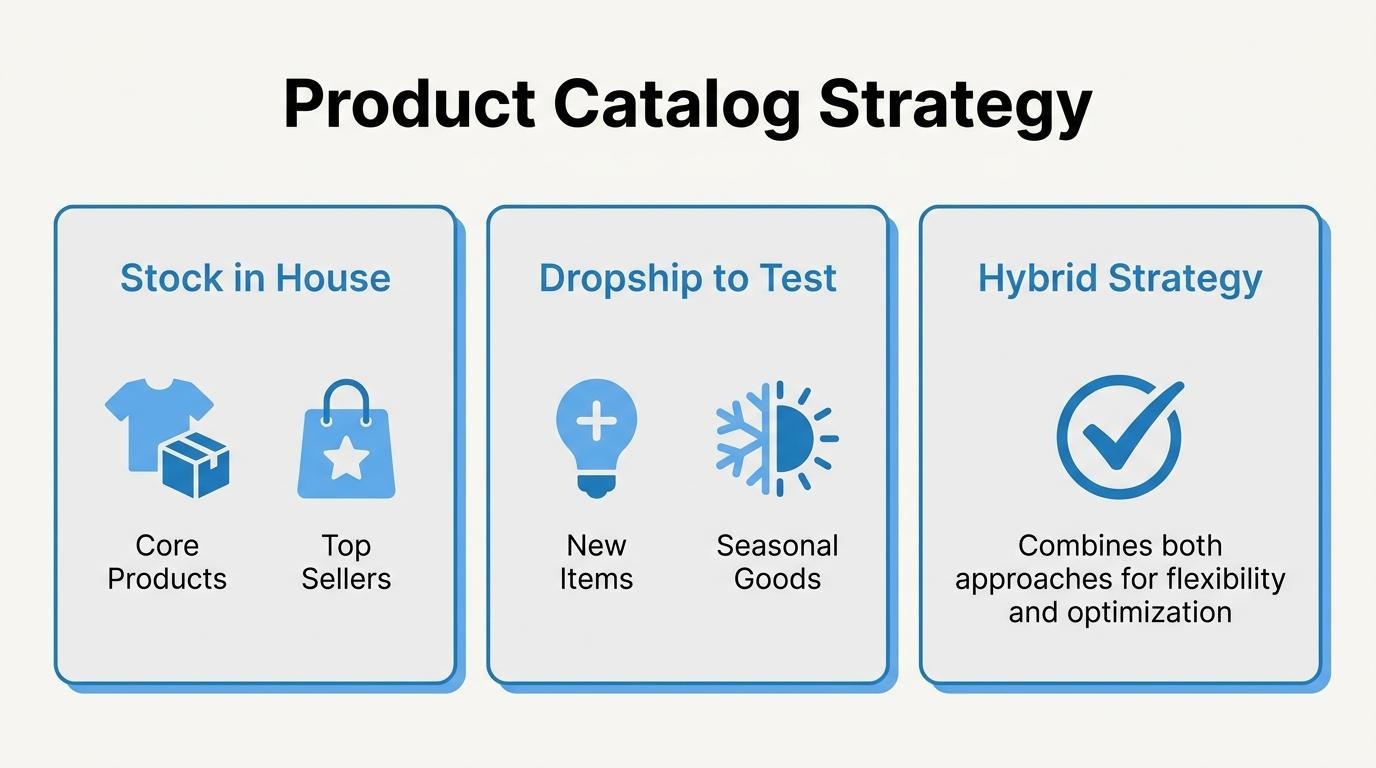
For brands that want flexibility, hybrid models let sellers stock core products while dropshipping new or seasonal items to test demand. Choosing a platform that unifies commerce, CRM, and marketing in one system reduces the data fragmentation that stalls growth at scale.
Ecommerce is the buying and selling of goods or services over the internet. It encompasses everything from storefront setup and inventory management to payment processing, order fulfillment, and shipping.
Ecommerce works by connecting a buyer's online order to a seller's fulfillment operation. A customer browses a digital storefront, selects a product, and completes payment. The seller then picks, packs, and ships the item from owned inventory, whether stored in-house or at a fulfillment center. According to the California Department of Tax and Fee Administration, fulfillment centers are warehouse facilities where orders for tangible personal property are packaged and shipped to customers. Because the merchant controls stock levels and logistics, delivery timelines remain predictable. This direct custody of inventory is what separates traditional ecommerce from models like dropshipping, where the seller never handles the product.
Ecommerce has become the default sales channel because global consumer behavior has shifted decisively toward online purchasing. In 2024, the World Bank reported that global B2C e-commerce sales hit $6 trillion, surpassing the GDPs of Germany and Japan. That momentum continues to accelerate; the U.S. Census Bureau estimated U.S. retail e-commerce sales at $340.2 billion for Q2 2026, up 3.8% from the prior quarter. For brands selling physical products, operating an online store is no longer optional. It is the primary revenue engine, and the infrastructure behind it determines how efficiently a business can scale beyond its first million in sales.
Dropshipping is a retail business model where the store owner never holds inventory. Instead, a third-party supplier ships products directly to the customer after each order. Below, the core mechanics, key participants, and step-by-step order flow explain how this model operates.
Dropshipping is defined as a retail fulfillment method in which the seller purchases a product from a supplier only after a customer places an order. The seller never stocks or handles the merchandise. According to Concordia University, St. Paul, drop shipping eliminates the need to own or store inventory, opening a wide range of opportunities for entrepreneurs. This makes it distinct from traditional retail, where merchants buy goods in bulk, warehouse them, and ship from their own facilities. Because no upfront inventory investment is required, dropshipping lowers the financial barrier to launching an online store.
The key players in a dropshipping transaction are the customer, the retailer, and the supplier. The customer places an order through the retailer's online store. The retailer accepts the order and payment, then forwards it to the supplier. The supplier, often a manufacturer or wholesaler, picks, packs, and ships the product directly to the customer. As the University of Pennsylvania Wharton School describes, the retailer serves as a middleman who acquires customers and accepts orders, while the wholesaler owns and holds inventory and fulfills orders. Each party earns revenue at a different point in the chain, with the retailer keeping the margin between the customer's price and the supplier's cost.
After a customer places a dropshipping order, the retailer sends the order details to the supplier for fulfillment. The supplier then picks the item from its own warehouse, packages it, and ships it directly to the customer's address. As Lehigh University College of Business notes, the vendor ships the product directly to the customer, and at no time is the product ever actually in the store's inventory. For the customer, the experience looks identical to buying from any online store. For the retailer, this hands-off fulfillment means no warehouse leases, no packing stations, and no shipping logistics to manage internally.
Understanding this fulfillment flow is essential before comparing dropshipping to traditional ecommerce operations.
Ecommerce and dropshipping compare on business model through differences in inventory ownership, order fulfillment responsibility, and supply chain structure. The following subsections break down each distinction.
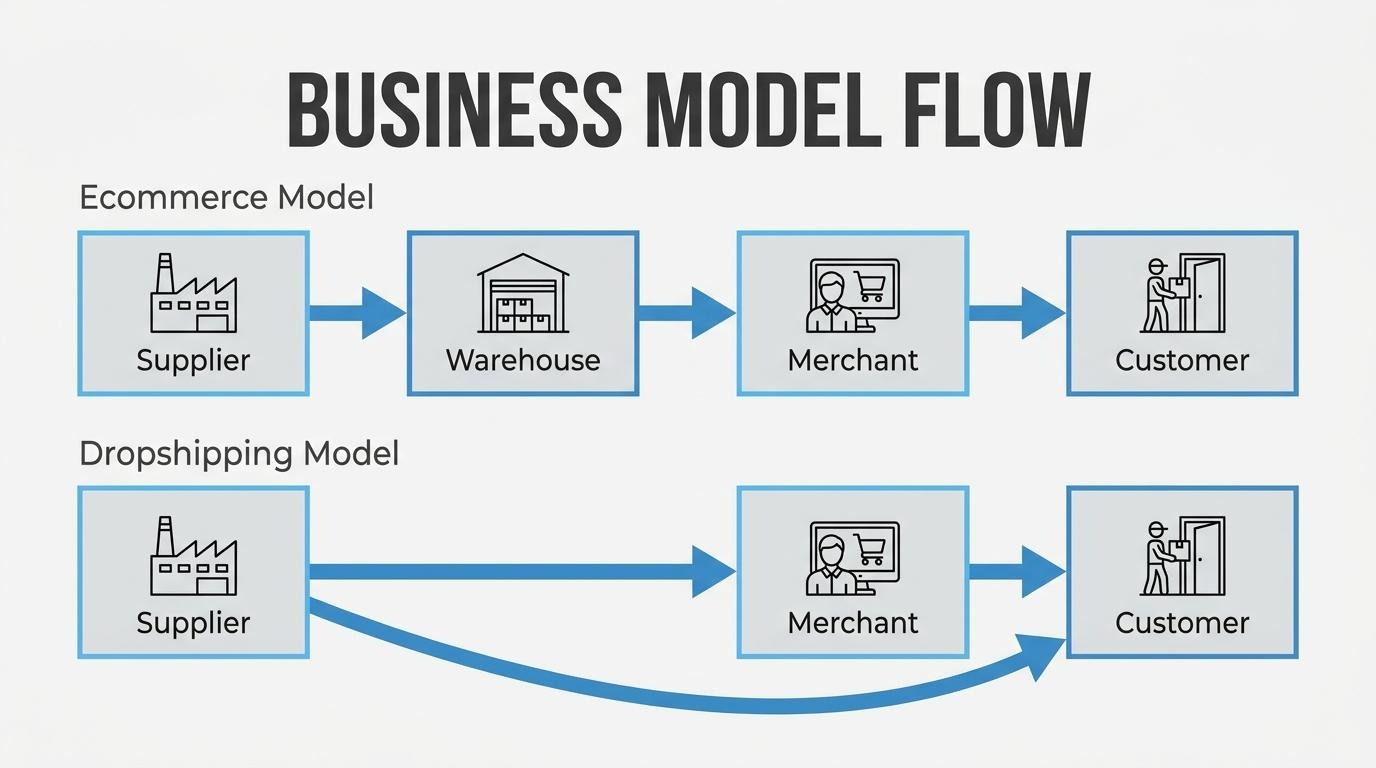
Inventory in ecommerce is handled by the merchant, while in dropshipping it is handled by the supplier. A traditional ecommerce brand purchases products in advance, stores them in a warehouse or fulfillment center, and manages stock levels directly. This means the retailer absorbs the cost of unsold goods but gains full control over availability and quality checks.
A dropshipping retailer never holds inventory. The supplier warehouses products and ships them only after a customer places an order. This removes warehousing costs entirely, though it also removes the merchant's ability to inspect items before they reach the buyer. For brands scaling past early traction, the inventory decision shapes nearly every downstream operational choice.
Order fulfillment in each model is controlled by different parties. In traditional ecommerce, the merchant manages fulfillment internally or through a dedicated fulfillment center. According to the California Department of Tax and Fee Administration, fulfillment centers are warehouse facilities where orders for tangible personal property are packaged and shipped to customers. The retailer selects packaging, controls shipping speed, and handles quality assurance before dispatch.
In dropshipping, the supplier controls fulfillment end to end. A retailer forwards customer orders to the manufacturer or distributor, who ships directly to the buyer at a predetermined price. This means the dropshipper never touches the product, which simplifies operations but limits oversight over packing quality and delivery timelines.
The supply chain differs between the two in the number of links the merchant controls. Traditional ecommerce operates a multi-node chain: the brand sources from manufacturers, receives goods into its own storage, then ships to customers. Each node adds cost but also adds a quality checkpoint.
Dropshipping compresses this chain. The supplier ships directly to the end customer, bypassing the retailer's warehouse entirely. While this reduces overhead, it increases exposure to disruption. As Harvard Business School Working Knowledge notes, small disruptions can cause significant harm if they result in temporary stock-outs and frustrated customers, because leaner operations amplify the cost of each break in the chain. Research from Universiti Teknikal Malaysia Melaka found a highly positive correlation between organizational strategy and a firm's adoption of the dropshipping supply chain, suggesting the model works best when deliberately chosen rather than defaulted into.
Understanding these structural differences in inventory, fulfillment, and supply chain sets the stage for comparing how each model affects profit margins.
Profit margins in ecommerce vs. dropshipping differ significantly due to cost structure, pricing power, and inventory risk. Decreased margins from price reductions or rising input costs directly hurt operations. The sections below break down typical margins for traditional ecommerce brands and dropshipping sellers.
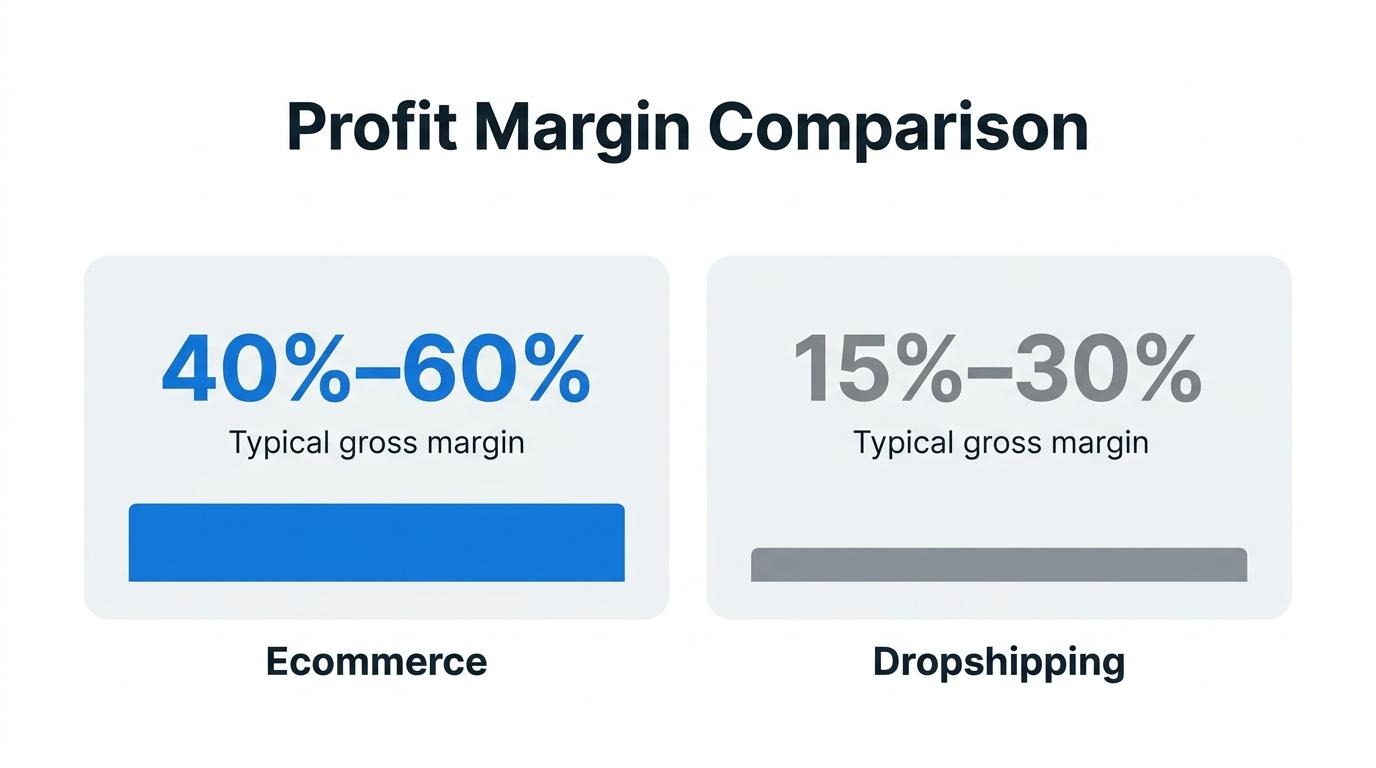
Traditional ecommerce brands can expect gross margins typically ranging from 40% to 60%, depending on product category, sourcing strategy, and brand positioning. Net margins, after accounting for fixed costs like warehousing, staffing, and marketing, generally fall between 10% and 20% for well-run operations.
Brands that own their inventory gain pricing leverage because they purchase in bulk at lower per-unit costs. This control over the supply chain allows room to absorb promotional discounts without eroding profitability entirely. According to the International Trade Administration, global B2C ecommerce revenue is expected to reach $5.5 trillion by 2027 at a 14.4% compound annual growth rate, suggesting that brands investing in owned-inventory models are operating in a rapidly expanding market where scale compounds margin advantages over time.
Dropshipping sellers typically see gross margins between 15% and 30%, with net margins often landing in the single digits. The lower range stems from a fundamental cost disadvantage: dropshippers pay per-unit wholesale prices without bulk purchasing discounts, and supplier fees eat into every transaction.
Several factors compress dropshipping margins further:
For most dropshipping operators, the path to meaningful profit relies on volume rather than per-unit margin. This volume dependency makes the model vulnerable when ad costs spike or conversion rates dip, which is why many sellers eventually consider transitioning to owned inventory as they scale.
Understanding margin differences helps clarify the startup investment each model demands.
The startup costs for each model differ significantly. Traditional ecommerce requires upfront investment in inventory, warehousing, and fulfillment infrastructure, while dropshipping eliminates most of those expenses. The sections below break down what each path typically costs.
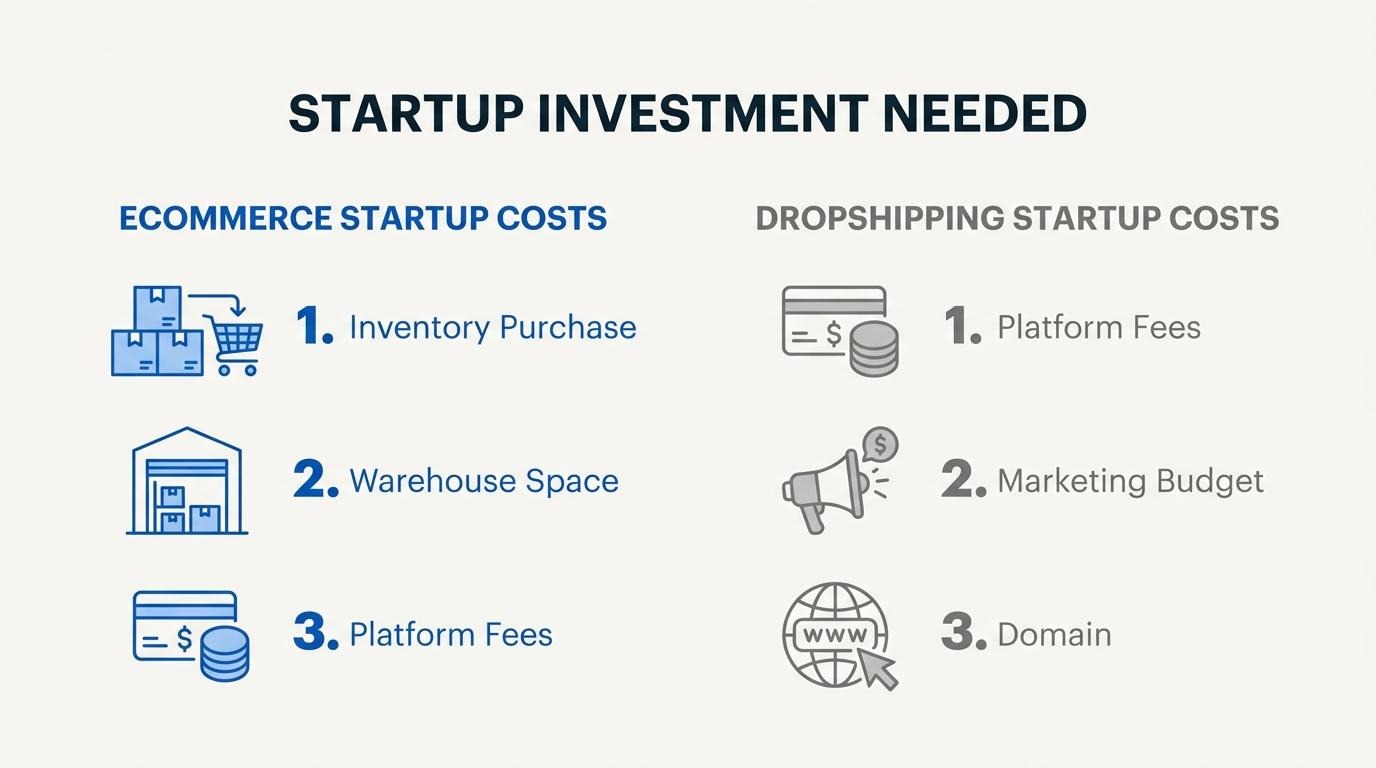
It costs significantly more to launch a traditional ecommerce store than a dropshipping operation because inventory, storage, and fulfillment require capital before the first sale. Core startup expenses include:
According to research from Cornell SC Johnson College of Business, U.S. ecommerce largely complements physical retail, meaning many traditional online stores still carry overhead tied to brick-and-mortar infrastructure. For operators planning to scale past seven figures, budgeting for inventory and fulfillment from day one is essential.
It costs far less to start a dropshipping business because the model eliminates inventory purchasing and warehousing entirely. Typical startup expenses are limited to:
According to USAGov, there are no federal grants for starting a business, so founders must self-fund or seek private financing regardless of the model. Because dropshipping removes bulk purchasing and storage from the equation, the break-even point arrives faster. However, those savings come with trade-offs in margin control and brand differentiation that become more apparent at scale.
Understanding startup costs helps clarify which model fits your current budget, but profit margins determine long-term viability.
Product quality control differs significantly between ecommerce and dropshipping. Traditional ecommerce brands inspect inventory directly, while dropshipping sellers depend on third-party suppliers they never physically oversee. Below, the key distinctions cover inspection access, counterfeit risk, and supplier vetting.
Traditional ecommerce brands inspect products before they ship because inventory passes through their own warehouse or fulfillment center. Staff can check items for defects, verify labeling, and confirm packaging standards before any order leaves the facility. This hands-on step catches flawed units before customers receive them.
Dropshipping removes that checkpoint entirely. The supplier ships directly to the buyer, so the seller never handles the product. According to the ISO 9001 Auditing Practices Group, organizations must verify externally provided products and services in a way that satisfies relevant quality requirements, including those from suppliers and partners. For dropshippers without physical access, verification typically relies on sample orders, supplier audits, and customer feedback rather than unit-by-unit inspection.
This gap makes proactive supplier management essential for any dropshipping operation.
The risk of counterfeit or low-quality goods is substantially higher in dropshipping than in traditional ecommerce. When sellers cannot physically examine inventory, substandard or counterfeit items can reach customers undetected.
U.S. Immigration and Customs Enforcement warns that counterfeit goods usually bear the trademark of a legitimate brand but are produced by another party, often illegally, and are not made to the original manufacturer's specifications. Key risk factors include:
Traditional ecommerce brands mitigate this by purchasing directly from vetted manufacturers and inspecting received shipments. For dropshipping sellers, counterfeit exposure is one of the most underestimated threats to both customer trust and legal standing.
Sellers can vet suppliers effectively by combining due diligence research with structured performance evaluation. Choosing a supplier based on lowest price alone often backfires. The Federal Acquisition Regulation notes that awarding a contract based on lowest evaluated price alone can be false economy if subsequent default, late deliveries, or other unsatisfactory performance results in additional costs.
A practical supplier vetting process includes:
For brands scaling past initial traction, investing time in supplier vetting pays for itself through fewer returns and stronger customer retention.
Understanding quality control gaps prepares sellers to evaluate how shipping and customer experience compare across both models.
Shipping speed and customer experience compare very differently between ecommerce and dropshipping because each model gives the seller a different level of control over fulfillment. Traditional ecommerce brands manage their own warehouses or partner with domestic logistics providers, while dropshipping sellers rely on third-party suppliers to pack and ship orders directly to customers.
Under a drop-shipping arrangement, the retailer serves as a middleman who acquires customers and accepts orders, while the wholesaler owns and holds inventory and fulfills orders, according to research from the University of Pennsylvania Wharton School. This structural gap means the dropshipper has limited visibility into packing quality, carrier selection, or shipment timing once an order is placed.
Traditional ecommerce brands can stock inventory in regional fulfillment centers, enabling two-day or next-day delivery windows that customers now expect. Because the brand controls the warehouse, it also controls packaging, insert cards, branded unboxing experiences, and quality checks before items leave the facility.
Dropshipping sellers, by contrast, often source products from overseas manufacturers. Shipping timelines can stretch to two or three weeks depending on the supplier's location and carrier network. Customers receive generic packaging with no brand identity, and tracking information may be inconsistent or delayed. These factors erode trust and increase support ticket volume.
Key differences in customer experience include:
A study published through the National Library of Medicine (PubMed Central) found that customers give significantly lower ratings to orders delivered late compared to orders delivered on time. For dropshipping sellers with limited fulfillment control, late deliveries are a structural risk rather than an occasional exception.
For brands serious about retention and repeat purchasing, controlling the post-purchase experience is not optional. Shipping speed sets the first impression after checkout, and every friction point between order confirmation and doorstep delivery shapes whether a customer returns or leaves a negative review. Dropshipping can work for testing product-market fit, but it consistently underperforms on the experience metrics that drive long-term customer loyalty.
Understanding these experience gaps helps clarify why brand-building strategies differ so sharply between the two models.
The pros and cons of ecommerce span financial upside, operational control, and resource demands. The subsections below break down the key advantages and disadvantages.
The main advantages of running an ecommerce business are higher profit margins, full brand control, and direct customer relationships. Owning inventory lets merchants set pricing without sharing margin with intermediaries. According to the U.S. Bureau of Labor Statistics, retail margins measure revenue by removing cost of goods from total sales revenue, which means brands that negotiate bulk purchasing unlock stronger unit economics.
Additional advantages include:
For brands processing real volume, these advantages become compounding assets that are difficult to replicate in leaner models.
The biggest drawbacks of traditional ecommerce are high upfront capital requirements, inventory risk, and operational complexity. Purchasing inventory in bulk ties up cash before a single sale occurs, and unsold stock creates carrying costs for storage, insurance, and depreciation.
Key drawbacks include:
These tradeoffs make traditional ecommerce best suited to brands with sufficient capital and a clear product-market fit, not those still testing demand.
Understanding these tradeoffs helps clarify how dropshipping's own pros and cons differ.
The pros and cons of dropshipping center on the trade-off between low entry barriers and limited operational control. Below, the key advantages and disadvantages are broken down individually.
The advantages of dropshipping include low startup costs, location flexibility, and a broad product catalog without warehouse commitments. Because the seller purchases from a vendor only after a customer places an order, there is no need to own or store inventory. This eliminates upfront bulk-purchasing risk entirely.
Key advantages include:
For entrepreneurs testing new markets or product categories, this model reduces financial exposure more than almost any other retail format.
The disadvantages of dropshipping include thin profit margins, limited quality control, and heavy dependence on third-party suppliers. According to the U.S. Bureau of Labor Statistics, retail margins measure revenue by removing the cost of goods from total sales revenue; in dropshipping, that cost is set by the supplier, leaving the seller with narrow room to compete on price.
Core disadvantages include:
These constraints make dropshipping harder to sustain as order volume grows and customer expectations rise. Understanding where these limits appear helps clarify when a shift toward inventory-based ecommerce becomes necessary.
Brand building differs between ecommerce and dropshipping primarily in how much control you have over product, packaging, and customer perception. Below, each H3 covers brand-building potential in dropshipping and why traditional ecommerce offers deeper brand control.
Yes, you can build a recognizable brand with dropshipping, but the path is significantly narrower. Because you never handle the product, you cannot control packaging design, insert materials, or unboxing quality. According to the United States Patent and Trademark Office, a brand encompasses how people feel about your product or service, with customers associating elements such as reputation, image, and emotion with different brands. Dropshippers must rely almost entirely on storefront design, ad creative, and customer communication to shape those associations. Without physical touchpoints, building emotional loyalty requires heavier investment in content marketing and community. It is possible, though the ceiling is lower than most sellers expect.
Traditional ecommerce offers more brand control because the merchant owns every stage from sourcing through delivery. Holding inventory means you can inspect quality before shipment, design custom packaging, include branded inserts, and enforce consistent product standards. This direct oversight eliminates the counterfeit and quality risks that plague sellers who depend on third-party fulfillment without verification. Private-label and white-label strategies become viable when you physically manage stock, allowing you to develop proprietary products that competitors cannot easily replicate. For brands targeting long-term equity rather than short-term margin, this operational ownership is what transforms a store into a brand customers actively seek out.
With brand identity established, the next consideration is how each model retains those customers over time.
Each model handles customer retention differently based on brand ownership, product control, and data access. Dropshipping faces structural barriers to repeat purchases, while traditional ecommerce brands leverage owned assets to increase lifetime value.
Repeat purchasing is harder in dropshipping because the seller controls neither the product nor the fulfillment experience. When a third-party supplier ships generic items directly to buyers, the customer forms no attachment to the retailer's store. Packaging, unboxing quality, and delivery speed all sit outside the seller's influence.
Price-driven shoppers who find identical products elsewhere have little reason to return. Without proprietary formulations or exclusive designs, dropshipping stores compete almost entirely on ad spend rather than earned loyalty. This cycle makes customer acquisition costs climb while repeat purchase rates stay flat, a combination that erodes profitability over time.
Ecommerce brands drive lifetime value by owning the customer relationship end to end. Direct control over product quality, branded packaging, and post-purchase communication creates memorable experiences that encourage repeat orders.
As the European Union Intellectual Property Office notes, a trademark differentiates products from competing brands and encapsulates a company's values. That distinct identity gives traditional ecommerce brands a retention advantage: customers recognize, trust, and return to a name they associate with consistent quality.
Loyalty programs, subscription models, and personalized lifecycle marketing further compound this effect. Each touchpoint reinforces the brand, turning one-time buyers into long-term customers. For brands serious about retention, consolidating these tools into fewer systems reduces the data fragmentation that weakens follow-up campaigns.
With retention mechanics established, the next question is which model supports sustainable long-term growth.
Traditional ecommerce scales better for long-term growth because it supports brand ownership, margin expansion, and infrastructure investment. Dropshipping faces structural limits that constrain sustained scaling. The sections below examine where dropshipping stalls and how ecommerce brands push past seven figures.
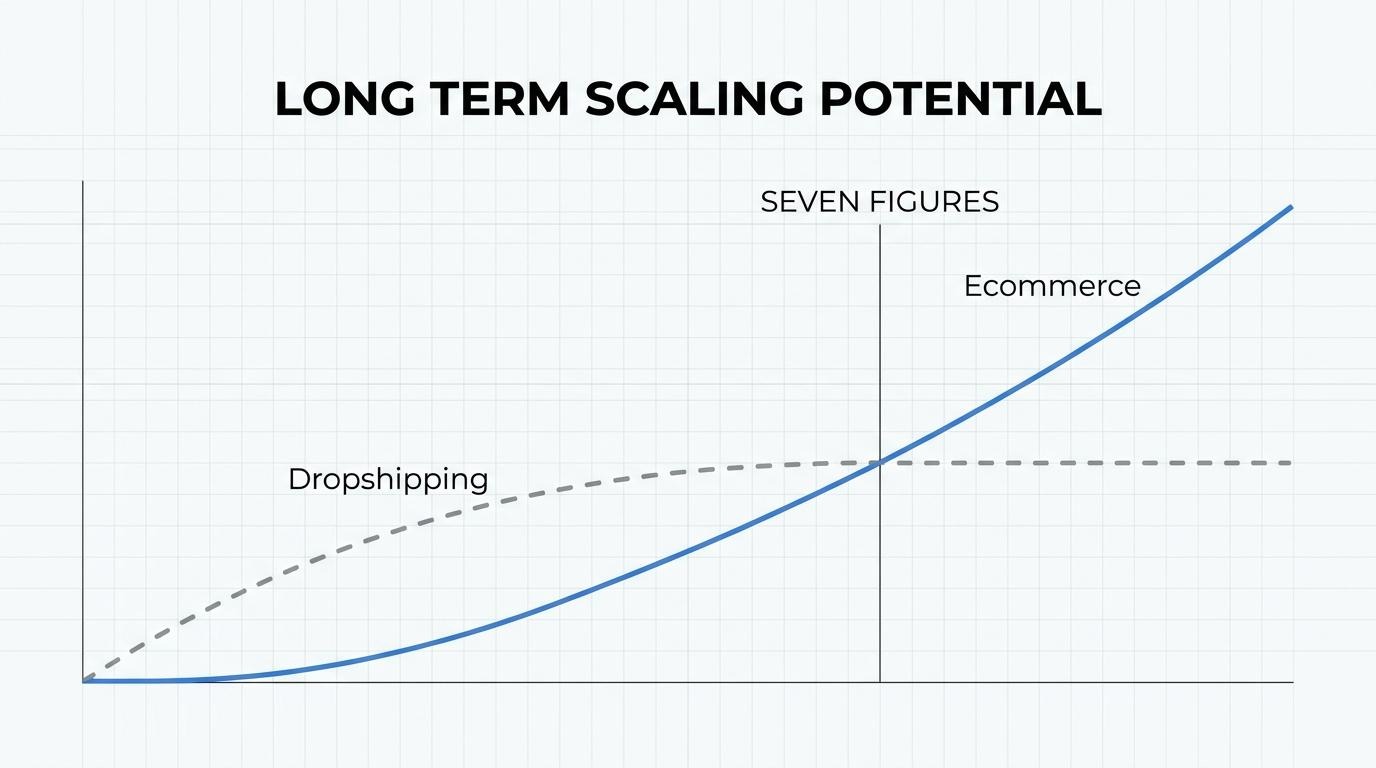
Dropshipping hits a scaling ceiling when thin margins, supplier dependency, and lack of brand equity prevent reinvestment into growth. Because the retailer never controls inventory or fulfillment, every additional sale remains subject to a third party's capacity, pricing, and reliability.
Several factors create this ceiling:
According to the OECD, scaling up requires sustained operation at higher productivity, which may involve innovating, entering new markets, or expanding networks. Dropshipping's structural reliance on external fulfillment limits most of these pathways. For operators serious about building lasting value, this ceiling typically forces a transition toward holding inventory or developing proprietary products.
Ecommerce brands scale beyond seven figures by investing in owned infrastructure, brand equity, and operational systems that compound over time. Controlling inventory, fulfillment, and customer data creates leverage that dropshipping cannot replicate.
Key scaling mechanisms include:
As the U.S. Bureau of Labor Statistics notes, retail margins measure revenue by removing cost of goods from total sales revenue. Brands that own their supply chain can negotiate better COGS and expand those margins as volume grows. This reinvestment flywheel, where higher margins fund better products and customer experiences, is what separates seven-figure brands from those that plateau.
With scalability differences clarified, the next consideration is whether both models can work together.
Yes, you can combine ecommerce and dropshipping into a single hybrid model. Many retailers use dropshipping to test new product categories while maintaining owned inventory for their best-selling items. This approach balances low-risk experimentation with the higher margins and brand control that stocked products provide.
A hybrid strategy works well in practice. Brands stock core products in-house for faster shipping and consistent quality, then dropship complementary or seasonal items without committing capital to untested inventory. According to a study published through IDEAS/RePEc (Omega journal), drop shipping is used by online as well as traditional retailers as an order fulfillment strategy, where a retailer forwards customers' orders to a manufacturer or distributor who fills them directly.
The key is segmenting your catalog deliberately:
For scaling DTC brands, this hybrid approach reduces the binary choice between full inventory commitment and zero product control. The transition point typically arrives when a dropshipped product proves consistent demand, justifying the shift to owned inventory for better margins and fulfillment reliability.
Understanding when each model fits best helps clarify what to look for in a platform that supports both approaches.
Growing DTC brands should choose a platform based on how well it unifies commerce, customer data, and marketing operations as order volume and complexity increase. The sections below cover what changes when these functions share one system and the key takeaways from comparing ecommerce and dropshipping.
Commerce, CRM, and marketing living in one system with SHOPLINE eliminates the data fragmentation that scaling brands encounter when stitching together separate tools for storefront management, email automation, subscriptions, and point-of-sale. A single shared customer data layer means every purchase, whether online or in-store, resolves to one record rather than sitting in disconnected silos.
This matters operationally because fulfillment compliance depends on accurate, real-time data. According to the Federal Trade Commission, advertisers must have a reasonable basis for believing they can ship within 30 days if no specific shipment timeframe is stated. Consolidated systems reduce the manual handoffs that cause delayed shipments and compliance gaps.
For brands approaching or exceeding seven figures, choosing a vendor on price alone often backfires. Unreliable integrations between disconnected apps create the same hidden costs that plague supply chains: late deliveries, data errors, and administrative overhead that erode margins. SHOPLINE addresses this by keeping lifecycle marketing, native subscriptions, and CRM inside the same platform as the storefront, so operators spend less time reconciling tools and more time driving repeat purchases.
The key takeaways about ecommerce vs. dropshipping center on a fundamental trade-off: control versus accessibility.
For DTC brands scaling past early traction, the decision is less about which model to start with and more about when to consolidate operations. The brands that grow sustainably are those that invest in unified systems early enough to avoid the compounding cost of fragmented tools, disconnected data, and manual workarounds that slow execution at scale.