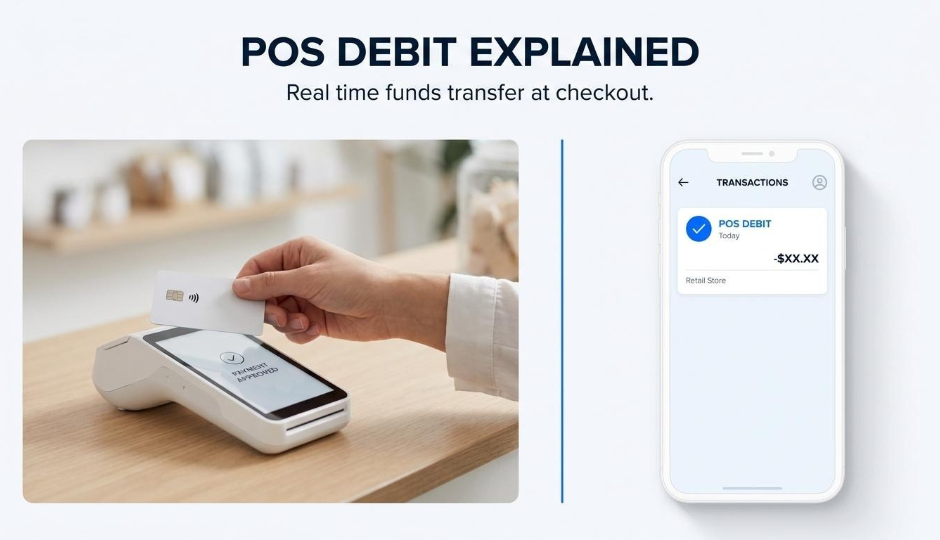
A POS debit is an electronic fund transfer that occurs when a consumer uses a debit card at a physical or virtual point of sale terminal, pulling funds directly from a checking account in real time. Point of sale charges encompass every fee, hold, and settlement record generated by that transaction across the payment chain.
This guide covers how POS debits work and how they differ from other payment rails, the types of POS charges and their processing mechanics, settlement timelines and temporary authorization holds, merchant fee structures and how they compare to credit card costs, and security measures and cost-reduction strategies for scaling brands.
POS debits split into five distinct types: PIN-based, signature-based, contactless, online, and recurring. Each uses a different verification method and payment network, which directly determines how fast the transaction settles and what the merchant pays in interchange fees.
Processing follows a three-stage sequence: terminal capture, bank authorization, and final settlement. PIN debit completes all three stages same-day through single-message networks, while signature debit separates authorization from clearing and typically takes two business days.
Temporary holds at gas stations, hotels, and subscription services can exceed the actual purchase amount by a wide margin, tying up consumer funds until the merchant submits the final charge. Understanding when and why these holds occur reduces unnecessary dispute inquiries.
Federal regulation caps debit interchange at $0.21 plus 0.05% per transaction, while credit card interchange remains uncapped. Merchants who enable least-cost routing and prioritize PIN entry at the terminal can lower acceptance costs significantly.
EMV chip cryptography, payment tokenization, point-to-point encryption, and PCI DSS compliance form the layered security framework protecting every POS debit from terminal to issuer. Consumers retain dispute rights under Regulation E, with 60 days from statement delivery to report unauthorized charges.
POS debit on a bank statement is a record of a purchase made using a debit card at a point of sale terminal, where funds were withdrawn directly from the cardholder's checking account. The label typically appears alongside the merchant name, transaction date, and dollar amount. These entries reflect real-time or near-real-time electronic fund transfers triggered when a card is swiped, inserted, or tapped at a physical or virtual checkout.
Bank statements abbreviate the entry as "POS Debit" or "POS Purchase" to distinguish it from other withdrawal types, such as ATM transactions, ACH debits, or wire transfers. Each POS debit corresponds to a specific merchant interaction where the cardholder authorized payment at checkout. If a transaction looks unfamiliar, consumers should cross-reference the merchant name and date against their receipts. According to the Office of the Comptroller of the Currency, consumers with personal accounts generally have 60 days from the date the bank sends the periodic statement to report errors in writing and keep a copy for their records. Acting within that window is essential, since dispute rights narrow significantly once the deadline passes.
A POS transaction differs from other debit types by how it is initiated, authorized, and settled. The key distinctions involve payment rails, settlement speed, and consumer interaction. The following sections compare POS debits to ACH debits, ATM withdrawals, and wire transfers.
A POS debit differs from an ACH debit in initiation method, authorization speed, and settlement mechanics. A POS debit originates at a physical or virtual terminal when a consumer presents a debit card; the issuing bank verifies funds availability in real time and earmarks the amount from the consumer's available balance. According to Nacha, ACH is a batch process, store-and-forward system that provides for value-dated settlement transactions for both disbursements and collections.
Key differences include:
For merchants handling both in-store and recurring billing, understanding which rail a transaction travels is essential to forecasting cash flow accurately.
A POS debit differs from an ATM withdrawal in purpose, location, and fund movement. POS debits transfer funds from a consumer's account directly to a merchant's acquirer as payment for goods or services. ATM withdrawals dispense physical cash to the cardholder from a machine.
Both fall under the Electronic Fund Transfer Act (Regulation E), but the transaction context is distinct:
A POS debit differs from a wire transfer in speed, cost, reversibility, and typical use case. POS debits are consumer-initiated retail payments processed through card networks. Wire transfers are bank-to-bank transfers processed through operators such as the Federal Reserve or The Clearing House.
According to the Office of the Comptroller of the Currency, the originating bank verifies the request, then initiates the transaction with the operator, which settles the payment between banks and forwards payment instructions to the beneficiary's bank.
Core distinctions include:
Recognizing these rail-level differences helps merchants choose the right payment infrastructure for each sales channel.
The types of POS charges are PIN-based debit, signature-based debit, contactless debit, online debit, and recurring debit. Each type uses a different verification method and payment rail, which affects settlement speed and merchant cost.
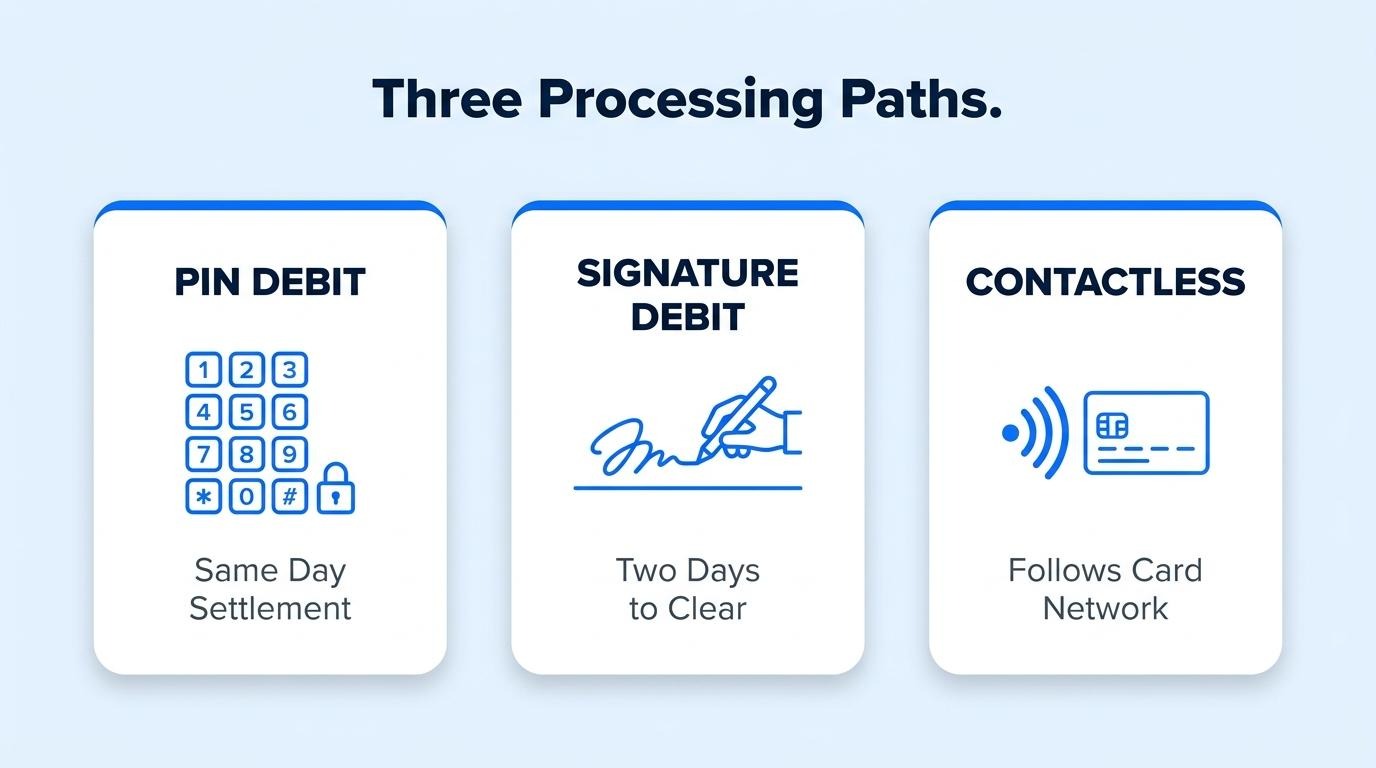
PIN-based POS debit is a transaction where the cardholder enters a personal identification number at the terminal to authorize a purchase. The PIN routes the payment through a single-message debit network, which verifies available funds in real time. According to a 2005 Federal Reserve Bank of Kansas City report on nonbank payment participants, an online debit card transaction allows the merchant to inquire on the consumer's account and verify fund availability, after which the issuing bank automatically deducts those funds. Because authorization and clearing happen in one step, PIN-based charges typically settle the same day. This makes PIN debit one of the fastest, lowest-friction POS charge types for both merchants and consumers.
Signature-based POS debit is a transaction where the cardholder signs a receipt or screen instead of entering a PIN. The payment routes through a dual-message network, separating authorization from clearing. The merchant's terminal sends an authorization request first; the actual fund transfer follows in a separate batch. This two-step process means settlement takes longer, often around two business days rather than same-day. Signature-based charges also tend to carry slightly higher interchange costs for merchants because they travel the same rails as credit card transactions. For consumers, the charge may appear as pending on a bank statement for a day or two before the final amount posts.
Contactless POS debit is a transaction initiated by tapping or hovering a debit card, smartphone, or wearable near an NFC-enabled terminal. The NFC Forum defines Card Emulation Mode as the most common operating mode, allowing a mobile device to emulate a contactless card and connect into an existing payment framework. Once the tap registers, the transaction routes through either a PIN or signature debit network depending on the card issuer's configuration and the merchant's terminal settings. Contactless adoption is growing rapidly; in Canada, the total number of contactless debit transactions increased 13% to 4.9 billion in 2023, according to Payments Canada. Despite this growth, consumer perception of tap-to-pay security still lags behind chip-reader transactions.
Online POS debit is a card-not-present transaction where a consumer enters debit card details on an ecommerce website or app to complete a purchase. The terminal in this case is virtual, but the charge still draws directly from the cardholder's bank account. Authorization requests travel through dual-message networks, and settlement typically follows within one to three business days. Because the card is not physically present, online POS debit transactions carry additional fraud-screening steps, such as address verification and 3-D Secure authentication. For merchants selling across both physical and digital storefronts, reconciling these charges alongside in-store POS data is essential to maintaining accurate financial records.
Recurring POS debit is a scheduled, repeated charge authorized by the cardholder for ongoing services such as subscriptions, memberships, or installment plans. The initial transaction may occur at a physical or online terminal, but subsequent charges are card-not-present transactions where stored card data is used. As the European Payments Council notes, subsequent installment payment transactions use card data extracted from stored records and are not necessarily initiated by the original point of interaction. Consumers should review bank statements regularly, since recurring POS debits can continue until explicitly canceled. For merchants offering subscription products, managing these charges within a unified commerce system reduces billing errors and simplifies customer dispute resolution.
Understanding each POS charge type helps merchants select the right payment acceptance strategy for their channels.
POS debit transactions get processed through a three-stage sequence: terminal capture, bank authorization, and final settlement. Each stage involves distinct parties and security protocols.
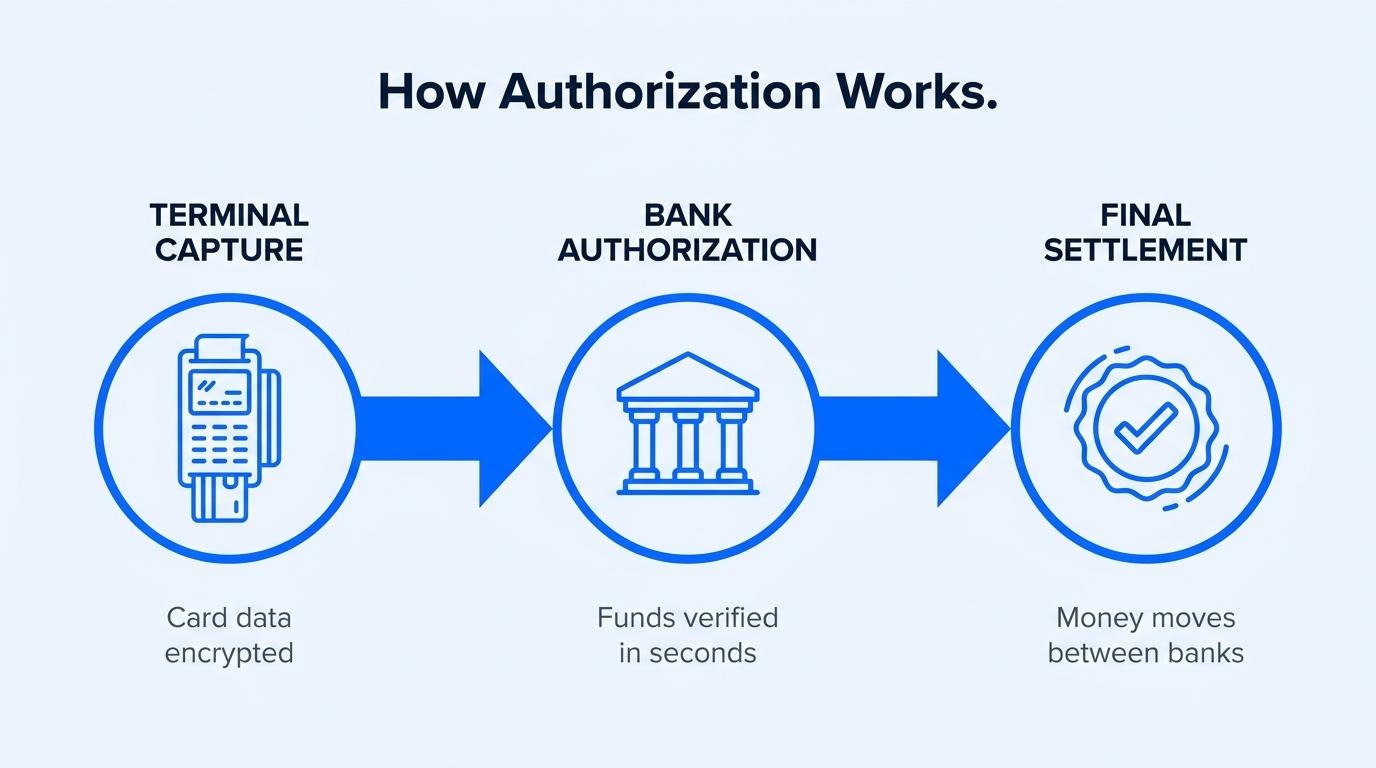
At the point of sale terminal, the customer's card data is captured, encrypted, and prepared for authorization. The terminal reads card information through chip insertion, contactless tap, or magnetic stripe swipe.
According to EMVCo, EMV Chip technology uses advanced cryptography to generate a one-time security code for each transaction, allowing the card issuer and merchant terminal to authenticate the card. Because each cryptogram is unique and cannot be reused, this process helps prevent counterfeit and stolen-card fraud.
CISA recommends hardware-based point-to-point encryption with Secure Reading and Exchange of Data (SRED) capabilities on PIN entry devices. Once captured and encrypted, the terminal packages the transaction details and routes them to the payment network for authorization.
Authorization between bank and merchant works through a multi-party message relay that confirms available funds before the sale completes. According to the Federal Reserve Bank of Richmond, four parties are involved in most card transactions: the consumer, the merchant, the issuing bank, and the acquirer (the merchant's bank that provides card processing services).
The process follows these steps:
This entire round trip typically completes in seconds. For merchants processing high volumes across online and in-store channels, authorization reliability directly affects checkout completion rates.
The final settlement posts to an account after the merchant submits a batch of authorized transactions for clearing and the issuing bank transfers funds to the acquirer. PIN-based debit transactions settle faster because they travel single-message networks that combine authorization and clearing in one step.
According to the Board of Governors of the Federal Reserve System, the average interchange fee for covered transactions on single-message networks was $0.24 in 2023, while dual-message networks averaged $0.22. Dual-message transactions, common with signature debit, separate authorization from settlement and typically take one to two business days longer to post.
For merchants managing cash flow, the settlement timeline difference between PIN and signature debit is worth factoring into daily reconciliation processes. Understanding these timelines helps anticipate when funds become available and when customer accounts reflect final charges.
A POS transaction involves multiple parties working together to authorize and settle a payment. The key participants are the consumer, the merchant, the issuing bank, the acquiring bank, and the card network.
According to the Federal Reserve Bank of Richmond, for the majority of card transactions involving the Visa, Mastercard, and, in some cases, Discover networks, four parties are involved: the consumer and the merchant, as well as the issuing bank and the acquiring bank, which provides card payment processing services and charges the merchant accordingly.
Each participant plays a distinct role in ensuring a transaction completes securely and settles correctly. For merchants running both online and in-store sales, the acquiring bank and card network remain the same core infrastructure, though how transaction data flows back into business systems varies by setup. Understanding these roles helps merchants evaluate processing agreements, fee structures, and where potential friction points arise during settlement.
POS charges take anywhere from seconds to several business days to post, depending on the verification method used. PIN debit, signature debit, and online POS transactions each follow different settlement timelines.
A PIN debit transaction typically clears within the same business day. The PIN verification process confirms fund availability in real time, so the issuing bank deducts the amount from the consumer's available balance almost immediately. Settlement between the merchant's acquirer and the issuing bank generally completes on the transaction date itself.
However, authorization holds can delay the final posted amount. According to a 2022 report by the Connecticut General Assembly Office of Legislative Research, a gas station may place a $60 hold when authorizing a card even if the consumer only intends to purchase $30 worth of gas, and that hold remains until the transaction clears. The gap between hold and final posting sometimes causes temporary discrepancies in account balances, even though the underlying settlement is fast.
A signature debit transaction takes approximately two business days to clear. Because signature-based transactions route through dual-message card networks rather than PIN debit networks, they follow a longer authorization-then-settlement cycle. The merchant captures the transaction, but final settlement requires a separate clearing step before funds move between banks.
A 2005 analysis by the Federal Reserve Bank of Chicago on debit card competition found that PIN-based transactions are generally settled faster, with merchants receiving good funds from their acquirers on the date of the transaction, whereas settlement of signature-based transactions takes approximately two days. For consumers, this means the charge may sit in a "pending" state longer before the final amount posts. Merchants experience the same delay in receiving deposited funds.
An online POS charge takes one to three business days to clear. Online transactions are card-not-present, which means the merchant submits the charge for batch processing rather than settling in real time at a physical terminal. The acquirer collects these batched transactions and routes them through the card network for clearing, adding processing time compared to in-store PIN debit.
Factors such as the merchant's batch schedule, the card network involved, and the issuing bank's posting policies all influence the exact timeline. Merchants who batch transactions once daily at close of business may see next-day settlement, while those batching less frequently can push clearing to two or three days. For brands managing both online and in-store channels, these timing differences affect cash flow forecasting and reconciliation workflows.
POS charges sometimes appear as pending because of the gap between authorization and final settlement. The sections below explain how holds work, why timing varies, and when the final amount posts.
When a merchant uses a card to authorize a payment, the payment is earmarked from the customer's available funds. According to a case reviewed by the Financial Ombudsman Service, the merchant then typically calls for this payment a few days later, and the money is debited from the account balance. This two-step process creates the "pending" status cardholders see on their statements.
Several factors determine how long a POS charge stays pending:
Pending charges are not yet finalized. The amount shown can change once the merchant submits the actual transaction total. This is common at restaurants where a tip adjusts the final figure, or at hotels where incidental charges are added after checkout.
For merchants managing both online and in-store sales, pending charge visibility matters operationally. When POS and ecommerce data live in separate systems, reconciling pending versus posted transactions requires manual cross-referencing. Platforms with a shared data layer reduce that friction by surfacing transaction status across channels in one view.
Understanding authorization holds helps set accurate customer expectations and reduces unnecessary dispute inquiries.
POS debit holds are temporary reductions in a cardholder's available balance that merchants place during authorization before the final transaction amount is known. The sections below explain when these holds occur at gas stations, hotels and restaurants, and subscription services.
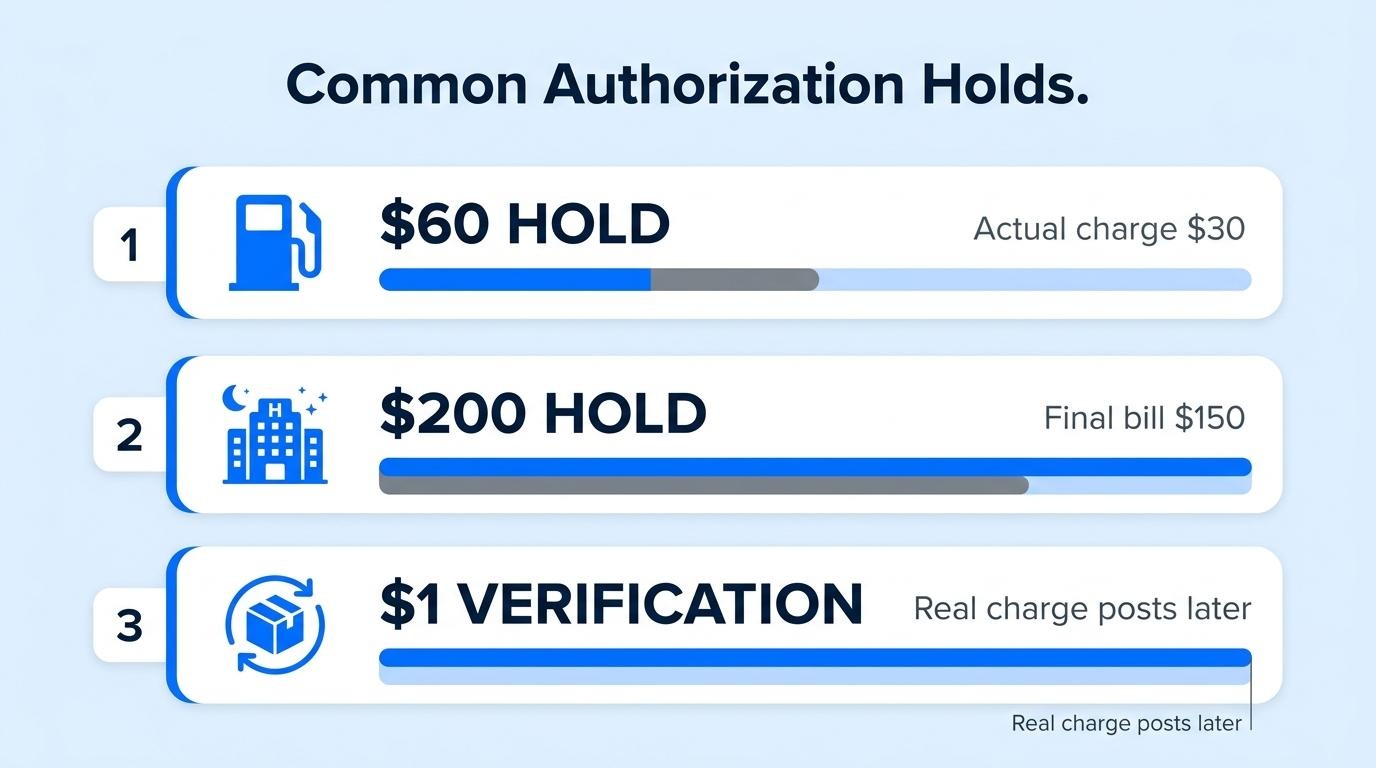
Gas station POS holds occur when a pay-at-the-pump transaction is authorized before the actual fuel amount is determined. The pump terminal sends a pre-authorization request to the issuing bank for a fixed amount that may exceed the purchase total. According to a 2022 report by the Connecticut General Assembly Office of Legislative Research, a gas station may place a $60 hold when authorizing the card even if the consumer only intends to purchase $30 worth of gas, and the hold remains until the transaction clears.
This gap between the hold amount and the actual charge can temporarily reduce available funds, which catches many cardholders off guard. Paying inside at the register instead of at the pump typically triggers a hold matching the exact purchase amount.
Hotel or restaurant POS holds occur when the merchant authorizes an estimated total before final charges are confirmed. Hotels typically place a hold at check-in covering the room rate plus an estimated incidental amount for minibar use, room service, or damages. That hold stays active until checkout, when the front desk submits the actual charge for settlement.
Restaurants follow a similar pattern. The initial authorization matches the bill total, but the final amount changes once a tip is added. The issuing bank earmarks the original authorized amount from the customer's available funds, and the merchant calls for the adjusted payment a few days later. For high-value hotel stays, these holds can tie up significant available balances across multiple days.
Subscription service POS holds occur when a recurring billing system validates the card before processing the scheduled charge. The merchant sends a small pre-authorization, sometimes for $0 or $1, to confirm the card is active and has available funds. Once validated, the actual subscription amount is submitted for settlement.
These verification holds usually drop off within one to three business days. However, if a subscription renews shortly after a card replacement or bank account change, the hold may fail and trigger a declined transaction. Monitoring pending charges around renewal dates helps prevent unexpected service interruptions.
Understanding how holds work across these common scenarios makes it easier to manage available balances and anticipate temporary balance reductions.
Merchants pay POS transaction fees that vary by verification method, card network, and sales channel. PIN debit typically costs the least, while signature debit, contactless, and online transactions each carry distinct fee structures.
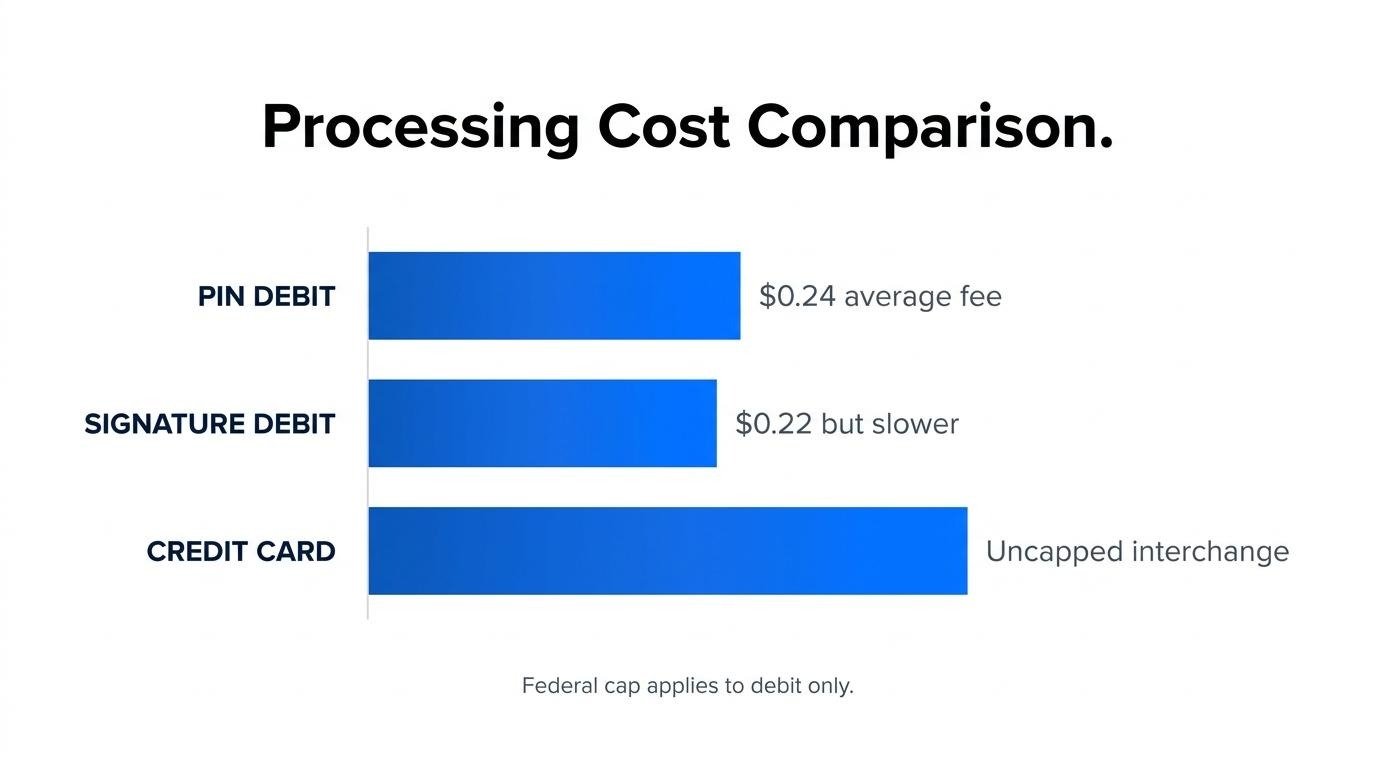
PIN debit transactions cost merchants less than most other card payment methods. These transactions route over single-message debit networks, which carry lower interchange rates than dual-message credit card networks. Surcharging is also restricted; according to the Michigan Attorney General, Mastercard and Visa rules do not allow surcharges on debit or prepaid card transactions.
Over 95% of merchants use standard pricing rather than interchange-plus-plus (IC++) contracts, meaning most absorb a blended rate set by their acquirer. Routing strategy matters here. Merchants who enable least-cost routing can meaningfully reduce acceptance costs, since the system automatically selects the lowest-fee network for each transaction.
Signature debit transactions cost merchants more than PIN debit. According to the Federal Reserve Bank of Boston, merchants prefer PIN debit because the cost to them is less; signature debit transactions are processed over the credit card network and do not involve a PIN.
Because signature debit rides dual-message networks, it inherits higher interchange categories and slower settlement. For merchants processing high volumes, this cost difference compounds quickly. Prioritizing PIN entry at the terminal, where possible, remains one of the simplest ways to reduce per-transaction expense.
Contactless POS transactions cost merchants fees that align with the underlying card network, not the tap itself. A contactless debit tap routes over the same debit rails as an inserted chip card, so interchange rates remain comparable. The NFC communication layer adds no separate fee from the card networks.
The real cost variable is whether the terminal routes the tap through a PIN debit network or a signature network. Merchants with least-cost routing enabled can direct contactless debit taps to the lowest-fee rail automatically, keeping acceptance costs closer to standard PIN debit levels.
Online POS transactions cost merchants more than in-store debit payments. Card-not-present transactions carry higher interchange rates because the issuing bank assumes greater fraud risk without physical card verification. Additional fees for fraud screening tools, 3-D Secure authentication, and gateway processing increase the total cost of acceptance further.
These elevated costs make it especially important for brands selling across both online and physical channels to track per-channel fee structures separately. Understanding where each dollar goes across in-store and digital checkout helps identify which channel mix optimizes margin, not just revenue.
POS debit fees are significantly lower than credit card processing fees, primarily because federal regulation caps debit interchange while credit card interchange remains unregulated. The key differences involve interchange caps, pricing structures, and surcharge rules.
Regulation II caps debit interchange fees at $0.21 per transaction plus 0.05% of the transaction value for covered issuers. According to the U.S. Government Accountability Office (GAO-25-107298), credit card interchange fees are not specifically regulated at the federal level, which allows card networks to set rates that typically run well above the debit cap. This regulatory asymmetry is the single largest driver of the cost gap between the two payment types.
For merchants processing high volumes of smaller transactions, the savings from accepting PIN debit over credit cards compound quickly. The Payment Systems Regulator's 2024 interim report found that over 95% of merchants operate on standard pricing contracts rather than interchange-plus-plus (IC++) models, meaning most businesses absorb blended rates that obscure the underlying interchange differential. Merchants on IC++ contracts gain visibility into the actual cost difference between debit and credit acceptance.
Surcharge rules further separate the two payment types. New York's Attorney General guidance (2023) requires merchants to post the higher credit card price rather than adding a surcharge at the register. Visa and Mastercard rules prohibit surcharges on debit and prepaid card transactions entirely. These restrictions mean merchants cannot directly pass credit card costs to consumers in every state or on every card type, making debit acceptance inherently more cost-predictable.
Consumer perception adds another layer. A 2020 Federal Reserve Bank of Philadelphia study by Tom Akana and Wei Ke found that only 30% of respondents considered contactless tap-and-pay most or second-most secure, compared with 64% for chip-reader payments. This gap suggests that even as contactless debit grows, merchants should expect some customers to prefer chip-inserted transactions, which route through the same lower-cost debit rails.
For scaling DTC brands running both online and in-store channels, the fee differential between debit and credit acceptance directly affects margin. Understanding how interchange, pricing models, and surcharge rules interact across channels helps merchants build a more cost-effective payment strategy.
The security measures that protect POS debit transactions include EMV chip cryptography, payment tokenization, point-to-point encryption, and PCI DSS compliance. Together, these layers defend cardholder data from terminal to issuer.
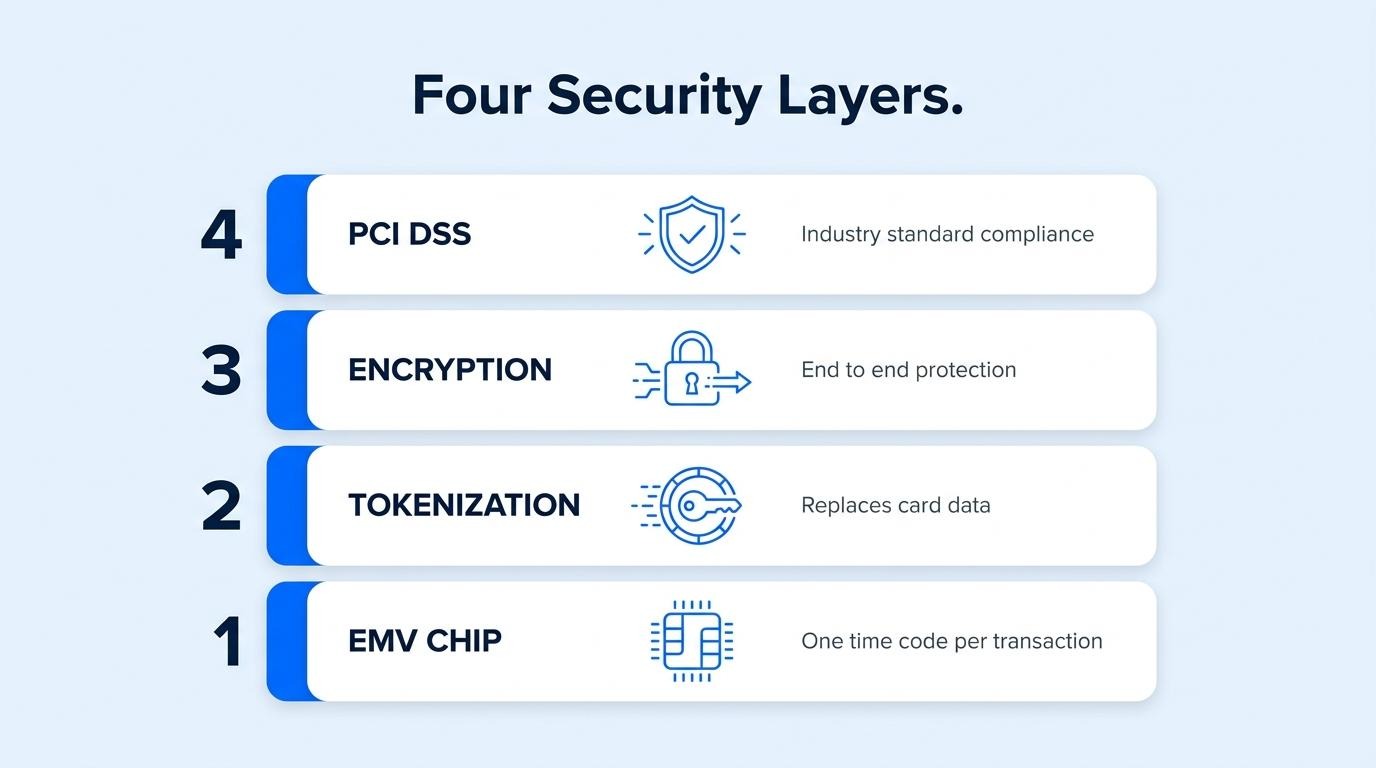
EMV chip technology authenticates transactions by generating a one-time cryptographic security code for each payment. According to EMVCo, this unique cryptogram allows both the card issuer and the merchant terminal to verify the card's legitimacy, and because the code cannot be reused, it prevents counterfeit, lost, and stolen card fraud.
Unlike magnetic stripe cards, which store static data vulnerable to skimming, chip-enabled cards make cloned card data essentially worthless. For merchants processing high volumes of in-store debit transactions, EMV authentication remains the most effective frontline defense against card-present fraud.
Payment tokenization replaces raw card data with substitute tokens that hold no exploitable value. A reference design published by the National Cybersecurity Center of Excellence (NIST) confirms that these tokens are useless to malicious actors, even if intercepted during transmission or stolen from stored databases.
Tokenization matters most in environments where card credentials are stored for recurring billing or omnichannel use. When online and in-store transactions reference a token instead of a primary account number, the blast radius of any single data breach shrinks dramatically.
Point-to-point encryption is important because it shields cardholder data from the moment of card read through transmission to the payment processor. In 2014, CISA recommended that merchants implement hardware-based point-to-point encryption, specifically advising EMV-enabled PIN entry devices with Secure Reading and Exchange of Data (SRED) capabilities.
Without end-to-end encryption, data traversing between the POS terminal and acquirer can be intercepted by malware. Encryption eliminates that window of vulnerability entirely.
PCI DSS is the Payment Card Industry Data Security Standard, a set of requirements governing how businesses store, process, and transmit cardholder data. In 2022, the PCI Security Standards Council published version 4.0, retiring version 3.2.1 on March 31, 2024.
PCI DSS applies to every entity that handles card data, including POS terminals, payment gateways, and back-office systems. Key requirements include:
For scaling DTC brands running both online and in-store channels, PCI compliance is not optional; it is the baseline that card networks require for continued processing privileges.
Consumer protections for unauthorized POS charges exist under Regulation E, which governs electronic fund transfers including point-of-sale debit transactions. According to the CFPB, financial institutions have up to 90 days to complete an error investigation when the disputed transaction resulted from a POS debit card transaction, compared to the standard 45-day window.
Cardholders should take these steps when disputing unauthorized charges:
With dispute protections in place, understanding how merchants can lower their processing costs completes the transaction lifecycle picture.
Merchants can reduce POS processing costs by optimizing interchange routing, adjusting pricing models, and leveraging debit-friendly payment acceptance strategies. The following approaches cover routing, pricing structures, and surcharge compliance.
Least-cost routing (LCR) directs each debit transaction through the network with the lowest interchange fee. According to the Reserve Bank of Australia's 2024 analysis, merchants with LCR enabled in 2022/23 had a cost of acceptance approximately 19 percent lower than similar merchants without it. Most dual-network debit cards support at least two routing options, giving merchants flexibility at the terminal level.
Enabling LCR is one of the highest-impact, lowest-effort changes a merchant can make; the savings compound quickly at scale.
Interchange-plus (IC++) pricing separates the interchange fee, network assessment, and processor markup into transparent line items. This structure lets merchants see exactly what they pay at each layer. Over 95 percent of merchants remain on standard (blended) pricing contracts, according to a 2024 interim report from the Payment Systems Regulator.
Switching to IC++ pricing benefits mid-to-high-volume merchants most. The visibility alone often reveals overcharges hidden inside bundled rates.
PIN debit transactions cost merchants less than signature debit because they route through single-message debit networks instead of dual-message credit card rails. Prompting customers to enter a PIN at checkout, rather than defaulting to signature, shifts more volume onto lower-cost networks.
Terminal configuration matters here. Merchants should set their POS systems to prompt for PIN entry as the default verification method on debit card transactions.
Surcharging rules differ between credit and debit cards. Visa and Mastercard rules prohibit surcharges on debit or prepaid card transactions. Several states impose additional restrictions on credit card surcharges. In New York, for example, merchants must post the higher credit card price rather than adding a surcharge at checkout.
Misapplying surcharges to debit transactions creates compliance risk and potential penalties, so merchants should review both card network rules and state law before implementing any surcharge program.
Prompt batch settlement reduces the window for downgrades, which occur when transactions fail to meet network qualification criteria and get reassigned to higher interchange tiers. Settling batches within 24 hours of authorization keeps transactions in the lowest-cost category.
Delayed settlement also increases authorization hold times for customers, which can generate support inquiries and disputes. For brands managing both online and in-store POS channels, a unified system that automates daily batch settlement removes one common source of unnecessary fees.
DTC brands should handle POS charges across channels by unifying online and in-store payment data into a single system. The sections below cover what changes when POS data is consolidated and the key takeaways from this playbook.
When online and in-store POS data live in one system, brands gain a single view of every transaction, customer, and inventory count regardless of where the sale occurred. Fragmented tools create reconciliation delays; a unified system ties each POS debit, authorization hold, and settlement record to one customer profile. According to a GS1 US case study featuring Target, Keurig, and Pilot Pen, consistency is key to closing the gap between channels, as consumers expect product descriptions to match when moving from store to online. For scaling DTC brands processing both PIN debit at retail and online POS charges, consolidation eliminates duplicate data entry, reduces fee-tracking errors, and simplifies dispute resolution across payment rails.
The key takeaways about POS debit and point of sale charges center on understanding transaction types, managing costs, and protecting both merchant and consumer: