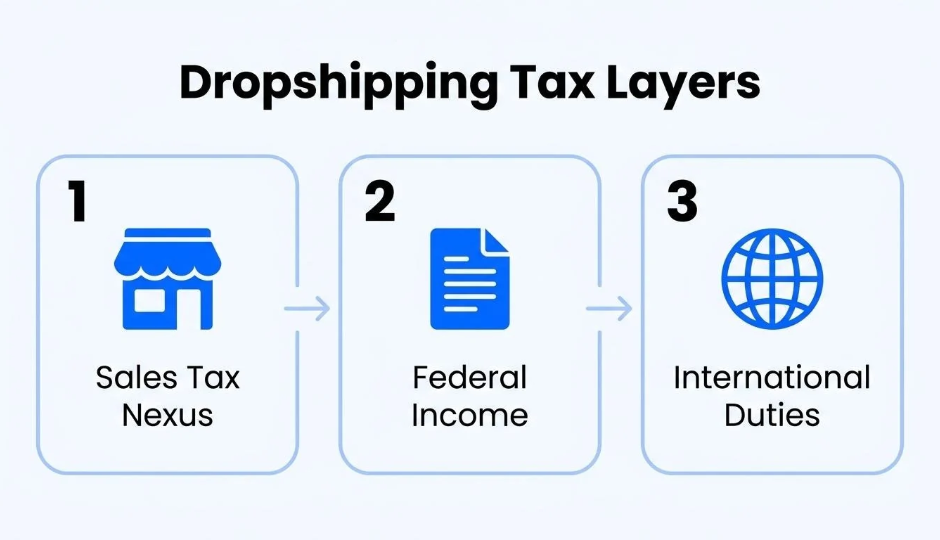
Dropshipping taxes are the combined federal, state, and local tax obligations that arise when a small business sells products online without holding inventory, while a third-party supplier ships directly to the customer. Because the seller, supplier, and buyer often operate in three different states, dropshipping creates layered tax responsibilities that standard ecommerce models rarely encounter.
This guide covers sales tax nexus and state collection requirements, tax exemption certificates, federal income and self-employment taxes, international supplier obligations, and multi-state compliance automation.
Sales tax nexus is the trigger behind most dropshipping tax obligations. Physical presence, economic thresholds (typically $100,000 in gross sales), and marketplace facilitator rules each create independent collection duties, and most states now enforce economic nexus regardless of whether a seller has a warehouse or employee in the state. Thresholds, sourcing methods, and filing frequencies vary widely; some states measure by calendar year while others use rolling 12-month lookback periods.
Resale exemption certificates prevent double taxation between the seller and supplier in drop-ship transactions, and the Streamlined Sales Tax form simplifies this across participating states. Missing or expired certificates shift liability back to the party that failed to collect them.
Federal income tax applies to all dropshipping profit at rates determined by business structure: sole proprietorship, LLC, or S-corp. Self-employment tax adds 15.3% on net earnings for sole proprietors and most LLC owners, while S-corp elections can reduce that burden through salary-and-distribution splitting. Deductible expenses, from cost of goods sold to platform fees, directly lower taxable income.
International suppliers introduce customs duties, tariff classifications, and the $800 de minimis import threshold. Automating tax calculation at the platform level, rather than tracking rates manually across dozens of states, is one of the most practical steps for staying compliant as order volume grows.
Dropshipping taxes differ from other ecommerce models because the seller never holds inventory, yet remains legally responsible for collecting and remitting sales tax to the customer's state. Three factors create unique complexity: split shipment chains, multi-state nexus exposure, and resale certificate requirements between the seller and supplier.
In a traditional ecommerce model, one business purchases inventory, stores it, and ships it directly to buyers. The tax obligation is relatively straightforward because the seller controls the entire fulfillment chain. Dropshipping breaks that chain apart. A customer places an order on the seller's storefront, but a third-party supplier ships the product from a location the seller may not even know about in advance.
This split creates a scenario where three parties operate across potentially three different states: the seller's home state, the supplier's warehouse state, and the customer's delivery state. Each state may treat the transaction differently for sales tax purposes. According to the North Carolina Department of Revenue's remote sales FAQ, the threshold for a seller to become engaged in business in North Carolina includes sales as a marketplace seller and marketplace-facilitated sales, sourced to North Carolina in the previous or current calendar year. That sourcing detail matters because dropshippers often trigger nexus obligations in states where they have no physical presence, no warehouse, and no employees.
Unlike retailers who stock their own goods, dropshippers also face a unique resale certificate dynamic. The supplier ships on behalf of the seller, so the transaction between seller and supplier may qualify as a wholesale purchase. Without a valid resale certificate on file, the supplier might charge sales tax on that wholesale leg, and the seller still owes sales tax on the retail leg to the customer's state. Managing both sides of this equation is a compliance challenge that traditional ecommerce sellers rarely encounter.
For most small business owners entering dropshipping, the critical takeaway is this: lower startup costs and zero inventory do not mean lower tax complexity. The operational simplicity of dropshipping masks a multi-state tax web that demands careful tracking from the first sale.
Understanding how nexus rules, sourcing methods, and exemption certificates interact is the foundation for staying compliant across every state where you sell.
Yes, you need a sales tax permit for dropshipping in most states where you establish sales tax nexus. The permit requirement depends on whether you meet physical or economic nexus thresholds in each state. The following sections explain how nexus triggers permit obligations, which states require collection, and how sourcing rules affect where tax applies.
Understanding nexus is the single most important step before registering for any permit. Many new dropshippers either over-register (wasting time and filing fees) or skip registration entirely (risking penalties). Knowing exactly where you have nexus prevents both mistakes.
Sales tax nexus is the connection between a business and a state that triggers an obligation to collect and remit sales tax. Dropshipping businesses encounter three types of nexus: physical nexus, economic nexus, and marketplace nexus.
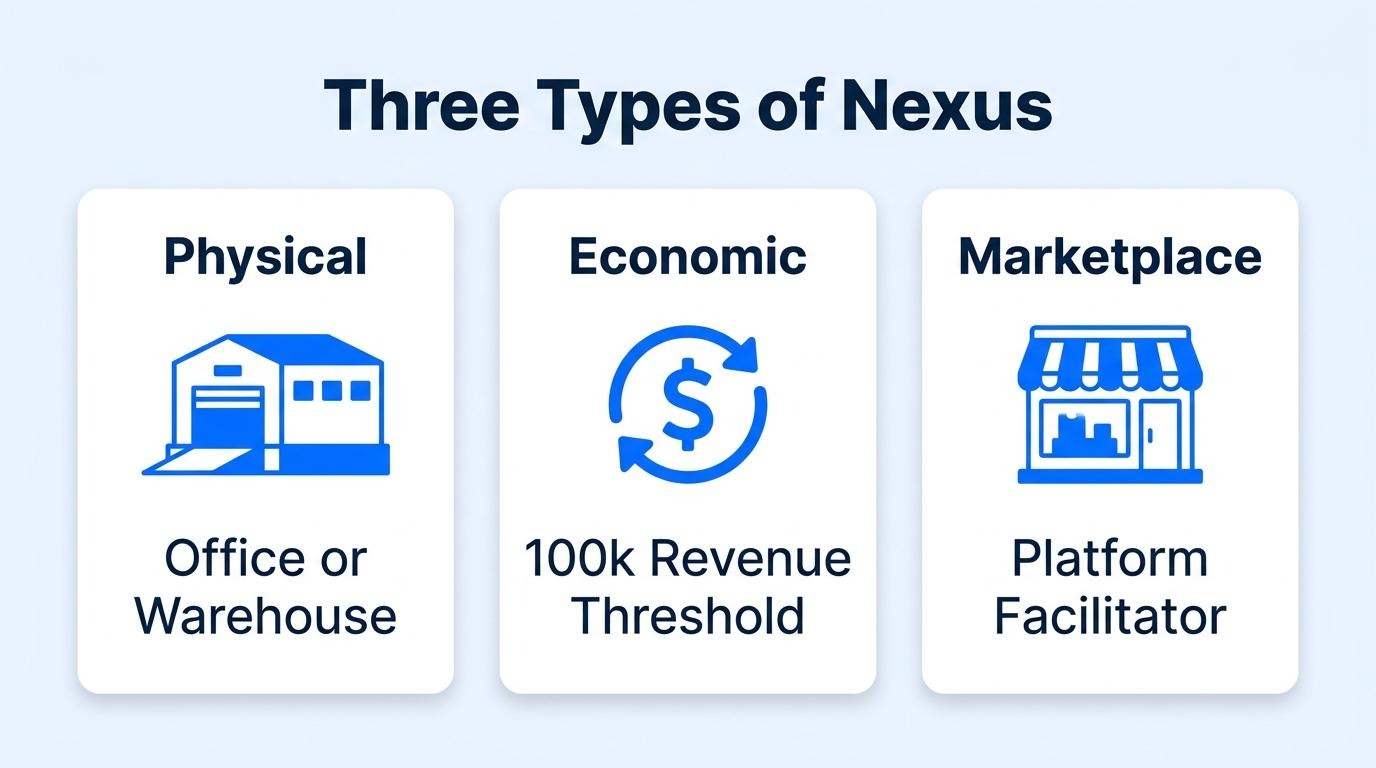
Physical nexus for a dropshipping business is the sales tax obligation created when the business maintains a tangible presence in a state, such as an office, warehouse, employee, or inventory location. Most dropshippers operate without warehouses or local staff, which limits physical nexus to the state where the owner lives or registers the business.
However, physical presence is not the only trigger. According to the South Dakota Department of Revenue, a remote seller without a physical presence in South Dakota must still collect sales tax if gross sales exceed $100,000 in the previous or current calendar year. States increasingly rely on economic thresholds rather than physical presence alone, which makes physical nexus just one piece of the compliance picture for dropshippers.
Economic nexus for a dropshipping business is the sales tax obligation triggered when the seller's revenue or transaction volume in a state crosses a defined threshold, regardless of physical presence. Most states set this threshold at $100,000 in gross sales or 200 separate transactions during the previous or current calendar year.
According to the Hawaii Department of Taxation, out-of-state businesses with gross income of $100,000 or more, or 200 or more transactions in the current or preceding calendar year, establish economic nexus. States such as Iowa, Michigan, South Carolina, and Virginia apply similar thresholds. For dropshippers selling across multiple states, economic nexus is typically the primary trigger because sales volume accumulates quickly even without any physical footprint. Tracking revenue by state on a monthly basis is the most reliable way to avoid missing a threshold.
Marketplace nexus for a dropshipping business is the sales tax responsibility that shifts to a marketplace facilitator when the facilitator hosts the sale, processes the payment, and collects tax on the seller's behalf. Platforms such as Amazon, eBay, and Etsy qualify as marketplace facilitators in most states.
According to the North Carolina Department of Revenue, the threshold for becoming engaged in business includes gross sales exceeding $100,000, and this figure counts both marketplace-facilitated sales and direct sales. When a marketplace handles collection, the individual seller is generally relieved of that obligation for those transactions. Dropshippers who sell through both a marketplace and their own storefront need to track each channel separately, since direct sales still require independent compliance.
Understanding all three nexus types clarifies where your collection duties begin, which the next section breaks down state by state.
The states that require you to collect sales tax on dropshipped orders include every state with a sales tax, once you exceed that state's economic nexus threshold. Thresholds, sourcing rules, and no-tax exceptions vary by state, as the sub-sections below explain.
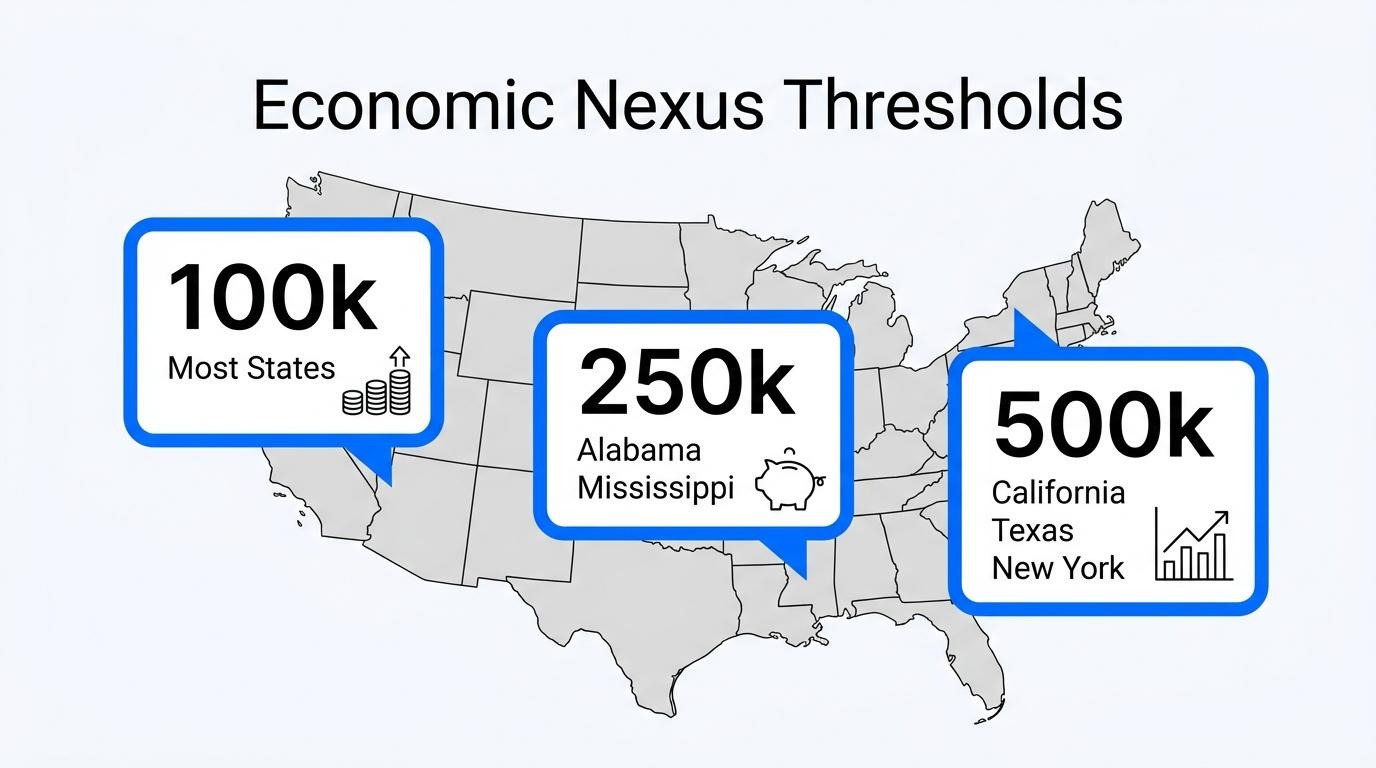
Most states set their economic nexus threshold at $100,000 in gross sales during the previous or current calendar year. A handful of states set higher bars. According to the Alabama Department of Revenue, all remote sellers directly selling over the $250,000 threshold of total retail sales delivered into Alabama the previous calendar year must collect and remit taxes on sales into Alabama. Mississippi similarly requires registration from out-of-state businesses whose sales exceed $250,000 over any twelve-month period. Tennessee applies a $100,000 threshold (effective after October 1, 2020), while California requires $500,000 in total combined sales for delivery in-state.
Several states also include a transaction count as an alternative trigger. Arkansas requires collection if sales exceed $100,000 or 200 taxable transactions in the current or previous year. Kentucky, Nebraska, Nevada, Rhode Island, Vermont, and Washington maintain similar dual thresholds. Indiana simplified its rules effective January 1, 2024, retaining only the $100,000 threshold.
Timing rules differ as well. Colorado requires collection once retail sales exceed $100,000 during the current calendar year. Missouri uses a rolling 12-month lookback evaluated each calendar quarter. North Dakota gives remote sellers 60 days after crossing $100,000 to obtain a permit and begin collecting, or they must start in the following calendar year, whichever is earlier. Pennsylvania measures the $100,000 threshold by calendar year and allows collection to begin in the second quarter to give sellers time to compile sales data.
For dropshippers selling into multiple states, this patchwork of thresholds and measurement periods makes ongoing tracking essential. Missing a single state's deadline can trigger penalties, which is why automated tax calculation tools are worth considering early.
Origin-based sales tax states affect dropshipping by taxing the sale at the seller's location rather than the buyer's. In these states, the tax rate applied to a transaction is determined by where the seller (or their business location) sits, not where the package is delivered.
This matters for dropshippers because your supplier's warehouse, your registered business address, and your customer's shipping address may each be in a different state. If your business is registered in an origin-based state, that state's rate applies to in-state sales. Out-of-state sales still follow the destination state's rules. Oregon, for example, has no general sales or use tax, so orders shipped from Oregon suppliers carry no Oregon sales tax obligation regardless of sourcing method. Most states use destination-based sourcing, making origin-based rules the exception rather than the norm.
Destination-based sales tax states affect dropshipping by taxing orders at the rate where the customer receives the product. The majority of U.S. states follow destination-based sourcing, which means the buyer's shipping address determines the applicable state and local tax rate.
For dropshippers, this creates a practical challenge. Your supplier may ship from a warehouse in one state, your business may be registered in another, and your customer may live in a third. Under destination-based rules, only the customer's location matters for determining the tax rate. Each state, county, and city can layer its own rates on top, so a single state may have hundreds of distinct tax jurisdictions. Tracking every applicable rate manually becomes unrealistic once order volume grows across multiple states, making automated tax calculation far more practical than spreadsheets.
When you dropship to states with no sales tax, you generally owe no state-level sales tax on those orders. Five states have no statewide general sales tax: Alaska, Delaware, Montana, New Hampshire, and Oregon.
The exception is Alaska. Although Alaska imposes no state sales tax, local jurisdictions do collect their own sales taxes. According to the Alaska Remote Seller Sales Tax Commission (ARSSTC), remote sellers and marketplace facilitators who meet the statewide threshold of $100,000 in gross sales annually must register with ARSSTC and collect applicable sales tax for remote sales into member jurisdictions. The 200-transaction threshold was removed effective January 1, 2025.
Delaware, Montana, New Hampshire, and Oregon impose no general sales tax at any level. Orders delivered to customers in these four states carry no sales tax collection requirement for dropshippers.
One important nuance: even sales into no-tax states can count toward your economic nexus threshold in other states. California, for example, measures its $500,000 threshold using total combined sales of tangible personal property for delivery in-state. Understanding how each state's threshold is calculated helps prevent unexpected collection obligations.
You handle sales tax when your supplier ships from a different state by focusing on where your customer receives the product, not where your supplier is located. The key factors are destination-based sourcing rules, economic nexus thresholds, and state-specific registration requirements.
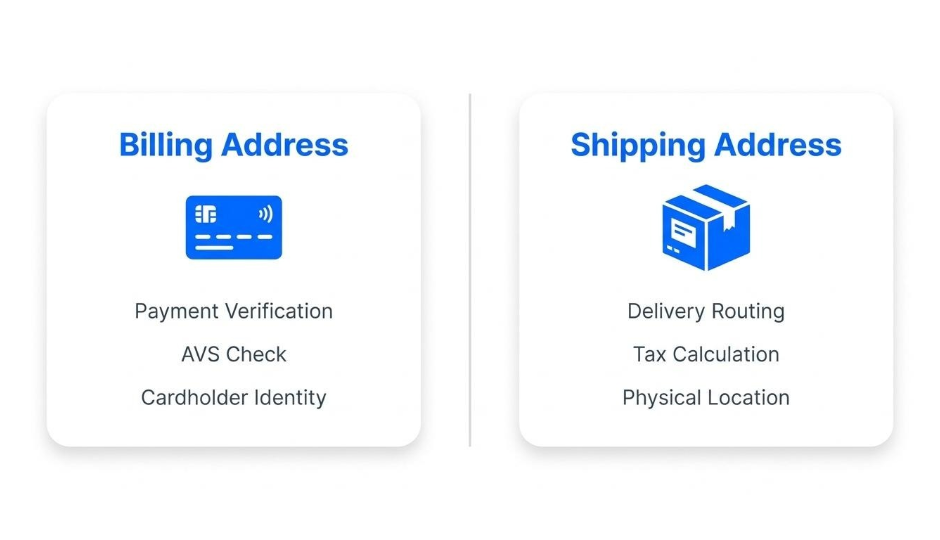
Sales tax obligations in dropshipping follow the customer's delivery address in most states. Your supplier's warehouse location does not determine your collection responsibility. What matters is whether you have established economic nexus in the state where the order arrives.
Most states use destination-based sourcing, which assigns the taxable sale to the buyer's location. According to the Multistate Tax Commission's 2014 presentation on sourcing, destination sourcing assigns a sale to the location of the purchaser or the place where the purchaser receives or takes delivery of the item. This means a dropshipper based in Texas whose supplier ships from California to a customer in Ohio owes Ohio sales tax, not California or Texas tax.
The economic nexus thresholds that trigger your collection obligation vary by state. While most states set the bar at $100,000 in gross revenue, several use higher or combined thresholds:
For dropshippers, the practical challenge is that a single supplier shipping from one warehouse can create nexus obligations in dozens of states simultaneously. Each state where customers receive deliveries must be evaluated independently against that state's threshold. Many dropshippers underestimate this complexity because they assume their supplier's location is what matters. In reality, every customer delivery address is a potential nexus trigger, making automated tax calculation tools essential rather than optional for any multi-state operation.
Understanding these state-specific rules also prepares you to properly handle tax exemption certificates with your suppliers.
Dropshipping tax exemption certificates are documents that allow one party in a drop-ship transaction to purchase goods without paying sales tax at the wholesale level. The sections below cover what resale certificates do, how the Streamlined Sales Tax exemption form works, and when you need to provide or collect these certificates.
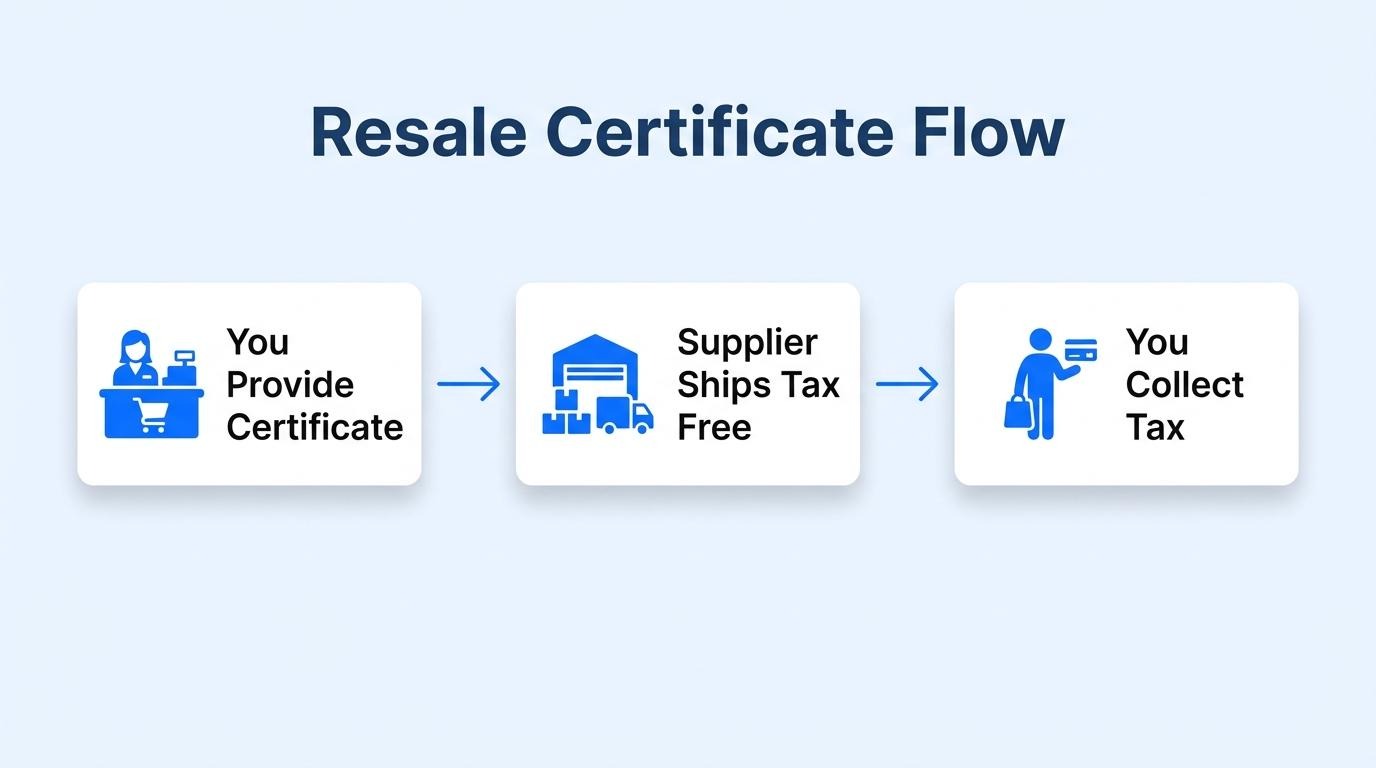
A resale certificate in dropshipping is a state-issued document proving that a purchase is made for resale, not personal use. When a retailer buys inventory (or directs a supplier to ship on its behalf), the resale certificate removes sales tax from that wholesale transaction. Tax is instead collected from the end customer at the point of final sale.
In a typical drop-ship arrangement, three parties are involved: the retailer, the supplier, and the end customer. The retailer provides the resale certificate to the supplier so the supplier does not charge sales tax on the wholesale transfer. The retailer then collects and remits sales tax on the retail sale to the customer. Without a valid resale certificate on file, the supplier must charge tax, which can result in double taxation on the same product.
The Streamlined Sales Tax (SST) exemption certificate applies to drop shipping by providing a standardized, multi-state form that drop shippers can accept in place of individual state certificates. According to the Streamlined Sales Tax Governing Board's Form F0003, the drop shipper may accept an ID number to claim the resale exemption, and that ID number may include one issued by another state. This is particularly useful because drop-ship transactions often span multiple state jurisdictions.
Not all states participate in the SST agreement, so sellers operating in non-member states may still need state-specific exemption forms. Keeping a current SST certificate on file simplifies compliance when fulfilling orders across participating states.
You should collect or provide a tax exemption certificate whenever a drop-ship transaction involves a wholesale transfer between the supplier and the retailer. Key scenarios include:
Certificates should be collected before the transaction occurs, not retroactively. Most states require sellers to retain exemption certificates for at least three to four years in case of audit. Missing or expired certificates shift the sales tax liability back to the party that failed to collect them, making proactive documentation one of the simplest ways to avoid unnecessary tax exposure.
Understanding when certificates apply sets the stage for the next step: calculating the correct sales tax rate on each dropshipped order.
You calculate and collect sales tax on dropshipped products by determining the correct tax rate for each customer's delivery address, applying it at checkout, and remitting collected tax to each state on schedule.
Sales tax calculation in dropshipping requires identifying the applicable rate, configuring your store to collect it, and filing returns with every state where you hold nexus. Once you exceed a state's economic nexus threshold, collection responsibility falls on you as the seller of record. According to the New Jersey Division of Taxation, as of November 1, 2018, a remote seller must register, collect, and remit New Jersey Sales Tax if gross revenue from sales delivered into the state exceeds $100,000, or if the seller completed 200 or more separate transactions, in the current or prior calendar year.
The core steps for calculating and collecting sales tax on dropshipped orders are:
For dropshippers selling across dozens of states, manual rate lookups become impractical quickly. Automating tax calculation at the platform level is one of the most effective ways to avoid misapplied rates and missed filings. Understanding the rates and deadlines involved sets the stage for managing international supplier obligations.
Dropshipping business owners pay federal income taxes based on their business structure. The three most common structures are sole proprietorships, single-member LLCs, and S-corporations, each with different filing requirements.
A sole proprietor dropshipper owes federal income tax on all net business profit, reported on Schedule C and flowing directly to the owner's personal Form 1040. According to the Congressional Research Service's analysis of federal individual income tax brackets, seven statutory rates have been in effect since 2018: 10%, 12%, 22%, 24%, 32%, 35%, and 37%. Net profit is calculated after deducting allowable business expenses from gross revenue. Because no separate business return exists, all dropshipping income is taxed at the owner's individual marginal rate. Sole proprietors also owe self-employment tax on this same net profit, which is covered in a later section.
An LLC dropshipper owes federal income tax based on how the IRS classifies the entity. Under 26 CFR 301.7701-3(b)(1), a single-member LLC is disregarded as an entity separate from its owner unless it elects otherwise. This means a single-member LLC files taxes identically to a sole proprietor, with all profit reported on Schedule C at individual rates. A multi-member LLC defaults to partnership taxation, where profits pass through to each member's personal return via Schedule K-1. Either type can elect S-corp or C-corp treatment by filing the appropriate IRS form. Choosing the right election matters; it directly affects how much self-employment tax applies to the owner's income.
An S-corp dropshipper owes federal income tax on their pro rata share of the corporation's income. Under 26 U.S.C. § 1366(c), each shareholder's gross income includes their proportional share of the S-corporation's gross income, which passes through to the shareholder's personal return. The S-corp itself files an informational Form 1120-S but pays no entity-level federal income tax. The key advantage is splitting income between a reasonable salary (subject to payroll taxes) and distributions (not subject to self-employment tax). For dropshipping businesses generating consistent profit, this split can reduce the overall tax burden compared to sole proprietorship or default LLC filing.
Understanding how each structure handles federal income tax sets the foundation for the next critical layer: self-employment taxes.
Self-employment taxes apply to dropshipping income earned by sole proprietors and most LLC owners. These taxes fund Social Security and Medicare and are separate from federal income tax. The amount owed depends on your business structure and net earnings.
According to the IRS, the self-employment tax rate is 15.3%, consisting of 12.4% for Social Security and 2.9% for Medicare. Sole proprietors and single-member LLC owners pay this rate on net self-employment earnings reported on Schedule SE. The Social Security portion applies up to an annual wage base limit, while the Medicare portion has no cap.
S-corp dropshippers handle this differently. Only the reasonable salary paid to owner-employees is subject to payroll taxes at the same combined 15.3% rate, split between employer and employee. Profit distributions above that salary are not subject to self-employment tax, which is why many growing dropshipping businesses eventually elect S-corp status.
One often-overlooked detail: you can deduct the employer-equivalent half of your self-employment tax (7.65%) when calculating adjusted gross income. This reduces your overall income tax liability. For dropshippers generating consistent profit, factoring self-employment tax into quarterly estimated payments prevents underpayment penalties at year-end.
Understanding how deductible business expenses lower your taxable profit can further reduce your self-employment tax burden.
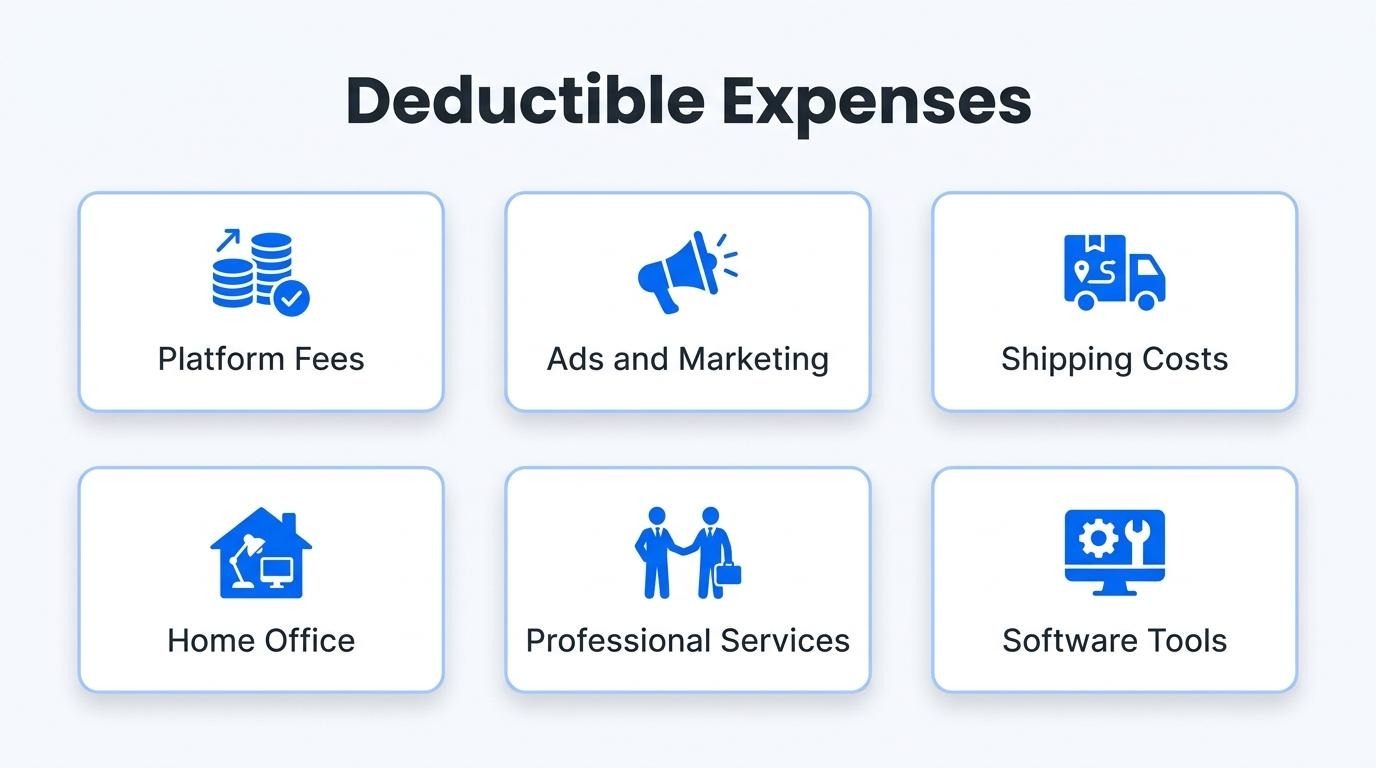
Dropshipping business expenses you can deduct on your taxes include any cost that is ordinary and necessary for running your ecommerce operation. Under 26 U.S.C. § 162, the IRS allows deductions for all ordinary and necessary expenses paid or incurred during the taxable year in carrying on any trade or business. For dropshippers, this covers a wide range of recurring and one-time costs tied directly to selling products online.
Common deductible dropshipping business expenses include:
Keeping detailed records of every expense is critical. The FDIC's Money Smart for Small Business guidance recommends retaining sales records for 3 to 7 years, depending on whether they support tax filings. Every receipt, invoice, and bank statement tied to a deductible expense should be organized and accessible in case of an IRS audit.
One often-overlooked strategy: tracking smaller recurring costs like app subscriptions, virtual assistant payments, and even bank fees. These individually small amounts compound over a full tax year and can meaningfully lower your taxable income. The key test for any deduction is whether the expense is both ordinary (common in the dropshipping industry) and necessary (helpful and appropriate for your business).
Understanding which expenses reduce your tax liability is one side of the equation; knowing your obligations when suppliers ship internationally adds another layer of complexity.
International dropshipping suppliers affect your tax obligations by introducing customs duties, import taxes, and de minimis threshold rules on top of domestic sales tax requirements. The subsections below cover duty liability and how the de minimis exemption applies to dropshipped imports.
Yes, you may owe customs duties on products dropshipped from overseas when shipments enter the United States above the duty-free threshold. U.S. Customs and Border Protection assigns duty rates based on each product's Harmonized Tariff Schedule classification, and the importer of record bears responsibility for payment. In most dropshipping arrangements, the supplier or freight forwarder acts as importer of record, but the cost is typically passed to the seller through product pricing or separate invoicing. Additional tariffs, such as Section 301 duties on China-origin goods, can further increase landed costs. Dropshippers should confirm with each overseas supplier who holds importer-of-record status before listing products.
The de minimis threshold applies to dropshipped imports by exempting individual shipments valued at $800 or less from formal customs duties and taxes. According to U.S. Customs and Border Protection's E-Commerce FAQs, this exemption covers merchandise arriving via all modes, including the international postal network, unless specifically excepted under a separate authority. Each package shipped directly from an overseas supplier to a U.S. customer is evaluated independently against this $800 ceiling. When a single order stays below the threshold, no duty is owed on that shipment. However, legislative proposals to narrow or eliminate this exemption surface regularly, so monitoring CBP updates is essential for any dropshipper relying on low-value international shipments.
Understanding import duty exposure helps dropshippers price products accurately before tackling domestic filing deadlines.
Sales tax filing deadlines and frequencies for dropshippers depend on the state where nexus exists and on the volume of tax collected. States assign monthly, quarterly, or annual filing schedules, and some adjust frequency as sales volume changes.
Most states assign a filing frequency when you register for a sales tax permit. The three standard schedules are:
States can change your assigned frequency based on your collection history. A dropshipper whose sales surge during Q4 may be moved from quarterly to monthly filing by the following year. Checking each state's taxpayer portal after the close of each calendar year is the most reliable way to confirm whether your frequency has shifted.
Deadlines vary by state but follow a general pattern. Quarterly filers in most states submit returns by January 20, April 20, July 20, and October 20. Monthly filers typically owe returns by the 20th of the following month. According to the U.S. Government Accountability Office's 2023 report (GAO-23-105359), one business reported spending $2.25 in compliance costs for every $1 of sales tax collected across 33 states over a 39-month period, which underscores how multi-state filing complexity compounds quickly for remote sellers.
Missing a deadline triggers penalties in nearly every state, even when the amount owed is small. Late-filing fees, interest charges, and potential permit revocation make calendar tracking essential. For dropshippers selling into multiple states, maintaining a centralized filing calendar or using automated tax software prevents missed due dates. Automating collection and remittance is one of the most practical steps a multi-state dropshipper can take to stay compliant without dedicating hours to manual tracking each month.
A dropshipping business should keep sales records, expense receipts, nexus tracking logs, exemption certificates, and supplier invoices. The subsections below are not broken into H3s, so here is what each record category covers.
Sales transaction records document every order: date, customer location, item sold, sale price, tax collected, and the tax rate applied. Because destination-based sourcing governs most states, each transaction must tie to the buyer's delivery address. These records support sales tax return filings and prove correct collection during audits.
Expense and supplier records include invoices from suppliers, shipping costs, platform fees, advertising spend, and software subscriptions. Under 26 U.S.C. § 162, only ordinary and necessary business expenses qualify as deductions, so retaining dated, itemized receipts for every cost is essential.
Nexus tracking logs monitor cumulative sales revenue and transaction counts per state. Since most states trigger economic nexus at $100,000 in gross sales (some at $250,000 or $500,000), a running log by state prevents missed registration deadlines.
Exemption certificates matter when purchasing inventory for resale. The Streamlined Sales Tax Exemption Certificate allows drop shippers to claim resale exemptions by providing a valid ID number. Keep copies on file for every supplier relationship.
Customs and import documentation applies when suppliers ship from overseas. Retain commercial invoices, HTS classification codes, and any duty payment records, especially given current Section 301 tariff changes on China-origin goods.
According to the FDIC's Money Smart for Small Business Recordkeeping Participant Guide, the suggested minimum retention period for sales records is generally 3 to 7 years, depending on whether records support tax filings. Matching your retention window to the longest applicable statute of limitations, typically three years for IRS audits but longer if underreporting exceeds 25%, is the safest approach for any dropshipping operation.
Organized records do more than satisfy auditors; they reveal which states are approaching nexus thresholds before collection becomes mandatory.
The penalties you can face for mishandling dropshipping taxes include late-filing fees, interest on unpaid balances, fraud charges, and loss of your sales tax permit. Consequences vary by tax type and jurisdiction.
Late filing and underpayment penalties for sales tax typically include a percentage-based fine plus daily or monthly interest on the outstanding balance. Most states impose penalties ranging from 5% to 25% of unpaid tax, with interest accruing from the original due date. Some states also revoke sales tax permits for repeated non-compliance, which blocks you from legally collecting tax on future orders. For dropshippers selling into dozens of states, a single missed filing deadline can trigger penalties in multiple jurisdictions simultaneously. Automating filing deadlines is one of the most effective ways to avoid this compounding risk.
IRS penalties for unreported dropshipping income include a failure-to-file penalty of 5% per month (up to 25%) and a failure-to-pay penalty of 0.5% per month on the unpaid balance. According to the IRS, the self-employment tax rate is 15.3%, covering 12.4% for Social Security and 2.9% for Medicare. Failing to report dropshipping profits means underpaying both income tax and self-employment tax, which compounds penalties and interest. The IRS can also impose accuracy-related penalties of 20% on underpayments caused by negligence or substantial understatement of income. Keeping clean records of all revenue and deductible expenses is the simplest defense against these charges.
Nexus violations occur when a dropshipping business fails to register, collect, and remit sales tax in states where it has established economic nexus. States can audit sellers retroactively and assess back taxes for the entire period of non-compliance, sometimes spanning several years. Interest and penalties stack on top of the unpaid tax balance. Because most states set their economic nexus threshold at $100,000 in gross sales or 200 transactions, fast-growing dropshippers can trigger obligations in new states without realizing it. Regularly reviewing nexus exposure across all active shipping destinations prevents surprise audit assessments.
Understanding these penalties makes the case for proactive tax automation across every state where you sell.
You automate dropshipping tax collection across multiple states by using tax calculation software integrated directly into your ecommerce platform. The subsections below cover how Shopline handles this natively and summarize the key tax takeaways from this guide.
Shopline handles multi-state tax compliance without separate tax apps by integrating Avalara AvaTax directly into the platform. Avalara AvaTax automatically calculates accurate taxes for each order based on the latest tax rules, eliminating the need to install and maintain a standalone tax application. Because the tax engine sits inside the same system as the storefront, rate lookups, exemption handling, and jurisdiction mapping happen at checkout without manual configuration per state. For dropshippers selling into dozens of states with different economic nexus thresholds, this built-in approach removes a significant layer of operational complexity that typically requires stitching together third-party tools.
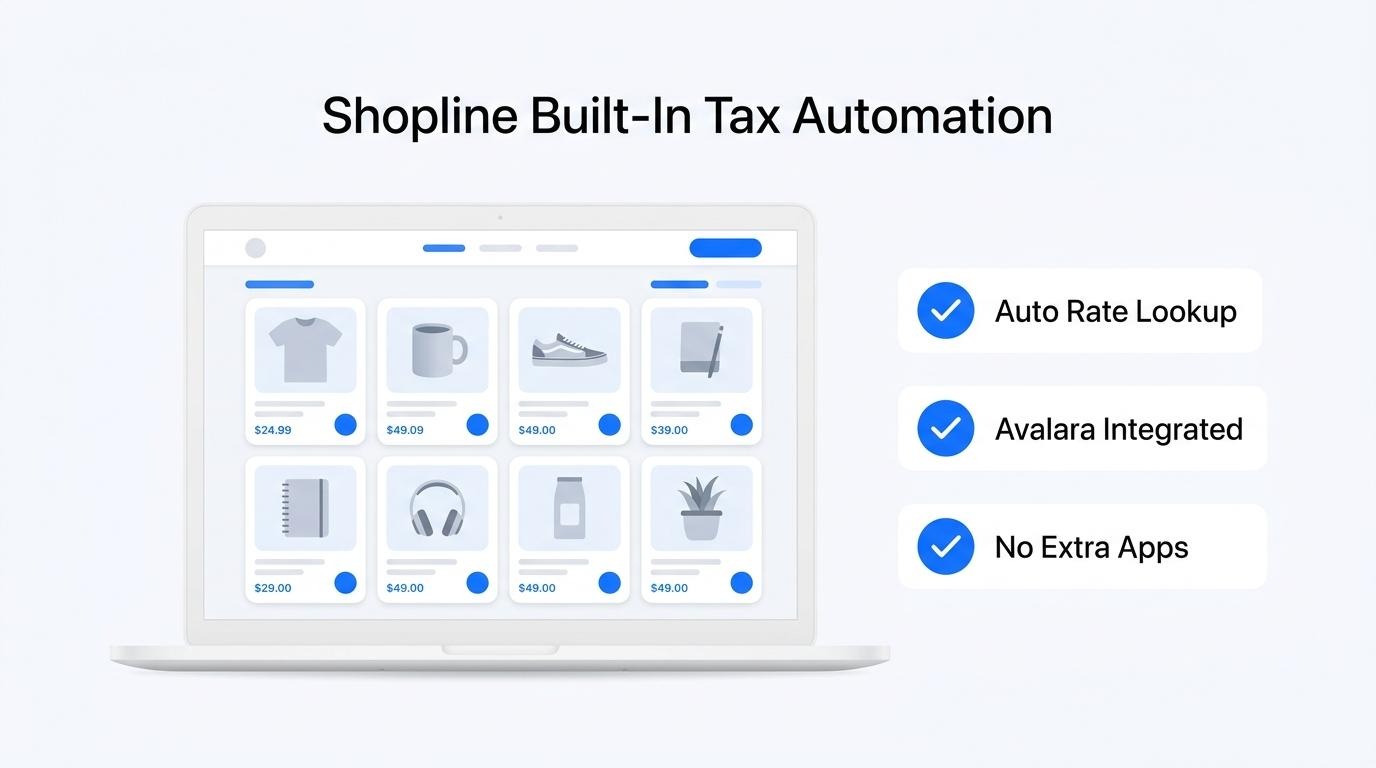
The key takeaways about dropshipping taxes covered in this guide are: