.png)
Choosing between wholesale and retail is a decision about how your business reaches buyers, controls margins, and deploys capital. Wholesale sells products in bulk to other businesses at lower per-unit prices; retail sells directly to end consumers at higher markups.
This guide covers how each model operates, the financial and operational trade-offs between them, profitability at different revenue stages, the factors that shape the right fit, hybrid strategies that combine both channels, and the role of ecommerce and unified systems in managing it all.
Wholesale and retail follow fundamentally different supply chain structures. Wholesale moves goods from manufacturers through intermediary distributors to retailers, with cash flow management and bulk logistics defining daily operations. Retail connects products to individual consumers through storefronts, online channels, and direct marketing, with customer acquisition and brand experience driving growth.
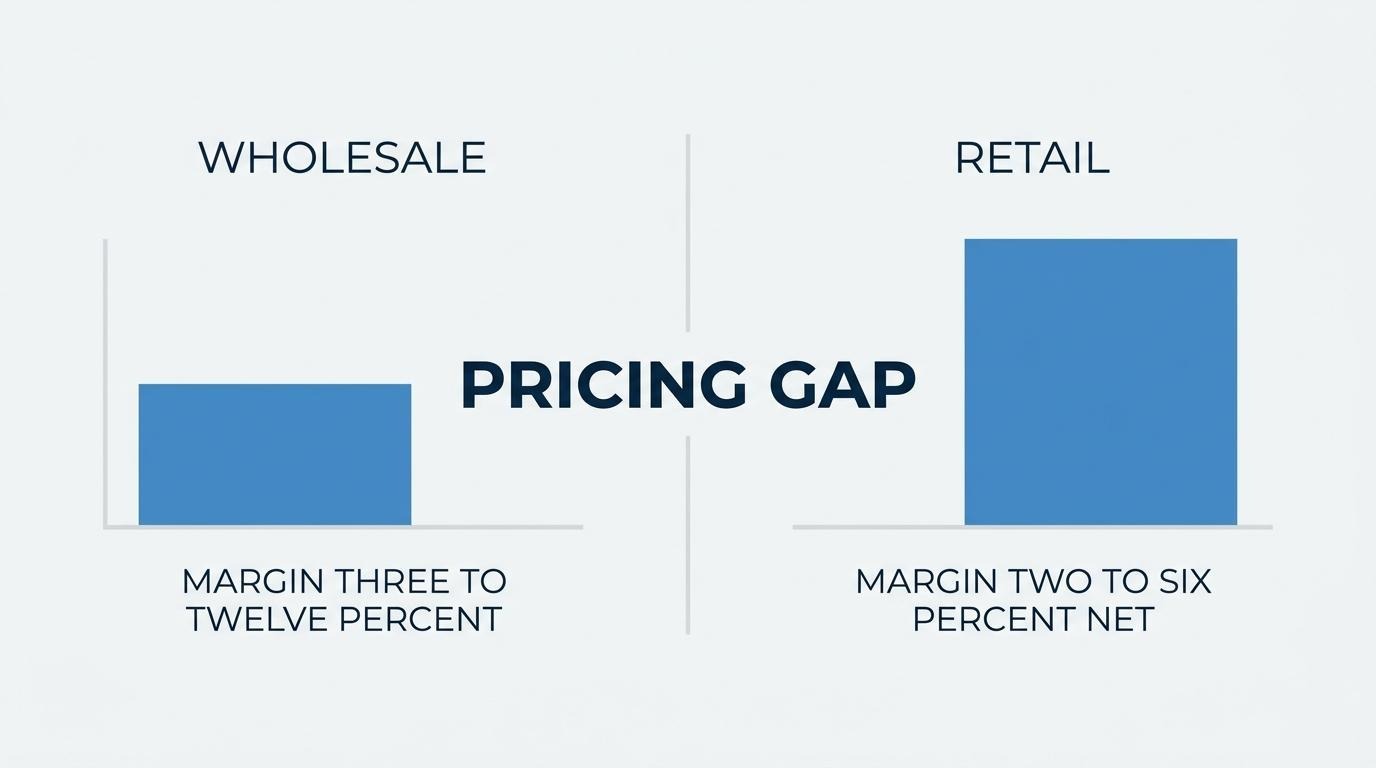
The financial gap between models is significant. Retail gross margins average around 30%, while wholesale gross margins sit closer to 13%. Yet net margins often converge, since retail absorbs heavier marketing, fulfillment, and overhead costs that wholesale avoids through bulk efficiency.
Profitability shifts at each revenue stage. At $1M, cash flow timing separates the two models more than margin percentages. By $10M, operational efficiency becomes the deciding factor. Past $50M, most successful brands run a hybrid split of wholesale and DTC, capturing volume stability from one channel and margin control from the other.
Product type, target audience, available capital, and team capacity all shape which model fits. Commoditized goods move well through wholesale; brand-driven products perform better in retail. Capital-constrained founders often start with DTC, while brands with production scale lean toward wholesale first.
As both channels grow, consolidating operations into a single system prevents the tool sprawl that fragments inventory, pricing, and customer data across disconnected platforms.
Wholesale is a business-to-business (B2B) model where goods move in bulk from manufacturers to intermediary distributors, who then sell those goods to retailers. Understanding how this model operates requires looking at the supply chain flow, bulk purchasing mechanics, and the financial tools that keep wholesale businesses solvent.
A wholesale business purchases products in large quantities directly from manufacturers at discounted per-unit prices. The wholesaler then resells those products to retailers, who mark them up and sell to end consumers. This three-tier structure, manufacturer to wholesaler to retailer, forms the backbone of most physical goods distribution.
Wholesale pricing depends on volume. Manufacturers offer lower per-unit costs because wholesalers commit to large purchase orders, often governed by minimum order quantities (MOQs). The wholesaler's margin comes from the spread between the manufacturer's bulk price and the price retailers pay, though that spread is typically narrow compared to retail markups.
Cash flow management is the operational challenge that defines wholesale more than any other factor. Because wholesalers buy inventory upfront but wait weeks or months for retailer payments, significant capital sits tied up in unsold or unpaid goods. According to Daylit, wholesale distributors use short-term financing tools like accounts receivable and accounts payable financing to bridge payment gaps, improve cash flow, and turn working capital into growth.
The wholesale supply chain also requires robust logistics infrastructure: warehousing, freight coordination, and inventory tracking systems capable of managing thousands of SKUs across multiple retail accounts. Unlike retail, where the focus is on individual customer experience, wholesale operations center on fulfillment reliability, order accuracy, and maintaining relationships with a smaller number of high-value business clients.
For brands evaluating this path, wholesale rewards operational efficiency and volume over brand storytelling. Understanding how retail operates on the other end of this supply chain clarifies where each model's strengths diverge.
Retail is the sale of goods or services directly to end consumers for personal use. It operates through physical stores, online storefronts, mobile apps, and social channels, connecting products to the people who actually use them.
Retail works by sourcing products from wholesalers or manufacturers, then selling those items in smaller quantities at a marked-up price to individual buyers. A retailer manages the entire customer-facing experience: merchandising, pricing, inventory, checkout, and post-purchase support. Each transaction typically involves one or a few units, and the sale completes in a single interaction rather than through a multi-step negotiation.
According to Track Hours, the average gross profit margin for general retail was 30.9% as of 2024, while the operating profit margin stood at 4.4%. Those higher per-unit margins come with a trade-off: retailers must invest in marketing, store operations, and customer acquisition to generate consistent traffic and conversions. Retail supply chain management coordinates sourcing, inventory, and distribution to deliver products efficiently and control costs at every stage.
For brands already generating meaningful revenue, the retail model offers direct control over pricing, brand presentation, and the customer relationship. That proximity to the buyer creates opportunities for repeat purchases and lifetime value growth that wholesale alone cannot replicate.
The key differences between wholesale and retail span pricing, order size, customer relationships, and sales timelines. According to DataWiz, the average net profit margin in retail typically ranges between 2% and 6%, depending on store type and market conditions. The sections below break down each difference.
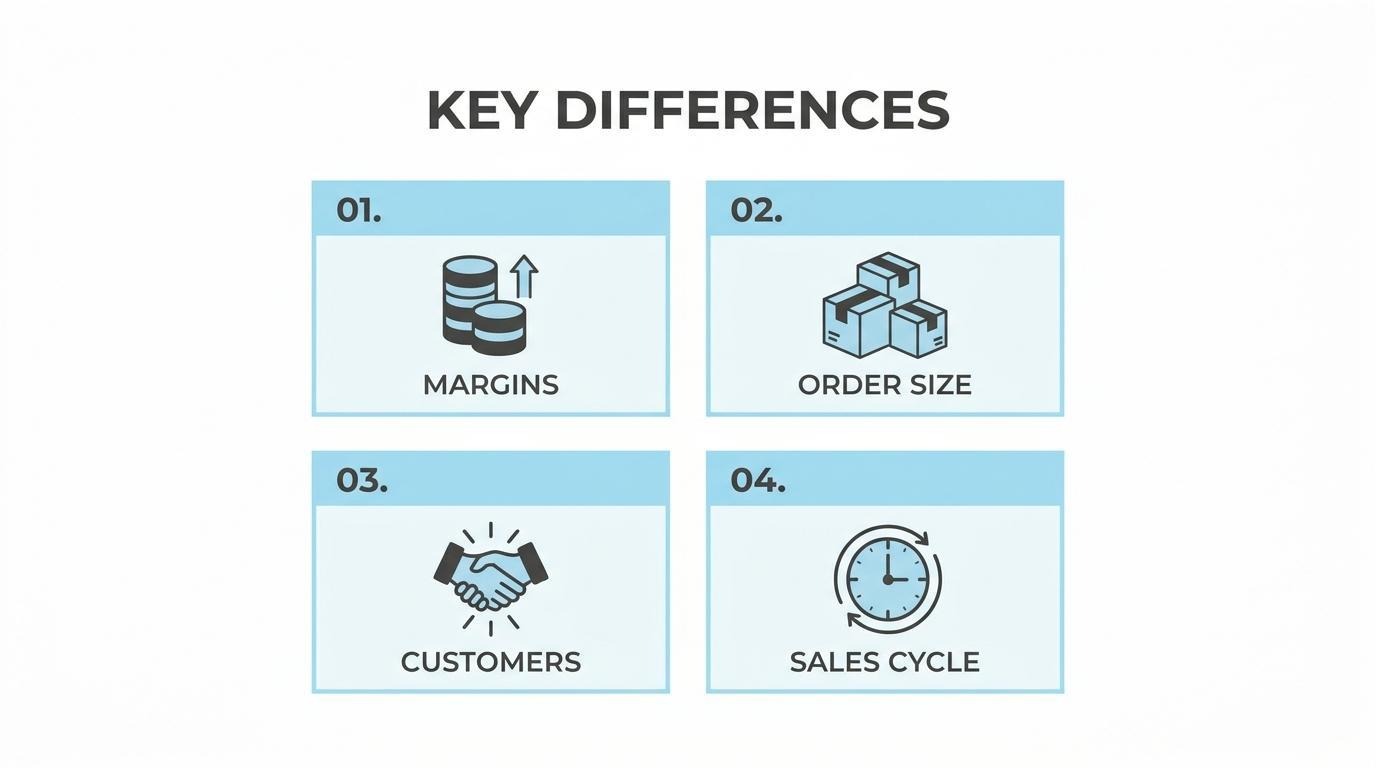
Wholesale and retail differ on pricing and margins primarily through markup structure and per-unit profitability. Retailers commonly use keystone pricing, which sets the final retail price at exactly double the wholesale cost, producing a 100% markup and a 50% gross margin. Wholesalers operate on thinner per-unit margins but move higher volumes; according to NstarFinance, wholesale ecommerce net margins typically range from 3% to 12%, with a typical wholesale discount sitting at 50% off retail.
Those thin wholesale margins create real cash flow pressure. When $500,000 in monthly inventory sits unpaid for 45 to 60 days, even a profitable quarter on paper can feel tight in practice. Retailers face lower volume risk per transaction but must absorb higher per-unit costs for marketing, storefronts, and customer acquisition.
Order volumes in wholesale far exceed those in retail on a per-transaction basis. Wholesalers enforce minimum order quantities that require buyers to purchase in bulk, often hundreds or thousands of units per SKU. Retail transactions involve individual items or small quantities purchased by end consumers.
This volume difference shapes everything downstream. Warehousing, shipping logistics, and inventory carrying costs scale differently when each order fills pallets versus fits in a mailer bag. For operators weighing both models, the capital locked in bulk inventory is one of the most underestimated factors in choosing wholesale over retail.
The customer relationship differs in each model through buyer type, communication frequency, and retention mechanics. Wholesale relationships are B2B: fewer accounts, higher lifetime value per account, and ongoing reorder cycles built on negotiated terms. Retail relationships are B2C, involving a much larger customer base where individual transaction values are lower and loyalty depends on brand experience.
Wholesale accounts often require dedicated account management, custom pricing tiers, and net payment terms. Retail customers expect seamless checkout, fast shipping, and personalized marketing. Managing both relationship types simultaneously is where many brands encounter tool sprawl, since the data and workflows for B2B and B2C rarely overlap cleanly.
Sales cycles in wholesale are significantly longer than in retail. According to HubSpot, B2B transactions require longer evaluation periods compared to B2C transactions, which typically involve shorter sales cycles, impulse purchases, and individual decision-makers. A wholesale deal may take weeks or months of samples, negotiations, and purchase order approvals before closing.
Retail sales cycles compress to minutes or seconds, especially in ecommerce. Despite this speed advantage, the sheer scale of both markets is enormous: U.S. merchant wholesaler sales have reached 9.7 trillion dollars, while U.S. retail sales are projected to hit 8.4 trillion dollars by 2028. Brands that understand these cycle differences can forecast revenue more accurately and allocate sales resources where they generate the highest return.
Understanding these structural differences sets the stage for evaluating the specific advantages and drawbacks of each model.
Selling wholesale offers high-volume revenue potential but requires trade-offs in margin, control, and capital. The sections below break down the main advantages and biggest drawbacks.
The main advantages of wholesale selling are larger order sizes, predictable revenue, and faster market reach. Each bulk purchase generates significant revenue per transaction, even at lower per-unit prices. Retailers place recurring orders on consistent schedules, which makes forecasting and production planning more reliable than chasing individual consumers.
Wholesale also scales distribution quickly. Instead of acquiring thousands of individual customers, a single retailer partnership places products in front of an established audience. According to IBISWorld, the U.S. Wholesale Trade industry has been growing at a CAGR of 4.7% between 2021 and 2026, reflecting steady demand from retail buyers.
Key advantages include:
For brands already producing at scale, wholesale remains one of the most capital-efficient paths to broad distribution.
The biggest drawbacks of a wholesale model are thinner margins, limited brand control, and heavy capital requirements. Because wholesale pricing typically sits around 50% off retail, the per-unit profit is significantly lower than selling directly to consumers. That discount compresses margins to a range where operational efficiency becomes critical.
Cash flow pressure compounds the issue. According to Paystand, wholesale businesses operating on 3–5% margins face cash flow blind spots when $500,000 in monthly inventory sits unpaid while waiting 45–60 days for customer payments.
Other notable drawbacks include:
Managing these trade-offs becomes especially complex for brands scaling past the first few million in revenue. With the advantages and drawbacks of wholesale clarified, the retail model presents its own distinct set of benefits and challenges.
The pros and cons of selling retail center on margin control, customer access, and operational demands. The advantages and drawbacks below cover what matters most when evaluating a retail model.
The main advantages of retail selling are higher per-unit margins, direct customer relationships, and full brand control. Retailers set their own prices, own the end-consumer experience, and collect first-party data that fuels retention and lifecycle marketing.
Key retail advantages include:
According to Midwest AWD, retail supply chain management coordinates sourcing, inventory, and distribution to cut costs and deliver products efficiently to customers. That coordination becomes a competitive advantage when paired with direct consumer feedback loops. For brands already managing meaningful volume, this visibility into both supply chain and customer behavior is where retail models compound their value over time.
The biggest drawbacks of a retail model are higher customer acquisition costs, greater operational complexity, and thinner net margins despite strong gross margins. Retailers bear every cost between production and the consumer's doorstep.
Core retail drawbacks include:
Scaling retail without consolidating operations typically leads to tool sprawl, where separate platforms for commerce, CRM, and marketing create data silos that slow decision-making. Understanding these trade-offs helps clarify whether a hybrid approach might offset retail's heavier operational load.
Neither wholesale nor retail is universally more profitable. Profitability depends on revenue scale, operating costs, and how efficiently each model converts volume into net margin. The following comparisons break down margin dynamics at three revenue stages: $1M, $10M, and $50M+.
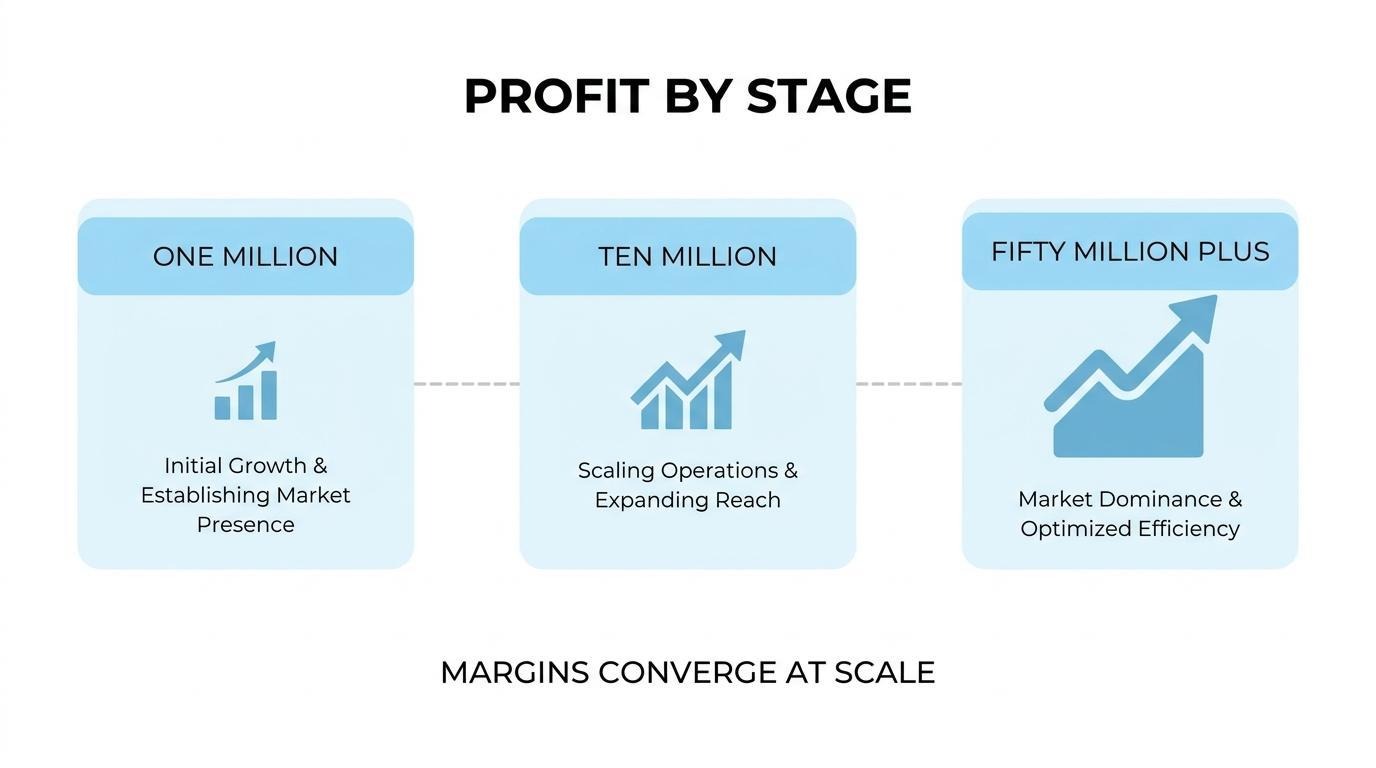
Profit margins at the $1M revenue stage differ sharply between wholesale and retail. A retail brand at this level typically earns gross margins around 30%, but after marketing, fulfillment, and customer acquisition costs, net margins often land between 2% and 6%. Wholesale operations generate lower gross margins, closer to 13%, yet carry fewer per-transaction costs since bulk orders reduce fulfillment overhead.
The catch for wholesale at this stage is cash flow. According to Paystand, wholesale businesses operating on 3–5% margins face cash flow blind spots when $500,000 in monthly inventory sits unpaid while waiting 45–60 days for customer payments. Retail collects payment immediately, making early-stage cash management simpler despite thinner net margins.
Profit margins at the $10M revenue stage begin converging as both models benefit from scale. Retail brands that have optimized customer acquisition and built repeat-purchase loops can push net margins toward 6% or higher, especially in categories like apparel and beauty. Wholesale operations at this level leverage larger order volumes to negotiate better supplier pricing, which improves the gap between their roughly 13% gross margin and their 3–7% net margin.
Operational complexity becomes the deciding factor here. Retail at $10M requires significant investment in marketing, returns processing, and customer service. Wholesale at $10M requires fewer customer touchpoints but demands tighter inventory management and credit risk assessment across a growing buyer base. For most operators, the model that matches existing team strengths will yield better margins at this stage.
Profit margins at $50M and beyond increasingly favor hybrid approaches over a single model. Pure wholesale operations at this scale produce net margins around 7%, according to Q2 2026 CSIMarket data showing the wholesale industry's net margin at 7.01%. Pure retail typically holds net margins between 4% and 5%, with operating margins remaining relatively stable across two decades.
At this revenue tier, the strongest profitability often comes from combining both channels. Brands that sell wholesale to expand distribution while maintaining direct retail for higher-margin sales capture advantages from each model. The real profitability lever at $50M+ is not the model itself; it is operational efficiency, specifically how well inventory, pricing, and customer data flow across channels without requiring separate systems for each.
Understanding margin dynamics at each stage sets the foundation, but profitability alone does not determine the right model.
The factors you should consider when choosing a model include your product type, target audience, available capital, and operational resources. Each shapes whether wholesale, retail, or a hybrid approach fits best.
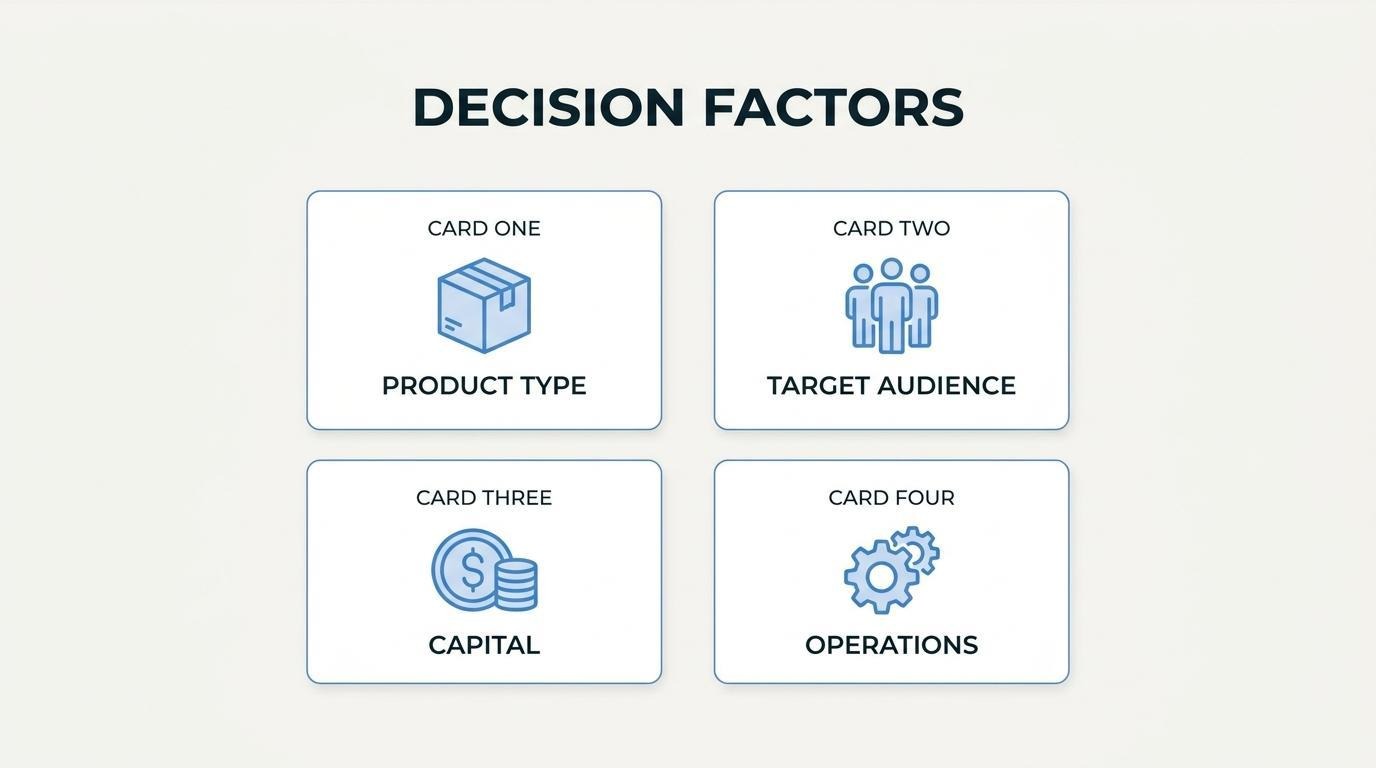
Your product type influences the decision by determining which sales channel delivers the strongest margin and turnover. Commoditized goods with thin differentiation, such as basic apparel blanks, cleaning supplies, or standardized electronics, move efficiently through wholesale because volume compensates for lower per-unit margins. Products that rely on branding, storytelling, or customization perform better in retail, where you control the presentation and can command premium pricing. Perishable or trend-driven items often favor retail's shorter inventory cycles, while durable, shelf-stable products suit wholesale's bulk distribution model. If your product requires education or demonstration before purchase, a direct retail channel gives you that opportunity.
Your target audience shapes the right model by defining whether you sell to businesses or end consumers. Wholesale targets B2B buyers: retailers, distributors, and procurement teams who purchase in large quantities on negotiated terms. Retail targets B2C buyers: individual consumers making smaller, more frequent purchases. B2B buyers evaluate purchases over longer cycles and prioritize reliability, pricing tiers, and minimum order quantities. B2C buyers respond to brand experience, convenience, and impulse triggers. If your ideal customer is another business that resells or integrates your product, wholesale is the natural fit. If your ideal customer uses the product personally, retail gives you a direct relationship and fuller margin capture.
Your available capital affects the choice because wholesale and retail demand very different upfront investments. Wholesale requires significant inventory capital. According to Paystand, wholesale businesses operating on 3–5% margins face cash flow blind spots when $500,000 in monthly inventory sits unpaid while waiting 45–60 days for customer payments. Retail typically requires less initial inventory but more spending on storefront setup, marketing, and customer acquisition. Short-term financing tools like accounts receivable and accounts payable financing can bridge wholesale payment gaps; however, a retail-first approach often lets capital-constrained brands start generating revenue faster. For most founders choosing between models, capital availability is the single most underestimated factor in the decision.
Your operational resources factor in by determining whether you can manage the complexity each model demands. Wholesale operations require warehouse infrastructure, bulk logistics coordination, dedicated account management for B2B clients, and systems for tracking large purchase orders. Retail operations require marketing teams, customer service, storefront management (physical or digital), and returns processing. A lean team of two to three people can often launch a retail storefront; wholesale typically needs specialized roles sooner. The operational question is not just headcount but also systems: order management, inventory tracking, and fulfillment workflows all scale differently depending on the model.
Understanding these decision factors sets the stage for exploring whether a hybrid approach could combine the strengths of both models.
Yes, you can combine wholesale and retail in a hybrid model. This approach splits revenue across B2B and DTC channels, balancing volume with margin. The following sections cover when a hybrid strategy fits, how to handle pricing conflicts, and how to keep inventory accurate.
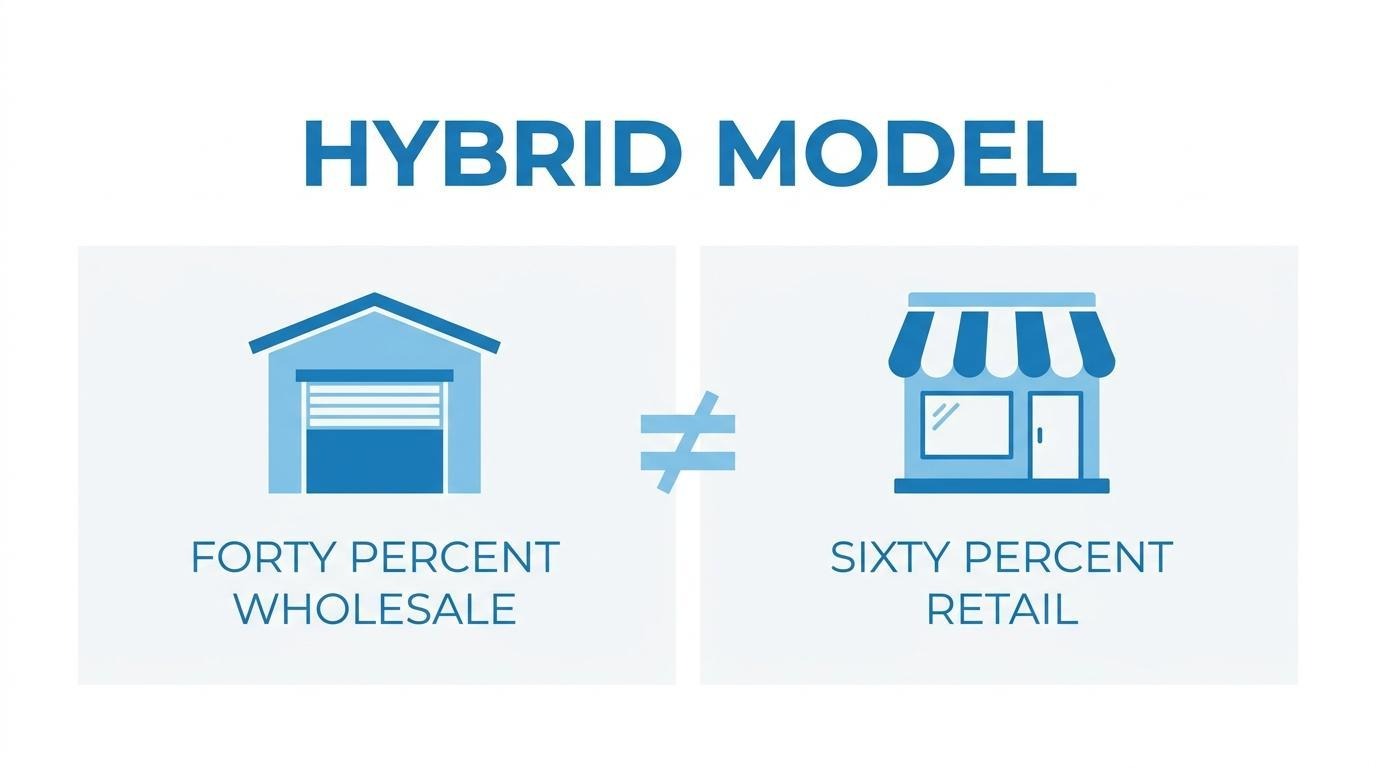
A hybrid wholesale-retail strategy makes sense when a brand has outgrown a single channel and needs both volume stability and margin control. Wholesale provides predictable bulk orders, while DTC retail preserves higher per-unit profit and direct customer relationships. According to ATTN Agency, the hybrid DTC and wholesale model is becoming the dominant strategy for brands scaling past $10M ARR, with successful brands shifting to a 40–60% DTC and 40–60% wholesale split by years four to five. Brands selling products with broad retail appeal alongside a loyal direct audience are the strongest candidates. For most scaling brands, launching wholesale first to fund operations and layering in DTC as the brand matures is a practical sequencing approach.
You manage pricing conflicts in a hybrid model by establishing clear pricing tiers and channel boundaries from the start. The core challenge: if retail partners discover a brand undercutting them on its own DTC site, those relationships erode fast. Effective conflict management includes:
Pricing discipline matters more than pricing creativity here. Brands that treat MAP enforcement as optional eventually lose their best retail partners.
You keep inventory accurate across both channels by centralizing stock data in a single system that updates in real time as orders flow from wholesale and retail simultaneously. Without a shared inventory view, overselling on one channel while sitting on dead stock in another becomes inevitable. According to McKinsey & Company, B2B customers use an average of ten interaction channels in their buying journey, and more than half want a true omnichannel experience with seamless switching across channels. That expectation makes real-time inventory visibility non-negotiable.
Key practices for cross-channel inventory accuracy include:
With inventory systems aligned, the next consideration is how to structure wholesale pricing and minimum orders effectively.
You set up wholesale pricing by calculating your cost of goods, adding a margin that still lets retailers profit at resale, and defining minimum order quantities that protect your unit economics. The process involves three core steps: building a tiered price structure, setting MOQ thresholds, and formalizing terms in a wholesale agreement.
Start with your cost floor. Calculate total cost per unit, including materials, labor, packaging, and shipping. Your wholesale price must sit above this floor by enough to sustain operations. According to Femfounded, keystone pricing sets the retail price at exactly double the wholesale cost, producing a 100% markup and 50% gross margin. If your retail price is $40, your wholesale price lands near $20 under this model.
Build volume-based tiers. Offering two or three price breaks encourages larger orders:
Set minimum order quantities carefully. Minimum order quantity is the smallest volume a supplier requires per purchase order. It influences inventory levels, order frequency, and capital allocation. Set your MOQ high enough to cover fulfillment costs per order, but low enough that new retail buyers can test your products without excessive risk. Many brands start with MOQs of 12–24 units per SKU for initial orders and raise thresholds for reorders once the relationship is established.
Formalize everything in writing. A wholesale agreement should specify pricing tiers, MOQ per SKU, payment terms (net 30 or net 60), shipping responsibilities, and return policies. Clear terms prevent disputes and protect cash flow on both sides.
For brands managing wholesale pricing alongside a DTC storefront, keeping both channels in one system eliminates the manual reconciliation that creates pricing errors at scale.
You build a retail pricing strategy that protects margins by anchoring prices to true landed costs, selecting a markup method that covers overhead, and adjusting based on competitive positioning. The approaches below cover cost-based foundations, competitive calibration, and margin monitoring.
A retail pricing strategy starts with knowing every cost that touches a product before it reaches the shelf. Landed cost includes the wholesale or production price, inbound freight, duties, packaging, and any handling fees. Without an accurate landed cost figure, every markup calculation sits on unstable ground. According to Femfounded, keystone pricing sets the final retail price at exactly double the wholesale or production cost, producing a 100% markup and a 50% gross margin. Keystone works well as a baseline, but products with high shipping weight or seasonal demand often require adjusted multipliers to preserve target margins.
Competitive pricing layers market awareness on top of cost calculations. Monitoring comparable products across direct competitors and marketplace listings reveals the price band customers expect. Pricing above that band requires clear differentiation through branding, bundling, or exclusive features. Pricing below it may drive volume but compresses margins quickly, especially when promotional discounts stack on top. The goal is positioning within the competitive range at a point where perceived value justifies your markup.
Margin protection requires ongoing measurement, not a one-time formula. Track gross margin by SKU, not just in aggregate, because underperforming products can quietly erode overall profitability. As of 2024, according to Track Hours (Get Harvest), the average gross profit margin for general retail was 30.9%, while the operating profit margin stood at 4.4%. That gap between gross and operating margin highlights how overhead, returns, and fulfillment costs eat into revenue after the initial sale. Reviewing margin reports monthly and adjusting prices or discontinuing low-margin SKUs keeps the strategy responsive rather than reactive.
Understanding how retail pricing protects per-unit margins sets the stage for how ecommerce is reshaping both wholesale and retail channels.
Ecommerce plays a central role in both wholesale and retail by serving as the top revenue-generating channel for organizations that offer it. DTC ecommerce and direct retail channels are reshaping how brands balance both models.
DTC ecommerce has changed the wholesale landscape by giving manufacturers and brands a direct path to end consumers, bypassing traditional retail intermediaries. According to data cited by a major ecommerce research source, DTC sales reached $240 billion in 2025, signaling that brands increasingly capture margin that previously went to wholesale partners.
This shift pressures traditional wholesalers to add value beyond distribution. Brands that once relied solely on bulk orders now use their own online storefronts to test products, control pricing, and build first-party customer data. For wholesale operators, the implication is clear: competing on logistics alone is no longer enough when manufacturers can sell direct with a single storefront.
Wholesale brands are adding direct retail channels to capture higher per-unit margins, own customer relationships, and reduce dependency on a small number of B2B accounts. Ecommerce now generates more than one-third of revenue for organizations that offer it, while in-person revenue has dropped five percentage points year over year, according to McKinsey's research on B2B growth trends.
The math reinforces the move: wholesale net margins typically sit between 3% and 12%, but selling direct at retail pricing lets brands recapture the markup they previously handed to retailers. A hybrid approach, blending wholesale volume with DTC margin, has become the scaling playbook for brands that want both reach and profitability. For brands already managing complexity across channels, consolidating wholesale and DTC operations into fewer systems becomes a practical priority as order volume grows.
You manage wholesale and retail without tool sprawl by consolidating both channels into a single unified commerce platform. The following sections cover what changes when data lives in one system and the key takeaways for choosing your model.
What changes when wholesale and DTC data live in one system is that inventory, pricing, and customer records resolve to a single source of truth instead of being scattered across disconnected tools. The wholesale supply chain, which involves procuring goods from suppliers and distributing them to other businesses, generates entirely different data patterns than DTC orders. When these streams feed separate systems, teams spend hours reconciling stock counts, price lists, and fulfillment queues.
According to Kibo, a unified commerce platform connects all backend commerce solutions into a fully unified commerce data model, delivering a consistent omnichannel experience whether online, on mobile, or in-store. For brands running both B2B and DTC channels, this eliminates the sync failures that typically multiply as order volume grows. SHOPLINE is one option for brands consolidating wholesale and retail operations into a single system rather than managing separate app stacks for each channel.
The key takeaways about choosing wholesale vs. retail come down to matching your model to your capital, margins, and operational capacity:
The right choice is rarely permanent. Most scaling brands revisit their channel mix as revenue grows and operational complexity shifts.
.png)
.png)