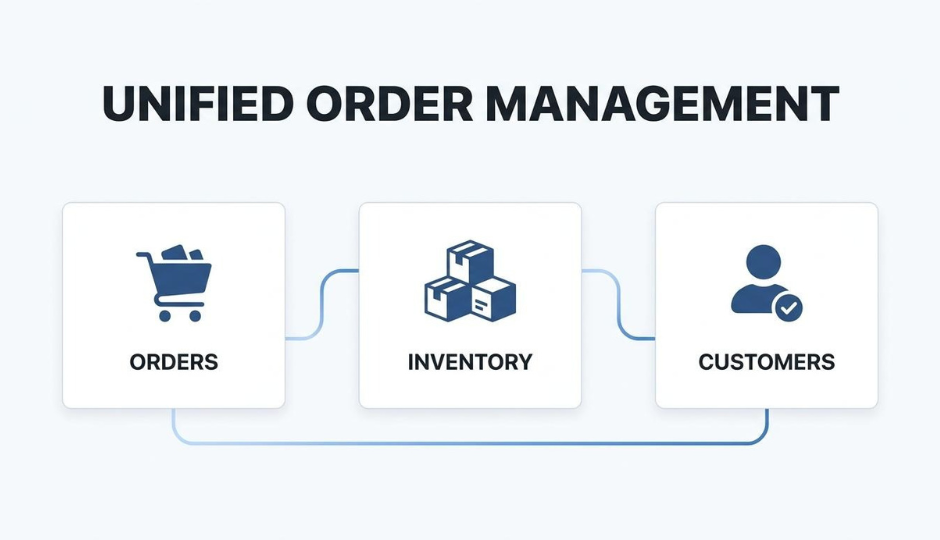
Omnichannel order management is the practice of unifying every sales channel's orders, inventory, and customer data into a single operational system so brands can fulfill purchases faster, reduce errors, and deliver consistent experiences regardless of where a customer buys.
This guide covers the business case for unified order management, the core system components that make it work, fulfillment strategies for cross-channel operations, the step-by-step process for building and implementing a strategy, and how to measure performance once the system is live.
Fragmented order systems don’t just create operational headaches–they directly erode customer experience and leave revenue on the table. When order data lives in separate tools for web, retail, and marketplace channels, customers encounter conflicting stock availability and disjointed support, while brands lose sales on inventory that sits idle in one channel as demand goes unfulfilled in another.
A functional omnichannel system depends on five operational layers: a centralized order repository, real-time inventory visibility across all locations, distributed order orchestration that routes each order to the optimal fulfillment point, a unified customer data layer, and standardized returns management. Each layer addresses a specific failure mode that siloed systems create.
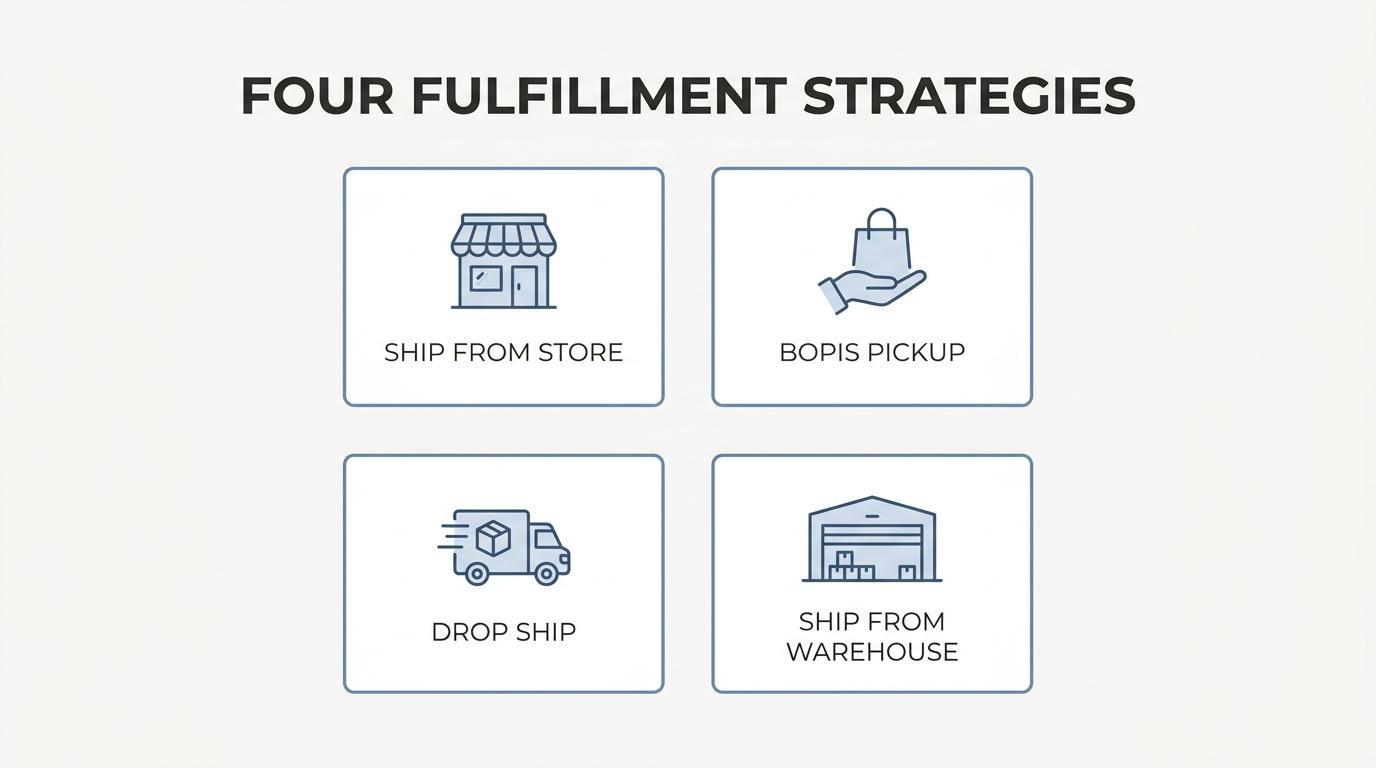
Fulfillment execution varies by context. Ship-from-store converts retail locations into distributed shipping nodes, BOPIS bridges online convenience with in-store pickup, drop-ship extends catalog breadth without warehousing costs, and ship-from-warehouse centralizes stock for consistency. Matching each strategy to channel demand is what separates scalable operations from reactive ones.
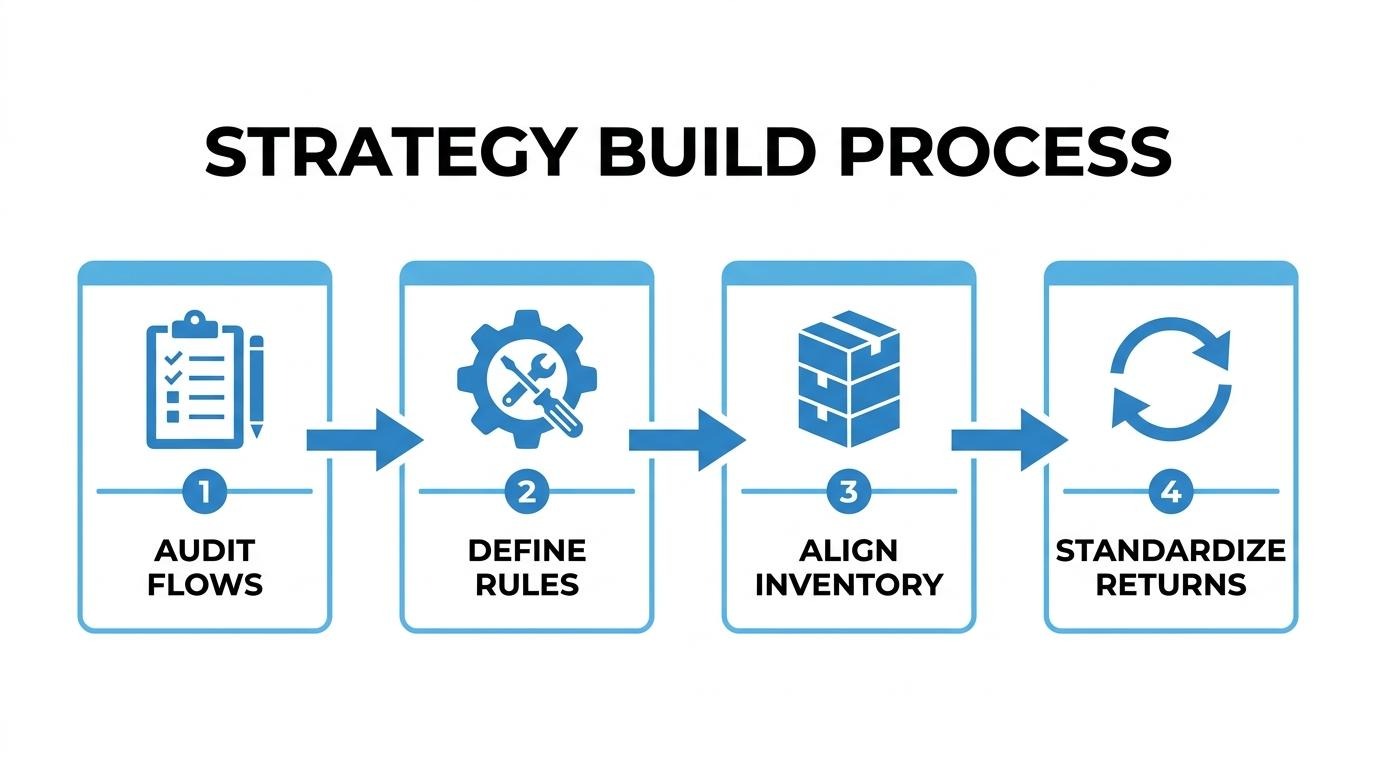
Building the strategy requires auditing current order flows, defining routing rules and fulfillment priorities, aligning inventory buffers to channel velocity, and standardizing returns across every touchpoint. The technology stack connecting these layers (POS integration, real-time inventory sync, and CRM unification) determines whether the system holds under volume.
We also cover the implementation challenges scaling brands face most often, the KPIs that reveal whether the system is performing, and what changes when order management consolidates into one platform.
Omnichannel order management matters for DTC brands because fragmented order systems degrade customer experience and leak revenue. The sections below cover how order fragmentation affects buyers and what disconnected channels cost in lost sales.
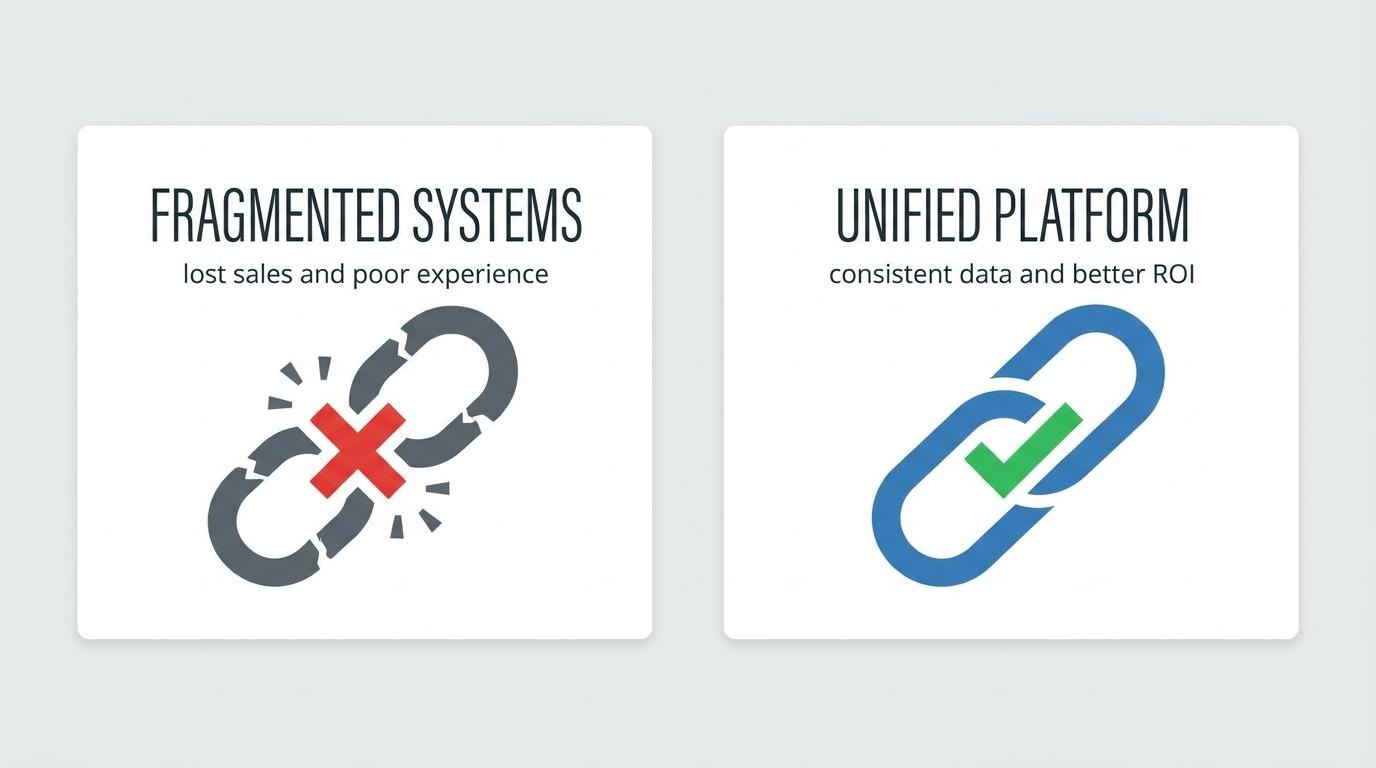
Order fragmentation affects customer experience by creating inconsistent information across touchpoints. When order data lives in separate systems for web, retail, and marketplace channels, customers encounter conflicting stock availability, duplicate communications, and disjointed support interactions.
According to a Zendesk customer experience report, roughly 54 percent of organizations identified fragmented or siloed data as their biggest barrier to leveraging data for customer experience. That gap shows up as mismatched order statuses, slower resolution times, and a lack of purchase history visibility for support agents.
By 2026, 89 percent of businesses are expected to compete primarily on customer experience. Brands that allow order fragmentation to persist risk falling behind competitors who have already unified their data layer.
Revenue is lost when online and offline orders are disconnected because inventory sits idle in one channel while demand goes unfulfilled in another. A customer who sees "out of stock" online, when units are available in-store, represents a missed sale that a connected system would have captured.
Disconnected channels also inflate return costs and prevent cross-channel upselling. Without a shared order record, store associates cannot reference online purchase history to recommend complementary products, and brands lose visibility into true demand signals across locations.
For scaling DTC brands running both ecommerce and physical retail, this disconnect compounds quickly. Every siloed order is a data gap that weakens inventory planning, distorts demand forecasts, and erodes the repeat-purchase behavior that drives long-term growth. Understanding these costs sets the stage for examining the core components that hold an omnichannel system together.
The core components of an omnichannel order management system are a centralized order repository, real-time inventory visibility, distributed order orchestration, unified customer data, and returns management. Each component addresses a specific operational layer.
A centralized order repository is a single database that captures every order from every sales channel. Web, marketplace, POS, and social commerce transactions flow into one record. This eliminates the need to reconcile separate systems manually.
Without centralization, teams waste hours cross-referencing spreadsheets and channel-specific dashboards. A unified repository assigns each order a single lifecycle record, from placement through fulfillment and post-purchase. It also provides the foundation that downstream components, like routing and returns, depend on to function accurately.
Real-time inventory visibility is the ability to see accurate stock levels across all locations and channels simultaneously. Warehouses, retail stores, and third-party fulfillment centers each report counts into a shared system that updates with every sale, return, and transfer.
Without this synchronization, overselling and stockouts become routine. A brand selling on its website and through physical retail needs both channels drawing from the same inventory truth. For scaling DTC brands managing five or more fulfillment nodes, even a 15-minute data lag creates order cancellations that erode customer trust.
Distributed order orchestration is the logic layer that routes each order to the optimal fulfillment location. The system evaluates factors such as proximity to the customer, current stock levels, shipping cost, and fulfillment capacity before assigning an order.
According to McKinsey, best-in-class omnichannel operations can fulfill orders within two hours, while most operations average four to eight hours for pick-and-pack. Intelligent routing is what separates those tiers. Rules-based orchestration also enables fulfillment strategies like ship-from-store and buy-online-pick-up-in-store without requiring manual intervention for each order.
A unified customer data layer resolves every interaction, whether online, in-store, or through social channels, to a single customer profile. Purchase history, communication preferences, and loyalty status all live in one record rather than scattered across disconnected tools.
Roughly 54 percent of organizations cite fragmented or siloed data as their biggest barrier to leveraging data for customer experience, according to Zendesk. When order data and customer data share the same layer, personalization becomes operationally feasible. Segment-specific promotions, accurate lifetime value calculations, and consistent service all depend on this single-record architecture.
Returns and exchange management is the component that standardizes reverse logistics across all channels. It governs policies for in-store returns of online orders, prepaid shipping labels, restocking workflows, and exchange routing.
The National Retail Federation reported that retailers estimate 16.9% of annual sales in 2024 will be returned, totaling approximately $890 billion. At that scale, inconsistent return processes across channels create margin erosion and customer frustration. A unified returns engine applies the same rules regardless of where the purchase originated or where the return is initiated. Understanding these core components sets the stage for distinguishing omnichannel from multichannel order management.
Omnichannel order management differs from multichannel order management in how channels share data, inventory, and customer context. Multichannel treats each sales channel as an independent operation, while omnichannel unifies them under a single system.
The distinction matters most at the operational level. In a multichannel setup, each channel maintains its own inventory pool, order processing workflow, and customer records. A brand might sell through its website, a marketplace, and a retail location, but each operates in isolation. Orders placed on one channel have no visibility into stock levels or customer history from another. This creates duplicate inventory counts, inconsistent fulfillment timelines, and fragmented customer profiles.
Omnichannel order management connects every channel to a centralized data layer. Inventory updates in real time across all touchpoints. A customer who browses online and purchases in-store appears as a single record, not two separate entries. Order routing pulls from the nearest or most cost-effective fulfillment point regardless of where the purchase originated.
The cost and complexity gap between these approaches is significant. According to a 2024 comparison by TK Turners, average implementation costs for an order management system range from $10,000 to over $500,000, depending on the complexity and scale of the retail operation. Brands running siloed multichannel systems often pay at the lower end per channel but accumulate redundant costs across multiple disconnected tools. A unified omnichannel system consolidates that spend into a single platform investment.
Measurement also diverges between the two models. Multichannel reporting tracks each channel independently, making cross-channel attribution difficult. Omnichannel systems enable metrics like order placement percentage, which measures the share of orders from each channel using the formula: (Number of sales via channel A / Total sales) x 100. This visibility reveals which channels drive volume and where fulfillment bottlenecks emerge.
For brands scaling past the $1M revenue mark, the multichannel approach tends to break under operational weight. Disconnected systems require manual reconciliation, increase error rates, and obscure the customer journey. Omnichannel order management eliminates those gaps by design, not by adding more integrations on top of fragmented infrastructure.
Understanding this operational divide sets the stage for choosing the right fulfillment strategies to support a unified approach.
Order fulfillment strategies that support omnichannel operations include ship-from-store, buy online pick up in store (BOPIS), drop-ship fulfillment, and ship-from-warehouse. Each approach routes orders differently based on inventory location, customer proximity, and cost efficiency.
Ship-from-store fulfillment works by converting retail store inventory into a distributed shipping network. Store associates pick, pack, and ship orders placed online directly from the store closest to the customer's delivery address.
This model reduces last-mile shipping distances and costs while preventing overstock at physical locations. It requires real-time inventory visibility so the order management system can identify which store has the item in stock and route accordingly.
According to McKinsey, best-in-class omnichannel operations can fulfill orders within two hours of purchase, compared to four to eight hours for standard pick-and-pack processes. Ship-from-store is one of the primary methods that enables this speed advantage, particularly for brands operating multiple retail locations.
A brand should use buy online pick up in store when customers want immediate product access without shipping delays or delivery fees. BOPIS bridges online convenience with in-store availability.
This strategy works best when a brand operates physical locations within reasonable proximity to its customer base. Key conditions that favor BOPIS adoption include:
Click-and-collect retail sales in the U.S. are estimated to reach $154.3 billion in 2025, a 16.2% increase from the prior year, according to ElectroIQ. For scaling DTC brands with retail footprints, BOPIS converts store locations into fulfillment assets rather than standalone cost centers.
Drop-ship fulfillment in an omnichannel context is a model where a third-party supplier ships products directly to the customer on behalf of the brand. The brand never holds that specific inventory in its own warehouse or store.
Within omnichannel operations, drop-shipping extends catalog breadth without increasing warehousing costs. A brand can list supplier-held products across its website, marketplaces, and even in-store ordering systems while the supplier handles physical fulfillment.
According to AppScenic, the global dropshipping market is projected to reach $301 billion in 2024 and grow to $476.1 billion by 2026. This growth reflects how brands increasingly use drop-ship as a complementary fulfillment layer alongside owned inventory, not a standalone business model.
Ship-from-warehouse handles cross-channel demand by centralizing inventory in dedicated fulfillment centers that serve all sales channels from a single stock pool. Orders from the website, marketplaces, and even store-assisted sales all draw from the same warehouse inventory.
This approach offers several advantages for scaling brands:
The trade-off is longer delivery times for customers far from the warehouse. Brands managing over 60% of their business through omnichannel strategies, as reported by the Economy and Society Journal in 2024, often combine ship-from-warehouse with ship-from-store to balance speed and cost across geographies.
With fulfillment strategies defined, the next step is building the operational framework that ties them together.
You build an omnichannel order management strategy by auditing existing order flows, defining routing rules, aligning inventory buffers to demand, and standardizing returns. Each step below covers one pillar of the process.
You audit current order flows across all channels by mapping every touchpoint where an order originates, moves, and resolves. This means documenting each channel's entry point, the systems it passes through, and where handoffs break down.
Start with these audit steps:
The goal is a complete picture of fragmentation before selecting technology or rewriting rules. Gaps found here directly shape routing logic and inventory allocation decisions in the next steps.
You define routing rules and fulfillment priorities by establishing decision logic that determines which fulfillment node handles each order based on proximity, stock levels, and cost. Without clear rules, orders default to a single warehouse regardless of whether a closer location holds inventory.
Key routing criteria include:
Priority sequencing matters as much as the rules themselves. For most scaling brands, proximity and availability should outrank cost optimization until fulfillment speed stabilizes across all channels.
You align inventory buffers with channel demand by reserving safety stock proportionally across each selling channel based on historical velocity and seasonal patterns. A single pooled inventory without channel-aware buffers leads to overselling on high-velocity channels and dead stock on slower ones.
According to McKinsey, winning in an omnichannel world demands excelling in all channels, from in-person to hybrid, inside sales, digital self-serve, and marketplaces. Meeting that standard requires buffer allocation that reflects each channel's actual contribution to total volume.
Practical alignment steps:
Static buffers are a common cause of fulfillment failure during peak periods; dynamic reallocation based on real demand signals separates operational brands from reactive ones.
You standardize the returns process across channels by creating a single returns policy and workflow that applies regardless of where the customer purchased or where they initiate the return. Inconsistent policies between web, store, and marketplace channels create friction and inflate processing costs.
A standardized returns framework includes:
Returns standardization is not just a customer experience play. It directly protects margin by reducing the manual labor, shipping costs, and inventory blind spots that compound when each channel manages returns independently. With returns standardized, the next consideration is what technology infrastructure supports all of these strategic layers.
The technology required to implement omnichannel order management includes a POS system, real-time inventory synchronization, and CRM integration. Each component connects a different layer of the operation.
A POS system plays the role of connecting in-store transactions to the broader order management ecosystem. It captures sale data, inventory changes, and customer information at the point of purchase, then feeds that data back to the central order repository.
Without POS integration, offline sales remain invisible to the rest of the operation. Orders placed in-store cannot trigger fulfillment logic, inventory adjustments, or customer profile updates across digital channels. SHOPLINE's native POS system integrates directly with its admin to connect products, orders, inventory, and member data across online and offline channels, according to SHOPLINE's Help Center documentation.
For scaling brands, the POS is not just a register; it is the bridge that prevents in-store activity from becoming a data silo.
Real-time inventory sync is critical across channels because without it, stock counts diverge the moment a sale occurs on any single channel. This divergence leads to overselling, canceled orders, and misallocated fulfillment resources.
When a customer purchases an item in-store, that unit must immediately decrement from availability on the website, marketplace listings, and any other active channel. Delays of even minutes create windows for duplicate sales on the same unit. According to a Zendesk report, roughly 54 percent of organizations identified fragmented or siloed data as their biggest barrier to leveraging data for customer experience.
Synchronized inventory is the technical prerequisite for every fulfillment strategy, from ship-from-store to BOPIS, because routing logic depends entirely on knowing what stock exists and where.
CRM integration improves order accuracy and personalization by resolving every transaction, regardless of channel, to a single customer record. This unified profile captures purchase history, preferences, communication opt-ins, and return behavior in one place.
Order accuracy improves because fulfillment teams see complete context: shipping preferences, past issues, and loyalty status inform how each order is handled. Personalization improves because marketing and merchandising teams work from real behavioral data rather than fragmented snapshots from disconnected tools.
Brands running separate CRMs for online and offline channels often find that the same customer appears as two different profiles, which distorts lifetime value calculations and fragments retention efforts. With CRM, inventory, and order data unified, measuring cross-channel attribution becomes the next operational priority.
The biggest implementation challenges for scaling brands include disconnected data between sales channels, tool fragmentation, and migration risk. Each creates operational drag that compounds as order volume grows.
You overcome disconnected data between POS and web by unifying both channels under a single order and customer data layer. When point-of-sale transactions live in one system and web orders in another, inventory counts diverge, customer profiles fragment, and order routing breaks down. According to a Zendesk report, roughly 54 percent of organizations stated that their biggest barrier to leveraging data for customer experience was fragmented or siloed data. The fix requires a shared data architecture where every transaction, regardless of channel, writes to the same record. Native POS-to-web integration eliminates the reconciliation lag that third-party connectors introduce.
Brands that rely on too many fragmented tools experience compounding operational costs, data inconsistencies, and slower execution speed. Each additional app in the stack introduces its own data model, sync schedule, and failure point. When an OMS, CRM, email platform, subscription tool, and POS each hold a partial view of the customer, no single system can route orders accurately or trigger lifecycle actions in real time. This is a common inflection point for brands scaling past the $1M–$10M range: what once felt like flexibility becomes a bottleneck. Consolidating onto fewer, natively integrated systems reduces both the technical debt and the manual reconciliation overhead that fragmented stacks demand.
You manage migration risk during implementation by phasing the rollout, preserving historical data integrity, and running parallel systems during transition. According to Doss, many enterprise-level order management platforms take six to twelve months to deploy, a significant timeline for rapidly growing brands. Key risk-reduction steps include:
For brands already managing real volume, the cost of a botched migration often exceeds the cost of the platform itself. Choosing a system with native channel coverage reduces the number of integrations that need rebuilding.
Understanding these implementation pitfalls clarifies how to measure the system once it is running.
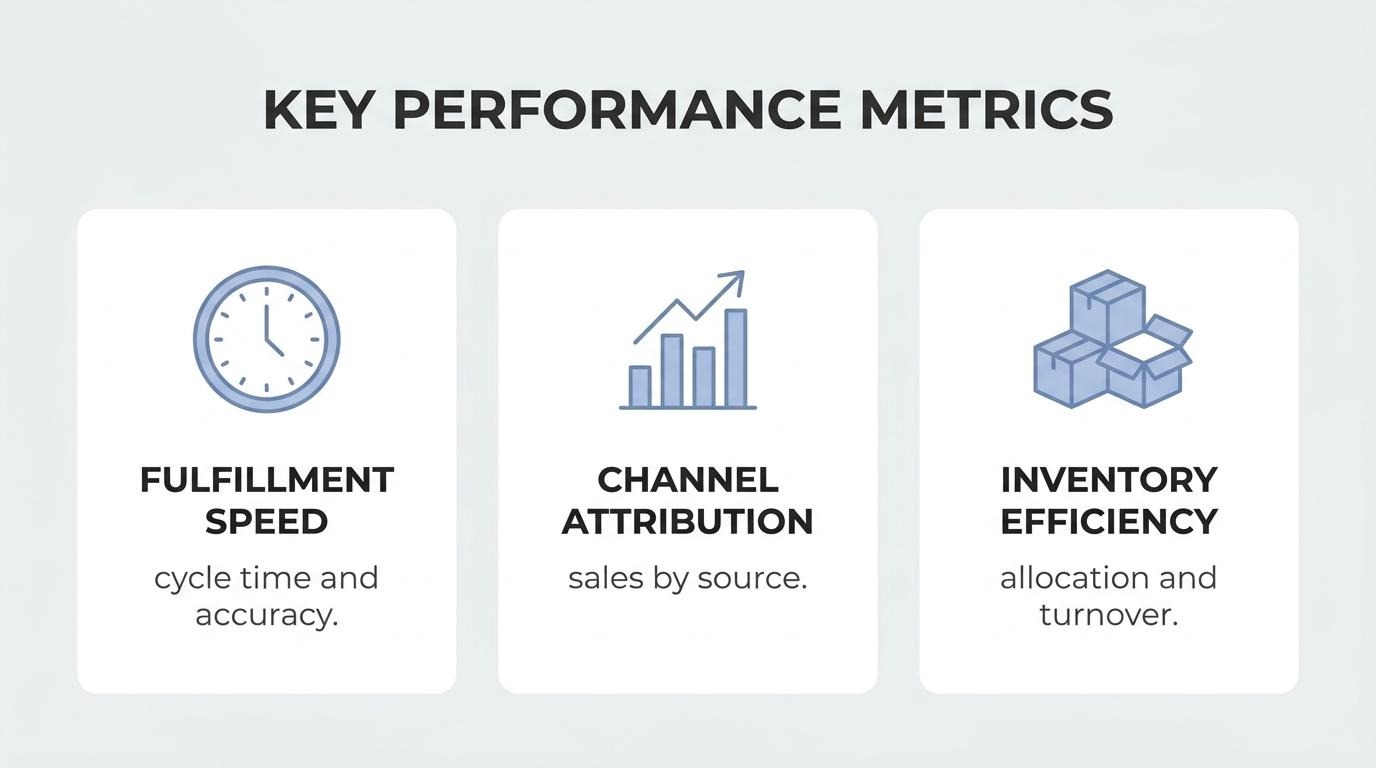
You measure omnichannel order management performance through KPIs that track fulfillment speed, cross-channel attribution, and inventory allocation efficiency.
The KPIs that track fulfillment speed and accuracy include:
Brands that monitor these metrics weekly, not monthly, catch routing failures and picking errors before they compound into customer churn.
You measure cross-channel order attribution by calculating the percentage of orders originating from each sales channel. According to NetSuite, the order placement percentage formula is: (Number of sales via channel A / Total sales) × 100.
This metric reveals which channels drive volume and which underperform relative to investment. When attribution data lives in disconnected systems, teams misallocate marketing spend and inventory. Unified platforms that resolve every transaction to a single customer record eliminate the double-counting problem that plagues multi-tool setups. For scaling DTC brands, accurate attribution is not a reporting luxury; it is the basis for every inventory and marketing decision.
The metrics that reveal inventory allocation efficiency are:
When these metrics diverge sharply across locations, it signals that routing logic or demand forecasting needs recalibration. Consistent measurement here is what separates brands that scale fulfillment cleanly from those drowning in misallocated stock.
With performance benchmarks established, the next step is understanding what changes when these capabilities converge in one platform.
Order management changes from a coordination problem into an operational advantage when it lives in one unified platform. Below, we cover how SHOPLINE handles cross-channel order routing natively and summarize the key takeaways from this guide.
SHOPLINE handles order routing across online and offline channels through its native POS system, which integrates directly with the admin backend. Products, orders, inventory, and member data connect across every channel within a single system. According to Racklify, SHOPLINE's automated order routing sends orders to the best fulfillment point, such as a warehouse or fulfillment center, based on predefined rules.
This architecture eliminates the sync layers that multi-app setups require. Because routing logic, inventory counts, and customer records share one data layer, there is no reconciliation step between online and in-store orders. For brands running both DTC storefronts and physical retail, consolidating these flows inside one platform removes a category of operational friction that typically scales with channel count.
The key takeaways about omnichannel order management strategy and implementation are:
Brands that treat order management as a system design problem, rather than a software selection exercise, position themselves to scale without compounding operational debt.