Dropshipping is a fulfillment method where the retailer never holds inventory; a third-party supplier ships products directly to customers. Wholesale is the opposite: the retailer purchases products in bulk at discounted rates, stores them, and fulfills orders from owned stock.
This guide covers startup costs and financial risk, profit margins across product categories, inventory control and order fulfillment, shipping speed and customer experience, and scaling strategy including hybrid models.
Dropshipping can cost under $500 to launch, while wholesale often requires around $5,000 to $25,000 or more in upfront inventory and storage. That low entry barrier makes dropshipping accessible, but intense competition and rising ad costs push most new stores out within the first year.
Profit margins split depending on strategy and industry. Dropshippers sacrifice per-unit returns and product quality control for zero inventory risk, with net margins often lower. In contrast, e-commerce gross margins for categories such as beauty often range around 50–70%, depending on brand positioning and channel mix. Wholesale models generally operate at lower per-unit margins than direct-to-consumer pricing due to bulk discounts, but bulk purchasing compounds cost advantages and purchasing power as volume grows.
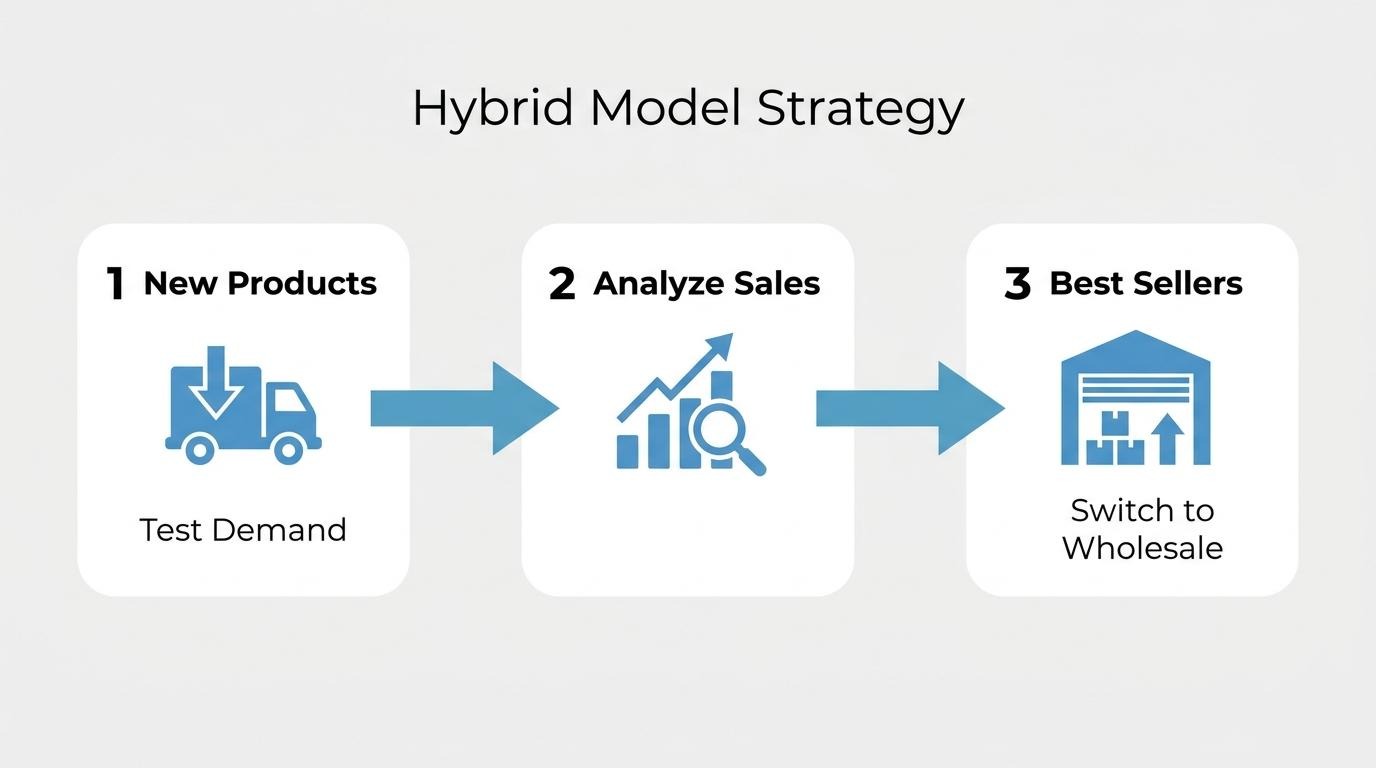
Some scaling brands combine both models. A hybrid approach dropships unproven SKUs to test demand with zero risk, then graduates best-sellers to wholesale for stronger margins and faster fulfillment. The right balance depends on product category, available capital, and growth stage.
Dropshipping is a retail fulfillment method where a store does not keep the products it sells in stock. Instead, when a customer places an order, the store purchases the item from a third-party supplier who ships it directly to the buyer. This section covers the core mechanics of the dropshipping supply chain and the retailer's role within it.
The dropshipping model removes the need for warehousing, bulk purchasing, or hands-on shipping logistics. According to Shopify, when a store sells a product using the dropshipping model, it purchases the item from a third party and has it shipped directly to the customer. The retailer acts as a middleman who manages the online storefront, product listings, and customer service, while the manufacturer or wholesaler handles inventory storage and order fulfillment.
In practice, the process follows a straightforward sequence:
Because the retailer never touches the physical product, startup costs stay low and geographic flexibility increases. However, this distance from the product also means less control over shipping speed, quality, and stock availability. For sellers evaluating business models, understanding this trade-off is the first step before comparing dropshipping against wholesale purchasing.
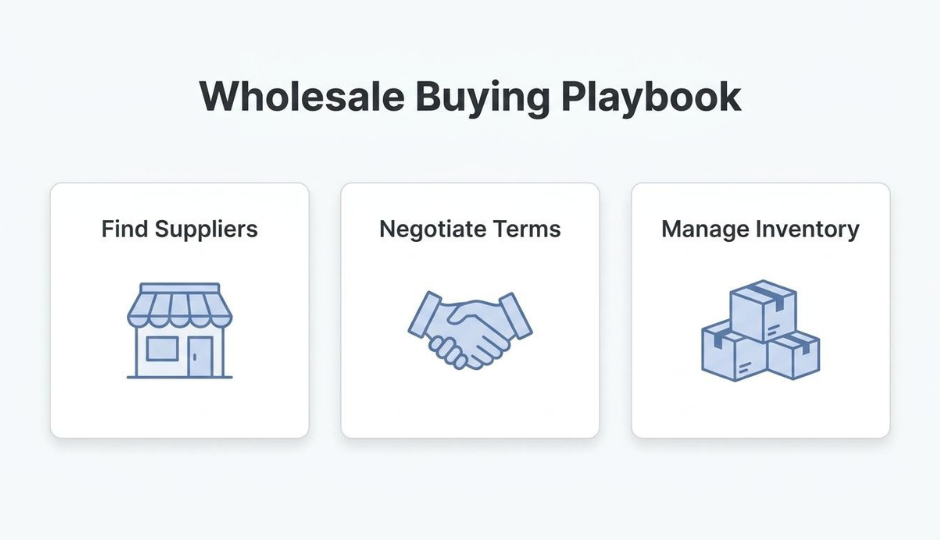
Wholesale is a retail model where a business purchases products in bulk at discounted rates, stores them, and sells them at higher retail prices. Below, the key mechanics cover sourcing, inventory ownership, and fulfillment.
Wholesale involves purchasing products in bulk directly from a manufacturer or a middleman at a discounted rate, then storing and selling those products to customers at a higher retail price. Unlike dropshipping, the wholesale retailer takes full ownership of inventory before any sale occurs. This means committing capital upfront to secure stock, leasing or managing warehouse space, and handling order fulfillment internally or through a third-party logistics provider.
The wholesale process follows a predictable cycle:
Because the retailer controls much of the supply chain from storage to delivery, wholesale provides more direct oversight of product quality, packaging, and shipping speed. That operational control, however, comes with higher financial risk; unsold inventory ties up cash and accumulates holding costs. For brands with proven demand and predictable sales velocity, wholesale consistently delivers stronger per-unit margins than models where a third party handles fulfillment.
Understanding how wholesale handles inventory and fulfillment sets the stage for comparing startup costs across both models.
Startup costs for dropshipping vs. wholesale differ significantly in upfront capital requirements. Dropshipping demands minimal initial investment, while wholesale requires substantial spending on inventory and storage before the first sale.

It costs relatively little to start a dropshipping business, often under $500 for a bare-minimum startup cost, to up to around $2,000. The primary expenses include an ecommerce platform subscription, a domain name, tools for designing brand identity, and marketing spend. Because the retailer never purchases inventory upfront, there is no cost for warehousing or bulk product orders.
However, advertising budgets represent the hidden cost that catches most new sellers off guard. According to AppScenic, the average success rate of a dropshipping business is between 10% and 20%, with most failures attributed to underestimated ad costs and unreliable suppliers. The low barrier to entry creates intense competition, which drives customer acquisition costs higher over time. Founders who budget only for platform fees while ignoring paid media spend are setting themselves up for an early exit.
It costs significantly more to start a wholesale business, typically ranging from around $5,000 to $25,000 or higher depending on the product category. The bulk of this investment goes toward:
Inventory holding costs represent the largest ongoing financial pressure. A study published in the Journal of Operations and Supply Chain Management found that for every dollar increase in inventory holding cost, the retailer's optimal profit decreases, particularly in wholesale price-driven supply chains. This means poor demand forecasting or slow-moving stock can erode margins quickly. For operators willing to commit the capital, wholesale offers more pricing control; the trade-off is that cash gets locked into physical inventory rather than staying liquid for growth initiatives.
Understanding these cost structures helps clarify which profit margins each model can realistically deliver.
Profit margins differ between dropshipping and wholesale primarily in per-unit returns versus volume potential. According to TrueProfit, most ecommerce businesses in 2026 typically maintain gross profit margins between 55% and 70% and net profit margins between 18% and 26%. The sections below break down what each model delivers.
The profit margins you can expect with dropshipping vary widely by niche, though they generally sit at or below overall ecommerce averages because supplier pricing leaves less room per unit. Dropshippers selling electronics or bulky home goods often face significant shipping costs and limited supplier pricing flexibility, which can materially compress net margins, sometimes into low single-digit territory depending on acquisition costs and return rates. Without inventory holding costs, stockout losses (averaging 4.1% of annual revenue for retailers who carry stock) are avoided, but that advantage gets offset by supplier pricing control. For many dropshippers, beauty and lifestyle niches offer some of the strongest margin potential as industries with the highest profit margins in e-commerce in 2026 according to an article by Eightx.
The profit margins you can expect with wholesale are lower per unit but higher in aggregate when volume scales. According to Million Dollar Sellers, wholesale per-unit margins are often 40–60% lower than direct-to-consumer margins because the retailer captures a significant cut of the retail price. That trade-off, however, comes with bulk pricing advantages that improve cost-of-goods as order volume grows.
An approach that some brands take is a hybrid model: dropship new items to test market demand with zero inventory risk, then transition proven best-sellers to wholesale purchasing for stronger per-unit economics. This strategy turns the margin disadvantage of wholesale into a calculated scaling lever rather than a fixed limitation.
Understanding margin structures across both models helps clarify which operational decisions, from fulfillment to inventory, shape your bottom line.
Inventory control in dropshipping vs. wholesale falls on different parties. Dropshippers rely on third-party suppliers to manage stock, while wholesale buyers own and store inventory themselves. Each approach shapes risk, flexibility, and operational responsibility differently.
Inventory works when you dropship by shifting all stock management to a third-party supplier. The retailer never purchases, stores, or handles products directly. When a customer places an order, the supplier picks, packs, and ships from its own warehouse.
This hands-off model eliminates warehousing costs but removes direct visibility into stock levels. Supplier stockouts become the retailer's problem, even though the retailer has no control over replenishment. For operators evaluating this model, the real risk is not inventory cost; it is inventory blindness. Without real-time sync between the supplier's stock system and the storefront, overselling and backorders erode customer trust quickly.
Inventory works when you buy wholesale by placing full ownership and storage responsibility on the retailer. The business purchases products in bulk at discounted rates, then warehouses that stock until orders come in.
This model provides complete control over stock levels, product quality, and fulfillment timing. The trade-off is upfront capital commitment and ongoing holding costs, including warehousing, insurance, and potential shrinkage. Every dollar tied up in unsold inventory is a dollar unavailable for marketing or growth.
Wholesale inventory management rewards accurate demand forecasting. Overstocking locks up cash; understocking means lost sales. For brands with proven, repeatable demand, this control is a significant operational advantage over relying on a supplier's stock availability.
Understanding who holds inventory sets the stage for how each model handles order fulfillment.
Order fulfillment differs between dropshipping and wholesale in who stores, packs, and ships each order. Dropshipping delegates fulfillment entirely to the supplier, while wholesale requires the seller to manage the process in-house or through a third-party logistics provider.
Orders are fulfilled in a dropshipping model by the supplier, not the retailer. When a customer places an order, the retailer forwards the purchase details to a third-party supplier who picks, packs, and ships the product directly to the buyer. The retailer never handles the physical product.
This hands-off structure keeps operational overhead low, but it also fragments the supply chain. Because the retailer has no visibility into warehouse operations, shipping errors and delays become harder to prevent or resolve quickly.
Orders are fulfilled in a wholesale model by the retailer or a logistics partner the retailer selects. After purchasing inventory in bulk, the seller stores products in a warehouse or fulfillment center and handles picking, packing, and shipping for every order.
This direct control over fulfillment allows tighter quality checks before items leave the facility. Shipping carriers can be negotiated, delivery timelines become more predictable, and packaging can be customized, though some manufacturers in dropshipping models also allow for package customization. The trade-off is higher operational complexity; the retailer absorbs warehousing costs, staffing needs, and the responsibility of managing stock levels accurately. For brands prioritizing consistent delivery experiences, that hands-on involvement is often worth the added overhead.
Understanding fulfillment mechanics sets the stage for evaluating how each model affects shipping speed.
Each model affects shipping speed and customer experience differently. Dropshipping depends on third-party supplier timelines, while wholesale gives sellers direct control over packaging and delivery. The sections below break down shipping speed for each approach.
Shipping with dropshipping is typically slower and less predictable than with wholesale. Because the supplier ships directly to the customer, delivery timelines depend entirely on that third party's location, processing speed, and carrier selection. Orders sourced from overseas suppliers can take two to four weeks, which creates a significant gap between customer expectations and actual delivery.
Long shipping times are one of the primary reasons dropshipping businesses struggle. According to a 2024 FreightAmigo analysis, approximately 90% of dropshipping businesses fail within the first year, primarily due to poor supplier selection and long shipping times. Sellers have limited ability to expedite orders or resolve delays once the package leaves the supplier's facility.
For most product categories, this lack of delivery control is the single biggest customer experience liability in the dropshipping model.
Shipping with wholesale is generally faster and more consistent because the seller stores inventory locally or in a domestic fulfillment center. Orders ship the same day or next day, giving customers shorter, more predictable delivery windows.
This direct control over fulfillment means sellers can choose carriers, negotiate rates, and offer branded packaging. When issues arise, such as damaged items or incorrect orders, the seller resolves them immediately without waiting on a third-party supplier. That responsiveness builds trust and drives repeat purchases.
The trade-off is operational overhead: warehouse space, packing staff, and shipping logistics all require investment. However, for brands prioritizing customer experience, that investment often pays for itself through higher satisfaction and lower return friction. Hybrid fulfillment models that integrate centralized storage with selective dropshipping are gaining traction as a way to balance operational risk and delivery speed.
Understanding delivery expectations sets the stage for evaluating product quality control.
The level of product quality control you have depends on whether you hold inventory yourself or rely on a third-party supplier. Dropshipping offers minimal direct oversight, while wholesale gives you hands-on inspection capability before anything reaches a customer.
With dropshipping, the supplier handles storage, packaging, and shipping. You never physically touch the product, which means defects, incorrect items, or substandard materials can reach customers without your knowledge. The only quality signals available are supplier samples, customer reviews, and return data collected after problems surface.
Wholesale reverses this dynamic. Because you purchase inventory in bulk and store it before selling, you can inspect every batch on arrival. Common quality control steps available to wholesale sellers include:
This physical access to inventory is the single biggest quality advantage wholesale holds over dropshipping. For brands selling in regulated categories like beauty or food, where compliance errors carry legal risk, that hands-on checkpoint is often preferred.
Quality control shapes brand reputation over time more than most sellers appreciate early on. A dropshipper competing on price can absorb occasional complaints, but any brand building repeat-purchase loyalty needs consistent product standards that only direct inspection reliably delivers.
Each model handles branding and packaging differently based on who controls the fulfillment process. Dropshipping limits customization, while wholesale gives sellers direct control over the unboxing experience.
Dropshipping sellers typically receive no branding or packaging options because the supplier ships products directly to customers, though some manufacturers do offer minimal customization options. Packages often arrive in generic or supplier-branded boxes, which means the buyer's first physical touchpoint carries no connection to the store they purchased from. Some suppliers offer white-label or custom insert services for an added fee, but availability varies widely and quality is difficult to verify without ordering samples. This disconnect makes it harder to build brand recognition through the post-purchase experience.
Wholesale sellers control the entire packaging process because they hold inventory in-house or through a contracted fulfillment center. Custom boxes, branded tissue paper, thank-you cards, and promotional inserts are all standard options. That level of control turns every shipment into a brand-building opportunity, reinforcing identity and encouraging repeat purchases.
For brands serious about customer retention, packaging consistency is one of the most underrated levers available. A forgettable unboxing rarely converts a first-time buyer into a loyal customer. Wholesale's packaging control directly supports the kind of branded, repeatable experience that drives long-term value, while dropshipping requires creative workarounds to achieve even a fraction of that impact.
Understanding branding trade-offs helps clarify which model supports long-term growth more effectively.
Dropshipping scales with minimal capital risk, while wholesale scales with stronger margins and operational control. The answer depends on whether your growth bottleneck is cash or infrastructure.
Dropshipping allows rapid product expansion because adding new SKUs requires no upfront inventory investment. You can test dozens of products simultaneously, cutting losers without financial loss. This asset-light flexibility makes it attractive during early growth phases when demand is unpredictable and cash reserves are thin.
However, that same flexibility creates a ceiling. As order volume climbs, per-unit costs remain high, supplier reliability becomes harder to manage across multiple vendors, and shipping inconsistencies compound. Wholesale requires more capital upfront, but it compounds advantages as volume increases. Bulk purchasing unlocks lower per-unit costs, negotiated shipping rates, and predictable fulfillment timelines. Brands that own their inventory can also customize packaging, maintain quality standards, and build a consistent customer experience across more brand touchpoints that strengthens retention over time.
The rising popularity of a hybrid ecommerce model lets businesses dropship new items to validate demand with zero inventory risk, then shift proven sellers to wholesale for better margins. This test-then-invest approach reduces the capital exposure that sinks many growing brands while preserving the margin architecture needed for long-term profitability.
For brands already operating at meaningful revenue, the real scaling question is less about choosing one model and more about when to transition volume from one to the other.
The main risks of dropshipping vs. wholesale center on different operational vulnerabilities. Dropshipping exposes sellers to supplier failures and thin margins, while wholesale carries inventory and cash flow risks.
The biggest risks of running a dropshipping store are supplier unreliability, thin margins, and lack of quality control. Because a third-party handles inventory and shipping, any supplier failure becomes the retailer's reputation problem.
Key dropshipping risks include:
According to a 2024 FreightAmigo analysis, approximately 90% of dropshipping businesses fail within the first year, primarily due to poor supplier selection and long shipping times. For most new sellers, the biggest underestimated risk is not the product itself; it is the total absence of fulfillment visibility and lack of brand touchpoint consistency that often drives repeat customer loyalty.
The biggest risks of running a wholesale store are cash flow strain, unsold inventory, and warehousing costs. Buying in bulk requires significant upfront capital before a single unit sells.
Core wholesale risks include:
According to SCORE, cash flow issues contribute to 82% of all small business closures, making them a critical vulnerability for inventory-heavy models. Wholesale models reward accurate demand forecasting and disciplined inventory management, while overestimating demand can quickly strain working capital and liquidity.
Understanding these risk profiles helps determine which fulfillment approach fits your operational capacity and product strategy.
Yes, you can combine dropshipping and wholesale in one store. A hybrid ecommerce model uses both fulfillment methods across different product lines, balancing risk and margin within a single operation.
According to Syncee, a hybrid ecommerce model allows businesses to dropship new items to test the market with zero risk, then transition to wholesale for proven best-sellers to increase profit margins. This test-and-graduate approach keeps capital efficient while building toward higher margins on validated products.
A practical hybrid store typically follows this structure:
The operational complexity, however, is real. Managing two supply chains means tracking separate supplier relationships, reconciling different shipping timelines, and maintaining accurate inventory visibility across both models. For brands already juggling multiple tools, this adds another layer of coordination that compounds quickly at scale.
Choosing the right model for specific product categories helps determine which items belong on each side of the hybrid.
The right model for your product category depends on margin structure, return rates, and shipping complexity. Below, two common category groupings illustrate how these factors shape the dropshipping vs. wholesale decision.
The model that works best for fashion and beauty brands depends on whether margin depth can absorb the category's specific cost pressures. Beauty brands benefit from high gross margins in e-commerce, typically around 50–70% for premium lines, which can create enough cushion for either model. Wholesale purchasing locks in lower per-unit costs, while dropshipping avoids the inventory risk tied to seasonal SKU turnover.
Fashion presents a different calculus. According to a 2026 Eightx analysis, apparel and fashion ecommerce brands typically see gross margins between 50% and 65%, but high return rates of 20–30% often erode net margins to just 15–25%. That return exposure makes wholesale riskier for trend-driven inventory. Dropshipping lets fashion sellers test styles without warehousing unsold pieces, though it sacrifices quality control over fit and fabric consistency.
For beauty brands with proven hero SKUs, wholesale generally maximizes per-unit profit. For fashion sellers managing fast-rotating collections, dropshipping reduces the downside of unsold inventory.
The model that often works best for food and home goods brands is wholesale, though each category carries distinct operational constraints. Food products require cold chain logistics, shelf-life monitoring, and FDA-compliant labeling. Dropshipping food is significantly more difficult, restricted, and risky, feasible only with suppliers who maintain proper certifications and temperature-controlled shipping. Wholesale gives food brands direct oversight of storage conditions and expiration management.
Home goods face a different pressure: shipping weight. Heavy or bulky items like furniture and kitchenware compress net margins to 10–20% once freight costs are factored in. Wholesale purchasing paired with regional warehousing reduces per-shipment costs compared to dropshipping from a single distant supplier.
For brands selling lightweight, shelf-stable consumables, dropshipping can work as a low-risk entry point. For most food and home goods sellers, however, wholesale offers the fulfillment control these categories demand.
With category-level model fit established, the next step is evaluating how your broader operational stack supports that choice.
Scaling DTC brands should consider how disconnected systems create delays, fulfillment errors, and margin loss. The sections below cover what changes when operations consolidate into one platform and the key takeaways from the dropshipping vs. wholesale comparison.
Inventory, CRM, and marketing running in one system on SHOPLINE eliminates the data silos that fragments efficiency across disconnected tools. When order data, customer profiles, and lifecycle marketing share a single backend, fulfillment triggers fire without the need to manually sync between platforms.
Consolidation addresses the issues that fragmented systems introduce: stock levels update in real time alongside customer purchase history, so marketing automation targets buyers based on actual inventory availability rather than stale data from a separate feed.
For brands operating at scale, reducing tool count is not about simplicity for its own sake; it is about removing the operational lag that costs real margin.
The key takeaways about dropshipping vs. wholesale center on a fundamental tradeoff between risk and control:
Choosing between dropshipping and wholesale involves considering various tradeoffs and business needs. The strongest ecommerce operators treat fulfillment strategy as a dynamic decision, revisiting it as unit economics, supplier reliability, and customer expectations evolve.