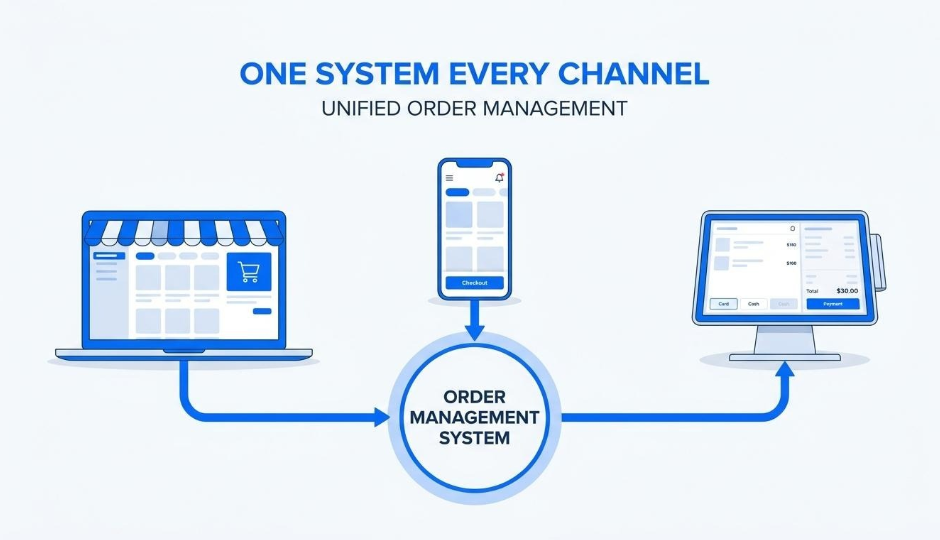
Omnichannel order management is the practice of capturing, routing, fulfilling, and tracking customer orders across every sales channel through a single coordinated system. It unifies inventory, order logic, and customer records so a business operates as one entity regardless of where a transaction begins.
This guide covers the core system components and how they work together, fulfillment strategies that leverage stores as distribution nodes, the technology integrations required for real-time execution, step-by-step implementation sequencing, operational challenges that compound at scale, and performance measurement across channels.
Centralized inventory visibility, unified customer data, distributed order routing, integrated payments, and returns management form the operational backbone. Each component addresses a specific failure point that disconnected tools leave exposed, from phantom stock to fragmented refund workflows.
Fulfillment strategies like ship-from-store, BOPIS, endless aisle, ship-to-store, and reserve-and-try each repurpose physical retail locations as flexible fulfillment nodes. Choosing the right mix depends on store density, labor capacity, and inventory depth at each location.
Real-time inventory systems, POS-to-ecommerce data layers, OMS-to-WMS connections, and channel-syncing APIs provide the technical foundation. Without sub-second inventory decrements and idempotent event handling, routing logic operates on stale data.
Implementation follows a defined sequence: auditing existing order flows, configuring routing rules, unifying product data, integrating POS with online processing, training teams through phased pilots, and iterating before full rollout.
Overselling, split-shipment margin erosion, cross-channel returns, and data accuracy at high volume represent the most persistent operational challenges. Tracking order fill rate, cost-to-serve, and cycle time by fulfillment source reveals whether the system performs as designed.
Omnichannel order management is the practice of capturing, routing, fulfilling, and tracking customer orders across every sales channel through a single coordinated system. It is not a CRM tool, although it shares customer data with CRM functions. The term "omni order" refers to any purchase that can originate on one channel and be fulfilled, modified, or returned through another. Rather than treating each storefront, marketplace, or physical location as a standalone operation, omnichannel order management unifies inventory, order logic, and customer records so the business operates as one entity regardless of where the transaction begins.
What separates this approach from simply selling on multiple platforms is integration depth. Modern POS solutions, though better than legacy systems, still force separate workflows for online versus in-store operations, reinforcing system fragmentation and siloed data, according to a 2025 commercetools analysis. Omnichannel order management eliminates that separation by design. When a shopper buys online and picks up in store, or starts a return at a location different from where they purchased, the system treats these as a single continuous order lifecycle rather than disconnected events requiring manual reconciliation.
For brands scaling past their initial channel mix, the distinction matters operationally. A disconnected setup means inventory counts diverge, refund logic breaks across channels, and customer history fragments between tools. Omnichannel order management solves this by making every node in the fulfillment network, whether warehouse, retail store, or third-party logistics partner, visible and actionable from one decisioning layer.
Understanding this foundation clarifies why the core components, channel differences, and implementation strategies covered next each depend on getting this single-system principle right.
Omnichannel order management matters for DTC brands because it unifies inventory, orders, and customer data across every sales channel, reducing fulfillment costs, preventing overselling, and creating a seamless buyer experience. Without it, growing brands face fragmented operations, rising tool costs, and inconsistent customer journeys.
According to a 2024 Forrester report, click-and-collect sales in the U.S. will double by 2028 to exceed $200 billion, accounting for 12% of online retail sales; 71% of retail business and technology professionals are already increasing investment in omnichannel fulfillment. That trajectory signals a structural shift, not a trend. DTC brands that delay unified order management risk compounding operational debt at the exact moment customers expect flexible fulfillment options like BOPIS, ship-from-store, and cross-channel returns.
A 2024 survey of 509 fashion shoppers published in Heliyon found a strong positive relationship (β = 0.976) between omnichannel customer experience and omnichannel satisfaction. For brands selling through their own website, marketplaces, social commerce, and physical retail simultaneously, that consistency depends on a single order management backbone connecting every touchpoint.
The cost implications are equally compelling. A 2022 study in the International Journal of Operational Research demonstrated that integrated rapid order fulfillment can reduce costs by an average of 7.4% compared to fulfillment from distribution centers alone. Meanwhile, a 2024 simulation of ship-from-store strategy showed potential freight price reductions of up to 60% and delivery time reductions of up to eight days. These savings compound as order volume grows, making the case for centralized order orchestration stronger at every revenue milestone.
For DTC brands operating between $1M and $50M in annual revenue, the real risk is not missing a single channel. It is running five to fifteen disconnected tools that each hold a fragment of the customer relationship. Inventory counts drift, return workflows break across channels, and the cost of reconciling siloed data quietly erodes margin. Unified order management solves this by making one system the source of truth for stock levels, order routing, and customer history, regardless of where the transaction originates.
The sections ahead break down the core components, strategies, technology requirements, and implementation steps that make omnichannel order management operational for scaling DTC brands.
The core components of an omnichannel order management system are centralized inventory visibility, a unified customer data layer, distributed order routing, integrated payment and checkout, and returns and exchange management. Each component addresses a specific operational requirement.
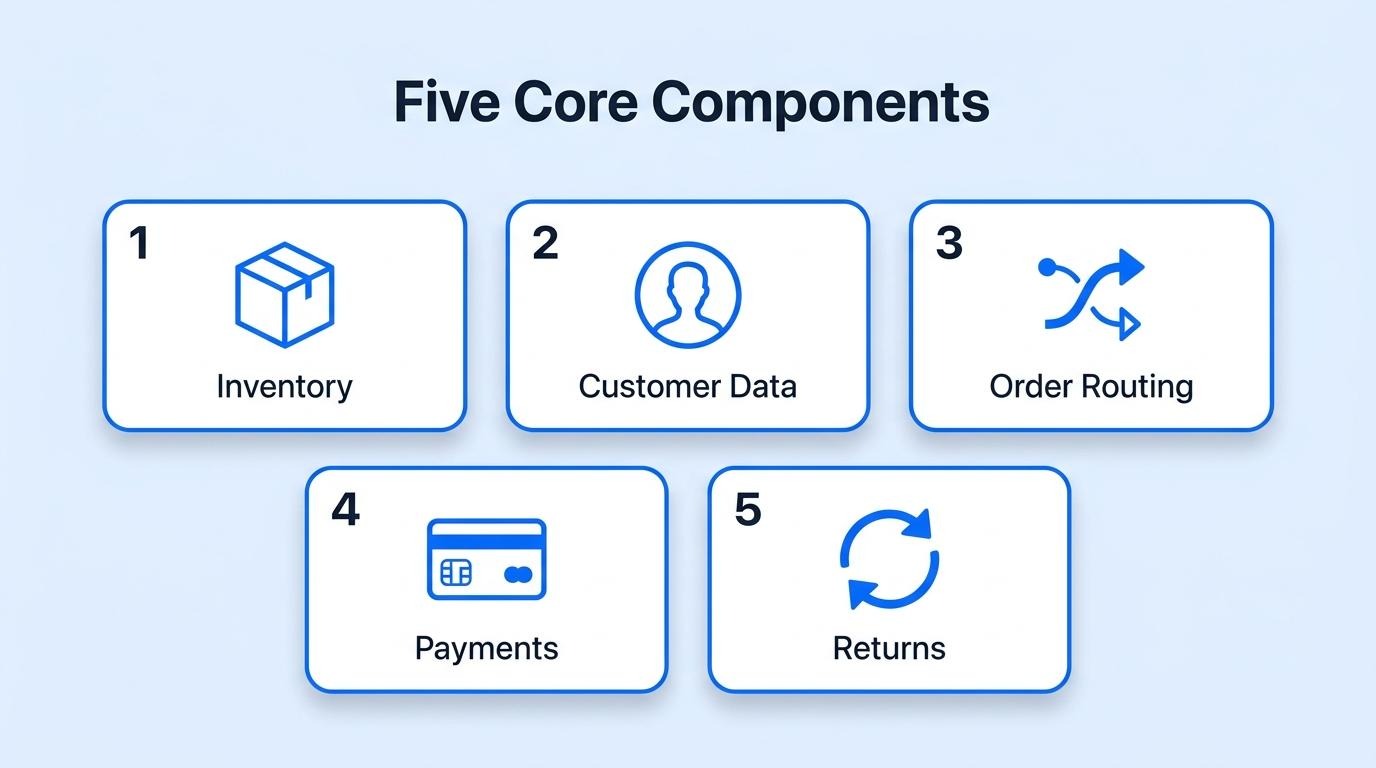
Centralized inventory visibility is a real-time, single view of stock quantities across every warehouse, store, and fulfillment node. This component prevents overselling on one channel while inventory sits idle in another. It also enables fulfillment options like BOPIS, ship-from-store, and same-day delivery by confirming available stock at the location closest to the customer. As Rukmani Subramanian, VP of Partnerships at Shopify, stated in a 2025 Manhattan Associates press release, "Mastering same-day, BOPIS, and ship-from-store, while ensuring inventory visibility and a seamless customer experience, is the new imperative." Without a centralized inventory layer, every downstream routing and fulfillment decision operates on unreliable data.
A unified customer data layer is a shared record that ties purchase history, preferences, and interactions across online, in-store, and service channels to a single customer profile. This layer enables personalized experiences regardless of where a customer engages. It also directly supports returns and loyalty workflows. A 2024 study in the International Journal of Physical Distribution and Logistics Management, analyzing 5,339 retail-level returns, found that returns policy and loyalty program capabilities are essential in creating a positive customer in-store experience. When return and loyalty data live in separate tools, these cross-channel experiences break down quickly.
Distributed order routing is the logic engine that determines which fulfillment location handles each order. It evaluates factors such as inventory availability, proximity to the customer, shipping cost, and promised delivery speed. The routing engine then assigns the order to the optimal node, whether that is a distribution center, a retail store, or a third-party logistics provider. Well-configured routing rules reduce shipping costs and transit times simultaneously. For brands operating multiple locations, this component is often the single biggest lever for improving fulfillment economics.
Integrated payment and checkout is the component that unifies transaction processing across digital storefronts, in-store POS terminals, and hybrid scenarios like endless aisle orders placed on store kiosks. It ensures that payment authorization, capture, and refund workflows remain consistent regardless of the purchase channel. A shared payment layer also simplifies reconciliation when a customer buys online but returns in-store, or when a split shipment requires partial captures. Without this integration, finance teams spend significant time manually reconciling transactions across disconnected systems.
Returns and exchange management is the system that processes reverse logistics across channels, handling scenarios where the purchase channel and the return channel differ. This component manages return authorization, inventory restocking, refund or exchange issuance, and customer communication. Effective returns management also feeds data back into inventory visibility so that returned stock becomes available for resale quickly. For brands scaling across online and physical retail, this component determines whether reverse logistics erode margins or strengthen customer loyalty.
With these five components working together, the next consideration is which fulfillment strategies best leverage them.
Omnichannel order management differs from multichannel by integrating all sales channels into one connected system, rather than operating each channel independently. The key distinctions span data sharing, customer experience, and fulfillment logic.
Multichannel retailing focuses on optimizing individual channels. Each storefront, marketplace, or physical location operates with its own inventory pool, order workflow, and customer database. A brand might sell on its website, in retail stores, and through a marketplace, yet none of those channels share real-time stock counts or customer purchase history. Orders placed in one channel cannot be fulfilled, returned, or modified through another.
Omnichannel order management requires the integration of all touchpoints to create a seamless experience. As Verhoef et al. (2015) define it, omnichannel management is "the synergetic management of the numerous available channels and customer touchpoints, in such a way that the customer experience across channels and the performance over channels are optimised." Inventory, order routing, and customer data flow across every channel as a single operational layer.
The practical differences between these two approaches include:
For DTC brands scaling past a few million in revenue, the gap between these models becomes operationally expensive. Multichannel setups force duplicate inventory buffers, manual reconciliation, and siloed reporting. Omnichannel consolidation eliminates that redundancy, though it demands tighter system integration and a shared data layer across every touchpoint.
Understanding this distinction shapes every decision covered in the sections ahead, from choosing fulfillment strategies to selecting the right technology stack.
The most common omnichannel order management strategies are ship-from-store, buy online pick up in store (BOPIS), endless aisle, ship-to-store, and reserve online try in store. Each strategy uses physical retail locations as fulfillment nodes in different ways.
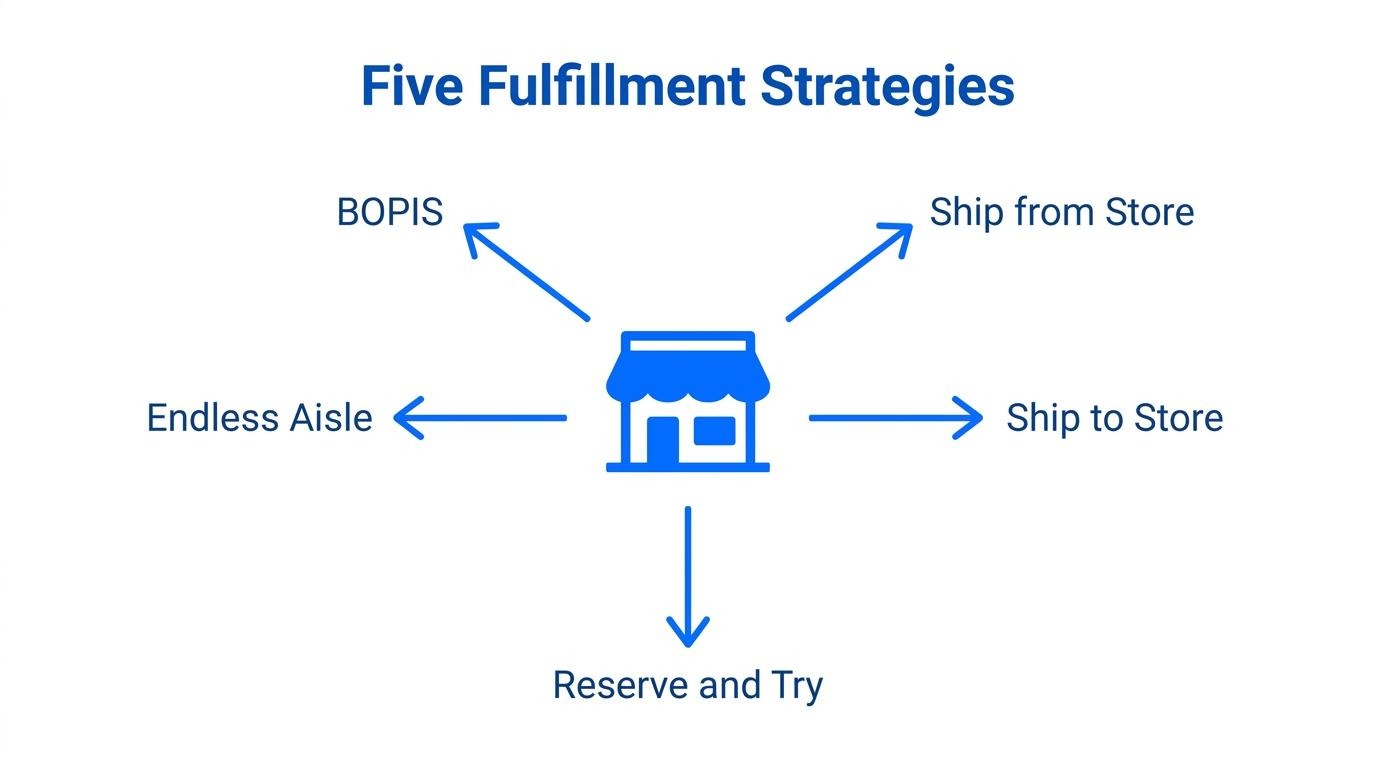
Ship-from-store works by routing online orders to retail store locations for picking, packing, and shipping directly to customers. Instead of fulfilling every digital order from a centralized distribution center, the order management system identifies the store closest to the buyer with available inventory and assigns fulfillment there.
This approach requires retailers to rework their fulfillment strategies. As noted in a 2016 University of Arkansas dissertation on omnichannel supply chain management, "retailers may need to evaluate whether online demand should be fulfilled from a distribution center or from retail stores." The decision depends on store labor capacity, real-time inventory accuracy, and proximity to the customer. For brands with a dense store footprint, ship-from-store shortens delivery windows significantly, though in-store processing costs must be factored into routing logic.
Buy online pick up in store reduces delivery costs by eliminating last-mile shipping entirely. The customer purchases online and collects the order at a nearby store, which means the retailer avoids parcel carrier fees for that transaction. According to a 2024 Salesforce retail survey, 57% of shoppers purchased a product online to pick up at the store, and in-store returns grew by 13% since 2021.
BOPIS routes an online order to the nearest store with stock, where associates pick and stage the item. Customers retrieve it at their convenience. Beyond cost savings, this model drives incremental foot traffic; shoppers who visit for pickup often make additional purchases. For brands scaling beyond pure DTC fulfillment, BOPIS is one of the highest-ROI strategies to prioritize early.
Endless aisle prevents lost sales from stockouts by letting in-store shoppers order items that are unavailable at that specific location through an in-store digital touchpoint. The order is fulfilled from another store, a warehouse, or a supplier and shipped to the customer's home or back to the store for pickup.
With U.S. e-commerce reaching an estimated $1,192.6 billion in 2024 according to the U.S. Census Bureau, customer expectations for product availability are higher than ever. Endless aisle captures demand that would otherwise walk out the door. Rather than accepting a lost sale when a size, color, or SKU is out of stock locally, the associate completes the transaction on the spot. This strategy turns every store into a showroom backed by the brand's full inventory network.
Ship-to-store consolidates last-mile logistics by batching online orders into bulk shipments to store locations rather than dispatching individual parcels to residential addresses. Customers place orders online and select a nearby store as the delivery destination, picking up at their convenience.
Bulk store deliveries use existing replenishment routes, which reduces per-unit shipping costs compared to individual home delivery. The store absorbs the final handoff, replacing expensive last-mile carriers with a controlled pickup environment. This model works best for retailers whose store network already receives frequent freight. For growing brands, ship-to-store is a practical middle ground between pure e-commerce fulfillment and full BOPIS, especially when stores lack the inventory depth to fulfill directly from shelf stock.
Reserve online try in store drives conversion by removing purchase hesitation. Shoppers reserve items online without paying, visit the store to evaluate fit or quality, and only complete the transaction if satisfied. This eliminates the friction of buying, returning, and waiting for refunds.
According to the Director of Digital Engineering at a large wholesale club, modernizing inventory services was projected to "drive down inventory-related cancellations by over 40 percent and improve conversion by 10 basis points." Accurate, real-time inventory data is what makes reservation models viable; without it, customers arrive to find items unavailable. For categories where tactile evaluation matters, such as apparel, footwear, and furniture, reserve-and-try removes the single biggest barrier between browsing and buying.
With these fulfillment strategies in place, the right technology stack determines how effectively each one operates.
Omnichannel order management requires real-time inventory systems, integrated POS and ecommerce data layers, OMS-to-WMS connectivity, and channel-syncing APIs. The following sub-sections cover each technology requirement in detail.
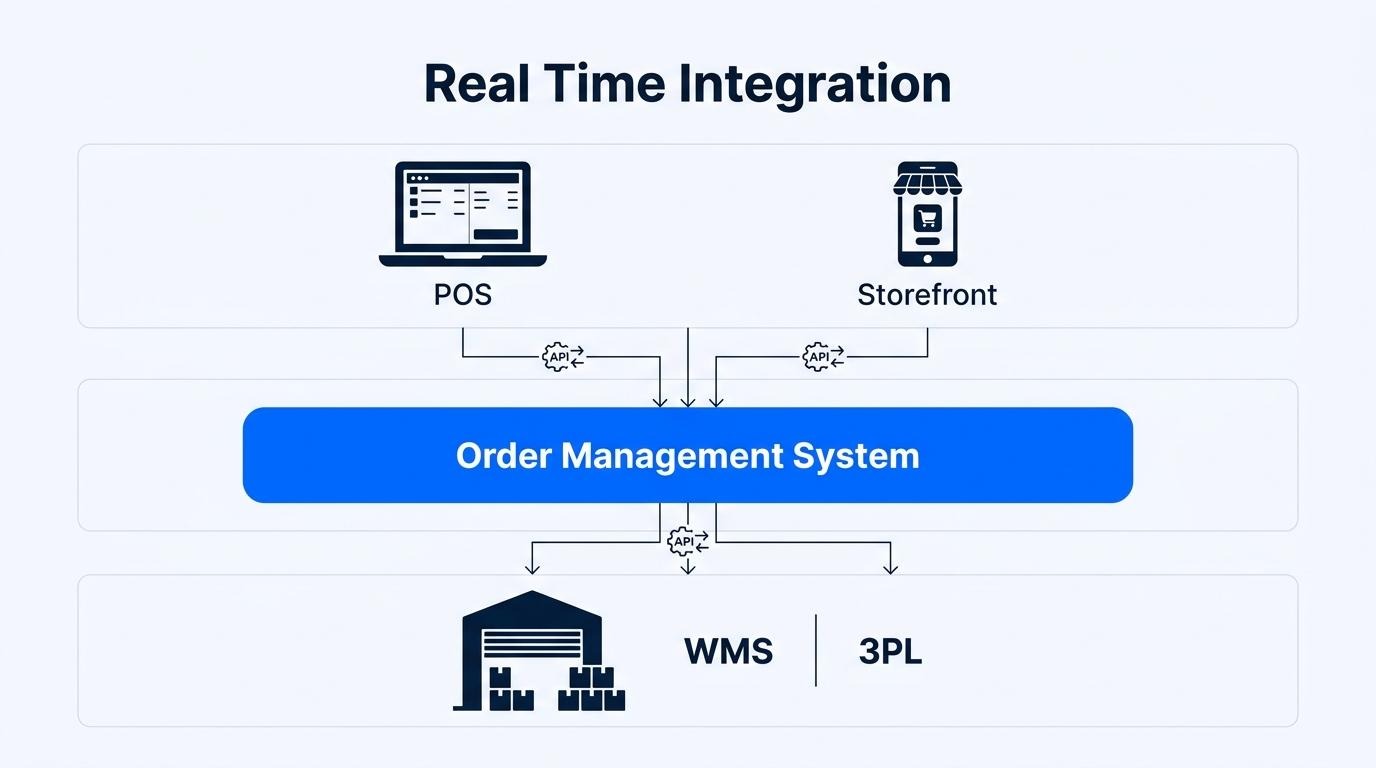
A real-time inventory management system plays the role of a single source of truth for stock levels across every warehouse, store, and fulfillment node. Without continuous synchronization, inventory records drift from physical counts. According to a Cardiff University/ECR Retail Loss study, 59.54% of audited SKUs had physical quantities that did not match the quantity displayed in the information system at the time of stocktake.
This level of inaccuracy triggers overselling, cancelled orders, and eroded customer trust. A real-time system must integrate with several adjacent platforms to maintain accuracy:
These integrations enable seamless data flow across operations, giving teams real-time visibility into inventory position, workforce allocation, and shipment status.
POS and ecommerce integration needs a shared data layer because without one, inventory counts, customer profiles, and sales transactions exist in disconnected silos. According to Extensiv's 2023 integration guide, an ecommerce POS integration connects a physical store's point-of-sale system with ecommerce applications, enabling synchronization of inventory, customer information, and sales transactions between the two systems.
When these data streams run through separate databases, a store sale does not decrement online availability, and an online purchase does not update the in-store register. A shared data layer eliminates this lag. For brands operating across physical retail and digital storefronts, this single synchronized record is what prevents phantom stock from appearing on the website after an item sells in-store.
An order management system connects to a WMS and 3PL through bidirectional data exchanges that pass order details downstream and receive fulfillment status updates in return. The OMS selects the optimal fulfillment node based on proximity, inventory availability, and shipping cost; then it transmits the order to the WMS for pick, pack, and ship execution.
Key data flows between these systems include:
Keeping payment data secure across this chain matters as well. PCI Security Standards define the cardholder data environment as all system components, people, and processes that store, process, or transmit cardholder data, including components with unrestricted connectivity to those systems. Every integration point between OMS, WMS, and 3PL that touches payment information must fall within that scope.
The APIs needed to sync channels in real time include inventory availability endpoints, order lifecycle webhooks, customer profile synchronization, and pricing or promotion feeds. Each API ensures that a change in one channel propagates to every other channel within seconds rather than hours.
As Laura Behrens Wu, founder and CEO of Shippo, stated: a true omnichannel system requires "planning for demand on both physical and online channels, and tracking inventory, in real time, across all locations where goods are stored." That real-time requirement translates into specific API categories:
For brands running high order volume, idempotent API design prevents duplicate processing when retries occur. With these integration layers in place, measuring performance across the entire order lifecycle becomes the next operational priority.
You implement omnichannel order management step by step by auditing existing systems, defining routing logic, unifying data, integrating POS with online channels, training teams, and running controlled pilots. The following H3s break down each phase.
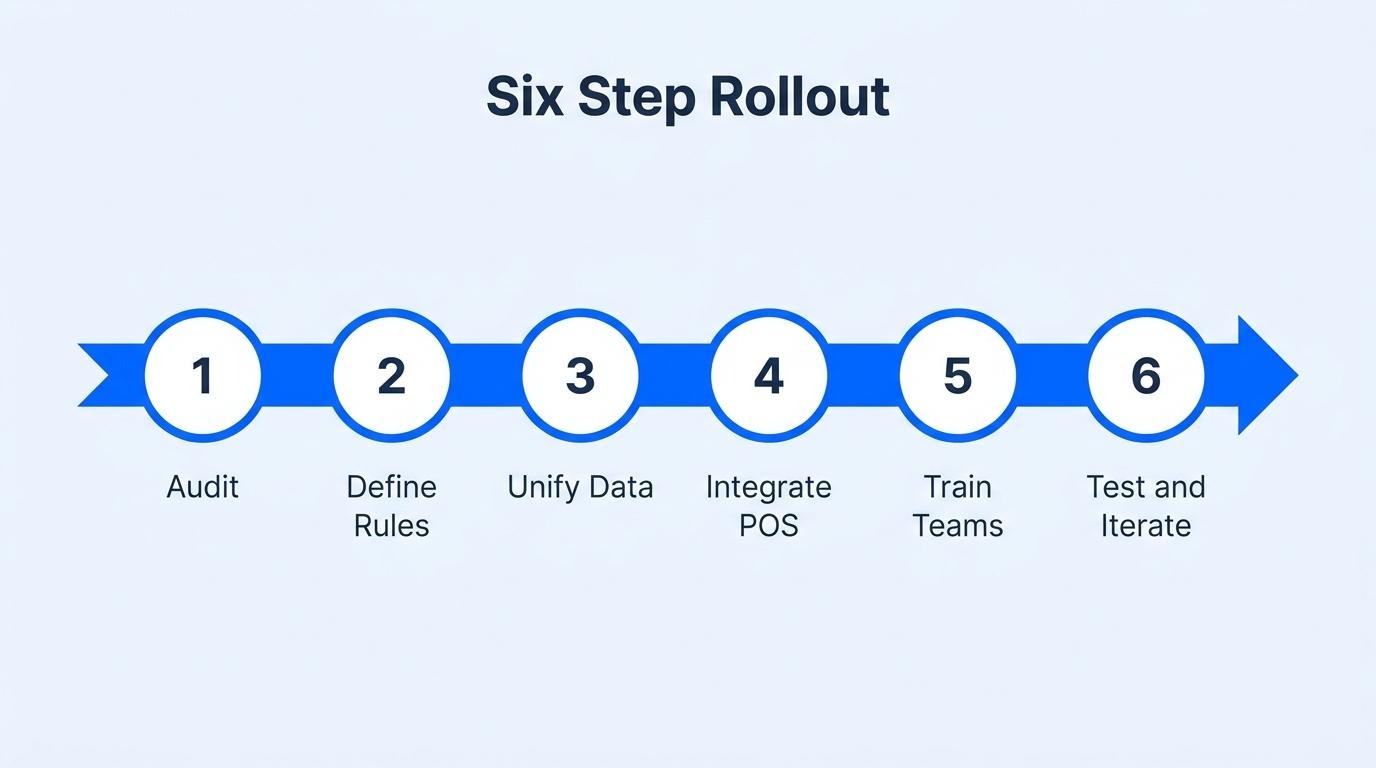
You audit current order flows across every channel by mapping every application, integration point, and manual handoff that touches an order from capture to delivery. According to a Bain & Company case study, one global retailer discovered more than 3,000 unique apps spanning back-office functions to core retail operations, all accumulating technical debt because no uniform processes governed them.
Start by documenting each channel's order lifecycle:
This audit exposes redundant integrations and data silos before any new system goes live. Brands that skip this step inherit legacy fragmentation into their new stack, which defeats the purpose of consolidation.
You define order routing rules and fulfillment logic by configuring distributed order management (DOM) software to evaluate inventory across your network and assign each order to the optimal fulfillment node. Gartner defines DOM as the software that orchestrates and optimizes order fulfillment by utilizing inventory throughout the supply chain to deliver targeted service levels for fill rate and cost-effective delivery.
Key routing variables include:
For high-volume operations, automated routing is essential. Well-defined rules prevent costly exceptions from becoming the default path.
You unify product and inventory data across locations by establishing a single source of truth that synchronizes stock counts, product attributes, and location metadata in real time. According to a OneRail case study, Advance Auto Parts gained cross-location inventory visibility through real-time dynamic selection, achieving a 98% on-time delivery rate and a 27% sales increase for their 30-minute delivery segment.
Standardized data sharing protocols make this possible. GS1's EPCIS standard provides the "what, when, where, why, and how" of product movement, enabling interoperable visibility across trading partners and internal locations. Without a shared schema, each location maintains its own version of truth, and discrepancies compound as order volume grows.
You integrate POS with online order processing by connecting in-store transaction systems to your ecommerce platform through a shared data layer that synchronizes inventory, customer records, and order status. BOPIS (Buy Online, Pick Up In Store) is a fulfillment type that routes a customer's digital order to a physical store for processing, and it depends entirely on this integration working in real time.
Critical integration considerations include:
Treating POS as an isolated system guarantees the kind of fragmented workflows that undermine omnichannel execution.
You train store and warehouse teams on new workflows by phasing rollouts and embedding hands-on practice into each stage. In the IBM World Market case study, three teams enabled BOPIS in sprints: an initial pilot went live in two stores, expanded to 24, then reached all 242 locations within four months.
Modern POS solutions still force separate workflows for online versus in-store orders, reinforcing system fragmentation and disconnected teams. Training must explicitly bridge this gap by teaching associates a single process that handles both digital and walk-in orders. Role-specific playbooks, not generic documentation, drive adoption. Associates who understand why a workflow changed, not just how, resist reverting to old habits under pressure.
You test and iterate before full rollout by running a controlled pilot scoped to a single warehouse, one store location, or a subset of order types. This isolates variables so failures surface without disrupting the entire operation.
Effective pilot structure follows a clear sequence:
Scaling too early locks in unresolved problems across the network. With workflows validated at small scale, full deployment carries far less operational risk.
The biggest challenges in omnichannel order management are inventory synchronization, split-shipment profitability, cross-channel returns, and data accuracy at scale. Each problem compounds as order volume and channel count grow.
You prevent overselling across multiple channels by maintaining a single, real-time inventory record that every sales channel reads from before confirming a purchase. Without this synchronization, two channels can sell the same unit simultaneously. Safety stock buffers, inventory reservation at checkout, and near-instant webhook updates between systems reduce the window where phantom availability exists. Even small sync delays during flash sales or peak periods create oversell risk. Brands operating across a marketplace, a DTC storefront, and physical retail need sub-second inventory decrements; anything slower invites cancellations and eroded customer trust.
You handle split shipments without eroding margins by optimizing fulfillment node selection before the order splits. Split shipments occur when items in a single order ship from different warehouses or stores, multiplying packaging, carrier, and handling costs. Effective order routing logic evaluates proximity, stock depth, and carrier rates to minimize the number of splits. When a split is unavoidable, consolidating partial shipments to the nearest hub before final-mile delivery can offset added freight. The most overlooked lever is assortment planning: stocking high-velocity SKU combinations together at the same node prevents many splits before they happen.
You manage returns when the purchase and return channels differ by connecting your returns workflow to a centralized inventory and order record. Cross-channel returns, such as buying online and returning in-store (BORIS), require the system to issue a credit memo, update salable quantities, and route the item back to available stock at the correct source. According to a 2025 MIT Center for Transportation & Logistics survey, returns management rose to a 47% challenge rate among omnichannel retailers, up from 38% the prior year. A unified returns policy, consistent across every channel, paired with automated restocking logic, keeps both refund accuracy and inventory counts intact.
You maintain data accuracy at high order volume by enforcing automated validation at every data entry point and reducing manual touchpoints. Order, inventory, and customer records degrade fastest when humans key data into disconnected systems. Automated checks, such as duplicate-order detection, address standardization, and SKU-level reconciliation on ingest, catch errors before they cascade. Event-driven architectures that propagate changes atomically across systems also prevent the stale reads that cause misrouted shipments or incorrect invoices. For brands processing thousands of daily orders, scheduled audits are not enough; real-time anomaly alerts on inventory variances and order exceptions are the minimum threshold for operational reliability.
Understanding these challenges clarifies which performance metrics matter most when evaluating your omnichannel operations.
You measure omnichannel order management performance by tracking fulfillment KPIs, calculating cost-to-serve per order, and analyzing order cycle time. These metrics reveal whether routing logic, inventory allocation, and channel operations are working together efficiently.
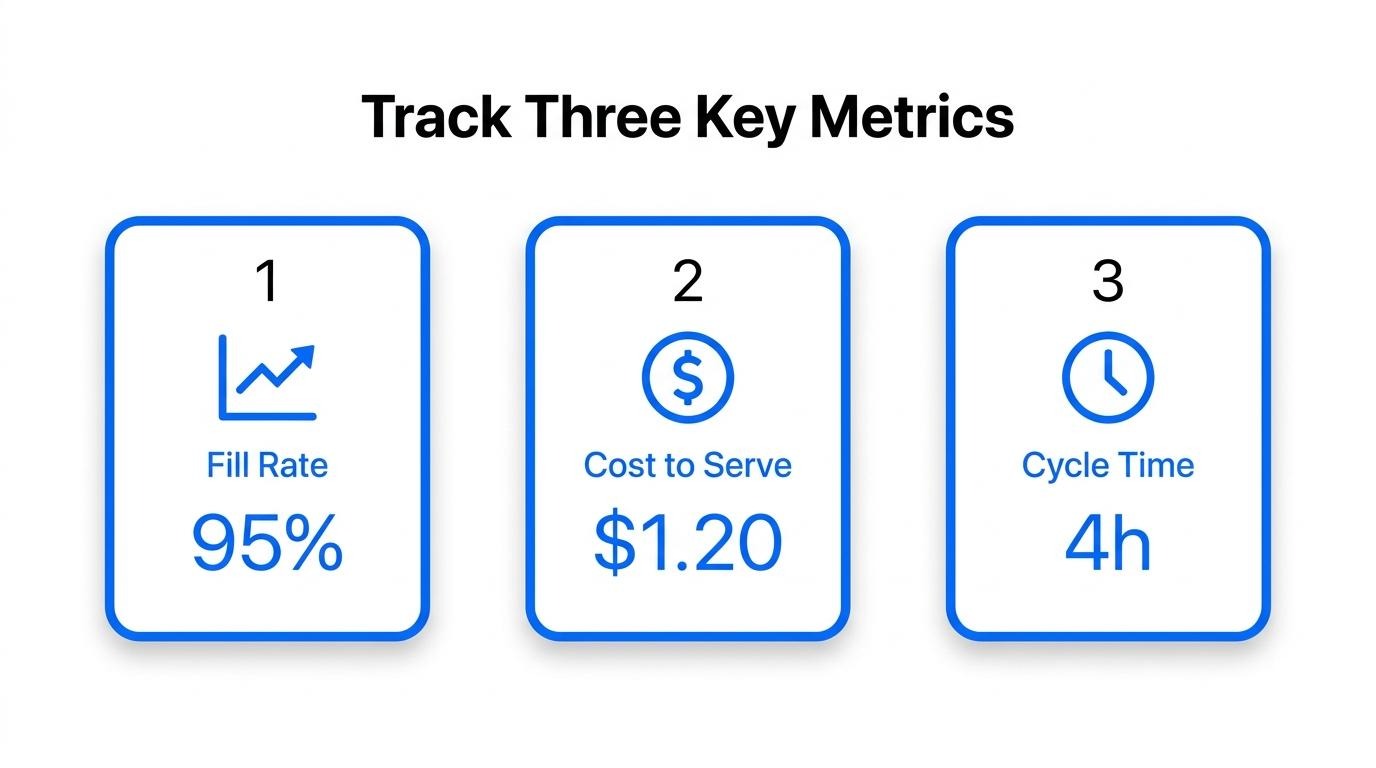
The fulfillment KPIs you should track across channels include:
An OMS and a fulfillment platform serve different roles; the OMS orchestrates routing decisions and order data, while the fulfillment platform executes warehouse-level pick, pack, and ship workflows. Tracking KPIs at both layers prevents blind spots where routing looks efficient but execution falls short.
True cost-to-serve per order is calculated by dividing total fulfillment costs by orders shipped over a fixed period, then layering in channel-specific variables. According to a Microsoft guide on order management systems, an OMS selects the closest or most accessible inventory location relative to the order destination, then calculates shipping costs and carrier options. That proximity-based routing decision directly shapes per-order cost.
A complete cost-to-serve formula should include:
Measuring monthly rather than quarterly gives operations teams enough signal to adjust routing rules before margin erosion compounds.
Order cycle time reveals whether your routing logic minimizes delays across processing, fulfillment, and delivery. According to ASCM Insights, this KPI measures the average duration from the moment a customer places an order to the moment they receive it, encompassing order processing, fulfillment, and final delivery.
When cycle time increases despite stable carrier performance, the bottleneck usually sits in routing or node-level processing. Segment cycle time by fulfillment source: warehouse, store, and 3PL. If ship-from-store orders consistently show longer cycle times than DC-fulfilled orders, store-level workflows or inventory allocation rules likely need adjustment. Cycle time is the single best diagnostic for routing efficiency because it captures every handoff between systems.
With performance benchmarks defined, the next step is understanding how disconnected tooling can undermine these metrics.
Disconnected tooling undermines order management at scale by fragmenting inventory data, customer records, and fulfillment workflows across systems that cannot communicate in real time. The resulting inefficiencies compound as order volume grows.
When a brand operates separate tools for its storefront, POS, warehouse management, and marketing automation, each system maintains its own version of the truth. Inventory counts diverge between channels, customer purchase histories split across databases, and order routing decisions rely on stale data. A 2024 structural-equation study published in Sustainability found that internal information integration has a significant positive impact on external integration, and that external information and organization integration positively impact omnichannel retailers' financial performance (n=356 retailers).
The operational toll is measurable. Middleware and custom integrations built to bridge these gaps are fragile, costly to maintain, and create scalability bottlenecks. One Bain & Company case study documented a global retailer running more than 3,000 unique applications across back-office and retail operations, accumulating significant technical debt from the absence of uniform processes and standards. That kind of sprawl is not an edge case; it reflects what happens when brands add tools reactively instead of consolidating proactively.
For growing DTC brands processing thousands of orders daily, every disconnected handoff between systems introduces latency, error risk, and hidden cost. Orders routed using yesterday's inventory snapshot lead to overselling. Customer service teams toggling between dashboards slow resolution times. Returns processed in one system fail to update salable quantities in another. These are not theoretical risks; they are daily operational realities for brands scaling past their initial tooling.
The compounding effect matters most. At low volume, a manual workaround or a nightly sync might suffice. At scale, those same gaps multiply into canceled orders, inflated fulfillment costs, and degraded customer experience. Brands that recognize this inflection point early and consolidate their order management stack avoid the exponential cost curve that disconnected tooling creates.
Understanding how fragmented systems erode performance at scale clarifies why growing brands need a unified approach to order management.
Growing DTC brands should approach order management by adopting a unified commerce model that consolidates order routing, customer data, and inventory into one platform. The subsections below cover what changes when these functions share a single system and the key strategic takeaways.
Order routing, POS, and customer data living in one platform eliminates the sync failures and data inconsistencies that plague disconnected app stacks. In a unified system, a single database update triggers event notifications atomically; as AWS Prescriptive Guidance explains, if those two operations do not run atomically, the downstream service never learns about the change and the system enters an inconsistent state. That risk multiplies across every bolted-on integration in a multi-app setup.
Consolidation also unlocks workflows that fragmented stacks cannot support cleanly. Customers can browse and order items not physically available in a store through an in-store digital touchpoint, with the order routed to their home or another location for pickup. When POS, inventory, and customer profiles share one data layer, that routing decision happens instantly without middleware reconciliation. Cross-border operations also simplify because a single system can enforce regional data-transfer safeguards, such as GDPR-compliant mechanisms, from one compliance surface rather than auditing each app independently.
For brands scaling past the point where five to fifteen tools still feel manageable, this consolidation is often the highest-leverage infrastructure change available.
The key takeaways about omnichannel order management strategy and implementation center on three priorities: start with unified data, phase rollouts carefully, and budget realistically for integration costs.