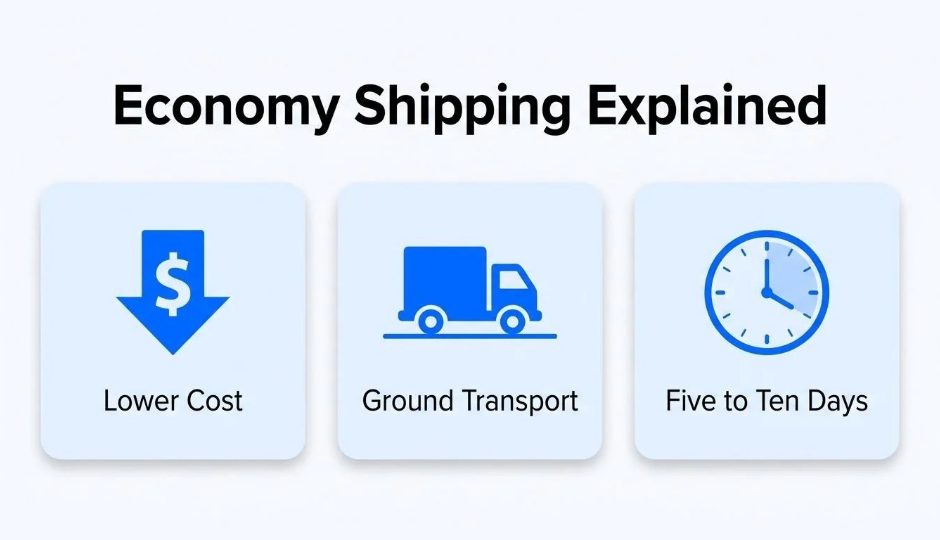
Economy shipping is the lowest-cost delivery option offered by carriers, moving packages through ground transportation or deferred routes instead of air networks. Domestic orders typically arrive in 5 to 10 business days, while international shipments take 2 to 6 weeks depending on customs processing and destination country.
We cover economy shipping fundamentals, carrier options across major US providers, product and scenario fit, store configuration, and customer experience strategy.
Economy shipping differs from standard shipping in cost, speed, tracking detail, and handling priority. Carriers calculate rates using zones, package weight, and dimensions, but economy tiers sit at lower rate tables because shipments are consolidated into less time-sensitive loads. Small packages typically cost $3 to $8 domestically, while heavy or oversized items run $15 to $50 or more due to dimensional weight pricing.
USPS Ground Advantage, UPS Ground, UPS SurePost, FedEx Ground, FedEx Ground Economy, and DHL eCommerce each serve the economy tier with varying transit windows and last-mile handoff models. Several hybrid services transfer packages to USPS for final delivery, reducing cost but extending transit slightly.
Non-perishable goods, lightweight fashion, home decor, beauty products, and subscription boxes pair naturally with economy shipping because they tolerate longer transit without quality loss. Economy rates also support free shipping thresholds and protect margins on low-value SKUs where expedited costs would erase profit.
Perishable items, peak holiday orders, and high-value fragile goods should bypass economy entirely. Spoilage risk, carrier backlogs during November through January, and limited insurance coverage make faster services the only responsible choice for these categories.
Proactive tracking updates, accurate delivery estimates at checkout, and post-purchase messaging offset slower transit times and sustain repeat purchase rates. Consolidating shipping rules, CRM, and subscription logic inside a single platform like SHOPLINE eliminates sync failures and simplifies conditional routing at scale.
Economy shipping is the lowest-cost delivery option offered by carriers, prioritizing affordability over speed. Packages travel by ground transportation or deferred air routes, reaching domestic recipients in roughly five to ten business days. Because carriers consolidate economy parcels into larger, less time-sensitive loads, per-package costs stay well below express or priority tiers.
For ecommerce merchants, economy shipping serves as a margin-friendly fulfillment method for orders where arrival speed matters less than price. Shoppers selecting this option accept a longer transit window in exchange for reduced or free shipping fees. The trade-off works especially well for non-urgent, lightweight, and low-to-mid-value products, categories where shipping cost often influences the purchase decision more than delivery date. According to a 2019 study published in the Journal of Business Logistics, delivery fee is by far the most important shipping attribute across convenience, shopping, and specialty product categories.
Understanding how economy shipping fits into a broader fulfillment strategy helps merchants balance customer expectations against operational costs, a theme explored throughout the sections that follow.
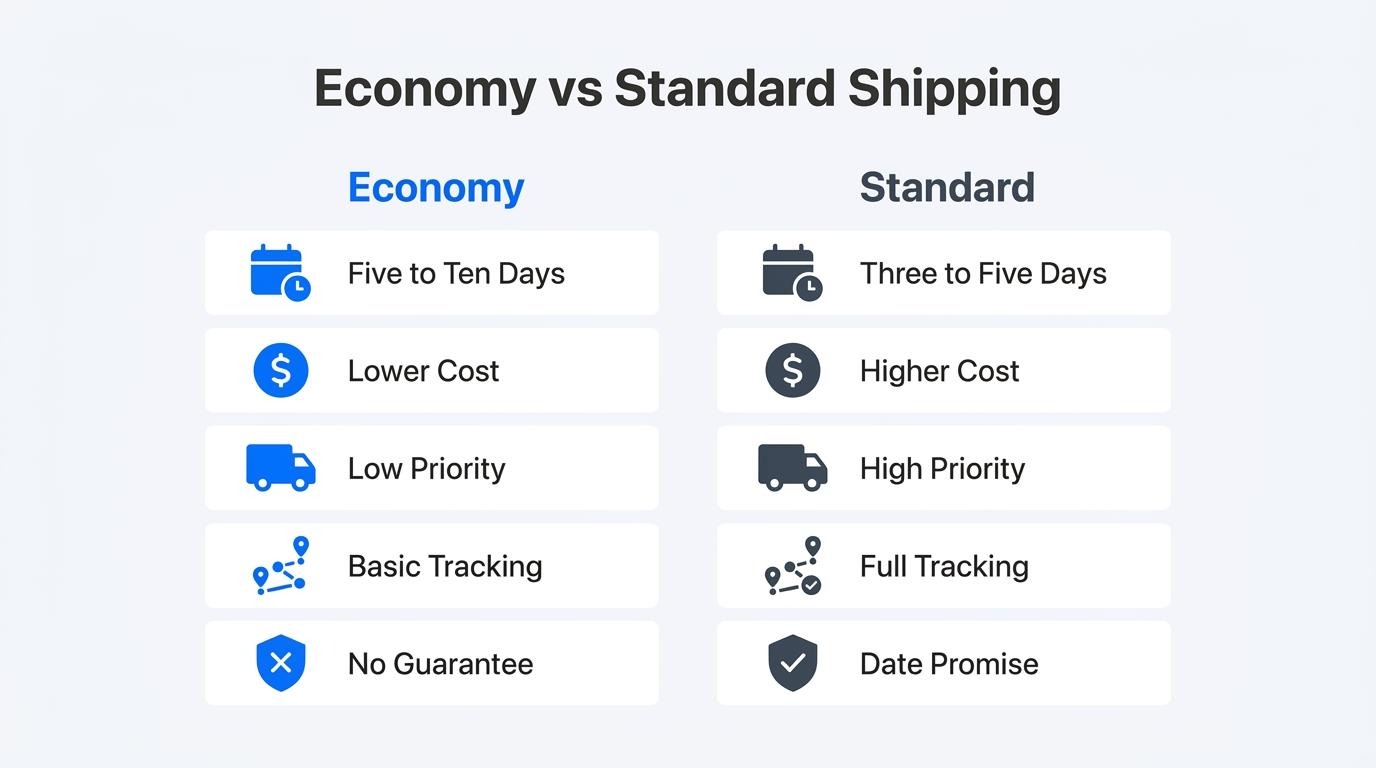
Economy shipping differs from standard shipping in cost, speed, tracking detail, and handling priority. The sections below break down each difference across delivery timelines, pricing structure, and service features.
Economy shipping uses ground-only or consolidated transport networks, which reduces carrier expenses but extends transit windows. Standard shipping typically combines ground and air routing to meet tighter delivery promises. For most domestic U.S. orders, economy shipping delivers in 5 to 10 business days, while standard shipping arrives in 3 to 5 business days. The cost gap matters most for low-urgency, non-perishable items where buyers accept longer waits in exchange for lower fees.
Pricing is the most visible distinction. Economy rates are calculated using the same inputs as standard rates: zones (distance between origin and destination), package weight, and package dimensions. According to Penn State Extension's September 2025 guidance, shipping carriers typically determine rates through a combination of these three factors. However, economy tiers sit at lower rate tables because carriers batch shipments, fill remaining truck or container capacity, and avoid air transport premiums.
Tracking granularity also separates the two tiers. Standard shipping usually includes milestone-by-milestone scan updates at each sorting facility. Economy shipping may only provide origin scan, in-transit confirmation, and delivery confirmation, with fewer intermediate updates. For sellers whose customers expect real-time visibility, this reduced tracking detail can affect perceived service quality.
Key differences between economy and standard shipping include:
For scaling DTC brands, the choice between economy and standard shipping is ultimately a margin decision. Economy shipping works best when average order values are modest and the product category tolerates longer delivery windows; defaulting every order to standard shipping erodes margin without proportionally improving retention.
Understanding these trade-offs sets the stage for estimating actual delivery timelines in practice.
Economy shipping typically takes 5 to 10 business days for domestic orders and 2 to 6 weeks for international shipments. Delivery windows vary based on distance, carrier, and customs processing.
Economy shipping takes 5 to 10 business days for most domestic orders within the United States. Ground-based carriers move packages through regional sorting hubs rather than air networks, which adds transit time compared to expedited options. Actual delivery windows depend on the distance between origin and destination, measured in carrier shipping zones. A package traveling one or two zones may arrive in five business days, while cross-country shipments spanning six or more zones often reach the upper end of that range. Rural delivery addresses can add one to two additional business days beyond the carrier's published estimates. For merchants selling non-urgent items, this window is predictable enough to set clear customer expectations at checkout.
Economy shipping takes 2 to 6 weeks for international orders, depending on the destination country, customs clearance speed, and the carrier's cross-border network. Packages entering the United States through international postal services are forwarded to a U.S. Customs and Border Protection International Mail Branch for clearance, according to CBP guidance. Items valued under $2,500 that are not restricted typically receive expedited paperwork processing, though delays still occur during high-volume periods. Outbound international economy shipments face similar variability; customs hold times in the destination country are largely outside a merchant's control. Setting delivery estimates at three to four weeks, rather than the minimum, helps avoid disappointment when customs or last-mile handoffs run slower than expected.
Economy shipping cost depends on package weight, dimensions, and distance traveled. Small, lightweight packages ship for a few dollars, while heavy or oversized items incur significantly higher rates due to dimensional weight pricing.
Economy shipping for small packages typically costs between $3 and $8 for domestic U.S. deliveries. Carriers calculate rates using a combination of zones (distance between origin and destination), package weight, and package dimensions, according to September 2025 guidance from Penn State Extension. A one-pound parcel shipped within the same region usually falls at the low end of that range, while cross-country deliveries push costs higher.
Packages under 16 ounces often qualify for the most affordable tier. Keeping box dimensions tight to the product reduces wasted space and avoids inflated charges. For online sellers moving lightweight items like accessories or beauty products, economy shipping remains one of the most cost-effective fulfillment options available.
Economy shipping for heavy or oversized items typically costs $15 to $50 or more, depending on weight class and destination zone. The primary cost driver is dimensional weight pricing: carriers charge whichever is greater, the actual weight or the dimensional weight. According to a standard referenced by the Object Management Group, freight carriers utilize the greater of actual weight or dimensional weight to calculate shipping charges.
This means a large, lightweight box can cost as much to ship as a compact, heavy one. To manage these costs:
For brands shipping bulky home goods or equipment, factoring dimensional weight into product pricing prevents margin erosion at checkout.
Understanding these cost structures helps merchants choose the right shipping strategy for each product category.
The carriers that offer economy shipping in the US include USPS, UPS, FedEx, and DHL. Each provides ground-level or lightweight parcel services designed for cost-sensitive shipments, though service names and delivery windows vary.
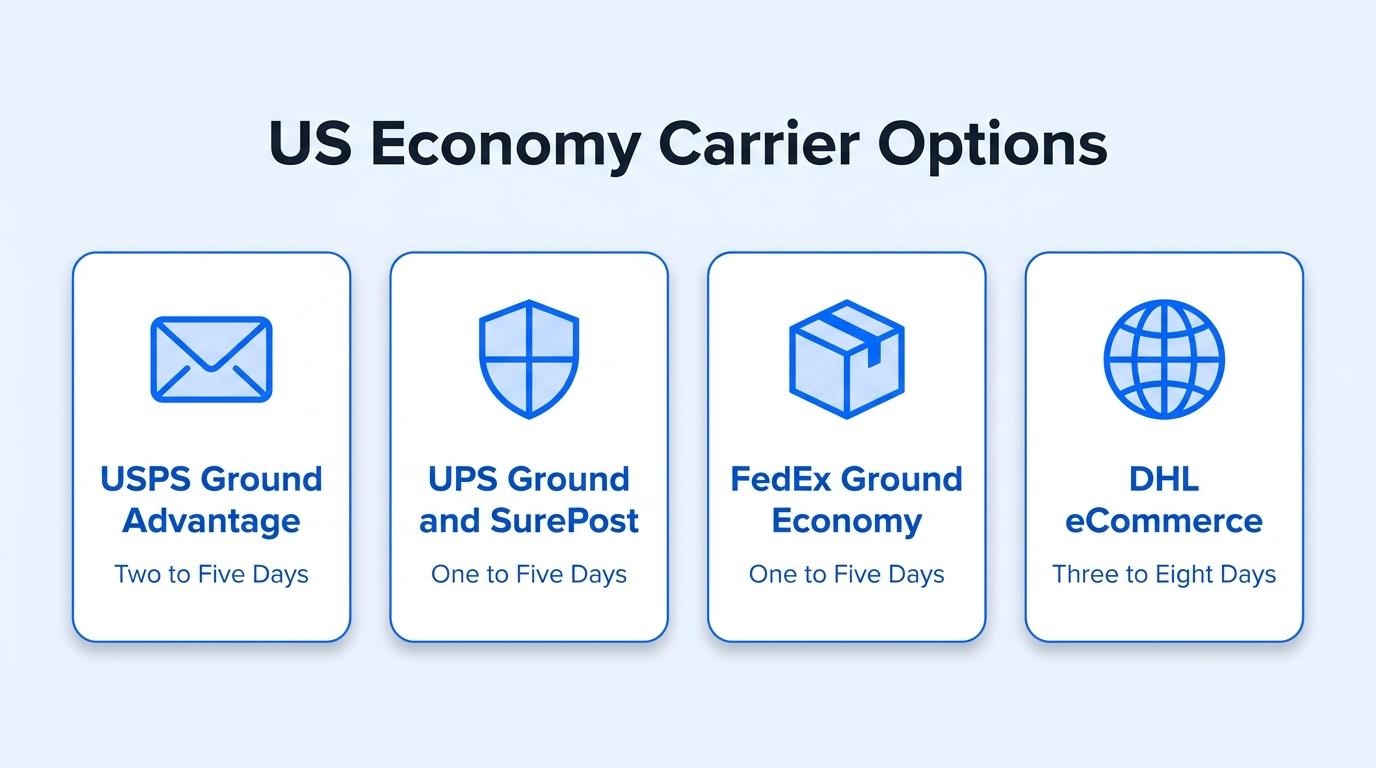
USPS Retail Ground and Parcel Select were two of the postal service's primary economy-tier options for domestic parcels. Both have since been retired. According to a July 2023 announcement from the United States Postal Service, USPS launched Ground Advantage as a consolidated replacement, retiring USPS Retail Ground, Parcel Select Ground, and First-Class Package Service. Ground Advantage delivers packages in two to five business days across the continental United States at lower cost. For merchants still referencing Retail Ground or Parcel Select in their shipping settings, updating to Ground Advantage is essential to avoid service disruptions.
UPS Ground and UPS SurePost are the two primary economy shipping options from UPS. UPS Ground uses the full UPS network for delivery, typically arriving within one to five business days depending on origin-to-destination distance. UPS SurePost is a hybrid service: UPS handles linehaul transport, then transfers the package to USPS for final-mile delivery. This last-mile handoff reduces cost, making SurePost a strong fit for lightweight, low-value items where speed is secondary to savings. The trade-off is slightly longer transit times and less direct control over the final delivery step.
FedEx Ground and FedEx SmartPost serve as FedEx's economy shipping tiers. FedEx Ground delivers within one to five business days across the contiguous US using a dedicated ground network. FedEx SmartPost (now branded FedEx Ground Economy) mirrors the hybrid model: FedEx transports the parcel to a regional hub, and USPS completes the last-mile delivery. Ground Economy works best for lightweight packages under three pounds where cost matters more than speed. Merchants shipping heavier items or needing tighter delivery windows generally benefit more from standard FedEx Ground.
DHL eCommerce is DHL's economy shipping service tailored for lightweight parcels and small ecommerce shipments within the US. DHL picks up packages in bulk, sorts them through its own network, then passes them to USPS for final delivery. Transit times typically range from three to eight business days. This service suits merchants with high parcel volumes of small, non-urgent items. DHL eCommerce also extends naturally into cross-border shipping, giving brands a single carrier relationship that covers both domestic economy and international economy lanes.
With carrier options mapped, the next step is matching the right products to economy shipping.
The types of products best suited for economy shipping are non-perishable, lightweight, and durable items where delivery speed is secondary to cost savings. Below, each product category explains why it pairs well with slower ground transit.
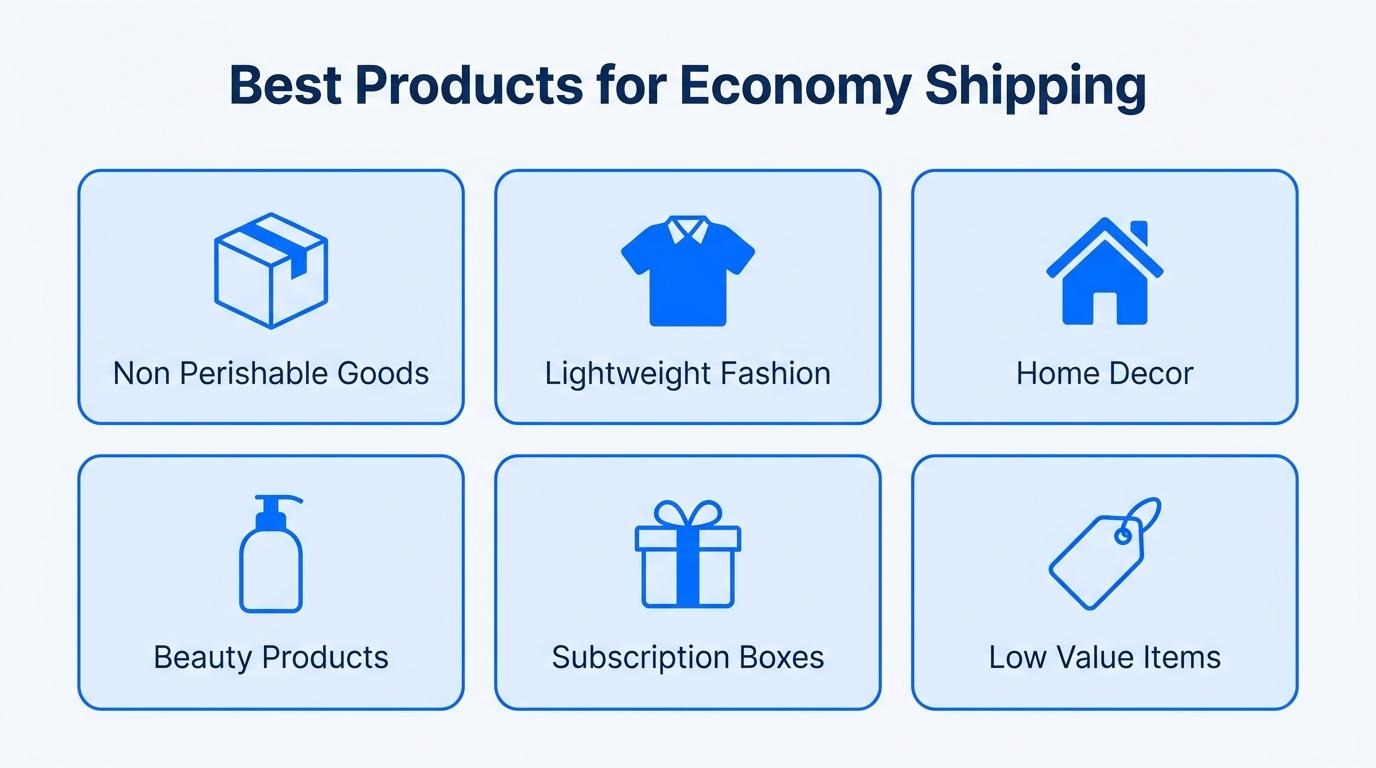
Non-perishable goods and shelf-stable items are ideal candidates for economy shipping because they carry no spoilage risk during extended transit windows. Dry foods, canned goods, supplements, and packaged snacks maintain quality regardless of whether delivery takes five days or ten. Unlike perishable products, which the USDA recommends shipping overnight, shelf-stable inventory tolerates ground networks and warehouse staging without cold-chain logistics. This durability eliminates the need for express delivery services that include expedited transport and continuous tracking control throughout the supply chain. For merchants selling pantry staples or wellness supplements, economy shipping keeps fulfillment costs low without compromising product integrity.
Lightweight fashion and accessories are well suited for economy shipping because their low package weight keeps ground rates minimal. Apparel items, jewelry, scarves, and small leather goods typically weigh under one pound, which means carriers calculate charges based on actual weight rather than dimensional weight. Shipping cost matters significantly to fashion shoppers; a 2019 study published in the Journal of Business Logistics found that delivery fee is the most important delivery attribute across product categories, including shopping goods like apparel. Most fashion purchases are planned rather than urgent, so customers willingly accept longer delivery windows when the trade-off is reduced or free shipping at checkout.
Home goods and decor products pair naturally with economy shipping because customers rarely need them urgently. Wall art, throw pillows, candles, and ceramic pieces are typically non-fragile enough for standard ground handling when packed properly. These items also tend to be low-frequency purchases tied to seasonal refreshes or room updates, so a five-to-ten-day delivery window rarely causes friction. Merchants benefit from the cost savings, especially on bulkier items where dimensional weight pricing could make express rates prohibitive. Economy shipping turns home decor into a high-margin category by keeping fulfillment spend proportional to product price.
Beauty and personal care products are strong fits for economy shipping because most formulations are shelf-stable and compact. Skincare serums, makeup palettes, hair products, and body lotions tolerate temperature variation within normal ground transit conditions. Their small, lightweight packaging keeps dimensional weight low, which directly reduces carrier charges. Customers shopping for beauty replenishments or trying new products are often price-sensitive at checkout, making a low-cost shipping option the deciding factor between completing a purchase and abandoning the cart. The one exception is products with extreme heat sensitivity; those may need faster transit during summer months.
Subscription box shipments are among the best use cases for economy shipping because delivery dates are predictable and urgency is low. Subscribers expect monthly or biweekly arrivals on a recurring schedule, which gives merchants flexibility to batch-ship through slower ground networks. This predictability allows fulfillment teams to optimize routes and consolidate shipments, reducing per-unit costs. Since subscription models depend on healthy margins over time, even small per-box savings compound into meaningful profit improvements across thousands of recurring orders. Economy shipping aligns the cost structure of subscription commerce with the patience subscribers already build into their expectations.
Understanding which products fit economy shipping helps determine when to offer it as a default checkout option.
An ecommerce store should offer economy shipping when slower delivery times are acceptable and cost savings matter most to the buyer. The scenarios below cover cart abandonment, free shipping thresholds, low-margin products, and subscription orders.
You should use economy shipping to reduce cart abandonment when unexpected shipping costs are the primary reason shoppers leave checkout. Displaying a low-cost economy option gives price-sensitive buyers a visible path to completing their order. Even when faster tiers are available, the presence of a budget-friendly alternative anchors the perceived shipping expense lower. Stores selling non-urgent items like apparel basics or home accessories benefit most, because customers accept longer transit when the savings feel proportional. For brands managing both acquisition and retention at scale, making economy the default checkout selection while offering paid upgrades keeps abandonment rates in check without eroding margins.
Economy shipping makes sense for free shipping thresholds when you need the lowest carrier cost to fund a "free shipping over $X" offer profitably. According to 2017 National Retail Federation research, 47% of online shoppers back out of a purchase if they do not qualify for free shipping, while 51% add items to meet a shipping minimum. Economy rates keep the per-order fulfillment cost low enough to absorb within the threshold margin.
Key factors that determine whether economy can support your threshold include:
Setting the threshold just above your average order value encourages upsells while economy rates protect the margin on each qualifying order.
Economy shipping is right for low-margin products when the shipping cost would otherwise consume most or all of the profit on the order. Items like basic phone accessories, budget skincare, or commodity home goods often carry thin margins that cannot absorb expedited rates. Economy ground services keep per-shipment costs proportional to the product price, preserving enough margin to sustain the SKU. If faster shipping would push the total fulfillment expense past the gross profit on the item, economy is the only viable default. Offering a paid express upgrade shifts the speed premium to customers who value it, protecting your baseline profitability on every low-margin sale.
You should default to economy for subscription orders when predictable, recurring shipments allow you to optimize around cost rather than speed. Subscribers expect their box on a regular cadence, not necessarily overnight. Because the next delivery date is known weeks in advance, longer transit windows rarely create dissatisfaction. Economy rates compound into significant savings across hundreds or thousands of recurring shipments each month. This is where an all-in-one platform matters: when subscription logic, shipping rules, and customer data live in one system, adjusting economy defaults by subscription tier or product weight becomes a single workflow rather than a sync between separate tools.
With the right scenarios identified, knowing when to avoid economy shipping is equally important for protecting customer trust.
You should avoid economy shipping when delivery speed, product integrity, or seasonal reliability is critical. The sections below cover perishable and time-sensitive items, peak holiday seasons, and high-value fragile goods.
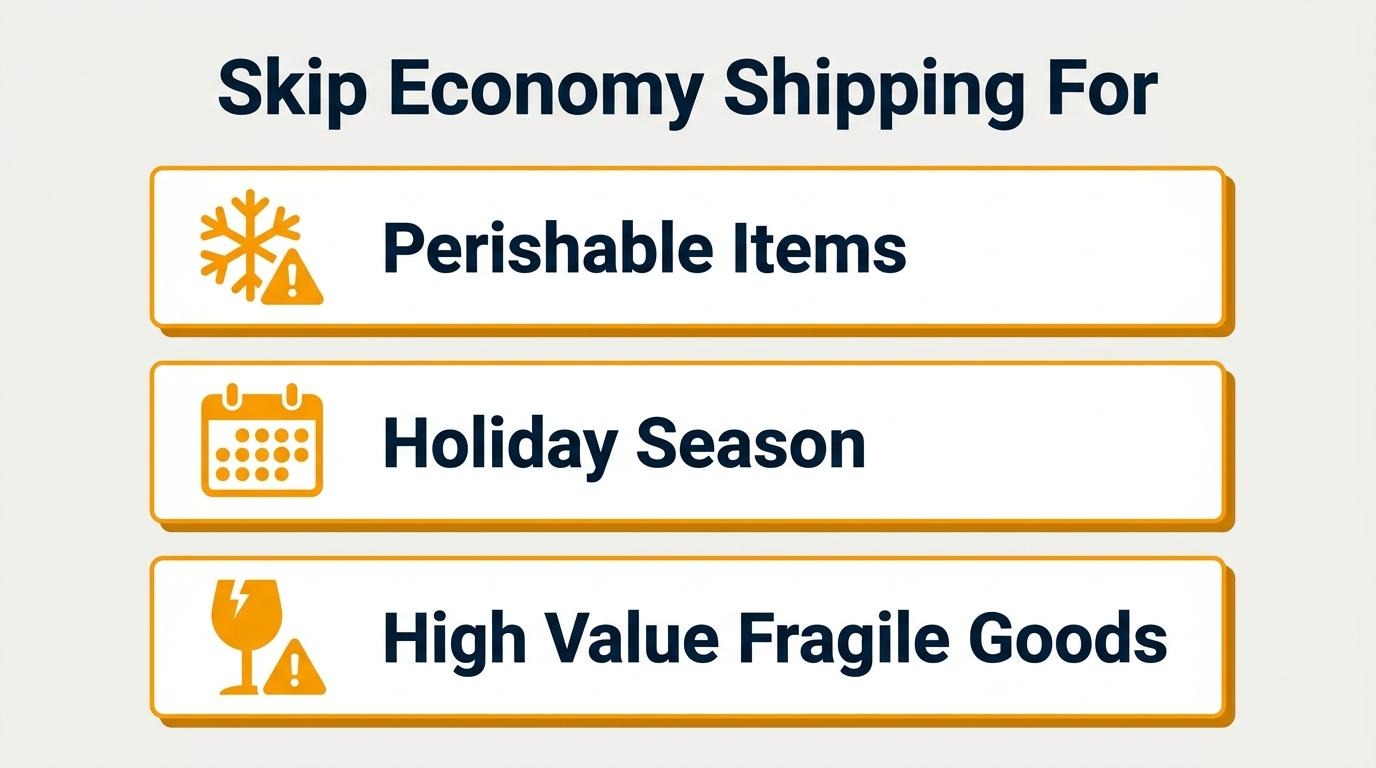
Economy shipping is wrong for perishable or time-sensitive items because extended transit times create food safety risks and product spoilage. According to the USDA Food Safety and Inspection Service, perishable food should be delivered as quickly as possible, ideally overnight, with packages labeled "Keep Refrigerated" to alert the recipient. Economy services typically take five to ten business days, far exceeding the safe window for temperature-sensitive products. Medications with expiration constraints, live plants, and items requiring cold-chain integrity all face the same problem. Overnight or express shipping remains the only responsible option when product quality degrades with each additional day in transit.
You should skip economy shipping during peak holiday seasons because carrier networks become overwhelmed, pushing already-slow economy timelines into unpredictable territory. According to the USPS Office of Inspector General, the 2020 holiday season saw considerable delivery delays, prompting the Postal Service to accelerate its purchase of 138 package processing sorters ahead of the 2021 peak season. Economy shipments sit at the lowest priority tier in sorting facilities, so they absorb the worst of these backlogs. For any order with a firm delivery date, upgrading to expedited or priority service during November through January protects both customer satisfaction and your brand reputation.
Economy shipping falls short for high-value fragile goods because these services typically offer limited insurance coverage, minimal handling guarantees, and fewer tracking touchpoints. Expensive electronics, fine jewelry, and handcrafted ceramics face greater exposure to damage when packages spend more days moving through sorting hubs and transfer points. Each additional handling event increases breakage risk, and filing claims on economy-tier services often yields lower reimbursement caps. Priority or insured shipping options provide signature confirmation, real-time tracking, and higher declared-value coverage. For merchants selling items where a single damaged shipment erodes margin, the cost difference between economy and a protected service pays for itself.
With product-level shipping risks now clear, configuring the right rate rules in your store ensures customers see the appropriate options at checkout.
You set up economy shipping rates by choosing a rate calculation method that matches your product catalog and delivery zones. The three most common approaches are flat-rate rules, real-time carrier-calculated rates, and zone-based shipping tables.
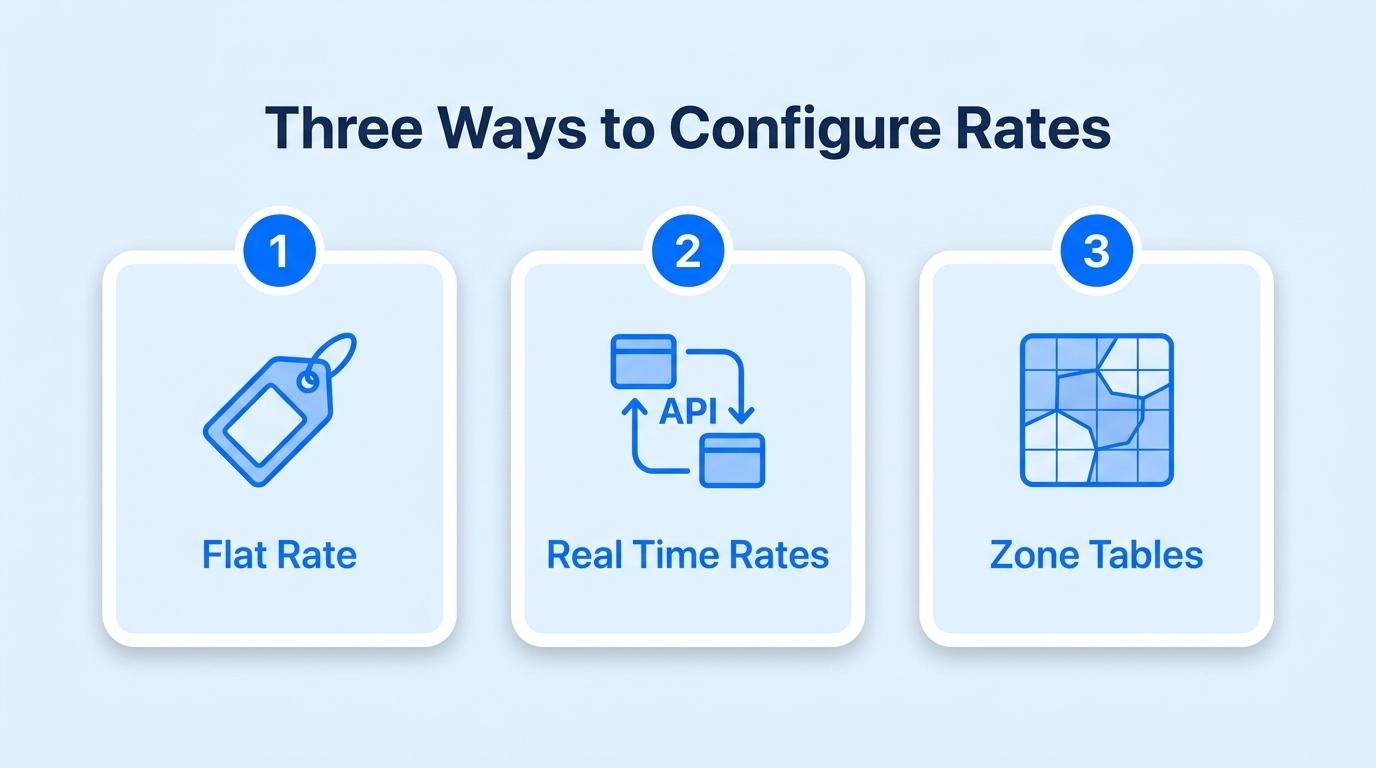
Flat-rate economy shipping rules work by charging every order a fixed shipping price regardless of package weight, dimensions, or destination. The store owner sets one rate, such as $5.99, that applies universally or per defined order-value bracket.
This approach simplifies checkout because customers see a predictable cost before completing payment. Flat rates work best when product weights fall within a narrow range. If your catalog spans lightweight accessories and heavy home goods, a single flat rate either overcharges small orders or absorbs losses on large ones. For brands selling within a consistent weight band, flat-rate rules reduce setup complexity and keep the shipping configuration manageable without carrier API integrations.
Real-time carrier-calculated economy rates work by pulling live pricing from carrier APIs at checkout based on package weight, dimensions, and destination. According to Penn State Extension, the rates charged by shipping carriers are typically determined through a combination of zones, package weight, and package dimensions.
When a customer enters a shipping address, the store queries carriers like USPS or UPS, then displays the exact economy option and cost. This method prevents overcharging or undercharging because each quote reflects current carrier pricing. Setup requires connecting your store to at least one carrier account and entering accurate product weights. Platforms that include carrier integrations natively eliminate the need for third-party shipping calculator apps, reducing one layer of tool complexity.
Zone-based economy shipping tables work by assigning shipping costs according to geographic distance zones between your fulfillment origin and the customer's delivery address. Each zone represents a distance range, and rates increase as the zone number rises.
Merchants build a rate matrix pairing zones with weight brackets. A two-pound package shipping to Zone 3 might cost $6.50, while the same weight to Zone 7 costs $9.75. This structure mirrors how carriers price ground services internally. Zone tables offer more pricing accuracy than flat rates without requiring real-time API calls, making them useful for stores with moderate catalog variety spread across domestic regions.
With rate structures configured, the next step is understanding how economy shipping influences customer experience over time.
Economy shipping affects customer experience and retention through two primary channels: the base shipping fee level and the transparency of the delivery process. Below, the key dynamics of delivery speed expectations and shipment tracking are explored.
Delivery speed expectations shape repeat purchases by setting a baseline against which every order is measured. When a store clearly communicates a 5-to-8-day economy window and the package arrives within that range, satisfaction remains intact. Late deliveries, however, increase the time between a customer's next order, while early arrivals have the opposite effect, according to a 2024 study published in the Journal of Service Research.
Setting realistic delivery estimates at checkout is more effective than promising speed you cannot guarantee. For economy shipping specifically, under-promising by one or two days creates a positive surprise without raising fulfillment costs.
Shipment tracking transparency influences satisfaction by improving the perceived quality of information customers receive throughout the delivery process. A survey of 351 ecommerce users published in the International Journal of Marketing & Distribution found that completeness, accuracy, tracking capability, and real-time updates significantly enhance perceived information quality, which partially drives repurchase intention through customer satisfaction.
For economy shipments that already move slower, proactive tracking updates reduce uncertainty. Automated notifications at key milestones, such as label creation, carrier pickup, and out-for-delivery, compensate for longer transit windows. This transparency matters most when delivery speeds are modest, because silence during a week-long wait erodes trust faster than a brief delay with visible progress.
With delivery expectations and tracking foundations in place, proactive communication strategies can further offset slower transit times.
You can offset slow economy shipping with better communication by setting clear delivery expectations before checkout, sending proactive status updates, and providing accessible tracking information. These tactics reduce anxiety around longer transit times and protect customer satisfaction.
Set accurate delivery windows upfront. Display estimated delivery dates on the product page and in the cart, not just at checkout. When customers choose economy shipping knowing the timeline, perceived wait times feel shorter than unexpected delays do.
Send proactive shipping notifications. Automated emails or SMS at key milestones, such as order confirmation, label creation, carrier pickup, and out-for-delivery, keep buyers informed without requiring them to check manually. According to a World Customs Organization study report, the availability of information and use of ICT are fundamental to facilitating the large volume of low-value e-commerce consignments; the same principle applies at the individual order level.
Provide real-time tracking access. Link tracking directly in confirmation emails and order-status pages. Completeness, accuracy, and real-time visibility matter more than delivery speed alone for many online shoppers. A tracking page that loads quickly and updates consistently turns a slow shipment into a transparent one.
Use post-purchase messaging to reinforce value. The gap between purchase and delivery is an opportunity. Share product care tips, usage guides, or complementary recommendations during transit. This reframes the wait as part of the brand experience rather than a service gap.
For brands managing economy shipping alongside lifecycle messaging, keeping these touchpoints inside one system prevents gaps between order data and communication triggers. With communication strategy in place, the right platform setup ensures these workflows scale without added complexity.
DTC brands should handle shipping strategy by consolidating shipping rules, CRM, and subscription logic into a single platform instead of layering disconnected apps. The sections below cover what changes with unification and the key takeaways on economy shipping.
What changes is that shipping rules, CRM data, and subscription workflows share one customer record, eliminating the sync failures that plague multi-tool setups. When a subscriber's delivery cadence, purchase history, and shipping preference all live in the same system, operators can automate decisions like defaulting economy shipping for routine subscription refills while flagging perishable orders for overnight delivery. According to the U.S. Food and Drug Administration, perishable items sent via mail order should specify overnight delivery with frozen gel-packs or dry ice to arrive refrigerator-cold. That kind of conditional routing becomes far simpler when shipping logic reads directly from CRM and subscription data rather than passing information between separate apps. SHOPLINE is one option for brands looking to run commerce, CRM, subscriptions, and shipping configuration inside a single system with a shared data layer. For brands shipping at scale, the operational cost of reconciling five or six tools often exceeds the subscription fees themselves.
The key takeaways about how economy shipping works and when to use it center on matching the shipping method to the product, the customer expectation, and the margin structure of each order: