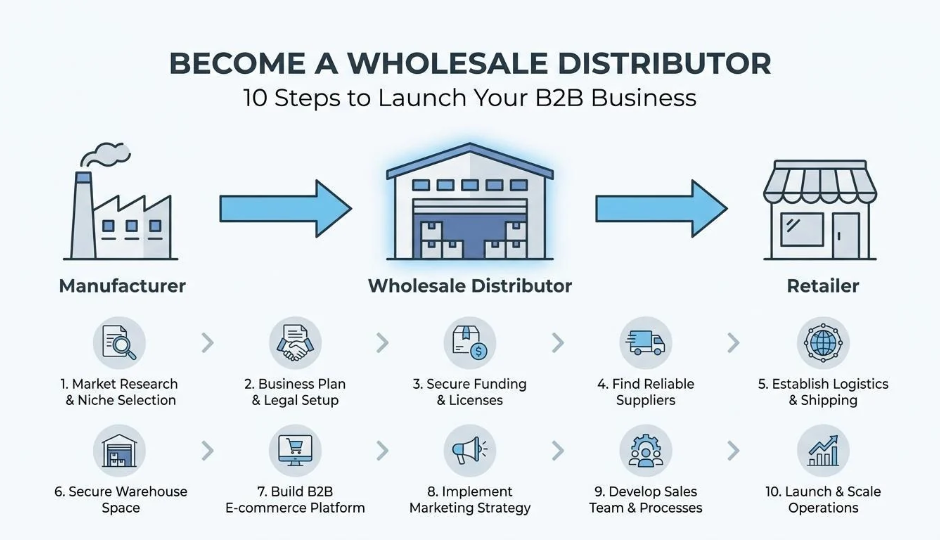
A wholesale distributor is a business that buys goods in bulk from manufacturers and resells them to retailers, restaurants, and other commercial buyers. Wholesale distribution sits between production and retail in the supply chain, generating revenue from the margin between manufacturer cost and the price charged to business accounts.
This guide covers niche selection and market validation, legal formation and licensing, funding and operational infrastructure, pricing and sales channel strategy, and unified platform management for scaling wholesale alongside DTC.
Choosing the right product category shapes every downstream decision, from which state permits you need to which suppliers will negotiate with you. Validating demand through industry reports and competitor analysis prevents capital commitments to niches without proven buyer interest.
Wholesale distributors must register a legal entity, secure a federal EIN, and obtain state-specific seller's permits and resale certificates before transacting. Requirements vary sharply by state and product type; regulated categories like pharmaceuticals carry additional licensing obligations.
Startup costs range from under $10,000 for a home-based operation to over $250,000 for a warehouse-scale venture. Warehouse setup, inventory management procedures, and logistics partnerships define the operational ceiling for order accuracy and delivery speed.
Profitable wholesale pricing accounts for landed cost, volume discount tiers, payment term financing gaps, and competitor benchmarks. Launching a B2B storefront with bulk ordering, MOQ enforcement, and net payment terms gives retail buyers the digital purchasing experience they now expect.
Running wholesale and direct-to-consumer channels inside a single system eliminates data silos between B2B and B2C orders, reducing tool sprawl and improving fulfillment accuracy as volume scales.
A wholesale distributor is a business that purchases goods in bulk directly from manufacturers and resells them in smaller quantities to retailers, commercial buyers, or other intermediaries. Wholesale distributors operate within the supply chain between production and retail, handling inventory storage, order fulfillment, and logistics on behalf of their buyer network.
Unlike retailers, wholesale distributors sell business-to-business rather than directly to end consumers. Their revenue comes from the margin between the manufacturer's price and the wholesale price charged to retail buyers. According to a 2024 U.S. Census Bureau release, U.S. merchant wholesalers recorded $11,382.3 billion in sales in 2022, reflecting a 17.4% increase from $9,693.4 billion in 2021.
This scale underscores just how central distribution is to the broader economy. For anyone exploring how to enter this space, understanding the distributor's core role as a supply chain intermediary is the essential starting point.
Wholesale distribution differs from retail in customer type, order volume, pricing, and position within the supply chain. The key distinctions span who buys, how much they buy, and what margin each channel captures.
For aspiring distributors, this margin gap is worth noting: wholesale captures a thinner slice per dollar but compensates through volume. Understanding where your business fits in this chain shapes every decision covered in the steps ahead.
You should consider becoming a wholesale distributor because the sector offers massive revenue potential, scalable margins, and steady B2B demand. The subsections below cover market size, profit mechanics, and key advantages.
Wholesale distribution in the United States represents one of the largest segments of the national economy. According to the U.S. Census Bureau's Annual Wholesale Trade Survey, U.S. merchant wholesalers recorded $11,382.3 billion in sales in 2022, a 17.4% increase from $9,693.4 billion in 2021. That growth reflects consistent demand from retailers, institutions, and other businesses that rely on distributors to source products efficiently.
The employment footprint reinforces this opportunity. In 2025, the wholesale trade sector accounted for 4.7 percent of nonfarm business sector employment, supporting 6.2 million jobs, according to the U.S. Bureau of Labor Statistics. For entrepreneurs evaluating where to build, those figures signal a mature yet still expanding market with room for new entrants who specialize effectively.
Beyond raw scale, wholesale distribution offers structural profit advantages that differ from retail or direct-to-consumer models:
The wholesale model also benefits from flexibility in how you enter the market. Distributors can start with a focused niche, a small warehouse, and a handful of supplier relationships, then expand as demand proves out. This incremental scaling path carries less upfront risk than capital-intensive retail buildouts requiring storefronts and consumer-facing branding.
For operators already running ecommerce businesses, wholesale distribution opens a second revenue channel that leverages existing supplier contacts and product knowledge. Selling B2B alongside DTC diversifies income and reduces dependence on any single sales channel. Understanding the specific steps involved turns this opportunity into a concrete plan.
The 10 steps to become a wholesale distributor are niche selection, market research, business planning, registration, funding, supplier sourcing, warehouse setup, pricing, sales channel launch, and marketing. Each step below breaks down what to do and why it matters.
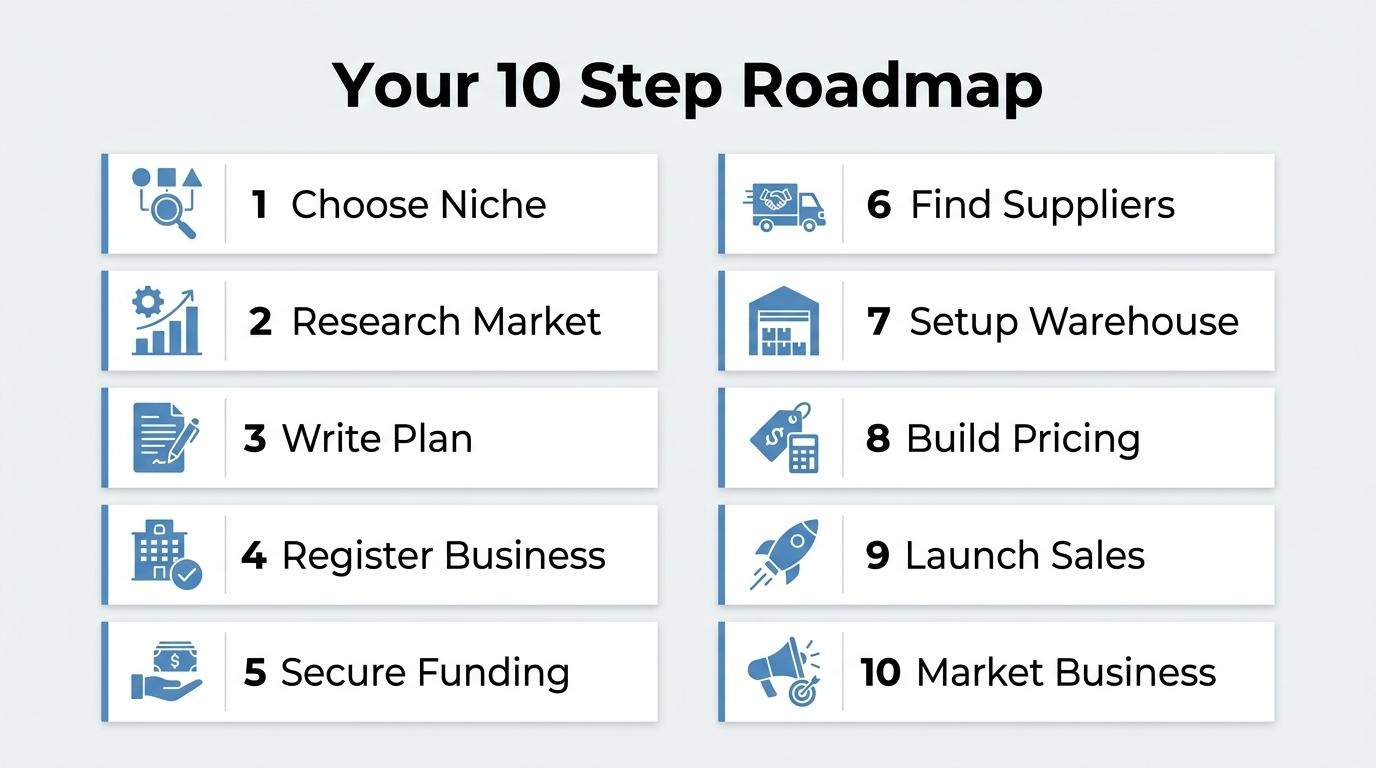
Choosing your wholesale distribution niche means selecting a specific product category that aligns with your expertise, supplier access, and buyer demand. Profitable niches include fashion and apparel, food and beverage, health and wellness, beauty products, and home goods.
Some niches carry additional regulatory requirements. According to the Iowa Department of Inspections, Appeals, and Licensing, any wholesaler distributing prescription drugs into, out of, or within Iowa must obtain a license from the Iowa Board of Pharmacy before engaging in distribution. Similar rules apply across regulated categories like alcohol, firearms, and supplements. Researching compliance obligations early prevents costly delays after launch.
Researching market demand and competition validates whether your chosen niche can sustain a profitable wholesale operation. This step confirms buyer interest, identifies gaps, and reveals competitor weaknesses before you invest capital.
Effective demand research follows a clear process:
According to the Library of Congress Small Business Hub, starting with industry reports, competitor analysis, and target market identification provides the foundation for sound market entry decisions. Skipping this step is one of the most common reasons new distributors fail within their first two years.
Writing a wholesale distribution business plan documents your strategy for operations, finances, marketing, and growth. This plan serves as both an internal roadmap and a requirement for securing funding.
A strong distribution business plan should include:
According to Penn State Extension, a cash flow statement showing predicted inflows and outflows over a year is essential for distribution businesses where inventory purchases create significant upfront costs. In 2025, the wholesale trade sector accounts for 6.2 million U.S. jobs, so lenders and investors expect detailed planning from new entrants in this competitive space.
Registering your business and getting required licenses establishes your wholesale distribution company as a legal entity. This step covers business structure selection, state registration, tax IDs, and industry-specific permits.
Key registration actions include:
According to the IRS, your form of business determines which income tax return form you must file. Seller's permit requirements vary by state; both wholesalers and retailers must apply in most jurisdictions. Getting these documents in order before your first transaction protects you from penalties and ensures tax-exempt purchasing from suppliers.
Securing funding and setting your budget determines how much inventory you can purchase, what warehouse space you can lease, and how quickly you can scale. Wholesale distribution is capital-intensive because you buy products in bulk before generating revenue.
Common funding sources for wholesale distributors include:
Budget categories to plan for are initial inventory, warehouse lease or 3PL fees, technology and software, insurance, licensing costs, and working capital for the first 90 days. Underestimating startup capital is a frequent mistake, so build a buffer of at least 20% above your projected expenses.
Finding and vetting reliable suppliers or manufacturers secures the product pipeline that drives your entire wholesale operation. The quality, pricing, and reliability of your suppliers directly affect your margins and reputation with retail buyers.
Effective supplier sourcing methods include:
Evaluate each potential supplier against objective criteria: price, quality, delivery timeliness, minimum order quantities, return policies, and willingness to accept your contract terms. Negotiating payment terms, such as net-30 or net-60, helps preserve cash flow during your early months of operation.
Setting up your warehouse and logistics operations creates the physical infrastructure for receiving, storing, and shipping inventory. Whether you lease your own space or partner with a third-party logistics provider (3PL), efficient operations protect margins and delivery speed.
Core warehouse setup priorities include:
According to a study published in Sensors (PubMed Central, National Library of Medicine), IoT technology can monitor and track goods, forecast demand trends, manage inventory, and perform warehouse operations in real time. Even small-scale distributors benefit from basic warehouse management software from day one. Retrofitting disorganized operations later costs significantly more than building systems correctly at launch.
Building your wholesale pricing strategy sets the price retailers pay for your products while protecting your profit margins. The wholesale price is the amount a retailer pays before applying their own markup for end consumers.
Key pricing factors to consider:
According to the University of Nebraska-Lincoln Extension, the wholesale price refers specifically to the price a retailer pays for a product, making it distinct from manufacturer cost or suggested retail price. Offering tiered discounts for bulk purchases encourages larger orders, which improves your cash flow and reduces per-unit fulfillment costs. Review pricing quarterly as supplier costs and market conditions shift.
Launching your sales channels and online storefront establishes how retail buyers discover, evaluate, and purchase your products. Distribution decisions concentrate on the methods and delivery channels that optimize your sales and profits across a defined geographic area.
Wholesale distributors typically sell through a combination of channels:
According to Purdue Extension, the distribution portion of your marketing plan should describe exactly how products reach buyers and over what geographic area. For wholesale specifically, an online storefront that supports tiered pricing, bulk ordering, and net payment terms is no longer optional. Retail buyers expect the same digital purchasing experience they encounter in consumer ecommerce.
Marketing your wholesale business to retail buyers drives the B2B customer acquisition that sustains long-term revenue. Unlike consumer marketing, wholesale marketing targets purchasing managers, store owners, and procurement teams through relationship-driven and data-backed strategies.
Effective wholesale marketing tactics include:
According to the U.S. Small Business Administration, market research blends consumer behavior and economic trends to confirm and improve your business idea. Apply this principle continuously after launch by tracking which channels produce the highest-value accounts and reallocating budget accordingly. The distributors who grow fastest treat marketing as an ongoing system, not a one-time launch activity.
With your marketing engine running, the next consideration is whether your business needs the licenses and permits specific to wholesale operations in your state.
Wholesale distributors need a combination of state-level seller's permits, resale certificates, and a federal Employer Identification Number (EIN). Regulated product categories may require additional industry-specific licenses.
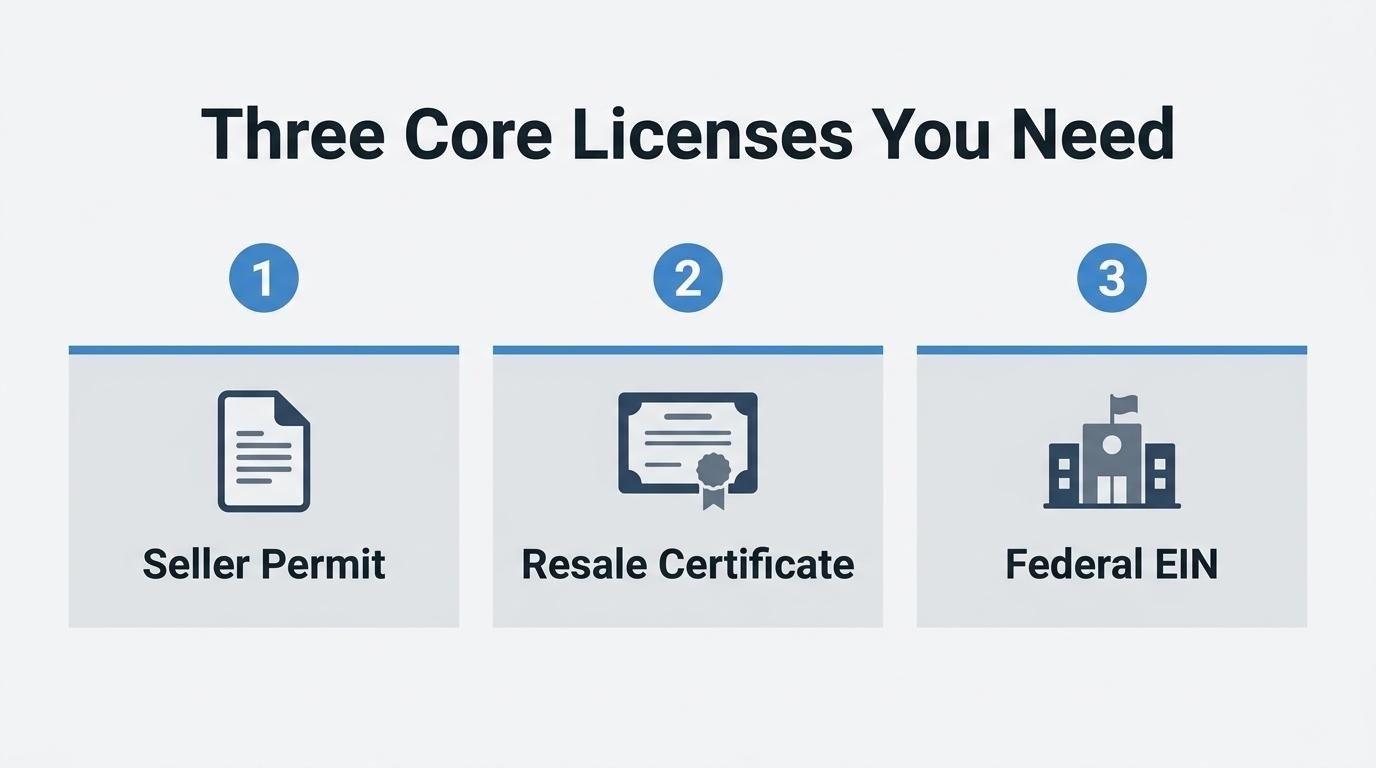
A wholesale license is a state-issued permit that authorizes a business to purchase goods in bulk from manufacturers and resell them to retailers or other businesses. Most states require some form of seller's permit or sales tax registration before a distributor can legally operate.
Requirements vary significantly by state and product category. In California, the requirement to obtain a seller's permit applies to both wholesalers and retailers, including individuals, corporations, partnerships, and limited liability companies. Certain industries carry stricter rules; according to the Iowa Department of Inspections, Appeals, and Licensing, any wholesaler distributing prescription drugs into, out of, or within Iowa must obtain a license from the Iowa Board of Pharmacy before conducting business.
Skipping this step carries real financial risk. Operating without proper registration can trigger penalties that compound daily, making early compliance far less expensive than remediation.
A resale certificate is a document that allows wholesale distributors to purchase inventory without paying sales tax, provided those goods are intended for resale. You need one whenever you buy products that will be sold to another business or end consumer rather than used internally.
The issuing process depends on your state's revenue department. According to the Florida Department of Revenue, businesses that register to collect sales tax receive a Florida Annual Resale Certificate, which allows owners or their representatives to buy or rent property or services tax-free when the items are resold or re-rented. Terminology also differs by state: Colorado calls its version a sales tax license, while other states use "reseller's license" or "vendor's license." Most Colorado sales tax license types are valid for two years and expire at the end of each odd-numbered year.
Always confirm your state's specific renewal timeline, since letting a certificate lapse means paying sales tax on inventory you intend to resell.
Yes, you need a federal EIN for wholesale distribution. An Employer Identification Number, issued by the IRS, serves as your business's tax identification number for federal purposes. It is required to open a business bank account, file federal tax returns, and hire employees.
Wholesale distributors also need an EIN to complete many state registration processes. In Tennessee, for example, registering for a sales tax account provides a state Tax ID number, which is a prerequisite before the Department of Revenue can issue a resale certificate. The EIN application itself is free and can be completed online through the IRS website in minutes.
Because so many downstream registrations depend on having an EIN first, securing one should be among the earliest administrative steps any new distributor takes. With federal and state credentials in place, the next consideration is how much capital the business will require.
The cost to start a wholesale distribution business ranges from under $10,000 for a small home-based operation to over $250,000 for a large warehouse-based venture. Key cost factors include inventory, warehousing, licensing, and technology.
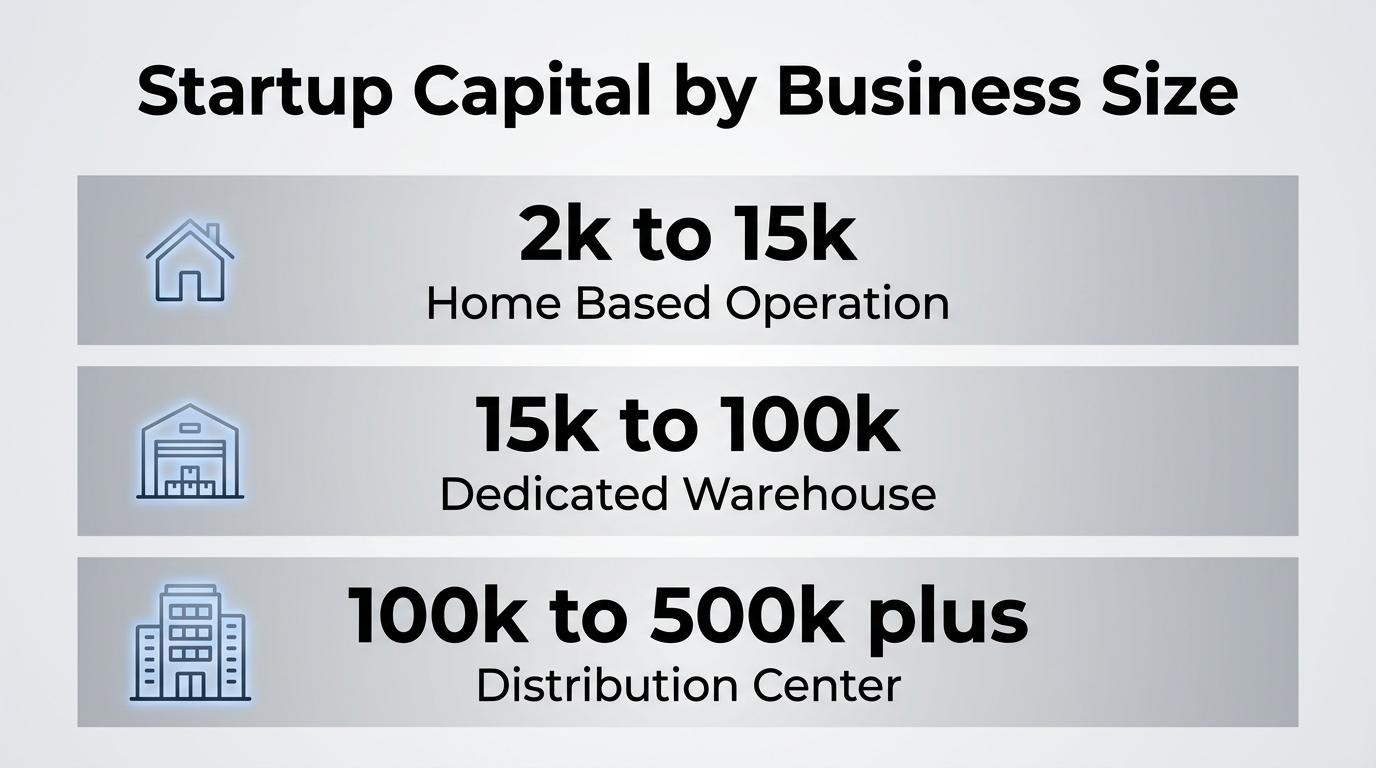
Small-scale distributors need roughly $2,000 to $15,000 in startup capital. This tier suits home-based or garage-based operations focused on a single product category with limited SKUs.
Typical startup expenses include:
Variable costs per unit may decrease as order volumes grow, since suppliers often extend quantity discounts to repeat buyers, according to the University of Missouri Extension. Starting lean and reinvesting early revenue into larger purchase orders is one of the most practical paths for bootstrapped distributors entering the wholesale market.
Mid-scale distributors need approximately $15,000 to $100,000 in startup capital. This range applies to businesses leasing dedicated warehouse space, carrying broader inventory, and hiring a small team.
Core cost categories at this scale include:
According to the 2025 Fed Small Business report, 59% of firms sought new financing in the 12 months leading up to the survey. Mid-scale distributors should plan for both initial capitalization and a working capital reserve covering at least three months of operating expenses.
Large-scale distributors need $100,000 to $500,000 or more in startup capital. Operations at this tier involve dedicated fulfillment centers, multi-state logistics, enterprise software, and sizable teams.
Major cost drivers include:
At this scale, securing external funding through SBA loans, lines of credit, or investor capital becomes essential. For distributors managing both wholesale and direct-to-consumer channels, consolidating operations into a single platform reduces stack complexity and recurring software costs as order volume scales.
Wholesale distributors find suppliers through trade shows, industry directories, online sourcing platforms, manufacturer outreach, and professional networking. Each channel offers different advantages depending on product category and scale.
Trade shows provide direct access to manufacturers and their product lines. According to the University of Michigan Ross School of Business Kresge Library Services, trade publication buyer guides, trade show exhibitor lists, association member directories, and marketing reports often provide better on-target supplier descriptions since they focus on a narrower, manageable market. The U.S. Department of Agriculture's Foreign Agricultural Service also supports participating companies at trade shows with marketing services, market intelligence, and logistical support.
Beyond events, distributors use several sourcing channels to build a reliable supplier base:
Once candidates are identified, vetting becomes the critical step. The Legal Services Corporation recommends using pre-determined, objective criteria to evaluate vendors, including price, quality, qualifications, technical expertise, capacity, past performance, timeliness, responsiveness, and willingness to accept contracting terms. Applying a structured scorecard across these dimensions prevents costly partnerships with unreliable suppliers.
Negotiation closes the loop. Distributors should enter supplier discussions with clear volume projections, target margins, and delivery requirements. For most new distributors, starting with two or three qualified suppliers per product line reduces single-source risk while keeping relationships manageable enough to maintain quality oversight.
With dependable suppliers secured, the next priority is setting wholesale prices that protect margins while staying competitive.
You set profitable wholesale pricing by calculating all costs, choosing a pricing model, and ensuring margins cover operations while staying competitive. The subsections below cover cost-based formulas, common models, and margin benchmarks.
Wholesale pricing starts with a complete picture of your landed cost per unit. This includes the manufacturer's price, shipping, duties, warehousing, and handling. Many new distributors undercount indirect costs, which erodes margins before the first invoice ships.
According to the University of Missouri Extension, variable costs per unit may decrease if the business can purchase larger volumes of inputs and receive quantity discounts. Building volume commitments into supplier contracts directly improves your cost basis and widens margins.
The most common wholesale pricing models include:
For most wholesale distributors, gross margins between 20% and 30% are standard, though this varies by product category and order volume. The pricing model you choose should protect a minimum net margin after accounting for returns, payment terms, and carrying costs.
One commonly overlooked factor: offering net-30 or net-60 payment terms effectively lends money to your buyers. Pricing should account for this cash-flow gap, either by building the financing cost into your unit price or offering small discounts for early payment.
With pricing strategy defined, the next step is identifying which product categories deliver the strongest margins.
The most profitable wholesale niches in the US span fashion, beauty, food, home goods, and health products. Each niche offers distinct margin profiles and demand drivers worth evaluating before committing inventory capital.
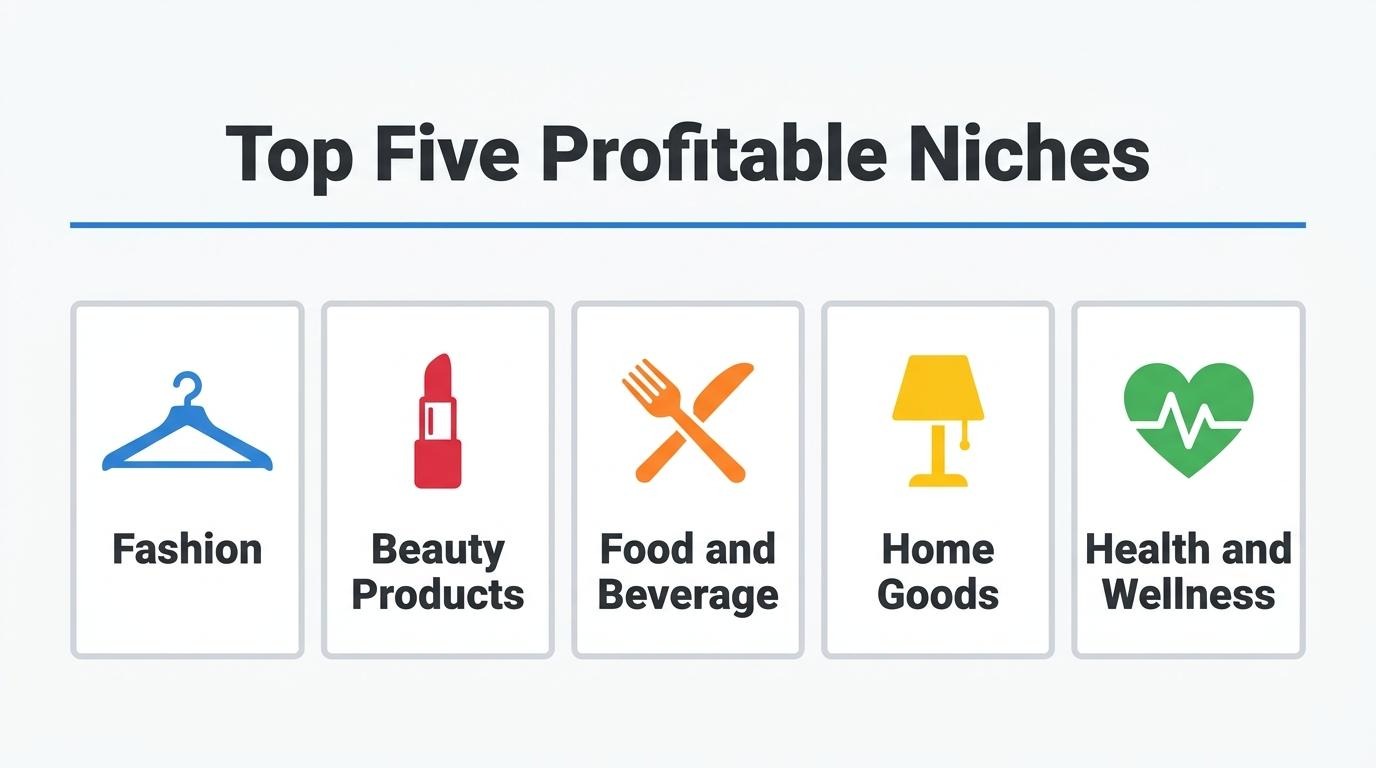
Fashion and apparel wholesale distributes clothing, footwear, and accessories from manufacturers to retail buyers. This niche benefits from seasonal purchasing cycles that create consistent reorder demand throughout the year. Distributors specializing in activewear, plus-size clothing, or sustainable fashion often command higher margins than those carrying generic basics. Private-label apparel, where distributors source unbranded goods and sell under a retailer's label, reduces direct brand competition and strengthens buyer loyalty. Fast trend cycles mean retailers need reliable distributors who can deliver new inventory quickly, making speed-to-shelf a competitive advantage in this category.
Beauty and personal care wholesale covers skincare, cosmetics, haircare, and grooming products sold in bulk to salons, spas, and retail stores. Clean beauty and organic formulations have driven consistent category growth as consumer preferences shift toward ingredient transparency. Margins in beauty wholesale tend to be strong because products are lightweight, shelf-stable, and carry high perceived value relative to production cost. Distributors who secure exclusive regional distribution agreements with emerging brands can build defensible market positions before those brands reach mass retail.
Food and beverage wholesale supplies restaurants, grocery stores, and institutional buyers with perishable and shelf-stable products. According to the U.S. Department of Agriculture Economic Research Service, for a typical dollar spent in 2024 by U.S. consumers on domestically produced food, 6.3 cents went to wholesale trade establishments. Specialty segments like organic snacks, craft beverages, and international foods offer better margins than commodity staples. Cold chain logistics requirements create a natural barrier to entry that protects established distributors from casual competition.
Home and lifestyle product wholesale includes furniture, décor, kitchenware, and organizational goods distributed to retailers and interior designers. This niche benefits from housing market activity, seasonal redecorating cycles, and the ongoing consumer shift toward home improvement. Eco-friendly and artisan home goods command premium wholesale pricing. Distributors who curate product assortments rather than carry everything can position themselves as trusted sourcing partners for specialty retailers looking to differentiate from mass-market chains.
Health and wellness wholesale distributes supplements, fitness equipment, personal protective equipment, and therapeutic products to pharmacies, gyms, and health retailers. Regulatory requirements around supplement labeling and ingredient sourcing create barriers that reward compliant distributors with stronger buyer trust. Recurring consumption patterns in categories like vitamins and protein powders generate predictable reorder revenue. This niche rewards distributors who invest in proper storage conditions and maintain documentation that satisfies both FDA guidelines and retailer audit requirements.
With profitable niches identified, the next step is building buyer relationships that convert product access into revenue.
Wholesale distributors attract retail buyers by combining competitive pricing, reliable fulfillment, and targeted B2B marketing across digital and in-person channels.
Retailers evaluate wholesale partners on price consistency, minimum order flexibility, product quality, and speed of delivery. Distributors who publish transparent wholesale pricing, maintain real-time inventory visibility, and offer tiered discounts based on volume give buyers confidence before the first order is placed.
According to the U.S. Small Business Administration, market research blends consumer behavior and economic trends to confirm and improve your business idea. Applying this principle to B2B outreach means studying which retail segments need your product category, then positioning your catalog and terms to match their buying cycles.
Effective buyer acquisition tactics include:
Relationship building matters as much as initial outreach. Distributors who assign dedicated account managers, provide consistent communication on order status, and resolve issues quickly retain retail accounts far longer than those competing on price alone. For most wholesale businesses, the cost of acquiring a new retail buyer far exceeds the cost of retaining an existing one, which makes service quality a direct profitability lever.
Understanding what your retail buyers need before they ask for it separates distributors who grow from those who stall.
The mistakes new wholesale distributors should avoid include reactive cash flow management, poor supplier diversification, neglecting proper licensing, and underestimating inventory complexity. Each of these errors can stall growth or create legal exposure before the business gains traction.
Reactive cash flow management. Wholesale distribution operates on thin margins, and extended payment terms from retail buyers create gaps between payouts and receivables. According to a 2025 paper from Yale School of Management, solving cash flow issues on a reactive basis causes CEOs to shift energy from core operations to shoring up the balance sheet, costing valuable time that could be spent on foundational improvements. Building a cash flow forecast into weekly operations, not just quarterly reviews, prevents this spiral.
Single-source supplier dependency. Relying on one manufacturer for a core product line leaves the entire business vulnerable to delays, quality issues, or sudden price increases. Vetting and maintaining relationships with at least two qualified suppliers per key SKU category provides a buffer that keeps fulfillment consistent.
Skipping or mishandling licenses and permits. Licensing requirements vary sharply by state and product category, and the penalties for non-compliance are steep. Operating without proper registration is one of the fastest ways to erode trust with retail buyers and expose the business to fines.
Underestimating inventory carrying costs. New distributors often overbuy to secure volume discounts without accounting for warehousing, insurance, shrinkage, and obsolescence costs. A lean initial inventory matched to confirmed demand, then scaled through reorder cycles, protects working capital during the critical first year.
Ignoring digital sales channels. Many new distributors default to phone and email ordering without building an online storefront. This limits discoverability and adds friction for retail buyers who expect self-service catalog browsing, real-time stock visibility, and digital invoicing. For most new wholesale operations, prioritizing even a basic B2B ecommerce presence from day one pays for itself through reduced order errors and faster buyer onboarding.
Understanding these pitfalls early sets the foundation for choosing the right technology to run wholesale operations efficiently.
Wholesale distributors need an ecommerce platform to manage bulk ordering, tiered pricing, and account-based purchasing at scale. The sections below cover essential platform features and how selling wholesale online differs from DTC.
A wholesale ecommerce platform should have features designed for B2B order complexity, not consumer checkout simplicity. Standard DTC storefronts lack the account structures and pricing logic wholesale buyers expect.
Key features to prioritize include:
Distributors operating both wholesale and DTC channels benefit most from platforms where B2B and B2C storefronts share inventory and customer data rather than running as disconnected systems.
Selling wholesale online differs from DTC in order size, buyer relationships, pricing structure, and sales cycle length. DTC transactions are typically single-unit purchases by individual consumers at full retail markup. Wholesale transactions involve bulk quantities sold to registered business accounts at negotiated or tiered prices.
According to the U.S. Census Bureau's Annual Wholesale Trade Survey, U.S. merchant wholesalers reached $11,382.3 billion in sales in 2022, a 17.4% increase from $9,693.4 billion in 2021.
Additional differences include:
These operational differences mean a platform built purely for consumer sales will create manual workarounds at every step of a wholesale workflow. With platform requirements clarified, the next step is unifying wholesale and DTC operations.
Running wholesale and DTC operations in one system eliminates data silos between B2B and B2C channels. Below, see how SHOPLINE approaches this consolidation and the key takeaways from the full wholesale distributor guide.
SHOPLINE handles wholesale and DTC without stitching together multiple tools by running both channels inside a single platform with shared inventory, customer data, and order management. Wholesale pricing tiers, minimum order quantities, and B2B-specific catalogs operate alongside the DTC storefront rather than through bolted-on apps.
This matters most for distributors scaling into direct-to-consumer sales. When B2B and B2C orders pull from the same inventory pool, overselling drops and fulfillment accuracy improves. Customer records from retail buyers and wholesale accounts resolve within one system, so lifecycle marketing and reorder campaigns draw on complete purchase history.
For brands tired of reconciling data across five or more disconnected tools, a single-system approach reduces operational overhead at the point where complexity typically stalls growth.
The key takeaways about becoming a wholesale distributor center on structured planning, legal compliance, and operational efficiency. According to the National Association of Wholesaler-Distributors, even a 1% improvement across core performance levers meaningfully increases profitability for distributors operating on thin margins.
The most actionable lessons from this guide are:
Distributors who treat each of these steps as interdependent, not isolated, build businesses that scale without compounding operational debt.