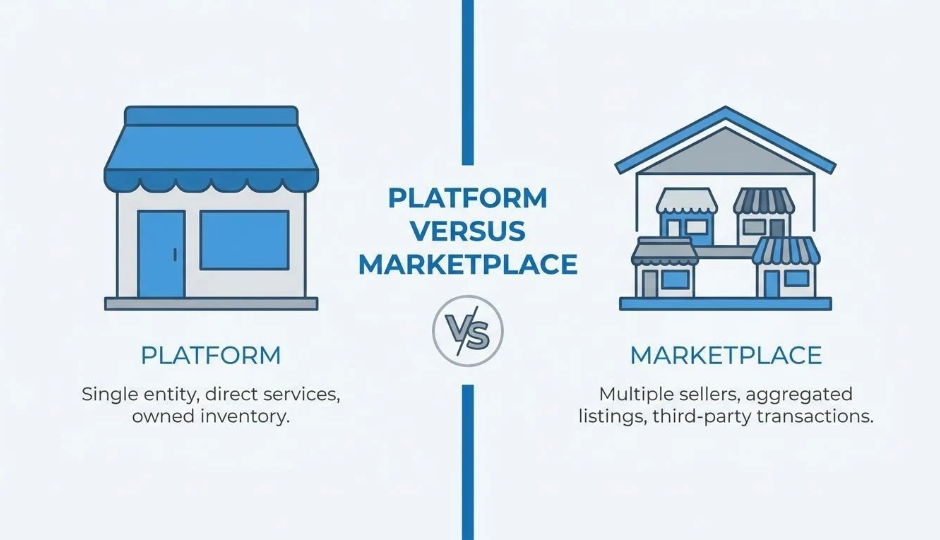
An ecommerce platform is software a brand uses to build and operate its own online store, while an online marketplace is an intermediation service that connects independent sellers with consumers on a shared platform. Each channel structures customer ownership, fees, and brand control differently.
This guide covers business model differences, the advantages and drawbacks of each channel, when to choose one over the other, hybrid selling strategies, and how consolidating commerce operations affects the decision.
Ecommerce platforms and marketplaces split ownership of the customer relationship, revenue structure, and branding in fundamentally different ways. On a platform you own, buyer data flows directly into your CRM for lifecycle marketing and retention. On a marketplace, the platform controls that relationship, limiting your access to the purchase history and contact information needed for repeat-purchase campaigns.
Selling on your own store preserves margin through predictable subscription pricing and gives you full control over storefront design, checkout optimization, and subscription billing. The trade-off is real: you bear complete responsibility for traffic acquisition, face higher upfront costs, and need months of sustained marketing before organic traction builds.
Marketplaces offset those challenges with built-in audiences, platform-level trust that lifts conversion rates, and integrated fulfillment programs that simplify logistics. Those benefits come at the cost of layered fees that compress margins at scale, restricted customer data, commoditizing price competition, and exposure to sudden policy or algorithm changes outside your control.
For mid-market DTC brands, the choice often hinges on repeat purchase strategy, tool consolidation, and whether fragmented customer data across disconnected apps is capping growth. A hybrid approach, using marketplaces for discovery and an owned storefront for retention, positions brands to capture both acquisition volume and lifetime value in one connected system.
An ecommerce platform is software that enables a business to build, operate, and manage its own online store. These platforms handle storefront design, product catalog management, checkout, payment processing, and order fulfillment from a single system. Unlike listing products on a third-party site, an ecommerce platform gives the merchant full ownership of the customer experience, brand presentation, and transaction data. The merchant controls pricing, marketing, and the post-purchase relationship directly. This model suits brands that need to shape every touchpoint, from first visit through repeat purchase, without intermediary restrictions on how they communicate with or retain their customers.
An online marketplace is a platform that connects independent sellers with consumers, enabling transactions without requiring sellers to build their own storefronts. According to the Organisation for Economic Co-operation and Development, online marketplaces are a type of online intermediation service, and essential to their operations are logistics and delivery services, payment services, authentication and login services, and cloud infrastructure. Examples include Amazon, eBay, and Etsy. Sellers list products on the marketplace, while the platform handles buyer traffic, checkout, and often fulfillment. In exchange, marketplaces charge fees such as listing costs, referral percentages, or commissions per sale. The marketplace owns the customer relationship, which means sellers typically receive limited buyer data and have minimal control over branding or post-purchase communication.
Ecommerce platforms and marketplaces differ in business model across three core dimensions: customer ownership, revenue structure, and brand control. Each channel allocates these differently between the seller and the platform operator.
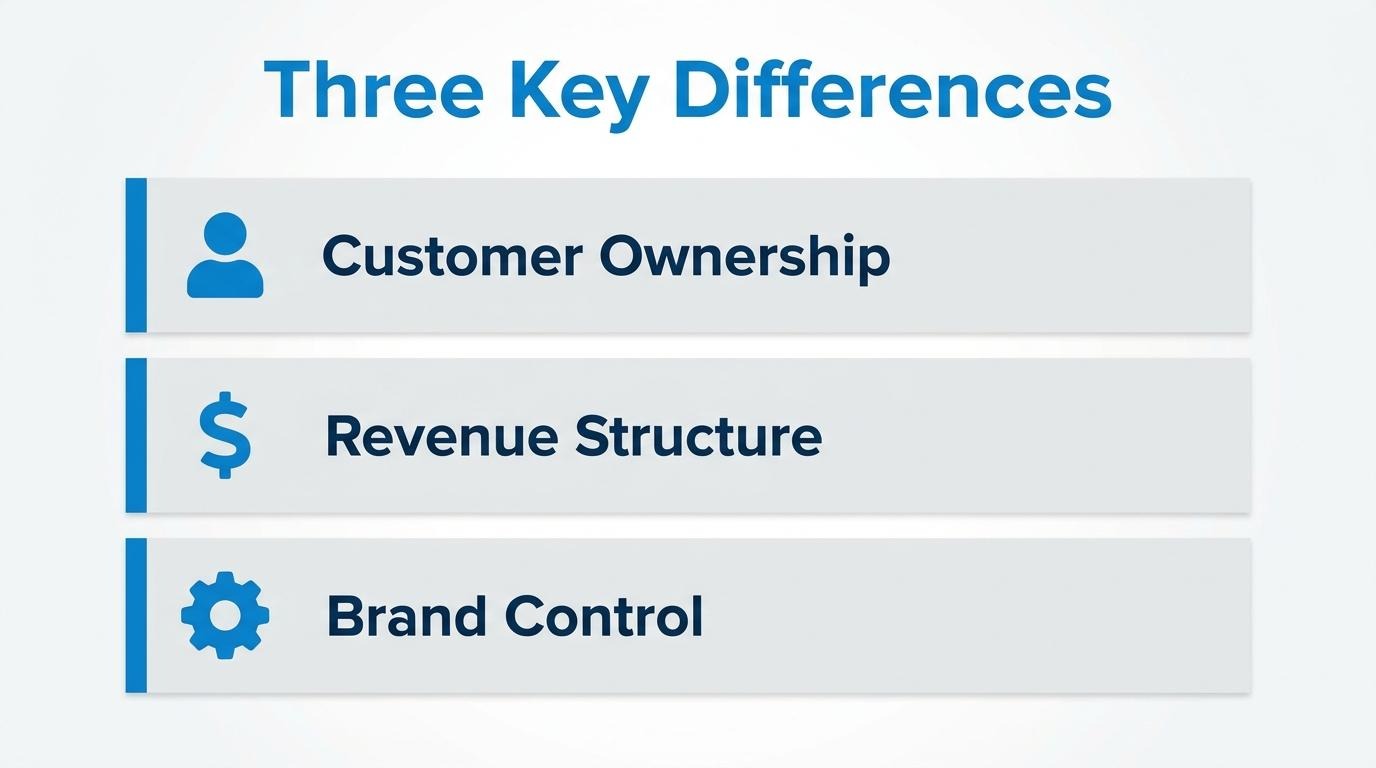
On an ecommerce platform, the merchant owns the customer relationship. The brand collects buyer data directly, controls post-purchase communication, and builds loyalty through its own CRM and lifecycle marketing. This direct access makes repeat purchases and long-term retention strategies possible without intermediary gatekeeping.
On a marketplace, the marketplace owns the customer relationship. Buyer contact information, purchase history, and communication channels typically remain under the marketplace's control. According to a 2020 study published by PubMed Central, end users' loyalty and trust are paramount for online vendors because social commerce intensifies competition and reduces switching costs, making customer retention harder. Without direct access, sellers on marketplaces struggle to build the brand-to-buyer connection that drives lifetime value.
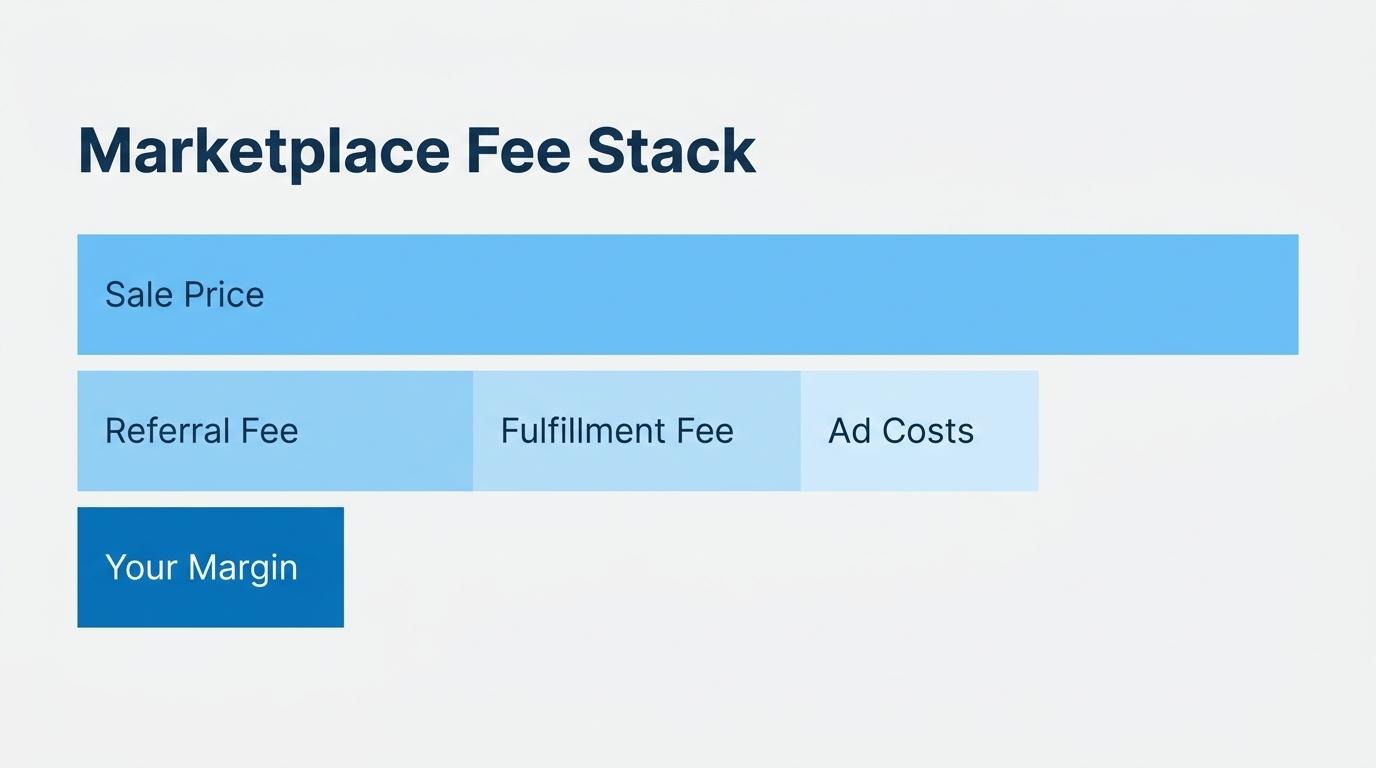
Revenue and fee structure compares as follows: ecommerce platforms charge a recurring subscription plus a transaction processing fee, while marketplaces charge per-sale commissions, referral fees, and often additional fees for fulfillment or advertising.
For brands with strong repeat-purchase rates, the subscription model of an ecommerce platform generally preserves more margin per order over time. Marketplace fee stacking, by contrast, compresses margins on every sale regardless of volume.
Branding control differs significantly between the two channels. An ecommerce platform gives the merchant full authority over storefront design, packaging experience, checkout flow, and post-purchase messaging. Every touchpoint reinforces the brand's visual identity and voice.
A marketplace standardizes the buyer experience. Product listings follow the marketplace's template, and the checkout, shipping notifications, and return processes carry the marketplace's branding rather than the seller's. Sellers compete within a uniform format where differentiation is limited to product images, titles, and pricing.
For brands investing in long-term equity, this distinction matters more than most operators initially realize. Controlling the end-to-end experience is what separates a recognizable brand from a commodity listing.
With these structural differences clear, the next sections break down the specific advantages and drawbacks of each channel.
The pros of selling on an ecommerce platform include full brand control, direct customer data ownership, pricing freedom, recurring revenue capability, and deep customization. Each advantage compounds as a brand scales.
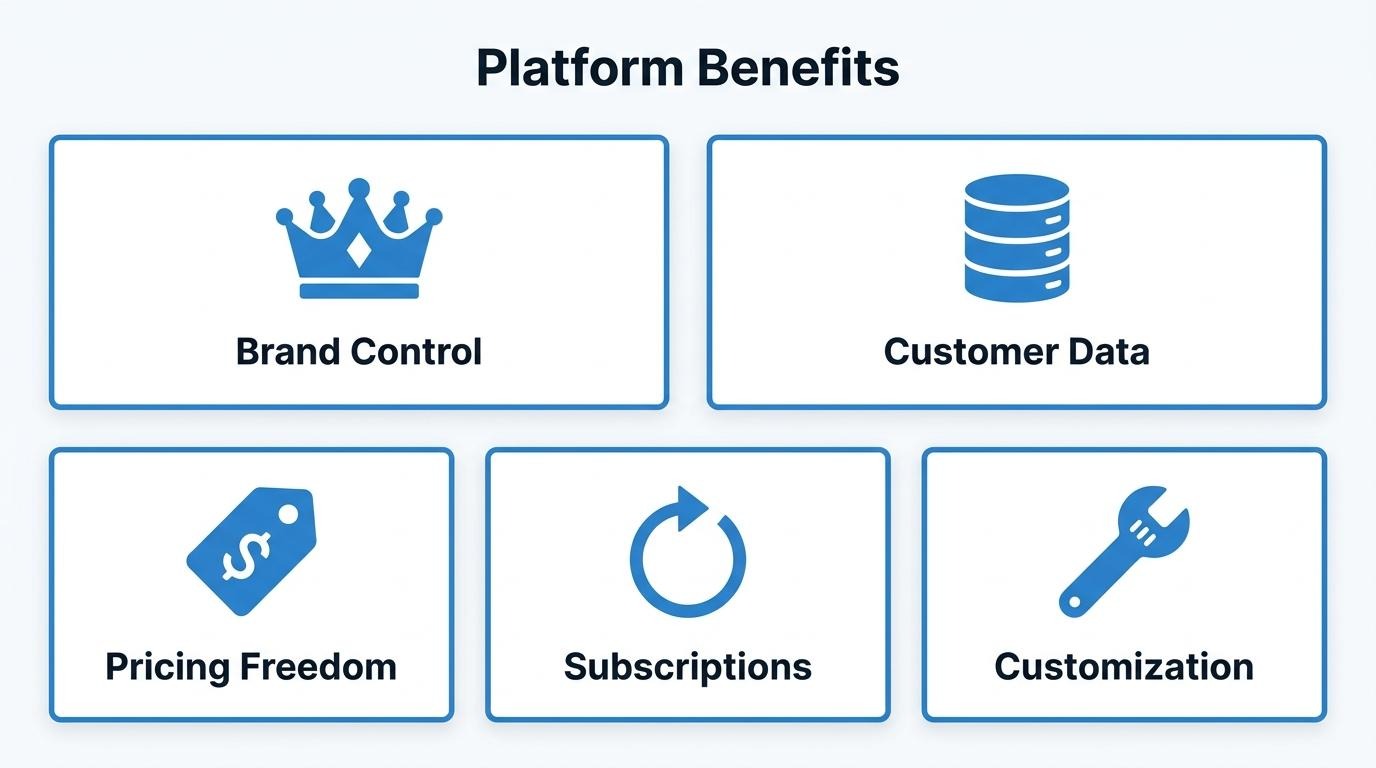
An ecommerce platform helps you build brand equity by giving you complete control over the customer experience. Every element, from the domain name and visual design to the checkout flow and post-purchase communication, reinforces your brand identity rather than a marketplace's.
On a marketplace, your products sit beside competitors under the marketplace's logo. Shoppers remember where they bought, not who sold it. With your own store, the entire journey builds recognition and trust tied directly to your brand name. Over time, that accumulated recognition becomes an asset that reduces customer acquisition costs and increases willingness to pay.
Owning customer data improves retention by enabling personalized marketing, segmented outreach, and lifecycle automation tied to real purchase behavior. On a marketplace, the platform typically controls the customer relationship and limits the data sellers can access or use for re-engagement.
With your own ecommerce store, you collect email addresses, purchase histories, browsing patterns, and consent preferences directly. Regulations like the CCPA and GDPR govern how this data must be handled. According to the California Department of Justice, the CCPA gives consumers control over the personal information businesses collect, which means owning data also means owning compliance obligations. That responsibility, however, is what unlocks permission-based email campaigns, loyalty programs, and targeted retention sequences that marketplaces simply do not allow.
Pricing and margin control on your own store works by eliminating per-transaction marketplace commissions and giving you full authority over retail prices, discount strategies, and bundle structures. Marketplace sellers often face referral fees, closing fees, and fulfillment surcharges that compress margins on every sale.
On your own platform, the primary costs are a fixed subscription fee and payment processing. This predictable cost structure makes it easier to run promotions, offer free shipping thresholds, or test premium pricing without a third party dictating minimum advertised prices or undercutting you with its own private-label products. For brands selling higher-margin products, this difference in fee structure can meaningfully change unit economics.
An ecommerce platform supports subscriptions and recurring revenue by providing native or integrated tools for automatic billing cycles, subscriber management, and retention workflows. Subscription models create predictable monthly revenue, higher customer lifetime value, and lower churn when managed within the same system that handles the storefront.
Consumable products in categories like health and beauty, food and beverage, and home essentials are natural fits for this model. When subscription management lives inside the commerce system rather than through a bolted-on third-party app, order data, billing records, and customer profiles stay unified. That single view makes it simpler to identify at-risk subscribers and trigger win-back sequences before cancellation.
Customization flexibility benefits growing brands by allowing them to tailor storefronts, checkout flows, and backend workflows to match specific operational needs rather than conforming to a marketplace's rigid template.
Key areas where customization drives impact include:
As order volume and product complexity grow, this flexibility becomes the difference between a platform that adapts to the business and one the business must work around. With these operational advantages established, the trade-offs of running your own store deserve equal attention.
The cons of selling on an ecommerce platform include full responsibility for driving traffic, higher upfront costs, and a longer timeline to gain traction. Each drawback is explored below.
The traffic responsibility falls entirely on the brand when selling on an ecommerce platform. Unlike marketplaces, where millions of shoppers already browse product listings, a standalone store launches with zero built-in audience. Every visitor must be acquired through the brand's own efforts.
Typical traffic acquisition channels include:
This reality means marketing budgets scale alongside growth targets. For brands accustomed to marketplace-generated demand, the shift to self-driven acquisition often requires new skills, dedicated headcount, or agency support. The upside is complete control over who visits and how they experience the brand.
The upfront costs and technical requirements for an ecommerce platform are higher than listing on a marketplace. Brands must invest in platform subscriptions, theme design or development, payment gateway setup, and often third-party integrations for shipping, tax compliance, and analytics.
Common cost categories include:
Technical requirements vary by platform complexity. Self-hosted solutions demand server management and developer resources, while hosted SaaS options reduce that burden. Either way, the initial investment in time and money exceeds the near-zero barrier of creating a marketplace seller account. Brands should budget for both launch costs and ongoing maintenance before committing.
It takes most ecommerce platform stores several months to see meaningful traction without built-in demand. SEO efforts alone typically require three to six months before generating consistent organic traffic, and paid acquisition campaigns need testing cycles to optimize return on ad spend.
Several factors influence the timeline:
Patience is non-negotiable. Marketplace sellers often see first-week sales because demand already exists; platform sellers must build that demand from scratch. For brands willing to invest in this ramp-up period, the payoff is a self-sustaining acquisition engine they fully own and control.
With these trade-offs understood, the advantages of marketplace selling offer a useful counterpoint.
The pros of selling on a marketplace include instant access to a large buyer base, built-in consumer trust, and simplified logistics. The sections below cover audience access, trust-driven conversion, and fulfillment support.
Built-in audience access accelerates early sales by placing products in front of millions of active shoppers without requiring a brand to generate its own traffic. New sellers bypass the slow, expensive process of building awareness from scratch. Marketplaces like Amazon, eBay, and Etsy already attract high-intent buyers who arrive ready to purchase, not just browse.
This matters most during the launch phase, when an independent store would typically invest months in paid ads, SEO, and content marketing before reaching comparable traffic levels. On a marketplace, listings can generate orders within days of going live. For brands testing new product categories or validating demand, that immediate feedback loop is difficult to replicate on a standalone storefront.
Marketplace trust influences buyer conversion by transferring the platform's established credibility to individual sellers. Shoppers who might hesitate to enter payment details on an unfamiliar website often complete purchases confidently on a recognized marketplace because the platform itself guarantees buyer protection, handles disputes, and enforces return policies.
Social proof amplifies this effect significantly. According to the Medill Spiegel Research Center at Northwestern University, the purchase likelihood for a product with five reviews is 270% greater than for a product with no reviews. Marketplaces aggregate reviews at scale, giving even newer sellers access to a trust infrastructure that would take years to build independently. For higher-priced items, this trust layer becomes even more critical, as buyers weigh risk more carefully before committing.
A marketplace reduces fulfillment complexity by offering integrated logistics programs that handle warehousing, picking, packing, and shipping on the seller's behalf. Programs such as Fulfillment by Amazon (FBA) and similar services from other platforms allow sellers to send inventory to centralized warehouses, where the marketplace manages the entire delivery chain.
This removes the need to negotiate carrier rates, lease warehouse space, or hire fulfillment staff during early growth stages. Sellers also gain access to fast-shipping badges that improve listing visibility and conversion rates. The trade-off is reduced control over packaging and the unboxing experience, which limits brand storytelling at the point of delivery. For volume-focused sellers prioritizing speed to market over brand presentation, marketplace fulfillment remains one of the most practical paths to scale logistics quickly.
With these marketplace advantages in mind, the potential downsides deserve equal scrutiny.
The cons of selling on a marketplace include fee erosion, limited customer data access, intense price competition, and vulnerability to sudden policy changes. Each of these drawbacks compounds as sales volume grows.
Marketplace fees erode profit margins over time through layered charges that compound at every stage of a transaction. Sellers typically face referral fees, fulfillment fees, advertising costs, and account subscriptions, all deducted before revenue reaches the business.
These costs become more punishing at scale. According to the California Department of Tax and Fee Administration, the Marketplace Facilitator Act (effective October 1, 2019) makes marketplace facilitators responsible for collecting and paying sales tax on retail sales, with additional fee obligations starting January 1, 2022. Tax compliance costs, layered on top of commission structures, further compress already thin margins.
For brands approaching volume, this stacking effect often makes owned-channel economics more favorable over a multi-year horizon.
Customer data access is limited on marketplaces because the marketplace, not the seller, owns the buyer relationship. Most platforms share only the minimum information needed to fulfill orders, withholding email addresses, browsing behavior, and purchase history that sellers need for retention marketing.
Without direct access to customer data, sellers cannot build segmented email lists, run personalized lifecycle campaigns, or calculate accurate customer lifetime value. Repeat purchases happen on the marketplace's terms, not the brand's. Privacy frameworks like CCPA and GDPR further restrict how intermediaries share personal data, reinforcing the marketplace's role as gatekeeper. This data gap makes it nearly impossible to build long-term customer relationships from marketplace sales alone.
Intense price competition on marketplaces affects your brand by pushing products into commoditized comparisons where the lowest price wins visibility. Marketplace algorithms frequently surface cheaper alternatives alongside your listings, training buyers to shop on price rather than brand affinity.
This dynamic erodes perceived value over time. Premium positioning becomes difficult when identical or similar products appear side by side, sorted by cost. Sellers who resist discounting lose buy-box placement; those who match lower prices sacrifice margins. Either path weakens brand equity. For brands built on quality, storytelling, or differentiated ingredients, marketplace price competition works against the very positioning that justifies higher price points.
Marketplace policy changes create business risk by shifting the rules sellers depend on without warning or negotiation. Fee increases, algorithm updates, category restrictions, and listing requirement changes can dramatically alter a seller's economics or visibility overnight.
A 2021 U.S. House Judiciary Committee investigation found that businesses described how dominant platforms exploit gatekeeper power to dictate terms and extract concessions carrying significant economic harm, yet sellers accept these as "the cost of doing business" given the lack of alternatives. Tax obligations add further complexity; Texas, for example, requires marketplace providers to collect, report, and remit state and local sales and use tax on all marketplace sales.
Relying on a single marketplace without a diversified channel strategy leaves brands exposed to changes entirely outside their control.
A brand should choose an ecommerce platform over a marketplace when it needs full ownership of customer relationships, recurring revenue infrastructure, or unified multi-channel operations. The scenarios below cover DTC growth limits, subscription requirements, and omnichannel complexity.
A DTC brand outgrows marketplace-only selling when customer acquisition costs rise but the brand cannot retarget or retain those buyers. Marketplaces limit access to purchase data, email lists, and browsing behavior, which blocks lifecycle marketing. Once a brand generates consistent demand through its own content, social channels, or paid media, funneling that traffic to a marketplace surrenders margin and customer ownership simultaneously. The tipping point typically arrives when repeat purchase rate becomes the primary growth lever. At that stage, owning the storefront means owning the relationship, and building retention sequences, loyalty programs, and post-purchase flows that marketplaces simply do not allow.
A subscription-based product needs its own store when recurring billing, flexible plan management, and branded subscriber experiences become central to the business model. Marketplaces rarely support native subscription logic; brands must rely on workarounds that fragment the customer journey. An owned storefront lets brands display reviews, customize pricing tiers, and manage renewals in one place. According to research published in Frontiers in Psychology, displaying reviews on a higher-priced product increased conversion rates by 380%, compared to 190% for lower-priced items. For subscription brands selling premium products, controlling how social proof appears alongside recurring offers directly impacts signup rates and long-term retention.
Omnichannel selling requires a unified platform when a brand operates across its own website, physical retail, and social channels but cannot reconcile inventory, orders, or customer data into a single view. Fragmented systems create fulfillment errors, inconsistent pricing, and blind spots in customer behavior across touchpoints. According to a U.S. House Committee on the Judiciary investigation, businesses reported that dependence on dominant platforms forces concessions carrying significant economic harm, described as "the cost of doing business" given the lack of alternatives. Consolidating operations onto one platform reduces that dependency while giving brands a single customer record across every channel.
Understanding when platform ownership becomes necessary helps clarify what marketplace selling still does well.
Selling on a marketplace still makes sense when a brand needs fast access to high-intent shoppers or wants to test new products without heavy upfront investment. The scenarios below cover product discovery and hybrid selling strategies.
A brand should use a marketplace for product discovery when it is entering a new category, launching an unfamiliar product line, or trying to reach buyers who do not yet know the brand exists. Marketplaces aggregate millions of active shoppers already searching with purchase intent, which removes the need to build awareness from scratch.
This approach works especially well for:
According to the OECD, online marketplaces function as online intermediation services connecting independent sellers and consumers, with built-in logistics, payment, and cloud infrastructure that lower the barrier to entry. For brands still validating product-market fit, that infrastructure means faster time-to-shelf without committing to a full storefront buildout.
A hybrid strategy works best when a brand has enough traction to justify its own storefront but still benefits from marketplace traffic for top-of-funnel acquisition. Rather than choosing one channel exclusively, the brand uses each for its strength: marketplaces generate discovery and first-time purchases, while the owned store captures repeat buyers, builds customer relationships, and protects margins.
A hybrid approach is particularly effective when:
The key tension in any hybrid model is data fragmentation. Marketplace sales rarely provide the customer-level data needed for lifecycle marketing, so brands running both channels need a system that unifies storefront and retention data in one place. Understanding how to connect those channels is central to deciding whether both can scale together.
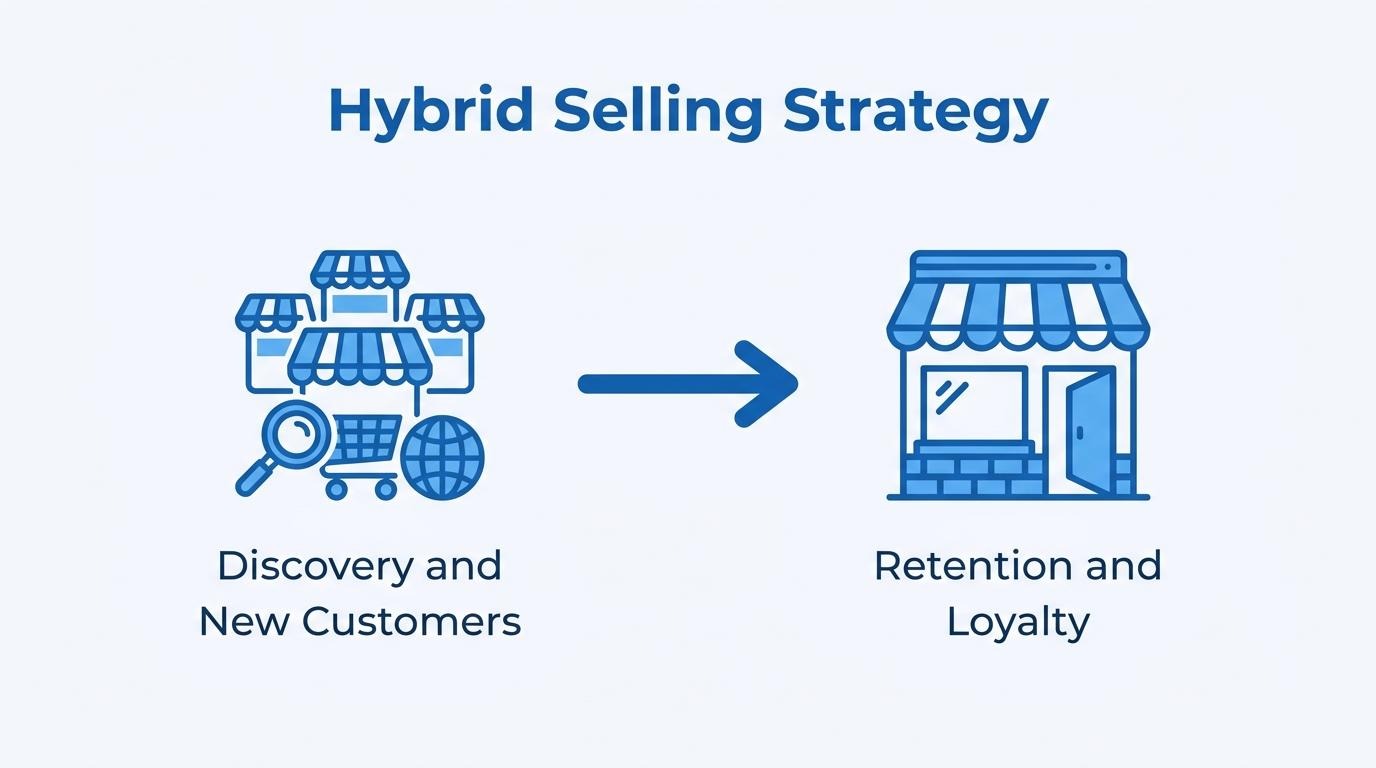
Yes, you can sell on both an ecommerce platform and a marketplace simultaneously. Most brands that reach meaningful revenue operate across both channels, using each for distinct strategic purposes. A marketplace functions as an intermediary connecting independent sellers with consumers, while an ecommerce platform serves as the brand's owned storefront. According to the OECD, online marketplaces are a type of online intermediation service whose operations depend on logistics, payment services, authentication, and cloud infrastructure. Running both channels lets a brand capture marketplace traffic for discovery while building direct customer relationships through its own store.
The key challenge is operational: inventory synchronization, consistent pricing, and unified order management require deliberate coordination. Brands that treat each channel as an isolated silo often encounter conflicting stock counts, margin erosion from misaligned discounts, and fragmented customer data that makes retention difficult.
For scaling DTC brands, a hybrid approach works best when the ecommerce platform acts as the primary revenue and data engine, with marketplace presence serving acquisition goals. This structure keeps customer ownership, lifecycle data, and margin control anchored to the owned storefront, where repeat purchase mechanics and CRM workflows can operate without marketplace restrictions.
Understanding how both channels interact leads directly to the platform decision itself, particularly for mid-market brands weighing tool consolidation against growth complexity.
Mid-market DTC brands should consider tool sprawl, customer data fragmentation, and repeat purchase strategy when choosing between an ecommerce platform and a marketplace. Each factor directly affects operational efficiency and long-term scalability.
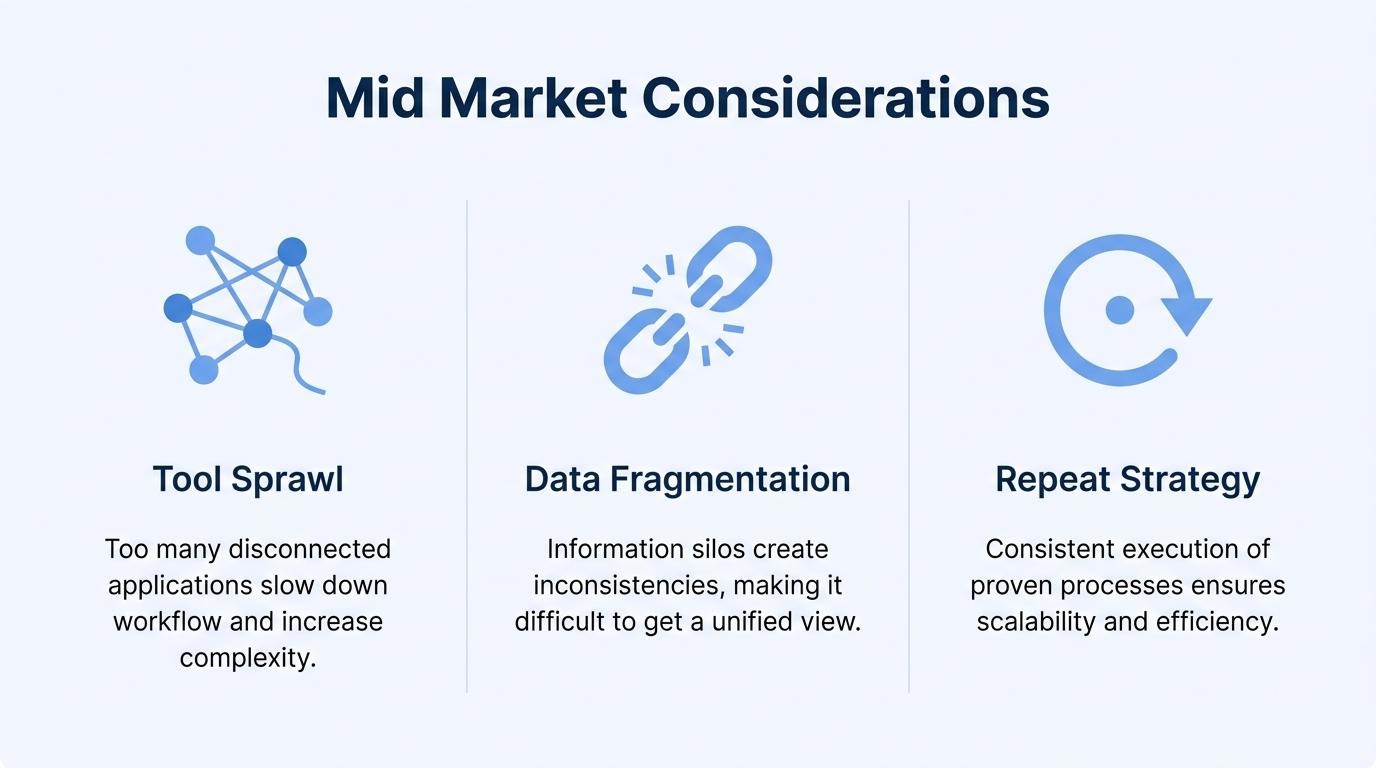
Tool sprawl factors into the platform decision by increasing operational cost, slowing execution, and creating dependency on disconnected third-party apps. Brands running five to fifteen separate tools for email, subscriptions, loyalty, POS, and analytics face compounding subscription fees and integration maintenance. Each added app introduces a potential failure point where data syncs break or workflows stall. For mid-market brands processing real volume, this fragmentation turns routine tasks into engineering projects. Consolidating core functions into fewer systems reduces both cost and the dev dependency that slows teams at scale.
Fragmented customer data limits scaling by preventing brands from building accurate, unified customer profiles across channels. When purchase history lives in one tool, email engagement in another, and in-store transactions in a separate POS, no single system holds the complete picture. This makes segmentation unreliable, lifecycle triggers inaccurate, and personalization superficial. Brands cannot confidently identify high-LTV customers or target lapsed buyers when the underlying data is split across disconnected silos. At the mid-market stage, where retention efficiency drives margin, incomplete customer records become a structural ceiling on growth.
Repeat purchase strategy plays a central role in choosing because platforms differ significantly in how they support post-purchase engagement. Marketplaces limit direct communication with buyers, restricting a brand's ability to run lifecycle campaigns, trigger replenishment reminders, or build loyalty programs. An ecommerce platform gives full control over these retention mechanics. Social proof compounds this advantage: according to research from the Medill Spiegel Research Center at Northwestern University, purchase likelihood for a product with five reviews is 270% greater than for a product with no reviews. Owning the storefront lets brands collect, display, and leverage reviews as part of a cohesive repeat purchase loop.
With these mid-market considerations mapped, the next step is understanding how consolidating commerce and CRM reshapes the decision.
Consolidating commerce and CRM changes the decision by shifting the evaluation from feature checklists to operational architecture. Instead of comparing individual tools, brands weigh whether a unified system reduces the fragmentation that limits retention and scaling.
SHOPLINE unifies storefront and retention without an app stack by running commerce, CRM, marketing automation, subscriptions, and POS inside a single system with a shared customer data layer. Purchase history, browsing behavior, and offline transactions resolve to one customer record rather than syncing across separate tools.
This architecture eliminates common failure points:
For brands operating at $1M to $50M in annual revenue, the practical effect is fewer tools to manage and faster execution on retention campaigns. Rather than maintaining a stack of five to fifteen apps, operators work within one environment where customer intelligence and commerce share the same foundation.
The key takeaways about ecommerce platform vs marketplace center on a core trade-off: audience access versus ownership and control.
The strongest position for a scaling DTC brand is one where customer data, lifecycle marketing, and commerce operations live in a connected system. Choosing between platforms and marketplaces is not binary; it is a question of which channel serves acquisition and which serves the relationship that drives lifetime value.