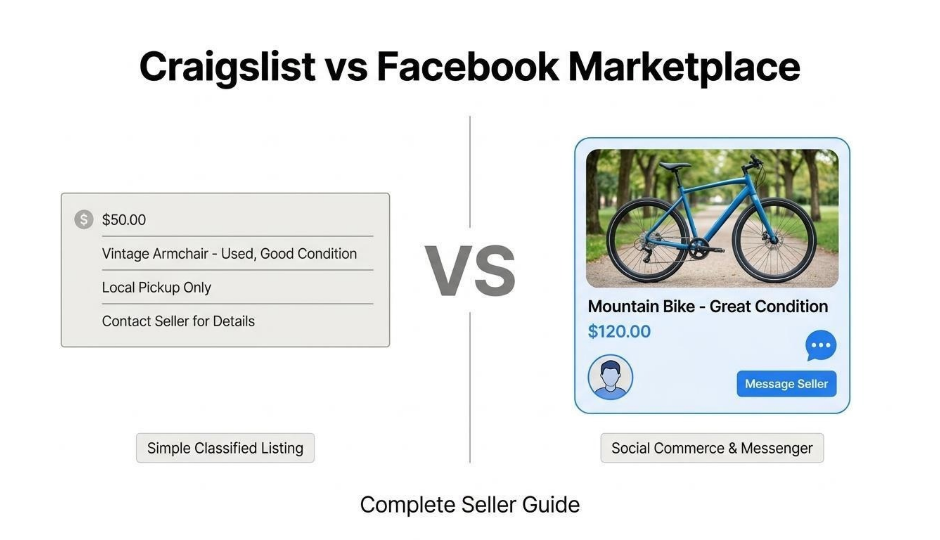
Craigslist is a classified-advertising website built on anonymous, local, cash-based transactions. Facebook Marketplace is a commerce feature embedded in the Facebook app that pairs algorithmic discovery with optional integrated shipping. Both platforms connect sellers with buyers, yet they differ in nearly every operational detail.
This guide covers platform mechanics and audience profiles, category performance and listing optimization, fee structures and payment safety, buyer communication and scam prevention, and when to transition to a dedicated ecommerce channel.
Craigslist organizes listings by city and category, relying on internal search rather than algorithmic recommendations. Facebook Marketplace surfaces listings based on location, browsing behavior, and interest signals, giving sellers passive exposure to a far larger user base.
Craigslist attracts privacy-conscious, price-driven buyers who expect to negotiate and pay cash in person. Facebook Marketplace draws a broader demographic that spans age groups from 18 to 65+, where visible profiles and seller ratings create social accountability.
Craigslist charges no fees for most personal listings, and its cash-and-carry model eliminates payment processing costs entirely. Facebook Marketplace is free for local pickup sales but deducts a 10% selling fee on shipped orders, calculated on the total transaction value including item price, shipping, and taxes.
Craigslist offers no built-in seller protection, dispute resolution, or shipping infrastructure. Facebook Marketplace provides a formal reporting system, purchase protection on eligible shipped orders, and prepaid shipping labels, though sellers trade privacy for that structure by linking every transaction to a personal profile.
Sellers consistently moving volume across both platforms eventually face inventory and order management limits that neither marketplace solves. Dedicated ecommerce platforms like SHOPLINE unify products, orders, and customer data across channels, giving growing sellers the brand control that peer-to-peer marketplaces cannot offer.
Craigslist and Facebook Marketplace are online platforms that connect local sellers with buyers. Each operates on a fundamentally different model, from listing mechanics to audience discovery.
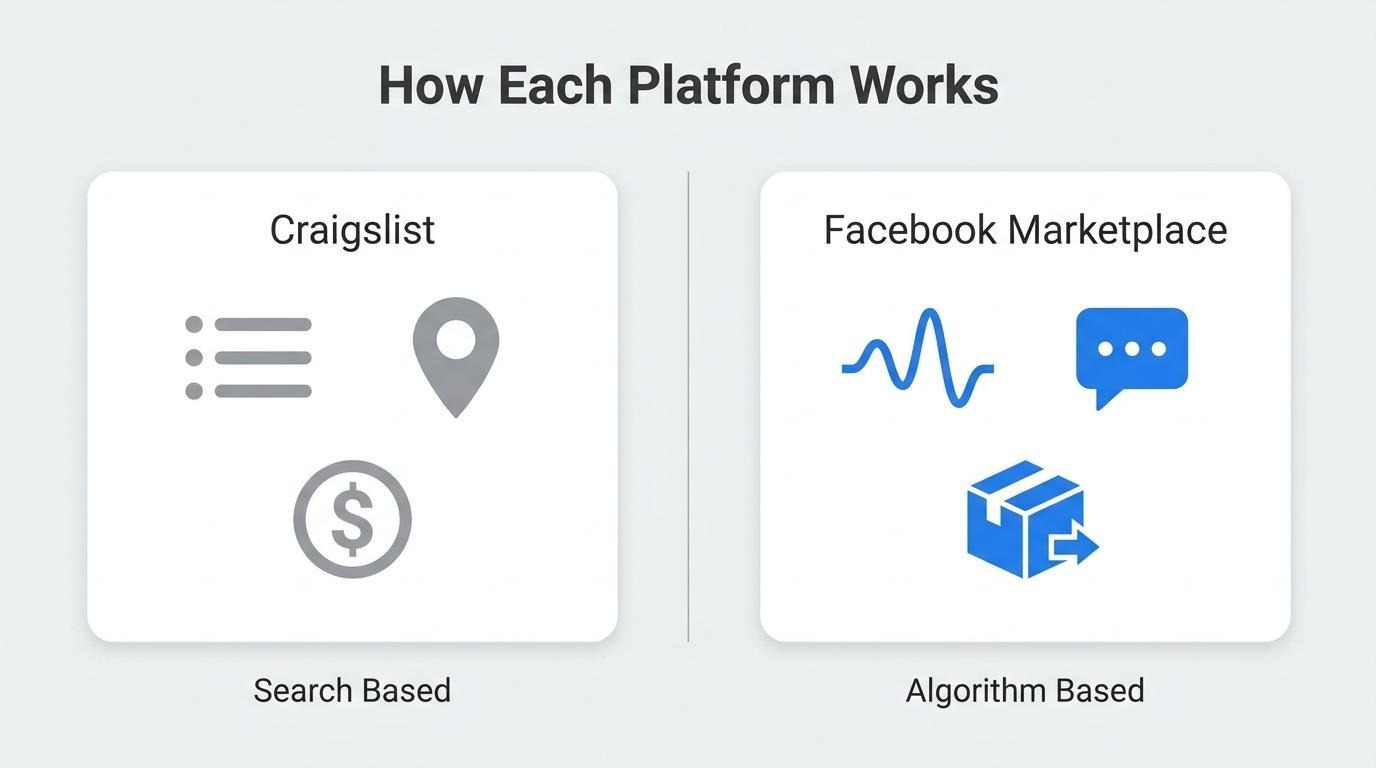
Craigslist is a classified-advertising website that organizes listings by city and category. Sellers select a geographic market, choose a category, and publish a text-based ad with optional photos. According to a Harvard Business School study on multi-sided markets, Craigslist's classified-advertising model significantly disrupted local U.S. newspapers by offering a free, direct alternative for buyers and sellers.
Most transactions happen in person. The platform does not process payments or manage shipping; sellers communicate through anonymized email relays and arrange cash exchanges at meetup locations. This simplicity keeps the barrier to entry low, though it also means sellers handle every step of the transaction themselves.
Facebook Marketplace is a commerce feature built into the Facebook app that lets users list items for sale to a built-in audience of active social media users. Sellers create listings with photos, descriptions, and pricing directly from their Facebook profile. The platform uses location data and algorithmic recommendations to surface relevant listings to nearby buyers.
Communication happens through Facebook Messenger, which ties each conversation to the buyer's real profile. For shipped orders, Facebook processes the payment and charges a selling fee. Local pickup transactions, by contrast, are handled directly between buyer and seller with no platform fee.
With both platforms now defined, understanding who actually shops on each one helps sellers target the right audience.
Craigslist attracts deal-driven, privacy-conscious buyers, while Facebook Marketplace draws a broader, socially connected audience. Each platform's user base shapes how sellers should price, communicate, and list items.
The type of buyer who shops on Craigslist tends to be privacy-conscious, price-driven, and comfortable with anonymous transactions. These buyers often prefer cash payments and in-person pickups, avoiding platforms that require a social profile or identity verification.
Craigslist shoppers frequently search for specific items at below-retail prices, such as used furniture, vehicles, electronics, and apartment rentals. Many are experienced negotiators who expect to haggle. Because Craigslist provides no buyer profiles or ratings, these users accept a higher degree of uncertainty in exchange for simplicity and anonymity. Sellers targeting this audience should expect direct, no-frills communication and price-focused inquiries.
The type of buyer who shops on Facebook Marketplace is typically a casual browser embedded in the broader Facebook ecosystem. According to Pew Research Center, Facebook usage spans 68% of adults aged 18 to 29, 80% of those 30 to 49, 74% of those 50 to 64, and 57% of adults 65 and older, giving Marketplace access to one of the widest demographic pools in online commerce.
Marketplace buyers often discover listings passively while scrolling their feed, which means impulse purchases are more common than on Craigslist. Visible profiles, mutual friends, and seller ratings create a layer of social accountability that builds initial trust. For sellers, this audience responds well to polished photos, competitive pricing, and prompt replies through Messenger.
Understanding each platform's buyer profile helps sellers tailor pricing, photos, and communication style to the right audience.
Both platforms support a wide range of product categories, but each attracts different types of inventory. The sections below cover top-performing categories on Craigslist, best-sellers on Facebook Marketplace, and restricted items on each platform.
The categories that perform best on Craigslist include furniture, vehicles, electronics, and housing-related items. Craigslist organizes listings into structured categories such as "for sale," "housing," and "services," which funnel buyers with specific purchase intent.
High-performing Craigslist categories include:
Bulky, high-value goods tend to outperform smaller items because Craigslist's cash-and-carry model suits transactions where shipping is impractical.
The categories that perform best on Facebook Marketplace include clothing, home decor, baby and kids' items, and consumer electronics. Facebook Marketplace benefits from visual-first browsing, which favors items that photograph well and appeal to a broad consumer audience.
Top-performing Facebook Marketplace categories include:
For sellers with visually appealing, lightweight products, Facebook Marketplace typically generates faster engagement than Craigslist due to its social discovery algorithm.
The items restricted on each platform overlap significantly but differ in enforcement. Both Craigslist and Facebook Marketplace prohibit illegal goods, weapons, recalled products, and hazardous materials, yet Facebook Marketplace enforces restrictions through automated content review, while Craigslist relies primarily on community flagging.
According to Meta Newsroom's 2016 announcement, more than 450 million people visit buy-and-sell groups each month, which makes Facebook's automated moderation system essential for managing listing compliance at scale.
Key restricted items on both platforms include:
Sellers should review each platform's current policies before listing, since restrictions change periodically. Understanding what is and is not allowed prevents listing removals and potential account suspensions.
Seller fees on Craigslist and Facebook Marketplace differ significantly. Craigslist charges nothing for most personal sales, while Facebook Marketplace applies a percentage-based selling fee on shipped orders. The sections below break down listing costs, selling fees, and shipping expenses on each platform.
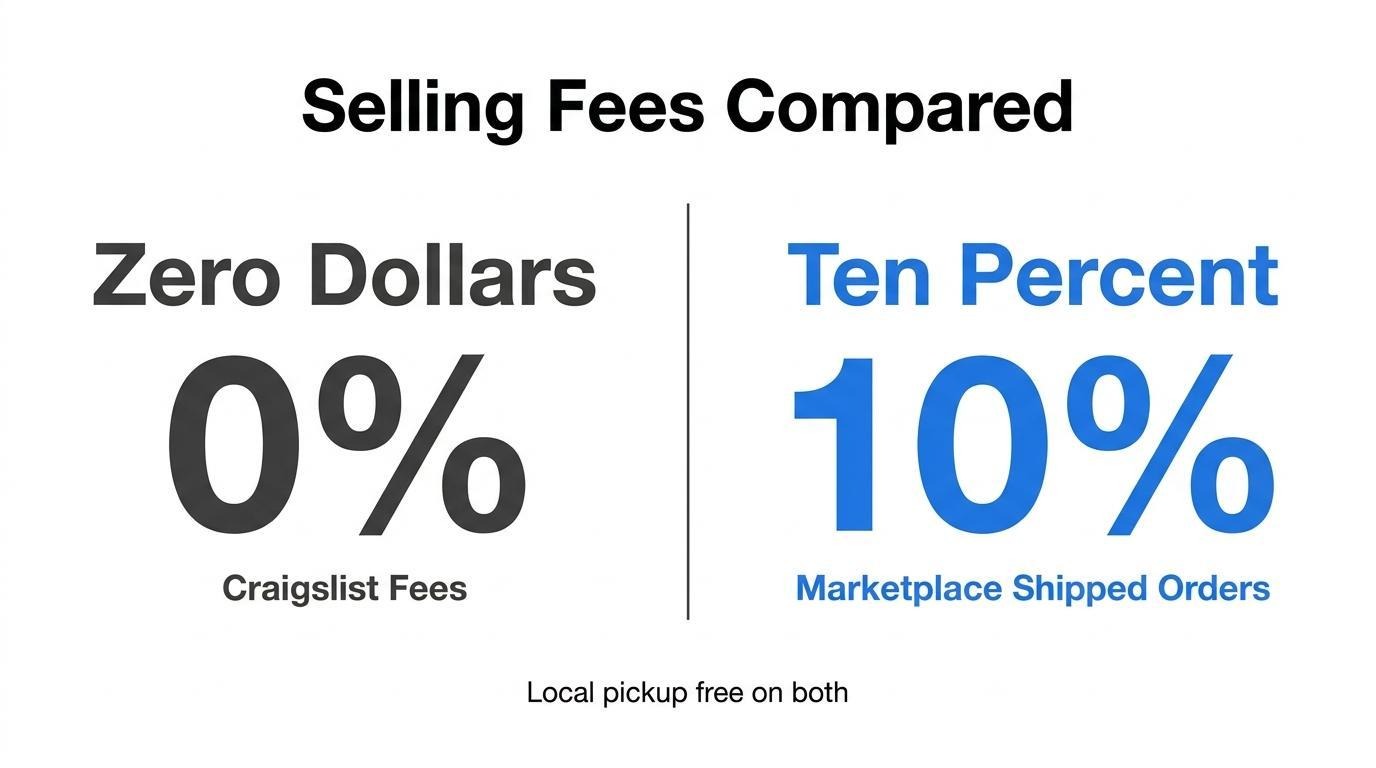
It costs nothing to list and sell most items on Craigslist. According to craigslist, Inc., publishing a posting is a one-time charge, and the platform has no subscription fees or additional charges. Most personal sale categories, such as furniture, electronics, and vehicles, carry zero listing fees.
Craigslist's community model relies on local, cash-based transactions. Sellers and buyers meet face-to-face for spot market exchanges, which eliminates payment processing costs entirely. This fee-free structure is one reason the platform disrupted traditional classified advertising. However, accepting only cash means sellers forgo any built-in payment protection, so verifying buyer legitimacy before meeting becomes the seller's responsibility.
It costs nothing to create a listing on Facebook Marketplace, but shipped orders incur a selling fee. According to the Facebook Help Center, a selling fee of 10% (or $0.80 minimum per order) is deducted from the seller's payout. This fee is calculated on the total transaction value, which includes the item sale price, shipping fees, and applicable taxes.
For local pickup sales where no in-app payment is processed, Facebook charges no fee. The 10% fee only applies when sellers use Facebook's checkout and shipping tools. That distinction matters: sellers moving high-volume, lower-priced items through shipped orders should factor this cost into their pricing strategy to protect margins.
Shipping fees differ because Craigslist does not offer any shipping infrastructure, while Facebook Marketplace provides integrated shipping labels and tracking. Craigslist operates as a local-only platform; sellers arrange all logistics independently if a buyer requests delivery, which typically means absorbing courier costs or limiting sales to in-person pickup.
Facebook Marketplace lets sellers purchase prepaid shipping labels directly within the listing flow. The buyer pays the displayed shipping cost at checkout, and that amount is included in the total transaction value subject to the 10% selling fee. Sellers who want nationwide reach without managing their own shipping accounts will find Facebook's built-in system more practical, though the added fee percentage should be weighed against the broader audience access.
Understanding fee structures helps sellers price accurately, but creating strong listings is what drives actual sales on either platform.
You create listings that sell by tailoring your title, photos, and description to each platform's search behavior and audience expectations. The subsections below cover title writing for Craigslist, title writing for Facebook Marketplace, and photo and description best practices for both.
You should write a listing title on Craigslist by front-loading the most searchable keywords, since Craigslist relies on its own internal search engine rather than algorithmic recommendations. Buyers on Craigslist type specific terms into a search bar, so your title must match those queries directly.
Effective Craigslist listing titles follow these principles:
According to the Kutztown University of Pennsylvania Small Business Development Center's Craigslist guide, sellers must select a specific posting type and category before their listing goes live. Choosing the correct category matters as much as the title itself, because a miscategorized listing never surfaces for the right search queries.
You should write a listing title on Facebook Marketplace by combining keyword relevance with conversational appeal, since Marketplace uses algorithmic recommendations alongside search. Facebook's system suggests listings to users based on browsing behavior, location, and interest signals, so titles need to work for both discovery paths.
Strong Facebook Marketplace listing titles share these traits:
Because Facebook Marketplace ties every listing to a personal profile, title clarity also signals seller credibility. Buyers scanning their feed are more likely to tap a listing that reads like a real person wrote it.
The photo and description practices that work best vary by platform, though both reward clarity and honesty. Craigslist displays fewer images per listing and offers minimal formatting, while Facebook Marketplace supports larger photo galleries and structured product fields.
Photo best practices for each platform:
Description best practices for each platform:
For sellers managing listings across multiple channels, maintaining consistent product details becomes harder as volume grows. Platforms like SHOPLINE unify product data across supported marketplaces such as Amazon and eBay, which helps prevent mismatched descriptions when cross-posting at scale.
Buyer communication differs on each platform primarily in channel and transparency. Craigslist relies on anonymous email relays and phone calls, while Facebook Marketplace uses Messenger with visible buyer profiles. Below, each platform's inquiry and negotiation dynamics are covered.
Inquiries and negotiations on Craigslist are handled through anonymous email relays, direct phone calls, and text messages. The platform does not offer a built-in chat system, so sellers must manage conversations across multiple channels manually.
Because Craigslist shows no buyer profiles, reputation scores, or transaction history, sellers evaluate legitimacy based on message quality alone. Vague one-line messages or requests to move off-platform often signal scams. Effective practices for Craigslist negotiations include:
This lack of identity verification makes careful message screening essential before agreeing to any in-person transaction.
Inquiries and negotiations on Facebook Marketplace are handled through Messenger, which links directly to each buyer's Facebook profile. This built-in messaging system centralizes all conversations within one interface, unlike Craigslist's fragmented email and phone approach.
Profile visibility is the key advantage. Sellers can review a buyer's profile age, mutual friends, and past Marketplace ratings before responding. A 2024 study by the Association for Computing Machinery, investigating trust factors among 42 Facebook Marketplace users in the U.S. and Canada, found that profile-based signals played a significant role in trading decisions. Marketplace also auto-generates quick-reply prompts like "Is this still available?" which accelerates initial contact but can feel impersonal. Sellers who reply with specific follow-up questions, such as confirming pickup times, tend to filter serious buyers from casual browsers more efficiently.
With communication patterns understood, the next step is comparing how payments and deliveries work on each platform.
Payment and delivery options differ significantly between Craigslist and Facebook Marketplace. The FBI Internet Crime Complaint Center recorded 56,478 non-payment and non-delivery complaints, making payment method selection critical for seller protection.
The safe payment methods to use on Craigslist are cash and, in limited cases, verified mobile payment apps used in person. Craigslist operates as a local, cash-first marketplace with no built-in payment processing. This structure means sellers handle transactions directly, without platform mediation or buyer protection programs.
Safe payment practices on Craigslist include:
Because Craigslist offers no transaction infrastructure, sellers bear full responsibility for verifying payment authenticity before completing a sale.
The safe payment methods to use on Facebook Marketplace include the platform's native checkout system for shipped orders and verified mobile payment apps for local pickups. Facebook Marketplace offers integrated payment processing that Craigslist lacks, giving sellers a built-in layer of transaction tracking.
According to the Meta Safety Center, sellers can report behaviors such as solicitation of personal information, inappropriate content, and offering overpayment, adding a reporting mechanism that cash-only platforms cannot match.
Sellers should also be aware of tax reporting obligations. The IRS requires third-party settlement organizations, including online marketplaces, to report payments on Form 1099-K when total payments exceed $20,000 across more than 200 transactions. Keeping clean sales records from the start simplifies compliance at tax time.
Shipping on Facebook Marketplace works through a built-in system where sellers can offer prepaid labels and buyers pay shipping at checkout. Craigslist does not offer any native shipping functionality.
Key differences between the two platforms include:
For sellers looking to reach buyers beyond their immediate area, Facebook Marketplace provides the only integrated shipping option between these two platforms. Sellers who outgrow both platforms often transition to dedicated ecommerce channels for full control over fulfillment and logistics.
Staying safe selling on Craigslist vs. Facebook Marketplace requires understanding each platform's unique scam patterns and built-in protections. The subsections below cover common Craigslist scams, common Facebook Marketplace scams, and how seller protection differs between platforms.
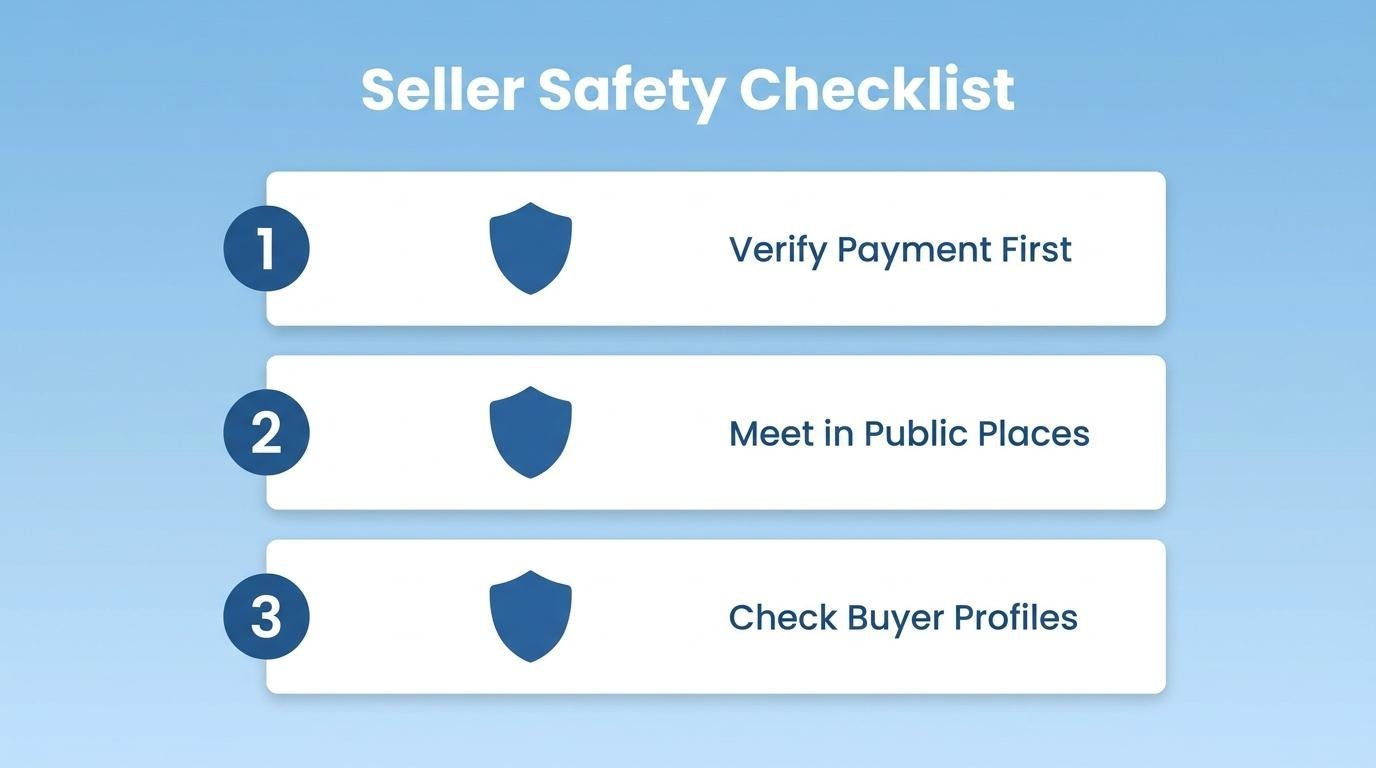
The common scams on Craigslist include fake check overpayment, wire transfer fraud, and phishing through off-platform email exchanges. Overpayment scams are especially prevalent: a buyer sends a check for more than the listed price, asks the seller to refund the difference, and the original check later bounces. According to the Federal Trade Commission's Consumer Advice division, when a bank says a check has cleared, that does not mean it was a good check, since it can take weeks for the bank to determine the check was fake. Because Craigslist relies on anonymous email relays and cash-based local meetups, sellers should insist on in-person transactions at public locations and refuse any payment that exceeds the asking price.
The common scams on Facebook Marketplace include fake buyer profiles, overpayment requests through third-party payment apps, and non-delivery schemes targeting shipped orders. The FBI Internet Crime Complaint Center's 2025 annual report recorded 56,478 non-payment and non-delivery complaints, underscoring how frequently these tactics succeed across online selling platforms. Unlike Craigslist, Marketplace links listings to real Facebook profiles, which deters some fraud. Still, scammers exploit this trust by creating convincing accounts. Sellers should verify buyer profiles for account age and activity, avoid sharing personal financial information, and use only platform-supported payment methods for shipped transactions.
Seller protection differs significantly between the two platforms. Facebook Marketplace offers a formal reporting system where sellers can flag solicitation of personal information, inappropriate content, and overpayment attempts directly through Meta's Safety Center tools. Marketplace also provides purchase protection on eligible shipped orders processed through its checkout system. Craigslist, by contrast, offers no built-in seller protection, escrow service, or dispute resolution. Its safety model depends entirely on the seller's own precautions, such as meeting in well-lit public spaces, bringing a companion, and accepting only cash or verified payments. For sellers handling higher volumes or higher-value items, the absence of any formal recourse on Craigslist makes Facebook Marketplace the safer structural choice.
Understanding platform-specific risks prepares sellers to weigh broader advantages and drawbacks next.
The pros and cons of selling on Craigslist versus Facebook Marketplace depend on your priorities around cost, reach, safety, and convenience. Below, each platform's strengths and weaknesses are broken down individually.
The advantages of selling on Craigslist include minimal fees, transaction simplicity, and seller anonymity. Most personal listings are free, and publishing is a one-time charge with no subscription fees or additional costs, according to craigslist, Inc. Sellers also benefit from:
For sellers prioritizing low overhead and quick local sales, this simplicity is hard to beat.
The disadvantages of selling on Craigslist center on limited reach, no built-in protections, and higher scam exposure. Key drawbacks include:
Because every transaction relies entirely on the seller's judgment, operating without a safety net can feel especially risky for higher-value items.
The advantages of selling on Facebook Marketplace include massive audience reach, built-in communication tools, and social trust signals. With Meta's family of apps reaching 3.60 billion daily active people as of June 2026 (per Meta Investor Relations), the potential buyer pool dwarfs most peer-to-peer platforms. Additional strengths include:
The disadvantages of selling on Facebook Marketplace include selling fees, algorithm dependency, and compliance obligations. Sellers should be aware of these specific drawbacks:
For sellers scaling volume, that 10% fee compounds quickly, making owned channels worth considering as order frequency grows.
A seller should choose Craigslist over Facebook Marketplace when specific transaction conditions favor anonymity, zero fees, or local cash deals. The following scenarios make Craigslist the stronger choice:
For sellers prioritizing maximum profit on straightforward local sales, Craigslist's fee-free structure is difficult to beat. The platform works best when a seller values simplicity over reach and prefers controlling the entire transaction without platform intermediaries.
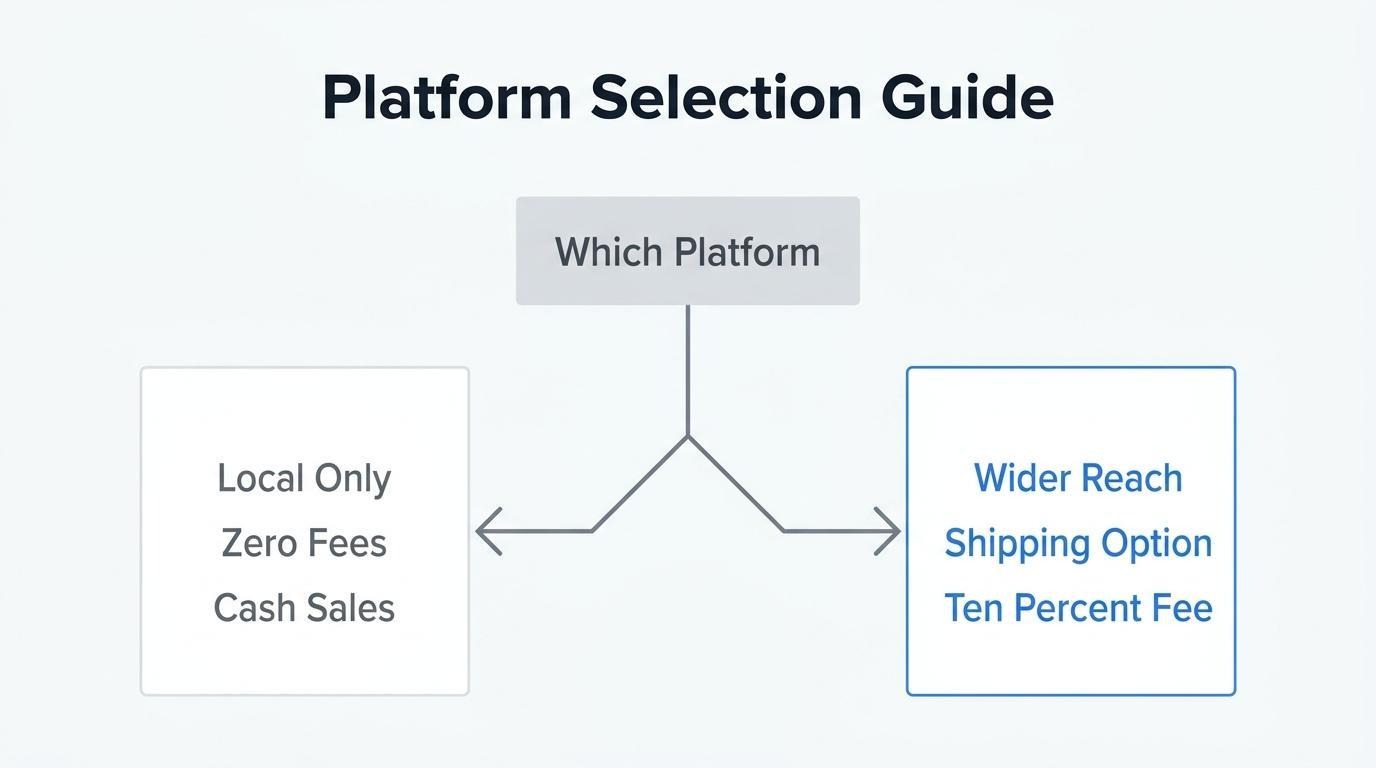
A seller should choose Facebook Marketplace over Craigslist when broad audience reach, built-in shipping, and profile-based buyer transparency matter most. The scenarios below outline when Marketplace is the stronger fit.
Facebook Marketplace connects sellers to Meta's massive user base, which reported 3.60 billion daily active people across its family of apps as of June 2026, according to Meta Investor Relations. That scale translates into faster listing visibility for everyday consumer goods, especially items like furniture, clothing, electronics, and home decor that benefit from photo-rich browsing.
Sellers should favor Facebook Marketplace in these situations:
For sellers whose items are niche, service-oriented, or hyper-local, Craigslist may still win. But when speed of sale, shipping flexibility, and audience size drive the decision, Facebook Marketplace is typically the better channel. Cross-posting on both platforms can capture the widest buyer pool.
Yes, you can sell on both Craigslist and Facebook Marketplace at once. Neither platform prohibits cross-posting, and listing items on both simultaneously maximizes buyer exposure.
Cross-posting works well because each platform attracts different buyer segments. Craigslist reaches cash-oriented, local-only shoppers, while Facebook Marketplace connects sellers with a broader audience through social profiles and built-in messaging. Running listings on both channels increases the odds of a faster sale without additional cost on Craigslist's side.
A few practical considerations make dual-platform selling manageable:
As Dr. Konstantin Beznosov noted in a 2024 University of British Columbia study, users continue choosing Facebook Marketplace because it is simple to set up, offers wide audience reach, and is effective in facilitating sales. Pairing that reach with Craigslist's zero-fee local model gives sellers the broadest possible coverage.
For sellers consistently moving volume across multiple channels, the real challenge becomes inventory and order management. That operational complexity is where dedicated ecommerce tools start earning their value over manual cross-posting.
Sellers should move beyond marketplace platforms when they need brand control, customer data ownership, and scalable operations that Craigslist and Facebook Marketplace cannot provide. Below, we cover how SHOPLINE supports that transition and the key takeaways from this guide.

Yes, SHOPLINE can help sellers build their own ecommerce channel. SHOPLINE is an all-in-one ecommerce platform that unifies commerce, CRM, marketing automation, subscriptions, and POS inside a single system. For sellers outgrowing the limitations of peer-to-peer marketplaces, this consolidation eliminates the need to stitch together separate tools for payments, customer data, and lifecycle marketing. SHOPLINE's Multichannel Connect unifies products, orders, and inventory across supported marketplaces such as Amazon and eBay, so sellers can maintain marketplace listings while building a branded storefront they fully control. This approach gives growing sellers direct access to customer relationships, something neither Craigslist nor Facebook Marketplace offers.
The key takeaways about Craigslist vs. Facebook Marketplace for sellers center on matching the right platform to each selling scenario:
Choosing between Craigslist and Facebook Marketplace depends on your product type, audience, and growth goals. For sellers ready to build lasting customer relationships, transitioning to a branded storefront represents the next logical step.