Klaviyo is a B2C CRM and marketing automation platform that unifies customer data and automates messaging across email, SMS, RCS, WhatsApp, and mobile push to drive ecommerce revenue.
This guide covers what Klaviyo does and who it serves, its core feature set for 2026, pricing structure and competitive positioning, platform strengths and limitations, and how its approach compares to native commerce-embedded lifecycle marketing.
Klaviyo functions as a unifying data layer for DTC brands, consolidating behavioral, transactional, and profile data into one system so merchants can build targeted segments and trigger personalized campaigns without switching between disconnected tools.
The 2026 feature set spans visual email automation, SMS messaging, predictive analytics, pre-built flows for common ecommerce scenarios, and native integrations with platforms like Shopify and SHOPLINE that sync store data in real time.
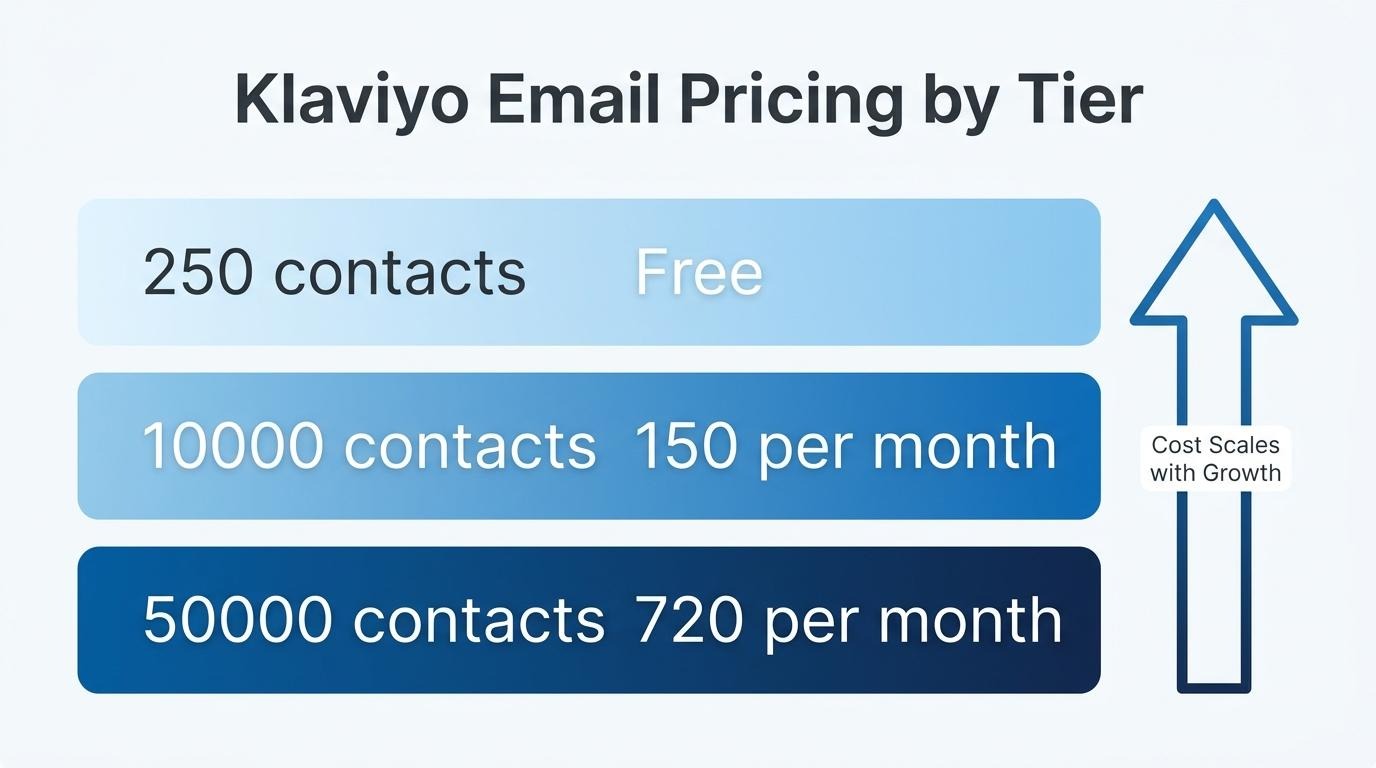
Pricing starts free for up to 250 contacts and 500 email sends, then scales to $150 per month at 10,000 contacts and $720 per month at 50,000 contacts for email alone; adding SMS compounds costs further based on message volume.
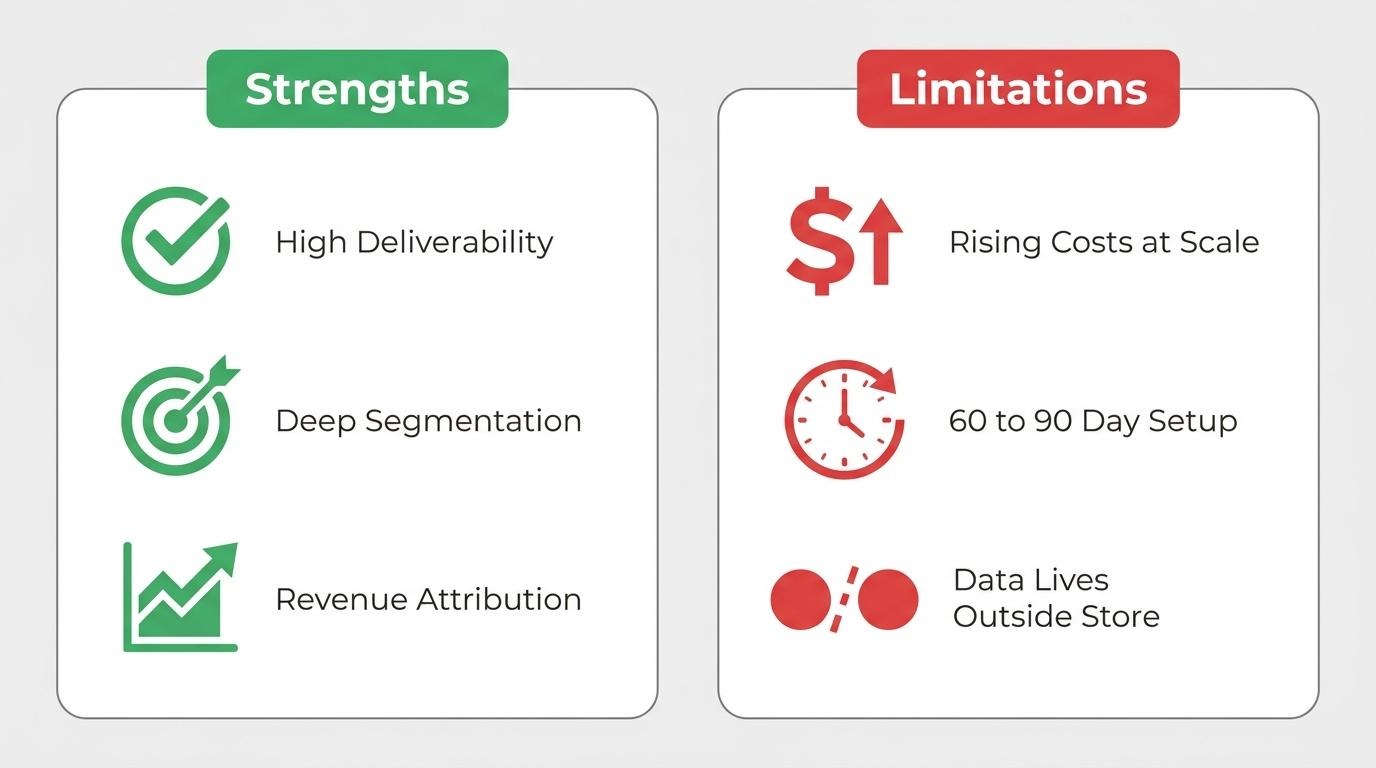
User feedback highlights strong deliverability, granular segmentation, and measurable revenue attribution as key advantages, while escalating costs at scale, a 60-to-90-day onboarding timeline, and data living outside the commerce platform emerge as consistent limitations.
For brands evaluating whether lifecycle marketing should live inside or outside the commerce layer, we examine how platform-native automation eliminates the fragmentation costs that standalone tools introduce as operations scale.
Klaviyo functions as a B2C CRM and marketing automation platform that unifies customer data and automates messaging across email, SMS, RCS, WhatsApp, and mobile push to drive ecommerce revenue. The platform consolidates behavioral, transactional, and profile data into a single system, enabling brands to build targeted segments and trigger personalized campaigns without switching between disconnected tools.
This consolidation addresses a costly problem. According to a 2024 Layerfive analysis, fragmented marketing data costs brands over $200,000 annually, while unified marketing data platforms cut costs and boost ROI by 72%. Klaviyo positions itself as that unifying layer for brands still operating across siloed point solutions.
For scaling DTC brands already running five or more marketing tools, the real question becomes whether that unification layer should live inside or outside the commerce platform itself.
Klaviyo is designed for B2B SaaS users in retail and ecommerce, with a strong concentration among direct-to-consumer brands operating online stores. According to MatrixBCG, Klaviyo's primary customer segments are in retail and ecommerce, with over 165,000 paying customers by mid-2025, concentrated largely in North America.
The platform serves businesses ranging from small startups testing their first email campaigns to mid-market brands running complex, multi-channel lifecycle programs. Regional adoption reflects this breadth; while North America holds the largest share of customers and annual recurring revenue, EMEA and APAC regions demonstrate the fastest percentage growth.
Klaviyo fits best when a brand needs granular segmentation tied directly to purchase behavior, browsing activity, and predictive analytics. Merchants already selling on platforms like Shopify or SHOPLINE often adopt Klaviyo to layer personalized messaging on top of their storefront data. For scaling brands already managing significant tool sprawl, however, the question becomes whether adding another standalone platform compounds the fragmentation problem it aims to solve.
Klaviyo's core features in 2026 span email automation, SMS marketing, advanced segmentation, pre-built flows, reporting, AI-driven predictive analytics, and a broad integration ecosystem.
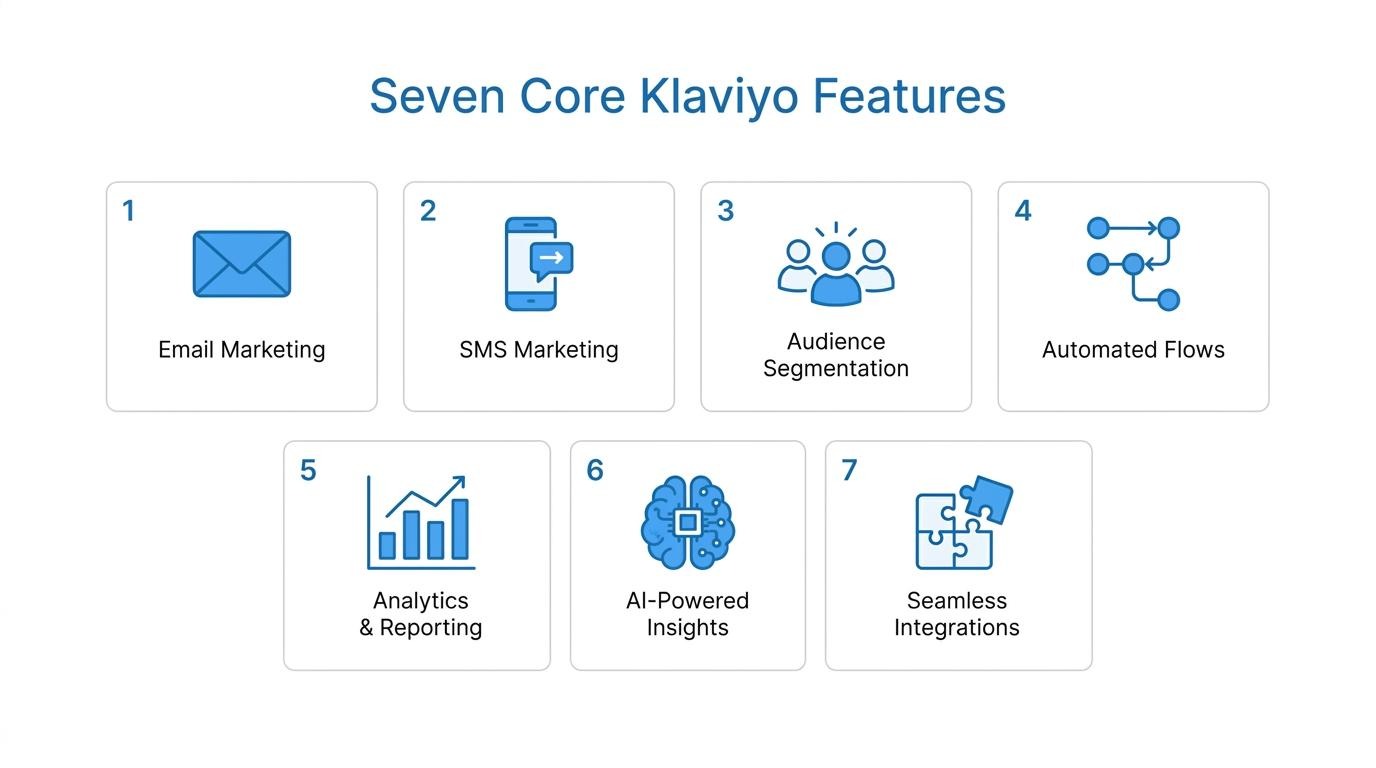
Klaviyo handles email marketing automation through a visual workflow builder that lets brands create trigger-based campaigns, scheduled sends, and behavioral sequences without custom code. According to Software Advice, reviewers highlight customer segmentation, marketing automation, and email campaign management as Klaviyo's top features. The platform supports A/B testing, dynamic content blocks, and conditional splits within each automation, giving operators granular control over message timing and audience targeting. For brands already managing complex lifecycle programs, this level of configurability is where Klaviyo earns its reputation.How Does Klaviyo Handle SMS Marketing?
Klaviyo handles SMS marketing through the same automation builder used for email, allowing brands to send text messages triggered by purchase behavior, browse activity, or list membership. SMS campaigns share the unified customer profile, so segmentation rules apply across both channels without duplicating logic. Consent management, quiet hours, and compliance tools are built into the SMS workflow. The channel works best as a complement to email for time-sensitive messages, such as flash sales, shipping updates, and cart recovery nudges.
Klaviyo offers segmentation and customer data tools built around real-time behavioral profiles that update as shoppers browse, purchase, and engage. Segments can filter by:
With over 165,000 paying customers by mid-2025 concentrated largely in North America, Klaviyo's data model is optimized for retail and ecommerce use cases. SHOPLINE store data syncs directly to Klaviyo after completing authorization and customer synchronization settings.
Klaviyo's pre-built automation flows work by providing templated sequences for common ecommerce scenarios that brands can activate and customize immediately. These include:
Each flow uses conditional logic, time delays, and branching splits. Operators modify triggers, messaging, and timing without rebuilding from scratch, which significantly reduces initial setup effort compared to designing every automation manually.
Klaviyo provides reporting and analytics through dashboards that track revenue attribution, campaign performance, and flow conversion rates at the individual message level. Metrics include open rates, click rates, placed order value, and unsubscribe trends. Cohort analysis and deliverability monitoring help brands identify engagement decay over time. The attribution model ties revenue directly to specific emails or SMS messages, though operators should validate inbox placement independently using seed list tools rather than relying solely on built-in metrics.
Klaviyo uses AI and predictive analytics to forecast customer behavior, including expected next purchase date, predicted lifetime value, and churn probability. These predictions feed directly into segmentation, enabling automated targeting of high-value or at-risk customers without manual analysis. AI also powers subject line optimization, send-time personalization, and product recommendations within email templates. For brands with sufficient historical data, these models surface actionable patterns that would otherwise require a dedicated analyst or external CDP.
Klaviyo supports integration options across hundreds of ecommerce platforms, advertising tools, loyalty programs, and helpdesk systems. Native connectors exist for Shopify, WooCommerce, BigCommerce, and SHOPLINE. The SHOPLINE integration syncs store data, including orders, customer profiles, and product catalogs, directly into Klaviyo's data layer. Additional integrations connect to Facebook Ads, Google Ads, review platforms, and subscription tools. For brands running a multi-tool stack, these connections centralize behavioral data; however, each additional integration adds a sync dependency that requires monitoring.
With these features mapped, the next consideration is how Klaviyo's pricing scales alongside them.
Klaviyo costs between $0 and $720+ per month in 2026, depending on contact count and channels used. The sections below break down the free plan, email-only tiers, combined email and SMS pricing, and additional SMS credit fees.
Klaviyo's free plan includes up to 250 active profiles and 500 email sends per month. This tier provides access to core features like segmentation, automation flows, and basic reporting, making it suitable for brands testing the platform before committing to a paid tier. No SMS credits are included at this level.
For brands evaluating options, common searches such as "Klaviyo free plan limits" and "Klaviyo pricing 2026" reflect how frequently merchants compare this entry point against competitors before scaling.
Klaviyo's email plan cost scales with contact list size. According to Retainful's 2025 pricing breakdown, the email-only plan costs $150 per month at 10,000 contacts and $720 per month at 50,000 contacts, before adding SMS, WhatsApp, Reviews, or CDP features.
Key email plan benchmarks:
This tiered structure means costs jump significantly as lists grow, which scaling brands should factor into long-term budget planning.
Klaviyo's Email and SMS plan costs $20 per month at the entry level, covering 500 contacts with 5,000 emails and 150 SMS credits. Pricing increases as contact volume and messaging needs expand, with higher tiers bundling larger SMS allotments alongside email sends.
Brands running both channels from one platform gain unified attribution and workflow simplicity. However, the combined plan's cost compounds quickly at scale since both contact count and SMS volume drive the monthly bill independently.
Additional fees for SMS credits apply once a brand exhausts the credits bundled in its plan tier. Klaviyo charges for SMS on a per-message basis, with costs varying by recipient country and message type (standard SMS versus MMS). Domestic US messages carry a lower per-credit rate than international sends, and MMS messages consume more credits than plain text.
This consumption-based model means brands with high SMS volume or media-rich campaigns should monitor usage closely to avoid unexpected overages beyond their base plan cost.
With pricing structures clarified, comparing Klaviyo's cost against alternative platforms reveals where it sits competitively.
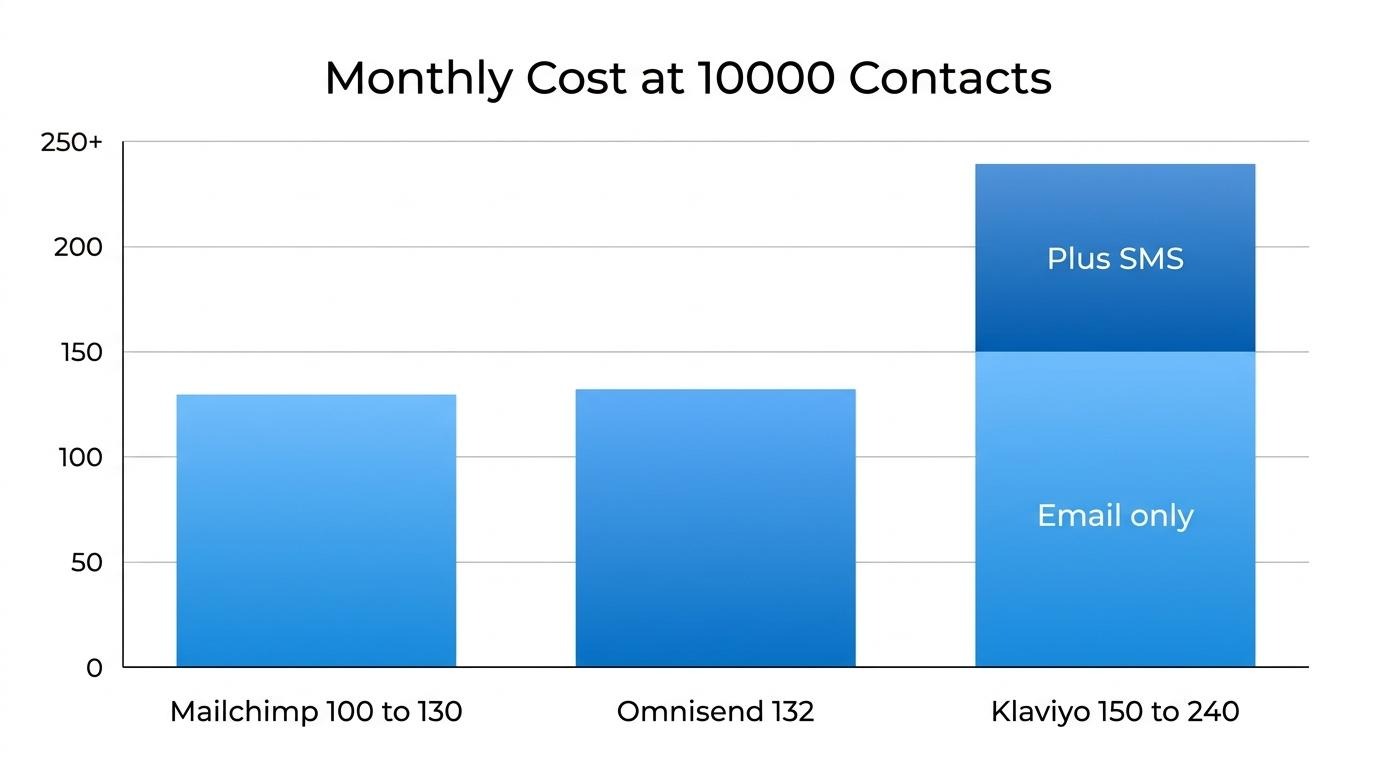
Klaviyo's pricing compares to alternatives by sitting at a moderate-to-high price point, particularly as contact lists scale. The differences become clearest when measured at the 10,000-contact tier against platforms like Omnisend and Mailchimp.
At 10,000 contacts, the cost landscape breaks down as follows:
According to a comparison by Chase Dimond, these figures place Klaviyo as the most expensive option at the 10K-contact tier when SMS is included. The gap widens further at higher volumes; at 50,000 contacts, Klaviyo's email plan alone reaches $720 per month before adding SMS, WhatsApp, Reviews, or CDP features.
For scaling brands already managing multiple tools, this cost trajectory is worth weighing against total stack expense. A brand paying $150 per month for Klaviyo email plus separate subscriptions for SMS, reviews, and customer data infrastructure may find the all-in cost exceeds what consolidated platforms charge natively. Platforms with lifecycle marketing built into the commerce layer eliminate these stacking fees entirely, which reframes the comparison from "email tool vs. email tool" to "total retention infrastructure cost."
Understanding where Klaviyo sits competitively on price helps clarify whether its feature depth justifies the premium.
The pros of using Klaviyo include strong email deliverability, deep ecommerce segmentation, robust automation flows, and measurable revenue attribution. These advantages make it a popular choice among DTC brands running dedicated email and SMS programs.
Klaviyo's strengths center on a few core areas:
For brands already operating a multi-tool stack, these capabilities explain why Klaviyo has attracted over 165,000 paying customers. That said, the strongest returns come when teams actively maintain segments and flows rather than relying on default settings. Brands that treat Klaviyo as a "set and forget" tool rarely see the ROI that hands-on operators achieve.
Worth noting: these advantages assume the brand's marketing team has bandwidth to manage a standalone platform alongside its commerce system, which introduces the operational question of consolidation versus specialization.
The limitations of using Klaviyo include escalating costs at scale, a steep learning curve for complex features, and occasional platform reliability issues. These drawbacks affect growing brands most acutely.
For brands already managing operational complexity at scale, these limitations compound. The cost of Klaviyo plus the cost of syncing fragmented data across separate tools often exceeds what an all-in-one commerce platform with native lifecycle marketing would require. Understanding how Klaviyo integrates with specific storefronts helps clarify whether these trade-offs are manageable.
Klaviyo works well for Shopify stores, offering a native integration that syncs customer and order data in real time. Below, the specifics of this integration explain why it remains a popular choice for Shopify merchants, along with considerations worth noting.
Klaviyo connects to Shopify in minutes, syncing orders, products, and customer behavior in real time to enable personalized marketing from a unified view. This tight data connection powers segmentation based on purchase history, browsing activity, and predicted lifetime value.
For most Shopify merchants running email and SMS as their primary retention channels, the integration delivers meaningful personalization without requiring custom development. Segmentation triggers update automatically as shoppers interact with the store, which keeps automation flows relevant.
However, this setup still introduces a separate system outside the storefront. Customer data lives in Klaviyo's environment rather than within the commerce platform itself, which means brands managing loyalty programs, subscriptions, POS, and lifecycle marketing across multiple tools may encounter the fragmentation challenges discussed earlier.
According to a Layerfive analysis, fragmented marketing data costs brands over $200K yearly, while unified marketing data platforms cut costs and boost ROI by 72%. For Shopify stores operating below that complexity threshold, Klaviyo's integration performs reliably. For brands scaling past it, the multi-tool architecture becomes a strategic consideration worth evaluating before costs compound.
With setup expectations in mind, the next section covers how long Klaviyo's onboarding actually takes.
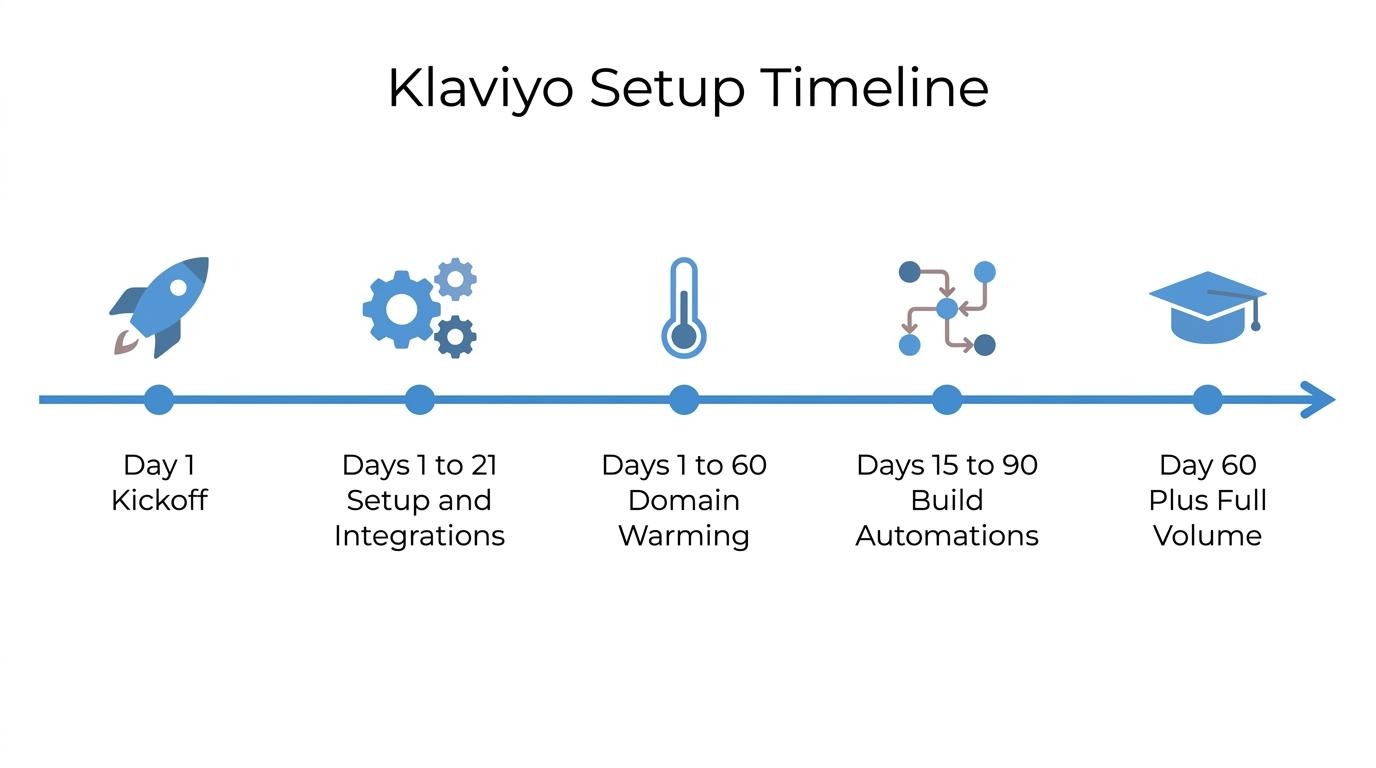
Setting up Klaviyo takes approximately 60 to 90 days to reach full operational maturity, though basic functionality can go live within the first week. The timeline spans account configuration, deliverability warming, integrations, and automation building.
According to Klaviyo Academy's onboarding framework, key milestones follow a structured sequence: Day 1 kickoff, Days 1–21 for deliverability and account setup plus integrations, Days 1–60 for domain warming, Days 15–30 for list acquisition, Days 15–90 for building automation flows, and Day 60 onward for graduation to full send volume. This phased approach prevents deliverability issues that arise from sending high volumes on a cold domain.
For brands already running on platforms with native integrations, some steps compress. SHOPLINE store owners, for instance, can sync store data to Klaviyo after completing authorization and customer synchronization settings, which handles the integration milestone in minutes rather than days. The longer phases involve warming sender reputation and building segmented automation flows that require real engagement data to optimize.
Most of that 60–90 day window is not active configuration work; it is waiting for deliverability signals to stabilize and collecting enough behavioral data to refine automations effectively.
With setup timelines established, the next consideration is whether managing email marketing as a separate platform creates long-term operational friction.
Email marketing outside your commerce platform creates data fragmentation, sync delays, and rising costs as your contact list grows. The subsections below cover how SHOPLINE handles lifecycle marketing natively and the key takeaways about Klaviyo's features and pricing for 2026.
SHOPLINE handles lifecycle marketing without a separate email tool by embedding automation directly into its commerce platform. The native marketing automation system lets merchants create, launch, and automate email, SMS, and pop-up campaigns with AI-driven capabilities, all drawing from the same customer data layer that powers the storefront and POS.
This matters because fragmented marketing data costs brands over $200K yearly, according to a 2024 Layerfive analysis, while unified marketing data platforms cut costs and boost ROI by 72%. When lifecycle triggers, purchase history, and segmentation live in the same system as checkout and fulfillment, there is no reconciliation step between platforms. Brands operating at scale avoid the compounding费用 of separate tools for email, SMS, subscriptions, and customer data.
For operators already managing complexity across channels, consolidating lifecycle marketing into the commerce layer eliminates one of the most common friction points in the retention stack.
The key takeaways about Klaviyo's features and pricing for 2026 are:
Klaviyo remains a capable standalone tool for brands that need deep email and SMS automation. However, the cost trajectory and data separation from the commerce layer make it worth evaluating whether a unified platform approach better serves brands crossing the $1M–$10M threshold, where tool consolidation often outperforms tool addition.