Cart abandonment occurs when a shopper adds items to an online cart but leaves before completing the purchase. With roughly seven out of ten carts abandoned across ecommerce, the gap between purchase intent and completed transactions represents one of the largest sources of recoverable revenue for online stores.
This guide covers the root causes of abandonment, checkout optimization, pricing and payment strategies, multi-channel recovery campaigns, and analytics-driven diagnostics.
Unexpected costs, forced account creation, security doubts, and poor mobile experiences are the primary reasons shoppers leave. Each cause points to a specific, fixable friction point in the buying journey.
Checkout optimization focuses on guest checkout, reduced form fields, progress indicators, and autofill tools that shorten the path from cart to confirmation. Fewer steps and less manual input directly protect conversion rates.
Pricing transparency and flexible payment options work together to eliminate sticker shock. Displaying shipping, taxes, and fees early prevents last-step surprises, while digital wallets and buy-now-pay-later services match how shoppers actually prefer to pay.
Recovery campaigns through email and SMS use timed sequences to re-engage abandoners within the first hour and escalate through objection handling and urgency over 72 hours. Exit-intent popups and live chat add a real-time layer that captures shoppers before they leave the site.
Analytics ties the entire system together. Funnel analysis, session recordings, and segmented abandonment data isolate exactly where and why shoppers drop off, so fixes target the highest-impact friction points first.
Cart abandonment is when a shopper adds items to an online shopping cart but leaves the website before completing the purchase. Understanding why it happens and what it costs reveals the scale of recoverable revenue.
Cart abandonment is the act of a customer adding products to an online shopping cart and then exiting the site without finishing the transaction. Salesforce defines it as the gap between purchase intent and purchase completion. This differs from browse abandonment, where a visitor views product pages but never adds anything to the cart. The distinction matters because each type requires a different recovery strategy; cart abandoners have demonstrated stronger buying intent, making them higher-value recovery targets. For scaling DTC brands, every abandoned cart represents acquisition cost already incurred with no return.
Cart abandonment affects ecommerce revenue by failing to convert traffic into sales at the final stage of the funnel. When roughly seven out of ten shoppers leave without purchasing, the gap between sessions and transactions widens dramatically. Customer acquisition costs go unrecovered, ad spend efficiency drops, and lifetime value projections shrink before the first order even occurs. The compounding effect is significant: abandoned carts reduce not just immediate revenue but also the repeat-purchase sequences and referral loops that depend on a completed first transaction. Diagnosing and reducing abandonment is one of the highest-leverage retention levers an ecommerce operation can pull.
The difference between cart abandonment and browse abandonment is the level of purchase intent each represents. Cart abandonment occurs after a shopper adds items to the cart, signaling a concrete desire to buy. Browse abandonment happens when a visitor views products or categories but leaves without adding anything. According to Klaviyo, browse abandonment targets early-stage interest, while cart recovery addresses shoppers who were moments from checkout. Recovery tactics diverge accordingly: browse abandonment campaigns focus on product discovery and recommendations, whereas cart recovery messaging emphasizes urgency, pricing reassurance, and friction removal.
With the definition and revenue impact clear, the next step is understanding how widespread the problem actually is.
The average cart abandonment rate in ecommerce is approximately 70%, a figure that has remained remarkably consistent over the past decade. Regional and device-level differences push that number even higher in certain contexts.
According to the Baymard Institute's 2026 meta-analysis of 50 different studies, the average documented online shopping cart abandonment rate stands at 70.22%. Statista's 2024 global data across all devices recorded a nearly identical figure of 70.19%, confirming this as a stable industry benchmark rather than a short-term trend.
Geographic variation is significant. Regional data shows that Latin America reaches around 83.43% cart abandonment and the Asian Pacific reaches around 80.05%, while the Middle East & Africa also appear well above the global mean. These disparities often reflect local checkout norms, payment preferences, and shipping cost structures. Additionally, the luxury and jewelry industry reaches one of the highest cart abandonment rates in 2026 at approximately 81.68%, according to SellersCommerce.
For merchants evaluating recovery strategies, retargeting click-through rates in ecommerce range from around 0.9% to 1.2% in 2025–2026, with display ads shown within the first 24 hours after abandonment performing best. That narrow window underscores why prevention through checkout optimization consistently outperforms post-abandonment tactics alone. Understanding where your store sits relative to these benchmarks is the first step; the reasons behind abandonment reveal where to act.
Shoppers abandon their carts due to unexpected costs, checkout friction, security concerns, limited payment options, poor mobile experiences, and unclear policies. The following sections break down each cause.
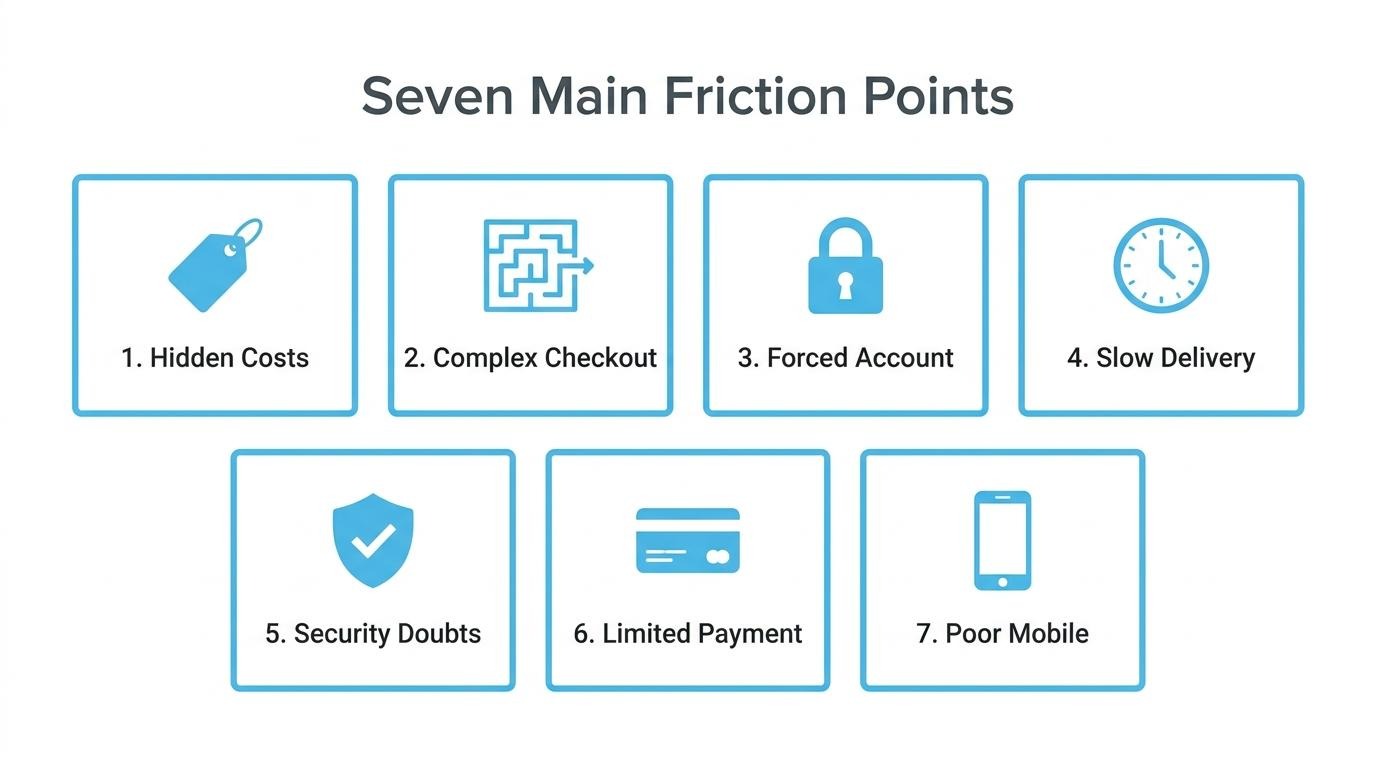
Unexpected costs cause cart abandonment because shoppers feel deceived when the final price exceeds what they anticipated. Shipping fees, taxes, and service charges that appear only at checkout create a gap between the expected total and the actual amount due. According to Red Stag Fulfillment, 39% of US online shoppers abandon their carts because extra costs such as shipping, taxes, and fees are too high. This makes surprise fees the single largest driver of checkout drop-off. Displaying all-in pricing early on, rather than hiding charges until the last step, can directly address this friction point.
A complicated checkout process drives shoppers away because each additional step increases the chance a buyer loses patience or gets distracted. Approximately 18% of users abandon an order due to a checkout that feels too long or complicated, while 19% leave because the site required account creation. An article by Nielsen Norman Group states that "Guest checkout with optional registration on e-commerce sites simplifies the purchase process and invites users to register when they feel comfortable." Streamlining fields and removing unnecessary steps keeps shoppers focused on completing the transaction.
Mandatory account creation requirements increase abandonment because they introduce an unwanted barrier between intent and purchase. Shoppers who are ready to buy often do not want to set a password, verify an email, or fill out profile fields unrelated to their order. This forced step signals that the store prioritizes its own data collection over the buyer's convenience. Offering guest checkout removes that friction entirely. Registration can be offered post-purchase, when the customer already has a positive experience and a reason to return.
Slow delivery estimates lead to abandoned carts because shoppers weigh shipping speed against alternatives, including local retail. When estimated arrival dates stretch beyond expectations, buyers reconsider whether the purchase is worth the wait. Research from the Baymard Institute shows that 17% of users have abandoned due to checkout complexity. This problem is compounded when vague delivery timelines add further uncertainty. By using specific delivery dates (e.g., "Delivers by Thursday") instead of generic windows like "3-5 business days", businesses can reduce ambiguity and keep the shopper committed.
Security concerns stop shoppers from completing purchases because submitting payment information requires trust. A site that looks outdated, lacks visible SSL indicators, or omits recognizable trust badges raises doubt about data safety. When shoppers question whether their credit card information is secure, they leave. Displaying PCI compliance badges, using HTTPS throughout the checkout flow, and featuring recognizable payment provider logos all reinforce credibility. For many buyers, a single missing trust signal is enough to override their purchase intent entirely.
Limited payment options cause checkout drop-off because shoppers expect to pay with their preferred method. If a store only accepts credit cards, it excludes buyers who rely on digital wallets, Buy Now Pay Later services, or region-specific methods. Friction at the payment step often pushes shoppers toward competitors who accept broader options. Integrating options such as Apple Pay, PayPal, Klarna, and Afterpay reduces this barrier substantially.
Poor mobile experience increases cart abandonment because small screens amplify every friction point. Buttons that are hard to tap, forms that require excessive scrolling, and pages that load slowly all compound frustration. Mobile devices already carry the highest average cart abandonment rates across device categories. Complex product pages perform poorly on mobile, meaning that responsive design, thumb-friendly navigation, and mobile-optimized checkout are essential for any store where the majority of traffic comes from phones.
Unclear return policies make shoppers hesitate because uncertainty about post-purchase options shifts all perceived risk onto the buyer. When a store buries its return terms, uses vague language, or fails to display a policy before checkout, shoppers assume the worst. This hesitation is especially strong for apparel, electronics, and higher-priced items where fit or function cannot be verified online. Placing a concise, clearly written return policy on product pages and in the cart summary reassures buyers that the risk of their purchase not working is manageable. Understanding these abandonment causes is the first step toward building a checkout experience that converts.
You can optimize your checkout process to reduce abandonment by removing friction at every step, from account creation to final confirmation. The key tactics include offering guest checkout, reducing form fields, adding progress indicators, and enabling autofill.

Guest checkout lowers abandonment rates by removing the forced account creation barrier that stops shoppers mid-purchase. When a site requires registration before payment, it introduces an unexpected step that feels irrelevant to someone ready to buy. Mandatory sign-ups add form fields, demand password creation, and sometimes trigger email verification delays.
Offering optional registration after order confirmation keeps the path to purchase short while still capturing customer data. According to Nielsen Norman Group, 18% of US online adults have abandoned an order specifically because they did not want to create an account. That single friction point represents nearly one in five lost transactions. For scaling brands processing thousands of orders monthly, even a small recovery percentage translates into meaningful revenue.
Reducing form fields speeds up conversions by shortening the time and cognitive effort required to complete a purchase. Every additional input field creates a moment where shoppers can reconsider, get frustrated, or simply run out of patience.
According to Baymard Institute's 2024 research, the average checkout flow is 5.1 steps long and contains 11.3 form fields, yet most sites only need 8 form fields in total. Those extra fields often collect data for the business, but can frustrate the customer. Consolidating first and last name into a single field, auto-detecting city and state from zip code, and removing optional fields like "Company Name" are practical cuts that can preserve data quality while accelerating completion. Fewer fields also reduce input errors, which means fewer failed submissions and less customer frustration at the final step.
Progress indicators keep shoppers moving forward by showing exactly where they are in the checkout process and how many steps remain. Without visible progress cues, a multi-step checkout feels open-ended, and uncertainty about the remaining effort triggers drop-off.
A labeled progress bar, breadcrumb trail, or numbered step indicator sets clear expectations. When shoppers see "Step 2 of 3," they understand the commitment required and are more likely to continue. This transparency is especially effective on mobile, where smaller screens make lengthy forms feel more overwhelming. Progress indicators also reduce the perception of checkout complexity without requiring any structural changes to the actual flow. For merchants running multi-step checkouts that collect shipping, billing, and payment data separately, even a simple visual cue can reframe the experience from tedious to manageable.
Autofill and address validation streamline checkout by reducing manual typing and eliminating input errors before they cause failed submissions. Browser autofill populates saved name, email, phone, and address data in seconds, converting what would be a 2-minute form into a few taps or clicks.
Address validation adds a complementary layer. Real-time lookup tools suggest verified addresses as shoppers type, preventing typos that lead to failed deliveries, chargebacks, and costly reshipments. Together, these tools cut form completion time significantly while improving data accuracy. Mobile shoppers benefit most, since small keyboards and touchscreen inputs make manual entry slow and error-prone. Enabling autofill compatibility requires clean HTML field labeling, which is a low-effort technical change with outsized impact on completion rates.
With checkout friction minimized, the next priority is making sure pricing transparency doesn't undo that progress at the final screen.
Pricing transparency prevents cart abandonment by eliminating surprise costs that trigger last-minute drop-off. The sections below cover recommendations for when to display shipping costs, how free shipping thresholds drive order completion, and how to present taxes and fees before checkout.
You should display shipping costs as early as possible, ideally on the product page or in the cart summary before a shopper reaches checkout. Unexpected charges at the final step are one of the largest drivers of abandonment. When costs appear upfront, shoppers make informed purchase decisions without the psychological shock of inflated totals.
According to the 2025 Ryder E-commerce Consumer Study, 76% of consumers rank free shipping as a top priority when shopping online. That expectation can mean that any shipping fee revealed too late in the funnel feels like a hidden surcharge. Displaying a shipping calculator on product pages, or showing a clear "free shipping over $X" banner site-wide, sets expectations before the cart is even built. Transparency early in the journey keeps price-sensitive shoppers engaged rather than forcing them to discover costs at the worst possible moment.
Free shipping thresholds encourage order completion by giving shoppers a clear spending target that offsets the perceived cost of delivery. When a customer sees they are $12 away from free shipping, the incentive to add another item often outweighs the friction of paying for delivery separately.
A Forrester Research report similarly found that 75% of US online adults consider free shipping a highly influential factor in choosing which retailer to buy from. Setting a threshold slightly above your average order value additionally nudges customers toward larger baskets. A progress bar in the cart, showing how close the order is to qualifying, reinforces this behavior visually. Exit-intent pop-ups offering incentives such as free shipping or 10% off can typically convert around 2%–4% of abandoning visitors, helping recapture shoppers who might otherwise leave due to delivery costs. For most mid-market brands, a well-calibrated threshold is one of the simplest levers to lift both completion rates and average order value simultaneously.
You should present taxes and fees before checkout by showing an itemized cost breakdown on the cart page itself, not after the shopper clicks "proceed to payment." Listing estimated tax, handling charges, and any surcharges in real time removes the final-step sticker shock that drives abandonment.
Effective approaches include:
Shoppers who see the full price early have a higher chance of electing to complete the purchase because there is nothing left to surprise them. When fees remain hidden until the payment screen, even small amounts feel deceptive. Proactive disclosure builds the trust that carries a buyer through to confirmation, making transparent pricing one of the most effective tools for reducing checkout friction alongside streamlined payment options.
Payment and financing options help recover abandoned carts by removing cost friction and matching how shoppers prefer to pay. The subsections below cover buy now pay later services, multiple payment method availability, and digital wallet integration.
Buy now pay later options reduce checkout drop-off by splitting the total cost into smaller, interest-free installments. This removes the sticker shock that causes shoppers to abandon higher-value purchases. Services like Klarna, Affirm, and Afterpay let customers commit at checkout while deferring the full financial impact. Nearly half of Americans (48%) consider BNPL for purchases exceeding $200, according to Numerator market insights. For mid-to-high AOV brands, enabling BNPL at checkout is one of the simplest ways to convert price-hesitant buyers who already signaled purchase intent by adding items to their cart.
Offering multiple payment methods improves completion by matching the checkout experience to each shopper's preferred way to pay. When a preferred option is missing, many buyers leave rather than enter unfamiliar credentials. Regional preferences vary widely: iDEAL dominates in the Netherlands, BLIK in Poland, and Alipay in China. According to Stripe's analysis of 50+ global payment methods, businesses that enabled Apple Pay saw an average 22.3% increase in conversion among eligible checkouts. Covering credit cards, digital wallets, and local payment methods together eliminates one of the most preventable friction points in the funnel through offering the right payment methods for your customer base.
Digital wallets simplify mobile checkout by storing payment and shipping details behind a single biometric authentication, such as a fingerprint or face scan. Apple Pay, Google Pay, and PayPal eliminate manual form entry on small screens where typing errors and frustration drive abandonment. According to Clearly Payments, projections suggested that Apple Pay could account for 10% of all global card transactions by 2025, doubling its share from approximately 5% in previous years. In the UK, 2 in 5 online purchases were made using a digital wallet in 2024. For brands selling to mobile-heavy audiences, enabling digital wallets is no longer optional; it is a baseline expectation that directly protects conversion rates.
With payment flexibility in place, recovery campaigns through email and SMS can recapture shoppers who still leave.
Email and SMS recovery campaigns win back lost carts by delivering timed, personalized messages that re-engage shoppers after they leave checkout. A structured sequence combining both channels covers the key recovery touchpoints: timing, frequency, incentives, and channel selection.
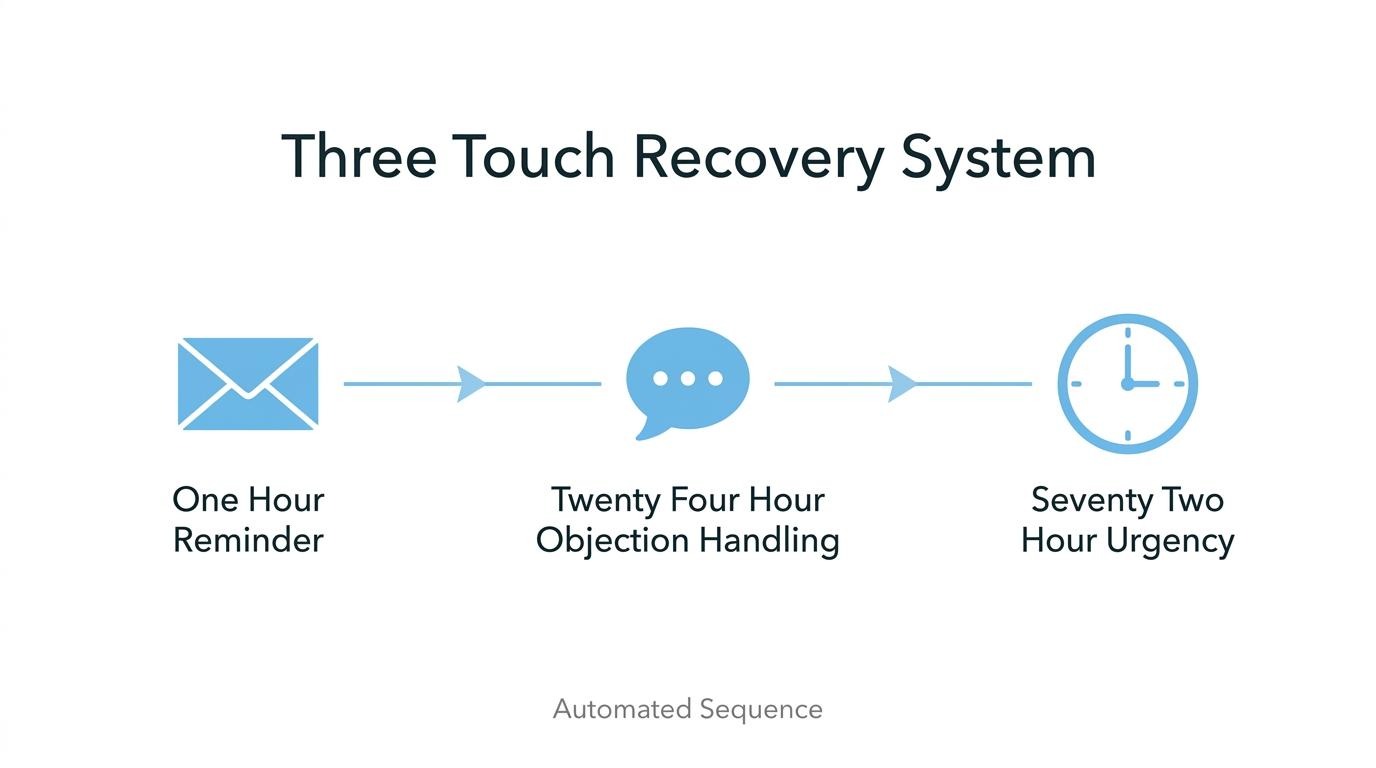
You should send the first cart recovery message within one hour of abandonment. According to Amra & Elma, emails sent within one hour of cart abandonment can increase conversion rates by up to 20% compared to those sent later. This narrow window catches shoppers while purchase intent remains high, before they comparison-shop or simply forget. SMS works especially well at this stage because push notifications demand immediate attention on a locked screen. Delaying even a few hours significantly reduces the likelihood of re-engagement, so automation is essential for consistent first-touch timing.
A recovery sequence might typically include three follow-up messages. The proven framework spaces them strategically:
This three-touch cadence balances persistence with restraint. Sending fewer messages leaves revenue on the table, while exceeding three risks unsubscribes and brand fatigue. Each message should serve a distinct purpose rather than repeating the same reminder.
The incentives that work best in cart recovery emails are tiered offers that escalate across the sequence. Effective options include:
Reserve the strongest incentive for the final email in the sequence. Leading with a discount trains shoppers to abandon intentionally, which quietly erodes long-term margins. Start with a simple reminder, then layer in value.
SMS compares to email for cart recovery effectiveness by delivering faster open rates and higher immediacy, while email provides richer content and stronger long-term revenue per message. Abandoned cart email flows generate the highest average revenue per recipient at $3.65 with a 3.33% conversion rate, according to Klaviyo. SMS, however, achieves near-instant visibility; some stores report recovery rates above 10% when SMS is integrated alongside email.
The strongest approach pairs both channels rather than choosing one. SMS captures attention in the first hour, while email carries detailed product imagery, social proof, and incentive copy that a text message often does not. Brands already managing lifecycle marketing within a single platform can coordinate these touchpoints without syncing separate tools.
Exit-intent strategies capture shoppers before they leave by detecting cursor movement toward the browser's close button and triggering a targeted intervention. The two most effective approaches are discount-driven popups and real-time chat support.
Exit-intent popups with offers reduce abandonment by presenting a compelling reason to stay at the exact moment a shopper signals departure. These popups track mouse trajectory toward the address bar or tab-close area, then overlay a time-sensitive incentive before the page unloads.
The most effective popup offers include:
Exit-intent popups featuring offers like 10% discounts or free shipping can increase conversion rates by often around 2% to 4%. That lift compounds meaningfully across high-traffic stores processing thousands of sessions daily. For brands already investing in acquisition, capturing even a fraction of departing visitors represents one of the highest-ROI interventions available.
Live chat or chatbot support prevents checkout drop-off by resolving friction in real time, before a shopper decides to leave. Common blockers during checkout, such as shipping questions, payment confusion, or sizing uncertainty, often go unanswered on static pages. A chat widget surfaces answers within seconds.
Many internet users prefer live chat for customer support, making it one of the most accepted channels for resolving purchase hesitation. Chatbots handle repetitive queries like return policies or delivery timelines instantly, while live agents can step in for complex issues requiring judgment.
For scaling brands, the ability to intervene during checkout rather than chasing recovery afterward is a fundamentally more efficient use of resources.
Retargeting brings abandoned cart shoppers back by serving targeted ads across display networks, social platforms, and search channels to remind them of the specific products they left behind. This section covers how retargeting works, when to deploy it, and what performance benchmarks to expect.
Retargeting works by placing a tracking pixel on your store that identifies visitors who added items to their cart but did not complete checkout. When those visitors browse other websites or social media feeds, the pixel triggers personalized display ads featuring the exact products they abandoned. This recognition-and-reminder loop keeps your brand visible during the critical decision window after a shopper leaves.
Timing determines retargeting effectiveness. According to SQ Magazine, retargeting click-through rates in ecommerce average 0.9% to 1.2% in 2025–2026, with display ads shown within the first 24 hours after abandonment performing best. Ads served in that initial window capitalize on residual purchase intent before shoppers move on to competitors or forget their original interest entirely.
The most effective retargeting campaigns combine several elements:
For brands running high volume, the real leverage comes from connecting retargeting data back to a unified customer record. When ad engagement, email opens, and on-site behavior feed into the same profile, you can suppress ads for shoppers who already converted through email recovery and reallocate that spend toward higher-intent segments. This coordination is where most fragmented tool stacks break down, often burning budget on customers who already purchased.
Retargeting should not operate as a standalone tactic. It performs best as one layer within a broader recovery system that includes email, SMS, and on-site interventions working from shared abandonment data.
Trust signals and social proof reduce checkout hesitation by replacing uncertainty with evidence that other buyers have completed the same purchase safely. Security badges, reviews, and transparent policies address the specific doubts that cause drop-off.
Security badges and SSL certificates matter at checkout because they provide visible proof that payment data is encrypted and protected. According to ZipChat, 19% of shoppers abandon their carts because they do not trust the website with their credit card information. Displaying recognizable trust marks from providers like Norton, McAfee, or PCI DSS compliance seals directly at the payment step addresses this fear. SSL encryption, indicated by the padlock icon in the browser bar, confirms that sensitive information travels through a secure connection. Placing these indicators near the credit card entry field, rather than buried in a footer, is one of the simplest ways to close the trust gap right where hesitation peaks.
Customer reviews and ratings build purchase confidence by offering peer validation that the product delivers on its promises. When a shopper sees hundreds of verified reviews with specific details about fit, quality, or shipping speed, the perceived risk of buying drops significantly. Star ratings provide a quick heuristic; detailed written reviews answer objections that product descriptions alone cannot. Displaying review counts and average ratings on cart and checkout pages, not just product pages, reinforces confidence at the moment of commitment. For brands scaling past initial traction, even a modest volume of authentic reviews outperforms polished marketing copy because buyers trust other buyers more than brand claims.
Money-back guarantees and return policies lower perceived risk by shifting the financial burden of a poor purchase from the buyer to the seller. When shoppers know they can return a product without friction, the cost of making a wrong choice approaches zero. Clearly stating return windows, refund timelines, and any conditions directly on the checkout page removes a common source of last-second doubt. Vague or hard-to-find return policies force shoppers to assume the worst, which often means abandoning the cart entirely. Brands that surface a concise, plain-language guarantee near the purchase button convert more hesitant buyers than those that bury terms in fine print.
Real-time purchase activity influences buying decisions by creating urgency and social validation simultaneously. Notifications like "12 people bought this today" or "3 items left in stock" tap into scarcity bias and herd behavior, two well-documented psychological triggers that accelerate decision-making. Live purchase counters and low-stock indicators can work because they signal that other shoppers have already evaluated and committed, reducing the cognitive effort required from the current buyer. Used sparingly and honestly, these signals shorten the gap between intent and action. Fabricated urgency, however, erodes trust quickly; shoppers can often recognize fake countdown timers and inflated purchase counts, which can permanently damage credibility.
With trust established at checkout, diagnosing where remaining shoppers still drop off requires the right analytics framework.
You should use analytics to identify cart abandonment causes by tracking funnel drop-off points, reviewing session recordings, and segmenting abandonment data by device, traffic source, and checkout step. The subsections below cover funnel analysis, session replay diagnostics, and segmentation frameworks.
Funnel analysis reveals where shoppers drop off by mapping conversion rates at each checkout stage, from cart view through payment confirmation. When a disproportionate percentage of users exit at one step, that step contains friction. Common high-exit points include the shipping cost reveal, account creation prompt, and payment form.
Behavioral analytics tools allow merchants to track abandonment at every stage of the funnel to identify specific friction points. Configuring Google Analytics (GA4) checkout events for each step (view cart, begin checkout, add shipping, add payment, purchase) creates the granular data needed to isolate problems rather than guessing.
Session recordings uncover hidden checkout friction by replaying actual user interactions, exposing rage clicks, form confusion, and layout issues that quantitative data alone cannot explain. A shopper who repeatedly taps a non-responsive button or scrolls past a hidden coupon field signals a UX problem no conversion rate metric would surface.
Session recording and replay tools help identify technical errors or UX hurdles that cause many shoppers to abandon their carts. UX designers should prioritize reviewing sessions where users reached the payment step but did not complete it, as these near-converters reveal the most fixable, highest-impact issues.
You should segment abandonment data by device type, traffic source, new versus returning visitors, and cart value to surface patterns that aggregate metrics obscure. A 70% overall abandonment rate means little without knowing whether mobile users abandon at 80% while desktop users convert at a much higher rate.
Key segmentation dimensions include:
Combining these segments with funnel and session data transforms analytics from a reporting exercise into a diagnostic system that prioritizes fixes by revenue impact.
Cart recovery and lifecycle marketing gain shared context when they live in one platform. Below, we cover how SHOPLINE handles components of this natively and the key takeaways for reducing cart abandonment.
SHOPLINE supports cart recovery through built-in lifecycle marketing tools integrated with its commerce platform. Abandoned cart emails, SMS campaigns, and segmentation are driven by commerce events within the system, allowing triggers to originate from centralized customer and order data. This reduces reliance on external marketing tools compared to more modular stacks, and customer and campaign data can be synchronized across connected components such as POS and messaging integrations.
This helps eliminate gaps between a standalone email platform and a separate ecommerce backend and build a fuller picture of where cart events get lost. When online and offline purchase history, browsing behavior, and messaging capabilities are integrated through a centralized commerce platform, merchants can build lifecycle-based automation that uses aggregated customer behavior over time rather than relying solely on single-session abandonment signals. For scaling DTC brands that might be running five or more tools, that consolidation can reduce both operational overhead and data fragmentation.
The key takeaways about reducing cart abandonment center on removing friction before, during, and after checkout:
The brands that recover the most revenue treat cart abandonment as a symptom of broader checkout and communication gaps, and fixing the root causes consistently outperforms layering on more recovery tools after the fact.