
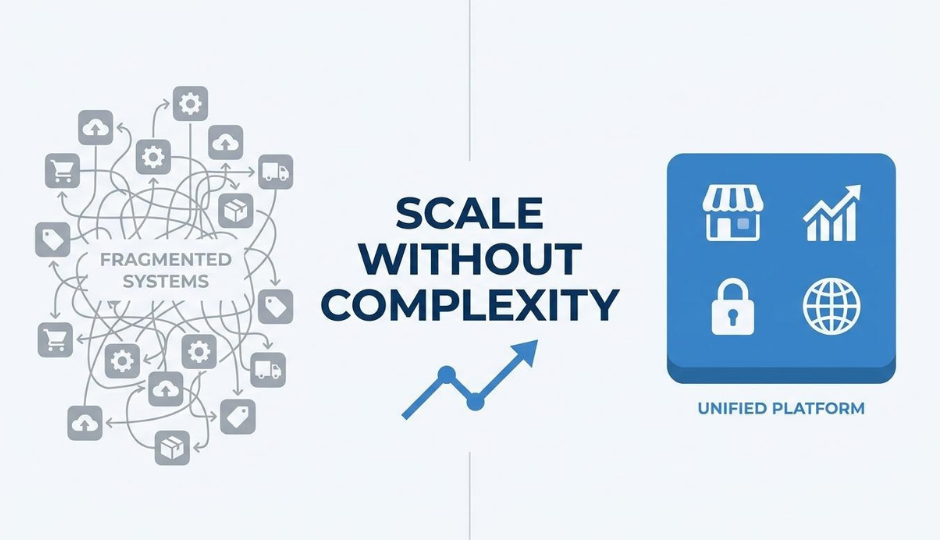
Scaling ecommerce without increasing complexity means growing revenue, channels, and customer volume while reducing the operational friction that typically accompanies that growth. We built this guide to cover the root causes of ecommerce complexity, its measurable costs, warning signs of an overloaded tech stack, consolidation strategies, platform evaluation criteria, and migration timing.
Complexity compounds as brands add disconnected tools for email, subscriptions, loyalty, POS, and analytics. Each app introduces its own data format, pricing tier, and sync requirements, creating tool sprawl that fragments operations and forces teams into manual reconciliation work instead of strategic execution.
The costs are concrete. Gaps in product and inventory data slow fulfillment, erode margins, and delay marketing campaigns. Fragmented customer records prevent personalized service across channels, accelerating churn precisely when brands should be capitalizing on loyalty. Leadership bandwidth shifts from growth planning to troubleshooting sync errors between platforms.
Recognizing the warning signs early matters. Integration failures during peak volume, teams spending more hours managing tools than executing strategy, and app stack costs rising as a percentage of revenue all signal that complexity has crossed from manageable overhead into operational drag.
The path forward centers on platform consolidation, unified customer data layers, native subscription management, built-in POS, and automated retention tools that operate from a single shared backend. These strategies eliminate the fragile integration layers that break at scale.
Choosing the right platform requires evaluating native feature depth and shared data architecture over integration count. Brands between $1M and $10M in annual revenue typically find consolidation most cost-effective, and a phased migration approach preserves customer journeys throughout the transition.
Complexity increases as ecommerce brands scale because growth demands more tools, more data, and more operational coordination. The subsections below examine tool sprawl, disconnected customer data, and rising app stack costs.
Tool sprawl is the gradual accumulation of disconnected software applications that a brand adopts as it grows. It fragments operations by forcing teams to manage workflows across platforms that do not share data or logic.
A brand might start with a storefront, then add separate apps for email marketing, subscription management, loyalty programs, customer support, and point-of-sale. Each tool introduces its own login, dashboard, data format, and update cycle. When these systems cannot communicate natively, staff spend hours on manual data transfers and reconciliation instead of strategic work.
The real cost is invisible at first. Each new app solves one problem while quietly creating sync gaps, duplicate records, and conflicting reporting across the stack.
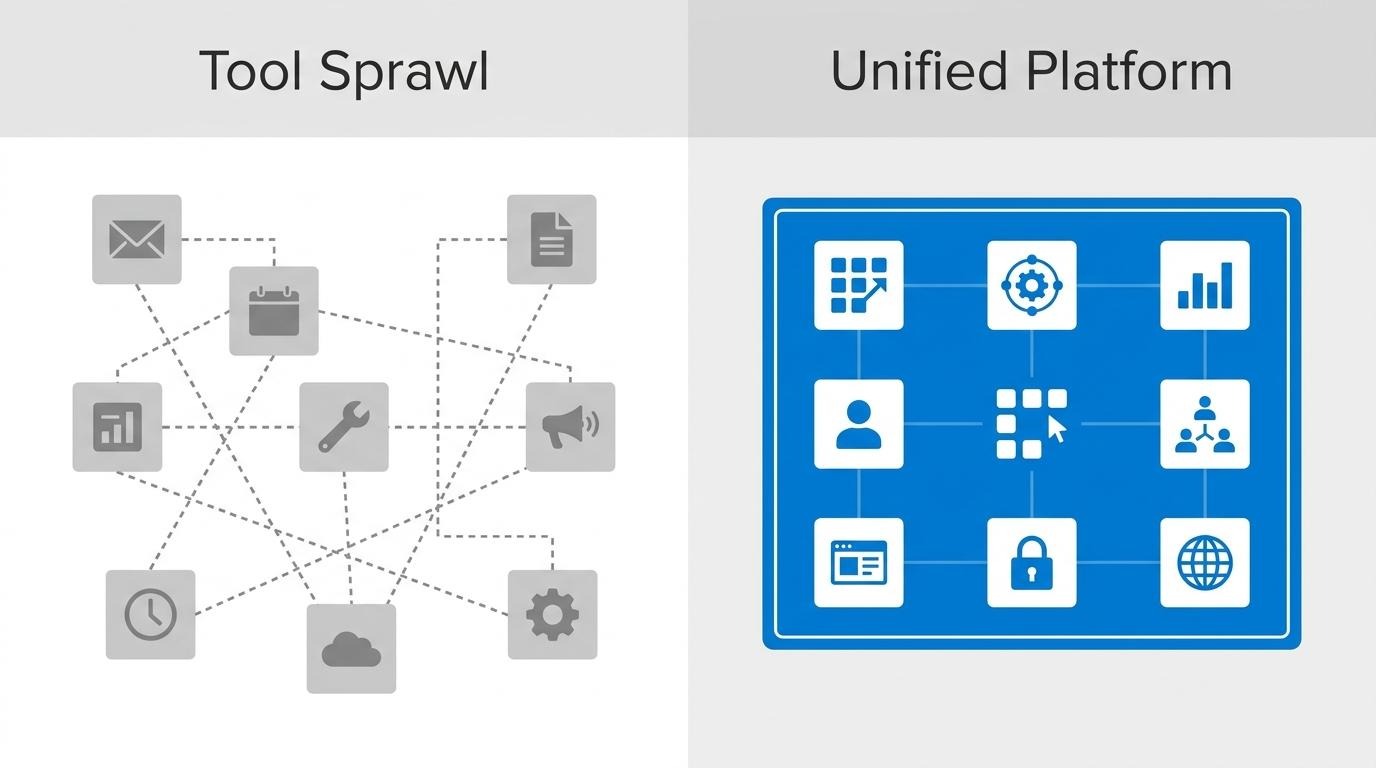
Disconnected customer data creates scaling bottlenecks by preventing teams from acting on a complete view of buyer behavior. When purchase history, browsing data, support tickets, and in-store transactions live in separate systems, every decision requires manual assembly of information.
This fragmentation directly undermines agility. A 2024 study published in Heliyon found that digital firms achieve four primary agility outcomes through integrated data: swift customer feedback loops, improved business processes with reduced delays, flexible partner ecosystems, and faster decision-making. Brands operating with siloed customer data lose access to all four advantages simultaneously.
For scaling ecommerce operations, the bottleneck compounds with volume; the more customers a brand serves, the more damaging each data gap becomes.
Rising app stack costs outpace revenue growth because most third-party ecommerce apps charge usage-based fees that scale with transaction volume, subscriber count, or contact list size. Revenue grows linearly, but the combined cost of five to fifteen apps compounds as each tool's pricing tier escalates independently.
Consider a brand processing more orders per month. Its subscription app charges more per subscriber, its email platform charges more per contact, its analytics tool charges more per event, and its POS system charges more per location. These layered increases often outrun the margin improvement that additional revenue provides.
This dynamic is why many brands at the $1M to $10M stage discover their effective platform cost has doubled while their margins have not. Consolidating to fewer, natively integrated systems is one path to breaking that cost curve before it erodes profitability.
Understanding these scaling pressures helps clarify what complexity actually costs a growing brand.
Ecommerce complexity costs growing brands slower execution, lower retention, and reduced strategic agility. The following sections break down how these costs manifest across marketing, customer data, and operational decision-making.
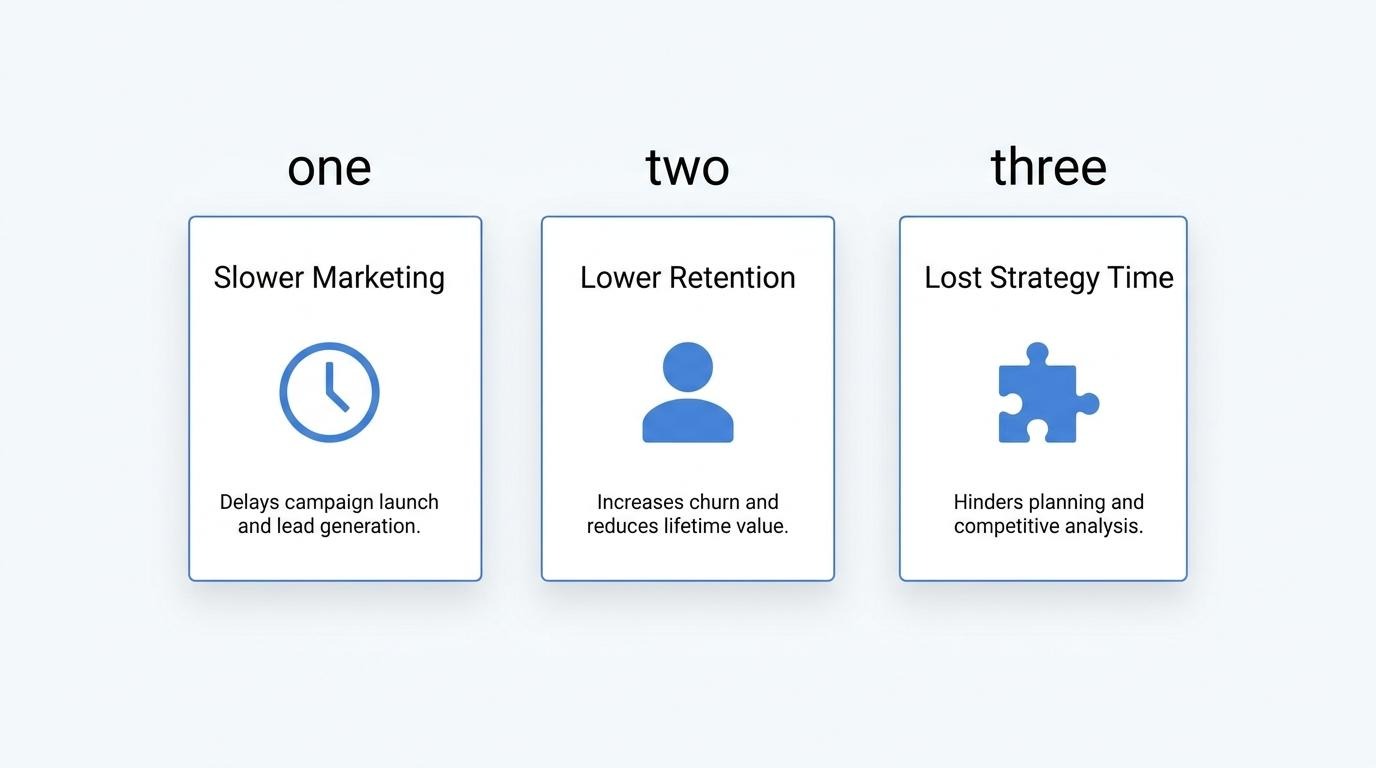
Complexity slows down marketing execution by forcing teams to reconcile data across disconnected tools before any campaign can launch. When product information, inventory levels, and customer segments live in separate systems, marketers spend hours pulling reports and verifying accuracy instead of activating campaigns.
According to GS1 US, gaps in product and inventory information and location inaccuracies slow down fulfillment times, reduce consumer trust, and erode margin. These same data gaps ripple upstream into marketing; a promotion built on inaccurate stock data risks overselling, damaging the customer experience, and creating manual cleanup work that delays the next campaign cycle. For brands processing real volume, even a one-day lag in campaign deployment compounds into measurable lost revenue over a quarter.
Fragmented data hurts customer retention rates by preventing brands from delivering consistent, personalized service across channels. When purchase history, support tickets, and browsing behavior sit in separate databases, no single team has a complete view of the customer relationship.
According to the International Trade Administration, U.S. Department of Commerce, return policies and responsive customer service are critical for customer retention, with messaging channels like WhatsApp emerging as preferred touchpoints for both sales and support. Meeting customers on their preferred channel becomes nearly impossible when service data is siloed from commerce data. The result is generic outreach, slower response times, and repeat customers who feel unrecognized. Brands that cannot unify these records often see churn accelerate precisely when they should be capitalizing on loyalty.
Operational overhead limits strategic decision-making by consuming leadership bandwidth on tool management instead of growth planning. When operators spend their weeks troubleshooting sync errors between platforms, reconciling conflicting dashboards, and managing vendor relationships for a dozen apps, the time available for evaluating new markets, refining pricing, or testing acquisition channels shrinks dramatically.
This is one of the least visible costs of complexity. Revenue reports that require manual stitching across systems arrive late, carry reconciliation errors, and lack the granularity needed for confident decisions. Teams default to reactive choices based on incomplete data rather than proactive strategies built on unified insights. For scaling brands, the inability to act decisively on reliable data is often more costly than any single software subscription.
Understanding these compounding costs clarifies the warning signs that a commerce stack has become too complex.
The signs your ecommerce stack is too complex include recurring integration failures, teams spending more time managing tools than executing strategy, and metrics that reveal hidden operational drag. The following subsections break down each warning signal.
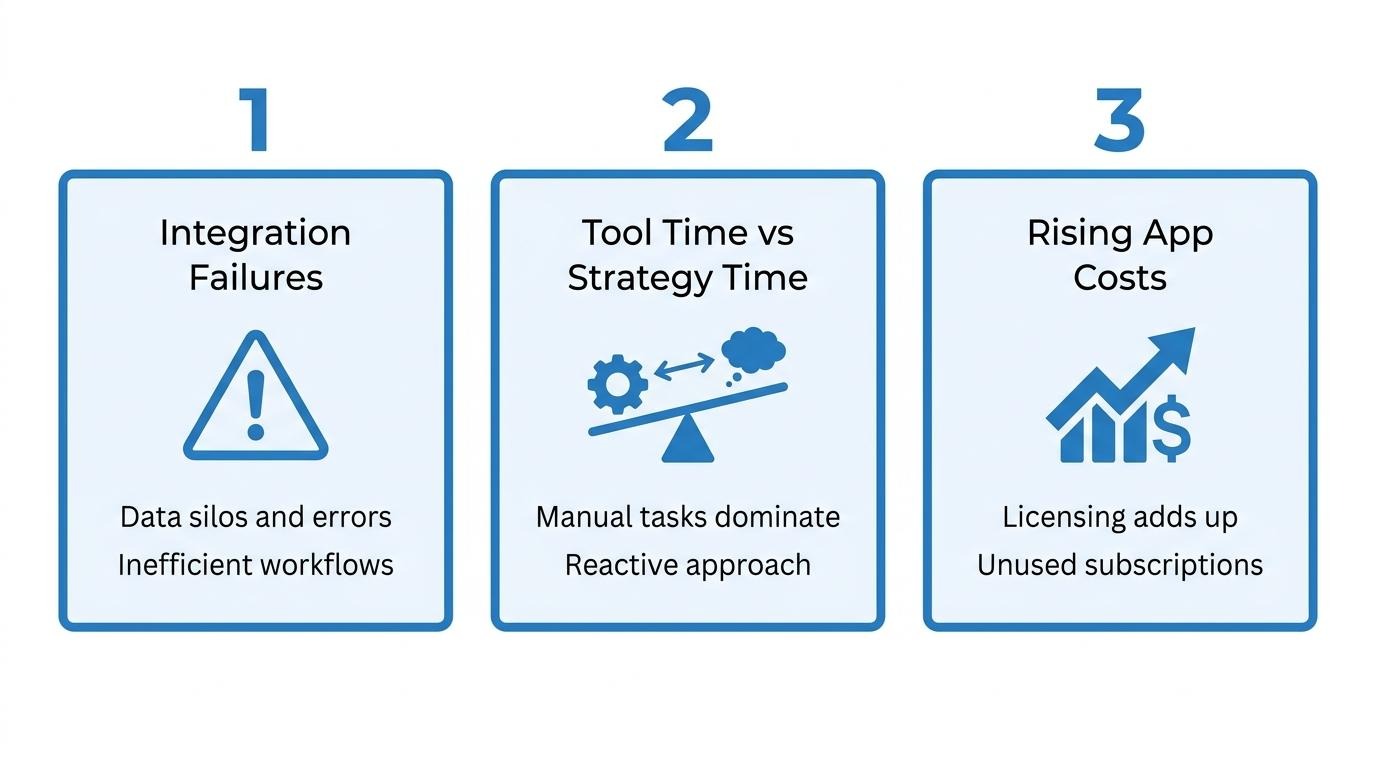
Integration failures start disrupting order fulfillment when disconnected systems create gaps between inventory data, order routing, and shipping execution. Inventory counts that lag behind real-time sales across channels cause overselling, backorders, and delayed shipments. These breakdowns erode consumer trust and compress margins.
Well-connected omnichannel systems work differently. According to the Maryland Department of Commerce and Regional Economic Studies Institute at Towson University, omnichannel systems prompt a check of inventory levels at stores or fulfillment centers closest to the consumer, minimizing time to delivery or offering the option of in-store pickup. When your stack cannot perform this basic coordination without manual intervention or custom middleware, the integration layer has become a liability rather than infrastructure.
If fulfillment errors correlate with periods of high order volume, the root cause is almost always a sync problem between tools, not a capacity problem.
You know your team spends more time on tools than strategy when daily operations revolve around maintaining integrations, reconciling data between platforms, and troubleshooting sync errors instead of improving customer experience or planning growth initiatives.
Common symptoms include:
When the tools designed to enable execution become the primary obstacle to it, complexity has crossed from manageable overhead into operational drag. Brands at this stage often find that consolidating platforms unlocks more capacity than hiring additional staff.
The metrics that reveal hidden complexity in your tech stack are operational indicators that expose how fragmentation quietly drains performance. These are not always on a standard dashboard, which is why the complexity stays hidden.
Key metrics to monitor include:
If three or more of these metrics trend upward while revenue growth plateaus, the stack itself is likely constraining scale. Identifying these patterns early gives brands the clarity to simplify before complexity compounds further.
Strategies that reduce complexity while supporting growth center on platform consolidation, shared data layers, native retention tools, built-in subscriptions, and unified point-of-sale systems. The following sections cover each approach.
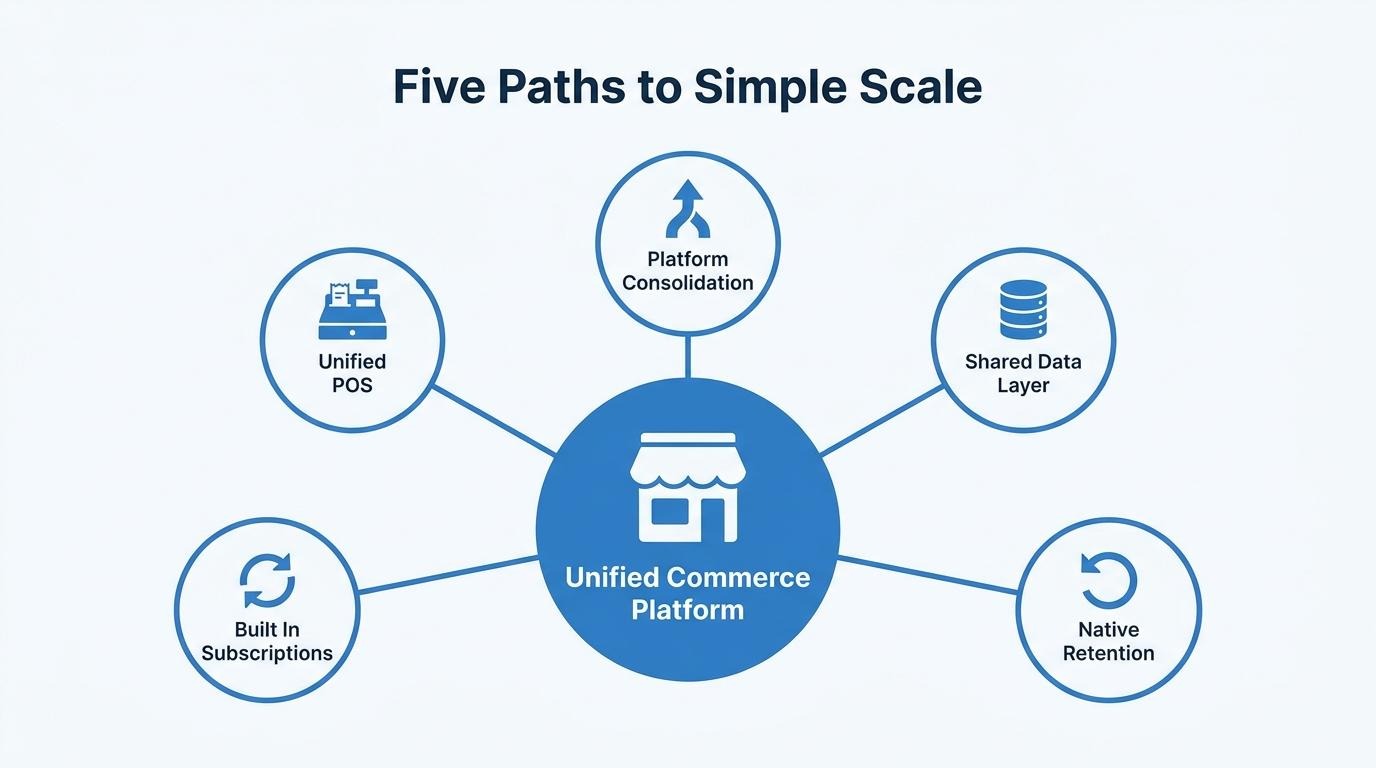
Platform consolidation simplifies daily operations by replacing disconnected apps with a single commerce system that handles storefront, marketing, CRM, and fulfillment from one dashboard. Instead of maintaining separate logins, sync schedules, and vendor contracts for each function, teams manage everything through unified workflows.
The operational benefits include:
For brands running five to fifteen tools, consolidation often recovers hours each week that were previously spent troubleshooting sync failures rather than executing growth initiatives.
A unified customer data layer replaces multiple apps by resolving online, offline, and marketing interactions into a single customer record. When browsing behavior, purchase history, and support tickets live in the same system, the need for standalone CDPs, analytics connectors, and data-stitching middleware disappears.
According to a 2024 study published in the Journal of Theoretical and Applied Electronic Commerce Research, a combination of engagement factors is essential for achieving optimal results, not any single element in isolation. A shared data layer makes this possible natively, since segmentation, personalization, and lifecycle triggers all draw from the same source. Brands that unify customer data at the platform level spend less time cleaning exports and more time acting on insights.
Automating retention within your commerce platform matters because it eliminates the latency and data gaps that occur when lifecycle marketing runs through external tools. When email flows, win-back sequences, and loyalty triggers operate inside the same system that processes orders, every automation fires on real-time purchase data rather than delayed syncs.
This native approach delivers several advantages:
Retention is a lifecycle discipline, not just an email function; embedding it inside the commerce layer reflects that reality.
Native subscription management eliminates plugin dependency by building recurring billing, subscription logic, and membership tiers directly into the commerce platform. Third-party subscription apps introduce a separate billing system, a separate customer record, and a separate analytics dashboard, all of which must sync with the storefront continuously.
When subscriptions run natively:
For brands building recurring revenue, this consolidation removes one of the most fragile integration layers in a typical ecommerce stack.
Built-in POS removes omnichannel integration friction by connecting in-store transactions to the same backend that powers the online storefront. According to a study by the Maryland Department of Commerce and Towson University's Regional Economic Studies Institute, omnichannel systems prompt inventory checks at stores or fulfillment centers closest to the consumer, minimizing delivery time or enabling store pickup.
When POS is native to the commerce platform, inventory levels update across all channels in real time, customer profiles capture both online and offline purchases, and promotions apply consistently regardless of where the transaction occurs. SHOPLINE POS, for example, unifies retail shops and online stores within a single system. Separating POS from ecommerce creates the exact data silos that scaling brands need to eliminate.
With these consolidation strategies in place, the next step is evaluating platforms against specific simplicity criteria.
You should evaluate an ecommerce platform for simplicity at scale by testing native feature depth, app replacement potential, and data architecture. The following subsections cover each evaluation criterion.
The questions you should ask about native feature coverage focus on whether core commerce functions exist inside the platform or require third-party apps. Before committing, assess these areas:
Each "no" signals a future integration point, and integration points compound into operational complexity as order volume grows. Prioritize platforms where the features your brand uses daily are first-party, not bolted on.
You assess whether a platform can replace your current apps by auditing your existing stack against the platform's native capabilities. Start by listing every tool your team touches weekly, from email marketing and subscription billing to analytics and customer support.
Then map each tool to a platform-native equivalent. The goal is not feature parity on paper; it is workflow parity in practice. A built-in CRM that unifies purchase history across online and offline channels may outperform a standalone CDP that requires manual syncing. For scaling brands running five to fifteen separate tools, even replacing half of them inside one system can measurably reduce operational overhead and monthly software costs.
A shared data architecture matters more than integrations because integrations move data between separate systems, while a shared architecture keeps all data in one system from the start. Integrations introduce sync delays, mapping errors, and maintenance burden that worsen as transaction volume climbs.
According to the Treasury Board of Canada Secretariat's guideline on digital service delivery, integrating decision-making across service, information, data, and IT functions ensures that impacts for each function are considered throughout the development of new initiatives. The same principle applies to commerce: when inventory, customer profiles, and marketing signals share one data layer, every team works from the same truth. This eliminates reconciliation work and accelerates decision-making at scale.
Evaluating architecture, not just features, reveals which platforms will sustain simplicity as your brand grows.
A scaling brand should migrate to a consolidated platform when tool sprawl costs, data fragmentation, and operational overhead begin outpacing revenue gains. The subsections below cover the ideal revenue stage for consolidation and how to migrate without disrupting customer journeys.
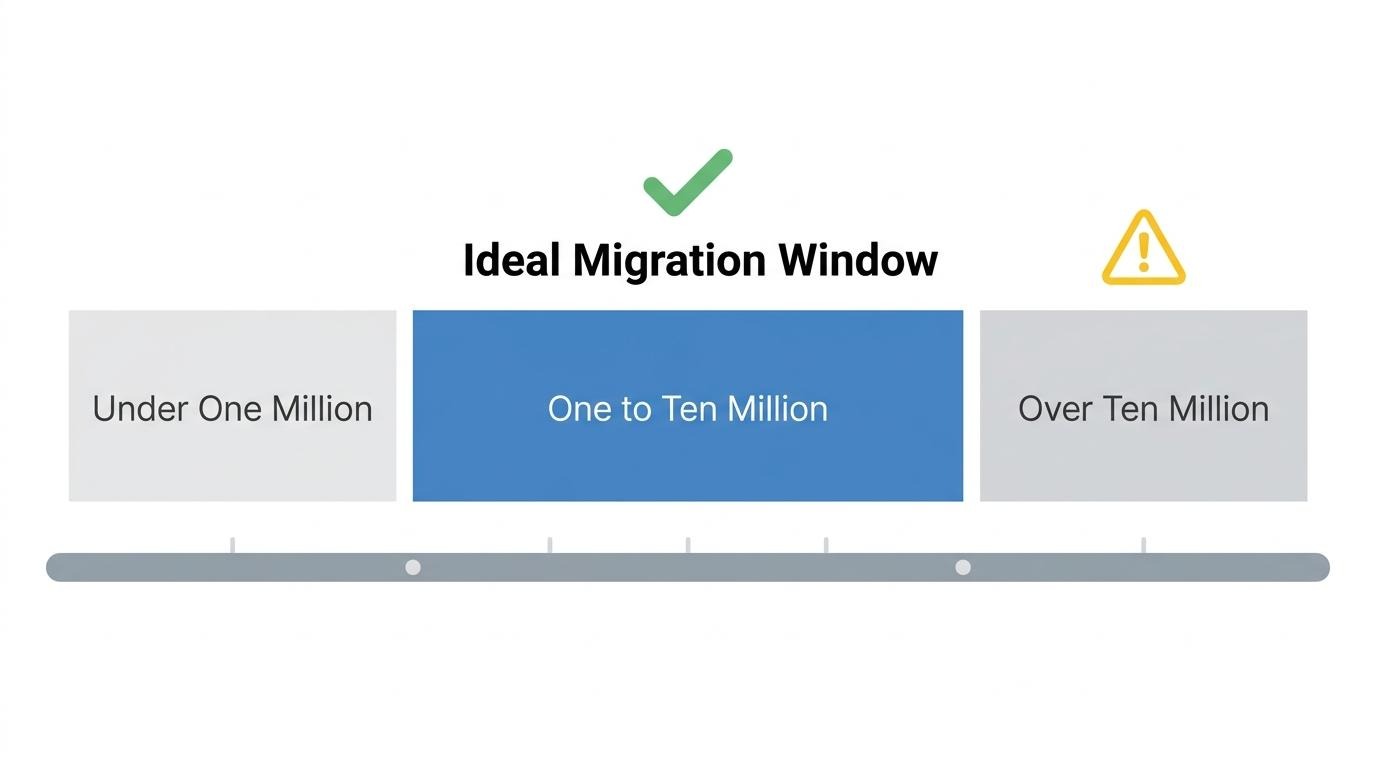
The revenue stage that makes consolidation most cost-effective is typically between $1M and $10M in annual sales, when app stack costs and operational friction start compounding faster than topline growth. At this stage, brands often run 5 to 15 separate tools for marketing, subscriptions, CRM, and fulfillment. Each tool carries its own subscription fee, integration maintenance cost, and data reconciliation burden.
Below $1M, the overhead of migration rarely justifies the savings. Above $10M, delayed consolidation means years of accumulated technical debt that makes switching harder and more expensive. The sweet spot falls where monthly SaaS spend crosses roughly 8 to 12 percent of revenue while team hours lost to manual workarounds become measurable. Brands that consolidate in this window typically recapture both margin and execution speed before complexity becomes structural.
You migrate without disrupting existing customer journeys by running parallel systems during a phased transition, preserving URL structures, and mapping every customer touchpoint before deactivating legacy tools. According to the U.S. Web Design System published by the General Services Administration, best practice is to minimize disruption and provide a consistent experience throughout services, over time, and across platforms and devices.
A low-risk migration sequence includes:
Rushing this process is the most common mistake scaling brands make. Each phase should have a rollback plan so no customer interaction falls through a gap during the switch. With a structured migration path in place, the next consideration is choosing a platform built to handle unified commerce from day one.
An all-in-one commerce platform helps you scale simply by replacing fragmented multi-app stacks with native features under a shared data layer. The following sections cover how SHOPLINE's unified system addresses this and the key takeaways for scaling without complexity.
Yes, SHOPLINE's unified commerce system can replace a multi-app stack for brands that have outgrown a patchwork of disconnected tools. SHOPLINE POS unifies retail shops and online stores, seamlessly integrating a brand's website, social media, messaging apps, and point-of-sale into a single system.
This architecture means commerce, CRM, marketing automation, subscriptions, and POS operate from one shared customer data layer rather than requiring separate syncs between five or more third-party applications. For scaling DTC brands spending heavily on app subscriptions and custom integrations, consolidating into a platform with native feature coverage eliminates recurring sync failures and redundant licensing fees.
SHOPLINE is one option among several for brands at this stage. Results may vary depending on implementation, industry, and scale.
The key takeaways on scaling ecommerce without complexity center on consolidation, shared data, and intentional simplification:
Fewer tools, fewer failure points, and a single source of customer truth: that is how scaling brands keep growth from becoming its own obstacle.
.png)

