
Enterprises evaluating SHOPLINE and Salesforce Commerce Cloud choose SHOPLINE for enterprise-grade omnichannel and B2B on a platform that publishes its plan prices. You keep total cost of ownership in view. SHOPLINE powers 700,000+ merchants worldwide since 2013.






Why the comparison matters
Salesforce Commerce Cloud's Einstein AI and Customer 360 integration are genuine strengths for organizations already standardized on Salesforce. That power comes on a quote-only model priced as a percentage of gross merchandise value, and Salesforce documents a build team of certified developers. SHOPLINE delivers enterprise-grade omnichannel, B2B, and open APIs with custom pricing that includes a platform fee based on transaction volume.
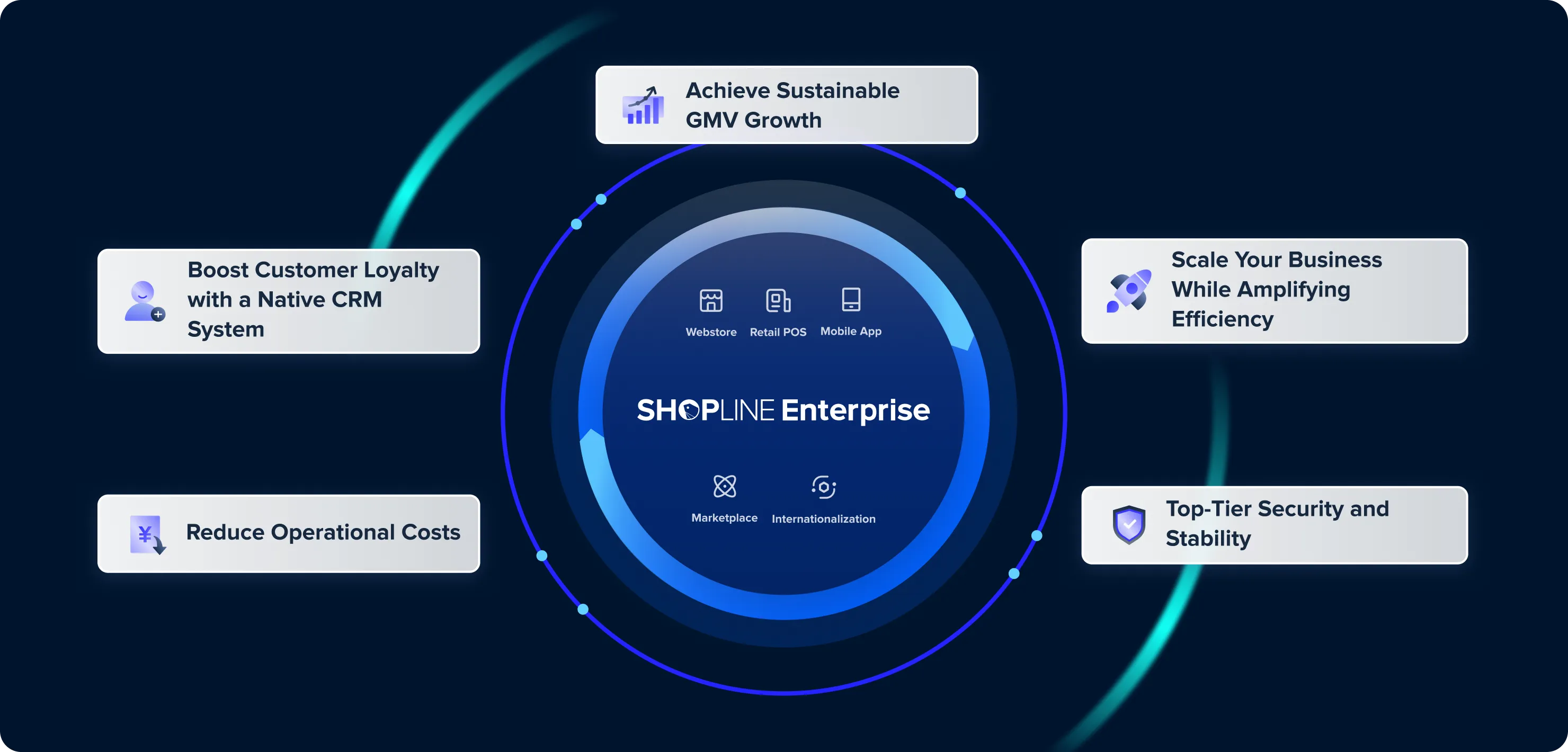
SHOPLINE serves more than 700,000 merchants and has operated as a global commerce SaaS since 2013. Its enterprise tier boosts GMV across online, physical, social, and app channels, integrates ERP, OMS, 3PL, and CRM through comprehensive APIs, and secures payments at PCI DSS Level 1 with a SOC 2 report.
Side by side
Enterprise commerce compared on cost model and delivery.
Sources: shopline.com/enterprise & /pricing; salesforce.com/commerce/b2b-ecommerce/pricing (Contact for Pricing; percentage of GMV, rate not published); Trailhead B2C Commerce project planning.
Why enterprises consider SHOPLINE
Both platforms reach enterprise scale, so the evaluation turns on what it costs and how long it takes to get there. SHOPLINE lightens the load in four areas: cost of ownership, build and team, omnichannel, and integrations. Select each to compare.


Salesforce Commerce Cloud is quote-only. Its B2B pricing page shows Contact for Pricing on both editions and publishes only the model, a percentage of gross merchandise value. SHOPLINE publishes its plan prices and its third-party gateway fee of 2%, 0.8% or 0.5% by tier, waived on SHOPLINE Payments. Enterprise is custom on both platforms.

SHOPLINE Enterprise uses custom pricing and includes a platform fee based on transaction volume. The enterprise tier includes omnichannel, marketing, and app access.

SHOPLINE lets teams start on a self-serve plan from $24/mo billed annually ($29 monthly) and grow into Enterprise. You validate the platform before committing to an enterprise contract.

Salesforce documents a build team of four certified developers and a certified architect. SHOPLINE pairs a no-code builder with enterprise APIs, so the team configures the store and brings developers in for integrations.

Salesforce documents a build team of certified developers. SHOPLINE is merchant-friendly while still offering deep APIs, so your internal team owns more of the work.
SHOPLINE Enterprise upgrades in one click with priority API calls and rapid data synchronization. Your store scales into enterprise infrastructure without a rebuild.

SHOPLINE unifies online store, physical store, social commerce, and shopping app to accelerate GMV. Your customers move between channels on one connected experience.

SHOPLINE builds social selling and livestream ordering into the platform. Your brand runs high-velocity social campaigns without stitching in separate tools.

SHOPLINE POS, a paid add-on from $39 per month, syncs inventory in real time with in-store pickup and local delivery. Your retail and digital operations share one stock and customer record.

SHOPLINE connects to your existing stack through comprehensive APIs. Your operations team integrates the systems it already runs rather than replacing them.

SHOPLINE exposes robust APIs, a query language, and an open layout engine. Your developers build custom storefronts and services on a flexible foundation.

SHOPLINE's AI suite powers search, recommendations, and content. Your merchandisers personalize the experience without a separate AI project.
The honest fit
Neither platform wins every deal. Here's a candid view of where Salesforce Commerce Cloud is the right investment, and where SHOPLINE is the lighter path to the same outcome.
SHOPLINE vs Salesforce Commerce Cloud FAQ
The answers below address what evaluation committees weigh most: pricing model, implementation time, B2B and B2C scope, integrations, and migration.
Salesforce Commerce Cloud is quote-only. Its B2B pricing page shows Contact for Pricing on both editions, and Salesforce publishes only the model, a percentage of gross merchandise value based on the commerce functionality needed. It does not publish the rate. SHOPLINE Enterprise uses custom pricing and also offers self-serve plans from $24/mo billed annually ($29 monthly).
SHOPLINE Enterprise uses custom pricing and includes a platform fee based on transaction volume. It includes omnichannel, marketing, and app access in its enterprise tier, and SHOPLINE publishes plan prices and transaction fees for its self-serve tiers, which Salesforce does not.
Salesforce does not publish an implementation timeline for Commerce Cloud. What it does document is the build team: four certified developers and a certified architect. SHOPLINE pairs a no-code builder with enterprise APIs, so fewer specialist hires are needed.
Yes. SHOPLINE runs a unified B2B and B2C solution with wholesale catalogs and custom pricing, alongside native social and livestream commerce and SHOPLINE POS, a paid add-on from $39 per month.
SHOPLINE connects to ERP, OMS, 3PL, and CRM systems through comprehensive APIs, so your existing stack integrates around the storefront.
SHOPLINE offers a multi-platform migration tool and one-click enterprise upgrade with priority API calls and rapid data synchronization, so replatforming avoids a full rebuild.

