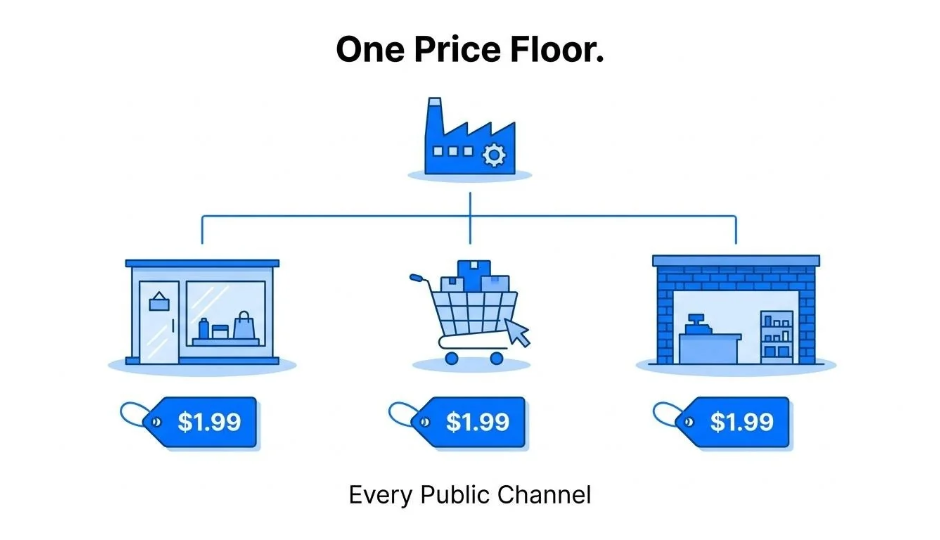
MAP pricing is a manufacturer-set floor on the lowest price a retailer can publicly advertise for a product. It governs advertising only; retailers remain free to sell below that floor at checkout, in private negotiations, or through non-public channels.
This guide covers why brands adopt MAP policies and how they protect channel health, the legal framework that governs MAP in the United States, how MAP differs from related pricing terms like MSRP and resale price maintenance, enforcement mechanics and common violations, and how MAP shapes DTC ecommerce strategy across fragmented sales channels.
Brands implement MAP to preserve perceived product value, prevent margin-destroying price wars among retail partners, and keep both online and physical sellers competing on service rather than price alone. Without an advertised price floor, retailers undercut each other until the entire channel becomes economically unviable.
U.S. antitrust law permits MAP when structured as a unilateral manufacturer policy rather than a binding agreement with retailers. The 2007 Supreme Court ruling in Leegin v. PSKS replaced the per se ban on vertical price restraints with rule-of-reason analysis, giving brands significantly more room to enforce advertised price floors. However, several states maintain stricter statutes, and any enforcement that crosses into coordinated pricing agreements risks antitrust exposure.
MAP operates differently from MSRP, which is a non-binding price suggestion, and from resale price maintenance, which restricts the actual transaction price and carries heavier legal scrutiny across multiple jurisdictions.
Effective enforcement requires automated price monitoring, graduated violation penalties, and clear policy language covering products, channels, and promotional exceptions. Coupon stacking, cart-level discounts, and algorithmic repricing tools represent the most frequent sources of unintentional violations, making promotional governance a core operational requirement for scaling brands.
MAP pricing in ecommerce is a manufacturer-set floor on the lowest price a retailer can publicly advertise for a product. It governs advertised prices only, not the final transaction price a consumer pays at checkout.
A minimum advertised price policy sets the boundary between what shoppers see in search results, product listing ads, and on-site pricing displays, and what happens once a buyer reaches the cart or negotiates directly. According to the UCLA Department of Economics, MAP policies impose a floor on the price at which retailers can advertise a product, but crucially, not the price at which it can be sold to a consumer; even if a MAP policy imposes a floor of $10 per unit, nothing restricts the retailer from selling it for $7.
This distinction matters for ecommerce operators because advertised prices drive click-through rates, comparison shopping behavior, and channel perception. MAP does not cap margins or dictate checkout totals. It controls visibility. Retailers remain free to offer lower prices through non-public means, such as post-login pricing, negotiated quotes, or in-store conversations, provided the publicly displayed price stays at or above the MAP threshold.
For brands distributing through multiple online and offline channels, MAP pricing creates a consistent price floor across every touchpoint where consumers compare options. Understanding exactly where the policy starts and stops is the foundation for every enforcement decision, promotional plan, and retailer agreement that follows.
Brands use a minimum advertised price policy to protect margins, preserve brand perception, and maintain fair competition across their retail channels. The subsections below cover brand equity, price erosion, and retailer relationships.
MAP pricing protects brand equity by preventing retailers from advertising products at prices that undermine perceived value. When a premium product appears at steep discounts across multiple storefronts, consumers begin associating the brand with bargain-tier positioning. A consistent advertised price floor signals quality and reinforces the manufacturer's intended market placement.
This matters most for brands selling through both direct and wholesale channels. If third-party retailers undercut advertised pricing, even a well-crafted DTC storefront loses its pricing authority. MAP policies give manufacturers a structured mechanism to keep advertised prices aligned with the brand story they have built through product development, packaging, and marketing investment.
MAP pricing prevents a race to the bottom by restricting how low retailers can advertise a product's price. Without this floor, retailers competing for the same customers tend to slash advertised prices until margins collapse for everyone in the channel. According to research published by the NET Institute, MAP restrictions function as manufacturer policies that can limit the ability of consumers to search for the lowest product prices, which in turn softens the intensity of pure price-based retail competition.
Once margins erode past a threshold, retailers cut service, reduce inventory depth, or drop the product entirely. MAP policies interrupt this cycle before it begins, keeping the channel economically viable for sellers who invest in customer experience rather than relying solely on price cuts.
MAP pricing supports authorized retailer relationships by creating a level playing field where all partners compete on service, expertise, and shopping experience rather than price alone. Retailers who invest in trained staff, branded displays, or superior fulfillment deserve protection from competitors who simply undercut on price without adding value.
When retailers trust that competitors cannot publicly advertise below the same floor, they commit more resources to stocking inventory and promoting the brand. This dynamic strengthens the entire distribution network. For brands managing both online and physical retail partners, MAP compliance ensures neither channel cannibalizes the other through aggressive discounting, which is one of the most common friction points in multi-channel distribution.
Understanding what motivates MAP adoption helps clarify how these policies differ from related pricing terms like MSRP.
MAP pricing differs from MSRP, UPP, and resale price maintenance in scope, enforceability, and legal risk. The sections below clarify each distinction.
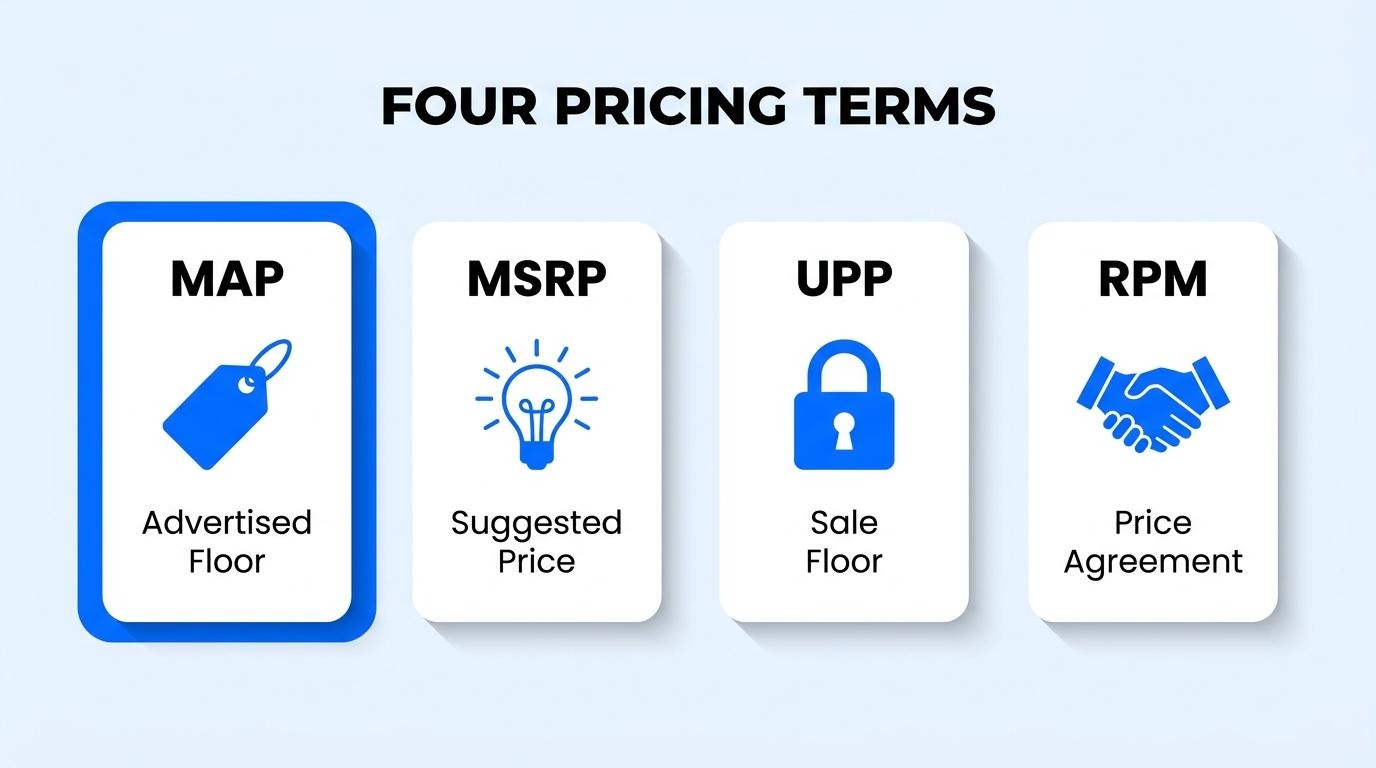
MAP differs from MSRP in what each term controls. MSRP (manufacturer's suggested retail price) is a recommended selling price printed on packaging or published in catalogs. It serves as a reference point for consumers, not a binding requirement. MAP, by contrast, sets a floor on the price a retailer can advertise, without restricting the actual transaction price.
A retailer can sell below MSRP or below MAP at the register. The difference is that violating a MAP policy triggers consequences from the manufacturer, such as loss of co-op advertising funds or account suspension, while ignoring MSRP carries no penalty. For brands managing multichannel distribution, this distinction matters: MSRP signals value to shoppers, while MAP protects margin consistency across authorized sellers.
MAP differs from UPP (unilateral pricing policy) in what each restricts. MAP controls only the advertised price; retailers remain free to sell below MAP during private negotiations or at checkout. UPP controls the actual sale price, prohibiting retailers from completing transactions below a set minimum.
Because UPP governs the final transaction, it carries greater antitrust scrutiny. Manufacturers implement UPP unilaterally, without retailer agreements, to stay within the boundaries established by the Colgate doctrine. MAP policies also operate unilaterally but are narrower in scope, restricting only publicly visible pricing. Brands choosing between the two should weigh how much pricing control they need against the legal exposure each approach creates.
MAP differs from resale price maintenance (RPM) in legality, mechanism, and enforcement risk. RPM involves an agreement between a manufacturer and retailer that sets a minimum resale price, restricting what the retailer can actually charge consumers. MAP restricts only the advertised price, leaving the sale price unregulated.
This distinction carries significant legal weight. According to the American Bar Association's Antitrust Law Section, MAP "limits the prices a retailer may publish, but not necessarily the prices offered in negotiations or ultimately charged to consumers," while RPM "constrains prices actually charged." RPM is prohibited outright in jurisdictions including the UK, Australia, and Canada. In the U.S., RPM is evaluated under the rule of reason since the 2007 Leegin decision, but several states still treat minimum resale price agreements as per se illegal.
Understanding where MAP ends and RPM begins is critical for any brand scaling wholesale distribution across multiple markets.
MAP pricing is legal in the United States when structured as a unilateral policy rather than a binding agreement between manufacturer and retailer. The legal foundation, key Supreme Court precedent, and scenarios where MAP crosses into antitrust risk are covered below.
The Leegin v. PSKS Supreme Court case affected MAP legality by replacing the century-old per se prohibition on vertical price restraints with a rule-of-reason analysis. In its 2007 decision in Leegin Creative Leather Products, Inc. v. PSKS, Inc. (551 U.S. 877), the Supreme Court overruled the Dr. Miles precedent, holding that vertical minimum price restraints are not automatically illegal. Instead, courts now evaluate whether a specific pricing arrangement unreasonably restricts competition based on the facts of each case. This shift gave manufacturers significantly more room to implement MAP policies, because a unilateral advertised-price floor analyzed under the rule of reason is far less likely to be struck down than one judged per se unlawful.
A MAP policy could cross into antitrust violation when it moves beyond a unilateral manufacturer announcement and becomes a coordinated agreement, either among competing manufacturers or between a manufacturer and its retailers. As established under the Colgate doctrine (United States v. Colgate & Co.), a seller may unilaterally set a suggested price policy and refuse to deal with retailers who undercut it; however, the methods used to enforce that policy have been a major area of legal dispute since Colgate was decided, according to Michigan Law Review.
Specific risk scenarios include:
The 2000 FTC enforcement against five major music distributors illustrates the risk clearly: when MAP policies were tightened under retailer pressure to ban discounted-price advertising across all media, the result was an estimated $480 million in overcharges to U.S. consumers. For brands building a MAP program, the safest path is a clearly unilateral policy, consistently applied, with no evidence of agreement or coercion in either direction.
A MAP policy applies to every reseller authorized to advertise a brand's products, regardless of sales channel. The sections below cover online retailers, brick-and-mortar stores, the brand's own DTC store, and marketplace sellers on Amazon.
MAP applies to online retailers. According to the UK Competition and Markets Authority, where the product is sold does not matter; pricing restrictions can apply to sales online and sales in shops. Any retailer advertising a product on a website, paid search ad, comparison shopping engine, or email campaign falls within a MAP policy's scope. Online channels are often the primary enforcement focus because advertised prices are publicly visible and easy for both competitors and consumers to compare. Brands that exclude online sellers from MAP coverage effectively create a two-tier system that undermines the policy's purpose.
MAP applies to brick-and-mortar stores in the same way it applies to online sellers. Physical retail advertisements, including print circulars, window signage, in-store digital displays, and local newspaper ads, must comply with the minimum advertised price. The policy governs the price shown to consumers before purchase, not the final transaction price. A physical retailer can still negotiate or offer a lower price at the register, provided the advertised price meets the MAP floor. Brands that enforce MAP consistently across physical and digital channels protect retailer margin parity and prevent channel conflict.
MAP applies to the brand's own DTC store if the brand chooses to include it in the policy. Since MAP is a unilateral policy set by the manufacturer, the brand controls its scope. Most brands hold their DTC storefront to the same advertised price floor to maintain credibility with retail partners. Advertising below MAP on a brand-owned site signals to authorized retailers that the policy is not taken seriously, which erodes compliance across the entire channel network. For brands running promotions or lifecycle campaigns through their own storefront, building clear promotional exception windows into the MAP policy avoids this conflict.
MAP applies to marketplace sellers on Amazon when those sellers are authorized resellers bound by the brand's MAP agreement. Amazon itself does not enforce MAP on behalf of brands; the responsibility falls on the manufacturer. Third-party sellers who sign a MAP agreement must keep their advertised prices at or above the floor, including the price displayed on the product detail page. Unauthorized or gray-market sellers, however, operate outside the agreement entirely, which makes enforcement difficult without additional brand registry tools or legal action. This is one reason brands invest in automated price monitoring across marketplace channels.
A MAP policy should include clearly defined product scope, covered advertising channels, a tiered enforcement structure for violations, and rules governing promotional exceptions. The sections below break down each component.
The products and channels a MAP policy should cover are every SKU the brand wants to price-protect, paired with every advertising surface where those prices appear. Most brands start by listing specific product lines or categories rather than applying MAP blanket-style across an entire catalog. Seasonal items, clearance inventory, and discontinued SKUs are often excluded to preserve markdown flexibility.
Channels to specify include:
Naming each channel removes ambiguity. Retailers cannot claim ignorance if the policy document explicitly lists where MAP applies.
The consequences a MAP policy should define for violations are a graduated series of penalties that escalate with repeat offenses. A tiered structure keeps enforcement credible without alienating retail partners after a single misstep.
A typical escalation framework includes:
According to research published by Kellogg Insight at Northwestern University, punishments that seem too draconian actually backfire; retailers stop believing they will be enforced, which leads to more MAP violations. Proportional, clearly communicated penalties are more effective than extreme threats that a brand hesitates to carry out.
A brand should handle promotional exceptions by defining them in writing before any sale event begins. Pre-approved exceptions prevent confusion and protect the policy's credibility during high-traffic periods like Black Friday, product launches, or seasonal clearance windows.
Key elements to formalize include:
Every participating retailer should receive identical terms. Selective discounting for favored partners risks antitrust scrutiny and erodes trust across the dealer network. A well-structured promotional exception strengthens the MAP policy overall because retailers see the brand as fair, consistent, and willing to support sell-through without abandoning price discipline.
With policy components defined, the next step is monitoring and enforcing compliance across channels.
Brands monitor and enforce MAP compliance through price tracking technology, structured violation response protocols, and escalating consequences for repeat offenders. The subsections below cover each stage of the enforcement process.
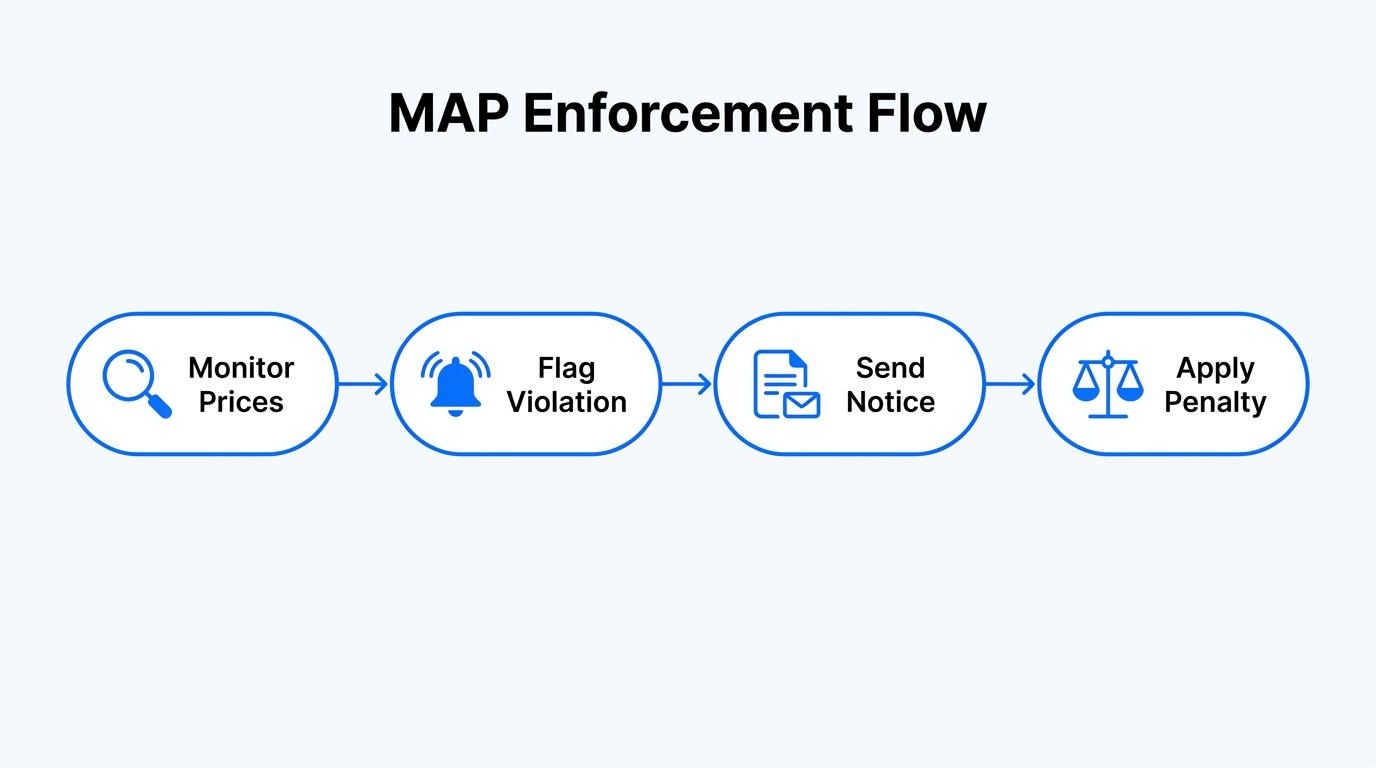
Brands track advertised prices across channels using automated price monitoring software that crawls retailer websites, marketplaces, and comparison shopping engines. These tools scan listed prices at regular intervals, flag deviations from the established MAP floor, and generate violation reports with timestamps and screenshots.
According to a 2024 National Bureau of Economic Research working paper on algorithmic pricing, these tools "enabled the manufacturers to monitor online retailers' pricing, identify discrepancies, and enforce minimum retail prices." Manual monitoring is impractical at scale; even a brand with 30 authorized retailers across Amazon, its own site, and independent stores can generate hundreds of daily price data points. Automated tracking converts that volume into actionable alerts.
The steps a brand should take when a violation occurs follow a graduated sequence:
Calibrating penalties matters more than most brands realize. As Israeli of the Kellogg School of Management notes, "When manufacturers impose punishments that seem too draconian, retailers do not believe that they will be punished upon violating MAP, which leads to MAP violations." Proportional, consistently enforced consequences produce better compliance than extreme penalties applied inconsistently.
Brands handle repeat MAP violators through escalating enforcement tiers that increase in severity with each subsequent offense. A common structure progresses from a written warning, to temporary suspension of cooperative advertising funds, to reduced product allocation, and ultimately to termination of the retailer's authorized status.
The key is consistency. Selective enforcement undermines the entire policy because other retailers notice when violations go unpunished. Brands that document every incident and apply the same escalation ladder to all partners, regardless of account size, build credibility across their channel. Termination should remain a last resort, reserved for retailers who demonstrate a pattern of deliberate non-compliance after multiple corrective opportunities.
With enforcement systems in place, understanding the most common violation types helps brands close remaining gaps.
Common MAP policy violations include advertising prices below the manufacturer's floor, using coupon stacking or cart discounts to effectively lower the visible price, and allowing automated repricing tools to undercut MAP thresholds on marketplaces.
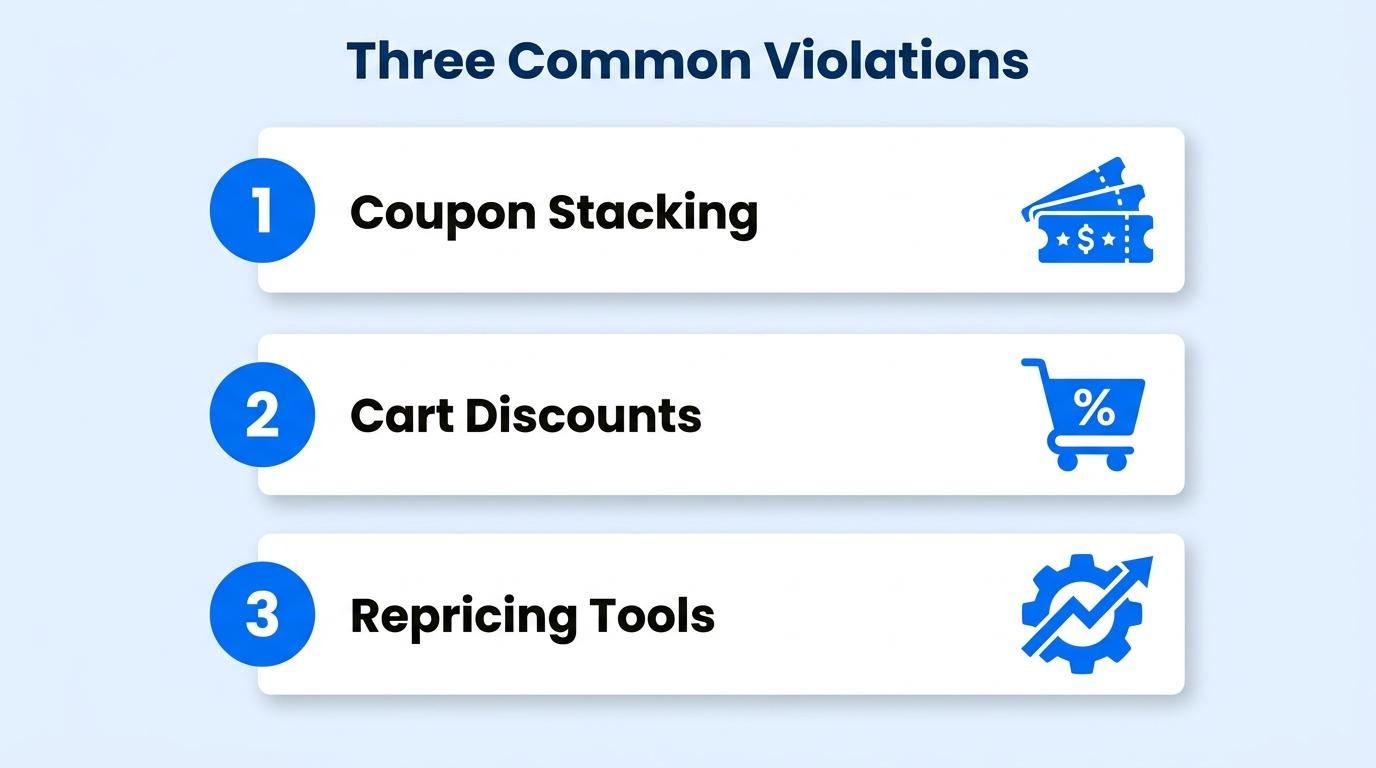
An advertised price below MAP is any publicly displayed price that falls beneath the minimum floor a manufacturer sets for product advertising. This includes prices shown on product listing pages, comparison shopping engines, paid search ads, email campaigns, and social media promotions.
The critical distinction: MAP restricts only the advertised price, not the final transaction price. According to the European Commission's 2022 Guidelines on vertical restraints, MAPs leave the distributor technically free to sell below the advertised price, but they disincentivize lower sale prices by restricting the distributor's ability to inform potential customers about available discounts.
Retailers sometimes blur this line by displaying a price at MAP while offering manufacturer coupons that reduce the effective advertised price. For brands enforcing MAP, any visible price communication that a reasonable shopper would interpret as below the floor counts as a violation.
Coupon stacking and cart discounts violate MAP by reducing the effective advertised price below the manufacturer's minimum, even when the listed shelf price appears compliant. A retailer might display a product at the MAP floor while simultaneously offering a site-wide coupon, a loyalty discount, or a cart-level percentage off that brings the visible pre-checkout price below MAP.
Manufacturer coupons add complexity. As the California Department of Tax and Fee Administration explains in Publication 113, manufacturer coupons allow customers to receive a percentage or amount off the advertised selling price. When retailers layer these on top of store promotions, the combined discount can push advertised totals well below MAP without any single discount appearing to violate the policy.
Most well-drafted MAP policies now explicitly address bundled discounts, stacked promotions, and cart-level reductions to close these loopholes.
Marketplace repricing tools trigger violations by automatically lowering a seller's advertised price to match or undercut competitors, often pushing the listed price below MAP without the seller's manual approval. These algorithms monitor competitor listings in real time and adjust prices on a continuous loop, prioritizing Buy Box wins over MAP compliance.
The risk is especially high on large marketplaces where thousands of third-party sellers compete on the same SKU. A single repricing algorithm that drops below MAP can cascade across the channel as competing sellers' tools respond in kind. For brands managing MAP across fragmented sales channels, automated repricing represents one of the hardest violations to detect and prevent without dedicated monitoring software.
With violations identified, the next step is understanding how MAP shapes a brand's own DTC pricing strategy.
MAP pricing affects DTC ecommerce strategy by shaping storefront pricing, constraining promotional mechanics, and complicating subscription models. The sections below cover how MAP influences a brand's own store, lifecycle campaigns, and recurring-revenue pricing.
MAP pricing influences a brand's own storefront by setting the floor for every publicly visible price on the site. Because MAP restricts only the advertised price, not the final transaction price, a DTC brand can still offer lower prices through non-public channels, such as logged-in customer portals or post-add-to-cart reveals. However, the storefront's catalog pages, Google Shopping feeds, and any crawlable product listing must display at or above the MAP floor. This creates a strategic tension: the brand controls the policy yet must also comply with it to maintain credibility with wholesale partners watching for inconsistencies. For most scaling DTC operations, treating MAP as the baseline storefront price actually simplifies pricing governance across channels.
MAP shapes promotions and lifecycle campaigns by limiting which discounts can appear in public-facing channels. Email subject lines, social ads, and banner promotions that display a specific below-MAP price constitute advertised prices under most policies. According to research published by the NET Institute, MAP restrictions can limit consumers' ability to search for product prices, which effectively softens retail competition by increasing search frictions. Lifecycle campaigns must work within these constraints:
The practical result is that retention-focused campaigns shift from price-led messaging to value-led positioning.
MAP interacts with subscription pricing by creating ambiguity around whether a recurring discount qualifies as an "advertised price." A subscribe-and-save offer displayed on a product page is publicly visible, so most MAP policies treat that discounted price as an advertised price subject to the MAP floor. Brands that want to offer subscription savings below MAP typically need to structure the benefit differently. Options include offering bonus products, loyalty points, or free shipping rather than a visible per-unit price reduction. When subscription mechanics, promotions, and storefront pricing all live in separate tools, enforcing these distinctions consistently becomes operationally difficult for brands managing volume across multiple channels.
Scaling DTC brands manage MAP across fragmented tools by consolidating pricing, promotions, and customer data into fewer systems. The sections below cover what changes with unified platforms and the key takeaways from this article.
What changes when pricing, promotions, and CRM live in one system is that MAP compliance becomes easier to maintain across every customer touchpoint. When promotional rules, cart-level discounts, and lifecycle campaigns share one data layer, the risk of accidental MAP violations drops significantly. Brands no longer need to reconcile pricing logic between separate tools for email, subscriptions, and storefront displays.
According to a 2022 National Bureau of Economic Research working paper on algorithmic pricing, monitoring tools enabled manufacturers to track online retailers' pricing, identify discrepancies, and enforce minimum retail prices. That capability matters more when a brand controls its own DTC channels; a single system applying consistent pricing rules eliminates the gaps where coupon stacking or misconfigured promotions quietly push advertised prices below MAP.
For brands operating at scale, this is where tool sprawl becomes a real compliance liability. SHOPLINE is one option for brands consolidating pricing, CRM, and promotions into a single platform rather than patching compliance across disconnected apps.
The key takeaways about MAP pricing are that it governs advertised prices only, carries real legal nuance, and requires active enforcement to work. This article covered several core principles:
The most practical lesson is that MAP compliance is not a one-time policy decision. It is an ongoing operational commitment that scales in complexity as brands add channels, retailers, and promotional campaigns.
MAP stands for minimum advertised price, a manufacturer-set floor on the price at which retailers can publicly advertise a product. This policy governs advertising only; it does not restrict the actual transaction price a consumer pays at checkout. According to the UCLA Department of Economics, even if a MAP policy imposes a floor of $10 per unit on advertised prices, nothing restricts the retailer from selling it to a consumer for $7. That distinction separates MAP from stricter controls like resale price maintenance, which caps or fixes the final sale price itself. For brands distributing through multiple retail partners, MAP policies create consistent price perception across storefronts, websites, and marketplaces without dictating what happens once a shopper reaches the register.
Brands use a minimum advertised price policy to protect perceived product value, stabilize retailer margins, and maintain fair competition across sales channels. The following subsections cover how MAP pricing safeguards brand equity, prevents destructive price wars, and levels the playing field for all retailer types.
MAP pricing protects brand equity by preventing retailers from advertising products at prices so low they erode the brand's perceived quality. When consumers consistently see a product discounted far below its intended positioning, they begin associating it with low value rather than premium craftsmanship or innovation.
A minimum advertised price floor keeps promotional messaging aligned with the brand's market positioning. According to research published by the NET Institute, MAP restrictions function as manufacturer policies that can limit the ability of consumers to search for product prices, which in turn preserves controlled brand presentation across retail channels. This controlled visibility ensures that a brand's investment in product development, packaging, and storytelling is not undermined by a single retailer's aggressive discount strategy.
MAP pricing prevents a race to the bottom among retailers by establishing a floor below which no retailer can publicly advertise. Without this constraint, retailers compete almost entirely on price, each undercutting the next until margins collapse for everyone in the channel.
This downward spiral is particularly destructive because it rewards scale over service. Large-volume sellers absorb thin margins while smaller retailers, who often provide superior customer education and support, cannot survive. MAP policies redirect competition toward service quality, product expertise, and shopping experience rather than who can post the lowest number. For brands distributing through dozens or hundreds of retail partners, this stability is not optional; it is the mechanism that keeps the entire channel economically viable.
MAP pricing supports brick-and-mortar and online retailers equally by holding both channel types to the same advertised price floor. Physical stores carry higher operating costs, including rent, staffing, and in-store displays. Without MAP, online-only sellers with lower overhead could consistently advertise lower prices, turning physical locations into unpaid showrooms where consumers browse before buying online.
A well-enforced MAP policy neutralizes this imbalance. Brick-and-mortar retailers compete on experience, immediacy, and personalized service rather than fighting a cost structure disadvantage. Online retailers, meanwhile, still differentiate through convenience, broader selection, and digital marketing. Both channel types retain healthy margins, which motivates continued investment in carrying and promoting the brand's products.
Understanding why brands implement MAP policies sets the stage for distinguishing MAP from related pricing terms like MSRP and resale price maintenance.
A MAP policy differs from MSRP and other pricing terms in what each one controls and who sets the restriction. The sections below clarify MAP versus MSRP, MRP, and resale price maintenance.
The difference between MAP and MSRP is that MAP sets the lowest price a retailer can advertise, while MSRP is the price a manufacturer recommends a retailer charge at the point of sale. MAP restricts advertising only; retailers remain free to sell below MAP in-store or at checkout. MSRP carries no binding enforcement mechanism, functioning purely as a suggestion.
Key distinctions include:
According to the FTC's 16 CFR § 233.3, many consumers believe a manufacturer's suggested retail price reflects the price at which a product is generally sold, which means advertised discounts from MSRP carry outsized persuasive power. For brands managing both terms, MAP is the enforceable floor that protects margin, while MSRP is the aspirational anchor that shapes consumer perception.
The difference between MAP and MRP is that MAP applies to advertised prices in competitive retail markets, while MRP (maximum retail price) sets a legal ceiling on what consumers can be charged. MRP is primarily a regulatory concept used in countries like India, where the government mandates that packaged goods display the highest permissible sale price inclusive of all taxes. According to the Department of Consumer Affairs, Government of India, "retail sale price" means the maximum price at which a packaged commodity may be sold to consumers.
MAP and MRP operate in opposite directions:
U.S. brands expanding into markets with MRP regulations need to understand that MRP compliance is non-negotiable, whereas MAP compliance depends on contractual relationships with authorized resellers.
The difference between MAP and resale price maintenance is that MAP restricts only the advertised price, while resale price maintenance (RPM) restricts the actual transaction price a retailer can charge. As the American Bar Association's Antitrust Law Section explains, MAP "limits the prices a retailer may publish, but not necessarily the prices offered in negotiations or ultimately charged to consumers. Unlike RPM, MAP only constrains prices that are posted and does not constrain prices actually charged."
RPM is a vertical restraint in which manufacturers dictate the minimum or maximum resale price. Several jurisdictions treat RPM as presumptively illegal. The Australian Competition and Consumer Commission, for instance, considers it illegal for a wholesaler to withdraw discounts from retailers who sell below a recommended price. In the U.S., the 2007 Supreme Court ruling in Leegin v. PSKS shifted RPM from per se illegality to rule-of-reason analysis, but states like Maryland still explicitly prohibit minimum resale price agreements.
This legal distinction matters for enforcement strategy. A well-structured MAP policy avoids RPM territory by never dictating the final sale price, keeping the restriction limited to public-facing advertisements. Understanding where MAP ends and RPM begins is essential for brands building compliant pricing frameworks across multiple channels and jurisdictions.
MAP pricing is legal in the United States when a manufacturer unilaterally sets and enforces its own advertised price policy. The legal foundation, key Supreme Court precedent, and situations that risk antitrust exposure are covered below.
The Leegin v. PSKS Supreme Court case affected MAP legality by replacing the century-old per se ban on vertical price restraints with the rule of reason. In Leegin Creative Leather Products, Inc. v. PSKS, Inc., 551 U.S. 877 (2007), the Court overruled Dr. Miles Medical Co. v. John D. Park & Sons Co. and held that vertical price restraints must be judged under the rule of reason, not treated as automatic antitrust violations. This means a MAP policy is not inherently illegal; courts now evaluate each arrangement's actual competitive effects. For brands, this ruling made well-structured, unilaterally enforced MAP policies significantly safer under federal antitrust law, though it did not grant blanket immunity.
A MAP policy could cross into antitrust violation when it moves beyond unilateral enforcement into coordinated action among competitors or coerced agreements with retailers. The line separating lawful policy from illegal restraint depends on how the policy is designed and administered.
Key risk factors include:
According to research published through Indiana University, major music distributors introduced increasingly stringent MAP policies that effectively banned retailers from informing consumers of discounted prices across print, electronic media, and in-store displays; stores that violated the policy had promotional support cut for 60 to 90 days, with penalties sometimes extending to an entire retail chain. That coordinated approach ultimately drew FTC action.
A unilateral policy, grounded in the Colgate doctrine, remains legally defensible. Once enforcement involves mutual agreements or industry-wide coordination, however, the risk of antitrust scrutiny rises sharply. Brands should treat MAP as a tool for protecting advertised pricing consistency, not as a mechanism for controlling the competitive market.
A MAP policy applies to any reseller that advertises a manufacturer's products, including authorized retailers, online marketplace sellers, and sometimes the brand's own direct-to-consumer storefront. The scope varies by how each policy is written.
MAP pricing affects authorized retailers by setting the lowest price they can display in advertising, whether in print, on websites, or in email campaigns. Retailers remain free to sell below the MAP threshold in private transactions, but publicly listed prices must stay at or above the floor.
For authorized dealers, compliance typically comes with benefits:
Violations usually trigger graduated consequences, from warnings to suspension of supply. Retailers who invest in brand presentation and customer education benefit most from consistent MAP enforcement, because it prevents price-only competitors from eroding the value those investments create.
MAP pricing affects online marketplaces like Amazon by extending advertised price floors to third-party sellers listing a brand's products. Enforcement on marketplaces is more complex than with direct retail partners because manufacturers often lack a direct contractual relationship with every individual seller.
According to the UK Competition and Markets Authority, where the product is sold does not matter; pricing restraints can apply to sales online and sales in shops. This principle means marketplace listings fall within scope.
Key challenges brands face on marketplaces include:
Brands typically use automated price monitoring software to scan marketplace listings and flag violations in near real time.
MAP pricing affects direct-to-consumer brands by creating a self-imposed pricing constraint on their own storefronts. When a brand sells through both wholesale and DTC channels, advertising below its own MAP undermines the policy's credibility with retail partners.
DTC brands must align promotional pricing, homepage banners, and product page displays with the same floor they enforce on third parties. Otherwise, retailers lose trust in the policy's fairness and become less likely to comply themselves.
However, some brands write MAP exceptions for their own channels, such as loyalty program pricing visible only to logged-in members or cart-level discounts that appear after the product page. These carve-outs must be defined explicitly in the policy to avoid channel conflict.
For scaling DTC operations managing promotions, lifecycle campaigns, and wholesale distribution simultaneously, keeping advertised prices consistent across every touchpoint becomes an operational challenge that grows with channel count.
A MAP policy should include product and channel scope, clearly defined consequences for violations, and a structured communication plan. The following subsections break down each component.
A MAP policy should cover every SKU and sales channel where the brand's products are advertised. This means listing specific product lines, model numbers, or categories subject to the minimum advertised price, rather than applying a blanket statement that leaves room for interpretation.
Channels typically covered include:
Excluding even one channel creates an enforcement gap that undercuts the policy's purpose. Brands that specify both the products and channels upfront face fewer disputes when violations occur.
A MAP policy should define consequences that escalate in severity with each repeated violation. Vague penalties invite non-compliance; a tiered structure gives retailers clear expectations.
A typical escalation framework includes:
Penalties that feel proportional tend to be the most effective. Overly harsh punishments for first-time offenders can actually backfire, because retailers stop taking the threat seriously if they perceive it as unrealistic.
A brand should communicate a new MAP policy to retailers through written documentation distributed well before the enforcement date. Providing a formal policy document, a compliance FAQ, and a dedicated contact for questions reduces confusion during rollout.
Key communication steps include:
Transparency matters because poorly communicated pricing programs have drawn regulatory scrutiny. According to the FTC, five major music distributors settled charges after modifying cooperative advertising programs to induce higher consumer prices, with U.S. consumers paying an estimated $480 million more over three years.
Treating the rollout as a partnership conversation, not a top-down mandate, builds retailer buy-in and makes long-term enforcement far more sustainable.
Brands monitor and enforce MAP pricing through a combination of automated price tracking, structured violation response, and dedicated monitoring software. The subsections below cover how violations are detected across online channels, what actions brands take against violators, and how MAP monitoring tools work.
Brands track MAP violations across online channels by using price monitoring algorithms that continuously scan retailer websites, marketplace listings, and comparison shopping engines. These tools crawl advertised prices at set intervals, compare them against the brand's MAP floor, and flag discrepancies automatically.
According to a 2024 National Bureau of Economic Research working paper on algorithmic pricing, these tools "enabled the manufacturers to monitor online retailers' pricing, identify discrepancies, and enforce minimum retail prices." Channels typically monitored include Amazon product pages, Google Shopping feeds, authorized dealer websites, and social media ads. For brands selling through dozens or hundreds of resellers, manual checks are impractical; algorithmic monitoring is the only scalable approach.
The actions a brand can take when a retailer violates MAP typically follow a graduated enforcement ladder:
Calibrating these consequences matters more than most brands realize. As Ayelet Israeli of Northwestern's Kellogg School of Management notes, "When manufacturers impose punishments that seem too draconian, retailers do not believe that they will be punished upon violating MAP, which leads to MAP violations." Credible, proportional penalties produce better compliance than extreme threats that go unenforced.
MAP monitoring software tools work by combining web crawling, price comparison logic, and automated alerting into a single dashboard. The typical workflow includes:
A 2022 study from Universitat Pompeu Fabra confirmed that price monitoring algorithms can detect deviations from minimum resale prices, noting that algorithm-enabled monitoring "does not constitute an RPM offence as such, but forms part of the RPM infringement" when paired with binding agreements. For brands managing MAP as a unilateral policy, these tools remain a standard compliance mechanism rather than a legal liability.
With monitoring infrastructure in place, understanding the most common violation types helps brands know exactly what to look for.
The most common MAP pricing violations involve advertising a product below the manufacturer's price floor through direct price cuts, coupon mechanics, or marketplace seller tactics. The sections below cover what qualifies as an advertised price, how discounts circumvent MAP, and how third-party sellers exploit policy gaps.
An advertised price under a MAP policy is any price displayed to consumers before the point of sale, including prices on product pages, search engine results, comparison shopping feeds, email campaigns, and social media ads. According to the UCLA Department of Economics, MAP policies impose a floor on the price at which retailers can advertise a product, but crucially, not the price at which it can be sold to a consumer; even if a MAP floor is $10 per unit, nothing restricts the retailer from selling it for $7.
This distinction matters because the violation occurs at the advertising layer, not the transaction layer. Prices visible in any public-facing channel count, while negotiated quotes, in-cart pricing hidden behind an "add to cart for price" button, and post-purchase adjustments typically fall outside MAP scope. Brands that fail to define "advertised price" precisely in their policy leave room for retailer interpretation and inconsistent enforcement.
Coupon stacking and cart-level discounts violate MAP by reducing the effective advertised price below the manufacturer's floor without changing the listed product price. A retailer might display a product at the MAP-compliant price, then layer a site-wide percentage coupon, a cart-level dollar-off promotion, and a loyalty reward on top of each other. The final price the shopper sees before checkout drops well below MAP, even though the product listing itself appears compliant.
This is one of the hardest violations to detect because monitoring tools often scrape only the listed product price. Bundle discounts create a similar problem: when a MAP-protected item is packaged with accessories at a combined price, the implied per-item cost can undercut the floor. For brands managing promotions across multiple retail partners, defining which discount types constitute an advertised price reduction is essential to closing these loopholes.
Marketplace seller workarounds undermine MAP policies by exploiting platform features that obscure the actual advertised price. Common tactics include:
These workarounds are especially prevalent on large marketplaces where thousands of third-party sellers operate outside direct brand relationships. Without automated monitoring that captures cart prices, shipping adjustments, and seller authorization status, brands often discover violations only after margin erosion has already spread across the channel.
With common violations identified, the next step is weighing MAP pricing's broader advantages and trade-offs.
The advantages and disadvantages of MAP pricing depend on whether you are a brand, a retailer, or a consumer. MAP policies protect margins and brand perception, but they also carry enforcement costs and legal risks. The sections below break down benefits for brands, benefits for retailers, and key drawbacks.
The main benefits of MAP pricing for brands are margin protection, consistent brand positioning, and stronger retailer relationships. By setting an advertised price floor, manufacturers prevent deep discounting from eroding perceived product value across channels.
Key brand benefits include:
For brands distributing through ten or more retail partners, these benefits compound. Consistent pricing across storefronts, marketplaces, and physical retail builds the kind of trust that sustains premium positioning over time.
The main benefits of MAP pricing for retailers are protected profit margins, a level competitive playing field, and the ability to differentiate on service rather than price. When every authorized seller advertises the same minimum price, no single retailer can undercut the rest into a margin-destroying spiral.
Specific retailer advantages include:
This matters most in categories like electronics, outdoor gear, and premium beauty, where knowledgeable sales support directly influences purchase decisions. Retailers investing in that expertise deserve margin protection.
The drawbacks of enforcing a MAP policy include increased administrative burden, potential legal exposure, reduced price transparency for consumers, and the risk of inconsistent enforcement undermining the policy itself. No MAP program is cost-free.
Primary risks to consider:
Balancing firmness with fairness is the central challenge. Brands that enforce selectively, punishing small sellers but overlooking large accounts, erode trust across their entire channel.
Understanding these trade-offs is essential before building the promotional and pricing strategies that MAP directly shapes.
MAP pricing affects ecommerce pricing strategy by constraining how low retailers can advertise products, which shapes promotional calendars and limits algorithmic price adjustments. The subsections below cover promotional planning and dynamic pricing tool interactions.
MAP influences promotional planning for online stores by setting a firm floor on publicly displayed prices, which forces merchants to build campaigns around value-adds rather than pure discounts. Instead of slashing advertised prices during seasonal events, stores must lean on tactics that preserve MAP compliance:
This constraint actually sharpens promotional strategy. Retailers who plan around MAP floors tend to protect margin while still creating urgency, rather than training customers to wait for deeper cuts.
MAP pricing interacts with dynamic pricing tools by acting as a hard floor that algorithmic repricing engines cannot breach when adjusting advertised prices. Dynamic pricing software continuously scans competitor listings and adjusts prices to maximize conversions or margin, but any automated reduction below the MAP threshold triggers a policy violation.
According to a 2024 National Bureau of Economic Research working paper on algorithmic pricing, monitoring tools now enable manufacturers to identify discrepancies and enforce minimum retail prices across online channels in near real-time. This means repricing algorithms must be configured with MAP as an absolute lower bound, not merely a reference point. Retailers running automated pricing without this safeguard risk losing authorized dealer status or cooperative advertising funds.
For brands managing MAP compliance alongside dynamic pricing, consolidating promotional rules and pricing logic within a single system reduces the risk of an algorithm inadvertently advertising below the floor.
DTC brands should manage MAP pricing across channels by consolidating pricing, promotions, and retail data into fewer systems rather than layering disconnected tools. The subsections below cover what changes with platform consolidation and the key takeaways from how MAP pricing works.
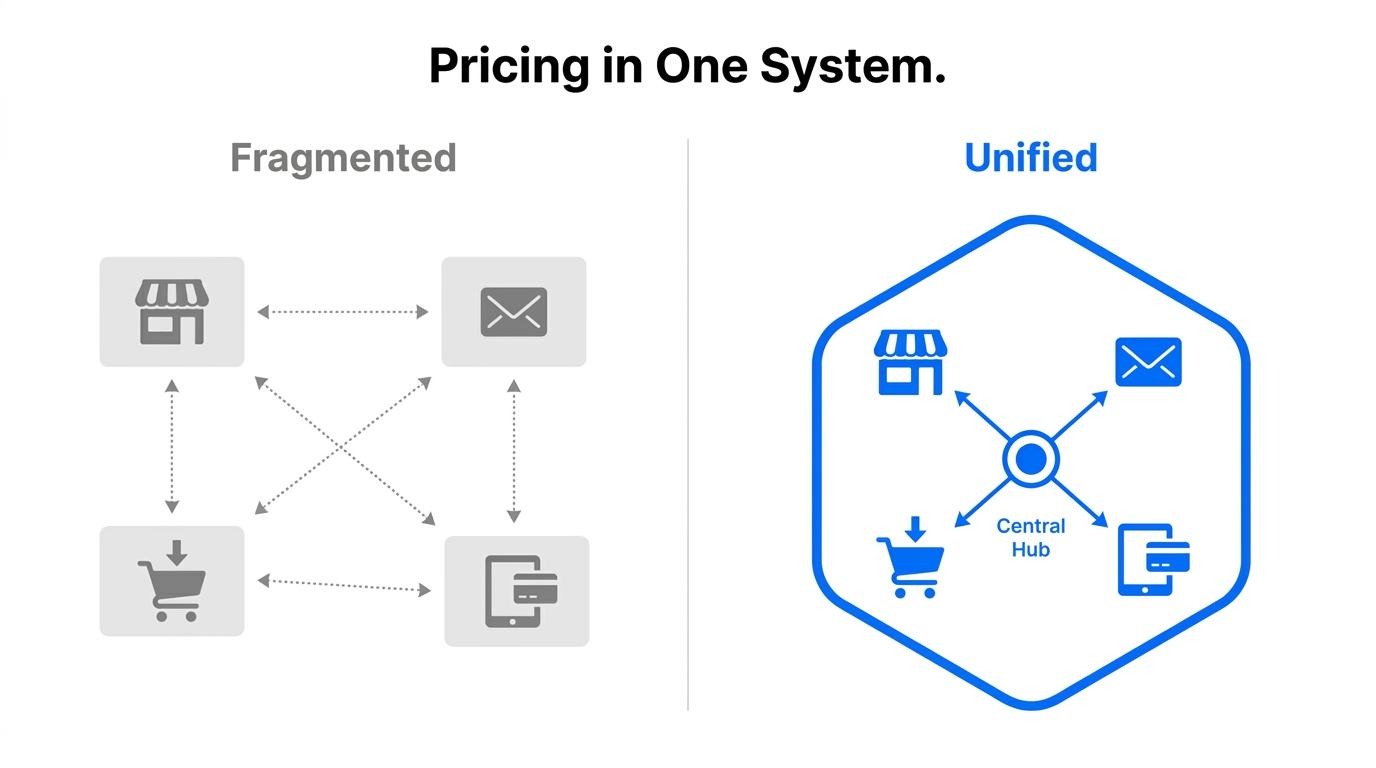
What changes is visibility: pricing rules, promotional calendars, and channel-level retail data become accessible from a single dashboard instead of scattered across disconnected apps. When a brand runs MAP-governed products through separate tools for storefront pricing, marketplace feeds, email promotions, and POS, each system can independently advertise a price that drifts below the MAP floor. Consolidation reduces that risk.
On SHOPLINE, pricing, lifecycle marketing, and CRM live in the same system as the storefront, which removes common sync failures between promotion engines and advertised prices. A single customer and product data layer means promotional exceptions, cart-level discounts, and subscription offers all reference the same price logic. For brands operating at scale, this reduces the manual auditing burden that tool sprawl creates when enforcing MAP compliance across online and offline channels.
The key takeaways about how MAP pricing works center on three practical realities for DTC brands: